
A medical meeting can put surgeons, researchers, nurses and first-year students in the same hall, so nobody agrees on what a normal outfit looks like. A little planning before you pack saves a lot of second-guessing in the lobby.
Quick answer: Wear business casual to most medical conferences, and step up to business professional if you are presenting, chairing or attending a formal dinner. A blazer, dress trousers or a skirt, and shoes you can stand in all day cover most sessions. Leave scrubs and white coats at the hotel unless the program says otherwise, and check the event page for a dress code before you pack.
What to Wear to a Medical Conference
Business casual suits most days at a medical conference, and business professional suits presentations, award sessions and dinners. Your role, the type of meeting and the number of days decide which one you need.

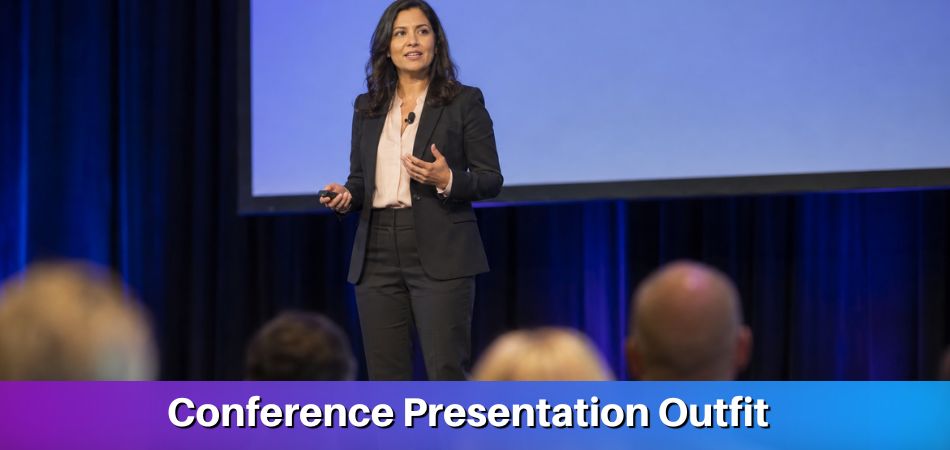
If you are a general attendee, a clean dress shirt or blouse, dress trousers or a skirt, and a blazer you can put on or take off depending on the room will work. If you are speaking or presenting research, step up toward business professional: a full blazer, polished shoes and neutral colors that look clean under stage lighting.
The Fastest Way to Decide
Ask yourself three questions before you pack:
- What is your role? Speakers and presenters need sharper, more deliberate outfits than attendees walking the exhibit hall all day.
- What type of meeting is it? A specialty surgical symposium runs more formal than a community health networking event.
- How many days? A multi-day meeting calls for wrinkle-resistant clothing and smart use of layers, so you are not overpacking or repeating the same look.
Comfort Matters More Than People Admit
A medical meeting means walking, sitting and standing for hours: plenary rooms in the morning, a poster hall at midday, an exhibit floor in the afternoon. Comfortable dress shoes are non-negotiable, and a jacket that you can take off when a room gets warm earns its place. Choose clothes you have already worn for a full day, not a new outfit you have only tried in front of a mirror.
The Standard Dress Code: Business Professional vs Business Casual
Business professional means a jacket and dress shoes; business casual keeps the polish but allows lighter fabrics and more comfort. Wearing the wrong one can leave you overdressed and stiff, or underdressed and self-conscious, so read the signals before you pack.

How to Tell Which One Applies to Your Conference
Organizers usually state the expected dress code in the registration materials, the event website’s FAQ, or the “what to expect” section of the attendee guide. If it is spelled out, follow it exactly.
If nothing is stated, use the event type as your guide. Meeting guides from professional associations often say business casual. The American Academy of Dermatology’s page for its 2026 meeting, for example, states that “business casual is appropriate for the meeting.” Presenting, chairing, award sessions and formal dinners usually call for a step up, so check the program for those. Smaller regional meetings, workshops and continuing medical education (CME) days sit comfortably in business casual too.
The venue is another signal. A hotel ballroom or convention center skews formal, while a university lecture hall or community clinic skews casual. You can also look at the conference’s social media for photos from previous years, which tell you more than vague invitation wording. When you are genuinely unsure, dress slightly up on day one and then adjust to the room, which is the advice ASBMB Today gave in its 2018 article on what to wear at an annual meeting. A blazer can always come off.
Specialty and Setting Change the Norm
Dress norms differ between specialties and between a hospital-run meeting and a trade-style congress. A 2019 report from a radiology news site on the European Congress of Radiology said jeans were once unthinkable at congresses and now seem increasingly acceptable to some imaging specialists, while physician bloggers describe emergency medicine meetings as more casual than most. These are individual views, not rules, so the event’s own guidance and photos from past years remain the best guide.
Business Professional and Business Casual Outfits (Men & Women)
Business professional at a medical conference reflects the same seriousness you would bring to a hospital board meeting or a formal clinical presentation. Business casual is not a dressed-down Friday at a startup, but it gives you more room for comfort and lighter fabrics without losing credibility.
| Dress code | Men | Women |
|---|---|---|
| Business professional | Well-fitted dress shirt, dress trousers, blazer or suit jacket, polished dress shoes. A tie is not always required but reads well at larger, formal events. | Blazer over a blouse with dress trousers or a pencil skirt, or a sheath dress with a blazer. Closed-toe, comfortable shoes. |
| Business casual | Chinos or neat dark trousers, collared shirt (tucked in), loafers or clean leather shoes. Blazer optional but handy for a networking lunch. | Trousers or a midi skirt with a blouse, a wrap dress, or a knit blazer over a simple top. Flats, block heels or low pumps. |
Stick to neutral colors in either case, such as navy, charcoal, grey, camel or dark brown, and avoid novelty prints or bright accessories that pull focus. For business casual, skip fabrics that wrinkle heavily, like jersey cotton or linen, especially across several days.
Men: a blazer is optional in business casual, but it adds a quick layer of professionalism when you head into a networking lunch or end up in an unexpected conversation with a keynote speaker. Leave the sneakers and jeans at the hotel, and keep shoes clean and polished under either code. Women: black, navy, camel and muted tones photograph cleanly on stage and look composed in session rooms. Shoes should be closed-toe and comfortable enough for a full day of walking between sessions, because nobody presents their best work after six hours of aching feet.
Across both codes, the badge will sit on your chest or lapel for most of the day. A busy pattern or embellishment near the neckline looks cluttered under it, while solid or subtly textured pieces hold up much better in person and on camera.
If you are speaking or presenting, your outfit sits in business professional territory whatever the general attendee dress code says. Dressing one step more formally than the audience is a reasonable default.
Dress Code Tips by Role: Speaker, Presenter, and Attendee
Your role shapes almost every outfit decision. A first-time attendee networking between sessions has different priorities from someone stepping up to a podium in front of 500 physicians.

If You Are Speaking or Presenting
A speaker’s outfit carries more visual weight than anything else in the room at that moment. The audience watches you continuously, often from a distance, and first impressions form before you say a word.
- Go one level more polished than your audience. If attendees are in business casual, wear business professional. A well-fitted blazer over dress trousers or a pencil skirt signals authority without looking out of place.
- Choose colors that photograph and film well. Cream, charcoal, navy and soft grey hold up under stage lighting and on recorded video. Avoid busy patterns, high-contrast stripes and stark white directly against skin, which can create visual noise on screen. Cooler, composed tones tend to support credibility, and a controlled pop of color, such as a structured top or a tie, helps you stand out without distracting.
- Think about microphones. A lapel mic clips to a collar or lapel, and a belt pack needs a waistband or back pocket. Unstructured dresses make mic placement awkward, so pick a shirt or blazer with a collar, or a dress with a defined neckline, and save yourself the scramble during setup.
- Pick fabric that stays pressed. You may be traveling, running between sessions and sitting in a green room before you present, so a wrinkle-resistant outfit matters more for you than for anyone else at the event.
- Poster presenters stand a lot. You will spend much of a poster session on your feet beside your board, so test your shoes the day before: broken in, but still sharp. ASBMB Today (2018) suggested dress trousers or dark, unfaded jeans with a simple shirt and a classic blazer for a poster, and advised against sneakers and ripped or faded jeans when presenting. Foot pain shows in your posture and energy, whether you are on a raised stage or at a poster board.
If You Are Attending or Networking
An attendee outfit is less about spectacle and more about lasting a full day. You will be on your feet, moving between rooms and meeting people across several hours or days.
- Business casual is the practical baseline. A blazer with dress trousers or a neat midi dress reads well in most medical conference settings without tipping into overdressed. Solid neutral colors keep you looking put-together after a long afternoon.
- Plan the whole trip, not one day. The packing section below shows how to cover several days with a few pieces that mix and match.
Scrubs, White Coats and Hands-On Sessions
Leave scrubs and white coats at the hotel unless the program tells you to wear them. Scrubs are clinical attire, and a medical conference is an academic and networking event, so wearing them outside a clinical setting can send a mixed signal. If you come straight from a hospital shift, change before you arrive. Some employers also do not allow scrubs outside the hospital, so check your own policy.
Hands-on workshops, simulation sessions and lab visits are the exception, and the host sets the rules. Typical requests include closed-toe shoes, long trousers, hair tied back and no dangling jewelry, with coats, gloves or eye protection supplied or specified by the host. Some hospital sites also ask visitors to go “bare below the elbows” in clinical areas, meaning short sleeves and no wrist watch or bracelets. Check the program or your confirmation email, and if it is unclear, ask the organizers before you travel.
| Session | What to aim for |
|---|---|
| Plenary, keynote, award session | Business professional, or business casual with a blazer |
| Poster hall | Business casual or better, with comfortable shoes for standing |
| CME day or breakout session | Business casual |
| Hands-on lab or simulation | Whatever the host specifies; otherwise closed-toe shoes and easy-to-move-in layers |
| Hospital or lab site visit | Follow the host’s instructions on footwear, sleeves and jewelry |
| Gala or awards dinner | Business professional, or whatever the program states |
Packing for a Multi-Day Conference: The 3-3-3 Rule
Pack 3 outfit bases, 3 accessories, and outfits that work across 3 days. It is not a rigid formula; it is a packing discipline that makes you plan combinations instead of stuffing in “just in case” pieces you never wear. It guards against two common mistakes: overpacking a suitcase you haul across a convention center, or underpacking and rewearing a wrinkled blazer three days in a row.

Build Around a Core Outfit Formula
Start by counting the full conference days, then plan one complete outfit per day: shirt or blouse, trousers or skirt, blazer and shoes. Each outfit should stand on its own. Resist packing “options” you never use, because extra pieces add weight without adding real flexibility. When most pieces are navy, charcoal, black or stone, they mix without planning, and one blazer can work across several outfits.
The 3 Outfit Bases
Your three bases should cover a formal day (keynote sessions, award dinners), a standard day (workshops, poster sessions, networking) and a flexible day (travel, evening events, casual satellite meetings).
Base 1: your sharpest outfit. A well-fitted blazer over a pressed shirt or blouse with dress trousers or a skirt, in navy, charcoal or stone.
Base 2: your comfortable professional look. Business casual territory, with a smart blazer over something slightly more relaxed. You will probably wear this one most often.
Base 3: a layer-based outfit. A dress or separates that can shift from a morning session to a dinner reception with a jacket on or off. It earns its place by doing double duty.
The 3 Accessories and the 3 Days
Choose three pieces that rotate across all your looks: a belt, a scarf or pocket square, and one piece of jewelry or a tie. These small swaps make the same base read differently on day two and day four. Count your badge holder too. A clean lanyard or magnetic holder sits at eye level all day, and a fraying lanyard from three conferences ago does not help the impression you are building.
For a three to five day conference you do not need a new outfit for every day. A dress shirt worn under a blazer on day one can reappear under a different jacket on day three, and neutral dress trousers pair with more than one top. If you are flying in, prefer fabrics like ponte, wool blends or performance knit, which hold their shape better than cotton or linen after a day in a suitcase.
At a conference of four or more days, add one repeat cycle. Plan days one to three, then repeat with swaps in accessories, layers or a fresh shirt. Repeating pieces is normal at a multi-day meeting. For a hybrid conference where some sessions are virtual, the at-home days only need a polished top half, so they do not use up your outfit count.
Shoes, Badge and Day-by-Day Organization
Two pairs of shoes are usually enough: a smarter pair for keynotes and formal dinners, and a comfortable pair in a similar neutral tone for all-day walking between breakout rooms. Wear both in before you travel, because new shoes at a conference are a mistake you only make once. Heels that looked fine at a dinner feel brutal after eight hours on a convention floor. Pack each pair in its own bag so scuffs and sole dirt do not reach your clothes.
A badge also affects what you wear. Lanyards pull at delicate fabrics and can distort the neckline of a lightweight blouse or fine-knit dress, and a busy pattern or statement lapel under the badge looks cluttered. Heavier blazers and structured shirts handle it best, and a lapel gives a clip-on badge somewhere clean to sit.
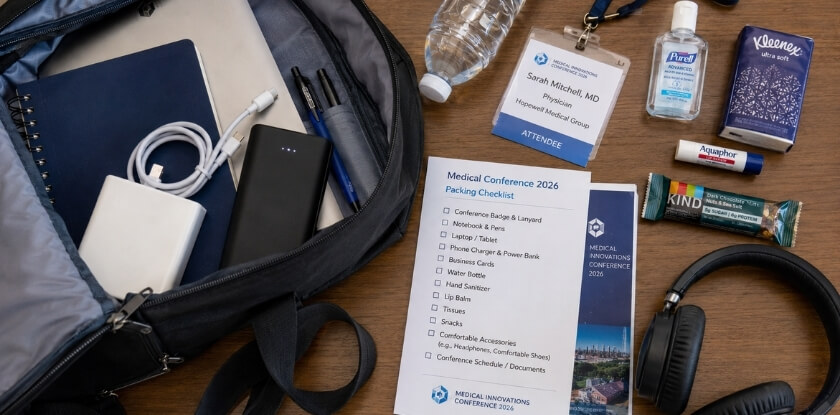
Rather than digging through your bag each morning, keep each day’s outfit together, shirt, trousers and extras, in a packing cube. Pack the formal evening outfit separately so it stays pressed.
- A backup dress shirt. Conference days are long, spills happen at networking dinners, and one spare shirt takes almost no space.
- A fabric refresher spray for long days when dry cleaning is not an option.
- A small lint roller, especially with darker neutrals.
- A spare button or small sewing kit, particularly for older blazers.
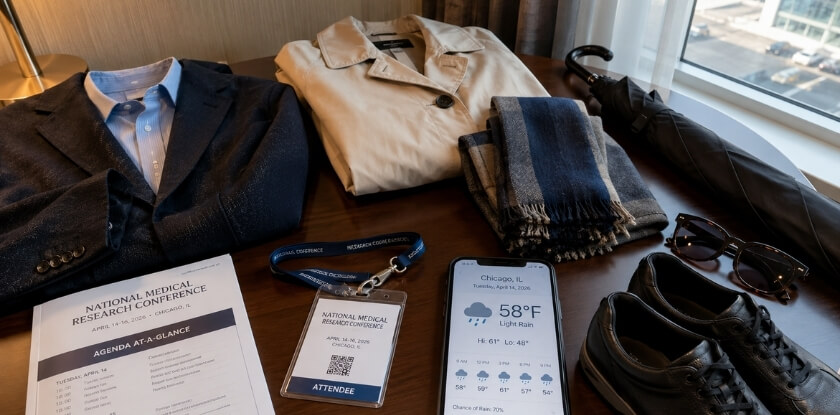
- A compact umbrella if you will move between venues.
Color Choice at a Medical Conference
Stick to neutrals and add at most one accent color. Color signals how seriously you take the room, and a medical conference tends to be full of sharp observers.
| Color | How it reads |
|---|---|
| Navy and charcoal | The workhorses: authoritative, photograph cleanly, pair with almost anything |
| Black | Reliable, but can look stark under harsh lighting in headshots or panel photos; navy or dark grey often reads better on camera |
| White and cream | Good as a shirt or blouse layer; a head-to-toe white outfit can feel clinical in the wrong way |
| Burgundy, forest green, slate blue | Credible, composed accents that add depth to a grey or navy base |
| Red or cobalt | Can work for a speaker whose visibility on stage is part of the goal, such as a bold blazer over neutral trousers |
A neutral base does not have to look dull. One accent color gives your look some personality without drawing attention away from what you are saying, and a deep burgundy or forest green adds dimension to grey or navy without becoming distracting. A single accent is enough. Multiple competing colors, loud plaid, graphic prints and bright florals pull focus at a formal session, and that matters most on a panel or at the podium. Fine stripes and subtle texture are fine.
Color for Different Formats
In person, the venue, lighting and formality should guide how conservative you go. On a webcam, pale tones like light grey or white can blend into the background and wash you out, while a medium-toned solid such as a teal blouse or slate blue shirt keeps your face the focal point. Avoid very dark colors against a dark background for the same reason. If you will be in the room one day and remote the next, choose pieces that work in both, because what looks polished in person does not always carry over to a screen.
Wrinkle-resistant fabric also tends to hold color better across a long day. Darker or mid-tone solids look as sharp at an evening networking event as they did at the morning keynote, while light-colored linen can look tired by noon. That counts for back-to-back sessions, where crisp color holds your overall presentation together even when the schedule is relentless.
Color and Culture
At an international meeting, color can carry cultural weight. White is associated with mourning in parts of East and South Asia, and some bright colors read as festive in one region and unprofessional in another. If you are less familiar with local norms, lean toward neutral tones. It keeps the focus on your content, not your outfit.
Is It Okay to Wear Jeans to a Medical Conference?
Usually no, with a few exceptions. This question comes up constantly among first-time attendees who do not want to look underdressed but also do not want to feel like they are in a job interview for three days straight.
Medical conferences that state a dress code usually ask for business professional or business casual, and standard blue jeans fall outside both. “Business casual” typically means dress trousers, chinos or a pencil skirt, not denim. Arriving in jeans when the room is full of colleagues in blazers and dress shirts creates an impression you probably do not want to make, especially if you are networking or presenting. If you are a speaker, jeans are essentially off the table, because your outfit signals competence before you say a word.
When Jeans Might Be Acceptable
Some specialties and events are more relaxed, so the program and the event’s past photos decide. These are the situations where jeans most plausibly work.
- Designated casual events. If the schedule says “casual attire” for an informal evening event or networking happy hour, dark, well-fitted jeans with a blazer and clean dress shoes are a reasonable choice.
- Workshop or pre-conference days. A hands-on workshop day before the main sessions tends to be smaller and more relaxed. If the agenda says “informal” or “workshop attire,” smart dark jeans may be fine, but check for any lab or footwear rules first.
- Very small or specialty meetings. A niche meeting of 80 attendees in a university seminar room operates differently from a 5,000-person international congress. Read the room, and look at photos from previous years if you can.
The Dark Jeans Compromise
If you want jeans at some point, dark, straight-cut denim with no distressing, fading or rips is the only version that comes close to acceptable. Pair it with a crisp dress shirt, a blazer and clean leather shoes. Light-wash and skinny jeans, or anything with visible wear, suggest you did not think about your outfit, even if that is not true.
Pack one pair for evenings or off-schedule time, but wear trousers or separates to any session, keynote, workshop or networking event in the official program. Even dark jeans shift the overall impression toward casual, whatever you pair them with. A second pair of dress trousers takes up the same space as jeans, and you can dress a formal outfit down by removing the blazer or tie, whereas you cannot dress jeans up past a certain point.
Outfit Guide for First-Time Attendees
Use business casual as your floor and pack one business professional option. If this is your first medical conference, the dress code feels stressful because you have no feel for the room yet, but the choices are simpler than they look.

Before You Pack Anything
Check the conference website or registration materials first. Many events state a dress code, and first-timers often miss it because they skip straight to logistics. Pack at least one business professional outfit in case the opening reception or awards dinner runs more formal.
Consider the venue too. A hotel ballroom runs more formal than a university lecture hall, and conference rooms are often cold regardless of the weather outside, so bring a layer. The 2026 American Academy of Dermatology page mentioned above says meeting rooms are typically cool and suggests a sweater or light jacket, and it recommends comfortable shoes because the convention centers and hotels are large.
What to Actually Wear as a First-Time Attendee
The goal is to look polished without being overdressed or visibly uncomfortable. You are there to learn, meet people and be taken seriously, so your clothes should support that without drawing attention either way.
- Stay neutral. Navy, charcoal, grey and soft beige mix easily across days and project quiet professionalism in any room. Save bolder choices for when you know the room.
- Build around a blazer. A well-fitted blazer over a shirt or clean blouse is the easiest way to hit business casual and move toward business professional if needed. It also gives you somewhere to clip your badge without damaging lighter fabrics.
- Wear shoes you have already worn. Between rooms, exhibition halls and networking areas you will walk more than expected, and a comfortable pair you have broken in beats a stylish pair you limp in by afternoon.
- Check fabric labels before you pack. Trousers and a blazer in wrinkle-resistant fabric look sharp on day three, while a cotton shirt stuffed in a suitcase does not.
A Simple Starting Formula
For day one, a well-fitted blazer, dress trousers or a skirt, a shirt or neat blouse in a neutral color, and comfortable shoes you have already worn cover virtually every first-day scenario. A structured blazer over a pencil skirt or neat trousers with a structured top both fit most medical conference settings. Add a small structured bag that holds your notebook, phone and conference materials without looking like a backpack.
You will walk more than expected between rooms, exhibition halls and networking areas, so avoid anything that restricts movement awkwardly. If the meeting draws an international crowd, erring slightly more formal signals respect and rarely offends anyone.
What to Avoid
Overly casual clothing, even well-fitted jeans, can make you feel out of place in sessions where most attendees wear dress trousers and button-downs. If part of the meeting is recorded, bright busy patterns and stark white can cause problems on camera, and solid mid-tones work both in person and on screen.
Virtual and Hybrid Medical Conference: What to Wear
Dress as you would in person from the waist up, in solid colors that read well on camera. Remote attendance has not made the dress code irrelevant; it has added decisions that in-person meetings never required.
Dressing for a Fully Virtual Conference
- The top half is what counts. A dress shirt or blouse in a solid color reads well on screen. Busy patterns, fine stripes and high-contrast graphics create visual interference on video. A blazer adds immediate polish.
- Avoid pure white near your face. It can blow out on camera and wash out your features. Soft blues, grays and warm taupes photograph cleanly.
- Keep jewelry minimal. Anything that catches light and flickers becomes distracting, especially if you are presenting.
- Your background is part of your outfit. A cluttered shelf or busy wall competes with your presentation, and even a good blazer will not fully save it.
Dressing for a Hybrid Conference
At a hybrid meeting you may be in a room where some participants are on-screen, or at home while speakers present live. If you are on site, treat it like any in-person conference. If you are remote but appearing on camera for a panel, Q&A or presentation, follow the virtual guidelines above. There is no need to dress head to toe unless you plan to stand up on screen.
Remote speakers sometimes underestimate how large their image is in the physical room. If your face is shown at conference-hall scale, soft lighting, a clean backdrop and a shirt with nothing distracting on it all matter.
If the virtual conference is international, cultural dress norms still apply through a screen. Erring toward more formal, covering shoulders and choosing subdued colors shows awareness, and a blazer solves most of it.
The one thing that does not change is the standard. Joining from a spare bedroom is not a lower bar than sitting in a conference hall, because you are representing your professional identity either way. Dress as though the people on the other side of the screen are the ones you would want to impress in person, because professionally speaking, they are.
Cultural Sensitivity and International Medical Conferences
Research the host country’s dress norms before you pack. What reads as polished in one country can come across as too casual, too formal or even disrespectful in another, and it matters most when you are building relationships on day one.
Research the Host Country Before You Pack
A conference in Tokyo, Riyadh, Seoul or Lagos carries different unspoken norms, and the Western blazer-and-trousers formula is not universally neutral.
Conservative cultures call for more coverage. In many Middle Eastern countries, both men and women should plan for more coverage than at a European or North American meeting. For women, that typically means hemlines well below the knee, sleeves that at least reach the elbow, and nothing form-fitting. A loose-fit jacket over dress trousers works well.
East Asian conferences tend to reward formality. In countries like Japan and South Korea, expectations often skew more formal than at equivalent events in the US or UK. Choose structured clothing in navy, charcoal or black, and skip loud patterns or overly casual footwear.
Some regions are more relaxed, but context still matters. A tropical location such as Southeast Asia or sub-Saharan Africa may see lighter fabrics, but that does not automatically mean a casual dress code. Check the conference’s own communications, look at past photos, and when in doubt dress a step above what you think the norm is.
Practical Dress Choices for International Travel
Longer travel, variable weather and luggage limits make wrinkle-resistant fabric especially valuable abroad: a blazer that arrives looking presentable after a twelve-hour flight saves real stress. Keep your presenter outfit in your carry-on if you can, since checked luggage gets delayed and your session does not. Comfortable shoes matter even more at an international venue, where you may walk well beyond what you planned between sessions, social dinners and off-site events.
Religious and Cultural Dress
If you observe a religious dress practice such as a hijab, turban or kippah, you have every right to wear it at any professional medical conference. It has no bearing on your credibility, and reputable international conferences are used to diverse attendees.
If you have no such practice, the consideration runs the other way: avoid graphic prints or imagery that may carry unintended meaning in another culture, and stick to solid neutrals and simple patterns when uncertain.
Gala Dinners and Cultural Events
Many international meetings include gala dinners, cultural evenings or excursions, which often call for different attire from the conference floor. Read the event-specific dress guidance in the program, because “business casual” for a gala in one country may mean something different from what it means at your home institution.
If local dress is offered or invited as part of a cultural evening, treat it with respect. Wearing traditional dress at the host’s invitation is a gesture of connection, but wearing it as a costume without one lands poorly. Follow the lead of local colleagues.
Gender-Neutral and Non-Binary Dressing
Dress codes in many countries remain firmly binary, which is a real consideration for attendees who prefer gender-neutral professional attire. The practical middle ground is structured clothing in neutral colors: well-fitted trousers, a clean dress shirt and a blazer read as polished in almost any professional setting. Avoiding overtly gendered styling in unfamiliar cultural contexts reduces the chance of drawing unwanted attention, which is exactly the goal for many attendees.
Budget-Friendly Medical Conference Outfit Ideas
One good blazer, neutral trousers and a few shirts can carry you through a multi-day conference. Looking polished does not require spending a lot, only some planning.
Build Around a Few Core Pieces
A well-fitted blazer is the most useful single purchase. One in navy, charcoal or black goes over a dress shirt, a blouse or a simple top and reads as conference-appropriate across several days.
Dress trousers or a pencil skirt in a neutral color pair with almost anything. Black, grey or dark navy means you never have to wonder whether pieces match.
Wrinkle-resistant fabric is worth looking for if you are flying. Ponte, nylon blends and certain polyester weaves pack flat and come out of a suitcase looking fine, which saves you hunting for a hotel iron at 7 a.m.
Where to Shop Without Overspending
Mainstream high-street stores carry blazers, dress trousers and dress shirts at reasonable prices. The quality will not match a made-to-measure suit, but fit matters more than label: an inexpensive blazer that fits well looks better than a costly one that does not.
Thrift and consignment shops are underrated for conference clothing, because people buy blazers and dress trousers for one occasion and then donate them. End-of-season sales help too. A conference in March is a good reason to check the previous fall’s clearance section.
Making a Small Wardrobe Do More
You do not need a different outfit for every session. Change the shirt or blouse and keep the same blazer and trousers. Few people track what you wore yesterday.
Spend on shoes before clothes. Supportive dress shoes are available at reasonable prices, and if you must choose between fit and style, choose fit, because feet that hurt by noon affect your focus and energy. If you are presenting, put a slightly larger share of your budget into your top half. A quality shirt or blouse with a good blazer reads well from the front of the room, even if your trousers came off a clearance rack.
A Note on Color and Accessories
Neutral colors make budget dressing easier because pieces coordinate without effort and outfits do not look mixed. Calm, authoritative tones also happen to be the most versatile ones to own. Keep accessories minimal: a clean watch, simple earrings or a belt that matches your shoes finishes the look, whereas piling on accessories does not make up for a lower-budget outfit, it only adds visual noise. Budget outfits do not need to be obvious. A few versatile pieces rotated across days with different accessories can carry a full conference week.
What Not to Wear to a Medical Conference
Knowing what to avoid is as useful as knowing what to pack. A few common mistakes can undermine an otherwise strong impression, and most are easy to sidestep once you know what to watch for.
Overly Casual Clothing
T-shirts, hoodies, shorts, flip-flops and athletic shoes sit below the baseline at most medical conferences. Even at events that list “business casual” on the invite, this usually means dress trousers and a collared shirt, not your everyday casual wear. Shorts are off the table whatever the climate, and comfortable dress shoes are the floor, not a bonus upgrade.
Clothing That Draws the Wrong Kind of Attention
Loud prints, neon colors and heavily logoed streetwear pull focus away from the work being presented. At a medical conference you want people remembering what you said, not what you wore. Very short hemlines and deep necklines are also best avoided. This is not about rigid rules but about reading the room, and a professional medical setting calls for clothing that looks put-together from across a lecture hall.
Wrinkled or Ill-Fitting Clothes
A blazer that is too tight across the shoulders or trousers that bunch at the ankles look as out of place as something too casual, so fit matters as much as the garment. Wrinkles are a particular problem at multi-day conferences after travel. Wrinkle-resistant fabric or the hotel iron before a session makes a visible difference, because showing up creased suggests you did not plan ahead, even if the rest of the outfit is appropriate.
Strong Fragrance
Heavy perfume or cologne is a real issue at conferences. Breakout rooms and lecture halls are enclosed with limited ventilation, and many attendees have sensitivities or allergies. Keep fragrance light or skip it, and remember that hospitals and labs may restrict it further.
Distracting Accessories
Chunky jewelry that makes noise when you move, pins or buttons with political or controversial slogans, and novelty lanyards can all work against you. This applies most to speakers and presenters who are front-facing for long stretches. Your badge is already on display, and pairing it with a minimal, polished look keeps the overall picture clean.
Anything That Fights You Over a Full Day
This one is practical rather than aesthetic. Shoes that look great but hurt by hour two change how you carry yourself through the afternoon, and very structured clothing that restricts movement becomes a problem during networking or back-to-back workshops. You are not on a runway: you need to function in these clothes for eight or nine hours at a stretch, so avoid anything that needs constant adjusting.
Cultural and Context-Specific Missteps
At an international meeting, clothing that reads as disrespectful in the local context, whether through coverage, symbolism or professional norms, can cause unintended offense. A small amount of research on the host country or institution is enough to avoid the obvious mistakes. Likewise, a white coat worn at a conference event with no clinical demonstration is the same mixed signal as scrubs, so leave it at the hotel.
From our experience at MS International: Our event pages do not set a dress code, and our events are held in person in the Greater Toronto Area. Presenting authors register after acceptance, and the check-in time is in the confirmation email, with the badge collected at check-in. Presenters meet the session coordinator or moderator before their slot. If you are unsure, dress as you would for a formal academic session, and ask the organizers through the contact details on the event page.
FAQ: What to Wear to a Medical Conference
Packing for a medical meeting brings choices about suits versus scrubs, shoes, what to wear at a poster session and where the name badge sits on your outfit.
Is a suit required at a medical conference?
No, a suit is not required for general attendance. Business casual is a common baseline, and a suit or full blazer is the safer choice if you present, speak or attend a formal dinner. Check the event page for a stated dress code.
Can I wear scrubs to a medical conference?
No, not unless the program says so. Scrubs are clinical attire, and a medical conference is an academic and networking event. Even if you come straight from a hospital shift, change before you arrive.
What shoes are appropriate?
Comfortable closed-toe dress shoes that you have already worn in. You will be on your feet far more than you expect, walking between sessions, standing at poster boards and networking during breaks, so prioritize fit without losing the professional look.
What should I wear to a poster session?
Business casual or better, with shoes you can stand in for a long session. Dress trousers or a skirt with a simple shirt and a blazer work well, and a blazer gives you a polished option if a senior colleague stops by.
Do I need to dress differently as a speaker versus an attendee?
Yes. A speaker’s outfit should lean more formal than an attendee’s, because the audience is looking at you the entire time. Business professional is the safe choice for presenters.
How do I handle a conference name badge with my outfit?
Wear a jacket or a top with a lapel or collar, where a clip-on badge sits better than on a knit fabric. If the lanyard pulls at a lightweight blouse, a blazer solves the problem immediately.
What’s the safest color to wear if I’m unsure?
Navy, charcoal, grey or black. These neutrals read as professional across every type of medical conference and every role, and they photograph well in event photos or recorded sessions.
Does the dress code change for a virtual or hybrid medical conference?
Not really. For virtual sessions, dress from the waist up as you would for an in-person appearance. At a hybrid event where you attend in person, standard conference attire applies, so do not dial it back because part of the event is remote.
Should I pack differently for an international medical conference?
Yes. Research the host country’s norms first, since some settings expect more formal attire than a typical North American conference. Being slightly overdressed is easier to recover from than the reverse.
What’s the best way to manage clothing across multiple days?
Use wrinkle-resistant clothing and build outfits around a few interchangeable pieces. A blazer, two shirts or blouses and a pair of trousers or a skirt can cover three days. The 3-3-3 rule in the packing section is designed for this.
Final Thoughts
What you wear to a medical conference will not define your expertise, but it shapes how quickly others take you seriously. Keep your clothing professional, your shoes comfortable enough for a full day, and your choices suited to your role and to any hands-on session on the program. Everything else in this guide is detail around that core idea.