
Attendees can blend in, but presenters are read the moment they walk to the front. Your outfit has to look right under bright lights, next to a lapel mic, and after a day of travel.
Quick answer: Dress one step more polished than your audience. Choose a blazer or jacket in a solid, mid-to-deep color such as navy, a collar or placket where the AV team can clip a lapel mic, and shoes you can stand in for an hour. Skip busy patterns, bright white, neon and loud jewelry. Fit and comfort matter more than brand.
What Should a Presenter Wear at a Conference?
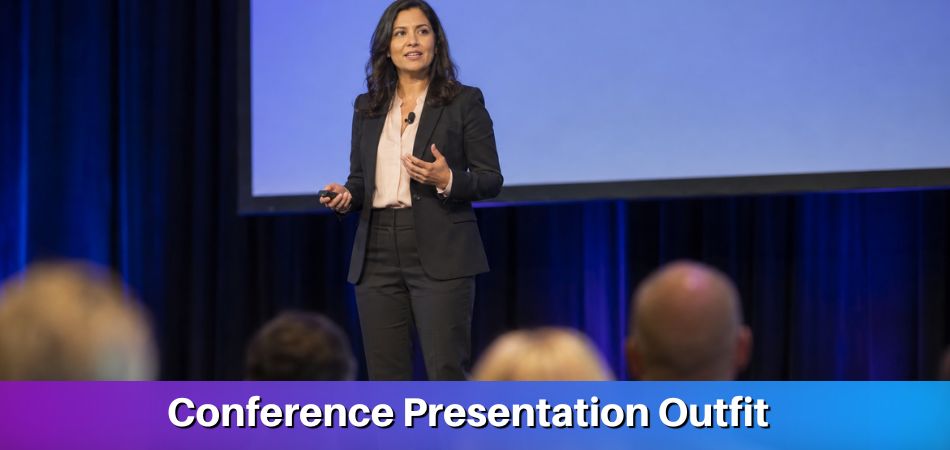
A presenter should wear a structured, well-fitted outfit in solid colors, one level above what the audience will wear, with a clip point for the mic and room to move. You are filmed, photographed and judged before you speak, so the outfit works harder than an attendee’s does.
Dress Code by Conference Type
Wearing the wrong register distracts as much as a wrinkled shirt. If the event site gives no dress code, look at speaker photos from previous years; they tell you more than any label. If you still cannot tell, ask the organizers. If you arrive before your talk, dress a little more formally on the first day and adjust to what others wear.
| Conference type | What presenters wear | Colors that work |
| Corporate | Business formal or polished business casual: suit, or blazer with dress trousers, a midi skirt or a structured dress | Navy, charcoal, deep burgundy, cool jewel tones |
| Academic talk | Smart casual to business casual: blazer over a fitted shirt, or a clean sheath dress; tie optional | Muted solids, earth tones, deep greens |
| Poster session | Business casual with comfortable shoes, because you stand and move around your board | Muted solids; navy for a committee Q&A |
| Tech | Clean smart casual: dark chinos, structured top or neat jacket; a notch above the room on a main stage | Medium blues, greens, warm jewel tones; all-black is more accepted here |
| Virtual or hybrid | Solid top with a clean neckline (see the virtual section below) | Solid mid-to-deep tones such as navy, teal, burgundy |
Corporate. The dress hierarchy is clearest here, so presenters should sit firmly at the formal end, especially if senior decision-makers or clients are in the room. Navy can hold its detail better than black, which can flatten under stage spots. Corporate days can be long, so pick fabrics that hold their shape.
Academic and poster. At academic events a full suit can look out of step, so skip it unless the event is formal. For men, pressed trousers, a collared shirt and a blazer cover most situations; women can add a sleek midi dress. Jeans and a T-shirt still signal attendee, not presenter. At a poster session you will be on your feet for long stretches, so comfortable shoes are a practical necessity, not a detail. If you are on a panel, you may be seated behind a table for the whole session, so the top half of your outfit is what the room sees.
Tech. At some tech events attendees wear jeans and sneakers, but “anything goes” is a misread of the room for a presenter. Dark jeans with no visible wear, a fitted quarter-zip or collared shirt, and clean leather sneakers or simple loafers keep you a step above without looking like you came from a finance keynote. A blazer over a clean T-shirt also works. A graphic tee or loud plaid adds noise in front of your slides.
The Core Rule: Dress One Step Above Your Audience
Dress one level above what your audience is expected to wear, deliberately and not by accident. If the room will be in business casual, wear business formal or polished smart casual. If attendees will show up in jeans and hoodies, wear neat chinos, a structured jacket or a clean dress. You do not need to look like you are at a board meeting, but you do need to look like you are running the room.
This is not about looking superior. Audiences form quick impressions of a speaker before the first word lands, and clothing is part of that first read. A slightly sharper outfit signals that you prepared and that you take the event seriously.
Why the Rule Works Differently for Presenters
Attendees dress for comfort and social fit. Presenters dress for authority and visibility, which is why a presenter dress code cannot be borrowed wholesale from general conference advice.
Stage visibility changes everything. Lights and distance compress detail and wash out pale or low-contrast outfits. What looks polished up close can disappear from the back of the room. Solid colors, structured shapes and clear contrast hold up best.
The audience projects onto what it sees. A very casual outfit for a serious topic can distract some people from your point. That is not always fair, but it is easy to plan around.
When the Rule Goes Too Far
Overdoing it creates distance. A speaker in a full black-tie outfit presenting to a casual tech audience does not look authoritative; they look out of touch. The goal is to look more polished than the room, not unrecognizable from it.
What to Wear as a Conference Presenter (Men and Women)
Start with a structured jacket or blazer in a solid color, a plain top underneath, and a fit that lets you gesture freely. These are starting points, not a uniform.

For Women Presenting at a Conference
There are many options here, which can lead to decision fatigue. Aim for polished and authoritative without spending mental energy on it during your talk.
Suit or structured blazer over a simple top. The most reliable combination for a professional or corporate conference. A well-fitted blazer signals authority, and a plain blouse or shell in a solid color keeps the look clean.
A sheath dress with a blazer. A knee-length sheath dress in navy, charcoal, burgundy or forest green gives a complete look with little effort. Add a blazer if the room runs cold or you want more structure. Avoid wrap dresses with loose fabric ties; they drift out of place as you move around the stage.
Trousers with a fitted top. High-waisted wide-leg or straight-cut trousers in a neutral tone with a tucked-in blouse suit academic and tech settings, and they are more comfortable if you are on stage for a long session.
Skirts. A midi or pencil skirt in a solid fabric is appropriate. Check the length against any stage risers: a skirt that works standing can be awkward when you climb steps to reach a podium.
Shoes. Wear heels you can actually walk and stand in for an hour. A block heel or a clean flat is fully professional. A stiletto that changes your posture or shortens your stride undermines your body language more than the extra height helps.
For Men Presenting at a Conference
Suit-based outfits have a narrower range and are easier to get right once you know the context. The variables are formality, fit and color.
Suit with a tie. For corporate or high-stakes industry events, a two-piece suit is the straightforward choice. Dark navy and charcoal are conservative choices that look sharp under stage lights. A white or light blue shirt keeps the contrast clean. Make sure the tie is secured; one that flips over your shoulder mid-talk is distracting.
Suit without a tie. At many professional conferences, a well-fitted suit without a tie is appropriate and reads as polished but approachable. Undo the top button for a cleaner look. It works for corporate, academic and medical settings.
Sport coat or blazer with chinos or dark trousers. A common choice for tech and creative events. A dark blazer over a solid crewneck or Oxford shirt looks intentional without being stiff. Avoid blazer-and-jeans unless the event culture clearly supports it, and then keep the jeans dark, slim and free of distressing.
No suit, smart casual. Some academic fields and tech workplaces have a smart casual culture for presenters. A well-fitted button-down or polo in a solid color works. The key word is fitted: an oversized shirt reads as unprepared in any setting.
Fit matters more than brand. A moderately priced suit that fits your body looks better on stage than an expensive one that does not. If you are buying something for presenting, spend on a basic tailoring appointment rather than a higher price tag.
Shoes. Clean, polished leather or leather-look shoes in black or dark brown suit any formality level above smart casual, as long as you can stand in them for a long stretch. Sneakers work only where the rest of the presenter lineup also wears them, so check photos from previous years.
If Neither Heading Fits
Choose the outfit that matches how you present yourself and apply the same principles: a structured top layer in a solid color, a clip point for the mic, a waistband or belt for the pack and shoes you can stand in. If you are unsure what an event expects, ask the organizers about the formality.
How to Dress for a Lapel Microphone
Wear a collar, lapel, placket or sturdy neckline for the clip, and a waistband or belt for the transmitter pack. Many in-person conferences wire presenters with a lapel (lavalier) mic, and the AV technician needs a stable spot on your chest and a path for the cable. A blazer solves the problem immediately.
| Makes mic placement easy | Makes it harder |
| Blazer or jacket lapel, shirt collar, button placket, structured V-neck | Crew-neck knits and T-shirts, turtlenecks, flowy fabrics, draping, halter or strapless tops |
| Trousers or a skirt with a waistband or belt for the pack | Dresses without belts, fluid or empire waistlines, silky fabric with no lapel |
| Small studs or a simple pendant, or no jewelry | Dangling earrings, long necklaces, heavy scarves, ruffles and heavy texture, which brush the mic and add noise |
The transmitter pack normally clips to a waistband or belt, so keep it uncovered by heavy layers. Sleeves or scarves that brush the clip add noise, and nervous gestures make that worse. If you plan to wear a crewneck or a dress without a waistband, tell the AV team beforehand so they can solve it before you are standing in front of the audience, and wear the outfit with the mic at any sound check you are offered. At hybrid events the same rules apply, and fixing a mic problem during a live session is disruptive.
Color Psychology: What Colors Work Best on Stage
Deep, solid colors work best: they read clearly from a distance, hold up under bright lighting and project confidence without drawing attention for the wrong reasons. Navy is a dependable choice.
| Color | On stage and on camera |
| Navy blue | Often read as authoritative and trustworthy, less severe than black, and it photographs cleanly on light and dark backgrounds |
| Jewel tones (teal, burgundy, forest green, cobalt) | Stand out from a neutral backdrop and hold their color under lights that wash paler shades out |
| Medium grey and slate blue | Formal enough for business, less stark than black, and easy to pair with an accent color |
| Earth tones (terracotta, chocolate brown, olive) | Come across as grounded and approachable at academic or tech events with a more casual dress code |
| Bright white | Reflects stage light and can look overexposed; ivory, cream or light blue holds up better, including for a shirt |
| Neon and very bright hues | Can bleed and distort on video; neon yellow, electric orange and vivid red may look fine in person and bloom on camera |
| Head-to-toe black | Not wrong, but it can flatten under lights, and against a dark curtain you vanish from the waist down; add a mid-tone or jewel-toned layer |
| Very pale pastels | Can read as soft and low-authority on stage; a deeper version of the same hue usually works better |
Patterns, Prints and the Camera Problem
Busy patterns such as fine checks, tight stripes, herringbone, houndstooth and small geometric prints can cause a moiré effect on camera, where the pattern seems to shimmer or vibrate. It distracts viewers from what you are saying. A bold, large-scale print can work in the room, but it is a risk you rarely need to take, especially if the session is streamed or recorded.
If you want visual interest, add texture instead of print: a woven blazer, or a matte fabric against a satin blouse. It reads clearly in person and causes no trouble on video.
The 3-3-3 Rule for Conference Clothing
The 3-3-3 rule says to bring 3 outfits in 3 base colors that cover 3 levels of formality. The label is used in other ways online, for example three tops, three bottoms and three pairs of shoes, so here it simply means the plan below. It is a planning shortcut, not an official standard, and it keeps you from packing only for comfort and then finding the night before your talk that nothing feels right for the stage.

What the Three Outfits Cover
| Outfit | Where it is worn | Formality |
| Presentation outfit | Your talk, main stage sessions, awards dinners; the look you would wear if the event were photographed or recorded | Business formal |
| Breakout and networking outfit | Panels you are not leading, receptions and hallway conversations | Business casual (daytime sessions and workshops) |
| Travel and low-key day outfit | Airport security, long transit, a quieter day two; clean and fitted, but not so casual that you would mind meeting an organizer | Smart casual (also off-site dinners) |
Prioritize shape-holding fabrics for the presentation outfit, because you will likely sit, stand and rush to the stage in it. Mix pieces between tiers if you need to land somewhere in between.
The Three Base Colors
Three colors that work together let every piece mix with every other piece, which multiplies your options without extra luggage. A reliable set is one neutral base (navy, charcoal or black), one warm or mid-tone neutral (camel, taupe, white or cream) and one accent that photographs well on stage or ties to your personal brand. Build around solids; patterns complicate mixing and misbehave on camera. Dark, solid colors also hide wrinkles and small spills better than pale ones.
Conference Outfit Packing: Capsule Wardrobe for Presenters
Pack the stage outfit first, in your carry-on, and build everything else around it. Your outfits have to perform under lights, survive travel and stay pressed through long conference days, so an 11pm hotel-room panic over a creased blazer is worth planning against.
Build Around One Hero Outfit
Choose your stage outfit first. Lay it out, check it for wrinkles, confirm the mic has somewhere to clip, and make sure it suits the conference type. Then build the rest of the wardrobe around it.
Pick a palette, not random pieces. If the stage outfit is navy and grey, bring separates in those tones. A navy blazer worn on stage can double as a dinner layer on day two. This is the core of a capsule wardrobe: fewer pieces, more combinations. Every item should earn its place by working in at least two contexts, so choose a blazer that suits at least two of your looks, one backup shirt or blouse that doubles across two outfits, and a single neutral shoe that reads as both polished and comfortable.
Fabrics That Travel
Wrinkle-resistant fabrics are non-negotiable when you live out of a suitcase. Ponte knit, gabardine, stretch crepe, travel-weight wool, wool blends, polyester-rayon mixes and performance suiting hold their shape far better than linen or 100% cotton. Linen looks beautiful fresh and usually looks wrong by the time you reach the stage. If you do rely on cotton or linen, check what pressing options your hotel has.
Merino wool is worth the investment for conference travel: it resists odor, packs small and looks polished under lights, so a merino sweater or blouse can go from a morning panel to an evening reception. Avoid fabrics that trap heat or show sweat, such as light grey, silk and very thin cotton, if you will present in a warm room.
Carry-On Packing Strategy
If your bags are delayed, your stage outfit cannot be in them. Roll soft items and fold structured pieces around them, using tissue paper or dry-cleaning bags to reduce friction and creasing.
Use a garment bag for your main outfit. Many carry-ons have a garment sleeve, or you can use a lightweight folding garment bag. Hanging the blazer as soon as you arrive pulls out most travel creases.
Bring a travel steamer. A compact steamer weighs almost nothing and fixes creases in minutes. Hotel irons are not always available, and some can damage delicate fabrics.
Pack shoes in dust bags at the bottom. One pair of comfortable dress shoes and one backup pair of flats or smart trainers covers most multi-day conferences.
Inspect everything the night before. Check it then, not ten minutes before you go on, and keep one spare presentation-ready piece, such as a second blazer or a clean shirt. Spills happen, zippers fail and buttons pop during setup.
Pack one layer for the room temperature. Meeting rooms can run cold or warm, so bring a cardigan, light jacket or blazer you can put on or take off, and check the forecast for the city before you pack.
Quick Outfit Formula for a Three-Day Conference
This works for a business casual or business formal conference:
- 1 fitted blazer (worn on stage, reused as an evening layer)
- 2 trousers or skirts in neutral tones
- 3 tops or shirts (including one solid-color stage-ready option)
- 1 smart backup layer (a lighter jacket or structured cardigan)
- 2 pairs of shoes
- Accessories to shift the register of an outfit (a scarf, a different belt, a lapel pin)
That is seven clothing pieces that mix into several different outfits, and they should fit in a carry-on for a short trip.
Virtual and Hybrid Conference Presentation Outfits
For a camera, wear a solid, mid-to-deep top that contrasts with your background, with a clean neckline and a matte fabric. The lens compresses detail and reacts to color differently from your eye, so some choices that work in a room work against you on screen. This section is general advice for streamed or recorded talks; our own events are in person.
What the Camera Does to Your Clothes
Fine stripes and small hatch textures cause the same moiré shimmer described above, which pulls attention away from your face. Solid colors largely avoid it.
Contrast with the background matters too. Against a white or light wall, a white shirt or pale blouse makes you partly disappear, so go one or two shades darker than the background. Shiny fabrics such as satin, sequins and some polyester blends catch studio and ring lights badly. Matte textures such as wool crepe, ponte and cotton-modal blends do not compete with your face.
Color Choices for Virtual Presentations
Navy, dusty blue, burgundy, forest green and medium grey look authoritative without harsh contrast on any background. Avoid true red on a standard webcam or lower-quality platform, where it tends to bleed and pixelate on compressed video. Avoid all-white and all-black as your main piece: white overexposes under ring lights, and pure black absorbs so much light it loses detail. Dark charcoal or off-white works better than either extreme.
Hybrid Conference Presentations
At hybrid events you present to the room and to a screen at once, so the outfit must work for both. Avoid bold patterns even if they look fine to the live audience; the online viewers change the calculation. The lapel microphone rules above apply in full.
What to Do About Your Background
Your outfit and background are one visual unit on camera. Against a warm background (wood shelves, brick, a warm wall), cooler clothing reads more clearly. Against a neutral or cool one, warmer tones such as burgundy or camel give contrast without clashing. If the colors compete, change the outfit rather than rearranging your room, and keep a second solid top in a contrasting shade within reach.
Green screens and virtual backgrounds struggle with loose hair, fuzzy textures and colors close to the background. Wear fitted, structured clothing with clean edges, and avoid any color near what your platform uses as its backdrop.
The Camera-Ready Check Before You Go Live
Test your full outfit on camera, not in a mirror. Turn on your actual lighting, record five seconds and look at how the fabric reads.
Check your neckline in the frame. Many video calls show you from the chest up, so a distracting necklace, an open collar or an awkward pattern at the neckline gets heavy visual weight. A V-neck or open collar usually photographs better than a high crew neck on a webcam.
How Your Outfit Affects Body Language and Presentation Confidence
What you wear changes how you move, hold yourself and breathe, not just how you look. When your clothes fit and suit the room you stop thinking about them, which frees up attention that would otherwise go to tugging a hem or adjusting a collar.

The Physical Side of Dressing for Stage
Fit affects posture. A jacket that pulls across the shoulders makes you less likely to gesture broadly, and trousers that are too tight discourage open, confident stances. Clothes that fit your actual body, not the one you are planning on, let you move expansively and with ease. Gaping buttons or a hemline you keep fixing pull your attention at the wrong moment, so check that your neckline stays in place when you bend toward a laptop or lectern.
Uncomfortable shoes change how you carry yourself. Shoes you have not broken in can make you shift your weight, rock slightly or limit your movement across the stage, and you may be walking to a podium or stepping up onto a stage before you begin. If you would not walk a mile in them, do not present in them.
Tight layers add tension. If you are already managing nerves, clothing that makes deep breathing harder adds stiffness, and visible tension can read as nervousness to the audience.
Does What You Wear Change How You Perform?
There is research on “enclothed cognition”, the idea that the symbolic meaning of clothing can affect the wearer’s mindset. Findings are mixed, so treat it as a plausible nudge, not a guarantee. Many speakers say they stand taller, slow down and make more eye contact when they feel appropriately dressed, and feeling underdressed can show as rushing or hunching. The practical lesson is to choose the outfit on purpose instead of grabbing whatever is clean.
Test the Outfit Before the Day
Do not debut a new suit, blouse or pair of shoes on presentation day. Wear the outfit for a few hours beforehand: sit down, walk around, reach up, climb a few steps, and clip something of similar weight where the mic pack will go. Clothes that feel good in a fitting room can pinch, ride up or restrict your arms once you move. If something gaps or feels wrong, you will find out before it matters, and a conference is not the place to test whether a new fabric is uncomfortable under hot stage lights.
Budget-Friendly Conference Presenter Outfits
A few well-chosen, well-fitted pieces do more for your presence than a closet full of expensive options. Spend a little on your top layer and save on everything underneath.

Build Around Neutral Anchors
Start with two or three neutral base pieces: a well-fitted blazer, trousers or a structured skirt, and a clean solid-color shirt or blouse. Navy, charcoal and medium grey look polished and camera-ready without a premium price. Mid-range high-street stores carry solid workwear basics, wrinkle-resistant suiting, ponte blazers and plain blouses that hold up through travel. Fit matters far more than the label: a modest blazer that fits properly beats an expensive one that pulls across the shoulders.
Where to Spend and Where to Save
The blazer or structured jacket is what the audience and camera see most, so it earns the extra spend. One good blazer can anchor several different looks in a corporate or academic setting, depending on what you pair it with. That is how budget outfits work in practice: you invest in anchor pieces, not full outfits.
Thrift and Secondhand Are Legitimate Options
A structured blazer from a secondhand or consignment shop is still a structured blazer, and professional workwear there can be in good condition and cost less than new. A well-fitted secondhand blazer in a solid color reads just as well on stage as a new one. The priority is fit and fabric, not where it came from.
What You Can Skip Entirely
You do not need a separate outfit for every day. Skip anything that needs dry-cleaning on the road, anything with hardware that sets off airport scanners repeatedly, and anything you have not worn before.
Plus-Size and Diverse Body Type Guidance
The presenter dress code is the same for every body size: dress one level above the audience, choose solid colors, avoid busy patterns on camera and wear something you can move and breathe in. What changes is how you apply those principles to your own body.
Fit Is the Foundation
Ill-fitting clothing undermines stage presence faster than any color or style choice, and a gaping button or a pulling shoulder can distract the audience. For plus-size presenters, buying up in structured pieces and then having them altered is often worth it. Look for retailers with proper extended sizing and proportional cuts, not just scaled-up standard ones, and check current ranges because they change.
Structured pieces over clingy ones. A fitted blazer or a well-cut ponte sheath dress holds its shape under lights. Soft knits and jersey can work if they have enough body that they do not cling or shift as you move.
Larger garments crease more visibly. They have more surface area, so wrinkle-resistant fabrics such as ponte, matte crepe and travel-knit suiting matter even more.
What Works on Stage for Different Body Types
The goal is a clean silhouette that looks intentional and composed from the back of the room.
Petite. Monochromatic outfits in one color family create a long vertical line. Hip-length or full-length jackets usually suit presenting better than cropped blazers, which interrupt that line.
Tall. Check trouser and sleeve length, because hems that are too short look unfinished on stage even if they barely register day to day.
Any build. A structured blazer with a defined shoulder adds shape without needing any particular cut underneath, and a single-button blazer in navy or charcoal is a reliable option. Choose a lining or fabric with some stretch so nothing pulls across the back when you gesture.
Skin Tones and Head Coverings
Color can read differently on different skin tones under stage lighting, and no color is right for everyone. Hold your outfit under indoor lighting before the event and check how it looks in a photo.
If you wear a hijab or another head covering, coordinating it with the outfit’s dominant color, such as the same tone as your blazer or a complementary solid, looks polished and intentional on camera.
Common Outfit Mistakes Presenters Make
Some mistakes seem fine at home or on a hanger. Fit, shoes, patterns, mic-friendly cuts and wrinkles are covered above; these are the rest.

Reflective Fabric and Jewelry
Sequins, metallic threads and large shiny accessories catch and scatter light under stage spots or camera lighting, which looks jarring. Keep accessories matte or low-key if you present under professional lighting.
Matching the Slides or the Backdrop
If your slides have a white background and you wear white, or the slides are deep blue and so is your blazer, presenter and content blur together on a live stream or recording. A contrasting color keeps you distinct. Check the staging if you can: a dark curtain behind an all-black outfit costs you definition.
Logos, Slogans and Hair
Large logos, slogans and brand names pull attention from your slides, so choose plain pieces. Keep hair and any scarf off your face and away from the mic so the audience can see your expression.
From our experience at MS International: All our conferences are held in person in the Greater Toronto Area. Presenters arrive at the check-in time stated in the confirmation email, collect a badge and meet the session coordinator or moderator before presenting. Our speaker pages also say to keep a backup copy of your presentation on a USB drive and to test your slides before the session. After presenting, approved speakers receive a certificate. Plan an outfit that stays comfortable from check-in through your talk.
FAQ: What to Wear When Presenting at a Conference
On stage, clothing choices shift: colors and patterns that read well, the 3-3-3 rule, where a lapel mic clips and dressing for a virtual talk all come into play.
What is the difference between a presenter dress code and regular business attire?
A presenter dress code is about being visible, credible and camera-ready on a stage, while business attire is about fitting in at work. That means thinking about solid colors, mic clip placement and how your outfit reads from the back of a room, not just across a desk.
Should I dress differently from the audience?
Yes, by about one level. If the audience is business casual, wear business formal; if they are smart casual, step up to business casual. You want enough visual separation to signal you are leading the room without looking like you came from a different event.
What colors are best for a conference presentation?
Navy blue is a dependable choice because it looks authoritative and photographs cleanly. Deep teal, charcoal and burgundy also work well. Avoid neon, bright white (it can overexpose under stage lighting) and all-black against a dark backdrop.
Can I wear patterns as a presenter?
Small patterns can look fine in person but are risky on camera. Tight stripes and houndstooth can create a moiré effect on video feeds. For virtual or hybrid events, stick to solid colors or very subtle textures.
What should I wear if the dress code is not stated?
Ask the organizers, then default to business casual and check speaker photos from earlier years. If you are unsure, lean slightly formal: you can take a blazer off, but you cannot add one you did not bring.
What should I wear to present a poster?
Wear business casual with comfortable shoes. You may stand for long periods, so a blazer or layer over a fitted shirt or a structured dress in muted solids works well, and a layer helps if the hall is cold.
What is the 3-3-3 rule for conference clothing?
It is a planning shortcut, not an official rule: bring 3 outfits in 3 base colors that cover 3 levels of formality, so pieces mix across sessions and dinners without overpacking.
How do I dress for a virtual conference presentation?
Wear a solid, mid-toned top and a clean neckline, and avoid anything reflective or heavily textured. Treat it like an in-person talk from the waist up, and test the outfit on camera before you go live.
Where do I clip a lapel microphone?
The clip goes on a lapel, collar or jacket placket, and the AV technician usually decides the exact spot. Open necklines and fitted jackets make that easy, while crewnecks, turtlenecks and flowy scarves make it harder.
Are there good budget options for presenter outfits?
Yes. A well-fitted blazer from a mid-range or secondhand shop with solid-color basics covers most conferences. Fit matters more than price, so a properly fitted modest blazer reads better on stage than an expensive one that does not sit right on your shoulders.
What should plus-size presenters keep in mind?
The same rules apply: dress a step above the audience, choose solid colors and prioritize fit. The practical addition is shopping at retailers with consistent extended sizing, since consistent sizing makes structured blazers and trousers easier to fit.
What fabrics travel best for conference packing?
Ponte knit, wool crepe and performance fabric blends resist wrinkles well enough to go from a suitcase to a stage with little effort. Cotton and linen look good fresh but crease badly in transit, so check your hotel’s pressing options before relying on them.
Do dress codes change by conference type?
Yes, they can. Corporate events lean formal, tech events lean casual and academic events vary by field, so the event’s own guidance beats any rule of thumb. When in doubt, check speaker photos from previous years.
Can my outfit affect how confidently I present?
It can, though the research is mixed. Many speakers feel steadier when they are comfortable and appropriately dressed, and clothes that fit and let you move remove one source of distraction. Choose the outfit deliberately instead of defaulting to whatever is clean.
Does MS International set a dress code for presenters?
No. The event pages we publish do not state a presenter dress code. Our conferences are held in person in the Greater Toronto Area, so ask the organizers if you are unsure about the tone of a specific event.
Choosing Your Presenter Outfit: A Simple Plan
Pick your stage outfit first, one step above your audience, in solid colors with a spot for the mic. Wear it for a few hours before you travel, pack it in your carry-on, and keep one spare piece. Then stop thinking about clothes and think about what you are there to say.