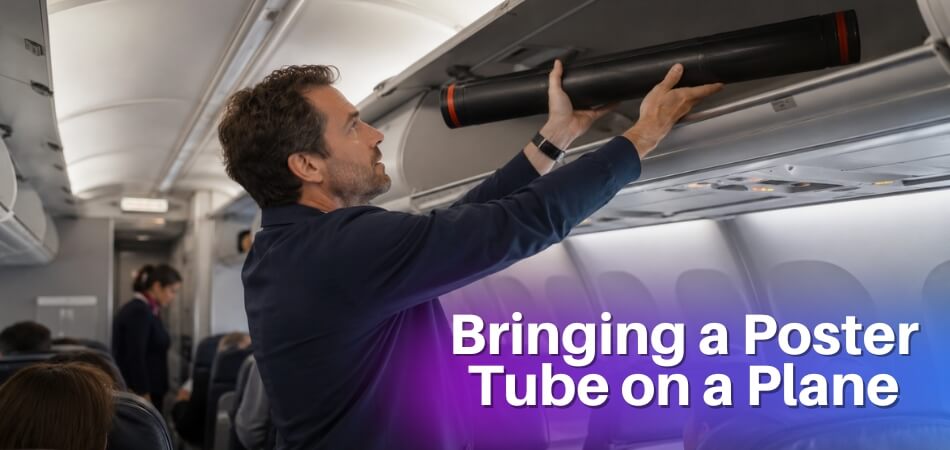
Imagine spending three weeks tweaking fonts, aligning graphs, and perfecting the color gradient on your academic conference poster — only to arrive at your session to find it bent in half, rolled into a crinkled mess, or worse, left behind at baggage claim. It happens more than you’d think. A single rough connection, an overstuffed overhead bin, or a careless baggage handler is all it takes to undo hours of work. The good news is that flying with a conference poster is very manageable once you know the rules, the right gear, and where things tend to go wrong.
The short answer: carry your poster on the plane in a rigid poster tube or a flat poster case whenever possible, so it never leaves your sight. That one decision eliminates most of the risk. But there’s a lot more to it — airline-specific policies, TSA checkpoint expectations, overhead compartment size limits, and solid backup options if everything falls apart at the last minute. This guide walks you through all of it.
Quick Answer: The safest way to fly with a conference poster is to carry it on the plane rather than checking it. A rigid poster tube fits in most overhead bins on major carriers like Delta Airlines, American Airlines, United Airlines, and Southwest Airlines, though you should verify carry-on baggage policy before you fly since budget airline policies vary. Roll your poster loosely, cap the tube securely, and label it clearly with your contact information. At the security checkpoint, TSA officers may ask you to remove the tube for X-ray screening — that’s normal and straightforward. Foldable fabric posters are an increasingly popular alternative because they pack flat into a standard suitcase. Always carry a PDF backup of your poster and research on-site conference printing options like FedEx Office or Staples in case something goes wrong in transit.
Whether you’re heading to a domestic academic conference or catching a connecting flight on an international trip, the steps are the same: plan your container, know your airline’s rules, and have a fallback ready. Let’s get into it.
Quick Answer: How to Carry a Conference Poster on a Plane
Use a rigid poster tube as a carry-on, keep it under 45 linear inches total (length + diameter), and confirm your airline’s overhead bin size rules before you leave home.
That’s the core of it. Everything else is planning for when that goes sideways.

The Container Decision Matters Most
You’ve got three real options:
- Rigid poster tube — the standard choice. Lightweight, protective, fits in most overhead compartments when sized correctly. Aim for a tube around 36–40 inches long and under 4 inches in diameter.
- Flat poster case — bulkier but keeps a mounted or foam-backed poster from rolling. These are harder to carry through a crowded terminal and less likely to fit overhead without a fight.
- Foldable fabric poster — only valid if your academic conference poster design was printed on fabric from the start. Don’t try to fold a standard inkjet print.
Pick the tube unless you have a specific reason not to.
Airline Rules You Need to Check
Carry-on baggage policy varies more than people expect. Delta Airlines and United Airlines generally allow tubes in the overhead bin if they fit — no dedicated policy against them. American Airlines is similar. Southwest Airlines operates on a “fits in the overhead compartment” basis without specific tube restrictions, but their bins run smaller on some aircraft.
Budget airline policies are stricter. If you’re on a Spirit or Frontier connection, check the exact overhead compartment size limits before you go. Don’t assume.
For an international flight, the rules compound. Some carriers outside the US treat anything longer than 40 inches as a special item requiring advance notice or checked baggage fees. Check that before booking, not at the gate.
TSA Won’t Be the Problem
The TSA (Transportation Security Administration) doesn’t restrict poster tubes. You’ll roll it through the security checkpoint on the conveyor belt or hand-carry it around — agents see them all the time at academic travel peaks. No special declaration needed.
What does slow you down: forgetting to remove it from a bag it’s shoved into, or having a tube that won’t fit through the X-ray machine mouth. Keep it accessible. Simple.
If You’re Checking It Anyway
Sometimes carry-on just isn’t worth the stress — especially on a connecting flight with a tight transfer. If you check the tube, label it clearly with your name, destination, and contact info on the outside. Use poster labeling seriously here: a strip of bright tape with your info written in permanent marker costs nothing and has saved posters that went to the wrong carousel.
Checked baggage fees apply, obviously. Usually $30–$40 domestic. Budget that in.
Your Backup Plan Should Already Exist
Save your poster as a print-ready PDF and have it on your phone and in cloud storage before you leave. FedEx Office and Staples locations near most major convention centers can print a 36×48 poster overnight for $50–$80. Many conferences also offer on-site conference printing — check the event FAQ page.
If your tube gets lost or crushed, you still present. That’s the whole point of the backup.
Carry-On vs Checked Baggage — Which Option Should You Choose?
The short version: carry it on if you possibly can. But there’s more to think through than just preference.
Benefits and Limitations of Taking Your Poster as a Carry-On
Keeping your poster with you in the cabin is almost always the safer call. Checked bags get thrown, stacked, rained on, and occasionally lost. Your poster doesn’t get a second chance if it arrives crushed or doesn’t arrive at all.
A rigid poster tube or a flat poster case fits in the overhead bin on most full-size aircraft — but not always easily, and not always guaranteed. Delta Airlines, United Airlines, and American Airlines all follow FAA-standard overhead compartment size limits, which typically allow items up to around 45 linear inches (length + width + height). A standard 36-inch tube usually clears this, but a 48-inch one almost certainly won’t.
Southwest Airlines is a bit more relaxed about carry-on enforcement in practice, but their official policy still applies the same dimensional rules. Don’t count on a gate agent looking the other way.
Here’s the real limitation: overhead bin space fills up fast, especially on a connecting flight. If you board in a middle group and the bins are packed, a gate agent may require you to check your poster at the last minute — right there on the jetway. That’s the worst outcome. You lose control of it at the worst possible moment with no time to protect it properly.
A few things that help:
- Board as early as possible. Use priority boarding if it’s available, even if you have to pay a few dollars for it.
- Use a rigid poster tube with end caps secured. Floppy tubes or cases that collapse get treated roughly.
- Label the tube clearly with your name, destination, and conference details — poster labeling matters if it gets separated from you even briefly at a security checkpoint.
At TSA, poster tubes and flat cases go through the X-ray belt without any special procedure. You won’t need to remove them from the bag in most cases. If a TSA officer asks to inspect it, just open the end cap and let them look. It’s rare but not unheard of, especially with dense rolled materials that look unusual on the screen.
The biggest limitation with carry-on is size. If your printed poster is 48×36 inches and you’re on a regional jet or a budget airline, you may simply have no room. Some smaller planes have no overhead bin that fits anything over 30 inches. Check the aircraft type before you fly.
Costs and Risks of Checking Your Poster as Baggage
Checking your poster costs money and introduces real risk. That’s the honest summary.
Checked baggage fees vary by airline and how far in advance you pay. American Airlines charges $35 for the first checked bag on most domestic routes (more at the gate). United Airlines is similar. If you’re on a budget airline, fees can run higher and apply to almost every passenger.
If your poster tube is over 62 linear inches combined or weighs more than 50 lbs, you’re looking at oversized or overweight bag fees on top of standard checked baggage fees. A large rigid case can hit that threshold quickly. Those fees often run $100–$200 each way.
Then there’s the damage question. Baggage handlers aren’t careless people, but the system they work in is rough. Tubes get stood on end, dropped, and wedged between hard-sided luggage. Even a rigid poster tube can crack under that kind of handling. A cardboard mailing tube — the kind from FedEx Office or Staples — has almost no chance in the cargo hold on a longer or connecting flight.
If you’re on an international flight, the rules get more complicated. International flight baggage rules vary by airline and even by route. Some carriers treat oversized items differently than domestic carriers do, and you might face fees you didn’t budget for at check-in.
That said, checking makes sense in specific situations:
- Your tube is genuinely too large for the cabin (48 inches or longer)
- You’re on a long international flight and the overhead bins are smaller
- You’re carrying multiple posters or a bulky flat case
If you do check it, invest in a proper hard-shell case. Not a cardboard tube. Pack the poster so it can’t shift inside the container. Write your contact information on the outside and a note on the inside with your conference venue — if it gets delayed, staff need to know where to forward it.
One more thing: if you’re checking your poster, always bring a PDF backup on your laptop or phone. On-site conference printing through a hotel business center or a local FedEx Office can save a presentation if your poster doesn’t show up. It’s not ideal, but it works.
Best Containers for Carrying a Poster — Tube, Folder, or Bag?
The container you choose matters more than most people realize. It affects whether your poster survives the trip, whether it fits in the overhead bin, and whether TSA gives you grief at the security checkpoint.

Using a Rigid Poster Tube
A rigid poster tube is the classic choice, and for good reason. It protects a rolled poster better than anything else. Most conference posters are printed on standard 36″ x 48″ paper, and a tube with an inner diameter of about 3–4 inches handles that easily when rolled without creasing.
Plastic tubes are cheaper. Aluminum tubes are tougher. Either works fine for carry-on.
Here’s where people run into trouble: tube length. Most airlines cap carry-on dimensions around 22″ x 14″ x 9″ total — but poster tubes routinely run 40–48 inches long. That’s a problem. Delta Airlines, American Airlines, and United Airlines all technically allow longer items in the overhead bin if they fit flat, but gate agents have discretion. Southwest Airlines is similarly inconsistent in practice.
A tube that’s 48 inches long will not fit in a standard overhead bin. You’ll need to place it lengthwise along the top of the bin, parallel to the fuselage, which works on wider jets but not always on regional aircraft. If you’re on a connecting flight with a small regional plane, you may be forced to gate-check it. That’s a real risk.
If you’re committed to the tube, bring a luggage tag and label it with your name, destination, and phone number — poster labeling is basic but often skipped. If it gets separated from you, that label is how it comes back.
One practical option: buy a tube under 36 inches and roll the poster tightly enough to fit. Most paper handles this fine. Mailing tubes from FedEx Office or Staples are cheap and sized more reasonably than specialty cases.
Using a Rigid Poster Folder or Flat Case
A flat case — sometimes called a poster folder or portfolio case — is a hard-sided rectangular case that holds the poster flat. No rolling. No risk of roll-curl when you unpack it.
The tradeoff is size. A flat case for a standard 36″ x 48″ poster is 36″ x 48″. That’s not going in any overhead compartment. Period. You’re checking it or shipping it ahead.
Checked baggage fees apply, obviously. And “fragile” stickers don’t guarantee careful handling. If you go this route, pad the case internally — foam corners, cardboard backing, whatever keeps the poster from shifting.
That said, flat cases make more sense for posters printed on thicker material, like foam board or fabric substrates, where rolling would damage them. If your academic conference poster is on something rigid, you don’t have a choice anyway.
Smaller document portfolios — around 24″ x 36″ — do occasionally fit in overhead bins on larger aircraft if placed flat across the top of other bags. You’d need to verify your specific aircraft’s overhead compartment size limits before counting on it.
Foldable and Fabric Posters — The Modern Alternative
Fabric posters have changed this whole situation for a lot of researchers and presenters. A fabric academic conference poster can fold down to roughly the size of a large hardcover book. It fits in your carry-on bag, your personal item, or even a large backpack.
No tube. No case. No negotiation with gate agents.
The print quality has gotten genuinely good. Companies like Spoonflower and several academic poster printing services produce fabric posters with sharp resolution at standard conference sizes. Yes, they wrinkle a bit — you hang them and let gravity do most of the work, or hit them briefly with a steamer at the hotel.
The one limitation is substrate. Some conferences require specific materials for poster board mounting, or the venue won’t have good hanging options for fabric. Check before you commit.
For international flights, where baggage rules vary significantly by airline, region, and fare class, the fabric poster is often the cleanest solution. Budget airline policies on international routes can be brutal — extra fees, stricter size limits, less overhead bin space. A poster that fits in your personal item sidesteps all of that.
If you’re still deciding which format to print in, think about your travel logistics first. Then pick the poster type that fits the container that fits your flight.
How to Properly Label Your Poster Tube and Container
This step gets skipped constantly, and it causes real problems. A plain black tube with nothing written on it looks identical to thirty other plain black tubes on a baggage carousel or in an overhead bin. Label yours like you mean it.
What to Put on the Label
At minimum, write your name, phone number, and email address. Add your destination city and the conference name. If you’re flying to ASM Microbe in Atlanta, write that on the tube. It gives whoever finds it context — and a reason to return it.
Put a label on both ends. Tubes get picked up from either direction, and one label gets obscured easily.
Use a luggage tag if the tube has a strap hook, but don’t rely on it alone. A strip of white label tape written in permanent marker and then covered with clear packing tape is more durable. It won’t peel off in cargo, and it won’t smear if the tube gets wet.
For flat hard cases — the kind you’d use as a carry-on — tape a business card to the outside under clear packing tape. Same information. Simple.
Label the Inside Too
Stick a folded piece of paper inside the tube with your contact details, the conference name, and a note like “academic conference poster — fragile, please handle with care.” If the external label gets destroyed, baggage handlers or airline staff can open it and trace it back to you.
This is especially worth doing on international flights. Baggage handling chains get longer, and your tube might sit in three different airports before it reaches you.
If You’re Checking the Tube
Some airlines route oversized items — including rigid poster tubes — through the oversized baggage or sports equipment counter. When you check it there, ask for a fragile sticker. Delta Airlines and United Airlines both offer these at check-in counters. They don’t guarantee careful handling, but they sometimes help route the item through manual sorting instead of automated conveyor systems.
Write “FRAGILE — DO NOT CRUSH” directly on the tube in large letters using a black marker. Looks low-tech. Still works.
One Thing People Forget
If your tube or flat case is part of your carry-on rather than checked baggage, label it with your seat number on a removable tag. During deplaning, people grab similar-looking items from the overhead bin by accident. A visible tag with “23B” on it takes five seconds to make and has saved more than a few posters.
What Happens at TSA and Security Checkpoints?
The short answer: carrying a poster tube through TSA is usually no big deal. But there are a few things worth knowing so you’re not holding up the line or getting pulled aside.
Will TSA Make You Open the Tube?
A rigid poster tube — whether it’s cardboard or hard plastic — goes through the X-ray machine just like any other carry-on item. TSA agents can see it’s a hollow cylinder with rolled paper inside. That’s about as suspicious as an umbrella.
That said, TSA officers can ask you to open anything they can’t read clearly on the scanner. It’s rare with poster tubes, but it happens. Don’t seal your tube with tape that’s impossible to remove quickly. A push-cap or screw-top lid is much faster to open if they ask.
A flat poster case gets laid flat on the belt, same as a laptop bag. No special handling required.
Poster Tubes as Carry-On vs. Checked Bag
If you’re carrying the tube onto the plane, it has to fit in the overhead bin or under the seat. Standard poster tubes — around 36 inches long — won’t fit under the seat. They’ll need to go overhead. Most overhead compartments on mainline aircraft (think United Airlines, American Airlines, Delta Airlines) are deep enough to lay a 36-inch tube diagonally, but it depends on the aircraft and how full the bin is.
Budget carriers are tighter. If you’re flying Southwest Airlines or a low-cost international carrier, check the overhead compartment dimensions for the specific aircraft if you can. Some regional jets have shallower bins where a long tube simply won’t fit flat.
If your tube is too long, the gate agent may check it at the door and put it in the cargo hold. That’s not ideal but it happens. They usually treat it like a gate-checked stroller — returned to you at the jetway when you land.
At the Security Checkpoint: Practical Tips
- Keep the tube capped and closed. Loose papers sliding around inside create scanner confusion.
- Label your tube before you leave home. Put your name, email, and conference name on a piece of tape on the outside. If it goes missing at the checkpoint or gets left in a bin, you want it coming back to you.
- Take it off the belt yourself. Don’t let it roll behind the X-ray conveyor and get forgotten. Pick it up immediately on the other side.
- Flat cases go face-up on the belt. Same as a painting or a framed piece — you want it scanned flat, not standing on its edge.
International Flights Add a Layer
Crossing international borders means your carry-on may go through security screening in both countries. TSA handles the U.S. departure side, but on the return trip you’re dealing with whatever the destination country’s airport security uses.
Most countries have similar screening protocols for tubes and flat cases. Just make sure your tube is clean inside — no random items mixed in with the poster. A bunch of pens, a laptop charger, and a rolled poster stuffed into the same tube looks messy on a scan and might get a second look.
Connecting Flights: The Real Risk Zone
If you have a tight connection, your gate-checked tube might not make it. That’s the scenario that kills conference posters. On a two-leg trip where the first leg is delayed, checked tubes sometimes don’t transfer in time.
This is exactly why you want a PDF backup of your poster on your laptop or phone. Services like FedEx Office and Staples can print a replacement poster at many conference cities overnight if disaster strikes. It’s not cheap or ideal, but it’s a real option. Some conferences also offer on-site conference printing — check the conference website before you fly. Knowing you have that fallback takes a lot of stress out of the journey.
Airline-Specific Rules — Delta, American, Southwest, and United
Rules vary more than you’d expect across carriers. The carry-on baggage policy wording on each airline’s website sounds similar, but the actual dimensions, fees, and gate agent flexibility differ enough to matter when you’re walking onto a plane with a 48-inch poster tube.

Delta Airlines
Delta allows one carry-on bag plus one personal item. The carry-on size limit is 22 x 14 x 9 inches — that’s the overhead bin standard across most major U.S. carriers. A rigid poster tube that’s 3–4 feet long is going to exceed those dimensions no matter how you measure it.
Here’s how most people actually handle it with Delta: they bring the tube as an “odd-shaped item” and politely ask the gate agent to stow it in the closet or first-class coat area. This works sometimes. Not always. Delta’s official policy says oversized items may need to be checked, and on smaller regional jets operated by Delta Connection partners, there’s almost no chance a long tube fits in the cabin.
If you’re checking the tube, Delta’s standard checked baggage fee applies — $35 for the first bag on most domestic fares as of 2024. Oversized fees kick in when the item exceeds 62 linear inches (length + width + height). A 48-inch tube with a 4-inch diameter clears that easily, so budget for a potential $200 oversized fee on Delta if you’re checking something large.
Your safest option on Delta: use a flat rigid poster case under 22 inches in one dimension, or carry a foldable fabric poster that rolls into a carry-on bag.
American Airlines
American’s carry-on dimensions are the same 22 x 14 x 9 inches. What’s different is how aggressively American enforces bag sizing, especially on Basic Economy fares — on those tickets, you’re often limited to a personal item only, meaning your poster tube could get gate-checked without warning.
If you’re flying American with a poster, avoid Basic Economy. Full stop. Pay for at least the main cabin fare so you’re entitled to overhead bin space.
American does allow odd-shaped items to be checked as standard baggage if they fit within 126 linear inches total. Oversized fees are $200 each way for items over 62 linear inches, same structure as Delta. On international flights with American, baggage rules shift based on the route and your ticket class — always check the specific flight’s baggage rules, not the general page.
One thing that works in your favor with American: their newer Airbus A321s have larger overhead compartments than older aircraft. Still not going to swallow a 3-foot tube, but a flat poster case has a better shot.
Southwest Airlines
Southwest is the outlier here. They don’t charge for the first two checked bags — period. That’s a real advantage if you’re traveling with a poster tube you’d rather not carry on. Check the tube, pay nothing extra (assuming it fits within the standard size and weight limits of 62 linear inches and 50 lbs), and don’t stress about overhead bin space.
Southwest’s carry-on policy allows one bag up to 10 x 16 x 24 inches plus one personal item. Still too small for a long tube, but if you’re using a compact flat case or rolling a foldable fabric poster into your main carry-on, you’re fine.
The checked bag perk makes Southwest genuinely attractive for academic conference travel. If your itinerary works with their routes, it’s worth considering just for this reason.
One caveat: Southwest doesn’t do assigned seating, so you have no control over where you sit, which means you can’t guarantee proximity to your overhead bin. For a delicate poster case you want to keep an eye on, that’s worth factoring in.
United Airlines
United’s overhead bin policies mirror Delta and American — 22 x 14 x 9 inches for carry-on bags. Basic Economy on United is similarly restrictive: personal item only, no overhead bin access. Don’t book Basic Economy if you’re carrying any kind of poster container.
United’s checked bag fees are $35 for the first bag domestically. Oversized fees (over 62 linear inches) run $200 each way, same as the others. On international flights, the baggage rules depend heavily on your Star Alliance status and destination — international flight baggage rules on United can allow more generous dimensions on certain long-haul routes, so check your specific itinerary.
United operates a lot of connecting flights through hubs like Chicago O’Hare, Denver, and Houston. If you’re checking a poster tube and you have a tight connection, there’s real risk of the tube not making the transfer, especially on a two-hour or less layover. Build in buffer time. And if you’re checking anything fragile or irreplaceable, add a PDF backup of your poster to your phone and email before you leave home — because checked luggage and tight connections don’t always cooperate.
Budget Airlines vs Full-Service Airlines — What Is the Difference?
This is where a lot of conference travelers get tripped up. The airline you book matters just as much as the tube you pack.
Full-Service Airlines Are More Forgiving
Carriers like Delta Airlines, American Airlines, and United Airlines typically allow one carry-on bag plus a personal item at no extra charge, even in basic economy on many routes. More importantly, their overhead bins are larger — usually sized to accommodate bags up to 22 x 14 x 9 inches. A standard rigid poster tube (around 3–4 inches in diameter, 36–40 inches long) fits lengthwise in these bins on most wide-body aircraft, though you may need to angle it carefully.
These airlines also tend to have more flexible gate agents. If your poster tube is slightly oversized, there’s a reasonable chance they’ll let it through without a fuss, especially if the flight isn’t full.
That said, don’t count on luck. Call ahead.
Budget Airlines Are a Different Story
Southwest Airlines is actually one of the more generous budget carriers — two free checked bags per passenger, no carry-on fees. That changes the math entirely. You could check your poster in a rigid tube inside a padded bag without paying extra, though you’d still be rolling the dice on baggage handling.
Carriers like Spirit, Frontier, and Allegiant are a completely different situation. Carry-on fees can run $50–$80 each way, and their overhead compartment size limits are stricter. A 40-inch poster tube may simply not qualify as a “personal item” and could get charged as a carry-on — or worse, flagged at the gate.
Budget airline policies also vary by route, aircraft type, and whether you check in online vs. at the airport. The same airline can treat you differently on two separate flights.
International Flights Add Another Layer
International flight baggage rules vary significantly by carrier and country of origin. Lufthansa, for example, has different carry-on allowances than Air Canada, even on transatlantic routes. A rigid poster tube that’s fine on a domestic United leg might get pulled at the gate for your connecting flight on a partner carrier.
If your trip involves a connection — especially on a different airline — check both carriers’ policies separately. Don’t assume the rules carry over.
The Practical Breakdown
| Carrier Type | Carry-On Fees | Overhead Bin Space | Tube-Friendly? |
|---|---|---|---|
| Delta / American / United | Usually free | Larger bins | Generally yes |
| Southwest | Free (generous) | Standard | Yes, if sized right |
| Spirit / Frontier / Allegiant | $50–$80+ | Smaller bins | Risky |
| International carriers | Varies widely | Varies by aircraft | Always verify |
The bottom line: if you’re flying a budget airline to an academic conference poster presentation, either ship the poster ahead via FedEx Office or plan to print on-site. Paying $80 in carry-on fees each way almost always costs more than local printing through Staples or a conference venue service.
How to Reduce Poster Risk on Connecting Flights and Layovers
Connecting flights are where poster disasters actually happen. It’s not the security checkpoint or the boarding gate — it’s the gap between two planes, especially when your layover is tight or your bags get rerouted.
Keep the Poster With You, Always
This is non-negotiable on any itinerary with a connection. If you’ve checked your poster tube and your first flight lands 40 minutes late, there’s a real chance the poster makes it to your destination on a later flight — or doesn’t make it at all. You won’t. Carry it on every single leg.
If overhead bin space fills up on a full regional jet and a flight attendant pressures you to gate-check it, ask specifically whether you can keep it in the cabin. A rigid poster tube under 36 inches usually fits diagonally in smaller overhead compartments, but this varies. Don’t assume. Board as early as possible to secure bin space before it’s gone.
Short Layovers Are a Real Problem
Under 60 minutes between connections is risky even without a poster. With one, it’s worse because you’re carrying something awkward that slows you down through a crowded terminal. If you have any control over your itinerary, build in at least 90 minutes for domestic connections and more for international ones.
If you’re connecting at a major hub — think O’Hare, Atlanta, or Dallas-Fort Worth — terminal changes are common. You might need to take a train between concourses while carrying a 4-foot tube. That’s not impossible, but it’s not fun either.
What to Do If Your Poster Gets Delayed or Lost
Have a PDF backup of your poster on your phone and laptop before you leave home. Not a low-res thumbnail — a full-resolution print-ready PDF. If your tube doesn’t arrive, you need this immediately.
Most large conference cities have a FedEx Office or Staples close to the convention center. Many academic conference venues actually have on-site conference printing available, but it fills up fast and costs more than printing at home. If you know your poster dimensions and have the PDF ready, you can usually get a replacement printed within a few hours. Call ahead once you know there’s a problem — don’t wait until you’re standing at the print shop at 7pm the night before your session.
Label the Tube With Your Destination and Phone Number
This goes on the tube itself, not just a luggage tag. A luggage tag can fall off. Write your name, conference name, hotel name, and mobile number directly on the tube with a permanent marker. If it ends up on a different flight or gets left at a gate, someone can actually reach you. Poster labeling sounds basic, but it genuinely speeds up recovery when something goes wrong.
International Connections Have Extra Variables
On an international flight, your bags may go through customs re-check even if you’re connecting. This means a poster you intended to carry on could briefly leave your hands in a bag screening process. Know the rules for your specific routing — an itinerary that connects through Toronto or Frankfurt works differently than a direct flight. If you’re flying on a budget airline for one leg of an international trip, check whether that carrier’s carry-on baggage policy conflicts with what the main carrier allowed. Budget airline policies on size and fees don’t always align with what Delta or United permitted on the first leg.
Special Rules for International Flights
Flying internationally with a conference poster adds a layer of complexity that domestic travel simply doesn’t have. Baggage policies vary not just by airline but by route, country, and even the specific aircraft operating that leg of the journey.
Carry-On Size Limits Change by Region
This is the biggest gotcha. Airlines based in Europe, Asia, and South America often enforce stricter carry-on dimensions than U.S. carriers. A rigid poster tube that slides into the overhead bin on a United Airlines domestic flight might technically exceed the carry-on size limit on a Lufthansa or Ryanair operated leg of the same trip.
Before you fly, check the specific carry-on dimensions for every airline operating every leg of your journey — not just the one you booked through. Codeshare flights are a common trap. You might book through Delta but actually board a KLM-operated aircraft with different size rules.
Most international carry-on limits run around 45–56 linear inches total. A standard 5-inch diameter, 36-inch long rigid poster tube sits right at the edge of that range once you factor in its length.
Checked Baggage Fees Hit Differently Abroad
On many international flights, one checked bag is included. That sounds great until you realize your poster tube as a checked item is now at the mercy of baggage handlers across multiple airports — some of which have a notoriously rough reputation for oversized items.
If you do check a poster tube internationally, triple-check the maximum linear size for checked bags. Most international carriers cap oversized baggage at 62 linear inches (length + width + height combined), and many rigid tubes with caps and handles push past that threshold.
Overage fees can be steep. Some carriers charge $100–$200 per oversized bag each way.
The PDF Backup Becomes Non-Negotiable
On a domestic trip, having a PDF backup feels like a nice precaution. On an international trip, it’s closer to essential. If your poster gets lost, damaged, or confiscated — yes, confiscated, more on that below — printing a replacement abroad takes real coordination.
That said, major conference cities have options. FedEx Office has international locations, and most large European and Asian cities have Staples equivalents or professional print shops near convention centers. Know where the nearest option is before you land. On-site conference printing is also worth checking — more academic conferences now offer this service, and for international travelers specifically it’s a genuine lifesaver.
Some Customs Checkpoints Will Flag Your Tube
International travel means customs, and customs agents in some countries do get curious about sealed tubes. Most of the time you’ll wave through without issue. But if you’re entering a country with stricter import screening — certain items in the Middle East, parts of Southeast Asia, or Australia with its tight biosecurity — don’t be surprised if an agent asks you to open the tube.
Have your conference documentation accessible. An email confirmation, your abstract, or your presenter badge goes a long way toward explaining what’s inside. A sealed tube with no explanation is more suspicious than one where you can say, “It’s a research poster, here’s the conference details.”
Liquid Rules Apply to Rolled Prints Too
If your poster was printed on a fabric substrate that was then rolled and sealed, some international customs officials have questioned whether specialty printing materials count as restricted goods. This almost never causes a real problem, but “almost never” isn’t never. Know what material your poster is printed on. Foldable fabric posters occasionally raise eyebrows at security checkpoints in countries with stricter import rules than the U.S. or EU.
Airline Alliance Connections Can Create Policy Conflicts
Say you’re flying from Chicago to Tokyo with a connection in Seoul. Your transatlantic leg is on United (Star Alliance), but your Seoul to Tokyo hop is on a smaller regional carrier with its own carry-on policy. The United booking might say one thing. The regional carrier does what it wants.
This happens constantly. Always verify with the actual operating carrier, and when connecting internationally, build in enough time that a size dispute at the gate doesn’t make you miss your flight.
One Practical Tip for Serious International Presenters
Ship your poster ahead. FedEx International Priority to a hotel or the conference venue itself typically takes 2–5 business days and, for a poster tube, usually runs $80–$150 depending on destination. That’s real money, but it’s also real peace of mind. Your poster arrives before you do, you travel with normal luggage, and you don’t spend the flight worrying about overhead compartment space limits or customs inspections.
For high-stakes academic conference presentations — the ones where your research visibility actually matters — this approach is worth the cost.
What to Do When Carrying Multiple Posters at Once
Carrying one poster on a plane is manageable. Carrying three is a different situation entirely — and it catches a lot of researchers off guard, especially when they’re presenting at back-to-back conferences or co-presenting with a colleague.
The first thing to think about is container consolidation. If you have two 36″x48″ posters, you can often roll them both into the same rigid poster tube — just roll one slightly tighter, place it inside the other, and slide both into the tube together. This works as long as the paper weight isn’t too heavy. For heavier media like fabric or foam-backed prints, you’ll need separate containers.
Stick to One Carry-On Tube
Most airlines — Delta, American, United, Southwest — treat your poster tube as your one personal item or carry-on. The moment you show up with two tubes, you’ve got a problem. Gate agents will flag it. You may get forced to check one, and then you’re dealing with checked baggage fees and the exact kind of risk you were trying to avoid.
The practical fix: get a wider-diameter tube. Most standard tubes run 3–4 inches across. Go up to 6 inches and you can fit two or even three rolled posters side by side, depending on the roll diameter of each. Some academic conference presenters specifically use 4″x48″ tubes from FedEx Office or their university’s print shop for exactly this reason.
If the posters genuinely can’t share a tube, use one tube and one flat poster case. The flat case can often pass as a second carry-on depending on its dimensions and how full your flight is. Under 22″x14″x9″ total, you’re usually fine fitting it in the overhead bin — but that varies, so check your specific airline’s carry-on baggage policy the day before you fly.
Split Between Travelers When Possible
If you’re traveling with a co-presenter or a colleague from your lab, split the posters between you. One person carries the tube, the other carries the flat case or a second tube. This is the cleanest solution. It also means that if one bag gets lost or delayed, you haven’t lost everything at once.
On connecting flights this matters even more. Shorter layovers — 45 minutes or under — leave almost no time to deal with a gate agent questioning your second tube. Keep things simple before you even get to that gate.
Shipping Extra Posters Ahead
When you genuinely can’t consolidate, ship at least one poster ahead. Staples and FedEx Office both do tube shipping to hotels and conference venues. You drop it off 3–4 days before your trip, and it’s waiting at the front desk when you arrive. Shipping a poster domestically through FedEx Office typically runs $20–$45 depending on tube size and distance — far cheaper than a checked baggage fee plus the anxiety of watching it go onto a conveyor belt.
For international flights, the math changes. International baggage rules often allow one or two checked bags in the base fare, so checking a poster tube might cost you nothing extra. Still, the handling risk doesn’t go away. A checked tube that gets crushed or bent during an international connection is a real scenario, especially on smaller regional aircraft where bags get manually loaded and space is tight.
Don’t Forget Your PDF Backup
This applies to multiple-poster situations even more than single-poster trips. If you’re managing two or three physical prints across a trip, something is more likely to go wrong. Have every poster saved as a high-resolution PDF on your laptop and on cloud storage. Most major conference venues have an on-site conference printing option — sometimes run by FedEx Office or a local print shop contracted by the organizers. Turnaround is usually 24 hours. It’s not ideal, but it saves the presentation.
Print the venue’s printing contact in your phone before you leave. Don’t look it up when you’re already panicking at baggage claim.
Printing at Your Destination — On-Site and Local Printing Options
Sometimes the smartest move is to not carry the poster at all. Flying with a 36×48 inch tube through two connecting flights is stressful. If you have a reliable way to print at or near the venue, that’s often the cleaner option.

Conference Venue Printing Services
A growing number of academic conferences now offer on-site conference printing as a registered service. This is especially common at large medical, scientific, and engineering conferences held in major convention centers. Check the official conference website early — usually under “Presenter Resources” or “Logistics.” Some conferences partner with a specific vendor who sets up a print station on-site the day before sessions begin.
Costs vary. Expect to pay $60–$120 for a standard 36×48 fabric or gloss poster through a venue-affiliated printer. That’s more than your local shop, but you’re paying for convenience and no shipping risk.
If on-site printing is available, you’ll typically submit your PDF file 48–72 hours in advance through an upload portal. Don’t wait until the night before. Files get rejected for wrong dimensions, low resolution, or incorrect color profiles. Submit early, confirm receipt, and keep a copy of the confirmation email.
One real downside: if there’s a printing error, your options for fixing it are limited. You’re at the venue, not at home. This is exactly why having a PDF backup on your laptop or phone matters — you can at least show your poster digitally if the physical print fails or gets delayed.
Using a Local Print Shop, FedEx, or Staples
If the conference venue doesn’t offer printing, you have good options in almost any mid-sized or large city. FedEx Office locations can print large-format posters, and many are open late or even 24 hours. Staples also offers large-format printing, though turnaround times and quality vary more by location.
Call ahead. Don’t just walk in assuming they have the right paper stock loaded and can turn it around in two hours. Ask specifically: “Do you have a large-format printer available today, what’s the lead time, and can you print on fabric or just paper?” Some locations only stock matte or glossy paper. Fabric posters usually aren’t available at walk-in print shops — that’s more of an online order situation.
Upload your file to their website the night before if possible. FedEx Office has a solid online upload system where you can specify size, paper type, and pickup time. This saves you standing at a counter explaining your dimensions to someone who may not be familiar with academic poster formats.
Budget for $40–$90 at a local shop depending on material and city. San Francisco or New York will cost more than Raleigh or Indianapolis. Factor that into your conference budget ahead of time.
One thing people forget: find the print shop’s address before you leave home. Don’t try to Google “FedEx near convention center” when you’re jet-lagged and hauling luggage through an unfamiliar city. Know where you’re going and how long it takes to get there from your hotel.
Always Keep a Digital and PDF Backup of Your Poster
Your poster tube can get lost. Your flat case can get crushed. A checked bag can end up in a different city entirely. None of that has to ruin your presentation if you’ve got a solid backup plan in place before you leave home.
The simplest backup is a high-resolution PDF saved in at least two places — your laptop and cloud storage. Google Drive, Dropbox, iCloud, it doesn’t matter which one you use. Just make sure you can pull it up without Wi-Fi, because conference venue internet is notoriously unreliable.
Save the Right File Format
Don’t just export whatever your design software spits out by default. You want a PDF at full poster dimensions, with fonts embedded, saved at a minimum of 150 DPI (300 DPI if the file size allows). A blurry reprint helps nobody.
If you designed your poster in PowerPoint, export directly to PDF rather than printing to PDF through a driver — the quality difference matters when you’re reprinting at 36 x 48 inches. Keep the original editable file too, not just the export. If something needs a last-minute fix, you’ll thank yourself.
On-Site Conference Printing Is a Real Option
Most mid-sized cities with major academic conferences have a FedEx Office or Staples within a reasonable distance of the venue. On-site conference printing services are also increasingly common — many large academic conferences now partner with a print vendor right in the hotel or convention center.
Check the conference website before you travel. Seriously, do it now. Some conferences list approved printers and even negotiated discount codes for attendees. If yours does, save that information to your phone.
Turnaround at FedEx Office for a large-format poster is typically a few hours for same-day service, sometimes less. It’s not cheap — expect $50 to $120 depending on size and material — but it’s a real solution, not a last resort.
What to Do If Everything Goes Wrong
Say your poster tube got checked by mistake and didn’t arrive. Or the tube cracked and the poster is creased beyond saving. Here’s the actual sequence to follow:
- Contact the airline’s baggage claim desk immediately and file a delayed baggage report with a reference number.
- Pull up your PDF and find the nearest FedEx Office or on-site printer.
- Email yourself the file if it’s not already accessible on your phone or laptop.
- Check whether your conference has a “poster emergency” contact — some do, especially for international attendees.
You won’t always get the poster reprinted before your session. If that happens, presenting from your laptop screen or a printed handout is genuinely fine. Judges and colleagues care about your research. The poster is a delivery mechanism, not the work itself.
Keep a Thumbnail Version on Your Phone
One underrated move: export a compressed JPEG of your poster and save it as your phone wallpaper or lock screen the day of your presentation. It sounds trivial. But if someone asks what your poster is about during a hallway conversation before you’ve set up your display, you can show them something immediately. It also works as a quick visual reference if you’re reprinting and need to confirm layout details with a print shop.
The backup isn’t just an emergency plan. It’s basic preparation, the same way you’d save a copy of a conference talk slides. Treat your poster file the same way.
Final Tips for Flying with a Conference Poster Without Damage
You’ve sorted your container, labeled it properly, and know the airline rules. These last few points can still make or break your poster on travel day.
Roll the Poster Correctly Before It Goes in the Tube
Always roll printed side out, not in. Rolling with the print facing inward puts stress on the ink layer and can cause micro-cracking, especially on glossy substrates. Use acid-free tissue paper or a sheet of clean kraft paper as a buffer layer before rolling. Secure with a rubber band — not tape directly on the poster surface.
Don’t Pack the Tube Into Checked Luggage at the Last Minute
If you decide to gate-check your rigid poster tube, do it intentionally and early. Handing it over at the gate gives baggage handlers a heads-up that it’s fragile. Throwing it in your checked bag as an afterthought, loosely sitting alongside shoes and cables, is how posters get creased or crushed. If it’s going below the plane, pack it as if it’s the only thing that matters.
Board Early Enough to Secure Overhead Bin Space
Overhead compartment size limits vary slightly by aircraft type, but the real problem is space availability. By boarding group 3 or 4 on most full-service carriers, the bins near your seat are often full. Use early boarding if it’s available — even paying a small fee for it can be worth it on a long tube that won’t fit horizontally in a packed bin.
Use the Overhead Bin Lengthwise, Not Crosswise
A tube placed crosswise across the bin gets shifted and squeezed by other bags. Lengthwise along the spine of the bin is more stable. If a flight attendant asks you to move it, explain politely that it contains fragile printed material. Most will work with you to find a workable spot.
Always Have the PDF on Your Phone
This isn’t optional. Carry a high-resolution PDF of your academic conference poster on your phone and in cloud storage. If your poster is lost, delayed, or damaged mid-transit, on-site conference printing at FedEx Office or Staples near the venue can save you. Most academic conferences are in or near cities where same-day large-format printing is available. You need that file ready, not sitting on a desktop back home.
Double-Check International Flight Baggage Rules the Day Before
International flight baggage rules differ from domestic ones, sometimes significantly. Budget airline policies in Europe and Southeast Asia are particularly strict about oversized carry-ons. Don’t assume what worked on your Delta domestic leg will apply on a connecting international segment operated by a partner carrier. Log into the actual airline’s website and check carry-on dimensions the day before you fly.
Take a Photo of the Poster Before You Travel
Lay it flat, take a clear photo. If the tube or flat case is damaged in transit, that photo is your evidence for a baggage claim. It takes 10 seconds and most people skip it. Don’t skip it.
Arrive at the Venue with Time to Re-Flatten
Even a well-rolled poster needs 30 to 60 minutes lying flat under slight weight before it presents cleanly on a board. Get to your room the night before if possible, unroll the poster, and set a couple of books on the edges. It makes a visible difference in how the final display looks.
Frequently Asked Questions (FAQ)
Can I bring a poster tube on a plane as a carry-on?
Yes, in most cases. A standard rigid poster tube that’s around 30–36 inches long will be treated as an oversized carry-on. Airlines typically allow it, but they may gate-check it if the overhead bin fills up. Get to the gate early. That’s the single most effective thing you can do to keep your tube in the cabin with you.
What size poster tube is allowed on a plane?
There’s no universal rule. Most full-service carriers like Delta Airlines and United Airlines follow a carry-on size limit around 22 x 14 x 9 inches for standard bags, but cylindrical tubes are judged differently — usually by their longest dimension. Tubes under 36 inches rarely cause problems. Anything over 45 inches is risky on almost every domestic route.
Does TSA have restrictions on poster tubes?
The TSA doesn’t specifically ban poster tubes, and they won’t open a sealed tube looking for prohibited items unless the X-ray flags something suspicious. At the security checkpoint, just place the tube separately on the belt. Don’t jam it into a bag. It scans fine on its own.
Will airlines charge me extra for carrying a poster tube?
Depends on the airline and whether they consider it a second carry-on or an oversized item. Southwest Airlines generally won’t charge you for a tube that fits in the overhead bin or under the seat. Budget carriers are a different story — some will charge a gate-check fee or even a checked baggage fee if they decide it’s oversized. Read the carry-on baggage policy before you fly, not at the gate.
Can I check a poster tube as luggage?
You can, but it’s a gamble. Checked baggage gets thrown around. If you check a rigid poster tube, it’ll likely survive — but it can also come out bent, cracked, or missing entirely on a connecting flight. If you must check it, mark it fragile, and have a PDF backup ready so you can use on-site conference printing if it doesn’t arrive.
What if my poster gets damaged or lost?
This is why the PDF backup exists. Before you leave, save your poster file on your phone, a USB drive, and cloud storage. Services like FedEx Office and Staples can print a replacement in a few hours if you bring the right file format — usually a high-resolution PDF at the correct dimensions. It’s not ideal, but it’s saved plenty of people at academic conferences.
Are foldable fabric posters better for flying?
For pure travel convenience, yes. A foldable fabric poster rolls up small, fits in your luggage, and won’t get flagged at the security checkpoint. The trade-off is print quality — fabric prints don’t match the sharpness of a standard paper poster. Whether that matters depends on your conference and how closely people typically view the work.
What about international flights — are the rules different?
Often, yes. International flight baggage rules vary by carrier and by country. Some European carriers are stricter about carry-on dimensions. If you’re flying internationally, check the specific airline’s rules for your departure and arrival country, not just the general policy. A tube that’s fine on a domestic United Airlines leg might get challenged on a European connection.
Should I ship my poster instead of flying with it?
Shipping is worth considering if you’re attending a multi-day conference with a fixed venue. You can send it ahead via FedEx to the conference hotel or convention center. The risk is delivery timing — if it arrives late, you have no fallback on day one. Ship at least 4–5 days early, and keep that PDF backup no matter what.
What’s the single best thing I can do to protect my poster on a plane?
Carry it on. Don’t check it. Use a rigid poster tube or a poster flat case, label the container clearly with your name and destination, arrive at the gate early enough to secure overhead bin space, and have your file backed up digitally. That combination covers almost every failure point you’re likely to hit.
Conclusion — The Right Preparation Is the Best Protection for Your Poster
Flying with an academic conference poster doesn’t have to be stressful. It just requires decisions made before you get to the airport, not at the gate.
Pick the right container first. A rigid poster tube handles rough baggage handling better than a fabric sleeve, but it’s bulkier to stow in an overhead bin. A poster flat case works well if you’re printing on lightweight paper and your airline allows the dimensions. Know which one you’re bringing before you book — not after.
Check the airline’s carry-on baggage policy directly on their website. Don’t assume Delta’s rules match United’s, or that Southwest’s informal culture extends to oversized items. Budget airlines are especially strict. A tube that flies free on one carrier can cost you $75 in checked baggage fees on another.
Label everything. Your name, phone number, and conference venue go on the outside of the tube. If the container gets separated from you during a connecting flight, that label is its best chance of finding you before your session starts.
Keep a high-resolution PDF backup in your cloud storage and your email drafts. Seriously — this one habit has saved presenters. FedEx Office and Staples locations operate near most major convention centers, and on-site conference printing services exist precisely for situations where bags go missing. A PDF doesn’t weigh anything and costs nothing to carry.
At the security checkpoint, just pull the tube out if an agent asks. TSA doesn’t have a specific rule against poster tubes, but a rigid container can look odd on the X-ray. Be ready to open it. Don’t tape it shut in a way that requires tools to open.
The single biggest risk isn’t TSA. It’s the overhead compartment filling up on a full flight and a gate agent forcing your tube into checked baggage at the last minute. Board as early as you can. Use priority boarding if your airline offers it.
You’ve done the research, printed the poster, and prepared the presentation. Don’t let the travel part undo that. Thirty minutes of planning at home is worth far more than scrambling at the airport.