
The first two minutes of a medical conference set the mood of the room before a single slide appears. A good welcome is warm, short, and careful about what it says about patients.
Quick answer: A welcome speech at a medical conference should greet the audience, name the event and its purpose, thank guests, organizers, and healthcare staff, invite participation, and hand over to the first session. Keep it to about 3-5 minutes, use plain professional language, and never include details that could identify a patient.
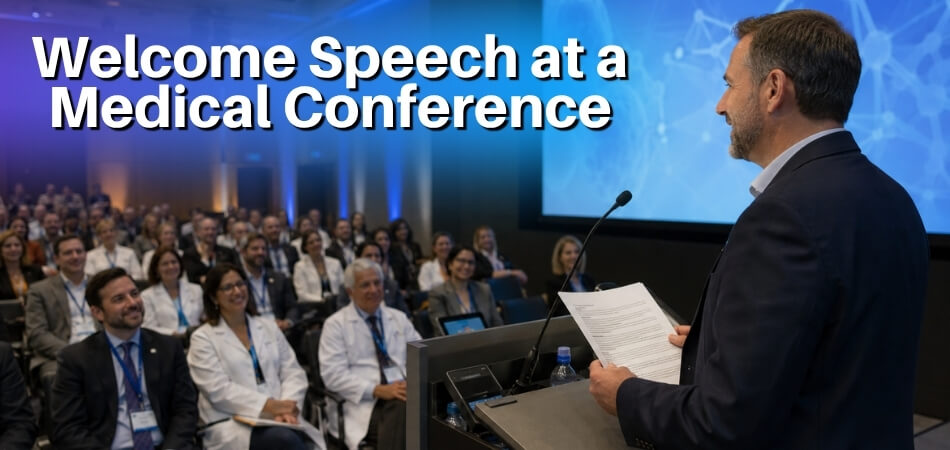
Medical conferences bring together doctors, nurses, researchers, healthcare leaders, students, educators, and public health professionals. A good opening helps each of them feel included and prepares everyone for the sessions ahead. It does not need complicated language. It only has to answer three things: why people have gathered, what the event hopes to achieve, and how attendees can take part.
What Goes Into a Medical Welcome Speech?
A medical conference welcome speech should include a greeting, a brief self-introduction, a welcome to guests, the purpose and theme, thanks to organizers and staff, a participation message, and a positive closing line. The table below shows what each part does.
| Part | What it covers | Medical tip |
|---|---|---|
| Greeting | A short welcome that matches the formality of the event | Use correct titles such as Dr or Professor for named guests |
| Self-introduction | Your name and role, in one line | Say your role only if it explains why you are opening the event |
| Welcome to guests | Speakers, clinicians, researchers, students, sponsors | Group people by role instead of reading a long list |
| Purpose and theme | Why the event is held and what it focuses on | Link the theme to one real healthcare concern |
| Thanks | Organizers, volunteers, sponsors, support and technical teams | Include the staff who covered shifts so others could attend |
| Participation message | Ask questions, visit posters, join workshops | Name one concrete activity, not a general plea |
| Closing transition | A line that hands over to the first session | End with the first speaker’s name |
Ideal Tone for a Medical Audience
The tone should be professional, respectful, and warm. Medical audiences expect clarity and accuracy, but the speech should not sound cold. Use simple language that works for senior consultants and first-year trainees alike. If students or early-career healthcare workers are in the room, keep the tone encouraging.
Skip jokes that may not fit the setting and avoid dramatic language about illness or suffering.
Core Message to Deliver
The core message is simple: this conference is a space for learning, exchange, collaboration, and better healthcare outcomes. You can build it from any of these ideas:
- Sharing medical knowledge
- The value of research alongside clinical experience
- Collaboration across healthcare fields
- The shared goal of improving patient care
- Taking an active part in sessions
Pick two or three. A clear core message gives the audience a reason to listen and gives the event a purpose from the first minute.
Why a Welcome Speech Matters at a Medical Conference
A welcome speech matters because it creates the first impression of the event and tells the audience what the day is for. It gives the opening a structure, recognizes the people in the room, and prepares attendees for learning and professional exchange.
Sets a Professional Tone
Medical conferences deal with serious subjects such as patient care, clinical practice, research, and public health. A thoughtful opening shows that the event is organized and focused on meaningful discussion.
Helps Attendees Feel Included
A senior doctor, a nurse, a researcher, a student, a speaker, and a sponsor should each feel named by the opening. Inclusive wording makes people more comfortable asking questions, joining discussions, and networking.
Explains the Purpose and Starts the Program Smoothly
The speech moves the room from arrival and registration into the formal program. It briefly says why the conference is being held, such as sharing research, improving clinical knowledge, or learning from experts, and it makes the move to the first keynote, panel, or session feel natural. Medical conferences benefit when attendees take part, so the opening can also invite people to ask questions, visit posters, and join workshops.
How to Structure a Welcome Speech at a Medical Conference
A strong medical conference welcome speech moves in a clear order: greeting, introduction, welcome, purpose, theme, appreciation, participation message, and closing transition. This order keeps the speech easy for the audience to follow and easy for you to remember.
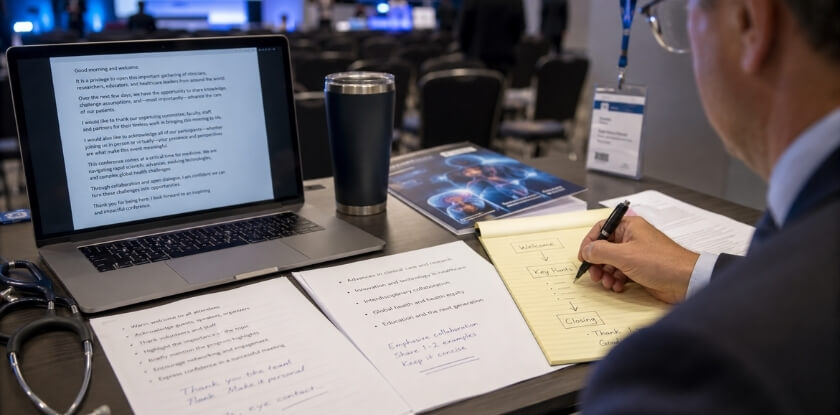
Start With a Respectful Greeting
Match the greeting to the event. A formal congress suits a full address to the room, while a hospital teaching day suits a simple “Good morning, everyone.”
Good morning, distinguished guests, respected speakers, clinicians, and colleagues from every part of the health system.
Introduce Yourself Briefly
Introduce yourself with your name and role in one short line, and only if it helps the audience understand why you are opening the event.
I am [Your Name], [Your Role], and it is my privilege to open [Conference Name] today.
Welcome Key Guests, Speakers, and Attendees
Name the groups that matter for this event: doctors, nurses, researchers, medical students, keynote speakers, organizers, sponsors, public health leaders, and invited guests. Keep this part short so the speech does not turn into a roll call.
State the Purpose of the Conference
Say in a sentence or two why the event exists: to share medical research, discuss clinical practice, explore healthcare innovation, improve patient care, or support professional development. If the event has run before, one line on its history is enough.
Highlight the Main Theme or Healthcare Focus
Mention the theme in one or two sentences and tie it to a real concern such as patient safety, evidence-based practice, public health, or medical education. This gives the speech direction. Then give a short preview of the day, such as the session blocks and the break times, and point people to the printed or online program for the details instead of reading it out.
Acknowledge Organizers, Sponsors, and Support Teams
Thank the organizing and scientific committees, volunteers, sponsors, partners, staff, and the technical team. A short, specific thank-you sounds more sincere than a long list.
Encourage Engagement During Sessions
Invite people to ask questions, visit the poster session, attend a workshop, and meet someone from another profession. One concrete invitation works better than a general request to participate.
Close With a Positive Transition
End by leading into the next part of the program.
With that, let us begin today’s program with curiosity, respect, and a shared commitment to better healthcare.
Key Elements of a Strong Medical Conference Welcome Speech
A strong medical conference welcome speech is clear, respectful, inclusive, and tied to the purpose of the event. The points below are what separate a medical opening from a generic one.

Clear Healthcare Context
Connect the speech to healthcare from the first lines. Name the focus of the meeting, whether it is clinical practice, medical research, healthcare leadership, public health, patient safety, innovation, or continuing medical education. This tells the audience the words were written for a medical setting and not for any event.
Respect for Medical Professionals and Students
Healthcare professionals balance demanding schedules, patient responsibilities, academic work, and research. One sincere line recognizing the effort it took to be in the room makes the opening feel thoughtful.
Focus on Patient Care, Research, and Collaboration
A medical conference is meant to improve something shared. Your speech can touch on patient care, evidence-based practice, new research, clinical learning, and collaboration across healthcare roles, but keep it to a few sentences.
Simple and Inclusive Wording
Do not address only doctors. Add nurses, allied health staff, researchers, students, educators, speakers, and guests when they are present, and use plain words so non-clinical attendees follow along.
Acknowledging Healthcare Workers and Sharing Patient Stories Safely
Thank healthcare workers by naming what they do, and share a patient story only if no one could identify the patient from it. Both choices make a medical opening feel real without risking trust.
Acknowledge Healthcare Workers Specifically
Generic praise is easy to forget. Naming the roles gives it weight: nurses on night shifts, porters, pharmacists, laboratory staff, paramedics, and administrators who keep a service running. If colleagues covered clinics so others could attend, say so.
Behind every person in this room is a team that kept the wards, clinics, and laboratories running today. To the colleagues who stayed behind so we could be here: thank you.
Keep Patient Stories Private
A short story can make a room listen, but patients have not agreed to be part of your speech. Do not use names, ages, photographs, dates, rare diagnoses, or a hospital unit that could point to one person. Follow your institution’s privacy rules and the law that applies where you work. If you want to tell one real patient’s story, ask your institution’s privacy or ethics office about consent first, and remember that a welcome may be recorded or streamed. A composite story is safer, as long as you say it is a composite. When in doubt, speak about patients in general terms or skip the story.
Think of the patient who finally understood a treatment plan because a nurse took five extra minutes to explain it. That kind of care is what this conference is about.
Welcome Speech Examples for Medical Conferences
Medical conference welcome speech examples should match the audience, the purpose of the event, and the tone of the program. Use these as flexible drafts, then change the theme, names, conference title, and audience details.
Formal Clinical Conference Welcome Speech
Good morning, respected guests, distinguished speakers, and delegates.
It is my honor to welcome you to [Conference Name], a program centered on [clinical topic]. You have come from hospitals, clinics, laboratories, and universities, and that mix of experience is the strength of this meeting.
Over the next [number] days we will hear from specialists, review recent findings, and ask hard questions about how we treat and support our patients.
My thanks go to our speakers, the scientific and organizing committees, our sponsors, and every delegate who made time to be here.
Let us open this meeting with a shared aim: safer, better care for the people we serve.
Warm Welcome Speech for a Research Meeting
Good morning, everyone.
Welcome to [Conference Name]. Thank you for joining us for a program on [research topic].
Research only matters when it reaches practice, so today is a chance for investigators and clinicians to talk to each other directly. Bring your questions, your doubts about a method, and your ideas for the next study.
Thank you to our speakers, reviewers, organizers, and the support staff behind the screen and the registration desk.
We hope you leave with a new contact and a sharper question. Welcome.
Welcome Speech for Medical Students and Trainees
Good morning, and a special welcome to our medical students, residents, and trainees.
You are in a room with people who once sat where you are sitting. Nobody here expects you to know everything. Curiosity and respect are enough to take part.
Thank you to the faculty, mentors, and senior colleagues who gave their time to teach today.
Please visit the posters, talk to the presenters, and ask the question you were afraid to ask. Welcome to [Conference Name].
Welcome Speech Honoring Healthcare Workers
Good morning, respected colleagues and guests.
Welcome to [Conference Name]. Healthcare depends on people who show up when it is difficult: in emergency departments, long-term care homes, community clinics, and laboratories.
This conference is our chance to learn from one another and to say thank you to the people who carry that work every day.
I thank our speakers, organizers, and partners, and above all every nurse, technician, physician, and support worker in this room.
May these sessions give you ideas worth taking back to your teams.
Interprofessional Welcome Speech for Healthcare Teams
Good morning, colleagues and friends.
It is a privilege to welcome you to [Conference Name]. Doctors, nurses, pharmacists, therapists, researchers, and administrators are all here, and that is deliberate.
Good care is never the work of one profession. It depends on clear handovers, honest communication, and respect for what each role brings. This conference is built around that idea.
Thank you to everyone who helped organize this program and to each participant for joining.
Let us listen across professions today, not only within our own.
Evidence-Based Welcome Speech on New Practice
Good morning, distinguished speakers, clinicians, and researchers.
Welcome to [Conference Name], where we will look at [new treatment, technology, or care model] through the evidence.
New tools and data keep arriving, and not all of them deserve a place in practice. These sessions give us room to test claims, compare results, and decide what helps patients and what only sounds promising.
I thank our speakers, organizers, and sponsors for supporting an honest conversation.
Let us begin with open minds and careful questions.
Short Welcome Speech at a Medical Conference
A short welcome speech at a medical conference greets the audience, states the purpose, thanks key people, and moves into the program within one to three minutes. These versions suit workshops, CME-style teaching days, student events, medical camps, and tight schedules.
1-Minute Welcome Speech Sample
Good morning, everyone.
Welcome to [Conference Name]. We are glad to see clinicians, researchers, and students here for today’s focus on [topic].
Thank you to our speakers and organizing team for building a full program.
Let us make good use of the time. Our first session begins now.
2-Minute Welcome Speech Sample
Good morning, respected guests and colleagues.
I am pleased to open [Conference Name], a one-day program on [topic] for [audience, such as primary care teams].
You will hear practical updates, see real cases presented without patient details, and have time to question the speakers.
Thanks to the organizing committee, speakers, and volunteers.
Please ask questions in the sessions and meet someone new at the break. Welcome, and let us begin.
3-Minute Welcome Speech Sample
Good morning, distinguished guests, speakers, healthcare professionals, researchers, and students.
It is an honor to welcome you to [Conference Name], focused on [topic].
Our audience includes people from hospital wards, community practice, laboratories, universities, and public health offices. Each of you sees the same problem from a different angle, and the program is arranged so those views meet.
Today’s sessions cover [session one], [session two], and [session three]. Take notes on what you can use on Monday morning, not only on what is interesting.
I thank our speakers, committees, sponsors, volunteers, and technical staff for making this possible.
To our delegates, thank you for the time you set aside. Let us begin.
Welcome Speech for Different Medical Conference Audiences
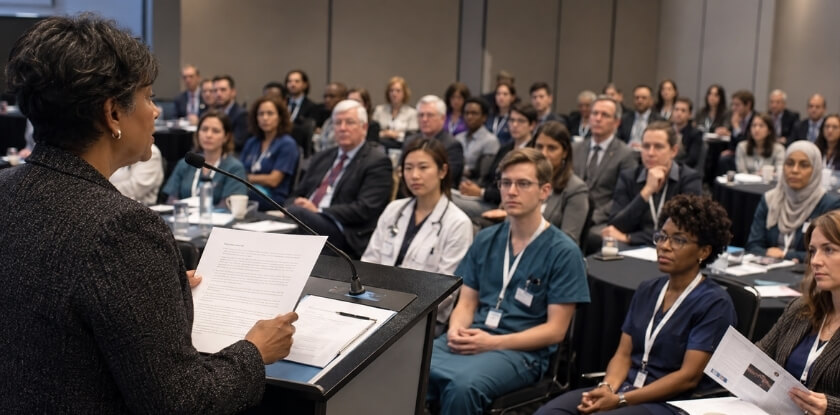
A welcome speech should match the people in the room. Senior doctors may expect a more formal tone, while students, nurses, researchers, and public health teams respond to a warmer or simpler one.
| Audience | Tone | Stress |
|---|---|---|
| Doctors and specialists | Respectful, concise | Medical excellence and evidence |
| Nurses and healthcare workers | Appreciative, practical | Teamwork and daily patient support |
| Medical students | Encouraging, inclusive | Asking questions and finding mentors |
| Researchers and academics | Precise, curious | Inquiry, data, and knowledge exchange |
| CME-style programs | Focused, practical | Updated clinical knowledge and standards |
| Medical camps and public health events | Kind, plain | Community service and access to care |
Welcome Speech for Doctors
It is an honor to welcome our consultants, specialists, and clinical leaders. Your presence shows a commitment to evidence-based practice and to learning that never stops.
Welcome Speech for Nurses and Healthcare Workers
We warmly welcome our nurses, allied health professionals, and support teams. Your daily work sits at the center of patient care, and your voice makes these sessions richer.
Welcome Speech for Medical Students
A special welcome to our medical students. This is a place to ask questions, meet mentors, and see how clinical work and research connect.
Welcome Speech for Researchers and Academics
We are pleased to welcome our researchers, faculty members, and scholars. Your work widens medical knowledge and helps clinicians make better decisions.
Welcome Speech for CME-Style Programs
For teaching days that follow a CME format, speak about ongoing learning and practical clinical updates. Leave credit hours out of the speech unless your organizer has them in writing, because credit is granted through an accredited provider.
Welcome to today’s educational program. These sessions are built around practical clinical updates and honest discussion that can strengthen everyday practice.
Welcome Speech for Medical Camps or Public Health Events
Keep the message clear and community-focused, and avoid promising treatments or outcomes you cannot guarantee.
We welcome our doctors, volunteers, health workers, and community members. This event reflects a shared effort to support health awareness and access to care.
Useful Opening Lines for a Medical Conference Welcome Speech
The opening line should greet the audience clearly and make the room ready for the program. Choose one that matches the formality of the event and the people attending.
Formal Opening Lines
Good morning, distinguished guests, respected speakers, clinicians, researchers, and delegates.
It is a privilege to welcome you to [Conference Name], a gathering devoted to learning and progress in healthcare.
On behalf of [Organization Name], I welcome our honored guests, speakers, participants, and partners.
Warm Opening Lines
Good morning, everyone. We are delighted you could join us at [Conference Name].
It is good to see so many clinicians, researchers, and students in one room.
Thank you for giving a day to learning, discussion, and meeting new colleagues.
Student-Friendly Opening Lines
Welcome, everyone, and a special welcome to our students, trainees, and early-career staff.
Today is a chance to ask questions, meet mentors, and see what a medical conference is like.
If this is your first one, we are especially glad you are here.
Theme-Based Opening Lines
This year’s theme, [Theme Name], reminds us that better care starts with shared knowledge and honest evidence.
Healthcare keeps changing, and this meeting gives us space to test new ideas against real practice.
Today we explore [conference topic] and ask what it means for patients and communities.
Useful Closing Lines for a Medical Conference Welcome Speech
The closing line ends the welcome with confidence and guides the audience into the next part of the program. Keep it short, positive, and tied to the purpose of the event.
Professional Closing Lines
Thank you once again for being here. We look forward to a productive conference.
With appreciation to every speaker, guest, and attendee, let us begin.
We are honored to have you with us and look forward to the discussions ahead.
Inspirational Closing Lines
May these sessions bring new ideas, stronger partnerships, and renewed dedication to patient care.
Let us use this conference to learn, reflect, and make real progress.
Let us begin with open minds and shared purpose.
Participation-Focused Closing Lines
I encourage everyone to ask questions, join discussions, and make the most of each session.
Your participation is what gives this conference its value.
Let us make this event interactive and useful for everyone in the room.
Transition Lines to the First Session
Now, it is my pleasure to invite [Speaker Name] to begin our first session.
With that, let us move to our opening keynote by [Speaker Name].
To begin the program, please join me in welcoming [Speaker Name].
How Long Should a Medical Conference Welcome Speech Be?
A medical conference welcome speech should usually be 3-5 minutes long. That is enough time to greet the audience, explain the purpose, thank key people, and move into the program without delaying the schedule. Treat these figures as a practical guide, and follow the program schedule or the organizer’s request when they differ.
| Event type | Suggested length |
|---|---|
| Formal international or national medical conference | 4-5 minutes |
| Standard conference or symposium | 3-5 minutes |
| Student event, workshop, or CME-style teaching day | 2-3 minutes |
| Tight schedule or keynote right after the welcome | About 1 minute |
Speaking pace decides how many words fit. One events guide from Jaarbeurs, a Dutch events company, uses 120 to 140 words per minute, which puts a 5-minute speech at about 600 words and a 3-minute speech at roughly 360 to 420 words. Fast speakers go above that and calm speakers below it, so read the draft aloud with a timer and trim to the slot.
Best Length for Formal Conferences
Five minutes is a sensible upper limit. Go longer only if the organizer asks for a keynote-style opening address, because the audience is waiting for the program to begin.
Best Length for Student or Training Events
These events need a quick, friendly start before teaching, discussion, or practical sessions begin, so 2-3 minutes is usually enough.
When a Shorter Speech Works Better
A shorter speech works when the schedule is tight, the audience already knows the event, or a keynote speaker follows right away. A 1-minute welcome still needs a greeting, the conference name, a short purpose statement, a quick thank-you, and a transition to the first session.
Delivery Tips for a Confident Welcome Speech
A confident welcome speech comes from preparation, steady pacing, and a calm voice. You do not need to sound perfect, only prepared and respectful.
Practice the Speech Out Loud
Read it aloud several times to catch awkward lines and long sentences, and time yourself so it fits the slot.
Get Names and Titles Right
Ask the organizers for the correct spelling and pronunciation of speaker names, degrees, and titles, and say them slowly. Getting a keynote speaker’s name wrong in front of colleagues is an easy mistake to avoid with one check.
Use a Calm and Steady Voice
Speak clearly and do not rush. If you are nervous, slow down a little and pause between key points.
Make Eye Contact With the Audience
Look around the room instead of reading every word. Brief eye contact with different areas of the audience is enough, and it makes the speech feel personal. If the session is streamed or hybrid, check the audio before you start and look at the camera for a moment when you greet remote attendees.
Pause Between Key Points
Short pauses make the speech easier to follow and give you time to breathe. Use them after the greeting, after the thank-yous, and before the closing line.
Keep Notes Instead of Reading Everything
Use short bullet points or highlighted phrases rather than a full script. That sounds more natural, and you can still read out the names and acknowledgments exactly.
Manage Nervousness Before Speaking
Nerves before a welcome are normal. Breathe slowly, relax your shoulders, and focus on welcoming people rather than performing perfectly.
Common Mistakes to Avoid in a Medical Conference Welcome Speech
Common mistakes in a medical welcome speech include speaking too long, using heavy jargon, forgetting thanks, skipping the theme, and ending without a transition. A good opening feels focused and easy to follow.
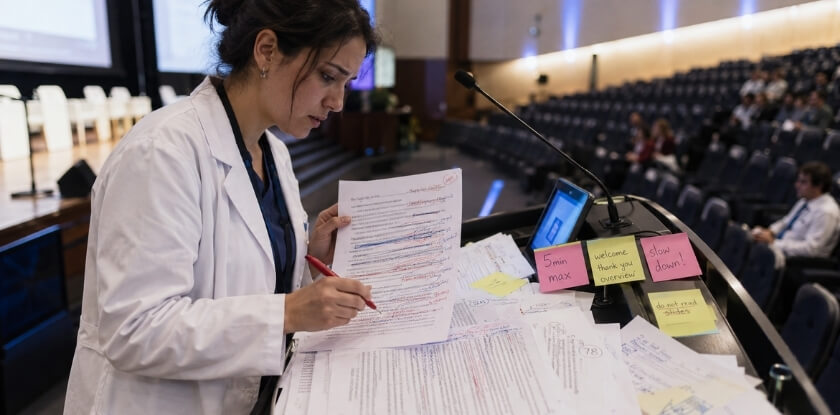
Making the Speech Too Long
A welcome opens the event, it does not take over the program. Stay inside the length guide above.
Using Too Much Technical Language
Medical audiences know the terms, but the welcome should not turn into a lecture or a research summary. Choose words that work for doctors, nurses, students, and non-clinical guests alike.
Forgetting to Thank Key People
Thank the speakers, organizers, sponsors, volunteers, and support teams when relevant. Keep it short, but make sure the main contributors are named.
Ignoring the Conference Theme
Without a line on the theme, the speech may sound generic. Use one or two sentences to tie it to patient care, learning, research, or public health.
Sounding Too Casual or Too Stiff
Avoid jokes that may not suit the setting, and avoid language that feels cold. A natural, respectful tone works best.
Sharing Identifiable Patient Details
A moving anecdote is not worth exposing a patient. Remove names, dates, locations, and unusual details, or leave the story out.
Promising CME Credit You Cannot Confirm
Do not mention credit hours or accreditation unless the organizer has confirmed them. A wrong promise creates problems for attendees who plan their professional records around it. In the United States, the ACCME (Accreditation Council for Continuing Medical Education) requires accredited providers to carry its accreditation statement on CME activity materials and brochures, so the organizer’s CME office will have the exact wording to use. Rules differ by country, so ask the organizer.
Ending Without a Clear Transition
The last line should guide the audience into the next part of the program by naming the first speaker, keynote, or session.
With that, let us begin our first session and welcome [Speaker Name] to the stage.
Medical Conference Welcome Speech Template
A medical conference welcome speech template gives you a clear opening without starting from scratch. Use it as a base, then adjust the tone, theme, audience, and event details.
Fill-in-the-Blank Speech Template
Good morning, respected guests, speakers, healthcare professionals, researchers, students, and attendees.
My name is [Your Name], and it is my pleasure to welcome you to [Conference Name], organized by [Organization Name].
Today we are gathered to discuss [Conference Theme or Main Topic]. This conference gives us a chance to share knowledge, learn from experts, exchange ideas, and look for ways to improve healthcare practice and patient outcomes.
I would like to thank our speakers, organizing committee, sponsors, partners, volunteers, and support teams for their valuable contribution. I also thank every attendee for being here.
I encourage everyone to take part, ask questions, join discussions, and connect with one another throughout the program.
With that, let us begin [Conference Name] with a shared commitment to learning, collaboration, and better healthcare.
Quick Customization Tips
- Replace [Conference Theme or Main Topic] with the exact event focus.
- Add a short line for doctors, nurses, students, researchers, or public health workers if one group is central to the event.
- Keep the speech within 3-5 minutes unless the organizer asks for more.
- Remove any line that does not fit the audience or program.
- Add the first speaker’s name at the end if you are introducing the next session.
From our experience at MS International: Our conferences are held in person in the Greater Toronto Area. Presenting authors go through double-blind review and register after acceptance, and listeners register to attend without presenting, so a welcome can name both groups. Presenters meet the session coordinator or moderator before they present, and the moderator introduces them, so confirm the presentation order with the moderator before you write your closing line.
FAQ: Welcome Speech at a Medical Conference
Standing at the podium to greet doctors brings its own doubts: how to open, whether humor or a patient story fits, mentioning CME credit and how many words fill 3 minutes.
How do you start a welcome speech at a medical conference?
Start with a respectful greeting, then welcome the audience and state the conference purpose. For example: “Good morning, respected guests, speakers, clinicians, researchers, and students. Welcome to [Conference Name].”
What should I say in a medical conference welcome speech?
Mention the conference name, the audience, the theme, the purpose, key guests, the organizers, and why participation matters. Keep the focus on healthcare learning, research, collaboration, and better patient care.
How long should a welcome speech at a medical conference be?
It should usually be 3-5 minutes long. For student events, workshops, or CME-style teaching days, 2-3 minutes is enough, and a tight schedule may call for about 1 minute. Always confirm the slot with the organizer.
How do you welcome doctors and healthcare professionals?
Welcome them with respect and thanks for their work. You can say: “We are honored to welcome our doctors, nurses, researchers, and clinical leaders, whose work supports better care and stronger health systems.”
Can I use humor in a medical conference welcome speech?
Light humor is fine only if it fits the audience and the event. Avoid jokes about patients, illness, medical errors, professional groups, or sensitive topics. A warm, respectful tone is safer.
Should I read from a script during the speech?
You can use a script, but do not read every word without looking up. Practice, mark your pauses, and use notes or highlighted lines so the delivery sounds natural.
Can I tell a patient story in my welcome speech?
Only if no one could identify the patient from it. Leave out names, ages, dates, locations, and rare details, and follow your institution’s privacy rules. To tell a real patient’s story, ask the privacy or ethics office about consent. Otherwise use a labelled composite or skip it.
Should I mention CME credit in a welcome speech?
Only if the organizer has it in writing. Credit is granted through an accredited provider, not by the speaker, and a guess can mislead attendees who plan their records around it. Ask the organizer for the exact wording.
How do I end a medical conference welcome speech?
End by thanking the audience and moving clearly into the next part of the program. For example: “Thank you for being here. Our first session starts now, and I hope the day is useful to you.”
How many words is a 3-minute welcome speech?
About 360 to 420 words at a pace of 120 to 140 words per minute. A 5-minute speech is about 600 words. Pace varies from speaker to speaker, so read your draft aloud with a timer and trim to the slot.
How can I feel confident before giving the speech?
Practice out loud, keep the speech short, breathe slowly, and focus on welcoming people rather than performing perfectly. Confidence comes from knowing your opening, your closing, and your main points.
Conclusion
A welcome speech at a medical conference works when it is clear, respectful, and purposeful. Choose a template from this page, adapt it to your audience and theme, and rehearse it aloud once or twice before the opening session. Keep every patient reference anonymous.