
A conference website can look polished and still tell you nothing about whether the event is respected. Checking rank does not take long, and several of the main tools are free.
Quick answer: To know the rank of a conference, search its name in a ranking list for your field, such as the CORE Conference Portal (A*, A, B, C) for computing. Then check its h5-index in Google Scholar Metrics and its proceedings record. No single list covers every subject, rankings change over time, and a missing entry does not prove a conference is weak.
Last verified against official sources: October 2026.
What Conference Ranking Means and Why It Matters
Conference ranking shows the academic standing, research quality, and reputation of a conference within its field. It helps authors, presenters, and attendees judge whether researchers, institutions, publishers, and professional communities trust the event.
A strong rank usually reflects several things together:
- Quality of accepted papers
- Strength of the peer review process
- Reputation of the organizing body
- Citation impact of published research
- Visibility in academic databases
- Recognition within a specific subject area
Rank matters because it affects how your work is viewed after you present or publish. A respected conference can raise your academic profile, help your paper reach more readers, and put you in the same room as researchers from your field. Some universities and funders also ask for a ranked or indexed venue, so it is worth knowing what yours expects before you submit.
No single source should decide the question. A conference may have strong citation numbers but weak transparency, or it may be well run and still missing from a particular ranking list. For example, a computing conference may appear in the CORE ranking, while a business or education conference may need to be checked through indexing records, Google Scholar Metrics, publisher records, and past proceedings. Compare conferences only inside the same subject area, because ranking standards and citation patterns differ from one field to another.
How to Check the Rank of a Conference Step by Step
To check the rank of a conference, verify its ranking status, indexing record, citation impact, peer review process, organizing body, and publication history. No single factor proves quality, so work through these steps before you submit a paper or register.
Step 1: Search Official Ranking Databases
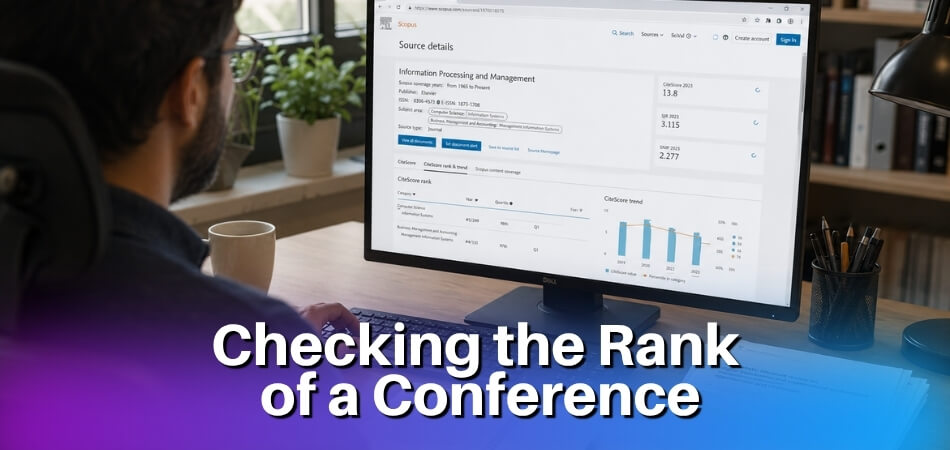
Start with ranking sources that match your field. For computer science, information systems, and related areas, the CORE conference ranking is a standard starting point. It sorts conferences into grades by reputation and quality.
For other fields there is often no single universal list. In that case, combine indexing platforms, citation metrics, publisher records, and the recognition your own institution gives.
Step 2: Check Indexing and Publication Visibility
A conference becomes more credible when its papers sit in recognized proceedings or trusted databases. Look for clear proof that past papers appear in places such as Scopus, SCImago, IEEE Xplore, the ACM Digital Library, Springer proceedings, or Google Scholar. Do not rely on a line like “indexed by major databases” on the conference site. Check the database or publisher platform directly.
Step 3: Review Citation-Based Metrics
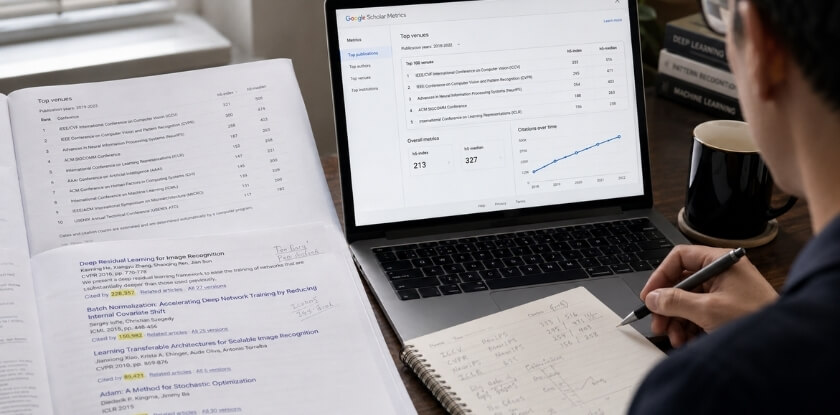
Citation data shows whether papers from the conference are being read and used. Google Scholar Metrics shows the h5-index and h5-median for the conferences it covers. You can also open recent papers from past editions and see whether they receive citations. A venue with steady citation activity usually has stronger research visibility than one with little or no traceable impact.
Step 4: Evaluate the Peer Review Process
A respected conference explains how submissions are reviewed. Look for details about:
- Review method
- Submission deadlines
- Acceptance notification dates
- Plagiarism checks
- Conflict-of-interest rules
- Final paper submission requirements
A low acceptance rate may suggest selectivity, but strong review standards, qualified reviewers, and transparent policies matter just as much.
Step 5: Verify the Organizers and Program Committee
Check who is behind the event. Reliable conferences show named organizers, chairs, advisory members, and program committee members with real affiliations. You should be able to confirm at least some of them through university pages, research profiles, publisher records, or professional websites. Support from a recognized academic society, university, or publisher also strengthens credibility.
Step 6: Look at Past Editions and Proceedings
A strong conference usually has a visible history. Review earlier editions for published programs, keynote speakers, paper lists, proceedings, photos, or archive pages. Past proceedings matter most, because they show that accepted research was actually published and can be found. If there is no clear record of previous papers, the conference’s reputation is harder to confirm.
Step 7: Compare It With Similar Conferences
Rank is most useful when compared within one subject area. A small education conference and a top artificial intelligence conference follow different citation patterns and review standards, so measuring one against the other tells you little. Put similar conferences side by side using the table later in this guide, and trust the pattern across several signals more than one number, one badge, or one claim from an event website.
Best Tools and Databases for Checking Conference Rank
The best tools for checking conference rank are CORE, the GII-GRIN-SCIE rating, Google Scholar Metrics, Scopus, SCImago, and recognized publisher databases. Each shows a different part of quality, so use several together.

| Tool | What it shows | Best for | Main limit |
| CORE Conference Portal (ICORE) | A*, A, B, C grades by edition | Computing and related fields | Does not cover most other subjects |
| GII-GRIN-SCIE (GGS) rating | Classes 1, 2 and 3 for computer science conferences | A second opinion on computing venues | Built partly from CORE and citation data; check its edition year |
| Google Scholar Metrics | h5-index and h5-median | Recent citation impact | Conferences appear only in Engineering and Computer Science |
| Scopus and SCImago | Whether a proceedings series is indexed | Checking an indexing claim | Covers series and sources, not every single event |
| Publisher platforms | Whether past papers are hosted | Proving a publication record | Partnerships can change between editions |
| Qualis (Brazil) | National classification of events | Researchers tied to Brazilian programs | Differs by area and has been revised over time |
GII-GRIN-SCIE (GGS) Conference Rating
The GGS rating is a joint computer science conference rating from Italian and Spanish research groups. It groups conferences into Class 1 (top), Class 2 (very high quality), and Class 3 (good quality), with finer steps from A++ down to B-. It builds on the CORE rating plus citation-based indicators, so it is useful as a second opinion on a computing venue rather than an independent verdict. The latest edition on its site is 2021, released in September 2021 and built from the CORE 2021 ratings plus citation-based indicators, so check the edition year before relying on it.
Qualis
Qualis is the classification system used by the Brazilian agency CAPES, and it has strata for conference events as well as journals. Early event classifications in computing started from each event’s h5-index. A venue can be rated differently in different areas, and the system has been revised over the years, so confirm the current list for your own area on the CAPES site if your institution uses it.
Scopus and SCImago
Scopus helps you check whether a proceedings series or publication source is indexed. SCImago shows broader performance when the conference papers belong to an indexed series. These tools matter most when a conference claims indexing. Search the database yourself and confirm that the title, publisher, and proceedings series match the event.
Publisher Platforms
Recognized publisher platforms can also confirm a publication record. Common examples include:
- IEEE Xplore
- ACM Digital Library
- SpringerLink
- Elsevier proceedings pages
- Wiley or Taylor & Francis platforms, where relevant
If past papers are hosted by a trusted publisher, the conference usually has stronger visibility. Still, check whether the current edition offers the same publication route, because publisher partnerships can change.
Official Conference Archives
The conference’s own website can give useful clues when it keeps past programs, proceedings, keynote speakers, committee lists, and publication partners. Look for consistency across editions. If the event has changed names often, removed old pages, or shows no proof of earlier proceedings, look at it more closely before you submit or pay a registration fee.
How to Use CORE Ranking for Computing Conferences
CORE ranking is mainly used to check the reputation of conferences in computer science and related computing fields. The CORE Conference Portal, listed on its site as the ICORE Conference Portal and run by CORE, the Computing Research and Education association in Australasia, lets researchers compare venues by grade. Its current edition is ICORE 2026, and it publishes new editions from time to time.
What A*, A, B, and C Rankings Mean
CORE uses grades to separate conferences by strength and reputation:
| CORE Grade | General Meaning |
| A* | Flagship conference in the field (an A conference with flagship status) |
| A | Excellent conference with strong reputation |
| B | Good to very good conference with recognized academic value |
| C | Meets the minimum standard to be ranked, with a lower level of influence |
An A* conference is usually the most competitive and widely respected in its area, and an A conference is also highly valuable. B and C conferences can still suit your research goals, institution, and field. ICORE’s 2026 update says an A* is not necessarily more cited than an A, because the flagship label is a separate judgment. The portal also uses labels outside this scale for some entries, such as Australasian B, Australasian C, National/Regional (a conference held in one country or a small group of countries, weaker than A), and Unranked, so read the exact label.
How to Search a Conference in CORE
Search by the conference’s full name first. If that fails, try the acronym, since many computing conferences are better known by short names. When you find a result, check:
- Conference title
- Acronym
- Field or subject area
- Ranking grade
- Ranking year or edition
- Any alternate names or title changes
Similar names are common, and picking the wrong entry leads to a false judgment.
Why CORE Has Limits
CORE focuses on computing disciplines, so conferences in business, education, healthcare, social science, engineering, or management may not appear there. A conference missing from CORE is not automatically weak. It may belong to a field where indexing, publisher reputation, citations, society support, or institutional recognition are better yardsticks. A small event can also fall outside the scope: ICORE says a ranked conference needs at least 10 full research papers each year. An “Unranked” label is also different from not being listed, and ICORE says that conferences submitted for addition but missing from the new rankings were judged unsuitable. ICORE also says its rankings combine expert judgment with objective data, so read a grade as informed opinion, not a measurement.
How to Use CORE With Other Checks
Treat CORE as one strong signal, not the final answer. After reading the grade, confirm it with citation impact in Google Scholar Metrics, indexing in Scopus or SCImago, the proceedings record on publisher platforms, the program committee, and the conference’s past editions.
How Google Scholar Metrics Help Measure Conference Impact
Google Scholar Metrics helps measure conference impact by showing how often recent papers from a venue are cited. It shows whether a conference’s published work is being noticed and referenced by other researchers.
What the h-5 Index Means
The h-5 index (Google writes it h5-index) is the h-index for articles published in the last five complete years. A venue has an h5-index of 30 when 30 of its articles have each been cited at least 30 times. The number shows recent influence, not just old reputation.
What the h-5 Median Means
The h-5 median is the median citation count of the articles that make up the h5-index. If a venue has a strong h5-index but a low h5-median, its impact may be thinly spread. A stronger median suggests that its top papers keep drawing attention across the field.
How to Interpret Citation-Based Performance
Compare citation metrics only between similar conferences in one subject area. Some fields collect citations faster than others, so an artificial intelligence conference and a public health conference should not be set against each other. When reviewing a venue, check:
- Whether it appears in Google Scholar Metrics at all
- Whether recent papers receive regular citations
- Whether the cited papers match the conference’s main subject
- Whether the citations come from real academic sources
- Whether the impact is consistent across several years
Limits of Google Scholar Metrics
Google Scholar Metrics lists selected conference articles in Engineering and Computer Science only. A publication needs at least 100 articles in the five-year window and at least one citation, so smaller, newer, or highly specialized conferences often do not appear. The release on Google’s page in October 2026 covers articles published from 2020 to 2024, with citations counted as of July 2025, so a recently started conference may not appear yet. The numbers also say nothing about:
- How strict the peer review is
- Whether the organizers are reliable
- Whether proceedings are indexed elsewhere
- Whether the acceptance rate is meaningful
- Whether experts in the field respect the conference
Use the metrics as one part of a larger review alongside ranking lists, indexing records, peer review standards, and conference history.
How Indexing Affects Conference Reputation
Indexing affects conference reputation because it shows whether the papers can be found through trusted academic databases or publisher platforms. It does not equal ranking, but it is an important credibility signal, since readers and institutions can confirm that the work has a real publication record.
Why Indexed Proceedings Matter
Indexed proceedings help papers reach a wider audience and make them easier to search, read, and cite after the event. They show that:
- The event has a traceable publication record
- Accepted papers are not hidden or hard to verify
- Other scholars can find the research
- Institutions can check publication details more easily
- Citation impact becomes easier to measure over time
If a conference has no visible proceedings, no publisher record, and no database presence, its academic value is hard to judge.
How to Verify Scopus or SCImago Coverage
Do not depend on logos or claims on the conference website. Elsevier says Scopus covers serial publications with an ISSN, such as conference series, and non-serial publications with an ISBN, and it offers a free Source Title page and a downloadable source title list that is updated monthly. Because the list works by source, search the proceedings title as well as the event name, and compare the details below.
- Exact conference name or proceedings title
- Publisher or publication series
- ISSN or ISBN, if available
- Coverage years
- Subject area
- Whether past editions are listed
- Whether the current edition clearly follows the same publication route
This matters because some conferences mention indexing when only an older edition, a partner journal, or a proceedings series was indexed.
Why Vague Indexing Claims Can Be Misleading
A weak conference may use broad phrases such as “indexed in leading databases” without linking to an official record. Be cautious when a conference:
- Shows database logos without official links
- Promises guaranteed indexing before review
- Uses a different title in the database
- Mentions Scopus or Web of Science without proof
- Claims indexing for all papers automatically
- Cannot show past proceedings from previous editions
A trustworthy conference explains its publication options clearly and avoids exaggerated promises.
Difference Between Conference Ranking and Database Indexing
Conference ranking measures reputation, selectivity, and academic standing. Indexing shows whether papers or proceedings are included in academic databases. A conference can be indexed without being highly ranked, and a respected one may be judged by field-specific reputation even when it is not in every database. Check both: ranking tells you about prestige, indexing tells you whether the work can be found.
Key Quality Signals That Support a Strong Conference Rank
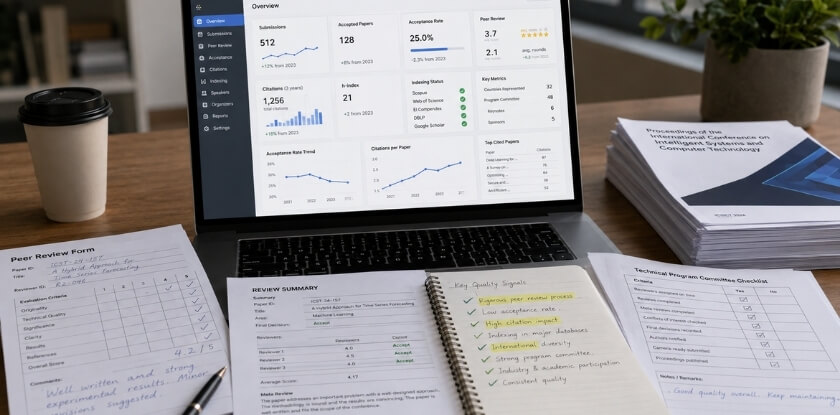
A strong rank is usually supported by transparent peer review, credible organizers, respected committees, indexed proceedings, citation activity, and a consistent event history. Together these show a conference that is visible and also trusted by its community.
Selective and Transparent Peer Review
A reliable conference explains the review model, submission rules, evaluation criteria, plagiarism checks, revision process, and notification timeline before it accepts anything. Papers should be judged for quality, relevance, originality, and contribution. If a conference accepts papers very quickly or says little about its review, treat its academic value with doubt.
Recognized Academic or Professional Support
Backing from known universities, academic societies, research groups, or established publishers adds trust when the partnership is real and verifiable. Look for official links from the supporting organization, such as university event pages, society announcements, or publisher records, rather than logos alone.
Qualified Program Committee
The program committee reviews submissions and guides the academic direction of the event. A strong one includes researchers, professors, industry experts, or field specialists with relevant backgrounds. If names are missing, unverifiable, or unrelated to the topic, the review foundation may be weak.
Strong Speakers and Event History
Well-regarded conferences tend to attract respected keynote speakers, panelists, and session chairs, which shows real links to the research or professional community. Events that run regularly, keep archives, and publish programs are also easier to evaluate than events with no clear record.
Published Proceedings and Citation Activity
Proceedings prove that accepted papers were formally published and made available. When recent papers are also cited by other researchers, the work has reached an audience and added something to the field.
Clear Policies and Communication
A trustworthy conference states its submission deadlines, registration fees, refund rules, publication terms, review timelines, ethics policies, and contact details. Good communication supports credibility too: organizers who reply clearly through official channels are easier to trust. Poor communication, hidden fees, or changing rules weaken confidence in the event.
Does a Low Acceptance Rate Always Mean a Better Conference?
A low acceptance rate can suggest that a conference is selective, but it does not prove that the conference is highly ranked. Quality depends on how papers are reviewed, who organizes the event, where the proceedings are published, and whether the research gets attention afterward.
A low acceptance rate is useful when it comes with other strong signs, such as:
- Expert reviewers
- Clear review criteria
- Recognized organizers
- Indexed proceedings
- Strong citation activity
- A respected history in the field
On its own, selectivity can mislead. A conference may accept fewer papers because it has limited space, a small program, or many weak submissions, which does not make it better than one with a higher acceptance rate but stronger papers and reviewers. Respected conferences may also have moderate acceptance rates because they run several tracks or workshops. In those cases, review quality and publication impact matter more than the percentage.
How to Compare Rankings Between Similar Conferences
The best way to compare conference rankings is to review similar conferences side by side using the same criteria. This keeps you from judging an event by a single number or database result.
Start with conferences from the same subject area. An artificial intelligence conference belongs next to other artificial intelligence conferences, not next to a healthcare, business, or education event. Then fill in a simple table for each one on your shortlist:
| Factor | Where to check | What to record |
| Ranking source and grade | CORE, GGS, a field list, or a society ranking | A*, A, B, C, or not listed |
| Indexing status | Scopus, IEEE, ACM, Springer, or another platform | Confirmed, partial, or unverified |
| h5-index and h5-median | Google Scholar Metrics | The numbers, or not available |
| Peer review details | The conference website | Clear, limited, or missing |
| Proceedings record | Past editions and publisher pages | Strong, partial, or missing |
| Organizer credibility | Committee and sponsor pages | High, moderate, or unclear |
A conference with a strong grade, verified indexing, visible proceedings, qualified committee members, and steady citations is usually more reliable than one that depends on promotional claims.
Your goal changes what counts. For academic recognition, ranking, peer review, and indexing matter most. For networking or industry exposure, keynote speakers, audience type, sponsors, and session quality may matter more, since academic and business conferences serve different goals. If a degree, promotion, or grant depends on the venue, ask your own institution which rankings or indexes it accepts before you submit. A balanced comparison picks the conference that matches your purpose, not the one with the best-looking website.
Why Rankings and Metrics Change
Rankings are not permanent. CORE publishes new editions, GGS has its own edition years, and h5 figures move as the five-year window slides forward. Movement goes both ways: stronger papers and reviewers lift a venue, while weaker review standards pull it down. Always note the ranking year, and look again if the edition you checked is several years old.
Red Flags That Suggest a Weak or Unreliable Conference
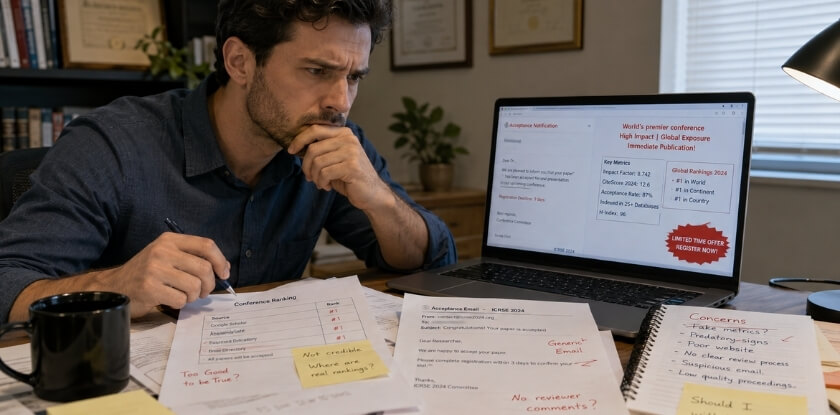
A weak conference often shows warning signs such as unclear indexing claims, poor review transparency, spam invitations, unverifiable committees, and no visible publication history. These signs do not always prove a conference is fake or predatory, but they mean you should investigate before you submit, pay, or attend.
Spam Invitations and Unrealistic Deadlines
Be careful with sudden emails that push you to submit quickly, pay early, or register before checking details. Weak conferences often send broad invitations that do not match your field or research topic. Promises of acceptance within a few days, guaranteed publication, or instant review suggest the peer review is not serious.
Missing Venue Details or Unclear Event Format
A trustworthy conference states whether it is in person, virtual, or hybrid, and gives the city, venue name, address, schedule, and contact details. Be cautious if the location keeps changing, only a country is named, or the page says “online or onsite” without explaining the format.
Fake Committee Names or Unverifiable Affiliations
If the website lists names without affiliations, misspells university names, or includes people you cannot find, treat it as a warning sign. You can check committee members through university websites, Google Scholar, ORCID, LinkedIn, or publisher pages.
No Archived Proceedings or Publication Record
A conference with several past editions should have some record of programs, accepted papers, or speaker lists. This matters most when it claims to be ranked, indexed, or internationally recognized, because strong conferences leave a trace in published papers, database records, or official event pages.
Broad Topics With Weak Academic Focus
A conference that accepts almost every subject area may struggle to assign expert reviewers. Some multidisciplinary events are legitimate, but they still need clear tracks, qualified reviewers, and transparent publication rules.
Unsupported Indexing or Ranking Claims
Logos from Scopus, Google Scholar, Web of Science, IEEE, or other platforms are not proof. Ask for official links, indexed proceedings, publication series details, or searchable records. If the claim cannot be confirmed outside the conference website, treat it with caution.
Quick Checklist: How to Know if a Conference Is Well-Ranked
A conference is more likely to be well ranked when its reputation, indexing, review process, organizers, proceedings, and citation impact can all be verified. Run through these points before you submit a paper, register, or add the event to your academic profile.
Ranking Database Checklist
- Search the name in CORE ranking if it belongs to computing or a related field, and note the edition year.
- Do not assume a conference is weak only because it is missing from one list.
Indexing and Publication Checklist
- Confirm that past proceedings appear on Scopus, SCImago, IEEE Xplore, ACM Digital Library, Springer, or another trusted platform, and that the current edition follows the same route.
- Match the exact conference title, proceedings title, publisher, and coverage years.
Organizer and Committee Checklist
- Verify the names and affiliations of chairs, speakers, and committee members.
- Avoid events where committee information is missing, copied, or hard to verify.
Review Quality and Transparency Checklist
- Read the submission process, deadlines, evaluation criteria, and notification timeline.
- Treat instant acceptance, guaranteed publication, or unclear review rules as serious warning signs.
From our experience at MS International: We organize in-person conferences in the Greater Toronto Area, and every submitted paper goes through double-blind peer review, with decisions usually returned in about 10 working days. We do not claim any CORE grade, Scopus or Web of Science indexing, or Springer or IEEE publication for our events. Accepted papers may be considered for conference proceedings where applicable. If your university or funder needs a ranked or indexed venue, ask them what counts before you submit, and ask any organizer, us included, to show proof for every claim.
FAQs About How to Know the Rank of a Conference
Judging a venue before you submit means reading CORE grades like A* and B, checking Scopus indexing, weighing Google Scholar and spotting vague claims of an international ranking.
What Is the Difference Between Conference Rank and Journal Rank?
Conference rank measures the reputation and quality of a conference, while journal rank measures the influence of an academic journal. Conferences focus on presentations, proceedings, and live research exchange. Journals focus on article publication, editorial review, and long-term citation impact.
Can a Conference Be Good if It Has No CORE Ranking?
Yes, a conference can be good without a CORE ranking. CORE mainly covers computing and related fields, so conferences in business, healthcare, education, social science, engineering, or management should be judged through indexing, citations, organizers, peer review, and proceedings instead.
What Do CORE Grades A*, A, B, and C Mean?
A* is a flagship conference, A is excellent, B is good to very good, and C meets the minimum standard for a ranked venue, according to ICORE’s 2026 update. Check the edition year, because grades are reviewed from one edition to the next.
How Do I Know if a Conference Is Indexed in Scopus?
Search the proceedings title, ISSN, or publisher on the Scopus Sources page, or in its downloadable source title list. If the exact name, coverage years, and series match, the proceedings are indexed. The conference website alone is not proof.
Is Google Scholar Enough to Judge Conference Quality?
No, Google Scholar is useful for citation visibility but not enough by itself. It does not show peer review quality, committee strength, acceptance standards, indexing status, or organizer credibility. Use it with other ranking and verification tools.
Do Keynote Speakers Affect Conference Reputation?
Yes, keynote speakers can support a conference’s reputation when they are respected experts in the field. Strong speakers often show that the event has academic or professional reach. Still, check their names alongside proceedings, review quality, and indexing.
Can Conference Ranking Change Over Time?
Yes, ranking can change as quality, citations, committee strength, acceptance standards, and community recognition change. Lists such as CORE also publish new editions. A conference may improve by attracting better papers and reviewers, or decline if review quality and trust weaken.
Should I Trust a Conference That Claims to Be Internationally Ranked?
Not without verification. Check the ranking source, indexing record, publication history, and organizer details. Reliable conferences give evidence that can be confirmed outside their own website.
What Is the Safest Way to Verify a Conference Before Submitting?
Check several signals together. Search trusted ranking lists, confirm indexing, read past proceedings, verify committee members, check citation metrics, and look for clear peer review policies. If important details are missing or cannot be verified, choose another event.
What Are the GGS Rating and Qualis?
The GGS rating is a computer science conference rating that places conferences in Classes 1 to 3, and Qualis is the Brazilian CAPES classification system. Both are field or country specific, so use them only if your institution accepts them, and check the edition year.
Conclusion
To know the rank of a conference, check more than one signal: a ranking grade where your field has one, indexing evidence, transparent peer review, credible organizers, and proceedings that can be found and cited. Compare the event with similar conferences in the same field, and note the year of every ranking you rely on.
A strong conference does not rely on claims. It gives proof that researchers, institutions, and publishers can verify, so ask for it, and confirm with your own institution what rank or indexing it needs.