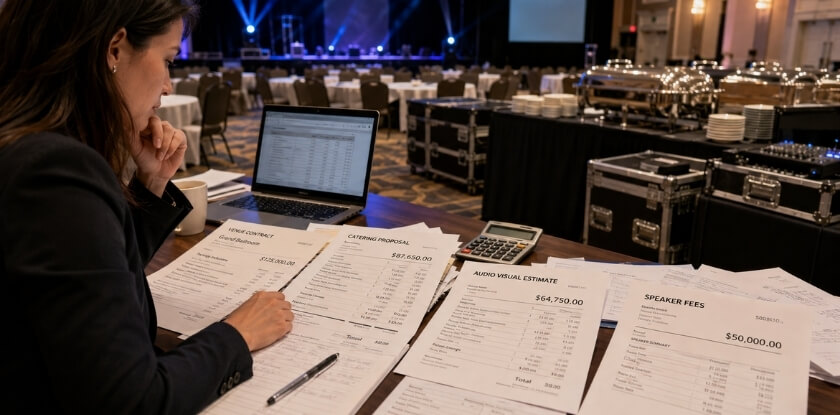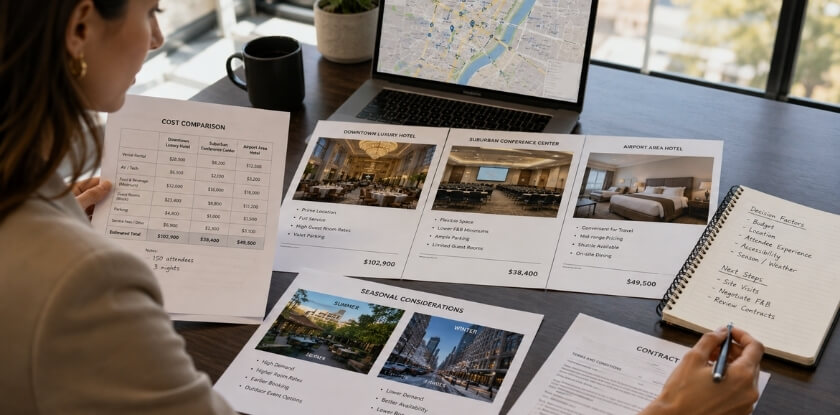
How Much Does it Cost to Run a Conference?

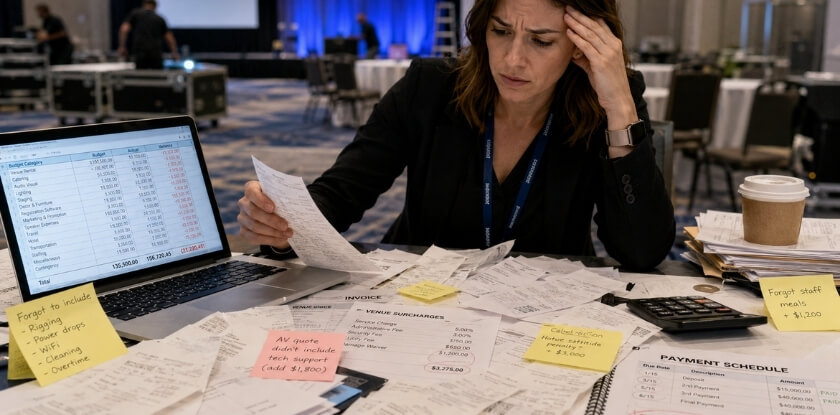
Planning a conference but have no idea where to start with the budget? You’re not alone — and the frustration is completely justified. Most organizers lock in a venue before they’ve mapped out a single line item, and that’s exactly where things go sideways. Within weeks of signing a venue rental agreement, the real costs start stacking up: catering per head costs, AV production company quotes, event liability insurance, keynote speaker fees, and platform service fees from tools like Eventbrite or Bizzabo. By the time you’ve factored in conference badge printing, a contingency fund, and ticket processing fees through Stripe or PayPal, the total can run three to four times your original estimate — and that’s before you’ve touched signage, event staffing, or social media advertising.

The hidden costs are the ones that hurt the most. A hotel attrition clause buried in your room block contract. A food and beverage minimum that kicks in whether your attendees show up or not. Simultaneous interpretation for a breakout session room you didn’t budget for. Organizations like PCMA and MPI (Meeting Professionals International) have documented these pitfalls for decades, yet first-time organizers — and even experienced ones producing IEEE or ACM conferences — still get blindsided.

This guide gives you real numbers. You’ll find exact cost ranges, a clear cost-per-attendee benchmark, a working profit and loss statement example, and practical ways to protect your profit margin without cutting corners that matter.

Quick Answer: How Much Does It Cost to Run a Conference?

Running a conference typically costs between $500 and $75,000+, depending on size, format, and location. Small virtual events using platforms like Hopin or Zoom Webinars can come in under $2,000. Mid-size in-person events for 100–500 attendees generally run $15,000–$50,000. Large-scale or hybrid events with full hybrid event technology, lighting and staging, and multiple breakout session rooms can exceed $75,000 easily.

The average cost per attendee falls between $150 and $500 for in-person events. Major cost categories include: venue rental, catering (typically $50–$150 per head), AV and production, speaker honorariums, event marketing budget, cancellation insurance, staffing, and platform or ticketing fees. Academic conferences add peer review fees and proceedings publication costs. A contingency fund of 10–15% of total budget is standard practice.

How Much Does it Cost to Run a Conference

How Much Does It Cost to Run a Conference? (Quick Answer)

The honest answer: anywhere from $5,000 to over $5,000,000, depending on scale, format, and how many decisions you make before actually looking at a spreadsheet.

That’s not a cop-out range. A 50-person academic conference held in a university lecture hall costs fundamentally different money than a 3,000-person industry event at a convention center with keynote speakers, a full AV production company, and a catered gala dinner.

Here’s a grounded starting point based on real-world numbers:

Conference SizeTypical Total BudgetCost Per Attendee
Small (50–150 attendees)$5,000 – $40,000$80 – $300
Mid-size (150–500 attendees)$40,000 – $200,000$150 – $500
Large (500–2,000 attendees)$200,000 – $800,000$250 – $600
Enterprise (2,000+ attendees)$800,000 – $5M+$300 – $1,000+
Virtual event$3,000 – $75,000$20 – $150
Hybrid event$50,000 – $500,000$100 – $400

Cost per attendee is the metric that actually matters. It tells you whether your ticket price, sponsorship revenue, and registration volume can cover expenses — or leave you short.

The Five Budget Categories That Drive Almost Every Number

Before getting into line-item specifics, five buckets account for roughly 85–90% of what you’ll spend:

  1. Venue and logistics — general session hall, breakout session rooms, room block commitments, hotel attrition clause exposure
  2. Food and beverage — catering per head cost, food and beverage minimum guarantees, service charges
  3. Speakers and content — keynote speaker fee, honorarium payments, simultaneous interpretation if needed
  4. Technology and AV — audio visual technician labor, lighting and staging, virtual event platform fees, hybrid event technology
  5. Marketing and administration — event marketing budget, conference badge printing, signage and print vendor costs, ticket processing fees through platforms like Eventbrite or Cvent

Everything else — event liability insurance, a contingency fund, staffing from an event staffing agency — sits on top of those five.

What “Hidden” Actually Means Here

Most organizers who overspend don’t get blindsided by one giant surprise. They get hit by twenty small ones. The venue rental agreement says catering must come through the hotel. The hotel’s food and beverage minimum is $40,000, not the $22,000 you planned. Stripe or PayPal charges a ticket processing fee plus the platform service fee from Eventbrite or Bizzabo. The AV quote didn’t include the audio visual technician overtime for setup day.

Those gaps are where profit margin disappears.

A practical rule: build your initial budget, then add 15–20% as a contingency fund. PCMA and MPI (Meeting Professionals International) both recommend this figure, and organizers who skip it almost always regret it.

Virtual and Hybrid Change the Math — But Don’t Eliminate It

Running a virtual event through Hopin, Zoom Webinars, or Whova drops your venue and catering costs to zero. That’s real. But you pick up virtual event platform licensing, live streaming production costs, and tech support labor. A poorly produced virtual event loses attendees fast, so cutting AV entirely isn’t a smart trade.

Hybrid events are the most expensive per-attendee format right now. You’re running two separate production pipelines simultaneously — one for the room, one for the stream — and hybrid event technology integration rarely goes perfectly on the first try.

The sections below break down each cost category with actual numbers, real profit and loss statement examples, and the specific line items that separate a conference that breaks even from one that builds a reserve for next year.

What Are the Main Cost Categories for a Conference?

Before you sign anything or put a deposit down, you need a clear picture of where the money actually goes. Conference budgets have a way of growing fast once you start filling in the real numbers. Here’s a category-by-category breakdown.

What Are the Main Cost Categories for a Conference?

Venue Rental Costs

This is usually your single biggest line item. A general session hall at a mid-tier hotel in a secondary market might run $3,000–$8,000 per day. The same space in Chicago, New York, or San Francisco? You’re looking at $15,000–$40,000 or more, before you touch catering.

Read your venue rental agreement carefully. Hotels often charge separately for each breakout session room, and a conference with five concurrent tracks can easily add $1,500–$5,000 per day just in room fees on top of the main hall. Convention centers typically charge by the square foot, with rates ranging from $0.10 to $1.50 per square foot depending on city and event type.

One thing that catches first-time organizers off guard: the room block. Hotels will often discount or waive venue rental fees if you commit to a minimum number of sleeping rooms. That sounds great until you hit the hotel attrition clause — if your attendees don’t fill those rooms, you can owe the hotel 80–90% of the revenue on unsold rooms anyway. Get a lawyer to look at that clause before you sign.

For academic conferences like IEEE or ACM events, university venues are significantly cheaper — sometimes $500–$2,000 per day — but they often lack professional AV infrastructure, which creates costs elsewhere.

Catering and Food and Beverage Costs

Catering is where budgets quietly explode. Most hotel and convention center contracts include a food and beverage minimum — a dollar amount you’re contractually required to spend on F&B whether you actually consume it or not. These minimums can range from $5,000 to $50,000+ depending on the property.

Catering per head cost varies widely by format and location:

  • Coffee break only: $15–$35 per person
  • Buffet lunch: $45–$85 per person
  • Plated dinner (awards banquet style): $95–$175 per person
  • Full-day package (breaks + lunch): $75–$120 per person

Multiply those numbers by 300 attendees and a 2-day event and you’re staring at a $45,000–$72,000 catering bill before tax and service charges. Speaking of which — always add 22–28% on top of the quoted per-head price for tax and service/gratuity. Venues bury this in the fine print.

Alcohol is its own calculation. A hosted bar for an evening reception runs $30–$60 per person on average. If you’re trying to cut costs, cash bars or drink tickets are standard and nobody’s usually offended by them.

AV Equipment and Technology Setup

Underestimating AV is one of the most expensive mistakes conference organizers make. An AV production company quote for a 500-person single-day conference with a main stage, two breakout rooms, and live streaming can easily land at $25,000–$60,000.

Line items inside a typical AV quote include:

  • General session hall main screen and projectors: $3,000–$8,000
  • Audio technician and sound system: $2,500–$6,000
  • Lighting and staging for a keynote set: $5,000–$20,000
  • Recording and live streaming setup: $3,000–$10,000
  • Breakout room AV (per room, per day): $800–$2,500
  • Simultaneous interpretation equipment: $1,500–$4,000 per language pair

If your venue has an “in-house AV” provider, be careful. Many venues require you to use their contractor or charge a “patch fee” to bring in an outside audio visual technician. That patch fee alone can be $500–$2,000.

For hybrid events, the technology layer gets more complex. Platforms like Hopin, Bizzabo, or Whova add both a platform service fee and the cost of a proper hybrid event technology production setup. Budget an additional $5,000–$15,000 for the virtual side of a hybrid event if you want it to look polished. A basic Zoom Webinars setup is cheaper but feels noticeably different to remote attendees.

Speaker Fees and Honorariums

Speaker costs range from zero to six figures. It really depends on who you’re booking and what category of event you’re running.

Keynote speaker fee ranges (rough industry benchmarks):

  • Local expert or industry practitioner: $0–$2,500
  • Regional/niche thought leader: $3,000–$10,000
  • National author or mid-tier professional speaker: $10,000–$35,000
  • Celebrity or top-tier keynote: $50,000–$150,000+

The word “honorarium” is used when you’re paying someone a modest, goodwill-based fee — common at academic conferences or nonprofit events. It doesn’t change the tax reporting requirements, just the framing.

Don’t forget the hidden speaker costs: travel, hotel, AV riders (some speakers require specific equipment), and green room catering. A $15,000 keynote can become an $18,000–$20,000 line item once you’ve covered flights, a two-night hotel stay, and their A/V requirements.

For academic events like a peer review-driven conference (think IEEE or ACM style), speaker fees are rarely paid, but you often have proceedings publication costs, peer review platform fees, and sometimes a per-paper submission fee to manage instead.

PCMA and MPI (Meeting Professionals International) both publish annual salary and speaker fee benchmarking data if you want current industry averages to use in your planning.

Marketing and Promotion

Your event marketing budget will vary depending on whether you’re building an audience from scratch or marketing to an existing community. A first-year conference typically needs to spend more here. An established annual event can get away with less.

A realistic event marketing budget for a 300–500 person conference might look like:

  • Social media advertising (Facebook, LinkedIn, Instagram): $3,000–$10,000
  • Email marketing platform (list management, sequences): $200–$800
  • Paid search/Google Ads: $1,000–$4,000
  • PR or media outreach: $2,000–$8,000
  • Eventbrite or Cvent platform listings/promotion: $500–$2,000
  • Affiliate or early bird incentives: variable

Total: roughly $8,000–$25,000 for a mid-size conference. Larger events with national ambitions spend considerably more.

Ticket processing fee and platform service fee are technically marketing-adjacent costs. Eventbrite charges 3.7% + $1.79 per paid ticket on its Flex plan. Cvent and Swoogo have platform-level pricing that runs into the thousands per year regardless of ticket volume. Stripe and PayPal charge standard 2.9% + $0.30 per transaction if you’re processing payments through your own site. These numbers add up fast at scale — on $200,000 in ticket revenue, you could be paying $6,000–$8,000 in processing alone.

Printed Materials and Signage

This category gets underestimated constantly. People forget about it until three weeks before the event.

Typical signage and print vendor costs for a 300-person event:

  • Conference badge printing (lanyards + cardstock inserts): $400–$1,200
  • Wayfinding signage and foam board prints: $500–$1,500
  • Step-and-repeat / sponsor backdrop banner: $300–$600
  • Printed programs or pocket guides: $600–$2,000
  • Tabletop signs, session title cards, exhibitor booth signage: $300–$1,000

Budget roughly $2,000–$6,000 for a professionally printed event at 300 attendees. Rush printing (ordered less than 2 weeks out) adds 20–40% to the bill, so build your print deadlines into the project timeline early.

Staffing and Volunteer Coordination

You can’t run a real conference alone, and labor costs are non-trivial.

If you hire through an event staffing agency, expect to pay $20–$35 per hour for general event staff (registration desk, room monitors, load-in crew) and $40–$75 per hour for experienced event coordin

Conference Costs by Event Size — Small, Mid-Size, and Large

Size is the single biggest variable in your budget. Everything else — catering per head cost, AV production company fees, staffing ratios — scales from it. Here’s what actual numbers look like across three tiers.

Small Conference (Under 100 Attendees)

This is the range where people most often underestimate costs. It feels small, so it feels cheap. It usually isn’t.

Typical total budget: $8,000–$45,000

A 50-person professional development conference held in a hotel meeting room is a realistic benchmark. Here’s roughly how that breaks down:

Cost ItemEstimated Range
Venue rental (half or full day)$1,500–$6,000
Catering per head cost (lunch + breaks)$65–$120/person
A/V technician + basic equipment$800–$3,500
Keynote speaker fee or honorarium$0–$5,000
Conference badge printing + signage$300–$900
Event liability insurance$400–$1,200
Ticketing platform (Eventbrite or similar)3–6% of ticket revenue
Event marketing budget (social + email)$500–$2,500
Contingency fund (10–15%)$1,000–$3,000

At 50 attendees, your cost per attendee often runs $200–$500 even before you pay a speaker. The food and beverage minimum alone at most hotel properties will surprise you. A hotel that looks affordable at $1,800 room rental may require $4,000 in F&B spend before they’ll give you the space.

Small conferences are also where organizers lean on Eventbrite or Square for ticketing because setup is fast. Just remember the ticket processing fee comes out of your revenue, not your expense line — it affects your profit margin either way.

For academic conferences at this scale — think departmental symposiums or small IEEE conference workshops — peer review fee income rarely covers full costs. Proceedings publication adds another $1,000–$3,000 depending on the publisher. Budget for it separately.

One realistic profit and loss snapshot:

  • Revenue: 50 tickets × $350 = $17,500
  • Total costs: ~$14,200
  • Net margin: ~$3,300 (19%)

That’s a decent margin, but one cancellation insurance claim or AV failure wipes it out without a contingency fund.

Mid-Size Conference (100–500 Attendees)

This is where professional event infrastructure becomes non-negotiable. You can’t wing AV for 300 people. You can’t manage registration at the door with a spreadsheet.

Typical total budget: $50,000–$350,000

A 250-person industry conference with two days of programming, a general session hall, multiple breakout session rooms, and exhibitor booths is a fair model.

Cost ItemEstimated Range
Venue rental (multi-day, multi-room)$8,000–$40,000
Catering per head cost (all meals + breaks)$120–$220/person/day
Lighting and staging + AV production$15,000–$60,000
Keynote speaker fee$5,000–$30,000
Event staffing agency or staff labor$4,000–$18,000
Event registration platform (Cvent, Whova, Bizzabo)$3,000–$12,000/year or per event
Signage and print vendor$2,000–$7,000
Event liability insurance$1,200–$4,000
Event marketing budget$5,000–$25,000
Contingency fund (10%)$5,000–$25,000

The hotel attrition clause is the financial landmine at this tier. If you negotiate a room block of 150 nights and only fill 90, you may owe the hotel for the difference — sometimes 80–90% of the unbooked room rate. Read every venue rental agreement before you sign. Get the force majeure clause in writing.

Exhibitor booth fees start making a real difference here. A 250-person conference with 15–20 exhibitors at $1,500–$3,000 per booth adds $22,500–$60,000 in revenue before ticket sales. A well-built sponsorship prospectus at this size can cover 30–50% of your total costs.

Platform fees are a real line item too. Cvent and Bizzabo both price mid-size events in the thousands. Swoogo is often more competitive for this tier. Factor in the platform service fee regardless of which tool you use.

Sample P&L for a 250-person conference (2 days):

  • Ticket revenue: 250 × $595 = $148,750
  • Sponsorship + exhibitor fees: $45,000
  • Total revenue: $193,750
  • Total costs: ~$158,000
  • Net: ~$35,750 (18% margin)

That margin looks healthy until you run into surprise costs. Simultaneous interpretation for a bilingual audience? Add $8,000–$20,000. Last-minute speaker cancellation? Add backup honorarium and travel. MPI (Meeting Professionals International) research consistently shows organizers underestimate costs by 15–25% on first-time events.

Large Conference (500+ Attendees)

At this scale, you’re running a small production company for several days. Every cost category multiplies, and new ones appear.

Typical total budget: $300,000–$3,000,000+

A 1,000-person annual industry conference with a full general session hall, 8–10 breakout session rooms, an expo floor, evening events, and live streaming capability is the baseline.

Cost ItemEstimated Range
Venue rental (convention center or large hotel)$30,000–$200,000+
Catering per head cost (multi-day, full service)$150–$350/person/day
AV production company (full production)$80,000–$500,000
Keynote speaker fees (multiple)$20,000–$200,000 total
Event staffing agency$25,000–$100,000+
Volunteer management + coordination$5,000–$15,000
Hybrid event technology + live streaming$20,000–$80,000
Event liability insurance + cancellation insurance$8,000–$40,000
Email marketing platform + social media advertising$10,000–$60,000
Conference badge printing (1,000+ units)$4,000–$12,000
Contingency fund (10–15%)$40,000–$150,000+

Hybrid event technology is one of the fastest-growing line items at this tier. Adding Hopin or Zoom Webinars for a 500-person virtual audience sounds straightforward — but the production cost to make a live stream look professional, with proper camera switching, overlays, and stream management, is significant. Budget $20,000 at minimum if you want it to look credible.

Payment infrastructure matters more here too. Stripe, PayPal, and Square all have transaction fees that compound at volume. On $500,000 in ticket revenue, a 2.9% processing fee is $14,500. Not a rounding error.

Large ACM conferences and PCMA-affiliated events often have dedicated event operations teams and multi-year contracts with venues. They also negotiate. If you’re new to this scale, work with a professional conference management company — the savings on the hotel attrition clause negotiation alone can pay for them.

Sample P&L for a 1,000-person conference (3 days):

  • Ticket revenue: 850 paid attendees × $1,200 avg = $1,020,000
  • Sponsorship + exhibitor booth fees: $280,000
  • Live streaming ticket sales: $45,000
  • Total revenue: $1,345,000
  • Total costs: ~$1,050,000
  • Net: ~$295,000 (22% margin)

Virtual and Hybrid Conference Costs — What Makes Them Different?

The assumption that virtual events are cheap is half-true at best. You cut the venue bill, sure. But you replace it with platform fees, production costs, and technical staffing that most organizers don’t price in until it’s too late. Hybrid events are even trickier — you’re essentially running two conferences at once, which means two budgets running in parallel.

Virtual Conference Cost Breakdown

The biggest line item for a virtual event is the platform. Hopin, Bizzabo, Whova, and Swoogo all price differently based on attendee count and feature set. A basic Zoom Webinars license for a 1,000-attendee event runs roughly $1,500–$2,500 for the license tier alone. Move to a full virtual event platform like Hopin or Bizzabo with networking rooms, expo halls, and session tracks, and you’re looking at $5,000–$25,000+ depending on headcount and contract length. Cvent’s virtual event pricing sits on the higher end and is typically custom-quoted.

Here’s a realistic virtual conference cost breakdown for a 500-attendee, one-day event:

Cost ItemEstimated Cost
Virtual event platform$4,000–$12,000
Production (host, graphics, stream management)$3,000–$8,000
Speaker honorariums (3–5 speakers)$2,000–$15,000
Event marketing budget (social media advertising, email marketing platform)$1,500–$5,000
Ticket processing fees (Eventbrite, Stripe, or PayPal)2–5% of gross revenue
Platform service fee (varies by provider)$500–$3,000
Contingency fund (10%)$1,200–$4,300

Total range: $12,200–$47,300 for 500 attendees, putting cost per attendee somewhere between $24 and $95.

That production line catches people off guard. A professional virtual event doesn’t run itself. You need someone managing the stream, handling technical issues in real time, and keeping transitions clean. An AV production company or a freelance broadcast technician typically charges $500–$1,500/day for virtual work. If you want lower-third graphics, branded overlays, and a proper host setup, add another $1,000–$3,000 for design and encoding work.

Ticket processing fees also compound fast. Eventbrite charges around 3.7% + $1.79 per paid ticket. Stripe is roughly 2.9% + $0.30. On a $299 ticket, Eventbrite takes about $12.90. Sell 400 paid tickets and that’s $5,160 gone before you see a dollar. Factor it into your profit and loss statement from day one, not as an afterthought.

One cost most academic conference organizers forget: peer review fees and proceedings publication. An IEEE conference or ACM conference running on a virtual format still has to pay for proceedings hosting, DOI assignments, and sometimes submission management platforms like EasyChair or Microsoft CMT. Budget $500–$3,000 for this depending on volume.

Virtual events also don’t completely eliminate staffing costs. You need moderators per session, a tech support person on standby, and someone managing the attendee chat. If you’re not using volunteers, event staffing agency rates run $25–$60/hour per person. For a full-day event with four concurrent sessions, that’s $800–$2,400 in staffing alone.

Hybrid Conference Cost Breakdown

Hybrid is the most expensive format per attendee, almost without exception. You’re carrying the full weight of an in-person event — venue rental agreement, catering per head cost, audio visual technician, lighting and staging, conference badge printing — plus the complete virtual stack on top of that.

The core mistake organizers make is treating the virtual component as a simple livestream. It’s not. Live streaming a conference properly requires dedicated cameras (usually 2–4), a video switcher, an encoder, separate audio feeds, and a technician who does nothing but manage the stream. Tack on $3,000–$10,000 to your AV production company quote just for hybrid-capable tech.

Here’s a working hybrid conference budget for 300 in-person and 500 virtual attendees, two-day event:

Cost ItemEstimated Cost
Venue (general session hall + breakout session rooms)$8,000–$25,000
Catering (300 in-person @ $75–$120/head/day x 2 days)$45,000–$72,000
AV production — in-room + hybrid streaming$12,000–$30,000
Virtual event platform$6,000–$18,000
Hybrid event technology (camera rigs, encoders)$3,000–$10,000
Keynote speaker fee (2 keynotes)$5,000–$40,000
Event staffing (on-site + virtual moderators)$4,000–$10,000
Signage and print vendor + conference badge printing$1,500–$4,000
Event liability insurance + cancellation insurance$1,500–$5,000
Event marketing budget$3,000–$8,000
Contingency fund (10%)$8,900–$22,200

Total range: $97,900–$244,200

That’s a wide range, but it’s honest. Your food and beverage minimum at the venue will likely be the single largest number. Hotels enforce these hard. A room block with a hotel attrition clause can also cost you if in-person registrations come in lower than projected — you may still owe the hotel for unused room nights.

The catering per head cost at a hotel venue typically runs $75–$150/person/day for a full-service setup (breakfast, lunch, two coffee breaks). That’s before AV rental markups, which hotels often add at 20–40% on top of whatever the AV production company quotes.

Simultaneous interpretation adds another layer for international hybrid events. A two-language setup with professional interpreters costs $800–$1,500/day per language pair, plus interpreter booths and receiver equipment.

Sponsorship revenue can offset a lot of this. Build a proper sponsorship prospectus with tiered packages, and pull in exhibitor booth fees from sponsors who want access to both audiences. A hybrid event with 800 total attendees is a credible audience size for mid-tier sponsors paying $2,500–$10,000 per package.

PCMA and MPI (Meeting Professionals International) both publish annual benchmark data on hybrid event costs if you want industry comparisons. Their numbers consistently show hybrid events running 30–60% more expensive than equivalent in-person-only events when you account for the full technology stack. That ratio holds in practice.

Academic Conference Costs — A Separate Breakdown

Academic conferences operate on a completely different financial logic than corporate events. The budget is smaller, the scrutiny is higher, and the funding often comes from a patchwork of sources — university grants, professional society support, registration fees, and sometimes IEEE or ACM chapter subsidies. If you’re organizing one, don’t apply the same cost model as a tech summit.

Academic Conference Costs — A Separate Breakdown

Here’s the honest picture.

Where the Money Comes From

Most academic conferences are not profit-seeking. The goal is usually to break even, or land a small surplus that goes back into the organizing society or next year’s event.

Typical revenue sources:

  • Registration fees — usually split by tiers (student, early bird, regular, virtual)
  • Peer review fees — some conferences charge authors $25–$75 per submission before acceptance
  • Sponsorship — often from publishers, software vendors, or academic institutions
  • Workshop and tutorial fees — these are often separate ticketed add-ons
  • Proceedings publication — if a publisher (Springer, ACM, IEEE) co-publishes, there’s sometimes a per-paper charge built into the model

A mid-size academic conference with 300–500 attendees might bring in $150,000–$300,000 total. That sounds like a lot. It rarely is, once you see the cost side.

The Cost Side of Academic Events

Venue

Academic conferences often piggyback on university facilities to keep costs low. But when they go to a hotel or convention center — which happens for larger events — the venue rental agreement and the food and beverage minimum hit just as hard as any corporate event. Don’t assume university affiliation gets you a free pass on room costs.

A general session hall plus four breakout session rooms at a mid-tier hotel can run $8,000–$20,000 just for the space. Add catering per head cost ($60–$100/day for basic meals and coffee), and a 400-person event might spend $40,000–$60,000 on F&B alone.

Audio-Visual and Technical Production

This is where academic organizers consistently get surprised. An AV production company quote for a 3-day event — screens, projectors, microphones, an audio visual technician on-site — often lands between $15,000 and $35,000. If you’re running simultaneous interpretation for an international conference, add $5,000–$15,000 on top of that.

Proceedings and Publication Costs

This is unique to academic events. If you’re publishing proceedings through IEEE or ACM, there are typically per-paper processing fees ranging from $100 to $600 per accepted paper. For a conference with 80 accepted papers, that’s $8,000–$48,000 just to get papers into the digital library. Some organizers build this into the registration fee; others charge authors separately.

Keynote Speaker Fee

Academic keynotes are almost always unpaid or paid a small honorarium — usually $500–$2,000 plus travel and hotel. That’s a significant difference from industry conferences where a keynote speaker fee of $15,000–$50,000 is normal. Travel reimbursement for 3–4 keynote speakers might run $6,000–$12,000 total.

Peer Review Infrastructure

Running a proper peer review process isn’t free. Most organizers use platforms like EasyChair, HotCRP, or Microsoft CMT — some of which have licensing costs or service fees. Budget $0–$3,000 depending on submission volume and which platform you’re using.

Registration and Ticketing

Academic conference organizers increasingly use Eventbrite, Cvent, or Whova for registration. Each comes with a platform service fee and ticket processing fee. On a $450 registration, Eventbrite’s fee alone might eat $15–$20 per ticket. For 400 attendees, that’s $6,000–$8,000 in platform costs. Some organizers route payments through Stripe or PayPal directly via their own website to reduce this, though that requires more backend setup.

Event Marketing Budget

Academic marketing is mostly email-driven — call for papers announcements, acceptance notifications, and reminders through an email marketing platform. Social media advertising spend is usually minimal, maybe $500–$2,000 for targeted ads on LinkedIn or X. Signage and print vendor costs for conference badge printing, posters, and programs typically run $1,500–$4,000.

Staffing

Unlike corporate events, academic conferences lean heavily on volunteers — usually graduate students or committee members. There’s no event staffing agency involved. But volunteer management takes real coordination time, and you’ll still need 1–2 paid staff or contracted event support for logistics. Budget $3,000–$8,000 for any paid coordination help.

Sample Academic Conference P&L (400 Attendees, 3 Days)

Line ItemEstimated Cost
Venue rental$12,000
Catering (400 × $80/day × 3 days)$96,000
AV production$22,000
Proceedings publication fees$18,000
Speaker travel/honorarium$9,000
Registration platform fees$7,000
Signage and badge printing$3,500
Event insurance (liability)$1,800
Marketing and email$2,500
Miscellaneous/contingency fund (8%)$13,700
Total Estimated Cost~$185,500

Revenue at $450/head for 400 attendees = $180,000. That’s a small deficit — which is why most academic conferences also require 2–4 sponsors to cover the gap, or adjust registration tiers accordingly.

What PCMA and MPI Say About Academic Events

Both PCMA and MPI acknowledge that academic and association conferences face tighter margins than corporate events. The cost per attendee model still applies, but the acceptable profit margin is often near zero. If your goal is a 10–15% surplus for the hosting organization, you need either higher registration fees, a strong sponsorship prospectus, or both.

Event liability insurance is non-negotiable regardless of event type. For a 400-person academic conference, expect $800–$2,000 for a standard policy. If there’s meaningful international travel involved or a venue with specific requirements, add cancellation insurance and make sure your venue rental agreement includes a force majeure clause — this matters especially if your event is in a region prone to weather disruption or if you have international attendees dealing with visa uncertainty.

The Hybrid Academic Conference Add-On

More academic conferences are going hybrid now, especially those with large international author communities. Adding a virtual event platform like Hopin or Zoom Webinars for remote attendees typically costs $3,000–$10,000 for a 3-day event, depending on attendee count and feature needs. Hybrid event technology also requires additional AV coordination for live streaming, which can add $5,000–$12,000 to your AV line.

If you’re running an IEEE conference or ACM conference with global authors, the hybrid option often pays for itself in additional virtual registrations — typically priced at $100–$200 versus $400–$500 for in-person.

One thing academic organizers underestimate: the staff time hybrid adds. Remote attendee management, technical troubleshooting, and session moderation across two formats essentially doubles your volunteer load. Plan for it.

Conference Insurance and Legal Costs — The Most Overlooked Budget Line

Most organizers build out their venue, catering, and AV budgets with reasonable accuracy. Then they get to insurance and contracts, shrug, and write in a placeholder number that’s usually too low. It’s one of the most consistent budget mistakes in event planning.

Here’s what you actually need to account for.

Event Liability Insurance

This is non-negotiable. Event liability insurance covers bodily injury and property damage that occurs during your conference. A vendor gets hurt setting up. An attendee slips in a breakout session room. A general session hall ceiling fixture falls on a table. These aren’t hypotheticals — they happen.

For a conference with 200–500 attendees, expect to pay $300–$800 for a basic event liability policy. Scale that up to 1,000+ attendees and you’re looking at $1,200–$3,500, depending on the venue, location, activities, and coverage limits. Some venues require $1M or $2M in general liability coverage, which affects your premium directly.

Check your venue rental agreement carefully. Most require you to name the venue as an additional insured on your policy. Your venue coordinator will ask for a certificate of insurance before you get a key to anything.

Cancellation and Postponement Insurance

Cancellation insurance is separate from liability coverage. It protects your financial exposure if you have to cancel or postpone due to circumstances outside your control — a named speaker cancels, a venue becomes unavailable, weather shuts down travel.

A policy covering a $150,000 conference budget typically runs $1,500–$4,500, or roughly 1–3% of insured revenue. The range is wide because underwriters price based on your dates, location, cancellation history, and what you’re actually asking them to cover.

Worth knowing: most cancellation policies have specific exclusions around pandemics and communicable disease. After 2020, insurers got very precise about this language. Read every exclusion clause before signing. If a broad force majeure clause matters to you, confirm explicitly that the policy covers it — don’t assume.

Force Majeure and Contract Legal Review

Speaking of force majeure clauses — if you’re signing a hotel room block contract, a venue rental agreement, or any multi-year conference deal, pay a lawyer to review it. Seriously. A one-hour legal consult costs $200–$500. A hotel attrition clause you didn’t understand can cost you $15,000–$40,000 if your room block underperforms.

Hotel attrition clauses require you to fill a contracted percentage of your room block — typically 80–85%. If you fall short, the hotel charges you for the unused rooms anyway. That number can hit five figures for a mid-size conference. PCMA and MPI (Meeting Professionals International) both publish guidance on negotiating attrition terms, and it’s worth reading before you sign anything.

Contracts You’ll Need (and Legal Fees for Each)

ContractEstimated Legal Review Cost
Venue rental agreement$150–$400
Hotel room block / attrition$200–$500
Keynote speaker fee agreement$100–$300
AV production company contract$150–$350
Sponsorship prospectus terms$200–$500
Exhibitor booth fee agreement$100–$250

You don’t necessarily need a lawyer for every single document. Standard speaker honorarium agreements and exhibitor contracts are often templated. But if there’s a cancellation penalty, an exclusivity clause, or a multi-year commitment, get eyes on it.

Permits and Compliance Costs

Depending on your location and event format:

  • Temporary event permits: $50–$500 depending on municipality
  • Food handling permits (if you’re managing your own catering): $75–$300
  • Music licensing (ASCAP/BMI if you’re playing background music): $200–$600/event
  • Alcohol permits: Hugely variable. Some venues hold the license; others require you to obtain a temporary one. Budget $150–$800 if it falls on you.

What This Realistically Adds Up To

For a 400-person conference with a $200,000 operating budget, a reasonable insurance and legal line looks like this:

  • Event liability insurance: $900
  • Cancellation insurance: $3,000
  • Contract legal review (3–4 documents): $900
  • Permits and licensing: $400
  • Total: ~$5,200

That’s about 2.6% of total budget. Most experienced organizers allocate 3–5% of gross budget to insurance and legal combined, then roll any remainder into the contingency fund.

If you’re running an IEEE conference or ACM conference through an institutional body, your organization may carry umbrella coverage that reduces your individual event exposure. Confirm this with your chapter administrator before buying standalone policies — double coverage wastes money.

One last thing: if you’re selling tickets through Stripe, PayPal, or Square, or using a platform like Eventbrite, Bizzabo, Cvent, or Swoogo, review their terms around chargebacks and refunds. Platform service fees are non-refundable in most cases, and if you cancel an event, you may be eating those ticket processing fees. Factor that into your cancellation insurance coverage amount — insure your gross revenue, not just your hard costs.

Hidden Costs and Contingency Fund — What Most Organizers Miss

Most conference budgets fail not because organizers got the big numbers wrong, but because they missed a dozen smaller ones that quietly ate the margin. Venue deposit? Checked. Keynote speaker fee? Checked. The 2.9% that vanishes on every ticket sale? Somehow never in the spreadsheet.

Hidden Costs and Contingency Fund — What Most Organizers Miss

Payment Processing Fees and Ticketing Platform Charges

Every ticket you sell carries a cost most first-time organizers treat as invisible money. It isn’t.

Here’s how it actually breaks down. If you’re selling tickets through Eventbrite, you’re looking at roughly 3.7% + $1.79 per paid ticket on their Pro plan. Sell 500 tickets at $200 each and that’s approximately $5,570 gone before you’ve paid for a single chair. Cvent charges differently — their fees are typically negotiated as part of an annual contract, but expect platform service fees that can run $5,000–$15,000 annually depending on your event volume. Whova and Bizzabo bundle registration inside broader event management packages, so the fee structure is less obvious but absolutely present.

On the payment processing side, Stripe takes 2.9% + $0.30 per transaction. PayPal is similar. Square runs about the same for online payments. These aren’t negotiable unless you’re processing serious volume.

Then there’s the platform service fee layer on top of that. Some platforms stack their own fee above the processor fee. You end up paying twice — once to Stripe, once to Eventbrite. Read the fine print before you go live with registration.

For a 300-person conference with $150 average ticket price, rough processing math looks like this:

  • Total ticket revenue: $45,000
  • Eventbrite Pro fees (~3.7% + $1.79/ticket): ~$2,202
  • Stripe processing (if separate): ~$1,350
  • Total lost to fees: ~$3,552 (roughly 8% of gross revenue)

That 8% doesn’t sound catastrophic until you’re already running on a 12% profit margin.

A few ways to reduce the hit: absorb the fee into ticket pricing and be transparent about it, use a platform that allows fee pass-through to buyers, or — if you’re running a large event — negotiate a flat-rate deal directly with a processor. Swoogo is worth looking at here; their pricing model can be more predictable for high-volume events.

Also don’t forget conference badge printing if you’re using a platform that generates printable badges — some charge per badge or per template beyond the base plan. Small cost, easy to forget.

How Much Contingency Budget Should You Set Aside?

The standard answer from PCMA and MPI (Meeting Professionals International) guidelines is 10–15% of your total projected expenses. That’s the floor, not the ceiling.

For a first-time conference organizer? Go 20%. You don’t yet know what you don’t know.

Here’s what the contingency fund actually covers in practice:

AV surprises. The AV production company quoted you for two breakout session rooms. You added a third at the last minute. That’s not a small change — it can mean another $2,000–$4,000 in audio visual technician hours, cables, screens, and labor.

Catering overruns. Your food and beverage minimum was $18,000. Final headcount came in 40 people over projection. Catering per head cost at $65 runs to an extra $2,600. Doesn’t sound massive, but your hotel contract likely has a hotel attrition clause that creates financial penalties if you underdeliver — so you were already nervous about the other direction.

Speaker cost changes. A keynote backed out three weeks before the event. The replacement wanted $3,000 more than the original honorarium. That’s not covered by cancellation insurance unless you structured the policy correctly.

Last-minute vendor fees. The signage and print vendor charged a rush fee because you sent final files late. The simultaneous interpretation equipment needed an extra technician. The lighting and staging setup ran two hours over because the room wasn’t ready.

Technology failures. For hybrid events, live streaming issues are common. Backup internet circuits, additional hybrid event technology support, or an emergency virtual event platform license all cost money fast.

A simple rule: take your total hard costs, multiply by 0.15, and put that number in a separate line on your profit and loss statement labeled “contingency fund.” Don’t touch it during planning. If you don’t use it, it becomes profit. If you do use it, you don’t end up calling sponsors begging for emergency cash three days before the event.

Cost per attendee math changes when you include contingency properly. A 200-person conference with $80,000 in hard costs looks like $400 per head. Add 15% contingency and you’re at $460 per head before you’ve priced a single ticket. That gap matters when you’re building your sponsorship prospectus and figuring out how much exhibitor booth fee revenue you actually need to break even.

One more thing: contingency isn’t the same as profit margin. Keep them as separate lines. Conflating them is how you end up thinking you made money when you actually just didn’t have any emergencies.

What Is a Good Profit Margin for a Conference?

Most conferences don’t make money on ticket sales alone. The ones that do well financially have figured out how to stack multiple revenue streams while keeping costs disciplined. Before you can talk about margin, though, you need a clear picture of what “profit” actually means in this context.

How to Calculate Your Conference Profit Margin

The formula is straightforward:

Profit Margin (%) = (Total Revenue − Total Costs) / Total Revenue × 100

So if your conference brings in $200,000 and costs $160,000 to run, your profit margin is 20%. That’s actually a solid result for a mid-size event.

Here’s what a simplified profit and loss statement might look like for a 400-person regional conference:

Line ItemAmount
Ticket revenue (400 × $350)$140,000
Sponsorships$45,000
Exhibitor booth fees$20,000
Total Revenue$205,000
Venue rental$28,000
Catering (per head cost ~$95)$38,000
AV production company$22,000
Event staffing agency + volunteers$9,000
Keynote speaker fee$15,000
Event marketing budget$11,000
Platform fees (Eventbrite or Cvent)$5,200
Conference badge printing + signage$3,800
Event liability insurance$2,400
Contingency fund (8%)$10,740
Total Costs$145,140
Net Profit$59,860
Profit Margin~29%

That 29% looks great on paper. In practice, a lot of organizers land between 15% and 30% on well-run events. Anything under 10% and you’re one hotel attrition clause dispute or last-minute speaker cancellation away from breaking even — or worse.

Cost per attendee is the other number worth tracking. Divide total costs by confirmed attendees. In the example above, that’s $145,140 ÷ 400 = $363 per attendee. If your ticket price is $350, you’re already underwater on tickets before sponsorships save you. That’s not unusual — but you need to know it going in.

Industry groups like PCMA and MPI (Meeting Professionals International) generally suggest targeting a 20–25% net margin for self-sustaining conferences. Nonprofit and academic conferences often run closer to 5–10%, sometimes intentionally, because the goal isn’t profit but community or reputation.

One thing to flag: don’t count unconfirmed sponsorship dollars in your revenue projections. Verbal commitments fall through. Build your cost model assuming only ticket revenue, then treat sponsorship income as margin improvement. If sponsorships don’t close, you’re not scrambling.

Revenue Sources Beyond Ticket Sales — Sponsorships, Exhibitors, and More

Ticket sales are your floor, not your ceiling. The conferences with healthy margins almost always have at least two or three of these additional income lines working.

Sponsorships are the biggest lever. A well-structured sponsorship prospectus with tiered packages — say, $2,500 Supporter, $7,500 Silver, $15,000 Gold, $30,000 Presenting Sponsor — can bring in more than ticket revenue at a 500-person event. Title sponsors often want logo placement, speaking time, and access to attendee data. Know what you can and can’t offer before you publish the prospectus.

Exhibitor booth fees vary wildly. A 10×10 booth at a niche B2B conference might go for $1,500–$4,000. At a large trade show format, $8,000+ is normal. Even five or six exhibitors adds meaningful revenue without much operational overhead on your end.

Workshop and pre-conference day tickets are often sold separately at $99–$299 on top of the main registration. These are relatively low-cost to run (a breakout session room, maybe an external trainer) and carry strong margins.

Recorded content and on-demand access is increasingly standard. Offer a post-event digital pass at $49–$99 for people who couldn’t attend. Platforms like Hopin, Bizzabo, and Whova make it easy to gate recorded sessions. It’s not huge money, but it’s nearly pure margin.

Peer review fees and proceedings publication are specific to academic conferences — IEEE and ACM conferences both use these models. Submission fees of $25–$75 per paper, plus publication charges for accepted papers, can offset a meaningful chunk of the program budget.

Ticket processing fees are worth thinking about strategically too. Platforms like Eventbrite, Stripe, and Square all charge per-transaction fees. Some organizers absorb these; others pass them to the buyer as a separate line item at checkout. Passing them through is common and widely accepted — just be transparent about it so you don’t get complaints.

Advertising in the conference app or program is a smaller but real revenue line. If you’re using Whova or Swoogo, check what in-app advertising options exist. A banner placement or push notification sponsorship might go for $500–$2,000, easy to sell to exhibitors who already have budget allocated.

The honest truth: conferences that rely entirely on ticket sales are fragile. Build your revenue model with at least 30–40% of projected income coming from sponsorships and exhibitors. That’s the buffer that turns a decent event into a financially stable one.

Real-Life Conference Profit and Loss Statement Example

Numbers on paper look clean. The reality of a conference P&L is messier — and more instructive. Here’s a worked example based on a mid-size professional development conference: 400 attendees, two full days, held at a mid-tier hotel in a secondary U.S. market. Call it TechForward Summit 2024.

Revenue Side

Revenue SourceDetailsAmount
Ticket sales (general)280 tickets × $595$166,600
Ticket sales (early bird)80 tickets × $449$35,920
Ticket sales (student/nonprofit)40 tickets × $299$11,960
Sponsorship income1 platinum + 3 gold + 6 silver$74,000
Exhibitor booth fees12 booths × $1,800$21,600
Workshop add-ons90 attendees × $149$13,410
Gross Revenue$323,490

Ticket processing fees on Eventbrite ran 3.7% of ticket revenue — that’s roughly $7,940 pulled straight off the top before the organizer sees a dollar. The sponsorship prospectus promised logo placement, keynote intro rights, and a hosted networking dinner for the platinum sponsor alone. Delivering those perks cost about $6,200 in production and catering. Net sponsorship after fulfillment: ~$67,800.

Adjusted gross revenue: ~$315,550

Expense Side

Cost CategoryNotesAmount
Venue rental (general session hall + 4 breakout session rooms)2-day rate$28,000
Food and beverageCatering per head cost: $142 × 400, plus evening reception$63,400
Audio visual technician + lighting and stagingAV production company, 2-day contract$31,500
Keynote speaker fees (3 speakers)$12,000 honorarium for headliner, $4,000 each for two others$20,000
Hotel room block (staff + speakers)22 rooms × 2 nights × $189$8,316
Event liability insurance2-day policy, 400 attendees$1,850
Cancellation insuranceIncluded force majeure clause$2,200
Event staffing agency (8 staff)2 days + training day$9,600
Volunteer management (12 volunteers)Stipends + meals$1,440
Event marketing budget (3 months)Social media advertising, email marketing platform, paid search$14,200
Signage and print vendorConference badge printing, banners, directional signs$3,800
Technology stackWhova for app, Cvent for registration backend$6,400
Simultaneous interpretation1 language pair, 2 interpreters$4,800
Proceedings publicationPrinted program + digital version$2,100
Contingency fund (8% of expenses)Held in reserve$15,500
Total Expenses$213,106

A few things worth calling out here. The food and beverage minimum in the venue contract locked them into $58,000 of F&B spend regardless of actual consumption. Final catering bill came in at $63,400 — meaning they exceeded it, which avoided the painful shortfall penalties, but only barely. The hotel attrition clause required filling 85% of the room block. They hit 91%, so no penalty. If they’d fallen short by even 10 rooms, that’s a $3,780 hit they weren’t expecting.

The AV bill also grew. Original quote was $26,000. A last-minute request for a confidence monitor setup and two additional wireless mics added $5,500. That’s a typical AV production company escalation pattern — low quote to win the contract, change orders during execution.

Profit and Loss Statement Summary

Amount
Adjusted Gross Revenue$315,550
Total Expenses (including contingency)$213,106
Net Profit$102,444
Profit Margin32.5%
Cost Per Attendee$533

That 32.5% profit margin sits above the typical 25–30% benchmark that experienced organizers at PCMA and MPI (Meeting Professionals International) tend to reference for sustainable events. But here’s the thing — it only looks that clean because the contingency fund wasn’t fully spent. About $11,200 of that $15,500 reserve went untouched. If AV had blown out further, or one keynote had cancelled and needed a last-minute replacement, that cushion disappears fast.

What the P&L Doesn’t Show

The profit and loss statement shows cash. It doesn’t show time. The lead organizer spent roughly 340 hours over four months on this event. If you cost that at even $75/hour, that’s $25,500 in labor that never appears on the expense sheet because it was handled in-house.

For associations running conferences as a primary revenue source, that’s fine — the overhead is built into staff salaries. For independent organizers or small teams, it matters. Your real margin after counting your own time might look closer to 24%, not 32%.

Also not visible: the Stripe and PayPal processing fees on sponsor invoices paid by card (typically 2.9% + $0.30 per transaction), or the platform service fee for the Cvent registration module, which ran $2,800 for this event and was bundled into the tech line rather than broken out separately.

A Simpler Version: 80-Person Niche Conference

Not every event is 400 people. Here’s a tighter example — a 1-day leadership conference for a professional association, 80 attendees.

Amount
Ticket revenue (80 × $350)$28,000
Sponsorship$9,500
Gross Revenue$37,500
Venue (hotel meeting room)$4,200
Catering per head ($95 × 80)$7,600
AV (single room setup)$3,800
Speaker honorarium (2 speakers)$3,000
Marketing$2,200
Event liability insurance$780
Badge printing + signage$640
Ticket processing (Eventbrite, ~3.7%)$1,036
Contingency (8%)$1,858
Total Expenses$25,114
Net Profit$12,386
Profit Margin33%
Cost Per Attendee$314

Smaller event, proportionally similar margin — because venue and catering costs scaled down, and so did the AV footprint. No general session hall, no lighting rig, no simultaneous interpretation. One breakout session room doubled as the lunch space. That’s how small conferences stay viable: ruthless simplicity on the production side.

How to Reduce Conference Costs Without Cutting Quality

Cutting costs doesn’t mean handing attendees a lukewarm box lunch and a printed agenda from 2019. It means being strategic about where money actually drives value — and where it quietly disappears.

Venue and Catering Cost-Saving Tips

The venue is usually your biggest single line item, and it’s also where the most negotiating room exists.

Book off-peak or off-cycle. A Tuesday–Wednesday conference in February will cost meaningfully less than a Thursday–Saturday event in October. Hotels are motivated. Their revenue managers will move on rate, parking, and even food and beverage minimums if their occupancy calendar looks thin.

Negotiate the F&B minimum hard. Most venues quote a food and beverage minimum as a non-negotiable. It isn’t. If you’re bringing 200 room nights through a room block, you have leverage on that number. Push for a lower minimum or ask them to roll a portion of sleeping room revenue toward it. Get this in the venue rental agreement in writing — verbal promises evaporate.

Reduce catering per head cost with smart menu choices. A buffet lunch with three proteins costs more than a stationed lunch with one. Breakfast receptions with pastries and fruit run $18–$28 per person. A full plated breakfast can hit $55–$75. Cutting one hot meal and replacing it with a heavy mid-morning break often goes unnoticed by attendees and can save $20–$30 per head across 300 people — that’s $6,000–$9,000 back in your budget.

Use a university or civic venue instead of a hotel. Convention hotels charge for everything. University event centers, public libraries, and civic auditoriums often offer lower base rental rates, especially for nonprofit or academic conference organizers. IEEE conferences and ACM conferences regularly do this. You’ll need to arrange outside catering and bring in your own AV, but the math usually still works in your favor.

Watch the attrition clause. A hotel attrition clause that requires you to fill 80–90% of your room block is a trap if registration underperforms. Negotiate the block down to a number you’re confident filling, or push for a lower attrition threshold — 70% is often achievable if you ask early in the contracting process.

Technology and AV Cost-Saving Tips

AV is the second biggest place where conference budgets bleed out quietly.

Get competitive bids from independent AV production companies. Hotel-exclusive AV vendors carry a premium — sometimes 30–40% above market rate — because the hotel takes a cut. You can often bring in an outside audio visual technician, though some hotels charge a “patch fee” for using the in-house infrastructure. Even with that fee, an independent company frequently comes out cheaper on a full event build.

Standardize your general session hall and breakout session rooms. Don’t spec custom lighting and staging for every breakout. A clean, consistent look with basic uplighting, a standard lectern, and a confidence monitor costs a fraction of what a fully dressed breakout room runs. Save the lighting and staging budget for the main stage where attendees actually remember it.

Use your virtual event platform license across multiple events. Platforms like Hopin, Bizzabo, Whova, and Swoogo all offer annual licensing rather than per-event pricing. If you run more than two events per year, an annual plan typically saves 20–35% compared to paying per event. Zoom Webinars is still the most cost-effective option for straightforward live streaming if you don’t need complex networking features.

Hire a freelance AV technician instead of a full crew for smaller sessions. One experienced audio visual technician running a 150-person breakout session doesn’t need a four-person crew. A freelancer at $400–$600/day versus a hotel crew at $1,800–$2,500/day is a real difference. Check local IATSE chapters or freelance AV networks in the host city.

Skip simultaneous interpretation unless your audience actually needs it. Simultaneous interpretation equipment rental runs $800–$2,000/day per language channel, plus interpreter fees. For domestic English-language events, it’s frequently spec’d into proposals by default. Remove it unless your attendee survey data shows it’s necessary.

Using Sponsorships as a Cost Offset Strategy

A well-built sponsorship prospectus can offset 30–60% of your total event costs. Most organizers build sponsorship packages after the budget is finalized. Do it before — design packages that directly cover specific cost lines.

Map sponsors to cost categories. Keynote speaker fees, catering, badge printing from your signage and print vendor, Wi-Fi — each of these can be a named sponsorship. A “Lunch Sponsor” at $8,000 covers your F&B cost for that meal. A “Lanyard Sponsor” at $2,500 covers conference badge printing. You’re not discounting your event — you’re transferring costs to partners who get visibility in return.

Use tiered exhibitor booth fees to anchor the package structure. An exhibitor booth fee sets a floor price for physical presence. Sponsors paying above that tier should receive added visibility: logo placement in your Eventbrite or Cvent event listing, email marketing platform inclusion in pre-event newsletters, and on-stage acknowledgment. These are low-cost deliverables for you and high-perceived-value for sponsors.

Offer content-based sponsorships to reduce your own production costs. A sponsor who wants to run a breakout session effectively co-produces content that fills your agenda. That’s a room you don’t have to program, a speaker you don’t have to recruit, and sometimes AV costs the sponsor will cover directly. PCMA and MPI (Meeting Professionals International) have both published research showing that thought-leadership sponsorships are among the fastest-growing sponsor preferences — it aligns with what sponsors want to buy right now.

Don’t discount cash for in-kind. In-kind sponsorships — donated AV equipment, catering, or printing — reduce hard costs but have no effect on your profit margin calculation unless you’re treating them as revenue at fair market value in your profit and loss statement. Track them separately. A $5,000 in-kind AV donation is worth $5,000 only if you would have otherwise paid $5,000 for it.

Start sponsor outreach early enough to matter. Sponsors signing on 6 weeks before the event can’t offset costs you’ve already committed to. Get your sponsorship prospectus circulating 6–9 months out. That timeline also gives you room to build custom packages for anchor sponsors rather than defaulting to a generic Bronze/Silver/Gold structure that sophisticated sponsors have stopped responding to.

How to Build a Conference Budget Template from Scratch

Start with a blank spreadsheet. Seriously — before you touch Eventbrite, Cvent, or any event management platform, you need a working budget file that you control completely.

How to Build a Conference Budget Template from Scratch

Here’s the structure that actually holds up through the planning process.

Step 1: Set Up Your Top-Level Categories First

Create a tab called Master Budget. Then build rows for each major cost bucket. Don’t mix revenue and expenses on the same rows — keep them in separate sections so your profit and loss statement is readable at a glance.

Your expense categories should include:

  • Venue — general session hall, breakout session rooms, pre-function space, AV setup areas
  • Catering — catering per head cost, food and beverage minimum, bartending, coffee service
  • Audio Visual — AV production company fees, audio visual technician labor, lighting and staging, microphones, screens
  • Speakers — keynote speaker fee, honorarium, travel reimbursement, accommodation
  • Technology — virtual event platform or hybrid event technology fees, live streaming costs, event app (Whova, Bizzabo, Swoogo)
  • Marketing — event marketing budget, social media advertising, email marketing platform, signage and print vendor, conference badge printing
  • Staffing — event staffing agency costs, volunteer management, on-site coordinator hours
  • Insurance and Legal — event liability insurance, cancellation insurance, venue rental agreement review
  • Registration and Payments — ticket processing fee, platform service fee (Stripe, PayPal, Square)
  • Contingency Fund — minimum 10–15% of total projected spend

Your revenue categories:

  • Ticket sales (by tier if you have them — early bird, general, VIP)
  • Exhibitor booth fee income
  • Sponsorship prospectus commitments
  • Peer review fee or proceedings publication income (for academic conferences like IEEE or ACM events)
  • Grants or association funding

Step 2: Add Three Columns for Every Line Item

For every single expense and revenue line, you need three columns:

ColumnWhat Goes Here
BudgetedYour estimate before any contracts are signed
ContractedThe number from the signed agreement
ActualWhat you paid or received in reality

This catches scope creep early. If your budgeted AV cost was $8,000 and the contracted number came back at $11,500, you need to know that before you’ve already committed the catering deposit.

Step 3: Build a Cost Per Attendee Calculator

Add a separate tab — call it Unit Economics or just Per Head. Pull your total projected expenses into a single cell and divide by expected attendance. That’s your cost per attendee baseline.

Then do the same for revenue. If your cost per attendee is $420 and your average ticket price is $395, you have a problem before the event even opens registration. This is the check most first-time organizers skip.

Track this number across three scenarios: conservative attendance (70% of goal), target attendance (100%), and stretch (120%). Your budget should be profitable at the conservative scenario, not just the optimistic one.

Step 4: Flag the Variable Costs Separately

Some costs don’t change whether 200 or 300 people show up. Others change dramatically.

Fixed costs — keynote speaker fee, general session hall rental, hybrid event technology license, event liability insurance, lighting and staging

Variable costs — catering per head cost, conference badge printing, simultaneous interpretation (if priced per attendee session), swag

Color-code them. Yellow for variable, white for fixed. When attendance projections shift — and they will — you immediately see which numbers need updating and which don’t.

Step 5: Add a Hotel Block Tab if You Have One

If you’ve negotiated a room block with a hotel, that hotel attrition clause is a financial liability, not just a logistics item. It belongs in the budget as a contingent cost.

Create a separate tab called Hotel Block. Log the total rooms committed, the room rate, the attrition threshold (typically 80–85%), and the penalty calculation. If you’ve committed to 100 rooms and only 70 pick up, you owe the hotel the difference at a contracted rate. That could be $3,000–$8,000 in penalties depending on your deal. Budget for it as a worst-case line.

Step 6: Build in Your Target Profit Margin

Decide your margin before you start spending. Not after. If you’re running this as a business, PCMA and MPI research consistently points to 20–30% net margin as the realistic target for mid-size conferences with reasonable sponsorship coverage.

Add a row at the bottom of your master budget:

Total Revenue - Total Expenses = Net Profit
Net Profit / Total Revenue = Profit Margin %

If that percentage is under 15% in your model, go back and find the cuts before you’ve committed to anything. The venue rental agreement and the AV production company contract are usually where the room exists.

Step 7: Lock Versions at Key Milestones

Save a dated copy of your budget at these exact moments:

  1. Before you sign any venue contract
  2. After all major vendor contracts are signed
  3. 30 days before the event
  4. Final actuals, post-event

This gives you a clean profit and loss statement you can actually learn from — and show sponsors or stakeholders if needed. Google Sheets works fine for this. So does Excel. You don’t need dedicated software until you’re running events at serious scale.

A template you built yourself and actually understand beats a Cvent-generated report you’re half-guessing through every time.

Frequently Asked Questions

How much does it cost to run a small conference?

A small conference — typically 50 to 150 attendees — usually runs between $10,000 and $75,000 depending on location, catering, and whether you’re bringing in a paid keynote speaker. The biggest variables are venue and food. If you can use a university room or co-working space and keep the catering simple, you can stay closer to $10,000–$20,000. Add a hotel venue with a food and beverage minimum and a keynote speaker fee, and you’re looking at $40,000–$60,000 fast.

What is the average cost per attendee for a conference?

It ranges widely. Budget events land around $150–$400 per attendee. Mid-range conferences typically run $500–$1,200 per head once you factor in catering per head cost, AV production, staffing, and printed materials like conference badge printing. High-end or association events can exceed $2,000 per attendee. Calculate your cost per attendee early — it’s the fastest way to know whether your ticket price makes any sense.

What percentage of a conference budget should go to the venue?

Roughly 20–30% is a common benchmark. If your venue is eating up 40% or more of the total budget, something else has to give — usually marketing or AV. The tricky part is that many venues bundle catering into the contract, so the “venue cost” ends up also being the food cost. Read your venue rental agreement carefully before signing anything.

How much does a keynote speaker cost?

It depends entirely on who you’re booking. A local expert or academic might accept an honorarium of $500–$2,000. A nationally recognized speaker typically runs $10,000–$30,000. A celebrity or top-tier executive? $50,000 and up, sometimes well over $100,000. That doesn’t include travel, accommodation, or any technical requirements they bring with them.

Do I need event liability insurance?

Yes. Full stop. Most venues require proof of event liability insurance before they’ll confirm your booking. A basic policy for a single event can cost $500–$1,500. If you’re running a multi-day conference with 500+ attendees, expect to pay more. You should also look at cancellation insurance, especially if your event depends on a single venue or a few headline speakers. The force majeure clause in your contracts matters, but insurance is what actually pays out.

What ticket processing fees should I expect?

If you’re selling tickets through Eventbrite, you’re typically paying 3.7% + $1.79 per ticket on paid events (their current Flex plan rates). Cvent and Bizzabo charge differently — usually a platform service fee negotiated annually rather than per-ticket. Payment processors like Stripe, PayPal, and Square add another 2.9% + $0.30 per transaction on top of that. None of this is optional. Build it into your ticket price, not your hope that it won’t matter.

How do I estimate catering costs?

Start with catering per head cost from your venue or caterer and multiply by attendance. Coffee breaks usually run $15–$30 per person. A full lunch buffet is typically $45–$90 per person. A seated dinner can hit $100–$200+ per person. Many hotel venues impose a food and beverage minimum for the space, so even if your attendees eat less, you’re paying that floor price. Always ask what the minimum is before you fall in love with a venue.

Are virtual conferences significantly cheaper to run?

Yes, but not as cheap as people assume. You’re cutting venue, catering, and most travel costs. But a quality virtual event platform — Hopin, Zoom Webinars, Whova, or similar — can cost $5,000–$20,000+ for a single event depending on attendee count and features. Live streaming production, hybrid event technology, and speaker tech support add up. A well-produced virtual conference for 500 people can still run $30,000–$60,000.

How much should I budget for conference marketing?

Most conferences spend 10–20% of their total budget on the event marketing budget. That covers social media advertising, an email marketing platform, signage and print vendor costs, and possibly PR or media outreach. Smaller events often underspend here and then scramble to fill seats. If you’re launching a first-year event with no existing audience, go toward the 20% end. Returning events with a strong email list can often operate at 10–12%.

How much contingency fund should I set aside?

The standard recommendation from PCMA and MPI (Meeting Professionals International) is 10–15% of your total projected budget held as a contingency fund. Most first-time organizers skip this. Most first-time organizers also panic at the 11th hour when catering runs over, a speaker drops out and needs a replacement flight, or the AV technician bills extra hours. Set it aside from the start. You’ll either use it or it becomes your profit.

Can a conference actually be profitable?

Absolutely — but it requires real numbers, not optimistic guesses. Revenue comes from ticket sales, exhibitor booth fees, sponsorship prospectus packages, and sometimes proceeds publication fees at academic events like IEEE conferences or ACM conferences. A realistic profit margin for an established conference is 15–25%. First-year events often break even or run a small loss. Build a proper profit and loss statement before you open registration, not after.

What is a hotel attrition clause and why does it matter?

A hotel attrition clause means you’ve committed to filling a certain number of rooms in a room block. If your attendees don’t book enough rooms, you pay a penalty — sometimes the difference between what you guaranteed and what was actually booked. This can be a five-figure surprise bill. Always negotiate the attrition percentage down (aim for 80% or lower) and track room block pickups weekly as your event approaches.

Leave a Comment

Your email address will not be published. Required fields are marked *

Shopping Cart
Scroll to Top