
Conference Calendar 2026
Upcoming Conferences in Canada 2026–2027
This is the complete calendar of upcoming conferences in Canada 2026, covering every event scheduled from now through July 2027 — 618 in-person conferences across 11 cities. Each event carries its own submission deadline, and the events taking place this month are pulled out first. The full list of conferences in Canada 2026 is grouped by month below, so you can plan submissions and travel across the year.
It works as your academic conference calendar 2026: every paper is reviewed by our experts and every conference is held in person at a Greater Toronto Area venue, and accepted papers presented there are submitted to a journal or the conference proceedings. Whether you are presenting a paper or attending as a listener, each listing opens to an event page with its submission deadline and host city, and every ticket includes a letter for your visa application. Each event page also shows the early-bird date, so you can see whether the $100 author saving is still open.
Submission Deadlines Closing This Month
These are the conferences taking place this calendar month. Their paper deadlines, about 30 days before each date, have mostly passed, so the conference submission deadlines in Canada that are still open sit with the later events in the calendar below. Listener registration needs no paper, so these events can still be booked as a listener until a week before each date. To see every deadline, narrow the calendar by month and open each event page, where its submission deadline is listed.
Toronto November 7
Toronto November 7
Toronto November 7
Toronto November 9
Conference Calendar — 2026 to 2027
All 618 upcoming conferences in Canada 2026 sit in the table below, in date order. The table shows 30 rows at a time, so the month filter is the quickest way to reach later dates. Each row shows the event date, the conference name with its subject and the host city, and links to the event page with its deadlines. Use this conference calendar Canada-wide: filter it by month, city or topic to land on exactly the events you need. Events drop off the list once registration closes, 7 days before each date, so everything you see can still be booked.
| Date | Conference List | Location |
|---|---|---|
| November 2026 | ||
| November 7, 2026 | 7th International Conference on Machine Learning and Artificial IntelligenceMachine Learning and Artificial Intelligence | Toronto, Canada |
| November 7, 2026 | 13th International Conference on Information Technology and Computer ScienceInformation Technology and Computer Science | Toronto, Canada |
| November 7, 2026 | 13th International Conference on Digital Marketing and TechnologyDigital Marketing and Technology | Toronto, Canada |
| November 9, 2026 | 7th International Conference on Leadership and Change ManagementLeadership and Change Management | Toronto, Canada |
| November 9, 2026 | 14th International Conference on Business ManagementBusiness Management | Markham, Canada |
| November 9, 2026 | 14th International Conference on EconomicsEconomics | Mississauga, Canada |
| November 10, 2026 | 14th International Conference on International Business and MarketingInternational Business and Marketing | Mississauga, Canada |
| November 10, 2026 | 14th International Conference on African Business and TechnologyAfrican Business and Technology | Brampton, Canada |
| November 10, 2026 | 14th International Conference on Accounting and Financial ManagementAccounting and Financial Management | Mississauga, Canada |
| November 12, 2026 | 14th International Conference on Human Resource ManagementHuman Resource Management | Richmond Hill, Canada |
| November 12, 2026 | 14th International Conference on Supply Chain ManagementSupply Chain Management | Vaughan, Canada |
| November 12, 2026 | 14th International Conference on Cyber Security and Cloud EngineeringCyber Security and Cloud Engineering | Markham, Canada |
| November 13, 2026 | 7th International Conference on Entrepreneurship, Innovation and SustainabilityEntrepreneurship, Innovation, and Sustainability | Toronto, Canada |
| November 13, 2026 | 14th International Conference on Women in Business and LeadershipWomen in Business and Leadership | Ajax, Canada |
| November 13, 2026 | 14th International Conference on Strategic Management and PlanningStrategic Management and Planning | Vaughan, Canada |
| November 14, 2026 | 7th International Conference on Medical and Health ScienceMedical and Health Science | Toronto, Canada |
| November 14, 2026 | 14th International Conference on Oil, Gas, and Petroleum EngineeringOil, Gas, and Petroleum Engineering | Oshawa, Canada |
| November 14, 2026 | 14th International Conference on African Economics and DevelopmentAfrican Economics and Development | Brampton, Canada |
| November 16, 2026 | 8th International Conference on Civil and Architectural EngineeringCivil and Architectural Engineering | Burlington, Canada |
| November 16, 2026 | 14th International Conference on African Culture and SociologyAfrican Culture and Sociology | Brampton, Canada |
| November 16, 2026 | 14th International Conference on Information Technology and Computer ScienceInformation Technology and Computer Science | Markham, Canada |
| November 17, 2026 | 15th International Conference on Business ManagementBusiness Management | Richmond Hill, Canada |
| November 17, 2026 | 15th International Conference on EconomicsEconomics | Oakville, Canada |
| November 17, 2026 | 14th International Conference on Digital Marketing and TechnologyDigital Marketing and Technology | Markham, Canada |
| November 18, 2026 | 15th International Conference on International Business and MarketingInternational Business and Marketing | Vaughan, Canada |
| November 18, 2026 | 15th International Conference on African Business and TechnologyAfrican Business and Technology | Markham, Canada |
| November 18, 2026 | 15th International Conference on Accounting and Financial ManagementAccounting and Financial Management | Oakville, Canada |
| November 19, 2026 | 15th International Conference on Human Resource ManagementHuman Resource Management | Ajax, Canada |
| November 19, 2026 | 15th International Conference on Supply Chain ManagementSupply Chain Management | Brampton, Canada |
| November 19, 2026 | 15th International Conference on Cyber Security and Cloud EngineeringCyber Security and Cloud Engineering | Brampton, Canada |
How to Read This Conference List
Each row in the calendar carries a lot in a single line. The row title follows one pattern, edition number then subject, and the city and date sit beside it, so you can scan a month for your subject in seconds. Knowing how to read those signals saves you time and helps you avoid missing a deadline or misjudging which events suit you. The conventions below apply to every listing of upcoming conferences in Canada on this page, whichever month or year you are planning for, so it is worth a quick read before you start sorting.
What to Expect On Site
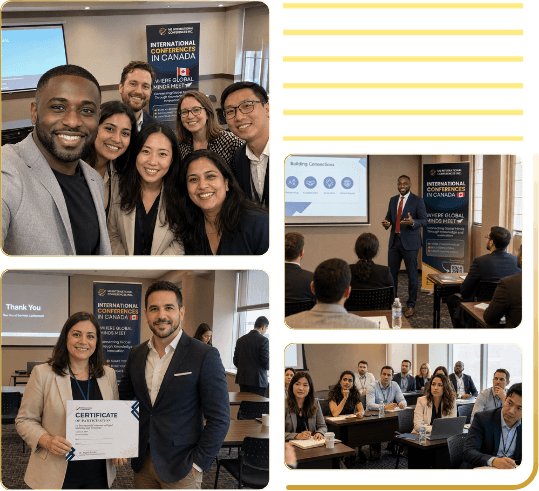
All conferences in Canada listed here run in person at a Greater Toronto Area venue, and every session takes place on-site, in the room with the other presenters. This section explains what a conference in Canada looks like on the day, from how sessions and presentations are run to how the networking works. That way you know what you are travelling to before you register. Each event runs on a single day, with paper sessions, keynote talks and panel discussions.
What Registration Costs
Conference registration fees in Canada are the same at every event we run; only the ticket type and the early-bird deadline change the price. All prices are in US dollars, and registration is non-refundable once payment is confirmed, with three exceptions set out in the refund answer below: a paper that is not accepted, a refused visa and a schedule change. Listeners pay one flat $499 whenever they book, because the early-bird saving applies to authors only.
AUTHOR REGISTRATION
$499-$599
Early bird $499, regular $599, every event.
LISTENER REGISTRATION
$499
Full access to every session.
EARLY BIRD AUTHOR DISCOUNT
Save $100
Available to authors until about 120 days before the event.
Save $100
Author (Early Bird)
$499 $599
USD per person
The same author benefits at a reduced rate. Available until the early-bird deadline.
Most Popular
Author (Regular)
$599
USD per person
Present your research and take part in the full programme. Available until registration closes.
Listener
$499
USD per person
Attend every session without presenting, ideal for tracking field developments rather than sharing your work.
Whichever way you pay, enter your name exactly as it appears in your passport when you register, because your visa letter is printed from your registration details.
Submission and Registration Timeline
Working backwards from the event date, here is how long each stage of the conference submission process takes. International participants should start at least four months ahead to leave enough time for visa processing, since the visa letter is issued only after payment is confirmed. An author who submits only at the 30-day paper deadline would get the letter just days before the event, far too late for most visa offices, so submit months earlier.
Conference Proceedings and Publication Consideration in Canada
After you present your accepted paper in person, we submit it to a journal or conference proceedings, and it receives a number such as an ISBN, DOI or ISSN, depending on where it is accepted. That is how conference proceedings publication in Canada works at every event we run: our expert review first, then your in-person presentation, then submission by us. Where a paper ends up depends on its subject, and the journal or proceedings that takes it works to its own publishing schedule.
How to Register From the Conference Calendar
Browsing the calendar is the easy part; turning a listing into a confirmed place takes a few deliberate steps. When you register for a conference in Canada through this list, the order you do things in matters. Authors work to a submission deadline, while listeners can register until 7 days before the event. If you miss a paper deadline, the same subject often has another edition later in the calendar, which you can find with the topic filter. The four points below cover the conference registration process: choosing the right event, submitting correctly, handling more than one conference, and timing your travel booking so you are not out of pocket if a paper is turned down.
Preparing for Your Conference
Once your place is confirmed, there is a short window before the event where a little preparation makes the difference between a smooth experience and a stressful one. Knowing how to prepare for an academic conference comes down to a few practical things: finalizing your conference presentation, sorting your travel, and knowing when the programme lands and how the networking works. Get those sorted and you arrive ready, rather than scrambling on the day.
Important Conference Dates and Deadlines
Every listed event runs to three dates that matter, and missing any one of them can cost you a place or a discount. The early-bird window closes first, about 120 days out. The conference submission deadlines in Canada follow about 30 days before, and your abstract has to be in by then for our expert reviewers to look at it. Registration itself closes 7 days before. Each card below explains what a deadline means, and every conference page lists its own exact dates, since they shift from event to event across the 2026 and 2027 season.
PAPER SUBMISSION DEADLINE
30 Days Before
from the Event date
For authors presenting a paper for a journal or proceedings. Submit before this date to be considered.
EARLY BIRD REGISTRATION DEADLINE
120 Days Before
from the Event date
Authors save $100, same access as standard registration.
STANDARD REGISTRATION DEADLINE
7 Days Before
from the Event date
Registration closes; the event leaves the list.
As dates move with each event, a March event already has its early-bird deadline in November.
Available Participation Options
There are three ways to take part in the conferences in Canada listed on this calendar, depending on whether you want to present your own work, address the whole conference, or learn from others. The cards below set out what each role does on the day. Authors and listeners book on each event page, while speakers apply through a separate route. Choose the role that fits your goals and career stage — the pricing for author and listener registration is shown in the cost section above.
Conferences by Topic
Most researchers look for a conference by subject first, so the calendar is organized into 21 topic tracks — from business and economics to information technology and health science. Each card below gives the nearest submission deadline for upcoming conferences in Canada in that track. There is also a line on scope, so you can tell what a track covers before you commit. Engineering subjects such as civil and petroleum engineering have their own tracks too, even though the cards below focus on eight others. Pick a topic to narrow the full list above to that subject alone; the list updates as new editions go up.
Strategy, operations, leadership and organizational behaviour. Dates run in many of our host cities.
Microeconomics, macroeconomic policy, trade and development economics, from applied econometrics to regional analysis.
Financial reporting, auditing, taxation and corporate finance, including IFRS developments and risk management.
Talent acquisition, workplace culture, employee engagement and organizational design across sectors.
Logistics, procurement, inventory and distribution planning, including disruption response and sustainable sourcing.
Search and content strategy, marketing analytics, customer acquisition and platform economics.
Software engineering, cybersecurity, cloud infrastructure, data systems and applied machine learning.
Clinical research, public health, healthcare delivery and medical technology, open to practitioners and health-services researchers.
Explore Upcoming Conferences in Canada by City
All of the conferences in Canada 2026 on this calendar are held in the Greater Toronto Area, so choosing by city is mostly about where you want to stay, since the venue address arrives 7 days before the event and the visa letter names the city. They cluster in and around Toronto, reaching out to Mississauga, Markham, Brampton and the surrounding municipalities, which keeps every venue inside the region served by Pearson airport and GO Transit. Pick a city below to see only its scheduled events. Each one links to a dedicated city page with its own calendar and local travel guidance, so you can plan the trip around the conference. Pearson International is in Mississauga, west of Toronto, and the UP Express reaches downtown in about 25 minutes.
Plan Your Conference Year
Serious researchers rarely attend just one event a year, so it helps to see the whole season at once. You can jump to any month in this conference calendar Canada-wide for 2026 to line up your submission deadlines, plan the travel and spread your participation sensibly, rather than clustering everything into one busy stretch. This academic conference calendar 2026 runs through July 2027, the full span of conferences in Canada 2026-2027, and each month link below takes you straight to that month’s listings. A month that has already passed simply shows no events left to book, because registration closes a week before each date.
Meet Our Keynote Leaders
Keynote sessions are often the highlight of an academic conference — they set the intellectual tone and draw the largest audiences. Across the 2026 season, our keynote speakers come from public health, technology and economics practice, each bringing a distinct perspective on where their field is heading. Below are a few of the speakers who have joined our events. Each event’s keynote speakers are confirmed 7 days before it and announced by email to registered participants.

Dr. Angela Brooks
Public Health – Global Health Solutions
A public health expert at Global Health Solutions, she shares insights on healthcare innovation, prevention strategies, and community wellness at conferences.

David Martinez
AI Innovation – NextGen AI Labs
An AI innovation professional who shares insights on emerging technologies and intelligent systems at conferences.

Kwame Mensah
Economic Strategy – Economics Plus
An economic strategy expert who speaks on market trends, policy insights and sustainable growth.
Voices From Our Community
These conference attendee reviews come from people who have taken part in our events: researchers, consultants, analysts and practitioners from several fields. Each one is a real account of the academic conference experience, from the quality of the sessions to the connections made during coffee breaks between talks. They are worth a read to gauge whether an event fits what you are after.

David Chen
Tech Entrepreneur
“The conference expanded my global network and opened doors to collaborations I never thought possible.”

Sophia Martinez
Policy Analyst
“Sessions were insightful and practical, giving me tools I can immediately apply in my professional work.”

Kwame Mensah
Business Consultant
“A powerful platform for African voices, enabling me to share ideas and learn from diverse perspectives.”

Emily Johnson
Research Scientist
“The balance between academic rigor and real-world application made this conference truly transformative.”

Ahmed Ali
Leadership Coach
“Networking opportunities were outstanding, connecting me with innovators across industries and sparking new ventures.”

Rachel Adams
Social Innovator
“The event gave me confidence, knowledge, and connections that will help drive meaningful change in my community.”
Frequently Asked Questions
These are the questions researchers ask most often before submitting to or registering for upcoming conferences in Canada. They cover the practical things — how far ahead events go up, what the edition numbers mean, whether you can submit the same paper twice, and how publication and refunds work. The answers stick to the calendar, the deadlines and how the listings work in practice, so you can go from browsing to registering with fewer surprises. Questions about visa letters are answered in full on the homepage, to keep this page focused on the calendar itself.