
Planning a conference trip from Uganda to Canada means working around a clock you do not control. The event dates are fixed, but the wait for an answer is not, and that gap worries many applicants. Here is how to plan around it.
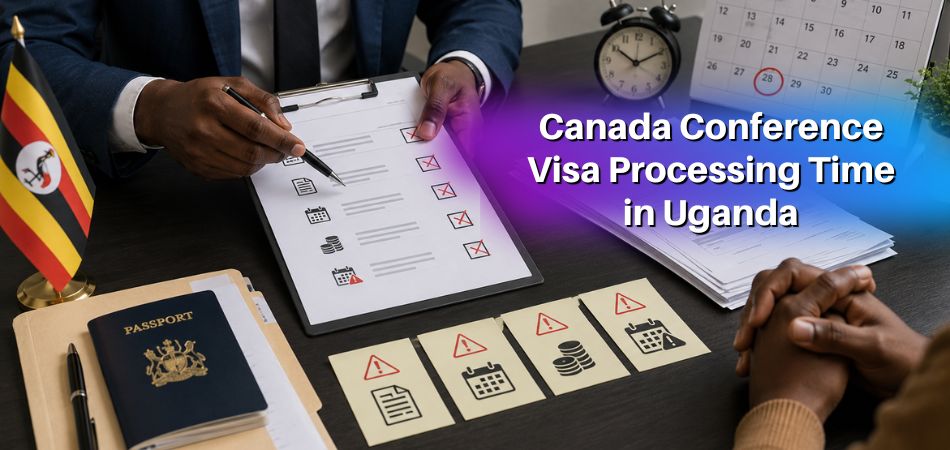
Quick answer: A Canada conference visa from Uganda has no fixed processing time, and right now IRCC is not finalizing visitor visa applications whose last country of residence is Uganda. Those measures run to 27 November 2026 unless extended. Ugandans apply for a visitor visa, not a special “conference visa”. Apply early and book flights only after the visa is in your passport.
Fact-checked by the MS International Editorial Team. Last verified against official sources: October 2026.
Your Canada conference visa processing time in Uganda depends on IRCC’s current visitor visa workload, how quickly you give biometrics, the quality of your documents, and whether the file needs extra review. A strong application proves four things: the event is genuine, your stay is temporary, you can afford the trip, and you have clear reasons to return to Uganda.
Conference dates are fixed, so the safest plan is to apply as early as your documents allow, but first read the section below on the current IRCC measures for applicants who live in Uganda.
Is IRCC Finalizing Visas From Uganda Right Now?
No. As of IRCC’s page updated on 28 September 2026, IRCC keeps working on applications but does not finalize any where the last country of residence is Uganda, South Sudan, or the Democratic Republic of the Congo. The measures began on 27 May 2026 because of the Ebola outbreak. IRCC extended them by 60 days to 27 November 2026, and they could be extended again, so check the IRCC page “Ebola disease: Temporary measures” before you plan.
Who Is Affected and What Changes
| Point | What IRCC says |
| Who | Anyone whose last country of residence in the application is Uganda. IRCC applies this to residence, not citizenship |
| Your application | It is still processed, but no final decision is made while the measures last |
| Existing visas | Visas, eTAs and permit counterfoils held by affected residents are temporarily not valid for travel, even if approved earlier |
| Passport | Do not send it to a visa application centre until the measures end. The centre will not hold it |
| After the end date | IRCC starts making final decisions again, and suspended documents become valid again. An expired document does not get extra time |
What This Means for Your Conference
A conference that falls before the end date is a real risk, because no decision may arrive in time. IRCC considers exemption requests case by case. You must explain your reason, give evidence, and show you pose no public health risk, and an exemption is not guaranteed. Keep your contact email current with IRCC, since notices go by email. Separate health screening rules also apply to travellers who were recently in Uganda, so read the IRCC page before you fly.
If your event is months away, you can still prepare the file and ask the organiser for the invitation letter, so you are ready when final decisions resume.
How Long Does a Canada Conference Visa Take From Uganda?
It can take a few weeks or several months. IRCC publishes a current processing estimate for visitor visas from each country on its website, and that figure is the one to use. It is not a promise. Extra document checks, background checks, or doubts about the conference purpose can make a file take longer, and a complete application can still wait in the queue.
Current IRCC Processing Estimate for Uganda
IRCC’s processing time tool shows how long it expects an application to take if it received it today, based on how long it took to finish 80% of past applications. The estimate moves with application volume and office capacity. Check it on the day you plan your dates, and note the date you checked. The estimate includes the time it takes you to give biometrics, so delays on your side add to the total. IRCC adds that the wait may be longer than shown when the last country of residence is Uganda.
Best Time to Apply Before the Conference
Apply as soon as your invitation letter, registration proof, passport, financial documents, and travel plan are ready. After submission you still need biometrics, the IRCC decision, and the return of your passport or visa, so build in extra weeks. If your event falls in a busy travel season, start even earlier.
Do not rush a weak file to save a few days. A slightly later but complete application is safer than a quick one with missing proof.
Canada Conference Visa Timeline for Ugandan Applicants
The timeline has several stages. Some depend on you, others on IRCC and VFS. IRCC’s clock starts only when it receives your complete application, so the full Canada conference visa process takes longer than IRCC’s review time alone.
| Stage | What Happens |
| Document preparation | You gather passport, invitation, registration, funds, ties, and travel proof |
| Online submission | You complete the visitor visa application and pay fees |
| Biometrics | You attend the VFS appointment after receiving the instruction letter |
| IRCC review | Your file, documents, purpose, funds, and background are assessed |
| Passport request | IRCC asks for your passport if the application is approved |
| Stamping and return | The visa is added to your passport, which is then returned to you |
Application Preparation and Submission
Preparation usually takes longer than the online form. Your conference name, event dates, travel dates, leave approval, hotel plan, and funding source should all match across documents. Read the file as the officer would: can they tell what event you attend, why, how you will pay, and why you will leave Canada? If any answer is unclear, fix the document or explain it before submitting.
Biometrics and VFS Appointment
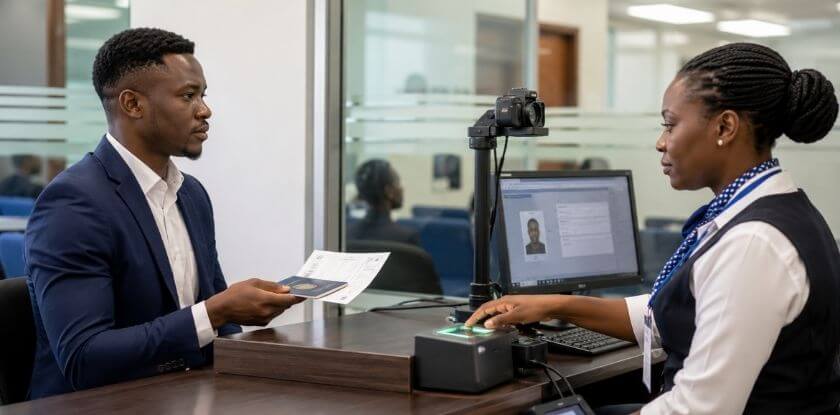
After you pay the fees, most applicants receive a Biometrics Instruction Letter. It lets you book an appointment at the VFS Global Canada Visa Application Centre in Kampala, where your fingerprints and photo are taken. Appointments must be booked in advance. The letter states your deadline, so read it and book quickly, because IRCC cannot finish the review until biometrics are done.
Processing After Biometrics
Biometrics confirm your identity. They do not mean approval. IRCC keeps assessing your conference documents, bank statements, employment proof, ties to Uganda, travel history, and admissibility. There is no fixed date for the next update. You may receive a document request, a medical request, a passport request, a refusal, or a status change. Check your IRCC account often and answer any request before its deadline, because late replies stretch the timeline.
Passport Request and Stamping
If the application is approved, IRCC sends instructions for the final step. VFS reported in 2026 that the Kampala centre no longer offers passport transmission because of IRCC operational changes, while biometrics appointments continue. Under the current Ebola measures, IRCC also says applicants who live in Uganda should not send a passport to a visa application centre until the measures end. Follow the exact instructions in your IRCC account and check the VFS Uganda notices, since this process has been changing. Stamping time varies with office workload, courier movement, and holidays.
What Type of Visa Do Ugandans Need for a Conference in Canada?
Ugandans attending a conference in Canada normally apply for a visitor visa, and the conference falls under business visitor activities. There is no separate conference visa. Your application should say clearly that your temporary visit is for a conference, seminar, meeting, workshop, or trade event.
Visitor Visa Under the Business Visitor Purpose
A business visitor comes for short-term activity without joining the Canadian labour market. Your file should show:
- The event name, location, dates, and duration
- Your role: attendee, speaker, presenter, exhibitor, or delegate
- Who is paying for the trip
- How the event relates to your work, business, study, or profession
- Your planned return date
Conference Attendance vs Work or Study
Attending sessions, networking, and presenting research are not the same as working in Canada. Your case needs more explanation if you plan to be paid by a Canadian organisation, serve Canadian clients, or join a long training programme. Keep the purpose simple: a specific event, then you leave.
Invitation Letter and Event Code
A conference invitation letter should include your name, the conference name, venue, dates, organiser details, and your participation type. Add any registration ID or event reference number. These details help IRCC verify the event but do not guarantee approval or speed.
Step-by-Step Process to Apply From Uganda
Apply online, give biometrics, and wait for the IRCC decision. Because conference travel is time-sensitive, handle each step carefully. The same online steps apply in other countries: you apply for a Canada conference visa from Ethiopia through the same IRCC secure account.

Step 1: Create an IRCC Account
Create an account on the official IRCC portal. You will use it to complete forms, upload documents, pay fees, and read messages. Use an email address you check daily.
Step 2: Complete the Visitor Visa Form
Fill in your personal, passport, travel, employment, and background details accurately. State clearly that you are attending a conference. Passport number, travel dates, employer details, and conference information must match your documents.
Step 3: Upload Your Documents
Upload clear, correctly labelled files from the checklist in the next section.
Step 4: Pay the Visa and Biometrics Fees
Pay both fees online. IRCC then issues the Biometrics Instruction Letter if biometrics are required. Keep the receipts and the letter.
Step 5: Attend Biometrics at VFS Kampala
Book your appointment and bring your passport and Biometrics Instruction Letter. Doing this quickly helps your file move forward.
Step 6: Monitor Your IRCC Account
Check the account often after biometrics. IRCC may ask for more documents, clarification, or medical information. Do not rely only on email notifications, because messages can be missed.
Step 7: Follow the Passport Instructions After Approval
If approved, IRCC sends passport or visa instructions. Follow them exactly and keep any tracking receipt. Do not send your passport before IRCC asks for it.
Step 8: Check Your Visa
When your passport comes back, check the visa sticker: name, passport number, validity dates, and number of entries.
Documents Required for a Canada Conference Visa From Uganda
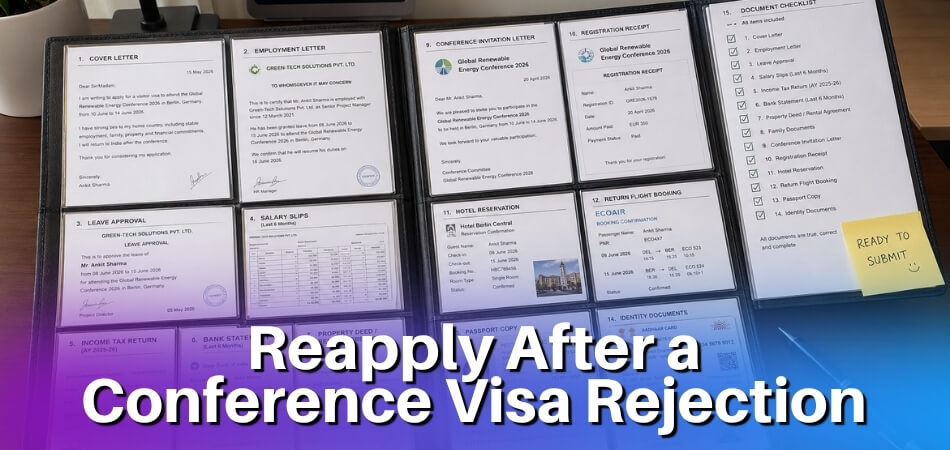
The documents should prove your identity, event purpose, financial ability, and ties to Uganda. A complete set lets IRCC review the file without asking for clarification.

Core Conference Documents
- Invitation letter
- Registration confirmation or payment receipt
- Conference agenda or programme and the event website or brochure
- Speaker, presenter, or delegate confirmation, if applicable
- Organiser contact details: official email, phone, website, venue address, and registration reference
Conference dates must match your travel plan, leave approval, accommodation, and explanation letter.
Passport and Identity Documents
Your passport must be valid and readable. Include the bio-data page and any previous visas or entry stamps that support your travel history. Name, date of birth, passport number, and expiry date must match the form exactly. Add a digital photo that meets IRCC rules, and make sure the passport has blank pages for the visa sticker.
Proof of Funds
Show that you can pay for registration, flights, accommodation, food, and local transport. Useful documents are bank statements, payslips, business income records, tax papers, or sponsor documents. Funds should match the travel plan. Large unexplained deposits weaken a file, so explain unusual transactions in your letter.
Employment, Business, or Sponsorship Evidence
If employed, include an employment letter, recent payslips, and approved leave. The letter should state your position, salary, length of employment, leave dates, and expected return date. If self-employed, include business registration, trading licence, business bank statements, tax documents, and invoices or contracts. If sponsored, provide a sponsor letter, sponsor ID, financial proof, and evidence of your relationship.
Travel Plan and Accommodation
Give your arrival and departure dates, conference city, and accommodation. A simple, realistic itinerary consistent with the event dates is enough. Avoid non-refundable bookings before approval; a proposed itinerary or refundable reservation supports your plan without financial risk.
Letter of Explanation
A letter of explanation joins your documents into one clear story: why you attend, how it relates to your work or studies, who pays, how long you stay, where you stay, and why you will return to Uganda. Keep it factual and personal. Generic cover letters copied from the internet and long templates full of repeated claims weaken the file.
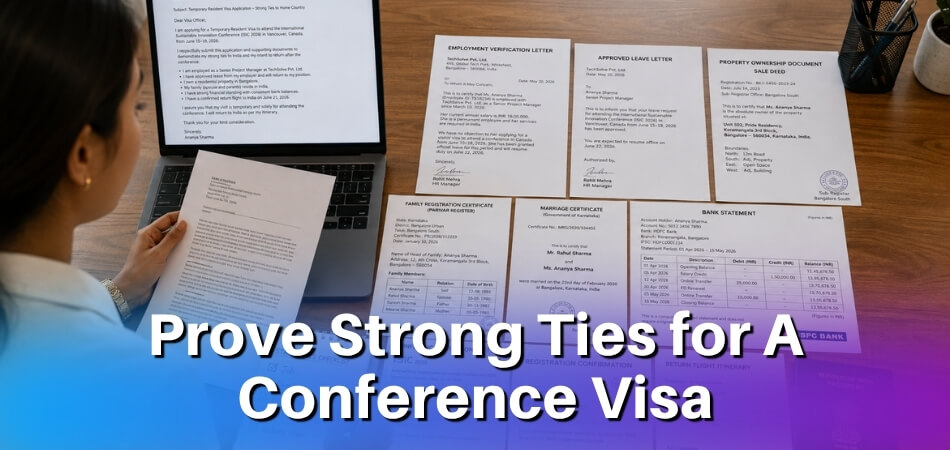
How to Prove Strong Ties to Uganda
Show that the visit is temporary and that you have clear reasons to return. Ties can be professional, financial, family-based, academic, business-related, or property-based.

Employment and Leave Evidence
A job is a strong return tie. The employment letter, approved leave and payslips listed above show the officer that your employer expects you back after the conference. A work ID or contract can add to this.
Business or Professional Commitments
Business owners should show active commitments in Uganda, such as an office lease, contracts or client records, in addition to the registration and tax documents listed above. You can also explain how the conference connects to your business goals.
Family, Property, and Community Ties
Where relevant, add marriage certificates, children’s birth certificates, school documents for dependants, land titles, rental agreements, or local authority letters. Each item should show a real responsibility in Uganda. Remove anything that does not support your case; a clean file with relevant evidence reads better than a large file with unrelated pages.
Financial Stability and Return Reasons
Stable income and regular account activity help. Make your return reasons specific: job duties, clients, family responsibilities, property, education, or community obligations. A concrete plan is stronger than a statement that you will come back.
Common Reasons for Delays
Many delays come from avoidable mistakes. Here is what slows files down and how to prevent it.

Form Errors
Wrong passport details, inconsistent dates, incomplete travel history, or incorrect answers about earlier refusals slow the review. Compare the form with your passport, invitation, employment documents, and travel plan before you submit.
Weak Financial Evidence
IRCC may need more time if statements are unclear, the balance does not cover the trip, the income source is not shown, or sponsor documents are incomplete. Your proof should explain how the full trip is paid.
Poor Document Uploads
Blurry scans, cropped or missing pages, dark photos, and over-compressed files cause delays. Check that letters are signed and dated and that bank statements show every page.
Late Biometrics
Every day you wait for biometrics is added to your timeline. Book the VFS appointment as soon as you receive the letter.
Background Checks and High Volume
Some files take longer because IRCC verifies employment, finances, travel history, or the conference itself. This does not always mean a problem. Holiday periods, summer, and peak conference months can also slow strong applications.
How to Avoid Delays
Remember who does what: IRCC decides the visa, while VFS handles biometrics. Watch your IRCC account, email, spam folder, and VFS updates.
Practical Tips for Uganda Applicants
- Save digital and printed copies of forms, passport page, invitation, registration, bank statements, receipts, and every letter from IRCC and VFS.
- Rules, fees, and VFS procedures change, so confirm them on the official IRCC and VFS pages before you apply or visit the centre.
- Never submit fake or edited documents. They can lead to refusal and long-term immigration problems. If something needs context, explain it honestly.
- Wait for the visa before paying for non-refundable flights or hotels.
Canada Visa Fees for Conference Applicants in Uganda
As of October 2026, IRCC lists a visitor visa fee of CAD 100 per person and a biometrics fee of CAD 85 per person. For families applying together, biometrics cost at most CAD 170, and a family of five or more pays at most CAD 500 in visa fees. The fees are paid online and are not refunded, whatever the decision. VFS charges extra for optional services in Kampala. Confirm all amounts on IRCC’s fee page before paying.
| Cost Item | When Paid | Notes |
| Visitor visa fee | Online application stage | CAD 100 per person |
| Biometrics fee | Online application stage | CAD 85 per person, CAD 170 maximum per family |
| VFS service fees | At VFS or service booking | Depends on selected services. VFS announced new service charges from 1 May 2026, so check the amount on the VFS Uganda page |
| Courier, SMS, printing | If selected | Optional; they do not speed up the decision |
Do not go to VFS for biometrics until you have the Biometrics Instruction Letter. Paying VFS for extra services does not improve your approval chances.
From our experience at MS International: We organise international conferences and issue invitation letters to registered delegates. Request the letter right after you register and pay, and make sure your file shows the link between your job, the conference, your budget and your return plan. Our letter is issued within 3 to 5 business days after payment clears, and a US$50 fee applies to corrections requested after it is issued, so check your name and passport details before you submit. The letter supports a visa application but does not guarantee a visa, and we cannot speed up IRCC’s decision. Our events are held in person in the Greater Toronto Area.
Frequently Asked Questions
Applying from Uganda with the conference date getting close? VFS Kampala’s speed and interviews, how long biometrics last, passport stamping and a passport lost mid-application are the practical worries here.
What is the current Canada visitor visa processing time for Uganda?
IRCC’s online processing time tool gives the estimate, but it is only a guide. For applicants who live in Uganda, IRCC is not finalizing applications while its Ebola measures last, now to 27 November 2026.
Can I still apply for a Canada conference visa from Uganda now?
Yes. IRCC says it keeps processing new and existing applications, but it will not finalize them while the measures are in place. Do not send your passport to a visa application centre until the measures end.
How fast is VFS Kampala for Canada visa processing?
VFS does not decide visas. It handles biometrics appointments, so its speed affects only the biometrics step. IRCC makes the decision.
Can a conference organiser speed up my application?
No. An invitation letter, registration proof, and an event code support your file but do not give priority.
What if my conference date is close?
Upload every requested document, but do not count on a fast decision. Neither an invitation letter nor extra VFS services speeds up the visa, and for Uganda residents no decisions are being finalized until the IRCC measures end. IRCC considers exemption requests case by case, with no guarantee. Do not travel until the visa is in your passport.
Does VFS Kampala conduct interviews?
No. If IRCC wants an interview or more information, it contacts you through your online account.
Can I travel while my application is pending?
No. Wait for approval and the visa, then check the details before you travel.
How long do biometrics last?
Biometrics are valid for 10 years for visitor visa applications. If you gave them for an earlier Canadian application within that period, you may not need to repeat them, and IRCC tells you in your account. A visa cannot be valid longer than your biometrics.
How long does passport stamping take?
There is no fixed figure, because office workload, courier delays, and public holidays all affect it. Right now VFS Kampala does not offer passport transmission, so follow only the instructions IRCC gives you.
Why is my application taking longer?
For applicants living in Uganda, the main reason now is that IRCC is not finalizing applications during its Ebola measures. Other causes are background checks, document verification, high volume, unclear finances, missing information, or late biometrics. A delay does not mean refusal.
Does travel history help?
Sometimes. A record of following visa rules in other countries supports your credibility, but it is not mandatory. A clear purpose, funds, and ties still support first-time travelers.
Do I need a visa for a virtual conference?
No. If you attend online and do not enter Canada, you do not need a visa.
What if I lose my passport after applying?
Report the loss, get a replacement, and update IRCC through your account. Expect some delay while your passport details are updated.
Conclusion
The Canada conference visa processing time in Uganda is not fixed. For applicants who live in Uganda, IRCC is not finalizing visitor visas until its Ebola measures end, currently 27 November 2026. Compare that date with your conference, check IRCC’s estimate, send a complete file, and make your purpose clear.
Disclaimer: This article is general information, not legal or immigration advice. Visa rules, fees, and processing times change. Confirm the current requirements on the official IRCC (canada.ca) website before you apply.