Planning to attend an economics conference in Canada but not sure which one fits your goals? Each event has a different focus, audience, format and price, and many of the 2026 dates have already passed. This guide lists what is still ahead as of October 2026, so you can compare events without opening ten tabs.
Quick answer: The top 10 economics conferences in Canada still ahead start with the Canadian Econometrics Study Group in Vancouver (16 to 18 October 2026) and run to the CAES annual meeting in Halifax (28 to 30 June 2027). The list also includes CLEA in Toronto, CPEG in Montréal, the Ontario Economic Summit (18 to 19 November 2026) and the Canadian Economics Association meeting in Waterloo (28 to 29 May 2027).
Last verified against official sources: October 2026. Dates, formats and fees can change, so confirm them on each official event page before you pay or book travel.
Top 10 Economics Conferences in Canada 2026/27: Quick Comparison
All ten entries below were confirmed on the official organizer pages (and, for the Atlantic Economic Forum, a Government of Canada announcement) on 11 October 2026. They are listed by date.
| # | Conference | Date | City | Type | Key focus |
|---|---|---|---|---|---|
| 1 | 41st Canadian Econometrics Study Group (CESG) Annual Meeting | 16 to 18 October 2026 | Vancouver, BC (Simon Fraser University) | Academic meeting | Econometrics |
| 2 | Canadian Law and Economics Association (CLEA) 2026 | 23 to 24 October 2026 | Toronto, ON (University of Toronto) | Academic meeting | Law and economics, financial institutions, labour markets, regulation |
| 3 | Canadian Public Economics Group (CPEG) 2026 | 6 to 7 November 2026 | Montréal, QC (ESG-UQAM) | Academic meeting | Public and political economics |
| 4 | 40th Canadian Macroeconomic Study Group | 13 to 14 November 2026 | Hamilton, ON (McMaster University) | Academic meeting | Macroeconomics |
| 5 | 2026 Ontario Economic Summit | 18 to 19 November 2026 | Toronto, ON (Metro Toronto Convention Centre) | Business and policy summit | Ontario’s economy and competitiveness |
| 6 | 3rd Canadian Labour Economics Forum (CLEF) Conference | 16 to 17 April 2027 | Banff, AB (Banff Centre) | Academic meeting | Labour economics |
| 7 | 2027 BC Economic Summit | 17 to 20 May 2027 | Penticton, BC (Penticton Trade and Convention Centre) | Economic development summit | Economic development in British Columbia |
| 8 | Canadian Economics Association (CEA) 2027, 61st Annual Meetings | 28 to 29 May 2027 | Waterloo, ON (Wilfrid Laurier University) | Academic meeting | All fields of economics |
| 9 | Atlantic Economic Forum 2027 | 31 May to 2 June 2027 | Antigonish, NS (St. Francis Xavier University) | Policy forum | Atlantic Canada regional economy |
| 10 | Canadian Agricultural Economics Society (CAES) Annual Meeting 2027 | 28 to 30 June 2027 | Halifax, NS | Academic meeting | Agricultural and food economics |
A few points about this table:
- Two kinds of event. Seven entries are academic meetings where researchers present papers. The Ontario Economic Summit, the BC Economic Summit and the Atlantic Economic Forum are business and policy gatherings, where you attend talks and panels rather than submit a paper.
- Academic meetings select papers. The study groups and associations review submissions, so ask early about calls for papers and whether non-presenting attendees can register. The CPEG page says its 2026 call for papers is closed.
- Two seasons. On this list, the meetings fall in October and November or between April and June, so plan your submissions around those two windows.
- Format is rarely stated. None of the ten pages lists an online ticket, so treat each one as an in-person event unless the organizer says otherwise.
Details of the Upcoming Economics Conferences
1. 41st Canadian Econometrics Study Group Annual Meeting (Vancouver)
The Canadian Econometrics Study Group meets at Simon Fraser University in Vancouver on 16 to 18 October 2026. It suits econometricians, empirical economists and PhD students who want feedback on methods and applied work from a specialist audience.
The CESG homepage confirms the dates, city and host. It does not list the format or fees, so write to the group at the contact address shown on its site before you plan a trip.
2. Canadian Law and Economics Association 2026 (Toronto)
The CLEA annual conference takes place on Friday 23 and Saturday 24 October 2026 at the University of Toronto Faculty of Law, hosted by Jackman Law. Participants present their current original research, and the listed topics include financial institutions, labour markets and regulation. It fits legal scholars, economists and policy researchers who work where the two fields meet.
The CLEA homepage links to a separate registration page and a program document but does not print a fee, so check the registration page before you budget.
3. Canadian Public Economics Group 2026 (Montréal)
The CPEG annual meeting is on 6 and 7 November 2026 at ESG-UQAM, the business school of the Université du Québec à Montréal. Selected papers from all areas of public and political economics, theoretical or empirical, are presented in plenary sessions, with keynotes by Pierre Boyer of École Polytechnique and Ernesto Dal Bó of UC Berkeley.
The page says the call for papers is closed and that online registration opened on 15 August 2026. It does not list fees. This one suits researchers in taxation, public policy and political economy.
4. 40th Canadian Macroeconomic Study Group (Hamilton)
The Canadian Macroeconomic Study Group holds its 40th annual meeting on 13 and 14 November 2026, hosted by the Department of Economics at McMaster University in Hamilton, Ontario. It is the late-fall meeting for macroeconomists, and it suits PhD students and researchers who work on growth, monetary policy, business cycles and related topics. The homepage does not state the format or fees, so check the conference details page of the group.
5. 2026 Ontario Economic Summit (Toronto)
The Ontario Chamber of Commerce holds the 2026 Ontario Economic Summit on 18 and 19 November 2026 at the Metro Toronto Convention Centre. This year’s theme is “Ontario Strong: Competing with Confidence”, and the summit brings together leaders from business, government, academia and communities.
The two days include keynote addresses, panel discussions, fireside chats and Cabinet Minister roundtables, plus a networking reception at Roy Thomson Hall. Tickets on the event page cost $1,449 plus HST for Chamber members and $1,749 plus HST for non-members. It suits policy staff, business economists and researchers who want to hear how government and industry see the provincial economy, not academics looking for a place to present a paper.
6. 3rd Canadian Labour Economics Forum Conference (Banff)
CLEF holds its third annual conference on 16 and 17 April 2027 at the Banff Centre in Alberta, hosted by the Department of Economics at the University of Calgary. The programme includes contributed papers, a keynote by David Card and a special session for the winner and two runners-up of the Best Paper Prize. It is a good fit for labour economists and early-career researchers.
All attendees must register. Registration details will be posted after acceptance notifications, which the organizers expect by the end of January 2027, so no fee is available yet.
7. 2027 BC Economic Summit (Penticton)
The British Columbia Economic Development Association (BCEDA) runs the 2027 BC Economic Summit from 17 to 20 May 2027 at the Penticton Trade and Convention Centre. The summit page names economic development professionals, policymakers, business professionals, Indigenous leaders, local governments, Community Futures organizations, Chambers of Commerce and elected officials as its audience, and it also welcomes people new to the field.
Registration is open through the summit page, which does not print a fee. The official hotel is the Four Points by Sheraton Penticton, and the organizer notes that hotel blocks fill up quickly, so book a room early if you plan to go.
8. Canadian Economics Association 2027 (Waterloo)
The CEA website lists its 61st Annual Meetings for 28 and 29 May 2027, hosted by Wilfrid Laurier University in Waterloo, Ontario. It is the main national gathering for academic economists, which makes it a good fit for researchers and PhD students in any field of economics.
The CEA page does not list fees or the meeting format for 2027 yet, so budget only after the CEA publishes them. Its 2026 meetings at Simon Fraser University ran on 28 to 30 May 2026, with an online day of meetings on 22 May, which shows the usual late-spring timing.
9. Atlantic Economic Forum 2027 (Antigonish)
St. Francis Xavier University hosts the Atlantic Economic Forum in Antigonish, Nova Scotia, from 31 May to 2 June 2027. A Government of Canada announcement in September 2026 confirmed federal support for the forum, which is meant to bring regional and national leaders together on the future of the Atlantic economy.
It suits policy staff, business and community leaders and researchers who follow regional development. Fees and registration details had not been published as of October 2026, so check with the organizer before you plan.
10. Canadian Agricultural Economics Society Annual Meeting 2027 (Halifax)
The CAES website lists its annual meeting for 28 to 30 June 2027 in Halifax, Nova Scotia. It suits agricultural, food and resource economists, along with graduate students and policy analysts in those fields. The listing does not give fees or the format, so watch the society site, where members register for the meeting.
Already Held or Closed to Registration in 2026
These events took place before 11 October 2026 or have closed registration. Watch for their 2027 editions if the topic suits you.
- 3rd AI in Finance 2026: 13 to 15 October 2026, Concordia University’s John Molson School of Business, Montréal. Focus: AI, machine learning and financial economics. In-person registration closed on 21 September 2026, and the online attendee ticket (CAD $75) was on sale only until 12 October 2026.
- IDA 72nd Annual Conference and Marketplace: 1 to 3 September 2026, Westin Harbour Castle, Toronto. Focus: downtown and urban economic development.
- EDAC 2026 Annual Conference: 14 to 17 September 2026, hosted in Southeast New Brunswick. Focus: economic development.
- 52nd Atlantic Canada Economics Association Conference: 2 to 4 October 2026, Acadia University, Wolfville, Nova Scotia. Theme: Better Living in Atlantic Canada.
- CREEA/ACERE 2026 (environmental and resource economics): 2 to 3 October 2026, Waterloo, Ontario.
- CEA 2026, 60th Annual Meetings: 28 to 30 May 2026, Simon Fraser University, Vancouver.
- Canadian Economic Theory Conference 2026: 8 to 10 May 2026, University of British Columbia, Vancouver.
- Société canadienne de science économique, 65th conference: 6 to 8 May 2026, Québec City.
Which Conference Fits Your Field?
Match the event to your research area first, and the date second. The upcoming events cover many fields, and the events already held show which topics to watch for in 2027.
| Your area | Upcoming option | Held in 2026 (watch for 2027) |
|---|---|---|
| Business and provincial economic policy | 2026 Ontario Economic Summit (Toronto, 18 to 19 November 2026) | None on this list |
| Finance, AI and fintech | None confirmed yet | 3rd AI in Finance 2026 (Montréal, registration closed) |
| Econometrics | CESG (Vancouver, 16 to 18 October 2026) | None on this list |
| Law and economics | CLEA 2026 (Toronto, 23 to 24 October 2026) | None on this list |
| Public and political economics | CPEG 2026 (Montréal, 6 to 7 November 2026) | None on this list |
| Macroeconomics | Canadian Macroeconomic Study Group (Hamilton, 13 to 14 November 2026) | None on this list |
| Labour economics | CLEF (Banff, 16 to 17 April 2027) | None on this list |
| Academic economics in any field | CEA 2027 (Waterloo, 28 to 29 May 2027) | CEA 2026, Canadian Economic Theory Conference 2026 |
| Atlantic Canada economics and policy | Atlantic Economic Forum (Antigonish, 31 May to 2 June 2027) | 52nd Atlantic Canada Economics Association Conference |
| Agricultural and food economics | CAES annual meeting (Halifax, 28 to 30 June 2027) | None on this list |
| Urban and downtown economic development | None confirmed yet | IDA 72nd Annual Conference and Marketplace |
| Regional economic development | 2027 BC Economic Summit (Penticton, 17 to 20 May 2027) | EDAC 2026 Annual Conference |
| Environmental and resource economics | None confirmed yet | CREEA/ACERE 2026 |
Regional and specialist meetings can be smaller than the national CEA meeting, so they may give graduate students and early-career scholars easier access to presenting and to conversations with senior researchers. Economists who study Canada-Africa trade and investment can also look at African business and technology events, where investors and policymakers from Canada and Africa meet.
Online vs In-Person: Which Conference Format Is Right for You?
Choose in person if your goal is networking or presenting, and choose online only if your goal is following the content on a budget. None of the ten events lists an online ticket as of October 2026, so online access is the exception in Canadian economics meetings rather than the rule.
The Case for Attending In Person
In-person attendance gives you the conversations before panels, during breaks and after presentations, which is where most contacts are made. If you present research, you can read the room, answer questions directly and be remembered by people in your field. For students and early-career researchers, that is often worth more than watching sessions from home.
The downside is cost. The Ontario Economic Summit charges $1,449 to $1,749 plus HST, and for every event flights, hotels, meals and local transport come on top of registration.
The Case for Going Online
Online options do exist in the field. The CEA ran an online day of meetings on 22 May 2026, a week before its in-person sessions, and the 3rd AI in Finance 2026 sold a CAD $75 online attendee ticket. Online attendance works well if you mainly want to learn or follow a technical field and cannot justify the trip. The limit is networking: online access to sessions rarely builds the same relationships as being in the room.
Before buying an online ticket, check what it includes. Can online attendees ask questions? Are sessions recorded? Does the ticket allow presenting, or listening only? A cheaper ticket is not better if it blocks the activity you came for.
A Quick Decision Framework
- Networking is the main goal: choose an in-person event such as the CEA meeting or one of the summits.
- You need a lower-cost option: pick an event close to home, and watch whether the CEA repeats its online day in 2027.
- You are presenting research: in person is usually stronger, and none of the ten pages advertises a virtual presenting slot.
- You are travelling from abroad: check the event page early and ask the organizer what documents it provides.
Conference Fees and Registration Costs: What Is Published
Only one of the ten events, the Ontario Economic Summit, publishes its ticket price so far. Where a fee is not shown, it is left out here rather than estimated.
| Conference | Published registration cost |
|---|---|
| 2026 Ontario Economic Summit | $1,449 plus HST for Ontario Chamber of Commerce members; $1,749 plus HST for non-members |
| CEA 2027 | Not yet published on the CEA annual meeting page |
| CESG, CLEA, CPEG, Canadian Macroeconomic Study Group, CLEF, BC Economic Summit, Atlantic Economic Forum, CAES | Not shown on the main official pages as of October 2026. CLEF says registration details follow acceptance notices. |
Academic meetings often price by membership or career stage, and some charge less for students, so look for those categories when a fee page appears. Registration is only one part of the budget. Add flights, accommodation, meals, local transport and any visa costs, and read the refund rules before you pay, because some organizers do not refund fees.
Where to Check Before Paying
Confirm the final fee on the official event page, because deadlines can close and some events add taxes or membership rules. Pay only through the organizer’s own registration page, not through a third-party listing.
Networking Opportunities at Economics Conferences: How to Make the Most of Them
The best networking happens before sessions, during breaks, after presentations and in the follow-up messages that come once the event is over.

Before You Arrive
Check the program, speaker list and attendee details if they are published, and note the people connected to your area, such as economic policy, development economics, financial markets or public finance.
Prepare a short introduction: who you are, what you work on and why you are attending. If you are presenting, add a clear one-minute summary of your research and have it ready before anyone asks.
During the Conference
Attend sessions in your field, but also try one outside it. A general economics researcher might gain something from an AI in finance session, and the reverse is also true.
Ask specific questions. “How do you see this affecting investment or regional growth?” starts a better conversation than “I liked your point about development policy.” Coffee breaks and lunch periods often matter as much as the formal sessions.
After the Conference
Follow up within two days with a short email or LinkedIn message that mentions something specific from your conversation, such as a paper or a topic you discussed. A generic message could be sent to anyone, so it gets ignored.
Keep notes: who you met, what they work on and whether you promised to send anything. Names and details fade quickly after a busy event.
Choosing the Event for Your Network
A summit such as the Ontario Economic Summit or the BC Economic Summit brings business, government and community leaders into one room, which is why the Ontario summit also counts among business management events for executives. The CEA meeting concentrates academic economists, and the study group meetings (CESG, CPEG, the Canadian Macroeconomic Study Group, CLEF) put you in a room with specialists in one field.
Give people a reason to remember you. “I study economics” is too broad. “I am working on development policy and investment patterns in emerging markets” is much clearer.
Special Benefits for Students and Early-Career Researchers
Student and early-career attendees can use these events to present research, meet senior professionals and understand policy debates, but not every event offers a student rate. Check the fee page first.
Reduced Registration Fees and Funding
None of the ten official event pages shows a student or PhD rate as of October 2026, mostly because fees are not posted yet. Ask the organizer, and check whether a student rate requires membership of the association.
Ask your department, supervisor or employer early about travel funding for presenting at academic events. Some regional events also help students directly: the 2026 Atlantic Canada Economics Association conference listed limited travel support for students and early-career scholars and prizes for the best student papers, so look for lines like that on a call for papers. If you present, keep your acceptance email, registration receipt and conference details, because internal funding offices often ask for them.
Presenting Your First Paper
Choose an event that matches your topic. The CEA meeting takes academic work in any area of economics, while CESG, CPEG, the Canadian Macroeconomic Study Group and CLEF suit papers in one field.
Before submitting, check whether the event accepts abstracts, full papers, posters or listener-only registration, because the submission process differs between events. Watch the deadlines too: CPEG’s 2026 call for papers closed on 15 May 2026, almost six months before the November meeting, and CLEF sends acceptance notices by the end of January 2027 for an April meeting.
Mentorship and Structured Networking
A mixed event gives you access to both academic and applied economists, while a specialist event gives more focused conversations in one field. Do not wait for networking to happen on its own. Prepare a short introduction to your research, attend a session outside your exact topic and follow up soon after the event.
How to Get an Invitation Letter for a Canada Conference
If you travel from outside Canada, you may need an invitation letter for your visa application, because it confirms why you are entering the country and who expects you. Request it from the official organizer only, after your registration is confirmed.
What an Invitation Letter Should Include
A proper letter contains specific details, and a missing one can cause delays at the embassy:
- Your full name exactly as it appears on your passport
- Your affiliation: university, institution or employer
- Conference name, dates and location
- Your role: attendee, paper presenter, keynote speaker or session chair
- A statement confirming your registration or the acceptance of your paper
- Organizer contact details and official letterhead
Some embassies also want the letter to say that the organizer knows you are applying for a Canadian visa, so it is worth asking the organizer to add that line.
Where to Request One and When to Apply
Go directly to the official organizer. Do not request a letter through third-party listing sites or unofficial contacts, and check the organizer’s email address before sending passport details.
Timing matters. Request the letter as soon as your registration is confirmed, because visa processing and organizer response times can both be slow. Organizers differ: some give only a registration confirmation, so ask what the event provides before you make travel plans. Visa and travel planning can take weeks, so do not leave the request until the last few weeks before the event.
A short request can look like this:
Subject: Invitation letter request, [Conference name], [Date]
Hello, I registered as a [listener/author] for [Conference name] in [City] on [Date]. My registration reference is [Reference]. Please issue my invitation letter with my name exactly as on my passport: [Full passport name], passport number [Number]. Thank you, [Name]
Where to Find the Best Economics Conferences in Canada
Knowing a conference exists is half the battle, so here are the places worth bookmarking.
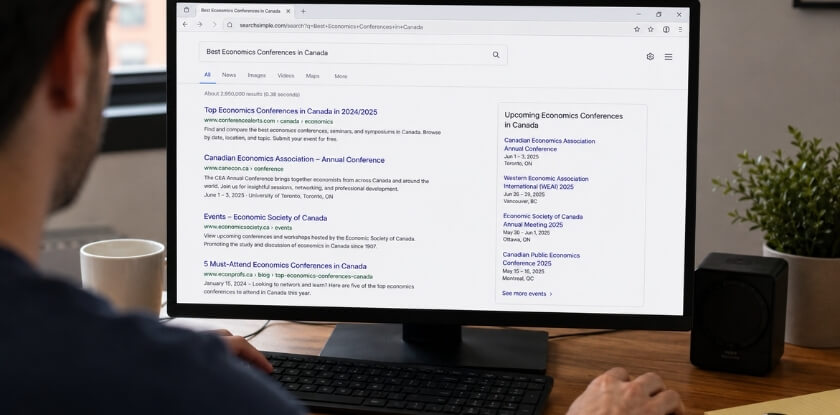
Conference Directories
Conference Index (conferenceindex.org) is an aggregator for academic events. You can filter by country, discipline and year, so a search for “economics Canada 2026” gives a usable list quickly. Listings include submission deadlines and venue details. It does not cover everything, and not every listing is updated promptly, so click through to the official site before making plans. Top Ten Events is a smaller directory that appears in search results for Canadian academic conferences. Use it only as a cross-reference.
Do Not Ignore Institutional Sources
Directories are a starting point, not the final word. The Canadian Economics Association posts its annual meeting details on its own website at economics.ca. University economics departments, such as those at Toronto, British Columbia, McGill, Queen’s and Calgary, often keep event calendars for conferences their faculty organize. These pages are often updated sooner than third-party directories.
A Practical Search Routine
- Start with Conference Index for a broad sweep.
- Check the organizer’s own site for every event on your shortlist: dates, fees and abstract deadlines.
- Set a Google Alert for “economics conference Canada 2027” to catch announcements before directories list them.
Best Canadian Universities to Study Economics (Beyond the Conference Circuit)
If you are thinking about a graduate degree or a research career, Canada has several universities with active economics departments worth a closer look.

Where to Look
The University of Toronto, the University of British Columbia in Vancouver, McGill University in Montréal, Queen’s University in Kingston and the University of Calgary all run economics programs. Their research areas differ, and Toronto and Montréal also put students close to government agencies, financial institutions and research networks. Read each department’s faculty research pages to see what it actually works on, and do not rely on ranking lists alone.
What to Look for When Choosing
- Supervisor fit: read faculty research pages and email professors before applying.
- Funding packages: Canadian PhD programs vary. Some offer full funding plus a stipend, while others expect you to piece support together through teaching assistantships or research work.
- Placement records: look at where recent PhD graduates ended up, such as academic jobs, government, central banking, consulting or policy research.
- Research culture: strong departments usually run seminar series and working paper workshops where graduate students present and refine their work.
Programs with strong mentorship and active faculty networks also help you build the contacts needed for long-term growth.
From our experience at MS International: We also run international economics conferences in the Greater Toronto Area, held in person only, with upcoming editions on 17 October 2026 (Vaughan), 2 November (Toronto), 9 November (Mississauga), 17 November (Oakville) and 1 December 2026 (Toronto). Every submission goes through double-blind review, which normally takes about 10 working days, so the later editions leave more room for a new paper. Accepted work may be considered for conference proceedings where applicable. The invitation letter is issued within 3 to 5 business days after payment clears, and a US$50 fee may apply to corrections after it is issued. Registration fees are non-refundable and non-transferable, so choose your edition and city before you pay.
Frequently Asked Questions (FAQ): Top Economics Conferences in Canada
Economists comparing Canadian events tend to look at the next CEA meeting, options for AI and finance research, online participation and what to check before paying a fee.
What is the best economics conference in Canada right now?
There is no single best option. The Canadian Economics Association meeting (Waterloo, 28 to 29 May 2027) is the national gathering for academic economists. For one field, a study group such as CESG or CPEG gives a smaller specialist audience, and policy-minded attendees may prefer a summit.
Which economics conferences in Canada are still ahead in 2026?
CESG in Vancouver (16 to 18 October), CLEA in Toronto (23 to 24 October), CPEG in Montréal (6 to 7 November), the Canadian Macroeconomic Study Group in Hamilton (13 to 14 November) and the Ontario Economic Summit in Toronto (18 to 19 November). The IDA, EDAC and ACEA conferences finished in September and early October.
When is the next CEA annual conference?
The next CEA meeting is on 28 and 29 May 2027 in Waterloo. The association has not posted fees or format yet, so look at economics.ca again closer to the date.
When are economics conferences in Canada usually held?
Mostly in two seasons. On this list, the meetings fall in October and November or between April and June, with the CEA meeting in late May each year. Calls for papers can close months before the meeting itself.
Which conference is best for AI and finance research?
The 3rd AI in Finance 2026 at Concordia University in Montréal (13 to 15 October 2026) is the closest fit, but in-person registration closed on 21 September and the online ticket was sold only until 12 October 2026. Plan for a future edition and watch the Concordia event page for its call for papers.
Is there an online economics conference option?
None of the ten events lists an online ticket as of October 2026. The CEA held an online day of meetings on 22 May 2026 before its in-person sessions, so check whether the 2027 meetings repeat it, and ask what any online ticket includes.
How much do the MS International economics conferences cost?
A listener ticket and an early-bird author ticket both cost US$499, and a regular author ticket costs US$599, so booking early saves US$100. Fees are non-refundable and non-transferable, so confirm the date and city on the event page before paying.
Can I attend as a listener without presenting?
Often yes, but the rules differ. Summits such as the Ontario Economic Summit sell attendee tickets, while academic meetings select papers and may limit places, so ask the organizer whether non-presenting registration is open. CLEF says all attendees must register.
Do I need an invitation letter to attend?
Only if a visa office, employer or sponsor asks for one. Request it from the official organizer after your registration is confirmed. A letter supports your application by showing why you are travelling, but it does not guarantee a visa.
What if I find a mistake in my invitation letter?
Contact the organizer right away and send your details exactly as printed in your passport. Some organizers charge a fee for corrections after the letter is issued, so check your name and passport number before you register.
How early should I register?
Register as early as possible, especially if you are presenting or travelling from abroad. For academic meetings the paper deadline comes first: CPEG’s 2026 call closed in May for a November meeting, and CLEF registration opens only after acceptance notices.
Can students and early-career researchers attend?
Yes, students, graduate researchers and early-career economists are welcome. Ask the organizer about student pricing, and ask your department whether it funds conference travel.
What should I check before paying a registration fee?
Check the official event page for the date, city, format, fee category and deadline. Also read the refund rules, because some organizers do not refund fees. Do not depend only on third-party listings.
Conclusion: Choose the Right Economics Conference and Start Preparing
Match the event to your field and your budget, then register early. Registration dates and fee categories change, so check the official page before you pay. If you need an invitation letter, register first, then request it from the organizer. Before you go, mark two or three sessions that matter most and prepare a short introduction about your work.