Your paper is accepted, the deadline is close, and the grant form is still blank. This page gives you a copy-ready conference travel grant proposal template, with placeholders you can fill in one section at a time.
Quick answer: A conference travel grant proposal needs a cover page, a personal statement, conference relevance and your role, research objectives with the expected benefit, a justified budget, and an evaluation and reporting plan. The template below gives fill-in text for each part. There is no standard length: funders set their own limit, and one example caps the applicant statement at two double-spaced pages, so the funder’s rules always come first.
Last verified against official sources: October 2026.
What Should a Conference Travel Grant Proposal Include?
A conference travel grant proposal asks a grant committee to cover your travel, registration, and related costs so you can attend and present at an academic conference. Committees tend to score proposals against the same few criteria, so knowing what to include, and in what order, helps before you write a word.
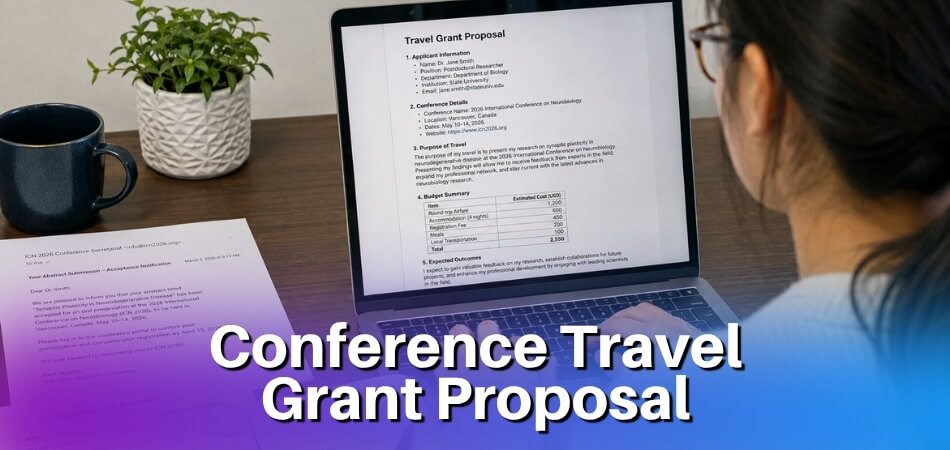
A complete proposal typically contains these parts:
- Cover page: your name, institution, applicant role (student, early-career researcher, faculty), the conference name and dates, and the total amount requested.
- Personal statement: a short narrative on who you are, what you research, and why this conference matters for your academic or professional path.
- Research objectives: your current work, the questions you are investigating, and where the project sits in the wider field.
- Conference relevance: an explicit link between your research and the conference theme, sessions, or community. Committees want to see that this is not a generic request.
- Applicant role: whether you are presenting a paper, a poster, or taking part in another formal capacity. Paper acceptance documents usually belong here.
- Budget justification: a line-by-line breakdown of estimated costs (travel, accommodation, registration, per diem) with a reason for each expense.
- Expected benefit: what you will bring back, such as skills, collaborations, data, or knowledge that strengthens your research program or department.
- Evaluation plan and post-award reporting: how you will judge the value of the trip, plus a brief statement that you will report on what you gained and how the funds were used. Addressing accountability upfront builds trust.
Some international conference travel grant applications also ask for letters of support, an abstract or presentation summary, or proof of institutional affiliation. Others want a CV and a statement of financial need: the NEAIR Memorial Conference Grant guide, for example, asks for an applicant statement of up to two double-spaced pages, a financial need statement with a detailed budget, and a CV (page read October 2026). Check the funding body’s guidelines before you fix your structure.
Conference Travel Grant Proposal Template (Full, Ready-to-Use)
Copy the text in the indented boxes and replace every [bracket] with your own details. Each section has a short note on what the committee looks for, and the sections build on each other, so work through them in order. The word counts in the boxes are suggestions: if the funder sets a limit, cut to it.
Section 1: Cover Page / Header
The cover page is administrative, but a messy or incomplete header tells the committee your attention to detail is low before they read anything else.
Include the following:
- Proposal title: “Conference Travel Grant Application: [Your Full Name]”
- Applicant name: as it appears on your institutional ID
- Institutional affiliation: department, faculty, and university or organization
- Program or degree level: for example PhD candidate, postdoctoral researcher, junior faculty
- Contact information: institutional email, phone number, mailing address
- Supervising faculty or advisor: name and email, if the funder asks for it
- Conference name and dates: full official name, city, country, and dates
- Submission date: the date you submit the proposal
- Requested amount: total funding requested, matching your budget section exactly
If the funder provides its own cover page form, use that and skip this section.
Section 2: Personal Statement / Applicant Background
The personal statement shows who you are and why you are a credible candidate. Keep it focused: reviewers do not need your full academic biography, only the parts that connect to this conference and this funding.
[TEMPLATE: 250 to 400 words recommended]
My name is [Full Name], and I am a [degree level / position] in the [Department Name] at [University/Organization Name]. My research focuses on [brief research area], with particular attention to [specific topic or question].
I am currently [describe your research stage, e.g. “in the third year of my doctoral dissertation” or “completing a postdoctoral fellowship on…”]. My work so far includes [relevant outputs: publications, conference presentations, awards, earlier grants], which show my engagement with this field.
I am applying for this travel grant to attend [Conference Name], scheduled for [dates] in [location]. Attending will let me [specific professional goal: present a paper, join workshops, meet collaborators, etc.].
Short filled example (invented details, for style only):
I am a second-year PhD student in [Department] at [University], studying how small firms in [region] adopt digital payment tools. My paper, ‘[Paper Title]’, has been accepted for presentation at [Conference Name] in [City] on [dates]. I am requesting $[amount] to cover registration, flights, and three hotel nights. The session on [topic] matches my second research question, and I plan to ask [Name], whose work I cite, for feedback on my sampling method.
Section 3: Conference Relevance and Applicant Role
This section answers two questions the committee always asks: why this conference, and what will you actually do there? Both carry equal weight.
[TEMPLATE: 200 to 350 words recommended]
[Conference Name] is [describe the event, e.g. “the annual international conference of the [Association Name]”] and is a main venue for [brief statement of its place in the field]. The 2026 programme focuses on [theme or topic], which matches my current research on [your research topic].
My role at the conference is [describe your participation]:
- If presenting a paper: “My paper, ‘[Paper Title]’, has been accepted for the session on [session topic], scheduled for [date/time if known].”
- If presenting a poster: “I will present a poster on [topic] at the poster session on [date].”
- If attending without presenting: “I will attend as a participant, with the goal of [workshops, panels, or networking aims].”
I plan to attend [two or three specific sessions, panels, or keynotes relevant to your work]. These will directly inform [specific aspect of your research or professional development].
Section 4: Research Objectives and Expected Benefit
Here the proposal moves from description to argument. You explain what your research aims to do and how this conference serves those aims.
[TEMPLATE: 300 to 500 words recommended]
Research Objectives
My current research investigates [state your research question or problem clearly]. The main objectives are:
- [Research objective 1]
- [Research objective 2]
- [Research objective 3, if applicable]
This work contributes to [field or discipline] by [brief statement of significance: fills a gap, extends a theory, has applied use, etc.].
Expected Benefit of Attendance
Attending [Conference Name] will help my research in these specific ways:
[Benefit 1, e.g. “Presenting my findings in [session name] will bring peer feedback while the work is still in progress, so I can use it before finalizing my analysis.”]
[Benefit 2, e.g. “The pre-conference workshop on [topic] teaches [method] that I plan to use in the next phase of my study.”]
[Benefit 3, e.g. “I will meet [collaborator/research group] to plan a co-authored paper that I could not move forward remotely.”]
Beyond this project, the conference will widen my network in [field], show me current work in neighbouring areas, and support my next step: [career goal, e.g. postdoctoral positions, field journals, future grant applications].
Section 5: Budget Justification
A budget justification is more than a list of numbers. It explains why each cost is necessary and reasonable. Western Sydney University’s grant-writing guidance advises saying where each estimate came from (a booking site, for example) and explaining why the trip and its length are needed (page read October 2026). Check the funder’s cap before you build the budget: the Wabash College student grants page, for example, caps conference travel at $1,000 for US travel and $1,200 for international travel per student per academic year (page read October 2026).
[TEMPLATE]
Requested Funding: [Total Amount]
| Expense Category | Estimated Cost | Justification |
| Round-trip airfare | $[amount] | Economy flight from [city] to [city], based on [airline/booking site] quotes dated [date] |
| Conference registration | $[amount] | Early-bird or standard fee as listed on the official conference website |
| Hotel accommodation | $[amount] | [X] nights at [hotel name or “conference hotel”], at $[nightly rate] per night |
| Ground transportation | $[amount] | Airport transfers and local transit, about $[amount] per day for [X] days |
| Per diem / meals | $[amount] | [X] days at $[daily rate], based on [institution’s per diem policy or funder’s stated rate] |
| Visa fees | $[amount] | Visa for [country], current fee as listed by [embassy/consulate] |
| Total | $[amount] |
For an international trip, visa costs, currency exchange, and health insurance are legitimate budget items. Include them if they apply.
Example with made-up numbers (replace every figure with real quotes):
| Item | Example calculation | Amount |
| Airfare | One economy round trip, quote saved on [date] | $600 |
| Registration | Early-bird author fee | $499 |
| Hotel | 3 nights at $150 | $450 |
| Ground transport | 3 days at $30 | $90 |
| Meals | 3 days at $60 | $180 |
| Total requested | $1,819 |
Other funding and financial need (add this if the funder asks):
I have also requested $[amount] from [department or other source], which [has / has not] been confirmed. This request covers the remaining costs of [items]. Without it, I would [be unable to attend / need to cover $[amount] myself].
Ask what the funder will reimburse and what proof it wants. Wabash College, for example, reimburses only receipted expenses, requires itemized food receipts, and does not reimburse alcohol (page read October 2026).
Section 6: Evaluation Plan and Post-Award Reporting
Some funders do not ask for a separate evaluation plan, but a short one makes the proposal feel complete. State what you will measure and when you will report, in two or three sentences.
[TEMPLATE: 80 to 150 words recommended]
After the conference I will judge the value of the trip against the aims above: [e.g. feedback received on my paper, a collaboration started, a method learned]. Within [number] weeks of returning I will send the committee a short report covering the sessions I attended, what I presented, how the funds were spent (with receipts), and the next step for my research, which is [planned output, e.g. a journal submission or a departmental talk]. I will also acknowledge [Funder Name] in any resulting presentation or publication.
Writing Tips: The 4 C’s and 5 R’s of Grant Writing
A proposal can be declined because of how the work is communicated, not because the research is weak. Two simple checklists help: the 4 C’s for the quality of your prose, and the 5 R’s for the logic of your application. They are practical rules of thumb used in this article, not an official standard.
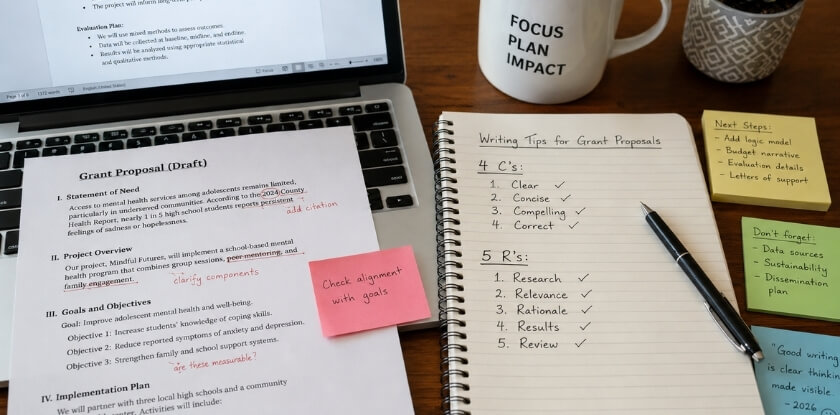
The 4 C’s of Grant Writing
Apply these four to every section, from the personal statement to the budget justification.
Clear. Use plain, direct language. A committee may read many applications in one sitting, and if your objectives need re-reading to understand, you have lost ground. Define discipline-specific terms, keep sentences a manageable length, and put your main argument early in each section.
Concise. Respect the word limits, and set your own if there are none. A personal statement far longer than the guidelines suggest can signal poor editing, not thoroughness. Cut anything that does not support the case for funding.
Compelling. Facts alone do not move a committee. Tie your attendance to a specific outcome: finishing a chapter, starting a collaboration, reaching the right audience with your findings. “This will advance my career” is weak. A benefit tied to your role and your research timeline is persuasive.
Consistent. Every section should tell the same story. If your personal statement says you are in the final year of your doctorate, your expected benefit and evaluation plan should fit that stage. Inconsistency reads as carelessness.
The 5 R’s of Grant Writing
The 4 C’s shape your sentences. The 5 R’s shape the strategy of the proposal.
- Relevant. The application should show why this conference, at this time, is the right use of grant funds. Name the conference, explain what makes it the right venue for your work, and connect it to the goals of your proposal. The question behind it is not only whether you are a capable researcher but whether this event, at this time, deserves the money.
- Realistic. Your budget must reflect actual costs. If registration is $800, do not list $400 to look modest. Committees can look up fees, and underbudgeting raises doubts about your planning.
- Results-oriented. Describe what success looks like afterwards: a paper submitted using the feedback, a collaboration started with a group you will meet. Your proposal should already hint at what you would report.
- Responsible. Accountability matters to committees even at the proposal stage, so acknowledge the funder’s investment. If you received a travel grant before, say how you used it and what came of it.
- Readable. Break up dense paragraphs and use headings if the form allows them. A proposal that looks organized suggests an organized applicant.
Two Review Passes Before You Submit
After drafting, read each section and ask which of the 4 C’s it might be failing. Then step back and ask whether the whole application meets the 5 R’s. Together, these two passes catch many common problems.
How AI Tools Fit Into This Process
AI tools fit best at the drafting and checking stages, and the dedicated section below covers them. Whatever they produce, read it yourself against the 4 C’s and 5 R’s: a draft that passes both checks beats an AI-polished one that skips the strategy.
Travel Grant vs. Research Grant Proposal: Key Differences
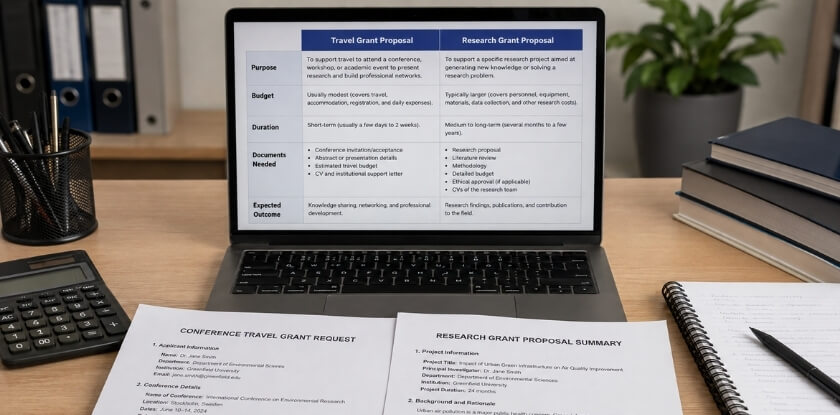
A travel grant proposal is not a shorter research grant proposal. A research grant asks a funder to invest in a project; a travel grant asks whether this specific event will produce a concrete, justifiable benefit.
What Each One Is Actually For
A research grant committee decides whether the science is worth funding: the methodology, expected outputs, and long-term impact. A travel grant committee has a narrower question. The work is already done or under way, and the question is whether presenting or networking at this event is worth the money.
Scope and Scale
Research proposals tend to include literature reviews, full evaluation plans, and multi-year budgets. A travel proposal is much shorter, and the budget covers registration, flights, accommodation, and meals for a short trip, not equipment or staff. The funder’s limit decides the length.
The Role of Paper Acceptance
In a research proposal you are asking for support for work that has not happened yet. Evidence of prior achievement strengthens the case, but the proposal is forward-looking. For a travel grant, paper acceptance is often the central credential, and some programs will not process a request without it (the Texas State Graduate College returns forms that lack the acceptance document, on its page read October 2026). If your paper or abstract has been accepted at an international conference, that letter moves the proposal from “I plan to attend” to “I have been selected to present,” which is a meaningfully different position.
Applicant Role and Institutional Fit
Research grants usually involve a principal investigator, co-investigators, and institutional infrastructure. In a research grant the applicant role is part of a larger team. Travel grants focus on the individual, so your personal statement must show that you, given your career stage, objectives, and access to other funding, are a strong candidate. Some programs are reserved for students or early-career researchers, so check who is eligible.
Conference Relevance vs. Research Merit
In a research grant, scientific merit is the dominant criterion: reviewers assess methodology, feasibility, and expected benefit to the field. In a travel grant, conference relevance carries far more weight. Calling a conference “prestigious” proves nothing. Show why this event, with its theme, audience, and location, connects directly to your work, and that its sessions, speakers, or networking opportunities line up with your specific objectives.
Post-Award Reporting
Research grants bring progress reports and audits that can span years. Travel grant reporting is lighter but still expected: a short report on what you attended, presented, and gained, and sometimes a write-up for a departmental newsletter. Skipping it can affect your eligibility for future funding.
Which Template to Use
To attend and present at an academic conference, use a conference travel grant template, not a research grant template. A research structure makes a travel application feel misaligned and padded. A travel request calls for focused answers to a short set of questions, not a dissertation proposal.
International Conference Travel Grant: Extra Considerations
An international conference travel grant adds visa, currency, and documentation questions, and committees may look at these proposals more closely because the costs are higher. These points apply when the conference is outside your home country.
Visa and Travel Documentation
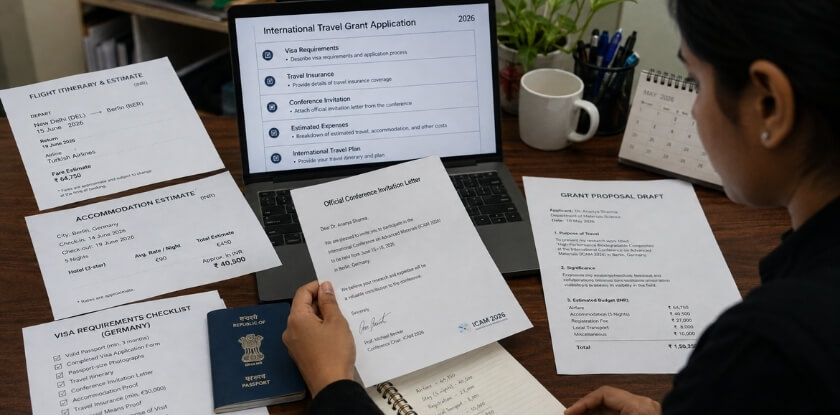
Address visa delays in the proposal. Note the visa requirements for your destination and say that you will start the process well before the conference dates. Some funders may not reimburse costs tied to a visa refusal, so showing awareness of the timeline shows planning. Check the current entry rules for the destination too, because they can change your budget: since 3 August 2026, for example, the US State Department’s visa bond program is permanent, and B-1/B-2 applicants from listed countries can be asked to post a bond of $10,000, $15,000, or $20,000 (Federal Register final rule, 3 August 2026). If your institution requires official travel authorization for international trips, mention it, since it signals institutional backing.
Budget Justification for International Travel
International budgets need more itemization than domestic ones. A single line reading “airfare: $1,200” will not hold up. Break the budget down like this:
| Budget line | What to include | Where to get the figure |
| Airfare | Economy round trip | A real booking search, with the date saved |
| Visa | Application fee | The embassy or consulate website |
| Travel insurance | Policy for the trip dates | An insurer’s quote |
| Accommodation and meals | Per diem for the destination city | Your institution’s approved rates |
| Ground transportation | Transfers and local transit | Local transit or taxi estimates |
| Registration | Conference fee | The official conference website |
If your institution has no approved per diem rates, use a published source. The U.S. General Services Administration publishes per diem rates for the continental United States, and the U.S. Department of State sets them for foreign countries (GSA per diem page, fiscal year 2027, read October 2026). These are government rates for official travel, so ask the funder whether it accepts them. Committees want numbers grounded in something verifiable.
Conference Relevance and Specificity
The bar for explaining relevance is higher for an international event. Is it the leading gathering in your subfield? Does it draw the community you need to reach? Name the session or track where you will present, refer to the programme if it is published, and link the event to your expected benefit and role. Committees see many proposals calling a conference “prestigious”; specifics are what stand out.
Currency and Exchange Rate Risk
If costs will be paid in a foreign currency, say that your figures use the exchange rate on a stated date and that you have added a small buffer for fluctuation. Some funders appreciate this note and others require it.
Post-Award Reporting for International Grants
Reporting can be more detailed for international grants. Expect to submit receipts for major expenses, a short written summary of what you presented or learned, and sometimes evidence of participation, such as a photo of your poster or a screenshot of the programme listing your name. If you used AI tools to draft parts of the proposal, keep notes on what you revised yourself, because the report may be compared with the original proposal.
Institutional Endorsement
Ask your supervisor or department head for an endorsement letter that mentions the international scope of the conference and why it suits your career stage. A letter on why this trip advances your research program is worth more than a generic statement of support.
Using AI Tools (ChatGPT) to Write Your Grant Proposal
AI tools can save time on a travel grant proposal if you use them for drafting and checking, not for facts. The risk is text that sounds polished but generic, which is the wrong result for a personal, committee-reviewed application. Check the funder’s rules too, since some programs ask applicants to disclose or limit AI use.
What AI Does Well Here
- Drafting a starting structure. Give it your conference name, paper title, institution, and funding gap. A specific prompt produces a usable draft; a vague one produces filler.
- Editing for clarity. Paste a paragraph you wrote and ask it to tighten the text or flag unclear sentences. Your voice and details stay intact, which beats asking it to write from scratch.
- Checking logical flow. Ask it to find places where the link between your objectives and the expected benefit is unclear. It catches gaps you stop seeing after the fifth revision.
- Listing budget items you forgot. Registration, visa fees, travel insurance, ground transport, and a currency buffer are easy to miss. Ask for a full list of possible costs, then check which ones your funder permits.
Where AI Falls Short
The personal statement is where AI causes the most trouble. A generic version talks about “advancing the field” and “meaningful professional development” with no detail about your research, your paper, or why this event matters to you. A reader learns nothing about why you need this trip.
Your role and your acceptance details are things only you know. AI cannot supply the right figures, conference name, or description of your contribution, and letting it fill those gaps risks inaccurate claims. That is an accountability problem, not just a writing one. AI also knows nothing about your committee’s priorities, so read the guidelines and write the evaluation and reporting sections yourself.
A Practical Prompt Framework
Structure each prompt in four parts:
- Role: your field, career stage, and institution type.
- Context: the conference name, location, dates, and whether you are presenting a paper or poster.
- Constraint: the word limit, the single section you are drafting, and any criteria from the funder’s guidelines.
- Scope: ask for one section at a time, not the whole proposal. The output is easier to edit into something accurate and personal.
Editing AI Output Before Submission
Treat anything ChatGPT produces as a first draft. Replace every generic phrase (“this conference provides an excellent opportunity”) with a specific one (“the panel on computational ethnography bears directly on Chapter 3 of my dissertation”). Check each budget figure against real quotes or published fees, then run the result through the checklist below like any other draft. AI-assisted does not mean AI-verified, and accountability for the award stays with you.
Checklist Before You Submit
Treat this checklist as a last pass before you click send, and read the timing note first, because a late request may not be considered at all.
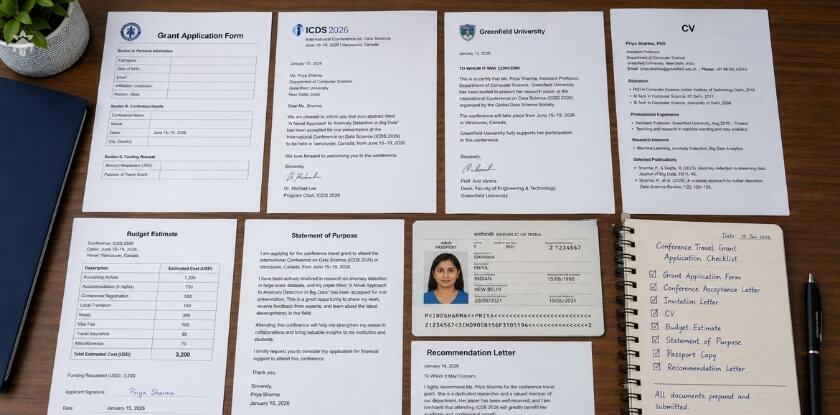
Deadlines and Timing
Submit before you travel, and earlier than the deadline if you can. Some programs do not fund trips after the fact. The Texas State Graduate College says funding is not retroactive and asks for the request, with the acceptance document, no later than 3 weeks before the conference. Wabash College says its committee cannot consider proposals submitted after student travel, needs at least two weeks for most proposals, and wants airfare requests in final form at least six weeks before travel (both pages read October 2026). Your funder’s dates will differ, so find them before you start writing.
Document and Formatting Checks
Page limits and font requirements. Reread the call for proposals. If it says five pages, count yours. If it specifies 12-point Times New Roman with one-inch margins, match that. Some programs may reject over-limit submissions without reading them.
Cover page is complete. Name, institution, department, contact email, conference name and dates, amount requested, and submission date. A missing field signals carelessness.
All required sections are included. Compare the funder’s section list with your document. The evaluation plan, the reporting commitment, and the applicant role statement are the ones people forget when they start from a general template.
Budget justification matches the budget table. Every line item needs an explanation in the narrative. If you list registration but never say why you are attending (paper, poster, invited discussant), add it now.
Signatures and institutional approval. Many applications need a signature from a department chair, supervisor, or grants office. Confirm these before the deadline, not on the morning of it.
Content and Accuracy Checks
Conference relevance is clear. Read that section as if you had never heard of the event. If it could apply to any conference, sharpen it.
Paper acceptance documentation is attached. If the program requires proof of acceptance, attach the official email or letter. Texas State, for example, wants your name, the full title of your work, and the full conference name to appear in it (page read October 2026). Some funders also want the abstract.
Research objectives are in plain language. The committee may not know your field. One unexplained acronym on page one can undermine a strong statement.
Expected benefit is concrete. “This conference will benefit my research” is not enough. Name the sessions, collaborators, or methods you expect to engage with and tie them to your current project.
Accountability language is present. If you promise a summary report, a departmental talk, or a blog post for the funder, make it specific instead of a vague promise to “share findings.”
Final Administrative Checks
File format is correct. PDF is usually safest unless the funder says otherwise, because a Word file can reformat on upload. If AI helped draft sections, read the final file closely for inconsistent capitalization, mismatched headings, or odd phrasing.
The portal accepts your file. Upload a test version if the system allows it. Some portals limit file size or reject certain PDF versions.
You meet the eligibility criteria. Recheck citizenship or residency rules, enrollment status, career stage limits, and previous award limits. For international travel, check whether the funder covers your destination country or excludes certain regions.
A colleague or advisor has read it. Fresh eyes catch what yours will not. Ask for a read focused on the personal statement and budget justification, the two sections where it is easy to assume context that is not on the page.
From our experience at MS International: Some funders ask for proof that you are presenting. At our events, presenting authors submit a paper or abstract for double-blind review (typically about 10 working days) and register as an author if accepted, so the acceptance email is the document to attach. Our event pages list Author Early Bird US$499, Author Regular US$599, and Listener US$499. Registration fees are non-refundable and non-transferable, with rare exceptions only in writing, so check what each event page asks you to pay and when, and compare it with the grant decision date. We do not list fee waivers or travel grants on our pages, so a travel grant would come from your own funder. All our in-person events are in the Greater Toronto Area. For a visa, an invitation letter is issued within 3 to 5 business days after payment clears; it supports an application but does not guarantee approval.
FAQ: Conference Travel Grant Proposals
Drafting a travel grant proposal raises practical points such as whether you need an acceptance letter, how long the document runs, budget justification versus a cost list and reusing one template.
Do I need a paper acceptance letter to apply for a conference travel grant?
Usually yes. Written proof of acceptance is a standard requirement, and the Texas State Graduate College, for example, returns requests that lack it. Ask your funder whether a submission confirmation is enough; if you have neither, say when you expect the decision.
How long should a travel grant proposal be?
There is no standard length, so the funder’s limit decides. The NEAIR conference grant, for example, caps the applicant statement at two double-spaced pages. If no limit is given, keep the proposal short and use the template word counts as a guide.
Can I apply for a conference travel grant if I’m not presenting a paper?
It depends on the program, because some fund only people who present. Others may allow it if you are chairing a session or joining a workshop. Read the eligibility rules, then explain your role clearly and make a strong case for conference relevance and expected benefit.
Is a personal statement required for every travel grant?
Not always, but adding one is usually to your advantage even when optional. A well-written statement lets you speak directly to your research objectives and to why this particular academic conference matters for your work.
What’s the difference between a budget justification and a simple cost list?
A cost list only shows numbers. A budget justification explains why each expense is necessary, how you worked out the figure, and where the estimate came from. It shows that you thought through your spending, not just estimated totals.
Can I use ChatGPT or other AI tools to write my proposal?
Possibly, but check the funder’s policy first, because some programs limit or ask you to disclose AI use. If it is allowed, use it for drafting and clarity checks, and revise in your own voice, because a generic proposal can work against you.
What happens after I receive the grant?
Requirements vary by funder. Common items are a brief summary of what you attended, what you presented, and how the conference connected to your research, plus receipts. Learn these requirements before you travel.
Do the 4 C’s of grant writing apply to travel grants specifically?
Yes. Being clear, concise, compelling, and consistent matters in a travel grant proposal as much as in any research proposal. A short proposal leaves little room for vague writing.
When should I submit a conference travel grant proposal?
Before you travel, and as early as the funder allows. Some programs will not pay for a trip that has already happened, and approval signatures take time. Find the funder’s own deadline first and work back from it.
Is there a standard grant proposal template I can reuse for multiple conferences?
Yes as a starting framework, but you must rewrite the conference relevance section, budget, and personal statement for each application. What worked for one funder will not transfer without revision.
Final Thoughts
Grant committees respond to three things: who you are, why this conference matters to your work, and how the money will be used responsibly. If your proposal is built on those, you are in good shape. Use this template as a starting point, then adapt it to each funder’s guidelines, because a polished but misaligned application loses to a plain one that follows the instructions.