
You’re wearing a name badge, holding a program sheet, and surrounded by a room full of experts with no idea what to say. Plenty of first-time attendees feel that. It fades quickly once you know how these events are put together and what is expected of you.
Quick answer: At your first academic conference, expect a mix of keynote talks, parallel paper sessions, poster sessions, panels and sometimes workshops, with coffee breaks and a social event in between. A session chair keeps time and runs the Q&A. You can attend without presenting. Wear your badge, mark your sessions in advance, keep questions short, and follow up within a few days.
What Happens at an Academic Conference?
An academic conference is a structured event where researchers, scholars and practitioners share work, exchange ideas and meet others in their field. Over one to several days, the program is filled with talks, posters and discussions, with breaks and social time between them.
The Core Formats at a Glance
Most conferences mix several session types, and each one serves a different purpose. The section on the main events below explains how each one works in the room.
| Format | Typical length | How interactive it is |
| Keynote | About 45 to 60 minutes | Mostly listening, a few questions at the end |
| Paper presentation | Often 15 to 20 minutes plus questions | Short Q&A after each talk |
| Panel discussion | Often an hour or more | Moderated debate, then audience questions |
| Poster session | One to two hours | Open conversation, you walk up and talk |
| Workshop | Half a day or longer | Hands-on, small group, often separate registration |
Lengths vary by conference, so treat these as rough guides and rely on the program for the real timings.
The Logistics Layer
Registration gets you into the venue, your name badge and the program schedule. The badge matters more than it sounds: it is your entry to sessions, the conference dinner and any materials covered by the fee. Keep it on.
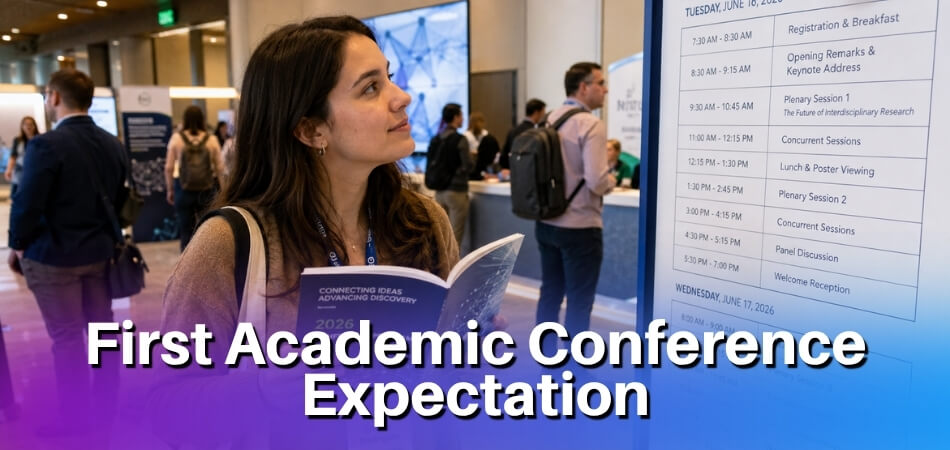
The program (a printed booklet, a PDF or an app) lists every session by time, room and presenter. At a large conference several sessions run at once, so map out your days in advance instead of deciding on the fly.
Conference proceedings, the published collection of presented papers, are often shared digitally with registered attendees during the event or shortly after. Whether a given event publishes proceedings, and in what form, is set by the organizers, so check the event page.
A Typical Day
Programs differ, but a conference day often follows a rhythm like this one. Treat it as an illustration, not a schedule.
| Time of day | What usually happens |
| Morning | Check-in and badge collection, then a keynote or an opening session |
| Mid-morning | Coffee break, then the first block of paper sessions |
| Midday | Lunch, often with a poster session or networking time |
| Afternoon | More paper sessions, panels or workshops |
| Evening | Closing remarks, a reception or the conference dinner |
What the Social Side Actually Looks Like
Networking is not a separate activity you do between sessions, and for a first-timer the social side can feel overwhelming. It happens at coffee breaks, at poster sessions, at the dinner, and in the hallway after a talk you both attended. You do not need to work every room. A few genuine conversations with people whose work connects to yours will serve you better than a stack of business cards from strangers.
What to Do Before the Conference
Register early, read the submission rules if you are presenting, sort out travel, and keep your documents in one place. A conference week goes more smoothly when the logistics are settled before you arrive.
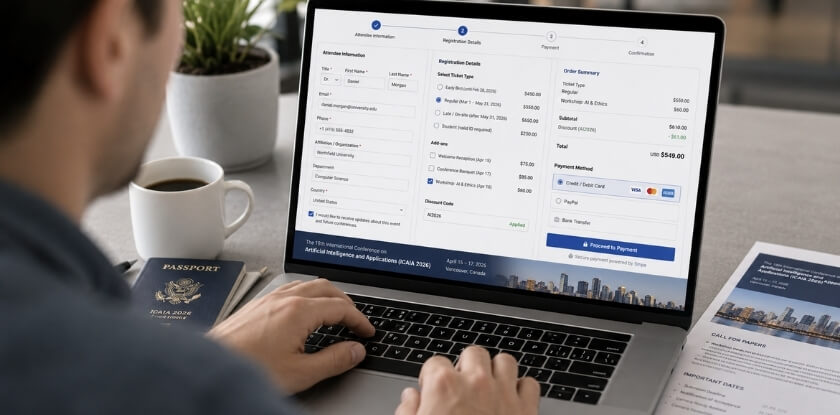
Registration, Abstract Submission, and Logistics
Most conferences open registration months in advance, and many offer an early bird rate. Check the conference website as soon as you know you want to attend and put the early bird deadline in your calendar.
If you are presenting, the abstract deadline usually falls well before registration closes. Read the submission guidelines carefully, because requirements vary: some conferences ask for a short abstract, others for a longer one, and the format (labelled sections or a single paragraph) differs by discipline. Submit on time. Late submissions are often not considered.
Once you are registered, sort out travel and accommodation. Staying close to the venue saves walking time between sessions and evening events. Some conferences arrange a block-rate hotel deal, so ask.
Keep your registration confirmation, hotel booking, travel itinerary and the program together, on paper or in one folder on your phone. Download the conference app if there is one, or print the schedule, because venue Wi-Fi can be unreliable when you are hunting for a room. Also confirm whether your badge will be sent to you to print or collected at the registration desk.
Conference Costs and How to Find Funding
Registration, travel, accommodation and meals add up, and an international trip can cost a lot. There are more funding options than most people expect.
- Travel grants are the most direct source. Professional associations and learned societies often offer them to students, early-career researchers and first-time attendees. Check your disciplinary association, the conference’s own funding page, and your graduate school or research office.
- Research funding from your supervisor or department is worth asking about. If your work is tied to an active grant, conference travel is often an allowable expense. Ask early, because decisions can take time and some departments run annual cycles.
- The conference itself sometimes offers fee waivers or reduced registration for presenters, volunteers or attendees from lower-income countries. If it is not clearly stated, email the organizers.
- Institutional travel funds exist at many universities for student and staff conference attendance. Your department administrator can tell you how to apply.
Apply for everything relevant at the same time and keep records. If you receive more than one source of funding, you may need to declare them.
What to Pack: A Complete Packing List
Beyond clothes and toiletries, a conference has its own short list.
For professional use:
- Business cards, if you use them. Include your name, institution, role and email. They are still quick in a noisy reception.
- A notebook and pen. Handwritten notes help you retain a talk, and laptops are awkward in crowded poster halls.
- The program schedule with your chosen sessions already marked.
- Your presentation files on a USB drive and in cloud storage, so you are not relying on a single copy.
- Comfortable shoes. You will walk more than you expect between session rooms, poster halls and catering areas.
For day-to-day practicality:
- A reusable water bottle, since conference rooms are often dry.
- A portable phone charger for the schedule, photos of posters and contact details.
- A tote bag or light backpack for programs and handouts.
- Snacks, because sessions sometimes run over mealtimes.
For travel specifically:
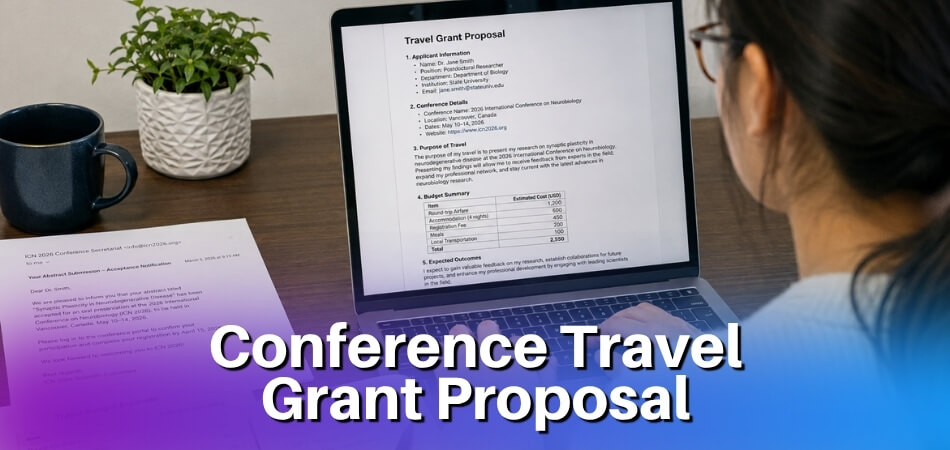
- Copies of your registration confirmation and any travel grant paperwork, in case you need them for reimbursement.
- Your institution’s travel insurance details, if applicable.
- Local currency or a card with low foreign transaction fees if you are travelling abroad.
Dress code is easy to forget. Business casual is a safe default at many academic conferences. Fields such as law, business and policy often lean more formal, and presenters usually dress a step above other attendees, for example with a blazer or jacket. A reception or dinner may call for something smarter, so check the program. Choose comfortable closed-toe shoes you can stand in all day. Photos from the previous edition on the conference website show what people actually wear, and if you are unsure, ask the organizers.
The Main Events at a Conference: What Each One Actually Is
Keynotes, paper sessions, posters, panels and workshops each work differently, and knowing which is which makes the program look much less crowded.
Paper Presentations and Keynote Sessions
A paper presentation is the workhorse of any conference. A researcher stands up, usually with slides, and spends roughly 15 to 20 minutes on the research question, methods, findings and implications. Questions from the audience and the session chair follow, often for five to ten minutes. Time for questions varies, so the program or the chair will tell you.
Sessions are grouped by theme, so you will often sit through three or four related talks in a row. You do not need to have read anyone’s work beforehand. Listening and taking notes is enough.
A keynote is different in scale. The speaker is usually a senior or well-known figure invited to address the whole conference, not just one room. Keynotes open or close major days, tend to run 45 minutes to an hour, and are usually non-interactive: you listen, take notes and applaud. They are scheduled to draw everyone, often first thing in the morning or right after lunch, and they are broader and more reflective than a standard paper talk. Think of one as the conference’s way of setting a tone or pointing to where the field is heading. They are a good way to orient yourself on day one, and you do not need to know the speaker’s work to get something out of them.
Poster Sessions
Poster sessions can look confusing at first glance. Researchers print a large visual summary of their work and stand beside it in a big room or hallway for an hour or two while attendees walk around, stop and chat.
There is no formal presentation. Poster halls are louder and more informal than session rooms. You browse at your own pace, stop at anything that interests you and talk directly with the researcher. For a first-time attendee this is often the easiest place to practise networking, because the poster gives you an obvious conversation starter. Posters also let researchers share early-stage work that is not yet in print, so you get a look at what is coming in the field. Some events add a short poster pitch of a few minutes before the poster hall opens, so check the program for it.
Panel Discussions and Workshops
A panel brings three to six researchers or practitioners together on a shared theme, usually without individual papers. It is a good place to see where a subfield is debating itself. A moderator guides the conversation, panelists give their views, and the floor then opens for questions. Because panelists often disagree or approach a problem differently, a panel can show you debates and open questions that a single paper would not.
Workshops are usually separate half-day or full-day sessions and may need their own registration. They are smaller and hands-on: you might work through a method, discuss a set of readings or practise a skill. The lower head count means more interaction with the people running it. If one matches your topic, sign up early, because places can fill quickly.
Etiquette: Q&A, Session Chairs and Everyday Manners
The unwritten rules are simple: be on time, keep questions short and aimed at the presenter, and respect the schedule. Most of the etiquette at an academic conference comes down to those three habits.
What a Session Chair Does
The session chair manages the room, introduces each speaker, keeps time and moderates the Q&A. If you have a question, address it to the presenter, not the chair. If you are presenting, confirm your slot with the chair before the session starts. Chairs often warn speakers when time is nearly up, with a card or a sign, and may ask the first question if the room stays quiet. Practices differ, so follow the chair’s instructions.
Asking Questions
Wait for the chair to open the floor. Keep the question to one or two sentences, and make it a question rather than a short talk of your own. If you have a longer thought, find the speaker afterwards. Questions in Q&A are also an easy way to start a later conversation, which the networking section below picks up.
Arriving, Leaving and Phones
Arrive before the session starts and take a seat near the door if you plan to move between rooms. Slipping out quietly between speakers or during a natural pause is acceptable. Leaving in the middle of a talk is disruptive, so wait for a break if you can. Silence your phone, and avoid filling your laptop screen with unrelated work in the middle of a room. If you are speaking, stay for the other talks in your session; it is courteous, and it gives you better questions to ask afterwards.
Networking: How to Introduce Yourself Confidently
Networking can feel intimidating at a first conference, yet the conversations in hallways and coffee queues often turn out to be worth more than any single session. The aim is not to impress everyone. It is to have a handful of genuine exchanges with people whose work connects to yours.
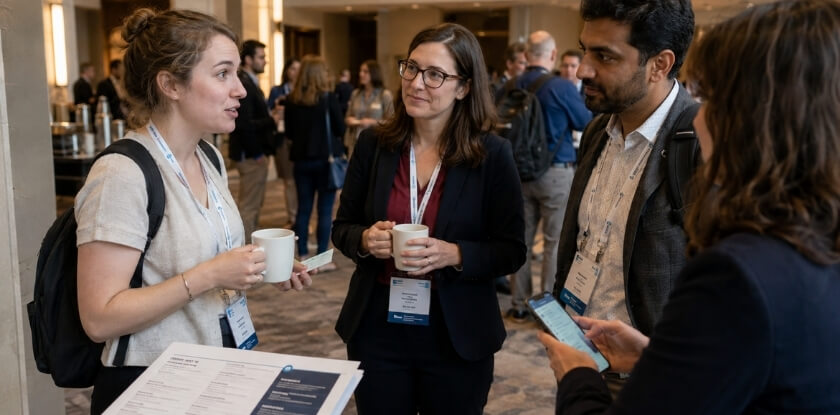
What to Say When You Introduce Yourself
It is easy to freeze with no ready answer to “So, what do you work on?” Prepare a two-sentence version before you arrive, for example:
“I’m a [PhD student / researcher] at [University]. My research looks at [topic] in [setting].”
That is all you need. Then ask about them. A simple “What brings you to this one?” or “Did you present something here?” carries a conversation forward without effort.
Using Your Name Badge as an Icebreaker
Other attendees read your badge, and you can read theirs. If it shows an institution you recognise or a research area that overlaps with yours, mention it. A line like “I saw you’re at [Institution], do you work with [Professor / group]?” opens a conversation and shows you did some reading. Plenty of people around you are first-timers too, and even senior researchers remember how it felt.
When and Where Networking Actually Happens
Formal networking sessions are useful, but most real connections happen at unstructured moments: coffee breaks, the registration queue, lunch seating, the reception after the keynote. Two or three good conversations a day is a realistic outcome for a first-time attendee.
If someone asks a Q&A question that connects to your own research, approach them afterwards: “Your question about [topic] is close to something I’ve been working on.” The same works after a poster conversation. Five minutes at a poster gives you enough common ground to swap contact details.
Step Away From Your Own Group
Sitting with your supervisor or lab group all day is comfortable, but a conference is one of the few places to meet people you would not otherwise. Share a meal with your group, then spend part of each break with someone new. If your supervisor offers to introduce you to a senior researcher, say yes.
Exchanging Contact Details
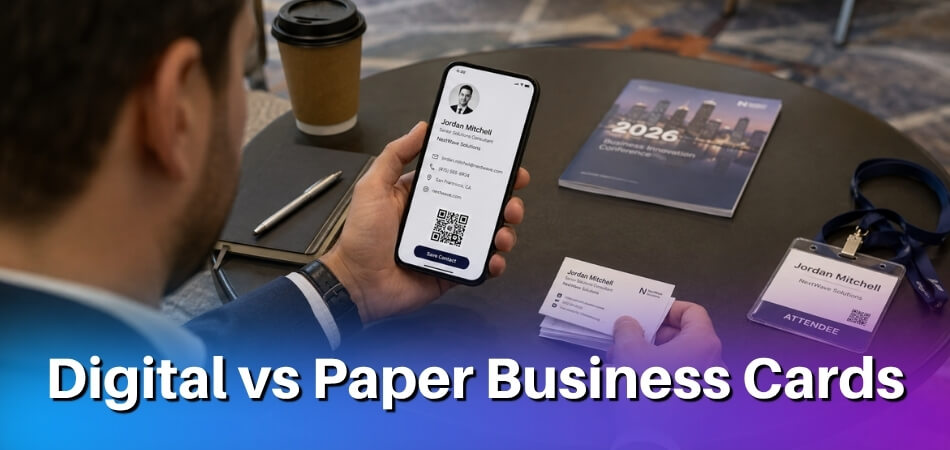
Carry business cards if your institution provides them, but do not worry if you have none. Most researchers are just as happy to connect on LinkedIn or swap emails typed into a phone. When you meet someone worth keeping in touch with, jot a note about what you discussed. Across a two- or three-day event that note makes your follow-up far more specific than a generic “great to meet you.”
A Note on Senior Researchers
Senior academics can seem unapproachable, and some are busy, but most are at the conference because they want to meet new people and new work. If a keynote speaker’s work is directly relevant to yours, it is fine to introduce yourself after the talk. Keep it brief, be specific about the connection, and do not take it personally if they are pulled away. One precise, informed comment about their work lands better than general flattery.
How to Take Notes and Actually Learn at a Conference
Write down your own reactions and the names and papers you want to chase, not the talk itself. Slides are often shared afterwards and many events circulate proceedings, so the content is not going anywhere. What disappears fast is your own thinking.
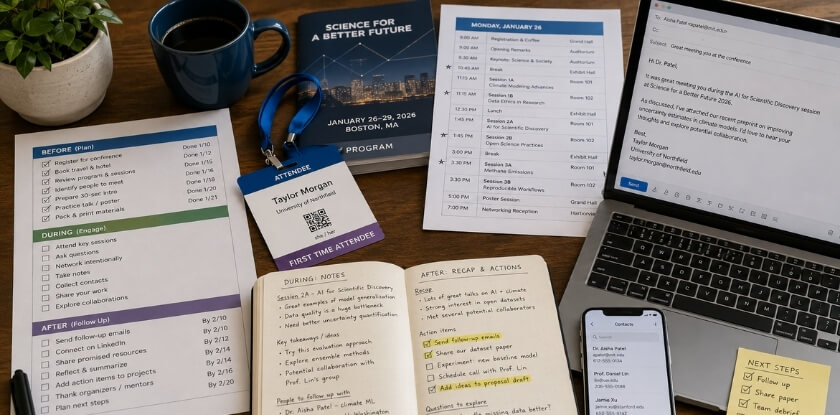
What to Actually Write Down
- Your own connections. When something a speaker says links to your research, note it immediately.
- Questions to follow up. If you hear a question that reframes something for you, note it. If you ask one, write down the answer.
- Names and context. After meeting someone, record what they work on, what you discussed and whether you promised to send something.
- Session details. Title, speaker and one or two key claims, enough to anchor the memory later.
Paper vs. Digital
Both work. The risk with a laptop is context-switching: you open it for notes and end up checking messages. A notebook keeps you present. If you prefer typing, keep one dedicated document open and close everything else. Voice memos can help too, since a thirty-second recording while walking to the next room can capture more than five minutes of reconstructing it later.
Processing Notes After Each Day
Do not leave this for the flight home. Spend about fifteen minutes each evening going through your notes: flag what matters, add context while it is fresh, and pull out action items such as papers to read and people to contact. The program can help you rebuild the sequence if your notes are thin.
Making the Learning Stick
What you hear only sticks if you do something with it. Share two or three takeaways with a colleague, write a short reflection, or update your own research notes. The first-timer mistake is treating the conference as the end point. The sessions, poster conversations and workshop exercises feed into your work afterwards. Feedback is part of that: people outside your own supervisory team may notice things your colleagues missed, which can help before a journal submission or a thesis defence.
Social Media and Online Engagement During a Conference
Many academic conferences have an online conversation running alongside the in-person event, usually under a hashtag. Using it lightly helps you follow what is happening in rooms you are not in.
Find the Conference Hashtag Early
Look up the official hashtag before you arrive. It is often listed in the confirmation email, the program or on the event website. Search it on X (formerly Twitter) to see which sessions people are excited about, any room changes, and who is posting live from keynotes. Following it during the event helps you track rooms you cannot be in and sometimes surfaces introductions worth making. If you use X for academic work, sharing your handle alongside the hashtag makes you easy to find afterwards. Posting with the hashtag also puts your observations in front of people who could not attend, and thoughtful posts about a panel or a poster can bring new connections.
What to Actually Post
A few targeted posts do more for you than a flood of low-effort ones.
- Quote something from a keynote. Credit the speaker by name or handle. Researchers often appreciate being quoted and may reply.
- Share a question you did not get to ask. The speaker or another attendee may answer, and it shows you were engaged.
- Mention your own session briefly. A post with your session time and a one-line description helps people find you. Do not over-pitch.
Avoid live-posting unpublished findings from other people’s talks unless the speaker has said it is fine. Some researchers present work that is not yet in print, and sharing it without permission is bad form.
LinkedIn vs. X: Different Audiences
X tends to be the fast channel during the event, because the hashtag conversation moves quickly. LinkedIn suits the follow-up: connecting with people you met and sharing a short reflection afterwards. Sending a LinkedIn request with a personal note while the event is fresh works far better than a cold message weeks later.
Don’t Ignore the Offline Signals
The online conversation complements being in the room; it does not replace it. If you are halfway through a post while the chair opens the Q&A, you are probably missing something. A reasonable rhythm is to take notes during sessions, post something during a break, then put the phone away and talk to people. The hashtag stays active for days, so a reflection can wait.
Tips for Presenting a Paper or Poster
Rehearse with a timer, lead with the problem, and be ready to say “that’s outside the scope of this study” when you do not know an answer. Presenting for the first time is nerve-wracking, but the audience is almost always on your side because they are researchers too.

Giving an Oral Presentation
An easy first-timer mistake is writing a paper and reading it aloud. A conference talk is a spoken argument, not a recitation. Your slides should guide the audience through your reasoning, not display every word.
Know your time limit and respect it. Slots are often 15 to 20 minutes with a few minutes for questions, but check yours. Running over is rude to the next speaker, and the chair may cut you off before your conclusion.
Open with the problem, not the background. Audiences disengage when a talk starts with three slides of literature review. Say what you were trying to solve, then how you got there.
Slow down on your key finding. Nervous presenters rush the most important result. Pause before it, say it clearly, and give people a moment to absorb it.
Prepare for Q&A honestly. You do not need an answer for everything. “That’s outside the scope of this study, but it’s a good direction” is acceptable. The chair manages the clock, but you control how you handle a tough question. Stay calm, do not argue, and if a question is unclear, ask for clarification before answering.
Presenting a Poster
A poster means many short, repeated conversations rather than one long talk. People glance at your poster and decide within seconds whether to stop, so the title and main visual have to do the work.
Design for skimmability. Use large fonts, clear section headers and one strong figure or table showing your main result. Aim for a layout someone can follow in about a minute without your help.
Prepare a two-minute verbal summary. When someone asks “so what’s this about?”, have a clean, conversational answer ready, and practise it until it stops sounding rehearsed. For example:
“I’m looking at how [X] affects [Y] in [group]. We found the link is [stronger / weaker] than earlier studies suggested, especially when [condition].”
Bring a handout if you can. A one-page summary with your contact details and key findings, perhaps with a QR code to the full paper, gives interested people something to take away.
Stay by your poster. Wander off and you will miss the people who came to find you. Bring water and plan to be on your feet.
Handling Nerves
First-time presenters often feel underprepared, and experienced researchers get anxious before presenting too. The audience is not there to pick holes in your work. They are there because the topic matters to them. If your mind goes blank at the start, take a breath and look at your first slide. The first 30 seconds are the hardest; after that, your preparation takes over.
Visit the room the evening before or early on the day. Check the screen size, find the clicker, and see where you will stand. Knowing the physical space removes one layer of uncertainty. Whatever happens, whether a fumbled answer or a slide that will not load, the session ends and life continues. One presentation does not define your research.
Local vs. International Conferences: Key Differences and How to Prepare
A local or national conference is usually the gentler first step, while an international one adds travel, cost and scale. The formats are the same either way; the preparation is what changes.
| Point | Local or national | International |
| Size | Smaller, often a day or two | Larger, several parallel sessions |
| Cost | Usually lower fees and travel | Higher fees, flights, accommodation |
| Atmosphere | More relaxed, easier to approach speakers | Busier, you have to make the first move |
| Preparation | Little beyond registration | Passport, possibly a visa, insurance, time-zone recovery |
Local and National Conferences
These are usually the better starting point. They are smaller, cheaper and less demanding logistically, and you are more likely to know a few faces already. The sessions follow the same structure, but the atmosphere is often more relaxed, the chair keeps things moving with less formality, and it is easier to approach speakers afterwards. If you are thinking of submitting work for the first time, the abstract process is the same and the stakes often feel lower.
International Conferences
An international conference raises the logistics on every front. You need a passport, possibly a visa, travel insurance and accommodation sorted well in advance. Flights alone can put the trip out of reach without a travel grant or research funding, so look into both early. Many institutions have funds for early-career researchers attending their first international event.
Register early. Fees can be steep, and the early bird rate usually saves money. Missing the deadline is an avoidable cost.
Allow for time zones. If you cross several, add a day to adjust. Dense sessions are hard to follow while jet-lagged.
Plan the program. Many parallel sessions run at once. Download or print the schedule, mark your sessions and note the keynotes you do not want to miss.
Be active when networking. In a large pool of researchers no one will find you. Keep your badge visible and use the hashtag and LinkedIn to connect with attendees before the event starts.
Language. Most international academic events run in English, but not everyone is a native speaker. Speak clearly in Q&A, avoid dense idioms when introducing yourself, and do not read a short reply as disinterest. A follow-up message often works better than expecting a long conversation in the moment.
Proceedings and visibility. How much a conference paper counts depends on your field and the specific event. Your supervisor can tell you which venues carry the most weight in your area.
What Both Have in Common
At any scale you need your registration details, a copy of your badge information and a look at the program before you arrive. Workshops and poster sessions work the same way whether you are at a two-hundred-person national event or a two-thousand-person international one, and the skills in this guide apply equally to both.
How to Split Your Time Between Small and Large Events
Use large events for breadth and small ones for depth and access. Keynotes tell you where the field is heading, while workshops and small panels are where you can ask a specific question and speak to someone afterwards.
Understand What Each Format Actually Gives You
A workshop with fifteen people is where you get a real answer to a specific question. A small panel is where you can catch a panelist afterwards without fighting through a crowd. Those smaller moments are often where the most useful conversations happen, sometimes with a session chair who knows everyone or a researcher working on something close to yours.
Build a Rough Priority List Before You Arrive
Go through the program and mark three groups: sessions you will not miss, sessions you want if timing works, and sessions that sound interesting but are not essential. You do not need a minute-by-minute plan, but tiers stop you drifting through the day and realising at 4pm that you missed everything you came for.
Keynotes rarely force hard choices because they usually do not compete with much. The real decision comes when a workshop you want overlaps with a relevant panel. If the proceedings will include the panel’s papers, you can read them later and attend the workshop in person.
Give Smaller Events More of Your Time Than You Expect
First-timers often spend most of the day in big rooms because it feels safer: easy to slip in and out, no obligation to speak. That instinct is understandable, but it costs you. Workshops and small-group sessions are where your badge starts to mean something, because people remember who was in the room with them. If you are presenting a poster, the people who stop to talk are far more likely to become real contacts than anyone who heard you mentioned in a keynote. For most conferences, aim to spend more of your time in smaller sessions than in large ones, and adjust to your goals.
Work Around the Energy Dips
Long conferences have low-energy stretches, usually after lunch and late on the second day. Large keynotes are hard to absorb when you are tired. If your focus drops, switch to something interactive, such as a workshop or an informal networking lunch, rather than another hour of passive listening.
Don’t Over-Schedule Yourself
Gaps are not wasted time. Some of the most useful conversations happen in hallways, over coffee or between sessions. If every hour is blocked, you cannot follow up on a conversation that is going well or attend something a fellow attendee just recommended. Build in at least one unscheduled hour a day. Pacing yourself across a two- or three-day event matters more than seeing everything on the program.
After the Conference: How to Follow Up Effectively
Send follow-up emails within 48 to 72 hours of returning, while the conversations are still fresh. It is easy to stop once you are home with a stack of cards and a notebook full of scribbles. The people who build lasting connections from a conference do not.
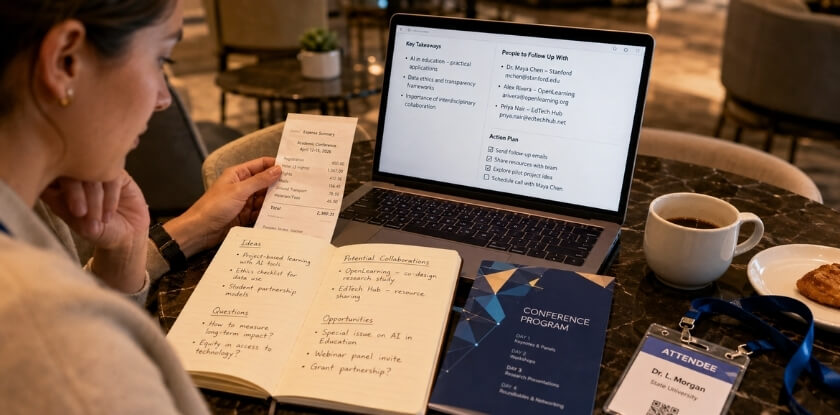
Send Follow-Up Emails While the Conversations Are Fresh
After a few days, context fades for you and for them, and a note sent two weeks later is far less likely to get a reply. Reference something specific: the paper topic you discussed, the Q&A you were both in, or the workshop idea they mentioned. A basic structure works well:
- One sentence reminding them who you are and where you met
- One sentence on what you talked about
- One sentence on what you would like next, such as a paper swap, a LinkedIn connection or simply staying in touch
A sample:
Hello [Name], we spoke after the session on [topic] at [Conference]. I wanted to share [the paper / resource] I mentioned. I’d be glad to stay in touch about [shared interest]. Best wishes, [Your name]
Keep the whole email under five sentences. Researchers are busy, and brevity shows respect for their time.
Connect on LinkedIn and X
Send connection requests while your badge is still fresh in their memory, with a short note instead of a blank request. On X, follow the people you met and join in on their conference posts. If you want to share what you learned, a short LinkedIn post works well and signals professional engagement to anyone viewing your profile.
Organize What You Learned
Before your notes turn into noise, separate ideas you want to apply to your research from references to track down, such as papers mentioned in keynotes or datasets cited in a workshop. Write a short list of your two or three main takeaways. If a travel grant or research funding paid for your attendance, you may need to submit a brief report anyway. Expect some catch-up work on return, such as reimbursement claims and emails, and plan time to rest.
Share What You Learned With Your Lab or Department
If colleagues could not attend, a short informal debrief is valued. You do not need to recap every panel. Highlight the work most relevant to your field and anything from the keynotes worth flagging. Updating your supervisor on what you learned and whom you met is a good habit. Some departments treat a debrief as standard after an international conference, and even if yours does not, offering to do it positions you well.
Check for Conference Proceedings
If papers from sessions you attended were not available beforehand, check the official conference website a few weeks after the event. Bookmark them, especially if you plan to follow up with someone about their published work. Whether proceedings exist for a given event is decided by the organizers.
Plan Ahead for Next Year
Early bird registration and abstract submission for the next edition are often announced soon after the current one closes, and the early rate can be worth having. Join the conference mailing list before you close the tab. If someone mentioned a funding lead or travel grant in conversation, follow that up as well.
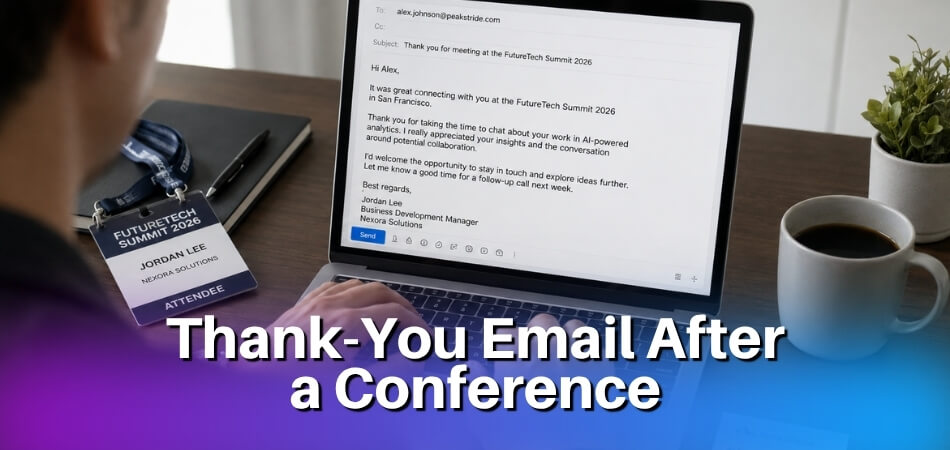
From our experience at MS International: Our conferences are in person and held in the Greater Toronto Area. You can register as a listener without presenting a paper, which suits a first visit. Presenting authors submit their work, which goes through double-blind review (about 10 working days), and they register after acceptance. On the day, the moderator introduces each speaker, and approved speakers receive a certificate after presenting. If you need a visa to reach one of our events, the invitation letter is issued within 3 to 5 business days after payment clears; a US$50 fee may apply to corrections after issue, and the letter supports a visa application but does not guarantee approval.
FAQ: What to Expect at Your First Academic Conference
Heading to your first academic conference? Dress, leaving a session early, poster sessions versus panels and whether you must present are the points newcomers puzzle over.
Do I need to present a paper to attend?
No. You can usually attend without presenting, and many attendees come purely to learn, network and explore the field. Presenting normally means submitting an abstract or paper for review first, while attending needs only registration, though rules differ by event.
What’s the difference between a poster session and a panel discussion?
In a poster session, researchers stand beside printed displays and attendees wander through and chat informally. A panel is a scheduled session where several speakers address a shared topic, usually followed by audience questions.
How formal are academic conferences?
It varies. Large international conferences tend to be more structured and formal than small local ones. Keynotes are usually the most formal part, while workshops and poster sessions are often quite relaxed.
What should I wear to an academic conference?
Business casual is a safe default, with comfortable shoes for long days. Dress slightly smarter if you are presenting. Photos from the previous edition show the local norm, and the organizers can tell you if the event has its own rules.
Should I stay with my supervisor or lab group the whole time?
No. Spend some time with them, but use breaks and meals to meet new people. Meeting researchers outside your own group is one of the main reasons to attend.
I don’t have a business card. Is that a problem?
No. Connect on LinkedIn during or right after the conversation, or type your email into the other person’s phone. Cards are optional.
What should I do if I miss a session I wanted to attend?
Check whether the proceedings, slides or a recording will be available, since some conferences share them. The conference hashtag on X can also surface notes from sessions you missed.
Can I attend sessions outside my specific research area?
Yes, and it is often worth doing. Keynotes are designed for a broad audience, and workshops sometimes teach methods that carry across disciplines.
When should I register to get the best rate?
As early as you can once the program is confirmed and your funding is clear. Early bird registration can close weeks or months before the event, so check the deadline on the conference page.
Is it rude to leave a session early?
Not if you leave quietly between speakers or at a natural pause. Walking out halfway through a sentence is what draws attention, so wait for the break.
What’s a session chair and should I interact with them?
A session chair runs the room: they introduce speakers, keep time and moderate the Q&A. Address questions to the presenter, not the chair. If you are presenting, confirm your slot timing with the chair beforehand.
Should I follow up with everyone I meet?
No. A brief email within a few days is enough for anyone you had a real conversation with. Focus on connections where there was a genuine reason to stay in touch.
Final Thoughts
Your first academic conference will probably feel overwhelming at some point, and that is normal. You will not catch every session, you will not have a brilliant question every time, and you will likely get lost looking for a room. None of that matters as much as showing up, paying attention and making a few genuine connections. Give it one event, and you will leave knowing far more than any guide can teach you.