
Your abstract is accepted, but the flight, the hotel and the registration fee are not covered. That gap stops a lot of early-career researchers from presenting work they have earned the right to present. A conference travel grant exists to close it, and they come from more places than a single search will show.
Quick answer: To get a conference travel grant, check your university’s graduate school and department first, then your professional society and the conference’s own awards. Many programs ask for proof that your abstract was accepted, a short proposal, an itemized budget and one recommendation letter. Apply as soon as you are accepted, because many deadlines fall weeks before the event, and confirm early whether the money is paid in advance or reimbursed.
Last verified against official sources: October 2026.
How a Conference Travel Grant Works
A conference travel grant is money from a university, a society, a funder or the conference itself that covers part or all of the cost of presenting at a conference: flights, hotel, registration and sometimes meals. You apply, a committee decides, and the money arrives either before the trip or, more often, after it.
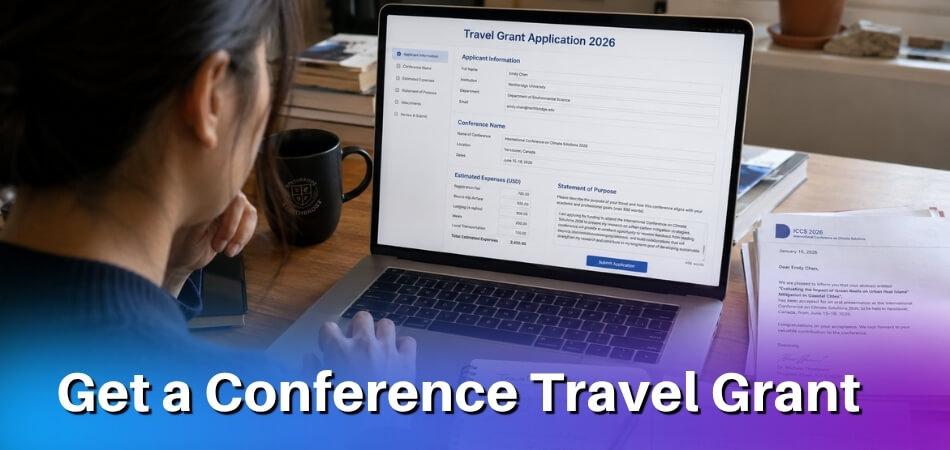
The process usually has five stages:
- Locate funding. Start with your own institution (university and department grants). Outside funders are more competitive and slower.
- Confirm eligibility. Your student level, your membership status and whether you have an accepted abstract all matter.
- Write the proposal. Say why you are attending, what you are presenting and why the money is needed. Attach an itemized budget based on real prices.
- Submit supporting materials. Usually a recommendation letter and proof of abstract acceptance.
- Receive the funds. Find out before you book anything whether the grant reimburses against receipts or pays upfront, so you are not left carrying a large bill for weeks.
Lists of funders from search engines or AI tools go out of date quickly, so confirm every deadline and eligibility rule on the funder’s own site. A society in your own field is often worth contacting before a broad federal program. If you are not funded, department travel pools, conference fee waivers and a stronger second application are all worth trying, and they are covered below.
What Is a Conference Travel Grant and Who Qualifies
Many travel grants go to people who are presenting, and the rules differ by student level and by presentation type. Some grants are competitive. Others are close to automatic if you meet a checklist, and that difference changes how much effort the proposal needs.
These grants exist because researchers presenting a first paper, often students, may not have the money to travel. They are an investment in your participation, not charity.
Undergraduate vs Graduate Applicants: Separate Eligibility Pools
Most funding bodies treat undergraduate and graduate applicants as separate pools, so an undergraduate is not competing against PhD students.
For undergraduates, reviewers look for faculty support, a real presentation and a clear benefit from attending. Honors colleges, undergraduate research offices and individual departments often hold travel funds, and it costs nothing to ask them.
For graduate applicants the expectation is a visible intellectual contribution. Applicants are usually asked to show how the conference connects to their research direction or dissertation, and some programs separate master’s students presenting early findings from PhD candidates presenting chapter work.
Read the fine print on who counts. Some programs say “graduate student” but mean doctoral students only, and others exclude students who have finished coursework or already defended. Some outside programs also expect your institution to co-sponsor or match part of the funding, which is worth checking with your grants office before you apply. Location can matter too: the two 2026 NSF-funded student travel awards named below are open only to students at US institutions.
Which Presentations Are Usually Funded
Many grants require you to be presenting, not just attending. The format can affect how competitive you look.
- Paper presentations are often the clearest case, especially when the abstract went through review. State it clearly in your proposal.
- Posters count too. If yours was selected through a competitive review, say so, because a reviewed poster may carry more weight than an open-call board.
- Symposia are fundable if you organized one or present within one, as long as you name your own role. Reviewers fund your contribution, not the session in general.
- Juried competitions, common in design, architecture and fine arts, are usually treated like paper presentations because the jury is external review.
Attending without presenting, chairing a session only, or joining a pre-conference workshop with no presentation usually does not qualify, though some programs make exceptions. If your acceptance letter names the format, attach it so the reviewer does not have to guess.
Where to Find Conference Travel Grants
Start looking earlier than you think you need to, because deadlines often fall weeks or months before the conference. Search three places at once: your institution, outside funders and the conference organizers.
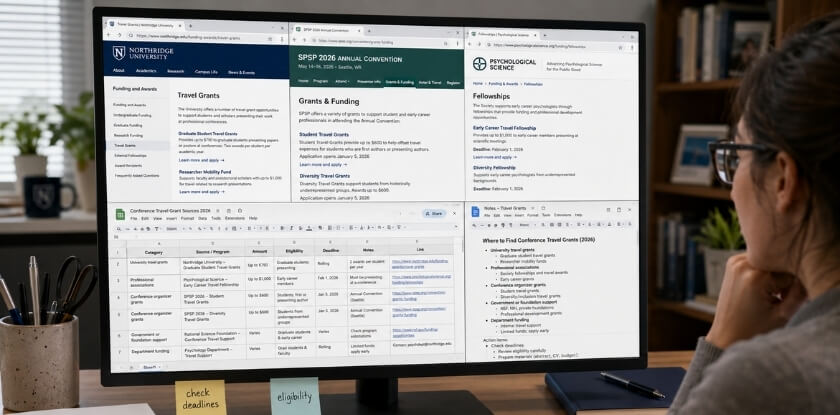
The table is a rough planning guide to how these sources are usually set up, not measured data. Competition and speed vary by program, so check the rules of each one.
| Source | Typical competition | What it usually asks for | Speed |
|---|---|---|---|
| Department or honors college | Low | Proof of acceptance, short form | Fast |
| Graduate school or provost office | Medium | Acceptance, budget, advisor support | Medium |
| Professional society (student award) | Medium to high | Membership, statement, acceptance | Medium |
| Conference travel award or fee waiver | Varies | Accepted abstract, sometimes membership | Deadline often near abstract date |
| Government funder program | High | Full proposal, institutional sign-off | Slow |
University and Department-Level Grants
Your university is often the fastest source. Many institutions run standing travel programs through the graduate school, the provost’s office or student government, and some departments keep their own funds on top of that.
Check your graduate school’s website for terms like “graduate student travel award” or “conference funding.” If nothing turns up, email your department’s graduate coordinator. These programs are not always easy to find. Undergraduates should ask their honors college or undergraduate research office.
A few practical points about internal funding:
- Awards are often modest and amounts vary widely, so read the actual program. Published examples are in the table further down.
- Many require proof of abstract acceptance first. Some accept an application earlier and release money only after you send proof, so read the rules before deciding when to apply.
- Some schools expect you to use internal options before applying for outside money.
If your department has a graduate student association, ask them as well. They sometimes control a small discretionary fund that moves faster than official channels.
External Funders: Government Programs and Professional Societies
Once you have mapped the internal options, look outside. These programs vary a lot by field, but the pattern is similar.
Government funders such as NSF often put travel money into awards that conference organizers run for students, so you apply through the conference, not through the funder. Two 2026 examples are the IISE Annual Conference NSF Student Travel Award (deadline 30 April 2026) and the IEEE/ACM CHASE 2026 NSF travel award, which is in the table further down. If a conference’s registration pages mention funder-supported travel awards, apply there.
For a direct outside grant, your best leads are these:
- Your field’s main professional society, which usually has a travel award for student members
- Specialty divisions or interest groups inside a larger society, which are often less competitive than the top-level award
- Foundations tied to your research topic, such as health, environment or area studies
Applications here can be more involved than internal ones: a short statement of purpose, a description of your research and an itemized budget, and sometimes an advisor letter. Search your society’s “awards” or “grants” page, then search the conference name plus “travel award” and filter to the past year.
Awards and Registration Waivers From the Conference Itself
This is the source most people overlook. Larger academic conferences, symposium-style meetings and juried competitions sometimes fund accepted presenters directly. Look at the registration page and any “support” or “awards” section for:
- Student travel awards, often reserved for authors of papers or posters
- Registration waivers, which remove the conference fee entirely
- Presenter stipends, a flat contribution some conferences give to invited or accepted presenters
Eligibility differs by event. Some awards are for graduate students only, some require membership in the hosting organization, and a few require a competitively reviewed paper.
The application window for conference-run awards often opens around the abstract deadline, sometimes earlier. Read the funding page when you submit your abstract so you know what to prepare if you are accepted. Poster presenters should not assume they are ineligible, and if the wording is unclear, a short email to the organizers is the quickest way to get a clear answer.
Published Examples: What Real Programs Offer
The four programs below were read on their own pages for this article. Amounts are quoted as printed there, and none of the pages names a currency beside the dollar sign. Programs change every year, so use them to see the pattern and confirm current terms yourself.
| Program (page read, year) | Amount as printed | Key conditions | Timing and payment |
|---|---|---|---|
| Flinders University research student conference travel grant (page updated 30 April 2026) | Up to $2,500 for international travel, up to $500 for domestic | Research students presenting a paper or poster; supervisor support; you may apply before acceptance, but funds are not awarded until you provide evidence of it | Apply at least 6 weeks before the conference; review typically takes 4 to 6 weeks; original receipts up to the awarded amount; short report afterwards |
| Centre for the Study of Democratic Citizenship (CSDC) travel grant for academic presentations (page updated September 2026) | Maximum $500 if the event is less than 500 km from your home university, $1,000 if more | Full-time Master’s, PhD or postdoctoral fellow and CSDC member; official confirmation that your paper was accepted before you travel | Reimbursed, not paid in advance; claim within four weeks of the end of the event; decisions confirmed by email within 30 days of the deadline |
| IEEE/ACM CHASE 2026 NSF travel award (page updated 12 August 2026) | About $600, depending on the award budget and applicant location | Students at US institutions with an accepted paper, a GPA above 3.5 and an advisor letter; two awards per institution | Application deadline 15 May 2026; reimbursement request within 30 days after the conference |
| Longwood University graduate student professional travel grants (current page, no year printed) | Up to $300 for attending; up to $400 in-state or $600 out-of-state for presenting; meals not covered | Graduate students admitted to a Longwood program | Request at least 3 to 4 weeks before travel; funds are limited and stop when the budget is used up |
Two lessons from the table. Programs treat the question of acceptance differently, so read each one before deciding when to apply. And the clock after the trip is often short, so plan your receipts from the first day.
How to Write a Grant Proposal: Step by Step
A travel grant proposal should be short, specific and easy to score. Most fail because they are vague or generic, not because the research is weak. The five steps below are the short version.
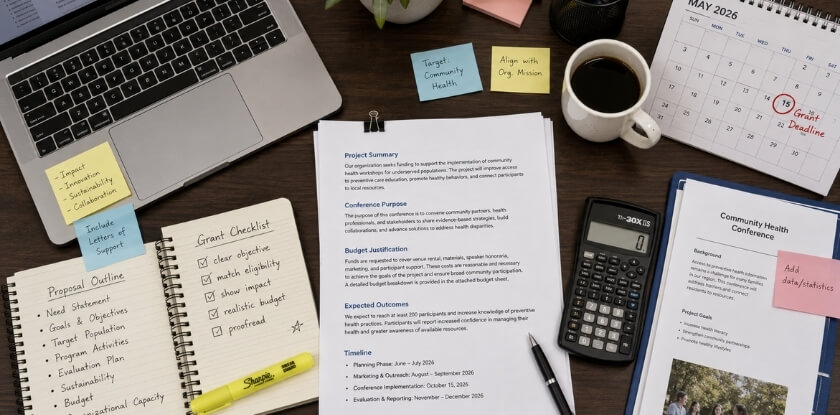
Step 1: Name the Conference and Your Role
Open with the conference name, dates, location and exactly what you will do there. Reviewers know the difference between attending a symposium and presenting a paper at one, so state your accepted abstract and your role (paper, poster, discussant) within the first 100 words, and reference the acceptance letter if you have one. An undergraduate accepted for a poster at a regional meeting is making a different case from a graduate student giving a paper at a nationally juried competition, and the proposal should show that from the first paragraph.
Be specific. “A major international conference in my field” tells the reviewer nothing, while the full name of the meeting with its city and dates lets them check you in seconds.
Step 2: Explain Why the Research Matters
You do not need a literature review. Write two to four sentences on what the work addresses, why that problem is worth attention and what your contribution is. Then connect it to the conference: why is this the right venue, and who in that room needs to hear the findings?
If you are applying to a society, make the disciplinary link explicit. If a program publishes priorities, such as health outcomes or broadening participation, read its announcements the way you would read a job posting, because the keywords matter. Even basic research needs one sentence on why it is worth knowing.
Step 3: Build an Itemized Budget
A round number with no breakdown looks like a guess, and an itemized budget looks like a plan. Typical lines:
- Transportation: airfare (attach a screenshot or quote if possible), ground transport, parking or mileage
- Registration fee: the real fee, noting any waiver that is offered or pending
- Accommodation: nightly rate times nights, using the conference hotel rate if there is one
- Per diem: meals and incidentals, using the funder’s rate if it sets one (the CHASE 2026 award, for example, covers meals up to the local per diem rate)
- Other: baggage, visa costs, poster printing
Total it, say how much you are requesting, and list any other funding you have applied for or received, including a department supplement. Keep the numbers honest, because padding is easy to spot and damages credibility.
Step 4: Justify the Need
Reviewers want to know the grant is what makes attendance possible, not just convenient. Write it plainly, for example: “Without funding, I could not cover the full cost of travel and registration from my current stipend,” or “My department has no travel funds for graduate students this cycle.” If you have partial institutional support, explain how the requested amount fills the rest. Implying the money is nice to have pushes your application below someone whose attendance depends on it.
Some programs set a length limit and ask for a faculty letter alongside it. The IISE 2026 student award asks for a statement of up to 300 words on financial need and how attending supports your goals. The CHASE 2026 award asks the advisor to commit to covering the student’s remaining travel expenses, so talk to your advisor before you apply.
Step 5: Match the Funder’s Priorities
A proposal copy-pasted to ten funders is usually obvious. Read each program’s goals and reflect its language back conceptually, not word for word. If the funder prioritizes early-career researchers and this is your first presentation, say so. If the program targets a certain stage, confirm your timeline fits. Details like your acceptance, your budget and your research context have to come from you, and that is what separates a funded proposal from a politely declined one.
A Sample Proposal With Notes
A short sample with notes on why each part works is more useful than general advice. This one is a condensed illustration written to show the structure. The names, figures and conference are placeholders, so replace every bracket with your own details and wording.
The Sample Proposal
Project and Participation Statement
I am a 2026-year doctoral candidate in [department], working on [one-line description of the research question]. My paper, “[Paper title],” has been accepted for oral presentation at [Conference name], held in [City] on [dates]. This is the main annual meeting for researchers in my subfield, and my session includes [number] other groups working on related questions. Attending will let me present results from [project stage], get feedback before I submit the manuscript, and meet [number] collaborators I have only corresponded with by email.
Why this works: The acceptance is named, the format is stated as oral, and the applicant explains why this conference and not just “networking.” A few sentences do the work that weaker proposals spread over a page.
Budget Breakdown (example figures only)
| Expense | Example amount |
|---|---|
| Round-trip airfare ([origin] to [destination]) | $[amount] (quote attached) |
| Conference registration | $[amount] (student rate) |
| Hotel ([nights] nights, shared room) | $[amount] (split with a labmate) |
| Ground transportation | $[amount] |
| Total requested | $[total] |
Why this works: Every line is itemized, the shared room shows the applicant is minimizing cost, and the student registration rate is used because no waiver existed. Never quote the full rate when a reduced one is available. Check whether the program has a soft cap on award size and keep the total under it.
My advisor’s current grant does not cover conference travel for graduate students in their first three years, and I have no external fellowship this year. I am also applying to [second funder], noted in the budget narrative. If I receive both, I will tell the department and return any overlapping funds.
Why this works: It is short and honest. Disclosing the parallel application up front matters because reviewers often ask anyway, and hiding it is a fast way to lose credibility.
Presenting at [Conference name] puts me in a position to submit a full manuscript by [month]. Feedback from the [topic] sessions will directly shape my revisions, and a peer-reviewed paper from this work is part of my plan to apply for [fellowship] next year.
Why this works: It shows the trip is one concrete step in a timeline rather than a vague “professional development” claim.
The advisor letter for a proposal like this can be short and cover three things: the student’s standing in the program, why this conference is the right venue, and the advisor’s view of the paper’s readiness. It stays factual and avoids stacking superlatives, because a letter that backs up your claims without overclaiming is the strongest kind.
What a Weak Version Does Instead
A weaker version uses vague phrases like “this opportunity will broaden my horizons,” leaves out the acceptance letter, lists the full hotel rate when a shared room was available, and applies two weeks before the event instead of two months. It also hides parallel applications. Funders and internal committees both respect openness about other funding.
Adapting It for Your Situation
- Poster: say so, and explain why the session or competition it sits in is selective.
- Undergraduate: the need statement carries more weight, since undergraduates often have little research stipend or lab funding. Some outside funders favor first-time attendees.
- Acceptance not issued yet: ask whether the funder allows conditional applications, apply with a note that acceptance is pending, and follow up as soon as the letter arrives.
How to Request a Letter of Recommendation
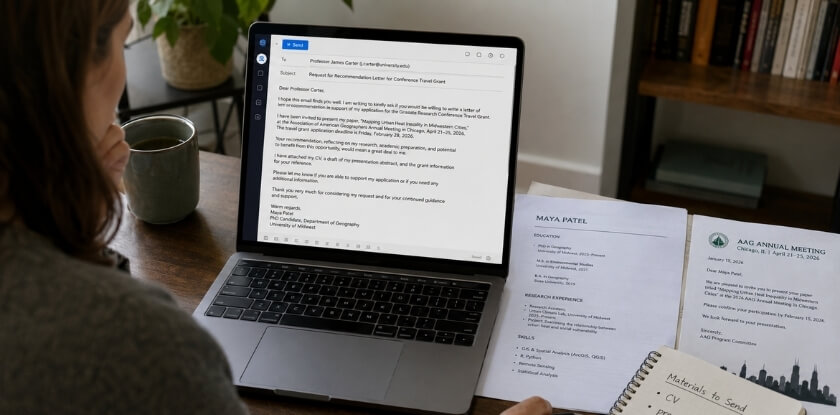
Ask at least four weeks before the deadline, and six if you can. Most travel grant applications require one letter, sometimes two, and a rushed letter from an unprepared recommender can quietly sink a strong proposal.
Who to Ask
Graduate applicants should usually ask their thesis advisor. Undergraduates should pick a faculty member who has seen their research directly, not someone who only gave a good grade in a lecture course. If the grant comes from a society or outside funder, a recommender with standing in that field carries more weight.
What to Send Them
Send the request by email, with the deadline, the grant name and what you need them to address. Do not just forward the application link and hope for the best. Some recommenders will ask to see your itemized budget or full application. Share it, because more context makes a more specific letter, and specific letters win. Include:
- A one-paragraph summary of your research and its link to the conference
- The conference name, your presentation type and your abstract title
- Your proposal draft, or at least the project description, and your budget if they ask
- The funder’s hard deadline for the letter, not your own internal one
- Any criteria the letter should address, such as financial need or stage of training
A strong letter confirms your qualifications, explains why the conference matters and makes a direct case for funding you. It does not recap your CV, since the committee already has that. If your recommender asks what to say, suggest they cover your role in the research, what you will present and how the conference fits your plans.
Following Up and Afterward
Send one short reminder about ten days before the deadline and another two days before if you have heard nothing. If the deadline is missed and the committee will not accept late material, you may lose the application. Some internal programs are flexible and most outside funders are not, so ask the coordinator rather than assume.
Thank your recommender whatever the result. If you reapply after a rejection, ask whether they would update the letter.
Common Mistakes That Get Proposals Rejected
Many rejections come from mistakes that can be avoided. The ones below add to the points above.
- Not reading the eligibility rules first. Some grants fund graduate students only, exclude undergraduates unless they present a paper, or require acceptance before you can submit, so you cannot apply speculatively. Government programs add rules on citizenship, institution and career stage. An ineligible proposal is often discarded unread.
- A budget that does not add up. Committees read many itemized budgets and know roughly what a flight on your route or a hotel near a major venue costs. Suspiciously round, outdated or missing figures read as careless. “Transportation: $400” says little, while “Round-trip economy airfare, [origin] to [destination], [dates]: $[amount] (screenshot attached)” shows the work. If a waiver is requested separately, do not count it twice.
- Burying the significance. Reviewers on mixed committees may not be specialists in your area. Two or three plain sentences on the problem, the finding and why it matters outside your lab go a long way.
- Missing the format. If the committee asked for a one-page narrative and yours runs to two, it can be disqualified on structure alone.
- Ignoring the payout rules. Some funders set a short window after the conference. The CSDC grant above does not process a reimbursement claim submitted more than four weeks after the event, and the CHASE 2026 award asks for the request within 30 days. Missing the window can mean no reimbursement even after approval.
- A weak or late letter. A generic line such as “Jane is a good student and I support her application” is almost worthless, and a late letter can disqualify the whole application.
Using ChatGPT or AI to Write a Grant Proposal: Is It Allowed?
Whether AI help is allowed depends on the funder, so check the specific guidelines before you use any tool. Policies differ, and many small funders have not written one yet.
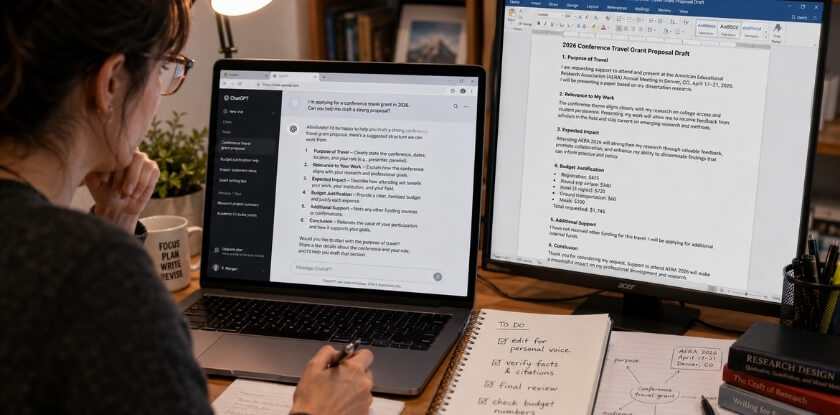
Two US government funders have published positions. An NSF notice (14 December 2023, page updated 21 May 2026) encourages proposers to say whether and how they used generative AI and makes them responsible for the accuracy and authenticity of anything an AI tool helped produce. NIH notice NOT-OD-25-132 (issued 17 July 2025, effective 25 September 2025) says NIH will not consider applications substantially developed by AI to be the original ideas of the applicant, and AI may be appropriate only for limited aspects of preparing an application. Those rules apply to their own grant applications, not to a small travel award from your department, but they show where the field is heading. If the guidelines are silent, email the grants office and keep the reply in writing.
What AI Does Well and Poorly
It can help with a first outline when you are facing a blank page, tighten dense prose, suggest clearer transitions, turn a rambling budget justification into something readable, and tell you whether your eligibility explanation makes sense to a non-specialist.
It does not know your conference, whether your abstract is accepted, or why your attendance is valuable. Those details are the core of a strong proposal, and an AI tool will either invent them or leave them vague. It also tends to strip the specifics that make a budget credible. “Travel expenses: approximately $[amount]” is weaker than a line giving the route, the fare quoted and the nightly hotel rate, and you must supply those numbers.
Tone and Detection
Even where AI is allowed, text that reads smooth but hollow can hurt you. Reviewers do not always run detection software, but they notice writing with no voice and no genuine stakes. The personal framing, such as why this meeting matters for your research this year, comes from knowing your own situation, not from a prompt.
A Safe Workflow and Confidentiality
Use AI as a drafting assistant, not a ghostwriter. Write your own rough draft first, then paste sections in and ask specific questions, such as whether a paragraph clearly explains why your presentation experience matters or whether the budget justification is specific enough. The final wording should be yours, which also helps if the committee asks follow-up questions.
If your proposal includes unpublished findings or sensitive data, be careful what you paste into any tool. Free versions of many AI tools do not guarantee that inputs stay private or are not used for training. Use a privacy setting or a locally run model, or leave sensitive content out. Feedback from a colleague, a writing center advisor or your supervisor is still safer and usually more useful.
Alternative Funding Sources If You Do Not Receive the Grant
A rejection usually means you need to look harder, not that you cannot go. Many researchers combine several smaller sources instead of relying on one grant.
Your Own Institution, Again
Your department may have a separate pot that is independent of the university-wide grant, so ask the department administrator directly rather than relying on the website, which is often out of date. Some departments fund travel from discretionary accounts and never advertise it.
Graduate students should also talk to their advisor, because faculty grants sometimes allow student travel as a budget line. Student government boards often give small travel awards through a one-page application, which may cover at least registration. Graduate-school and provost-level awards usually have deadlines separate from the main cycle, so you may have missed one and still be eligible for another. Awards tied to presentations are worth a look, since you will already meet the accepted-abstract condition.
Societies and the Conference
Many fields have at least one society that gives travel awards to students or early-career researchers, often with a lighter application: a short statement and proof of acceptance. Search “[your field] + professional association + travel award.” Eligibility is usually narrow, which helps you if you qualify.
Go back to the conference website and look for volunteer programs and work-study arrangements. Some conferences give free or reduced registration in exchange for a shift or two, such as badge scanning or session moderating. Sponsor-funded travel grants are not always listed prominently, so email the organizers. If the conference runs an award for student presenters, apply, since a prize sometimes comes with a cash award or registration waiver.
Crowdfunding and Personal Networks
It is not glamorous, but it works for some people. Platforms such as GoFundMe or Experiment.com (the latter built for research projects) let you make a public case for your attendance. A personal link to your topic may persuade donors, for example if you study rural healthcare access and grew up in a rural area. Your institution’s alumni network is another option, since some alumni giving programs target student professional development.
When There Is Truly No Funding
Sometimes the math does not work. Ask whether the conference offers a remote or hybrid presentation option, which some now do. If not, consider presenting the same research at a nearby regional symposium, which is cheaper to reach, sometimes easier to fund internally and still a real line on your CV. Save the full proposal for the next cycle.
After the Decision: Getting Feedback and Reapplying
A rejected proposal is useful if you handle the next steps well. Reapplication works best when the same conference or grant cycle returns, and a stronger budget, a tighter research case or an extra letter can change the outcome.
Find Out Why
Send a short, professional email within a week or two of the decision asking whether reviewers have comments for a future application. Internal funding offices and department programs may be willing to help. Outside funders vary: some give written comments automatically and others give nothing unless asked. If specifics are not shared, ask whether the pool was competitive and whether your application was close.
Read the decision letter closely, too. It sometimes spells out the problem, such as an eligibility mismatch, acceptance arriving after the deadline or a budget that lacked detail. These are fixable.
Patterns Worth Recognizing
If several reviewers flag the same weak point, such as a thin statement of impact, a vague link between your paper and the conference theme or a padded budget, treat it as a signal. Commonly, reapplications fail for these reasons:
- Resubmitting nearly the same proposal with small edits, which reviewers from the previous cycle will notice
- Ignoring the format limits
- Leaving the recommendation letter generic instead of asking for a revision that speaks to your role
Get Outside Eyes and Plan the Timing
Do not revise alone. Show the feedback and the revised draft to someone who has won a travel grant or reviewed applications, such as a faculty mentor, a program coordinator or a campus writing center. Ask one question: does the proposal make a clear case for why this conference matters to your work right now?
Check whether the funder allows immediate reapplication or requires you to wait a cycle. If the same conference will not recur for a year, adapt the revised proposal for a different conference or a department, society or outside program. The core of a strong proposal transfers more than people expect. An AI tool can give a second read for clarity and budget consistency, but it should not rewrite the proposal.
If you are rejected twice by the same program, look at fit before a third try. The award may be designed for a different type of applicant, discipline or kind of participation, and knowing when to redirect your effort matters as much as writing a stronger proposal.
What Happens When You Win: Disbursement and Receiving Your Funds
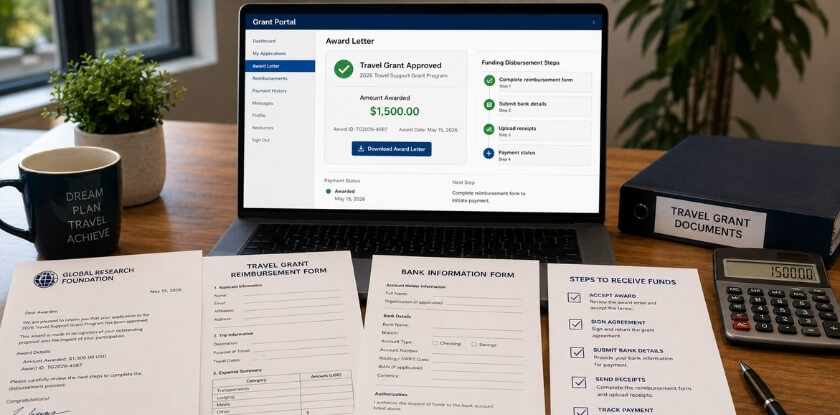
Many travel grants are paid as reimbursement after the conference, so expect to pay first and wait unless the award letter says otherwise. The payout process has its own requirements, and missing a step can delay your money or, in some cases, cost you the award.
The Award Letter and Its Conditions
Most funders send a formal award letter or email. Read it fully, because it states the amount, the eligible expense categories, any conditions and the deadline to accept. Some awards need a written acceptance, and missing that window can void the award.
Common conditions include:
- Proof of abstract acceptance: send the confirmation as soon as you have it.
- Conference registration: some funders will not release money until you register, while others arrange a registration waiver directly.
- Enrolled status: your student status may need to be confirmed at the time of payment, not just at application.
Reimbursement or Advance Payment
Many university and department grants use a reimbursement model: you pay, attend, submit receipts and wait. Some funders issue an advance instead. Government-funded money that flows through your institution often follows the institution’s accounting timeline, so it may pass through the department’s finance office first.
Ask directly: “Is this a reimbursement grant, or will funds be issued in advance?” Ask early, so you do not front a large amount on a credit card without a plan.
Keep Receipts and Match Your Budget
Expenses are usually checked against the budget you submitted. If you estimated flights lower than you actually paid, some funders cover only the estimated amount, and others adjust to the actual cost only if you ask and the award ceiling allows it.
Save everything: flight confirmations, hotel folios, ground transport receipts and registration payment confirmations. A receipt that does not show your name, payment method and itemized amount can be rejected by the finance office. Email receipts to yourself, track each expense against its budget line, and note whether you paid by personal or university card.
The Post-Conference Report
Many society and outside grants require a brief report before final payment, typically a one-page summary of what you presented, what you learned and how it matched your proposal. Treat it seriously, since some funders use these reports to decide whether to fund you again.
Taxes and Reporting
Disclaimer: this section is general information, not tax, accounting or legal advice. Rules vary by country, student status and how the funds are paid, so check with your institution’s grants or financial aid office before filing.
In the United States, the IRS (Publication 970 for tax year 2025, and Tax Topic 421) says a scholarship or fellowship grant is tax free only for a degree candidate and only to the extent it pays qualified education expenses. Publication 970 lists travel among costs that are not qualified education expenses, and IRS Tax Topic 421 says amounts a grant pays for travel are included in income. So travel money paid to a student as a grant can be taxable income. Reimbursement of documented expenses under an institution’s expense rules may be treated differently. Ask the office that pays you which one applies, and do not assume either way.
Rough Timeline and When Things Go Wrong
The table is an example for a reimbursement-model grant. Real timelines depend on the funder, so use it only as a planning guide.
| Stage | Example timeline |
|---|---|
| Award notification | A few weeks to a couple of months after submission |
| Pre-conference conditions cleared | Before you travel |
| Post-conference report | Within a few weeks after the conference |
| Reimbursement paid | Often a few weeks after report approval |
If you depend on the money to pay a card bill, build in a buffer. Internal and department grants often move faster because fewer offices are involved.
If payment runs late, contact the grants administrator directly, not a general help desk, and give your award number and the date you submitted documents. If an expense you believed was covered is rejected, ask for a written explanation. Sometimes it is a documentation problem you can fix, and sometimes the rules were tighter than the award letter implied. Stay organized and professional, because you may apply to the same funder again.
From our experience at MS International: Our conferences are held in person in the Greater Toronto Area, so a travel budget for them should include getting to the Greater Toronto Area. For most applicants, the route to our in-person conferences is the presenting-author track: submit work for review and register as an author if it is accepted. Review normally takes approximately 10 working days, and the decision arrives by email, which gives you a document for grant paperwork. The event pages list Author Early Bird US$499, Author Regular US$599 and Listener US$499. Registration fees are non-refundable once payment is completed, and registrations are non-transferable, with exceptions only in rare cases and with written approval. Do not assume an honorarium, travel reimbursement or free registration is included unless it is confirmed in writing. The invitation letter is issued within 3 to 5 business days after payment clears; it supports a visa application but does not guarantee a visa.
FAQ: Conference Travel Grants
Before applying for travel funding, students weigh how much an award covers, stacking several grants for one trip, slow payment after the award and whether a rejection is worth retrying.
Do I need an accepted abstract before I apply for a conference travel grant?
Not always. Some programs, such as the Flinders grant above, let you apply first and release money only after you show acceptance. Others, such as the CSDC and CHASE awards above, require proof of acceptance before you travel or apply. Read each program’s rules.
Can an undergraduate apply for the same grants as a graduate student?
Often yes, but not through the same pools. Many universities fund undergraduates presenting their own research through an undergraduate research office, while some outside awards favor graduate students. Read each program’s eligibility rules first.
How much money can a conference travel grant cover?
It depends on the program. The published examples above range from up to $300 for attending (Longwood) to up to $2,500 for international travel (Flinders), and many programs cover only part of the cost. Check the actual program, and send a realistic itemized budget.
Does an international conference change anything?
It can change the amount and the justification. Some programs pay more for distant events: Flinders lists up to $2,500 for international travel against $500 for domestic, and CSDC allows $1,000 beyond 500 km against $500 closer. Explain why this venue matters, and budget visa fees, currency conversion and travel insurance as line items.
Can I apply for several grants for the same trip?
Yes, if each program’s rules allow it. Be open about it, because some funders ask whether you have applied elsewhere, and hiding it risks disqualification. List every source in your budget and do not claim the same cost twice.
How long does payment take after the award?
It varies by funder, and the money often arrives after the trip. CSDC, for example, confirms decisions within 30 days of the deadline and reimburses only after you submit a claim. If the timeline is unclear, ask the grants office before booking anything.
Is it worth reapplying after a rejection?
Yes, if the program allows another application. Ask for feedback where available, tighten the narrative and revisit the budget. Some programs limit how many grants you can receive, so check the rules first.
Should I use ChatGPT or another AI tool to write my proposal?
You can use it for outlining and clarity checks, but not to write the substance. Check the funder’s rules first, because some programs restrict or require disclosure of AI use. Reviewers notice generic phrasing, and the details must come from you.
Does presenting a poster instead of a paper hurt my chances?
Not necessarily. Flinders, for example, funds students presenting a paper or poster. If the funder distinguishes between types, the eligibility rules will say so. Read them before deciding not to apply.
Why do travel grant proposals get rejected?
Typical reasons are ineligibility, missing documents and a vague statement of significance. If the proposal does not explain why the research matters and why this conference is the right venue, reviewers have no reason to fund it over one that does.
Final Thoughts: Apply, Then Improve
You cannot be funded by a program you never applied to. Once you find two or three realistic sources and write one solid proposal, you can adapt it for each application, and the second one takes a fraction of the time. Start earlier than feels necessary, since internal deadlines often close before outside ones, and ask for feedback whatever the outcome. You can improve and reapply, but you cannot do anything with a proposal you never submitted.