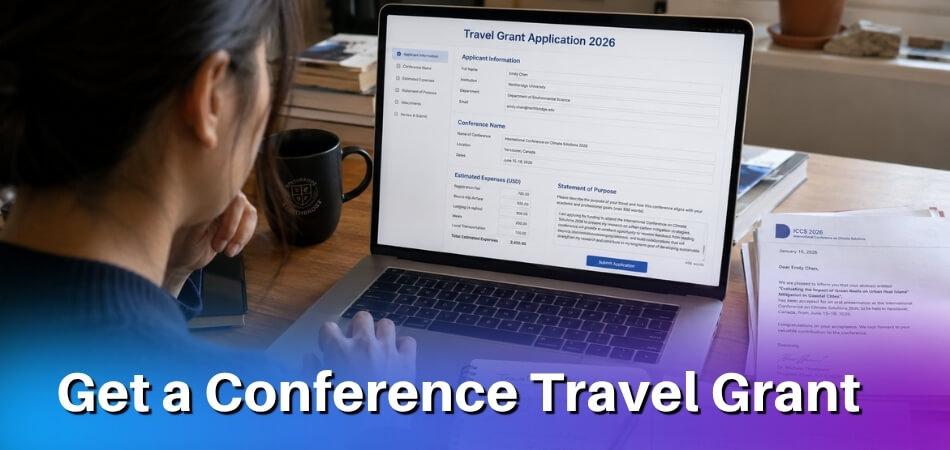

A conference trip rarely gets funded by accident. Someone has to send a clear request to the person who holds the budget, and that is easier than it sounds once you know what to include and when to send it.
Quick answer: To ask for funding to attend a conference, send your manager or department head a short written request that names the event, itemizes every cost, and explains what the organization gets back. Ask early, attach your acceptance letter or the programme, and apply to other sources at the same time, so a partial yes still covers the trip.
How to Request for Conference Funding
A good request answers four questions: which conference, why you, what it costs, and what your funder gets in return. Send it to the person who controls the budget, with your documents ready.
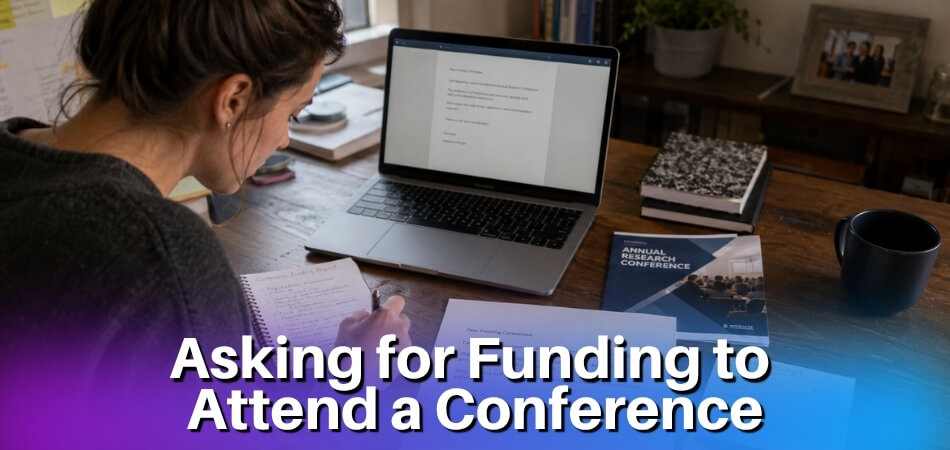
The Core Request, Summarized
Whether the request goes to a manager, a department head or a grant committee, it covers the same points:
- Which conference you are attending, when, and where
- What you will do there (presenting, chairing a session, meeting a collaborator)
- The total cost, split into registration, travel, accommodation and meals
- What you are asking for, and what other funding you have secured or applied for
- How the trip connects to your work, your research or your professional development
That is the whole request. A department head does not need a long letter. Two clear paragraphs and a cost table will do more than a page of justification.
What Makes a Request Work
Funders want a concrete return on their money. “I want to grow professionally” is too vague. “I am presenting a paper, meeting two possible collaborators, and bringing findings back to the research group” gives them something to approve.
Who Can You Ask? Funding Sources to Consider
Start with your employer or department, then add a professional society, the conference organizers and an outside grant. Applying to several at once is normal, and funder forms often ask what else you have applied for.

| Source | Usually covers | Timing and effort |
|---|---|---|
| Employer or department | Registration, travel, sometimes all of it | Often first come, first served. An email may be enough. |
| Graduate school or student office | A small pot for student presenters | Ask the graduate coordinator |
| Professional or academic society | Travel stipend, sometimes registration only | Firm deadlines, can be months ahead. Membership is often required. |
| Conference organizers | Travel award or fee waiver, where offered | Separate application with its own deadline |
| Outside foundation or national funder | Travel as an eligible expense | Longest forms and timelines |
Your Employer or Department
Ask here first. Many organizations keep a professional development budget for travel, training and conferences. It is often handed out first come, first served, so early requests have the advantage.
At a university or research institute, the department head is usually the route. Some departments have a form or portal, others just want an email. Ask the department administrator who controls the budget before you write anything. Either way, show how the trip connects to your current work. A request that names a project or a skill gap is easier to approve than a general wish to attend.
Academic Societies and Professional Associations
If you belong to a society, check its funding pages. Many offer travel grants to members who are presenting, with extra support for students and early career researchers. These grants are competitive, the deadlines can fall months before the conference, and some cover only registration. Read the eligibility rules closely, because many favor presenters and some are limited by career stage or region. If you are not a member yet, add the membership fee to your budget. A fee plus a grant can still cost less than paying everything yourself.
Conference Organizers (Travel Grants)
Some conferences, mostly academic ones, offer travel grants funded by the organizers or sponsors. They are sometimes listed on the home page and sometimes buried in the FAQ. Search the conference name with “travel award”, “registration waiver” or “diversity grant”. Awards often target students, early career researchers, first-time attendees or presenters from lower-income countries, and presenting a paper or poster improves your chances. The funds are limited, so apply as soon as the window opens.
External Grants and Foundations
National science funders, humanities councils, disciplinary foundations and private trusts sometimes list conference travel as an eligible expense. Ask colleagues what they have used, check your institution’s grants office, and search a funding database or your national research funding body. Applications are longer and rarely have rolling deadlines, so treat these as one part of a plan, not the only one. Budgets, letters of support and a statement of purpose are common requirements.
How to Write a Conference Funding Request (Step by Step)
A request succeeds when it answers three questions clearly: why this conference, why you, and what the money pays for. The steps below work for a short email to a manager or a formal letter to a foundation.
Step 1: Identify the Right Person or Body to Contact
Confirm who actually decides before you write. A graduate student request sent to general administration instead of the graduate school can add weeks or get ignored.
For internal requests, look for a form or portal on your institution’s website. The right contact is often a department coordinator, not the department head. If you are unsure, a quick call to the department office saves time. For outside sources, read the funder’s guidelines first, since some want a full application and others accept a short letter of intent. Some departments also set an order: one university department’s student guide (read October 2026) asks students to confirm an accepted presentation first, apply for external awards, get the faculty advisor’s backing, and only then make a departmental request. Ask your own department what order it expects.
Step 2: Explain Why This Conference Matters (ROI Justification)
Funders read this part most closely. Name the conference, give the dates and location, and say why this event fits your work. “A major conference in my field” is too vague. “The annual meeting of [Society Name], where I am presenting a paper written with my supervisor” gives the reader something to check.
Then link attendance to outcomes. For research, that may be presenting findings, meeting collaborators or learning a method for a current project. In a workplace, it may be knowledge that applies to a live initiative. Two or three focused sentences are enough. If you are a student or early career researcher, mention your career stage, because many funds prioritize it.
Step 3: List the Specific Costs You Need Covered
Itemized requests are approved more often than vague ones. Put a figure beside every line. The numbers below are an illustration only, so replace them with real quotes:
| Cost line | Example amount |
|---|---|
| Conference registration | $450 |
| Return flights (economy) | $620 |
| Hotel (3 nights at the conference rate) | $390 |
| Ground transport and incidentals | $80 |
| Total requested | $1,540 |
Use the funder’s own allowance for meals and lodging where one exists. Some institutions base it on government rate tables, such as the US General Services Administration per diem rates (FY 2027 on gsa.gov), so ask which table applies to you before you estimate. Also check what the funder lists as eligible: one university department’s guide (read October 2026) lists ground transport, flights and baggage, meals, lodging, conference fees, visas, vaccinations and travel insurance, and says meals provided by the conference cannot be reimbursed even if you skip them.
If you only want partial coverage, say what you will pay yourself or get from other sources. Marking the costs you will cover yourself shows commitment, and it shows that you are not expecting one body to carry the whole cost. For an online event, the list is shorter, usually registration and any required technology, so do not pad it.
Step 4: Mention What You Will Deliver in Return
It is easy to leave this out, and that is a missed chance. Employers and departments want to know what they get back. Offer a short summary report, a presentation to your team, or your session notes. Some societies and foundations also expect their support to be credited in any resulting talk or paper. If so, say you will do it. Two or three sentences about one concrete deliverable carry more weight than a paragraph of general promises.
Step 5: Attach Supporting Documents
A request with documents behind it is stronger than a letter alone. Common attachments:
- A letter of acceptance or invitation from the conference (essential if you are presenting)
- A brief CV, especially for society and foundation grants
- Your abstract or paper, if accepted
- An endorsement from your supervisor or line manager, particularly for student and early career applications
- A simple budget spreadsheet showing all costs and any contributions from other sources
- Quotes or screenshots for flights and lodging, and the conference’s published fee page
For a manager, a clear email with the conference details and cost breakdown is often enough. For a formal grant application, send everything unless the guidelines say otherwise. Check file formats before you send, since some portals accept only PDFs or set upload limits, and an incomplete file can disqualify a strong request before anyone reads it. Prepare one master set of documents and adapt it for each application. Have someone proofread it and practise presenting the ask out loud, as the SACNAS funding guide (read October 2026) suggests.
Lead Times: When to Send the Request
There is no single deadline, because every funder sets its own. These three pages, read in October 2026, show how far apart they are:
| Funder page | What it asks |
|---|---|
| A university agricultural economics department (student travel guide) | Requests at least 4 to 6 weeks before the conference. Travel authorization two weeks before domestic travel and one month before international travel. |
| A university statistics department (PhD travel funding) | Apply as early as possible and no less than 90 days before the trip. Retroactive applications are not considered. |
| An IEEE society (conference funding request form) | A minimum of 120 days before the event. Funding transfers may take up to 8 weeks. |
Read the funder’s own page, put its date in your calendar and work backwards from it. If you cannot find a deadline, ask the budget holder, and do not pay or book before you have an answer, because some funders do not accept retroactive requests.
If Your Manager Hesitates
A hesitant manager usually has a specific worry. Answer it in the request itself.
| Likely concern | What to offer |
|---|---|
| “There is no budget this year” | Ask for partial coverage, or for cost sharing where you pay the travel and they pay the registration |
| “What do we get out of it?” | A named deliverable: a team briefing, a written report, or a contact list for a current project |
| “You will be away from work” | A coverage plan for your tasks, and the exact days you will be out |
| “Could you attend something cheaper?” | One sentence on why this event beats the alternatives, and the cheapest registration category that fits your plans |
If the answer is still no, ask whether time off or a later budget cycle is possible, so the conversation stays open.
Sample Funding Request Templates
Treat these as starting points. Swap in your own conference details, amounts and reasons, because a request that reads like a form letter gets far less attention than one that reflects your situation.
Email to Your Employer or Department Head
Keep this one brief and focused on return on investment. Your manager needs to know what the conference is, what it costs, and what the team gains.
Subject: Funding request for [Conference Name], [Date]
Hi [Manager’s Name],
I would like to ask for support to attend [Conference Name] on [dates] in [location]. The registration fee is [amount], and I estimate [amount] for travel and accommodation, so the total is [amount].
The event matches my current work on [project or skill area]. I plan to attend the sessions on [topics], which relate to [team goal or challenge], and I will meet [relevant people or organizations]. When I return, I will write up the key points for the team and give a short talk at [team meeting].
The programme and a cost breakdown are attached. Could we talk this week?
Thanks, [Your Name]
Tie the conference to something your manager already cares about, such as a project, a skills gap or a business goal. “Great networking opportunity” on its own will not move anyone.
Letter to an Academic Society or Grant Body
A grant committee does not know you, so the letter has to establish your credibility and the value of your participation by itself. It needs more formality and detail than an email to a manager.
[Your Name] [Institution/Affiliation] [Date]
[Grant Committee Name] [Academic Society or Foundation Name]
Dear Members of the [Committee Name],
I am applying for a travel grant to attend [Conference Name], held [dates] in [location]. I am a [role, for example third-year doctoral candidate, early career researcher or assistant professor] in [field] at [Institution].
My [paper/poster/presentation], “[Title]”, has been accepted for the session on [topic]. The work looks at [brief, jargon-light description]. Going will let me [specific benefit, for example get feedback from leading scholars, start collaborations on related questions, or share findings with an international audience].
The total cost is [amount]: registration ([amount]), travel ([amount]) and accommodation ([amount]). I have also applied to [other source] [or: I have received partial support from [other source]], so I am asking [Society/Foundation Name] for [amount] to cover the remaining balance.
Enclosed are [documents, for example acceptance letter, abstract, CV, itemized budget]. I can be reached at [email] if you need anything more.
Thank you for considering this request.
Sincerely, [Your Name] [Contact details]
Applicants early in their training should say so plainly. Committees want to see that the money fills a real gap and that the experience will matter at your stage.
Request to a Conference Organizer for a Travel Grant
Some conferences offer travel grants for people who could not otherwise attend, such as students, researchers from lower-income countries, independent scholars and early career professionals. Some use a short statement, others a full form. When a free-form letter is accepted, keep it focused.
Subject: Travel grant application from [Your Name] for [Conference Name]
Dear [Travel Grant Committee / Conference Organizers],
I would like to apply for a travel grant for [Conference Name] this [month/year]. I am a [role] at [institution or organization] and I have been accepted to [present a paper / join a panel / attend as a first-time delegate].
My research is about [brief description]. The sessions at [Conference Name], especially [track or session], line up closely with my current work, and taking part would help me [specific goal].
I cannot attend without support because [honest, specific reason, for example my department does not fund travel for doctoral students in their first two years, or I work independently without an institution]. Total cost is about [amount], and a grant of [amount] would cover [registration / travel / accommodation].
My [CV / abstract / acceptance letter] is attached as requested. I am glad to send anything else you need.
[Your Name] [Email / Affiliation]
Being direct about your finances is expected here. Committees are trying to reach people who face real barriers, and a clear statement works better than vague talk of “limited resources”. Mentioning other funding you are pursuing is fine too, since committees tend to read it as responsible planning.
A Short Follow-Up Nudge
If a week or two passes after the stated decision date, a brief note keeps you visible without pushing.
Hi [Name], I am checking in on my request to attend [Conference Name]. The registration deadline is [date], so a decision by [date] would help me plan. Happy to send anything that would make the review easier.
Combining Multiple Funding Sources
A trip can be pieced together from two or three places at once, because no single pot is built to cover everything.
Why Stacking Sources Makes Sense
A society grant might cover registration, your department might pay for flights and hotel, and an outside funder might close the gap. Funders also tend to award partial amounts, so expecting partial coverage from each gives you a realistic budget instead of a bet on one full award.
Map Your Sources Before You Apply
Before drafting any email, list every source you qualify for: your department or institutional budget, a society grant, outside foundations (some aimed at students or early career researchers), the conference’s own awards or waivers, and a lower-cost online option if one exists. Then check each funder’s rules on concurrent awards. Some allow them, some do not, and a few require you to disclose other support.
Build a Master Budget First
Know your total before you ask anyone. Without firm figures for travel, accommodation, registration and incidentals, every request will be vague and likely underfunded.
Assign each cost to a likely source. Registration suits a society grant, travel suits institutional funding, and accommodation is often easiest to cover from a department or professional development budget. That lets you write purposeful requests instead of “please fund my conference”.
Leave a contingency. Exchange rates, fees and fares move. The SACNAS funding guide (read October 2026) suggests adding a cushion of about $100 for surprise expenses and asking for a range if costs may fluctuate. If your final gap is small, you can cover it yourself.
Be Transparent With Each Funder
Mention parallel applications in one line, such as “I am also applying to the [society name] travel grant to help cover registration”. It shows you have planned the budget and are not charging the same expense twice. Never claim the same expense from two funders. One university statistics department’s page (read October 2026) calls that wrong, so assign each receipt to one funder when you submit reports. Undisclosed overlapping awards can cause real trouble later, when reporting and acknowledgment come up.
Sequence Your Applications
Society grants often close months ahead, while institutional requests can go in closer to the date. If a fast source approves first, you can mention that partial award when you write to the slower ones, which strengthens those requests.
If the Total Still Falls Short
Options people regularly use:
- Ask your main funder whether a top-up is possible after the first decision
- Check whether the conference offers a volunteer or session chair role in exchange for a registration waiver
- Restate the return on investment in a final round of asks: what you will bring back and what you will produce afterward
- Look at an online attendance option, if one exists, to shrink the remaining gap
The goal is not to fund every trip perfectly. It is to build a track record so that each later request comes with context: you delivered on past awards, met acknowledgment rules and reported back.
Special Tips for Students and Early Career Researchers
Students and early career researchers often have the least institutional support and the most competition for it. Some funding channels exist specifically for you, and using them well changes the outcome.
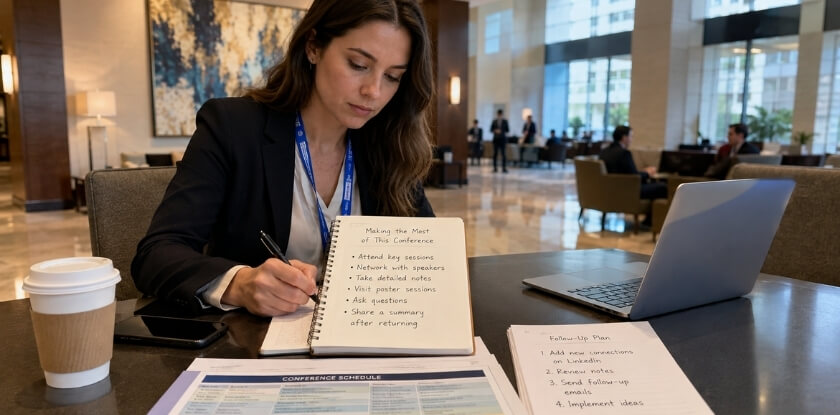
Know Which Funding Pools Are Actually for You
Not all conference money is open to everyone. Check these in order:
Graduate student funding is often run at department level. The graduate coordinator or graduate school office usually controls a small pot earmarked for student presenters. Ask for it by name, since it is separate from general departmental budgets.
Early career researcher funding is offered by many academic societies alongside their main conferences, typically for people within a few years of their PhD or without a permanent post. Look under “awards” or “grants” on the conference website as well as the society’s page.
External foundation grants are worth researching even if they feel like a long shot. Some support student and early career travel to peer-reviewed conferences, but the timelines are long, so plan months ahead.
Make Your Presenter Status Central
If you have been accepted to present a talk, poster or workshop, lead with that in every request. Many funders give priority to presenters, and some require a presentation as a condition. Include your acceptance letter with every application, because nobody will take it on faith.
Address the ROI Question for Your Supervisor
A request from a student works best when it ties the conference to your research and the department’s interests. Name the sessions you will attend, the collaborators you hope to meet or the conversations relevant to your project. You do not need a business case, just a concrete reason to say yes, for example “I will present results from [project name], which is part of my dissertation / the lab’s current grant”.
Apply to Multiple Sources at Once
Individual awards at this stage are often small, so a trip is commonly pieced together from three or four of them: your department, your graduate school, the conference’s own travel grant and a society grant. Say so in each application. Funders usually ask whether you have applied elsewhere, and partial support from one source does not rule you out for another.
Can You Request Funding for a Virtual Conference?
Yes, and it is worth asking before you assume the answer is no. There is no plane ticket, but there are still real costs.
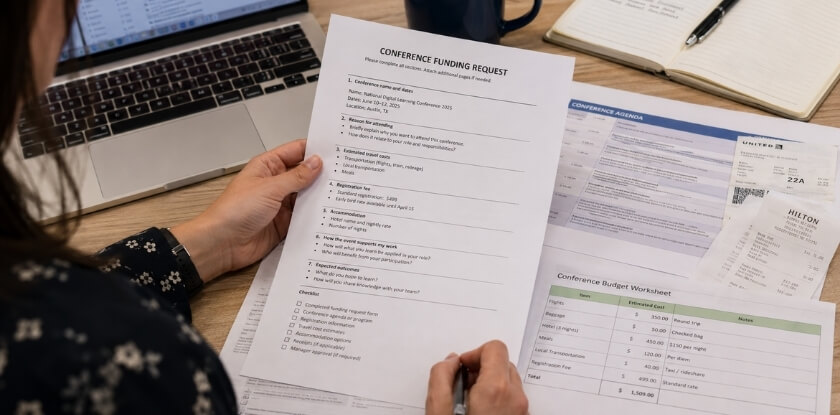
Registration fees for online events vary widely, so quote the exact amount from the fee page in your request.
What Costs Are Actually Fundable
Registration fees. The main cost. Include the exact figure.
Technology and equipment. If you are presenting, you may need a reliable headset, a better webcam or a stable connection. Some departments allow a one-time equipment stipend.
Workshop add-ons. Pre-conference workshops usually cost extra and can be funded as professional development.
Time-zone disruption. This is not a billable expense, but it can affect your productivity enough to mention if you are also asking for protected time or flexible hours.
How Funders View Virtual Requests
Some funds now name virtual events explicitly. Others still describe “travel grants” in ways that technically exclude them. If the wording is unclear, email the fund coordinator before drafting a full request. More often than not, online events turn out to be covered under a broader professional development category.
Societies and foundations vary a lot. Some added virtual tracks after 2020, and others still prefer in-person attendance because the networking case is easier for reviewers to see. If the grant page does not say, check whether past recipients attended online events.
Making the ROI Case for a Virtual Event
You are not saving the funder flights and hotels, so show what the lower fee still buys: a paper presentation slot, recorded sessions you can watch afterward, a workshop in your specialty, or a structured online community. “I will learn a lot” will not move a reviewer. If you are presenting, say so clearly, because a talk or poster carries more weight than passive attendance. Some departments hesitate to fund online attendance because it feels less substantial, so address that directly.
Reporting and acknowledgment rules apply to online events just as they do to in-person grants. Keep your registration confirmation, certificates of participation and your slides or session recording, as these are the equivalent of travel receipts.
Mistakes to Avoid When Requesting Conference Funding
Even a strong case can fail if the request is handled badly. Most of the common mistakes are covered in the sections above, so the table points you back to the fix.
| Mistake | What to do instead |
|---|---|
| Sending the same generic message to every funder | Reword it for each audience. A manager and a society committee care about different things. |
| Asking too late | Check every deadline first. Travel grants often close weeks or months before the event. |
| No return on investment | Say what you will present, learn and bring back (Step 2) |
| Asking for a vague amount | Itemize registration, flights, accommodation and meals (Step 3) |
| Skipping supporting documents | Attach the acceptance letter, programme and cost estimates (Step 5) |
| Pinning everything on one source | Spread the risk across several (see Combining Multiple Funding Sources) |
| Going silent after sending | Send a short, polite follow-up a week or two after the decision date. It keeps your name in front of a busy reader. |
| Giving up after a no | Ask about feedback, appeals or a revised application. Some programs hold funds back for later in the year. |
| Ignoring acknowledgment and reporting rules | Read the award terms before you accept (see After You Get Funded) |
What to Do If Your Funding Request Is Rejected
A no rarely ends your chances. It usually means you need a different source, a better-timed ask or a stronger request.
Do Not Assume the Decision Is Final
Some rejections are soft. A department request may come back “not this time” because the budget cycle is closed or another request arrived first. If you got a vague reply, send a brief, polite note asking whether partial support or next quarter is possible. Keep it short, since you are clarifying, not arguing.
Ask Why, If You Can
Formal programs sometimes give brief feedback on unsuccessful applications. Ask for it. A single line such as “the budget lacked itemization” or “priority went to presenting authors” gives you something to fix. Many programs repeat annually, so that knowledge pays off at the next round.
File an Appeal Where One Exists
Some institutional programs have a formal appeals process. Use it only with something new to add, because restating the original request achieves nothing. Stronger appeals bring a specific change: a revised return-on-investment case, better documents, a lower amount, or proof that another source already covers part of the cost.
Go Back to Your Multiple Funding Sources Strategy
If your department said no, try a society. If the society’s grant is used up this cycle, ask your research office about an outside foundation. Sources run on different timelines and fund different things, which is why applying to several is worth the effort.
Revise Before You Reapply
Do not resubmit the same letter. Reread it and find where you were vague. Weak applications usually share the same flaws: no clear return, missing documents, or a budget that does not add up. If the fund targets early career researchers, make that alignment explicit.
Consider the Virtual Option
If the in-person trip is no longer affordable, see whether online attendance exists. Costs are usually much lower, so approval can be easier. A funder who turned down a $2,000 travel request (an example figure) may well approve a $150 registration fee. You keep the content and the relationship for next time.
After You Get Funded: Reporting and Acknowledgment
Funders such as your department head, a society or a foundation expect something back after the conference. Knowing the terms before you leave saves a scramble later.

What Funders Typically Expect
A post-funding report. Many funders want a written summary of the sessions you attended, what you presented and how it connects to your work. Some use a form, others an email. Write it about a week after you return, while the details are fresh.
Public acknowledgment. If you presented, you are usually expected to name the funder in your slides, poster or paper. Check the award letter for the exact wording. Skipping this can cost you future funding from that source.
Receipts and expense records. Keep registration confirmations, transport, hotel and meal receipts as you go. It is far easier than rebuilding them from a card statement weeks later.
A Note on ROI Justification
If your employer or department paid, send your manager one or two paragraphs on what you presented, who you met and how the work applies to your role, even if no report is required. It makes the next request easier, and it matters most for students and early career researchers who may ask the same supervisor or committee again.
Online Events and Thank-You Notes
Online funding often has lighter reporting, but send a short summary anyway. Whatever the format, a brief thank-you note to the person or committee who approved your funding is standard practice. The people who fund you often fund others in your cohort, write references, and remember who acknowledged the support.
If You Cannot Attend After You Are Funded
Tell the funder in writing as soon as you know, whatever the reason. Then try to rebook or get a refund on what you have already paid. One university travel grant policy (April 2020 guidance, read October 2026) asks recipients to seek a refund first, to decline any credit before reimbursement, and to send receipts, the cancellation notice and a letter of explanation. Its reimbursement is capped at the approved amount. Your funder’s terms will differ, so read your award letter.
Keep a Copy of Everything
Save the award letter, receipts, your report and the acknowledgment wording you used. This becomes your reference file for future applications, and a clean record of follow-through genuinely influences decisions on competitive awards.
From our experience at MS International: Our events are held in person in the Greater Toronto Area, and attendees can register as presenting authors or as listeners. Presenting authors submit their work, it goes through double-blind review (about 10 working days), and they register once it is accepted. Event pages currently list Author Early Bird at US$499, Author Regular at US$599 and Listener at US$499. Registration fees are non-refundable and non-transferable, so get your funder’s approval in writing before you pay, and check the dates on the event page so you do not miss the early-bird price while waiting. Travel, accommodation and visa costs are not included in the fee. Our invitation letter can support a funding request, but it does not mean the organizer is providing sponsorship, so budget for the full cost and seek it from your own funders.
FAQ: Asking for Conference Funding
Writing a funding request for a conference trip involves timing the request, combining sources, documents to attach and convincing a boss who has to sign off.
Do I need to be presenting a paper to qualify for funding?
No, but it helps. Many grants prioritize presenters, yet some programs also fund attendees who organize sessions, serve on committees or are building connections in their field. Check each source’s eligibility rules.
How far in advance should I submit a funding request?
Check the funder’s own deadline first, because it varies. Pages read in October 2026 ask for anything from 4 to 6 weeks (one university department) to 90 days (another) or 120 days (an IEEE society form). Society and foundation grants often close months ahead.
Can I apply to multiple funding sources for the same conference?
Yes, usually. Combining a conference travel grant, department funding and a small society grant is a common approach. Tell each funder what else you are pursuing or have received, and never claim the same expense from two of them.
What if I don’t know my total costs yet?
Give a conservative estimate using current fares, the conference’s listed registration fee and the funder’s own daily allowance for the location. Reviewers know costs change. They want a realistic breakdown.
Is a funding request letter different from a funding request email?
Not in content. Both say who you are, what the conference is, why it matters and what you are asking for. Letters suit society and foundation applications, and emails suit internal requests to a manager or department head.
What supporting documents should I include?
At minimum, the programme or acceptance letter, a cost breakdown and a short statement of how attending benefits your work. Some funders also want a CV, a supervisor’s letter of support or proof of registration.
Do virtual conferences qualify for funding?
Sometimes. Funding for online events is less common because costs are lower, but registration, software or protected work time can still be legitimate expenses. Ask even if the funding page does not mention online events.
What happens if I get funded and then cannot attend?
Tell the funder in writing as soon as you know. Unused funds usually have to be returned, unless the terms allow reimbursement of costs you cannot recover, and prompt notice protects your chances of applying again.
Are there acknowledgment requirements after I receive funding?
Often, yes. Some funders ask for a written report and others want credit in any talk or publication from the trip. Read the award terms before you accept.
How do I convince my boss to pay for a conference?
Show your boss what the team gets back. Link the sessions to a current project, name one deliverable such as a briefing or short report, give a cost table and offer a plan for covering your work while you are away.
How do I justify funding as an early career researcher with no track record?
Focus on what the conference offers: the sessions, mentors or research communities you will join, and the concrete next step in your work. Funders of early career applicants know they are investing in potential.
Should I pay the registration fee before my employer approves?
No, if you can avoid it. Conference fees are often non-refundable, and ours are too, so a payment made before approval can be lost. Some funders also refuse retroactive requests. Ask for approval in writing first, and use the early-bird deadline to argue for a quick decision.
Final Thoughts
Asking for conference funding feels awkward the first time. A clear, documented ask is easier to approve than a vague one. Start early, be specific about the cost and the return, and do not rely on a single source.