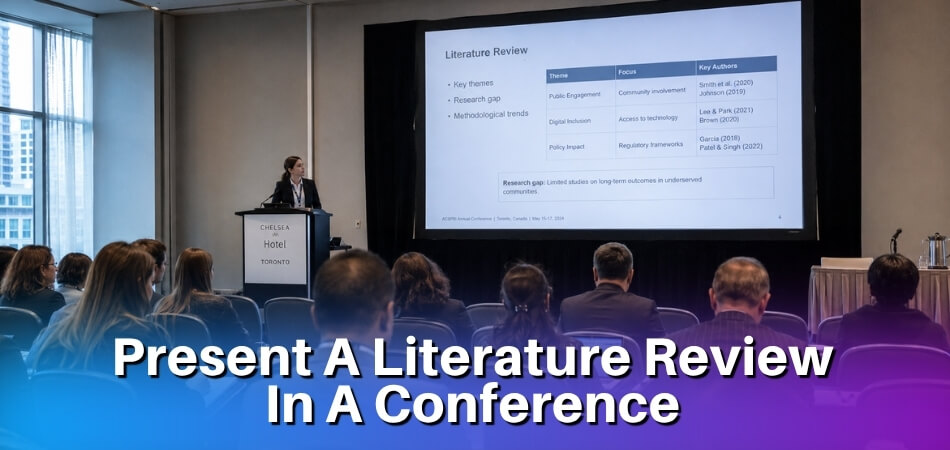

You have spent months on the data, the model and the regressions, and now someone says “take it to a conference.” In economics and finance that advice hides a few questions. Is a conference paper a publication at all? Who reviews it? And what happens to the paper afterwards?
Quick answer: To publish at an economics or finance conference, pick an event that fits your field, submit an abstract or full paper before the deadline, pass the review, and present the paper. A conference talk is not a journal article. The real publication usually comes later, when you revise the paper using discussant and audience feedback and send it to a journal, and only some events publish proceedings at all.
Last verified against official sources: October 2026.
The trouble is that this is rarely explained from start to finish. Your supervisor says “find a good conference” but does not tell you how a working paper differs from a journal article, what a discussant does, how to spot a predatory event, or how the conference version turns into a journal submission. This guide walks through each stage, from choosing the event to the revise-and-resubmit round that follows.
The Complete Process of Publishing at Economics and Finance Conferences: At a Glance
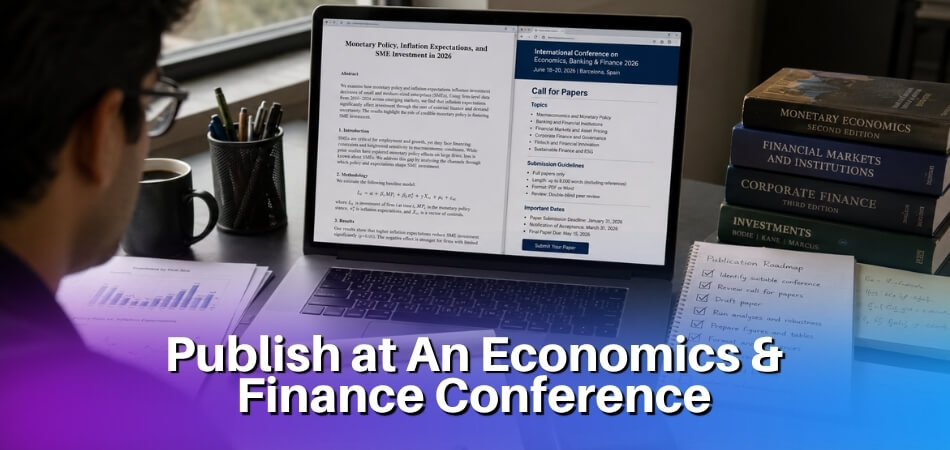
The path has four stages: choose the event, submit, get reviewed and revise, then present and turn the paper into a journal article. The table gives the short version, and the sections below cover each stage.
| Stage | What you do | What to check |
| 1. Choose the event | Match your paper to the scope and track in the call for papers | Named programme committee, past programmes, no promise of “guaranteed acceptance” |
| 2. Submit | Send an abstract, or a full paper if the call asks for one | Deadline, word or page limit, anonymisation, whether a membership or fee applies |
| 3. Review and revise | Pass the review, answer every reviewer comment | Decision date, revision window, response letter |
| 4. Present and publish | Present, post the working paper, revise for a journal | The target journal’s policy on prior circulation and prior publication |
A point that surprises newcomers: economics and finance have a strong working-paper culture. Authors circulate drafts on SSRN, NBER or their own university series long before a journal accepts anything. The NBER describes its working papers as new research “circulated prior to peer review for discussion and comment,” and Elsevier describes SSRN as a preprint server whose papers have not been peer reviewed. So in this field, the conference is often where a working paper gets its first serious test, not where the final version gets printed.
Choosing the Right Conference: Where One Mistake Can Make All Your Hard Work Worthless
Choose the event that fits your topic and career stage, and check its history before you submit anything. Picking the wrong venue costs money and time, and a paper placed at a doubtful event can hurt your CV more than a quiet working paper would.
How to Verify Reputation and Indexing (Scopus, Web of Science, ABDC Listing)
In economics and finance, a conference earns its reputation from the people who attend, the discussants it recruits and the papers that were on earlier programmes. Indexing matters only when the event publishes formal proceedings.
If an organiser says the proceedings are indexed, check it yourself. In Scopus, search the proceedings series on the source title list (scopus.com/sources), not the event name, and look at the coverage years. Elsevier says that list also includes a discontinued sources list, so a title can be covered for a while and then dropped. Clarivate says its editors evaluate proceedings volumes before adding them to the Conference Proceedings Citation Index in Web of Science, so inclusion is a decision, not an automatic result. A line on the conference website is not proof.
The ABDC list is a different thing. It is the Australian Business Deans Council’s Journal Quality List (current to its 2025 review), which rates journals as A*, A, B or C. It lists journals, not conferences. A conference can be linked to an ABDC-listed journal, but the conference itself has no ABDC grade, so “ABDC-ranked conference” is a claim to question.
Also look at who publishes the proceedings. A recognised academic publisher or a university press is a good sign. A PDF on the organiser’s own site with no DOI is much weaker.
Scope and Track Match: Which Conference Is the Right Fit for Your Paper
Read the actual call for papers, not the homepage. It tells you the themes, the methods the committee expects and the tracks on offer, such as macroeconomics, behavioural finance, financial markets, development economics or monetary policy.
Your paper must fit a specific track, not only the general subject. A household debt and financial literacy paper does not belong at an event built around corporate finance and capital markets, even though both are “finance.” In double-blind review the committee routes your paper to reviewers by track and keywords, so the wrong track gives you the wrong reviewers and generic feedback.
A quick test: find two or three papers from the previous programme that sit close to yours. If none exist, ask why before you pay anything.
Some researchers have measured venue quality. Reinartz and Urban (Journal of Empirical Finance, 2017) ranked 47 finance conferences by how often papers presented there later appeared in top finance and economics journals. Treat such a ranking as a guide to which meetings are selective, not as a promise for your paper, and check which years it covers.
How to Identify Predatory Conferences
Predatory conferences take your fee, sometimes put your paper in a fake proceedings volume, and occasionally never hold the event. Watch for these signs:
- Too-broad scope. One event covering economics, engineering and medicine together is a fee-collection business, not an academic meeting.
- No named programme committee. Real committees list real people with real affiliations. A generic “international organising committee” is not enough.
- Instant acceptance. Full acceptance within a day or two suggests no review took place.
- Payment with no real review, no published refund rules, acceptance guaranteed before review, or a fee with no breakdown of what it covers.
- No archive. If earlier editions do not appear in Google Scholar or any academic database, the proceedings do not exist in any useful sense.
- A guarantee of journal publication. No conference can promise that.
Early-career researchers are frequent targets of cold emails, often with flattering words about your “distinguished work” and promises of fast acceptance. Cross-check with your department’s list, your supervisor or a senior colleague. Beall’s List and its mirrors are a starting point, but they are not complete. If nobody in your field has attended or refereed for the event, that tells you something.
The Think. Check. Attend. initiative publishes a checklist for this. It asks, among other things, whether you know the society or association behind the event, whether the fees and any waivers for accepted speakers are clear, whether the committee is listed and you recognise its members, whether it is clear what peer review is used, and whether the proceedings publisher belongs to a recognised initiative such as COPE, DOAJ or OASPA.
Abstract and Full Paper Submission: Step by Step
Read the call, follow its limits exactly, and submit early. The abstract is your first filter, and a missed limit or a leaked author name can end the submission before anyone reads the research.
Abstract Writing Format and How to Use the Submission Portal
Abstract length differs by call, so follow the limit in the call for papers. Portals often cut the text off or reject the file when you exceed it.
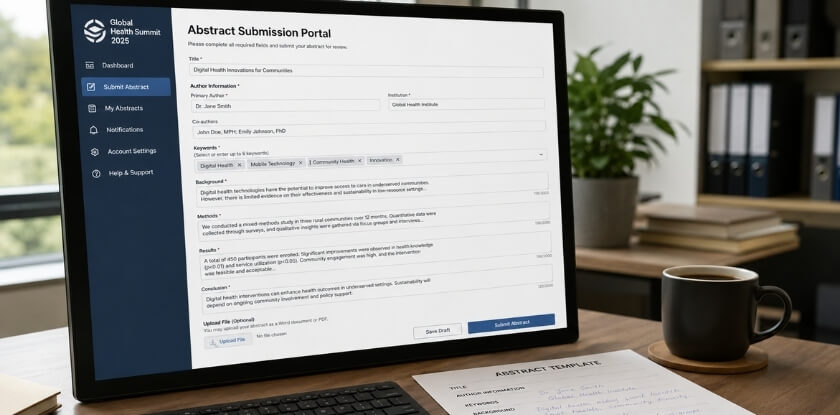
A good abstract holds four things: the research question, the method, the main finding and one sentence on contribution. Skip the background literature and the long caveats. Reviewers read many of these, and an economics abstract that hides the result tends to lose to one that states it.
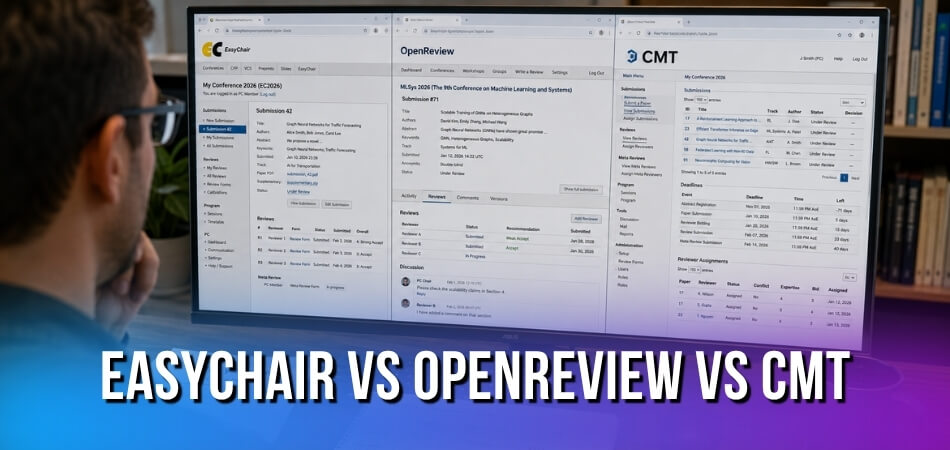
Create your portal account early. Systems such as EasyChair or Oxford Abstracts, and event-specific portals, can have file size limits, required metadata and mandatory keyword fields. Have your author details, affiliation and, for economics papers, JEL classification codes ready. Save the confirmation email as proof of submission.
Some societies add conditions on top. For example, the American Finance Association (AFA) states for its 2027 annual meeting that there is no paper submission fee, that the submitting author must be an AFA member, and that you may submit only one paper, although you can be a coauthor on others. Calls change every cycle, so read the current one.
If the call says review is double blind, your upload must carry no name, institution or identifying acknowledgement. Strip the document properties of Word and PDF files too, since author metadata can break anonymity. Avoid phrases such as “as I argued in my 2022 paper” in the body.
Preparing Your Full Paper Manuscript: Formatting, Length and Template
Some events want only an abstract first and invite the full paper later. Others, especially those that publish proceedings, want the complete paper upfront. Check which one applies.
When a full paper is due, use the template exactly. Proceedings are compiled into one volume, and a paper that ignores the layout can be sent back without review. Typical points to check in the call:
- Length: set by each event, in pages or words, and it may include tables, figures, references and appendices.
- Reference style: some events accept a journal-style format or Chicago author-date, while others require APA. Use the one the call names.
- Tables and figures: in the text unless the template says otherwise.
- Equations: numbered and formatted consistently. LaTeX users should use the event’s class file if one is supplied.
If the conference feeds a special journal issue, its formatting rules may follow that journal’s author guidelines. Check both pages, since they sometimes differ. Cut to the limit rather than shrinking fonts or margins. Reviewers notice, and it looks careless.
Run a Plagiarism Check Before Submitting
Check your own paper first, because some events screen submissions and a high similarity score can end a submission before review. iThenticate is widely used in academic publishing, and some university libraries provide access. Turnitin is also common.
Read where the matches come from, not only the percentage, and go through the highlighted parts by hand. Standard methods language, data descriptions and reference lists produce harmless matches. A long unquoted passage that matches another source is the real problem, even when that source is your own earlier work.
Self-plagiarism counts. If the paper grows out of a thesis chapter or an earlier working paper, paraphrase, update or cite the earlier text. Some calls also ask whether any part has been published before, including as a working paper, so answer honestly.
The Peer Review Process: How Double-Blind Review Works
In double-blind review, reviewers do not know who you are and you do not know who they are, so the paper has to stand on its own merits. A typical portal asks for two files: a title page with your details and an anonymised manuscript. Upload the wrong one and the paper may be desk-rejected.
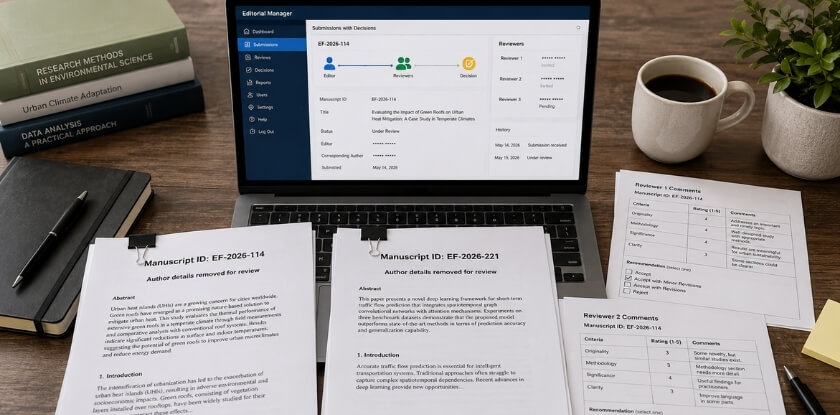
Reviewers are matched by track and subject, and each recommends an outcome such as accept, revise or reject; the exact categories differ by event. The programme committee then combines the recommendations into a decision. Timelines depend on the event, so read the stated decision date. If it has passed with no word, a short polite email to the programme chair is reasonable.
Handling Reviewer Comments and Submitting Your Revision
A major revision is not a rejection. Treat it as a conditional acceptance with work attached.
Read the comments once, then step away for a day. When you return, number every comment and group them by reviewer. Some will concern methodology, some missing literature, and some will be poorly aimed. You still answer all of them.
A revision has two parts: the revised paper and a response letter. Go through the comments in order, quote each one, and say what you did. Paste in the changed paragraph where you made a change. Where you disagree, explain why, calmly. Give locations such as “revised on page 8, third paragraph” instead of “we have addressed this.” The same letter format works again later at a journal, which is why it pays to write it well now.
If the portal asks for a resubmission, follow its file naming and format rules. Some events are stricter about format at the revision stage than at first submission.
What to Do If Your Paper Gets Rejected
A rejection means the paper did not fit that venue at that time, and the reviewer notes are free advice. Read them before you do anything else. Rejection with two pages of comments is worth more than a polite acceptance with none.
Some events may offer a poster slot or a different session to papers that missed the main programme. For a PhD student, that is still an appearance and a chance for feedback, so think before declining.
If the feedback was thin, the likely causes are a wrong track, a crowded topic that cycle, or a formatting or similarity problem. Pick the next venue on fit, not on frustration. Do not jump to a higher-ranked event just to prove a point, and do not drop to a doubtful one just to collect a line on your CV.
Working Papers, Discussants and Meetings Like the AFA and WFA
At many economics and finance meetings, you present a working paper, not a finished article, and the “publication” comes later in a journal. Some events also assign a discussant to your paper.
A discussant is a researcher who reads your paper in advance and comments on it in front of the session, usually by summarising the contribution, raising concerns and suggesting next steps. The 2026 Sydney PhD Conference in Economics and Business, for example, pairs each presenter with a dedicated discussant, described as an experienced senior researcher chosen for subject expertise. Formats differ, so ask the programme chair how the discussion is run, and check whether the call asks authors to volunteer as discussants or session chairs.
Post your working paper before the meeting so people can find it. SSRN and NBER are the usual places, and authors can keep the draft updated after each round of comments. Check the target journal’s policy first, because journals differ on circulated drafts. The American Economic Review, for instance, states that papers under consideration for publication at another journal are ineligible, which is a rule about concurrent journal submission, not about conference talks.
| Output | Reviewed by | What it is for |
| Working paper (SSRN, NBER, university series) | No formal peer review | Early visibility, feedback, a citable draft |
| Conference paper with discussant | Programme committee, sometimes double blind | Structured criticism before submitting to a journal |
| Proceedings paper | Depends on the event | A formal record, if the event publishes proceedings |
| Journal article | Referees and an editor | The version that carries long-term weight |
Submission Fees and Registration Costs: What to Watch Out For
Fees differ widely, so read the call and ask what each one covers. Some events charge a submission fee and many charge a registration fee once the paper is accepted. Others do not charge for submission: the AFA states there is no paper submission fee for its 2027 meeting. Fee levels vary by event and year, so this guide gives no price ranges.
The Full Cost Picture
If you attend in person, the registration fee is only part of the bill. Add flights and accommodation, visa fees if you need a visa, and any per-page or open access charge from a proceedings publisher. Do not assume the organiser pays any of these: unless the call or a written agreement says otherwise, expect to cover them yourself.
How to Verify Before You Pay
Before you pay anything, check three things. First, find earlier proceedings or programmes and confirm that papers from past years exist. Second, check whether a recognised society such as the AEA, AFA or EFA stands behind the event, or whether the organiser can be traced. Third, confirm the programme committee has named people at real institutions, and look up two or three of them on their university pages to see whether they mention the event. Be suspicious of an acceptance that arrives within days with no reviewer comments, or of a payment demanded before any decision.
Fee Waivers and Funding
Some events reduce or waive fees for PhD students who present. You usually apply separately or write to the organiser after acceptance, and the fee structure is not always advertised. Research councils, central banks and university departments may fund conference travel. Some require an accepted paper before they approve funds, and some accept an application based on a submitted abstract. Know your institution’s deadlines, because they rarely bend.
If the paper has co-authors, sometimes only one needs to register for the paper to be included. Confirm this with the organiser first.
Publication in Conference Proceedings: Is This a Real Publication?
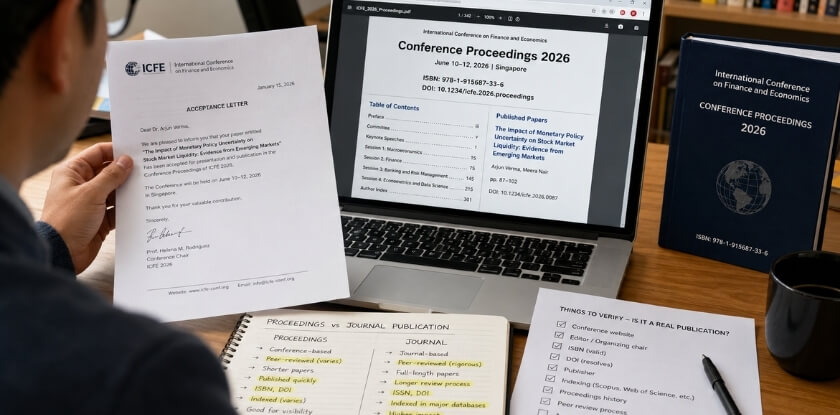
It counts as an academic output, but how much it counts depends on where the proceedings are listed and what your field values. In economics and finance, being accepted onto the programme of a selective meeting can matter more than a proceedings volume.
Where Proceedings Are Indexed and How Much They Are Worth
Proceedings listed in Scopus or Web of Science appear in citation databases and can count in institutions that track indexed output. Elsevier says Scopus covers conferences that publish full-text papers, and that conference series with an ISSN are serial titles while one-off proceedings with an ISBN are non-serial. Non-indexed proceedings are closer to a PDF on an organiser’s site. Check the source title list yourself, as described earlier, before you rely on a claim.
At a selective meeting built around working papers, the proceedings are not the point. Being accepted is the signal, and the paper you present becomes a working paper and then, hopefully, a journal article. Check the call: if it does not mention proceedings, ask whether there are any.
At smaller and regional events, proceedings can add a citable record, especially when indexed. They supplement a journal record, and how much they count in a promotion decision is set by your own institution, so ask your department.
Some predatory events claim Scopus indexing that does not exist. You can check in a few minutes, so do it before you pay.
Open Access Proceedings vs. Restricted Access
Open access proceedings travel further, because other researchers can find, cite and build on them. But open access does not guarantee quality, and some open proceedings use a light editorial check instead of real review. If the review process is not described, treat that as a flag.
There is a downstream point. If you plan a longer journal version, check whether the journal treats your proceedings paper as prior publication. Some journals accept it when the journal version is substantially expanded, but others do not. Restricted-access proceedings avoid that problem but leave the paper largely unseen, unless you post a working paper yourself on SSRN or an institutional repository. If your funder requires open access, check that the proceedings arrangement meets it before you submit.
Rules and Tips for Presenting Your Paper at a Conference
Check the programme for your format and slot length first, then rehearse for that time. Session length differs by event, so treat the numbers below as a rule of thumb and not an event rule.
Oral Presentation vs. Poster Presentation
Most events offer an oral session, a poster session, or both. You may be asked for a preference, but the programme committee makes the final call based on fit and available slots.
Oral presentations are the standard format. You speak in a thematic session, often followed by questions, and a discussant may comment on the paper. That feedback is valuable if you plan a journal version.
Poster presentations give you extended one-to-one conversations with other researchers. A dense empirical study with many robustness checks can gain more from this than from a short talk, and it is lower stakes for a first-timer. A clean theoretical argument often suits an oral slot better.
Practical Tips for Building Your Presentation
Slide structure. A common rule is about one slide per one to two minutes of speaking time, so a 20-minute talk needs somewhere between ten and twenty slides. A clean order for most economics and finance papers:
- Title, authors, affiliation. Keep it clean.
- Motivation and research question. One clear question and why it matters.
- Where your paper sits. Not a literature review, only the gap you fill.
- Data and methodology. Longer if identification is the contribution.
- Main results. Lead with the headline finding, show the coefficients that matter and not the full regression table.
- Robustness and extensions. Short. Questions will come here anyway.
- Conclusion. Three points at most.
Do not put your whole abstract on slide one, keep fonts large enough to read from the back, and skip animating every bullet. A strong graph, such as a trend break or a clear scatter plot, can work well at the front.
Time management. Practise out loud with a timer. A slide that takes ten seconds to read silently can take much longer to explain to a room. For a 20-minute slot, one way to split the time is:
- Motivation and research question: 2 to 3 minutes
- Data and methodology: 4 to 5 minutes
- Results: 8 to 9 minutes
- Conclusion: 2 minutes
- Buffer: 1 minute, because sessions run late and questions interrupt
If you have a discussant, send the paper early, because a discussant responds to the papers after they have been given. The programme may set a deadline, but a week ahead is basic courtesy, and a discussant who has read the paper gives far better comments.
During questions, write down every one. Questions from senior researchers can point at weaknesses a journal referee may also find, which makes this a free pre-submission review. If you do not know an answer, say so. “That is outside this version, but it is a good direction for follow-up” works fine.
From Conference Paper to Journal Publication: The Next Step
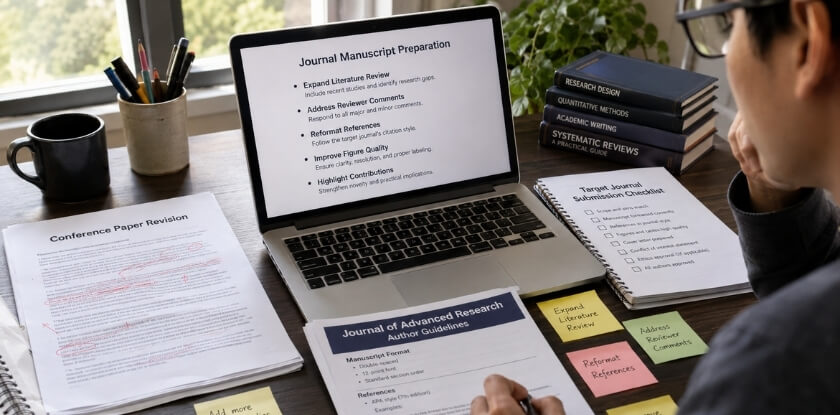
Present the paper, revise it, and then submit it to a journal as a substantially expanded version. Treat the conference as a stop on the way to the journal, not the destination.
Can You Submit the Same Paper to Both a Conference and a Journal?
Usually yes, in sequence, but not at the same time to two outlets that both review it. Many economists present drafts at meetings and post working papers before submitting, but journal rules differ. What you cannot do is send identical text to two places at once or present a published article as new work. That is duplicate submission, and journals treat it seriously.
Policies differ, so check the journal’s guidelines for three things:
- whether it asks for a statement that the paper is not under review elsewhere (the AER, for example, does not consider papers under review at another journal);
- whether it asks about earlier conference or working-paper versions, and whether it expects you to describe prior work on the same subject (the AER says papers must represent original work and fully reference and describe all prior work on the same subject);
- whether your proceedings paper, especially one with a DOI, counts as prior publication.
If you are unsure, email the editorial office. It takes two minutes and can save months.
How to Upgrade Your Conference Version into a Full Journal Version
Think of the conference version as the proof of concept and the journal version as the complete argument. The upgrade usually involves:
- A wider literature review. Include recent papers that appeared after your conference submission.
- More robustness checks. Referees may ask for other specifications, samples or estimators, so build some in before you submit.
- A fuller methods section. Spell out identification, data sources, sample construction and assumptions that could be challenged.
- Journal formatting. Check word limits, reference style and file rules. Portals can reject non-compliant files before a human reads them.
- A plagiarism check on the full manuscript, including text carried over from the conference paper.
If your conference paper had formal review, you already hold reviewer comments. Use them as a free first round and address every substantive point.
Refereeing and Revise and Resubmit at the Journal
A revise and resubmit (R&R) is the normal outcome at a good journal, and it is not an acceptance. The editor sends you referee reports and expects a revised paper plus a point-by-point response, the same format you used at the conference. Answer every comment, show where you changed the paper, and explain politely where you disagree. Expect more than one round. Journal timelines vary by journal and can be much longer than a conference decision, so read the journal’s own page before you plan around a date.
When the Conference Offers a Journal Route
Some calls say that authors of strong papers will be invited to submit to a partner journal or a special issue. Read that as an invitation to submit, not an acceptance. One finance conference page, for example, says authors of high-quality papers are invited to submit to a named journal and does not describe how papers are selected. Ask whether the journal runs its own full peer review, what it charges, and where it is indexed before you commit.
Top Economics and Finance Journals vs. Conferences: Which Should You Choose and When
PhD students: usually conference first, journal second. You need structured criticism before a long revision cycle, and the feedback can change the paper.
Early-career researchers: both matter. Indexed proceedings can support an application where output counts, but what counts is set by your institution, and a paper in a strong journal, such as an ABDC A* or A title, usually carries more weight.
Experienced researchers: the conference can be used for visibility, testing an argument and meeting co-authors and editors. The journal paper is the goal.
Track match matters here too. Read the last two or three programmes of the conference and recent issues of the journal you are targeting. If your paper does not clearly fit, move on to a better match. The journal version does not have to be unrecognisable: the core argument, data and main results stay yours, and what changes is depth, framing and engagement with the literature.
Special Advice for Early-Career Researchers and PhD Students
Submit a solid draft early, pick an event that matches your stage, and treat the feedback as the real prize. The process looks harder than it is.
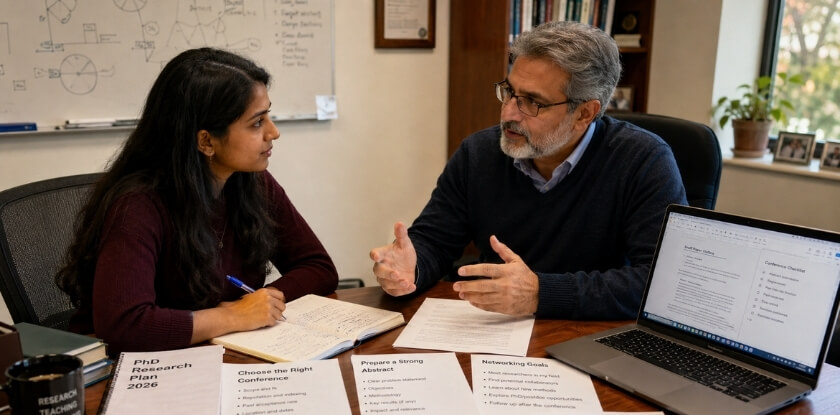
Your First Conference Paper Doesn’t Need to Be Perfect
It needs a clear question, a credible method and results you can defend. It is tempting to wait until the paper is “ready,” and it never is. Review will show you what is missing. A rejected abstract with comments is data, not failure.
Choose Conferences That Match Your Stage
Do not start with the biggest meeting in your field. Look for workshops, doctoral colloquia and smaller regional events in your subfield. Do not obsess over indexing for a first paper, since feedback and presentation practice have real value even at a modest event.
Abstract Submission Is Your First Test
Write the abstract before the full paper. Drafting a short abstract that states question, method and contribution forces you to learn what the paper argues. Have keywords, JEL codes and a short bio ready, because a missing requirement is an avoidable reason for desk rejection.
Manuscript Formatting Takes Longer Than You Expect
Budget time for it and read the formatting guidelines before you write. Converting a 30-page paper from APA to Chicago author-date the night before the deadline is miserable. If the proceedings are open access, check whether the final version will be publicly indexed, since that affects the journal version later.
Use the Presentation as a Learning Tool
Questions will come from people your supervisors never met. Write them down right after your session. If you present orally, rehearse the timing out loud at least twice, since it is easy to run over.
The Conference Paper Is a Starting Point, Not the Destination
Do not sit on the revision. Reviewer comments fade quickly, so a reasonable target is to submit the revision or the journal version within a few months of the event. The exact time depends on how much the paper needs.
From our experience at MS International: Our conferences are held in person at venues in the Greater Toronto Area, and every submission goes through double-blind review, with decisions usually within about 10 working days. The decision can be an acceptance, a revision request or a rejection. Submitted work must be original and not previously published or under review elsewhere, full papers should normally be four to twelve pages in APA format, and accepted authors then register as authors. Accepted papers may be considered for conference proceedings where applicable. Speakers cover their own travel, accommodation, visa and personal expenses unless we have agreed otherwise in writing, and keynote or invited-speaker roles are arranged separately rather than through an author ticket.
FAQ
Dual submission to a journal and conference, spotting a predatory event and deciding whether SSRN working papers count as publications are the worries economists and finance researchers bring to this stage.
Can I submit the same paper to a conference and a journal at the same time?
Usually not to two outlets that both review it. Journals such as the American Economic Review will not consider a paper that is under consideration at another journal. Present at a meeting first, then submit the revised version to a journal, and disclose the earlier version if the journal asks.
Does publishing in conference proceedings count as a “real” publication on my CV?
Yes, list it as a conference paper, labelled as proceedings. How much it counts depends on whether the proceedings are indexed in Scopus or Web of Science and on your institution. A PDF on an unindexed site carries much less, and in economics and finance a journal article usually carries the most weight.
How do I know if a conference is predatory?
Check who organises it, who sits on the programme committee, how review works and where the proceedings are published. Warning signs are instant acceptance, a very broad scope, a guaranteed publication and no archive of past proceedings. The Think. Check. Attend. checklist covers the rest.
What does a discussant do at an economics or finance conference?
A discussant is a researcher who reads your paper in advance and comments on it in front of the session, usually summarising the contribution, raising concerns and suggesting next steps. Not every event assigns discussants, so check the programme or ask the chair.
Are working papers on SSRN or NBER a publication?
No. The NBER describes its working papers as circulated prior to peer review, and SSRN is a preprint server. They make a draft visible and citable, but a journal article is the peer-reviewed version.
What is the difference between an oral and a poster presentation?
An oral presentation is a timed talk to a session, sometimes with a discussant, while a poster is a printed display you explain one-to-one during a dedicated session. Neither is inferior. Some events let you state a preference, and others assign the format.
My abstract was accepted but my full paper was rejected. What now?
Read the comments first. A full paper can fail to deliver what the abstract promised, through weak methods or thin literature. If the feedback is useful, revise and send it to the next fitting event. If it is vague, revise and consider a journal.
Do I need to pay a registration fee even if I am only attending, not presenting?
Usually yes, at a rate that differs by event. Presenters generally register as authors after acceptance, and non-presenting attendees register separately. At MS International, listener registration is for attending without presenting a paper. Ask about student or early-career discounts.
Can I run a plagiarism check on my own paper before submission?
Yes, and you should. Use iThenticate, Turnitin or whatever your library provides, and read where the matches come from. Self-citation without attribution can raise the score, so cite your earlier work properly.
Is open access required for conference proceedings?
No, it depends on the event and your funder. Some proceedings are open access and some give authors a paid open access option. If your funder mandates open access, confirm that the proceedings arrangement satisfies it before you submit.
How long should I wait before submitting a journal version?
There is no fixed rule. Present first, use the feedback, then expand the paper, and aim for a few months. A rushed revision usually shows, and a thin journal version will draw the same criticisms again.
What does “track match” mean when submitting to a conference?
It means choosing the thematic track, such as monetary policy or corporate finance, where your paper belongs. Reviewers in that track are specialists. A wrong track can bring generic feedback or an early decline, so match the paper to its real field.
Final Words: Your Roadmap to Your First Conference Publication
Check the event, submit a tight abstract that fits the track, answer every reviewer comment, present the paper, then turn it into a journal article. You do not need a perfect paper to start, only a good one sent to the right place.