
Many researchers spend months writing a literature review but only a few hours preparing to present it. You have done the reading, built the argument and found the gaps. Then your work is accepted at an academic conference and you face a different problem: how do you compress weeks of careful writing into a 12-minute oral presentation, or a poster someone will scan in under two minutes? The instinct is to shrink the document. That instinct will cost you.
Quick answer: To present a literature review at a conference, turn it into one argument, not a summary: what the field agrees on, where it falls short, and the research gap your work fills. Pick an oral talk for an argument or a poster for a map of the field, give each slide one idea, rehearse with a timer, and prepare five likely questions.
This guide covers the format decision, the structure of the talk, a slide template, timing, audience engagement, the Q&A session and the mistakes worth avoiding.
How to Present a Literature Review at a Conference
You present a literature review by telling the story of the field in a few minutes: show the main positions in the conversation, name the research gap your work addresses, and explain why that gap matters to the people in the room. The same logic applies whether you give an oral presentation or stand beside a poster.
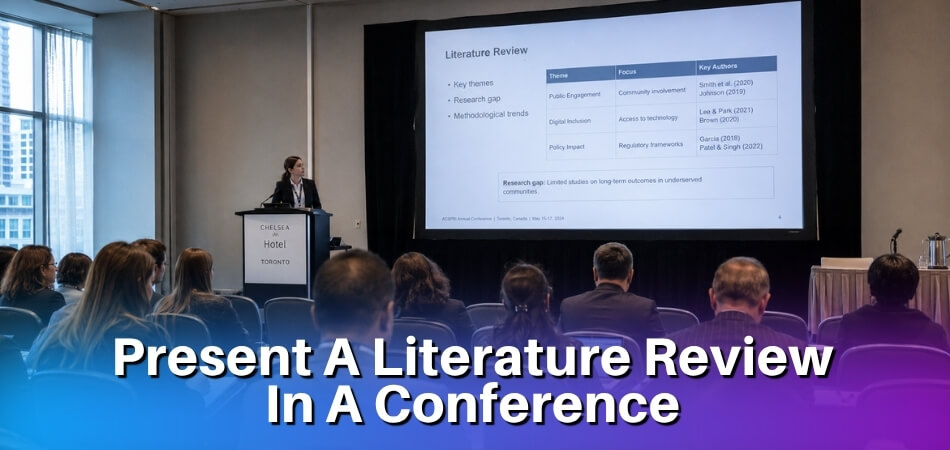
The Narrative Distillation Problem
A literature review written for a dissertation or journal article can run 30 pages or more. A conference talk gives you a handful of slides to cover the same ground. The skill is narrative distillation: pulling out the through-line instead of summarizing every source.
It is tempting to cram in every citation. Resist it. An academic audience does not need a bibliography recap. They need to see how the field arrived at the question you are asking. The table below shows how the same material changes between the written review and the conference version.
| Element | Written review | Conference talk |
|---|---|---|
| Sources | Everything relevant | The few that anchor your argument |
| Organization | Often chronological or by author | Thematic, built around tensions |
| Reader or listener | Can scan back through pages | Hears it once, in real time |
| Role of the gap | Stated near the end of the review | Named early, then returned to |
Oral Presentation vs Poster Presentation: Which Format Fits Your Literature Review
Choose an oral presentation when your review builds toward an argument, and a poster when it maps a field. For a literature review, this choice decides how much depth you can cover, how the audience engages and how you handle questions about gaps in the scholarship.

| Oral presentation | Poster presentation | |
|---|---|---|
| Time | A set block; the IEEE Author Center says most conference presentations are 10 to 20 minutes long | No fixed slot; you give a 2 to 3 minute version to whoever stops |
| Who controls the pace | You do; the slides carry the structure and your voice carries the argument | Viewers browse at their own speed, so the review must work visually: short text blocks and a clear flow from problem to gap to your contribution |
| Best for | An argumentative thread: how the field shifted, where consensus broke down | Taxonomic or comparative reviews: a field organized by method, population or region |
| Q&A | One group question period after the talk | One-to-one conversations with individual researchers |
Slot lengths and formats differ between conferences and tracks, so check the call or your acceptance email instead of assuming.
When to Choose an Oral Presentation
An oral presentation suits a literature review when a clear argumentative thread runs through the scholarship: a story about how the field has shifted, where consensus broke down, or what a research gap reveals about future work. Oral delivery lets you control the sequence and pace of that argument.
- You have 10 to 20 minutes of structured content. A review that synthesizes competing theoretical frameworks, traces methodological change across decades, or makes a case for a specific gap usually has enough substance to fill a slot without padding.
- The narrative distillation matters. An oral slot lets you explain why certain studies belong together and others do not, the connective reasoning that is hard to scan on a static poster. If your review applies the 5 C’s of literature review (cite, compare, contrast, critique, connect), you have room to walk through those moves explicitly.
- Your conference abstract was accepted as a paper. Many academic conferences assign the format at submission. If you submitted a paper abstract and it was accepted, the decision is already made. If you do have a choice and your review has a strong argumentative spine, oral is usually the stronger vehicle.
Presenters sometimes worry that a literature review “isn’t enough” for an oral slot. It can be, provided the review does analytical work instead of cataloguing sources.
When a Poster Works Better
A poster fits when the material is primarily taxonomic or comparative, so you are mapping a field instead of arguing through it. If your review organizes the literature by methodology, population or regional focus, a well-designed poster lets attendees scan the structure and stop at the sections that matter to their own work.
- The review is a component, not the centerpiece. If it underpins a larger empirical study, a poster shows the theoretical background visually while your conversation time goes to the study itself. This can be a practical way to present full background without talking about it for 15 minutes straight.
- You want more individual Q&A. At a poster, researchers stop and ask specific questions about your sources, inclusion criteria or handling of conflicting evidence. That one-to-one exchange can be very useful for a graduate student still refining a research framing.
- Your review covers a very large or dispersed literature. If you are synthesizing across disciplines or dozens of studies spanning 30 or more years, a layout with sections, a timeline or a categorization matrix communicates scope faster than a spoken summary. Trying to say all of it in 15 minutes usually means glossing over too much.
From our experience at MS International: We accept abstracts, full papers, case studies, review papers and professional presentations, so a literature review can be submitted as a review paper. Papers go through double-blind review and should follow APA format. Presentation lengths may vary, so your speaker confirmation and the final conference programme are the official sources for your speaking time. Authors must complete author registration before presenting, and accepted papers presented in person may be considered for conference proceedings where applicable. On the day, speakers are asked to bring the final presentation in the requested file format with a backup copy on a USB drive, and to confirm the room, speaking time, presentation order and technical setup with the session coordinator.
How to Structure Your Literature Review for a Conference Talk
Structure the talk around a thematic argument, not a source-by-source tour. A written review might span 40 pages, while your oral slot might give you 12 minutes, so the structure has to do different work from a document.
The 5 C’s of Literature Review Presentation
The 5 C’s (Cite, Compare, Contrast, Critique and Connect) are a framework published in university writing resources, for example by the Texas Tech University Writing Center. They give you a spine for what you say and travel well from written work into a talk. The framework is a teaching aid, not a formal standard, so use it to shape your own argument.
Cite means grounding your claims in specific sources, not speaking in vague generalities about “previous research.” Even in a 12-minute talk, your audience expects named studies, key authors and approximate dates. You do not cite everything from your written review. You cite the three to five sources that anchor your argument.
Compare is where you show you have genuinely read the field. Group studies by what they agree on. If four independent teams found similar results using different methods, say that plainly, because it signals consensus and helps the audience calibrate what is settled.
Contrast is what makes your narrative interesting. Where do scholars disagree? Which findings contradict each other? Flagging real disagreements shows methodological awareness and sets up the next C.
Critique does not mean tearing down others’ work. It means identifying limitations such as small samples, narrow geographic scope or outdated data collection. It is easy to skip this because it feels presumptuous. Skip it and your review reads as a summary, not an analysis.
Connect is the payoff. Link the literature directly to your own research question or gap. The audience should leave knowing exactly why the existing work makes your study necessary. If this step is weak, the whole structure loses its point.
The five functions do not each need their own slide. They are organizational logic, not slide labels. A single slide can cite, compare and contrast at once through a well-designed visual or a crisp two-sentence synthesis.
Distilling Your Narrative: What to Keep and What to Cut
A thesis chapter includes everything: the methodological lineage, tangential debates, studies that inform your approach but do not shape your argument. None of that survives the move to a talk intact. Ask of every piece of content: does my audience need this to understand why my study matters? If not, cut it.
Distillation is not dumbing down. It is choosing signal over noise. When your review is the background to a larger study, it should take roughly three to five minutes and three to five slides of a 15-minute slot, which forces real decisions. Published guides run shorter: a conference presentation guide on an LSE blog gives the literature review about 2 minutes of a 15-minute talk, and the Purdue OWL advises moving most of it to a handout or appendix so the talk can focus on methods and findings. Treat three to five minutes as the upper end.
Chronological organization rarely works in a spoken setting, because listeners cannot hold a timeline in their heads the way a reader can flip back through pages. Thematic organization almost always lands better: group the literature by what it shows, not by when it was published.
One pattern works well for oral talks: open with the dominant view in the field, show where that view falls short, then use that critique to introduce the gap your study addresses. This three-part arc of consensus, limitation and gap gives a clear through-line and sets up your methodology cleanly.
For posters, distillation goes further. A viewer may give a poster only a minute or two before deciding whether to stop and talk (a rule of thumb, not a measured figure), so your review on a poster might be four sentences and a diagram. The 5 C’s still apply, but Cite and Connect carry almost all the weight.
The urge to include more sources, more context and more nuance is understandable. But the researchers in your session are not grading your comprehensiveness. They are deciding whether your work is credible and interesting, and a tight narrative does that better than an exhaustive one.
Building Your Slides: A Simple Conference Slide Template
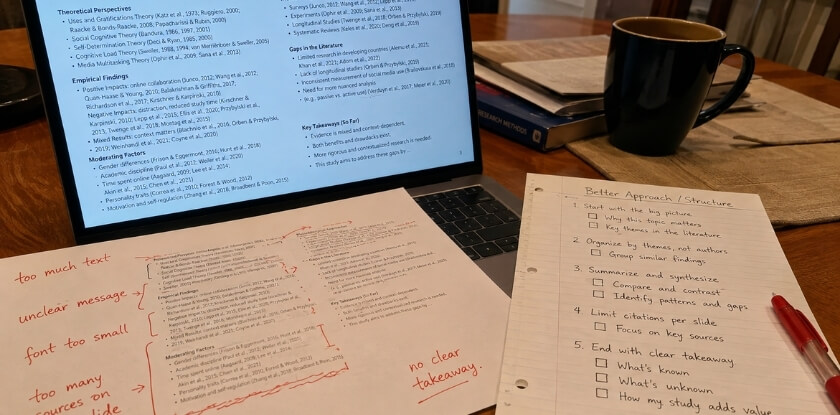
Build your slides as a visual aid, not a transcript. The temptation with a literature review is to reproduce the written version on screen with dense text, long reference lists and exhaustive tables. Your audience is there to follow your argument, not to read your screen.
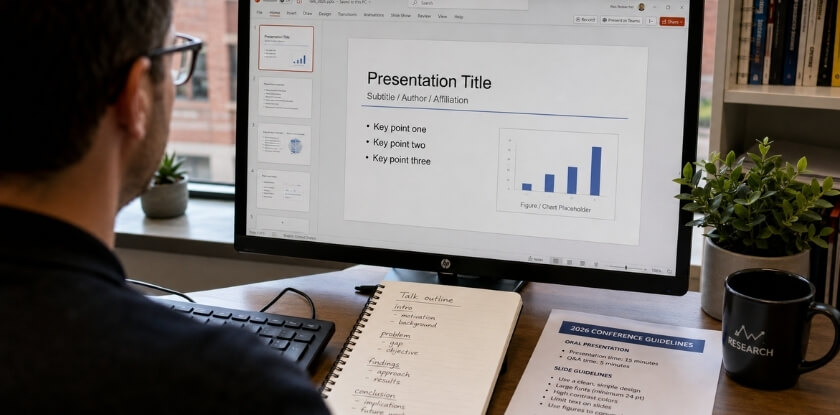
Two Cases: Review as Background or Review as the Whole Talk
How many slides you need depends on the role of the review. If it frames a larger study, keep it to three or four slides inside your talk:
- Slide 1: The dominant conversation in your field, with two or three major positions named concisely.
- Slide 2: Where those positions agree, and where they conflict or leave something unanswered.
- Slide 3: The specific research gap your work targets, stated in plain language.
- Slide 4 (optional): A brief note on how your methodological or theoretical approach responds to that gap.
If the review is the whole talk, for example a review paper, use the fuller template below. It assumes a 12 to 15 minute oral presentation and works in PowerPoint, Google Slides or Keynote. For a shorter slot, trim the middle sections. For a poster, the same logic applies to the panel layout.
| Slide | Job | What goes on it |
|---|---|---|
| 1 | Title and framing | Title, name, affiliation, conference, date; optional one-line framing |
| 2 | Question or gap | The gap in one or two plain sentences, in its own larger text box |
| 3 to 4 | Scope and method | Inclusion criteria (databases, year range, keywords); sources reviewed versus included |
| 5 to 8 | Thematic body | One theme per slide with a headline stating the finding or tension |
| 9 | Research gap, expanded | Three or four focused points on what is missing |
| 10 | Implications | What kind of work is needed, for theory, practice or method |
| 11 | References | Key sources only, small consistent font |
Slide 1: Title and Framing
One clean slide with your title, name and affiliation, conference name and date. Some presenters add a single framing sentence beneath the title, such as the example below. It is optional, but it tells the audience at once that this is a synthesized argument, not a summary report.
A synthesis of 47 studies on X, identifying a persistent research gap in Y.
Slide 2: The Research Question or Gap
This is the anchor slide. State the gap or the question driving your review in one or two sentences. If the review exists to frame a larger study, say so here.
Put the gap in its own text box, larger than the surrounding text. Audience members may photograph this slide, so make the core claim legible at a distance.
Slides 3 and 4: Scope and Method of the Review
Audiences at academic conferences want to know how you selected your literature. Two slides are usually enough: one for inclusion criteria (databases searched, year range, keyword strategy) and one for how many sources you reviewed versus included.
A simple table or two-column list works better here than paragraphs. If you used a structured framework such as a PRISMA flow or the 5 C’s, name it briefly. You do not need to explain it: anyone who knows it will recognize it, and anyone who does not will follow your structure anyway.
Slides 5 to 8: The Thematic Body
This is where most graduate students either overload the slides or lose the thread. Four slides is a reasonable allocation, and you might use three or five depending on how many themes you cover.
Each slide should carry one theme or argument, not one source. Building slides around individual papers (“Smith et al. found X; Jones et al. found Y”) produces a list instead of an argument. Group by idea.
One theme per slide. Use a short headline that states the finding or tension, such as “Studies diverge on measurement validity” or “Qualitative work consistently underrepresents X population.” Then add three to five bullet points that are actual findings, not author names, with citations in small text beneath or in parentheses.
Do not cite more than six sources per slide. If twenty papers support one theme, your bullets represent the pattern across them. The citations are evidence, not the content.
Slide 9: Research Gap (Expanded)
You named the gap on slide 2. Here you return to it with specifics. What have the reviewed studies failed to address? Where do findings contradict each other without resolution? What population, context or variable is consistently missing?
This slide is the payoff of the whole presentation, so keep it to three or four focused points. If your review connects to a study you are proposing or have already done, this is where the connection becomes visible.
Slide 10: Implications or Directions Forward
One slide on what the gap means for theory, practice, methodology or future research. Be specific about what kind of work is needed. “More research is needed” lands as filler in front of a research-literate audience. End the talk with a short summary of your two or three key points, as the Purdue OWL conference presentation guide advises.
Slide 11: References
A references slide is expected, but nobody reads it during the talk. Keep it to your key sources, fifteen or twenty at most, in a small, consistent font. Its purpose is to exist for anyone who photographs it or reviews your slides afterward. The Purdue OWL also suggests a shortened link or QR code on the final slide so the audience can reach your slides later.
A Note on Visual Design
You do not need a custom template. A clean built-in theme with good contrast is enough. Avoid slides that use three font sizes without logic, background images that reduce legibility, and colour schemes that do not survive a projector.
If your institution offers a branded template, use it. Some conference organizers also provide a template with the submission package, so check your conference materials before designing from scratch. The Purdue OWL adds that closed captions on slides, a microphone and a large-print transcript make a talk more accessible.
White space does real work. A slide with four short bullets and room to breathe is easier to follow live than one packed with eight points in small text. Your audience is listening to you while reading the screen, and can hold only so much at once.
Timing Your Slides
Plan roughly 60 to 90 seconds per slide. At the lower end, eleven slides fit a 12-minute talk with a little room at the start. At 90 seconds per slide, a 15-minute slot holds about ten, so a 15-minute slot with 12 slides is already a problem before you walk in. Treat this as a rehearsal self-check, not a formula: your gap and thematic slides will take longer than the title slide.
Eighteen slides for a 12-minute talk works out at about 40 seconds each, which is almost nothing once you get to the point, so that is too many. Spend the most time on the research gap slide. It is the hinge the whole talk turns on, and the part reviewers and senior colleagues will remember and question. Practise with a stopwatch. If you reach slide 5 at the eight-minute mark, cut content instead of speaking faster.
Time Management in a 10–15 Minute Presentation Slot
Plan your time before you build slides, and finish a minute or two early. A 10 to 15 minute slot sounds short until you are at the podium and realize you have spent eight minutes on background. Time is easy to lose control of, and the fix is usually structural.
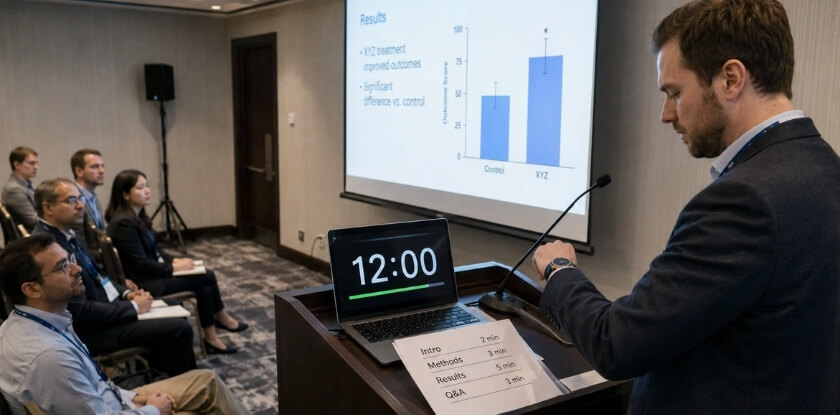
Know Exactly What You Are Cutting
Most literature reviews cover far more than a slot can hold. Before you open a slide deck, decide what stays and what gets summarized in a single sentence. If a source or theme does not build toward your research gap, it belongs in the written review, not on a slide. The audience does not need your full reading history. They need the thread.
A rough guide for a 12-minute oral presentation:
| Part | Time | Content |
|---|---|---|
| Opening and framing | 1 to 2 minutes | Why this review matters and what question it addresses |
| Thematic synthesis | 5 to 6 minutes | The 2 to 3 main threads, using the 5 C’s as a backbone |
| Research gap and significance | 2 to 3 minutes | What the existing literature leaves unanswered |
| Closing and transition | 1 minute | A clean handoff, especially if the review leads into your own findings |
That structure treats the talk as a narrative distillation, not a compressed version of every paper you have read.
Rehearse With a Timer, Not in Your Head
Reading through slides mentally is not rehearsal, and it consistently underestimates the time. People speak more slowly live, lose a beat when a slide loads, or pause to recover a thought. Budget for all of that.
Record yourself giving the talk once, even on your phone, and listen back. If your thematic section alone runs nine minutes, you will know where the problem is. At this step you may find your opening runs much longer than planned. In a 10-minute slot, you should reach the research gap slide around the eight-minute mark, not at minute nine and a half.
If you plan to read a written paper instead of using slides, a commonly cited writing-centre rule of thumb is about two minutes per double-spaced page. That puts a 20-minute slot at roughly seven to ten pages. The CUNY Graduate Center Writing Center gives about seven for 20 minutes, so treat this as a starting estimate and time yourself. The Purdue OWL also warns against reading a research paper aloud without revising it, because papers lack the repetition and simple sentence structure that listeners need.
Build In a Buffer, Not a Sprint
If your content fills 14 minutes of a 15-minute slot, you have no room for a late start, a microphone problem or a quick question from the session chair. Aim to finish in 12 to 13 minutes. A talk that ends slightly early is always received better than one the chair has to cut off.
When You Fall Behind Mid-Talk
You look at the room clock and you are two minutes behind at the halfway point. The instinct is to speed up. Do not. Rushing means the audience stops following, and the Q&A becomes much harder when people did not absorb the talk.
Instead, decide on the spot to compress or skip one thematic thread. A clean line such as the one below signals awareness, not panic.
I’ll set this cluster aside for now, but I’m happy to discuss it in the Q&A.
Academic audiences accept that gracefully. What they do not accept is a talk that runs four minutes over because the speaker refused to edit in real time. If the clock is nearly gone, skip to your conclusion: dropping your last two body slides and landing the key finding cleanly beats rushing through everything and overrunning.
Poster Presentation Timing Is Different
At a poster there is no fixed slot, but plan for roughly two to three minutes before a viewer moves on (a rule of thumb). Your spoken summary should fit in about 90 seconds, covering the key gap and your framing, while the poster carries the supporting detail. Visitors who want more will ask. Let them lead the conversation, and use those first two minutes to give them enough to decide.
How to Engage Your Audience During the Presentation
Engage the room by naming the gap early and narrating how the studies fit together, instead of reading findings off slides. Engagement does not require performance. It requires deliberate choices about how you speak, where you pause and how you connect ideas to the people in front of you.
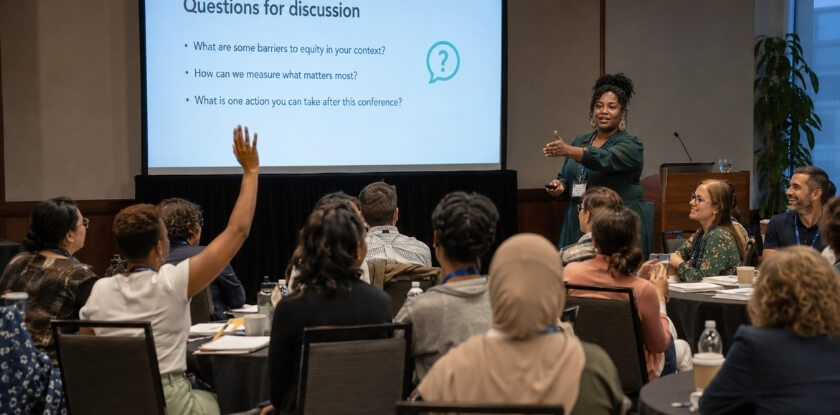
Start by Anchoring the Audience in the Problem
Before you say what the literature says, give the room a reason to care. State the gap in plain language within your first minute or two. Researchers in your audience have probably met adjacent problems in their own work, and naming the gap creates immediate recognition. Do not spend your first thirty seconds thanking organizers, describing what you are about to do or apologizing for the complexity of the topic, because the audience can decide whether to engage within the first half minute.
- Name the gap specifically. A sentence like the one below makes people sit up. Vague framing such as “this is an underexplored area” does nothing.
Studies have consistently examined X, but almost none have looked at the intersection of X and Y.
- Connect to what the audience already knows. Acknowledging that the gap has been noticed but not resolved, instead of presenting it as brand new, builds credibility with experienced reviewers.
Narrate, Don’t List
The biggest engagement killer is reading through studies one by one. A line such as “Smith (2019) found X, then Jones (2020) found Y, then Patel (2021) found Z” is a bibliography read aloud, not a talk. Your job is to show how the pieces fit, where they agree and where they pull apart.
- Group by theme or tension, not chronology. If your review covers three competing frameworks, present them as a conversation. Let the audience feel the tension before you resolve it.
- Use transition phrases that signal movement. Phrases like “this is where the consensus breaks down” or “two camps emerged from this debate” cue the audience that something important is coming and help them track the argument.
- Reference your own synthesis explicitly. Do not leave the audience guessing what you think. A sentence like “across these studies, the pattern suggests…” shows you have made a judgment, which is what a conference presentation is for.
Make Eye Contact and Use the Room
Slides are a reference tool, not a teleprompter. If you read the bullets, the audience reads ahead and disengages. Know your material well enough to glance at the screen and look back at people.
Scan different parts of the room as you talk. When nervous, it is easy to anchor on one spot, usually the screen or the floor, but distributed eye contact feels like a conversation instead of a broadcast. At a poster this matters even more: poster sessions are fully conversational, and you will need to read individual visitors and adjust what you emphasize on the fly.
Anticipate What the Audience Is Thinking
A strong presenter stays half a step ahead. When you introduce a study, briefly acknowledge what a skeptical reader would question before anyone raises it. Pre-empted criticisms become non-issues in the Q&A.
- Signal when you are simplifying. If you are condensing a complex methodological debate, say so: “I’m necessarily compressing this here, but the full picture involves…” That tells the audience you know the nuance exists.
- Pause after key claims. A brief pause after a central finding gives the audience time to process and signals that the point matters. Rushed delivery flattens everything to the same weight.
Handling Questions During, Not Just After, the Talk
At some conferences, particularly smaller workshops, people may ask clarifying questions mid-talk. If yours allows it, do not treat it as a disruption. A short, direct answer followed by “I’ll come back to that in more detail shortly” keeps the session moving without shutting down engagement.
How to Handle the Q&A Session After Your Literature Review
Prepare for the Q&A in advance, answer honestly and briefly, and treat pushback as interest in your work. This is where many graduate students lose the confidence they built during the talk, but it does not have to go that way.
Prepare Before You Present
You can anticipate most of the questions you will get. Read your own review critically and ask what a skeptical colleague would challenge. Common targets are your inclusion or exclusion criteria, whether you missed a major body of work, and how you justify the gap.
Write down five or six likely questions and think through your answers out loud. This is not about memorizing scripts. It is about removing the moment of blank panic when a question lands. Include at least one question you would be uncomfortable getting.
What to Do When You Don’t Know the Answer
This happens to everyone, including senior researchers. Say so directly, and do not bluff. If you promise a follow-up, keep it. An academic audience respects that far more than watching someone improvise.
That’s outside the scope of what I reviewed. I’d want to look at that before I could give you a useful answer.
If the question is partly answerable, answer the part you can and acknowledge the rest.
I can speak to the quantitative studies I reviewed, but I didn’t cover the ethnographic work in that area. That’s a genuine gap I’d want to address in the full version.
Managing Pushback on Your Source Selection
This is a common challenge after a literature review talk. Someone will say you missed a key paper, or that a strand of scholarship should have been included. Questions tend to fall into two types: requests for sources you did not cite and challenges to how you characterized a debate.
- Stay calm and stay specific. Ask for the author and year if they are not given, note it down visibly, and say you will follow up. It is fine to say you focused on the dominant strands and can share a fuller reference list afterward. Do not get defensive about scope.
- Clarify your scope if needed. If the suggested source falls outside your parameters, explain them briefly.
My review focused on peer-reviewed empirical studies from 2010 onward. I excluded theoretical frameworks deliberately, so that one may fall outside my criteria.
- Treat it as useful input. If the gap is real, acknowledge it. For a challenge to your characterization of a debate, acknowledge the alternative reading, note where you see the difference and move on cleanly. A calm answer does more for your credibility than a technically perfect one.
Keeping Answers Concise
The Q&A is not the place for a second talk. Keep answers to two or three minutes at most, and if you find yourself re-explaining your whole framework for one question, pull back. Restating the question briefly before you answer gives you a few seconds to think, confirms you understood and helps the rest of the room follow.
Pause before answering. Three seconds of thinking looks like confidence, while answering at once and then backtracking looks like panic. If a question falls outside what your review covered, it is fine to say so: “that’s a direction the literature doesn’t address well yet, which is actually part of why this gap matters.” Audiences also want your own reading of the evidence, so use the Q&A to show judgment, not just knowledge of sources.
When Questions Are Vague or Off-Topic
Sometimes a question is really a comment, or so broad you are unsure what is asked. Ask for clarification: “Could you say a little more about what aspect you’re focusing on?” That is not evasive, just good communication.
If a question is genuinely tangential, redirect politely: “That’s an interesting direction. It’s a bit outside what I covered today, but I’d be happy to talk about it after the session.”
After the Session Ends
The Q&A closing does not end the conversation. People will come up afterward, and these informal exchanges at an academic conference often produce the most useful feedback. Bring a notebook or use your phone to jot down questions and references. If someone suggested a source, track it down before your next draft.
Common Mistakes to Avoid When Presenting a Literature Review
Many mistakes come from treating the talk as a written paper read aloud. The causes are covered in the sections above, so the table below keeps only the points not made there.
| Mistake | What goes wrong | Better habit |
|---|---|---|
| Reading the paper verbatim | The audience stops following | Speak to the two or three central tensions that your review resolves |
| Copying your abstract onto slides | Abstracts are dense by design; slides should be the opposite | Use a phrase, a diagram or a short claim, then explain it aloud |
| Burying the gap in the final slide | The talk loses its through-line | Name the gap in the first minute or two, then return to it |
| Running over on a poster | A five-minute walkthrough becomes a 12-minute monologue and the visitor leaves | Finish a minute early; the saved minute goes to the Q&A |
| Leaning on a rigid structure | The audience loses interest by the second section | Treat structure as a scaffold, not a script; skip a sub-point if time is short |
| Not adapting on the day | You keep a 12-minute plan when the session runs behind | If you have eight minutes instead of twelve, cut gracefully with one visual instead of three bullets |
FAQ
Turning a literature review into a talk means deciding how much time it takes, whether each source belongs on a slide, where the 5 C’s fit and where it departs from presenting original research.
Can I present a literature review as a standalone conference paper?
Only if the conference accepts review submissions, so check each call. Some focus on new empirical work. If yours accepts reviews, state in the abstract what the review adds, and name the databases searched, the time frame and the number of sources.
How long should a literature review conference presentation be?
Plan for 10 to 20 minutes, since the IEEE Author Center says most conference presentations fall in that range, but your acceptance email sets the exact slot. Posters have no fixed duration, and your spoken summary should take under three minutes.
Do I need to cite every source on my slides?
No. Cite the works your argument actually pivots on, and keep the full bibliography for a handout or the full paper. Slides are a visual guide, not a reference list.
How much of my talk should the literature review take?
If the review is background for your own study, keep it short: one LSE-hosted guide gives it about 2 minutes of a 15-minute talk, and the slide plan above caps it at three to five minutes. If the review is the whole talk, it fills the slot.
What are the 5 C’s of literature review, and should I mention them in my talk?
The 5 C’s are cite, compare, contrast, critique and connect. They are a framework for organizing a review, not a structure to announce. Use them behind the scenes, and name the framework in one line only if your review was built on it.
How do I handle a question I can’t answer in the Q&A session?
Say clearly that the question goes beyond your current scope and that you would check the literature before giving a reliable answer. Offer to follow up by email. That is a professional response, and no one expects you to know everything.
Is a slide template necessary, or can I design my own?
Use your institution’s or the conference’s template if one exists, because it signals professionalism and saves time. If you design your own, keep it simple: consistent fonts, minimal color and enough white space.
How is presenting a literature review different from presenting original research?
A review talk draws on published work, so your contribution is the synthesis: the pattern across sources, the gap or the framework. An original research talk is carried by your own new data. Organize a review by theme or tension and state that argument on the first slide.
What should I do if my time management falls apart mid-talk?
Skip to your conclusion. Chairs and audiences understand when a speaker runs tight. Dropping your last two body slides and landing the key finding cleanly is far better than rushing through everything and overrunning your slot.
Final Thoughts
Presenting a literature review feels daunting the first time, but the fundamentals are simple: know your research gap, build a clear narrative of the existing work, and give your audience a reason to care where that gap leads. A talk that tries to cover too much ground makes the Q&A harder, while one argument made well is easier to defend.
You do not need a perfect template or a polished abstract. You need a structure the audience can follow in real time and a sense of how your review fits the conversation already happening in your field.