Reviewers go through a pile of abstracts, and sound research still gets turned down because the summary did not make its case fast enough. Most of that comes down to habits you can change.
Quick answer: To get your conference abstract accepted, match the call for abstracts exactly, state a clear problem, method, result and takeaway, and respect the word limit and formatting rules. Reviewers read many abstracts quickly, so specific numbers and a topic that fits the conference matter more than polished language or a famous affiliation.
Last verified against official sources: October 2026.
This guide covers what reviewers score, why abstracts get rejected, how to fit a specific call, the ethics rules that can sink a submission, and what happens after you click submit.
How Conference Abstract Review Works
An abstract is usually judged by a program committee of active researchers and practitioners, who score it on fit, clarity, method, takeaway and audience match. Knowing who reads your abstract and what they look for lets you write straight to those points.

Who Reviews Abstracts and What They Score
Reviewers are subject experts, not box-tickers. They can usually spot thin methodology or overclaimed findings quickly. Many conferences use blind review, so reviewers do not see your name or institution and the abstract has to stand on its own. Some conferences give reviewers a formal scoring rubric, while others rely on informed judgment. Published rubrics, such as the one the Boston University Conference on Language Development (BUCLD) gives its reviewers, ask whether the question is clearly stated, whether the work is original, whether it is finished or strongly promises to be finished before the conference, and whether the conclusions are supported by the data. The underlying criteria are similar either way.
| What reviewers check | What earns a good score | What loses points |
|---|---|---|
| Relevance to the theme | The work clearly belongs in this conference or track | Off-topic work, which is rejected quickly whatever its quality |
| Research problem | A specific question or gap in one or two sentences | Vague framing that reads as underprepared |
| Method and rigor | Design, sample size and instrument named (“a survey of 1,240 students using a validated scale”) | “A survey was conducted” and nothing more |
| Concrete takeaway | A reader knows what they will learn from your talk | No answer to “so what?”, so reviewers assume the talk will not give one either |
| Audience alignment | Language and implications pitched to the people in the room | A highly technical framing sent to a practitioner conference |
| Readability | Plain wording for an intelligent reader outside your sub-field | Acronym-heavy text that hides rather than shows expertise |
Why Abstracts Get Rejected, and How Often
Yes, conferences reject abstracts, and selective ones reject many. There is no single reliable rate: acceptance varies by discipline, conference type and the strength of that year’s submissions, and a high volume of submissions pushes it down because the schedule has a fixed number of slots. Some conferences publish past acceptance rates, so look for yours before you judge your odds. The Association of Collegiate Schools of Architecture (ACSA), for example, lists 23% for its 2024 annual meeting (127 accepted of 541 submitted) and 41% for its 2024 international conference (96 of 230).
A rejection does not always mean weak research. The usual fixable reasons are:
- the abstract does not fit the conference theme or track;
- the word limit or formatting rules in the submission guidelines were ignored;
- the problem, method and outcome structure is missing, so reviewers cannot quickly see the contribution;
- the abstract says what you set out to do but never reports what you found;
- too much background or raw data crowds out the main finding, so the reader cannot tell what the contribution is.
Strong research with a weak abstract can be rejected too, because the abstract is your whole case at that stage.
How to Write an Abstract That Gets Accepted
Write for fit first and structure second. An abstract usually fails before its first sentence does its job, because the author did not think about who is reading and whether the work belongs at this conference at all.
Match the Conference Theme and Audience First
Read the call for abstracts as a brief, not as bureaucratic preamble. The committee is not scoring against a universal quality bar. It is asking whether your work serves what this conference is trying to do this year.
If the conference draws practitioners, stress application over theoretical contribution. At a specialist academic conference the reverse often applies. Too much jargon loses a mixed audience and too little loses a specialist one, so calibrate to the readers rather than to your own field’s habits.
Before writing, ask two questions. Does your research speak to the specific themes in the call? Do your conclusions matter to the people who will be in the room? A quick test: pull three or four titles from last year’s program. If your abstract would look out of place beside them, reframe it or choose a better-fitting conference.
Structure: Problem, Method, Result, Takeaway
Most submission guidelines recommend or expect something close to this order, and following it makes an abstract readable rather than formulaic.
- Problem. Open with the gap or question. Reviewers read dozens of abstracts in one sitting, so one or two sentences must show why the work matters.
- Method. Name it specifically: survey, ethnographic fieldwork, systematic review, computational analysis. “A qualitative approach was used” tells reviewers almost nothing, while a concrete description signals that the work is real and reproducible.
- Result. Report what you found, even if it is preliminary, and pick the key figures rather than listing every number, since too much data can overwhelm the reader. “This paper will present findings on X” is far weaker than “X was significantly associated with Y under condition Z.”
- Takeaway. End on what the audience should know or reconsider. This sentence is what separates two abstracts of similar quality.
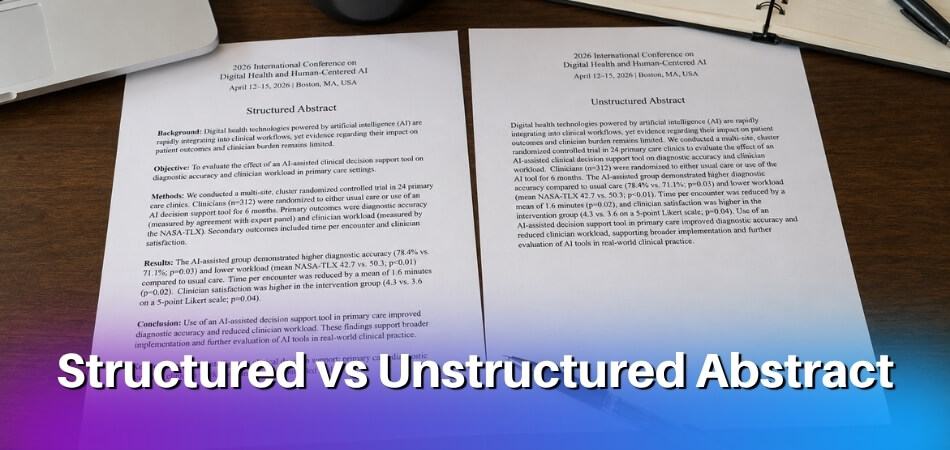
Some conferences want a flowing paragraph and others require labeled headings such as Background, Methods, Results and Discussion. Check the submission portal first, because some portals enforce word counts for each field separately.
Write a Clear Title and Get a Second Reader
A title should be descriptive, unambiguous and an accurate picture of the work. A clever title that hides the topic wastes the first thing reviewers see. Draft several titles and keep the one a stranger would understand without reading the abstract.
Then ask a colleague outside your project to read the abstract and tell you what the finding is. If they cannot, reviewers will struggle too. Expect to rewrite it more than once.
Length, Formatting and Anonymity
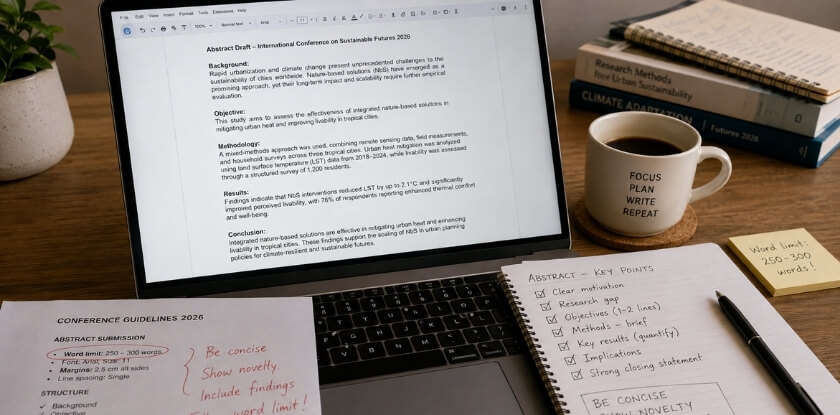
The word limit is a ceiling, not a target. Many calls set it somewhere between about 200 and 500 words, structured formats may go higher, and some portals count characters instead. Counting rules differ, so check whether the title, keywords and references count toward the limit. Check the call for papers for the exact figure. Cut hedging phrases, excess background and restated conclusions, and delete any sentence that carries no specific fact or claim.
Follow the formatting instructions exactly. If the call asks for, say, Times New Roman 12 pt and single spacing, do not switch to a font you prefer: small deviations signal carelessness, and in a blind review the abstract is the only thing judged. Most abstracts carry no references, but if yours does, use the citation style the conference specifies, not the one from your last journal submission.
If review is blind, remove anything that identifies you, your institution or your co-authors, including references to your own earlier work phrased in the first person. The portal sometimes strips this automatically, but not always.
Ethics Rules That Can Sink an Abstract
- No duplicate submission. Sending the same or a lightly changed abstract to several conferences at once breaks the submission guidelines of many events. The Committee on Publication Ethics (COPE) calls concurrent submission poor practice because it wastes the time of editors and reviewers, and many venues state in writing that it leads to rejection. MS International requires that work is not under review elsewhere. If a policy is silent, ask the organizers before you submit.
- Disclose related work. If your work has been published, presented or submitted elsewhere, say so when the form asks. The ICMJE recommendations say a meeting abstract or poster is normally treated as a preliminary report, not as prior publication of a later full paper. That is a journal rule, though, and a conference can apply stricter ones.
- Do not overstate findings. Writing “demonstrate” for preliminary results is misrepresentation. A careful committee will flag it, and an audience will notice it even if the committee does not.
- Check for text overlap. Running a plagiarism check is sensible, especially when you draw on your own earlier publications. Reusing substantial text from your own earlier work without acknowledgment is self-plagiarism, not a technicality.
- Be accurate about authorship. Everyone listed should have contributed meaningfully. Adding names as a courtesy or leaving out real contributors both cause problems, and most conferences ask every listed author to confirm participation.
Good vs Bad Abstract Examples
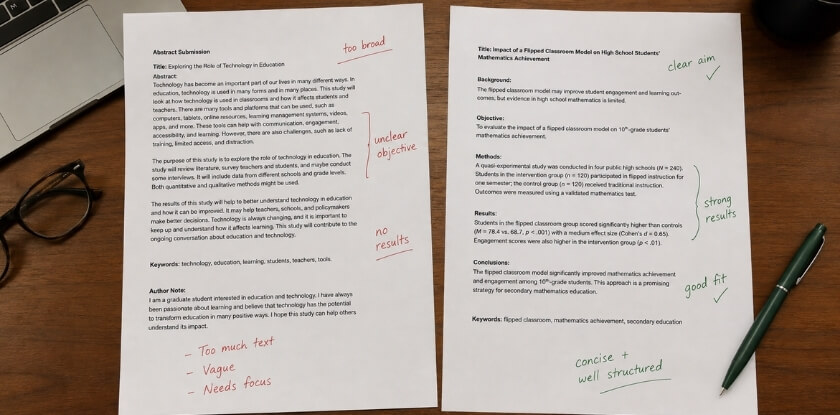
Seeing a weak and a strong abstract on the same topic shows the difference faster than any list of rules. The first sample below is deliberately poor. The figures in the second are invented for illustration and are not real data.
The Weak Abstract
This paper explores the relationship between social media use and mental health outcomes in young adults. Mental health is an important issue today. We surveyed some participants and asked them about their social media habits. Results showed some interesting findings. We discuss the implications for practitioners and future research directions.
Every sentence fails in a different way. The problem is not specific, there is no sample size or method, no finding is reported, and “interesting findings” tells a reviewer nothing. It would fit almost any study on the topic, so the committee has no basis for judging whether the work belongs at the conference.
The Strong Abstract
Screen-time guidance often treats all social media use as equivalent, yet few studies separate passive scrolling from active communication. This study surveyed 1,240 college students aged 18 to 22 across six universities using the PHQ-9 depression scale, and measured passive consumption and active communication separately. Students averaging more than two hours of passive scrolling a day scored 4.1 points higher than active-use peers, even after controlling for prior mental health history. These findings suggest that guidelines treating all use as equivalent may understate the specific contribution of passive scrolling to depressive symptoms.
This one moves from gap to method to finding to implication, which is the progression committees are trained to look for. The method has enough detail (sample, validated instrument, separated variables) for a reviewer to judge rigor, and the last sentence gives clinicians and policy readers a clear takeaway.
What the Comparison Shows
The difference is specificity, not sophistication. In blind review, reviewers cannot assume your sample was large or your finding notable, so you have to state it. Replacing numbers with “some” and “interesting” suggests the work is unfinished or that the author cannot communicate findings.
The strong sample also stays within a normal word limit. You need better-chosen words, not more: cut stage-setting lines such as “Mental health is an important issue” and spend the space on data. And if the conference is about clinical interventions but your abstract spends its words on literature history, it could have been sent to any conference unchanged, which reviewers notice.
How to Tailor Your Abstract to a Specific Conference
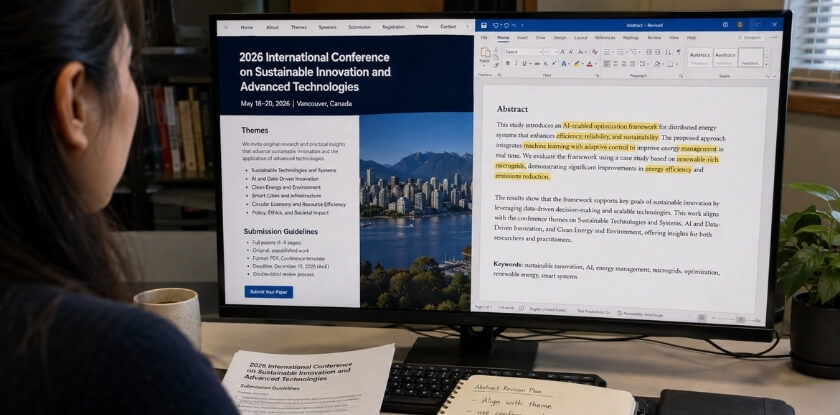
Rewrite the abstract for each conference: a generic submission rarely survives a competitive selection, and reviewers can tell when a text was not written with their event in mind.
Read the Call for Abstracts Closely
Most researchers skim the call for the deadline and word limit, then stop. Go further and pull out the exact themes, methods, populations or practice implications it names, then check that your abstract speaks to them. If the theme is “Translating Evidence into Practice”, an abstract confined to lab results and theory is misaligned even if the science is strong.
Match the Language and Weighting
- Read recent programs. Many conferences publish abstract titles, sometimes full text. This shows whether the audience expects dense technical language or accessible writing for a mixed crowd.
- Calibrate terminology. Jargon hurts at interdisciplinary events, while omitting field-standard terms makes work look thin at a single-discipline one.
- Check what they value. Some conferences stress methodology and others care more about the takeaway and its practical use. The call or the past program usually says which.
Check the Submission Guidelines
Requirements vary more than you would expect. One call may set a strict 250-word limit and another allow 500, and some demand structured headings while others want prose. Sending a structured abstract where free text was requested, or the reverse, shows you did not read the guidelines. It rarely disqualifies you, but it creates friction before reviewers reach your ideas.
Write for the Audience, Not Just the Theme
The theme is the headline and the audience is the finer filter. A public health conference may cover epidemiology, policy and clinical practice, but if most attendees are policymakers, an abstract written for lab scientists will not connect. Ask who will actually sit in the room, then state the implications in terms that group cares about. This is not dumbing down. It points your “so what” at the right people.
After You Submit: What to Expect
After submission you wait for a decision, usually accepted, accepted with revisions, or rejected. Knowing the typical timeline and next steps saves anxiety and avoids mistakes that can cost you a slot.

Timeline and Notification
Review time varies by conference. After the call closes, large conferences with hundreds of submissions often need several weeks to a couple of months, while smaller single-track events can move faster. The notification deadline on the conference website, usually next to the call for papers, is your anchor. If it passes in silence, a polite email to the organizers is reasonable, since emails land in spam folders and systems fail.
| Decision | What it means | What to do |
|---|---|---|
| Accepted | Your abstract meets the requirements | Complete registration and send camera-ready files on time |
| Accepted with revisions | Suitable, but changes are requested | Read the reviewer feedback and answer each point before the deadline |
| Rejected | Outside scope or below the review criteria | Read the feedback, fix the weak points and resubmit elsewhere |
If you are accepted, the next step is usually a camera-ready submission, a final polished version of the abstract (sometimes a full paper or slides) due by a second deadline. Missing it can get your work dropped from the program even after acceptance.
How Many Abstracts Can You Submit to One Conference?
It depends on the conference. Some allow one abstract per presenting author, some allow several if each is a genuinely distinct piece of research, and a few high-volume events state no limit but expect every submission to stand alone. If you have two or three separate research threads, separate abstracts are a legitimate strategy. Each one must reflect real, differentiated work, not slices of the same study.
How to Withdraw an Abstract If Needed
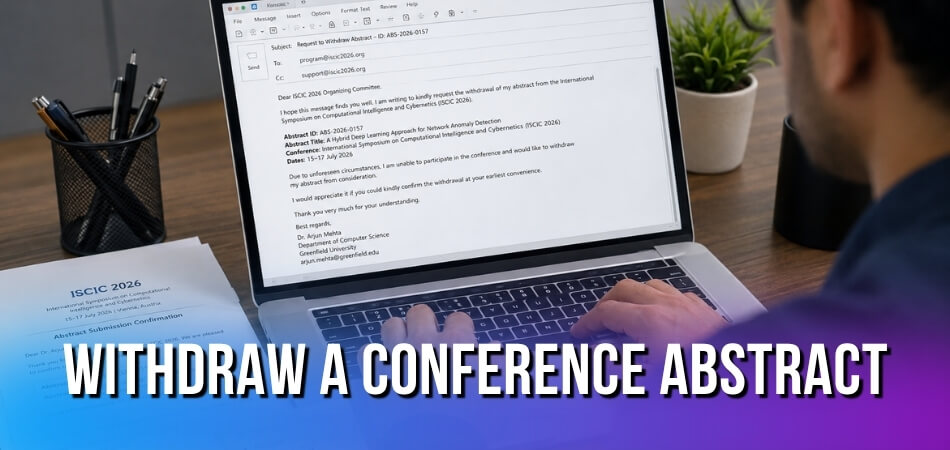
Withdrawing is a normal part of the process when a project stalls or a schedule clash appears, and the sooner you act the better. Before a decision, a short email to the organizers or the withdraw option in the portal is usually enough.
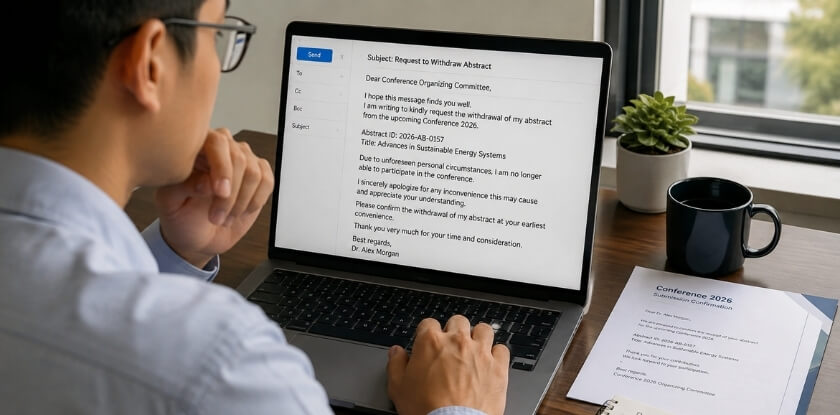
After acceptance, tell the organizers as soon as possible, give a brief reason and apologize. Do not simply fail to show up, because a no-show leaves an empty slot in the program. Some conferences state withdrawal terms at submission, including possible limits for repeat withdrawals, so read them before you submit, not after.
From our experience at MS International: We run a double-blind peer review and accept abstracts, full papers, case studies and review papers. Work must not be previously published or under review elsewhere, and papers follow APA format. Reviewers look at topic, clarity, methodology, structure, APA formatting and fit with the selected conference, and authors receive an acceptance, revision request or rejection by email, typically within about 10 working days. Our practical tip is to submit well before the deadline, so a revision request does not push you past the final submission date.
FAQ
Want your abstract accepted? Reviewer priorities, the word limit, how long the review takes, typical acceptance rates and reusing your own earlier abstract deserve attention early.
Can I submit the same abstract to more than one conference?
Usually not. Many calls prohibit sending the same abstract to more than one conference at once, and organizers can reject both if they find out. Some fields allow exceptions, so read each call or ask the program committee first.
What happens if I miss the abstract word limit?
Most portals enforce the limit: they may cut your text or block submission, and an over-length abstract can be marked down for ignoring instructions. Check whether the title, keywords and references count, and leave a small buffer.
How long does the review process take?
It varies by conference, usually from a few weeks to a couple of months, and large events take longer. The notification date is usually published with the call for papers. At MS International, review typically takes about 10 working days.
Is the review process anonymous?
Often, but not always. Many conferences use blind review, and the submission guidelines say whether it is single-blind, double-blind or open. MS International uses double-blind peer review, so author and reviewer identities stay confidential.
What do reviewers actually look for?
Fit with the conference theme, a clear problem, a credible method, a concrete result and a takeaway. A clear title, correct formatting and conclusions that match the data also count, while jargon overload and unsupported claims lose points.
Can I withdraw my abstract after submitting?
Yes. Use the portal’s withdraw option or email the organizing committee as early as possible. Prompt withdrawal frees the slot for someone else and is standard professional practice.
What is the typical abstract acceptance rate?
There is no typical rate. It depends on the conference, field and year, and published figures range widely, from about a quarter to well over a third at the same society. Look for your conference’s own past rates.
What do I do after my abstract is accepted?
Read the acceptance email and follow its deadlines for camera-ready materials and registration. Missing a follow-up deadline can forfeit your spot, and acceptance alone does not complete registration.
Does a weak abstract mean weak research?
Not necessarily, but reviewers only have the abstract to go on. Strong research with a poorly written abstract can still be rejected, because the abstract is your entire case at that stage.
Is it plagiarism to reuse your own previous abstract?
It can be. If the work substantially matches something you already published or presented, resubmitting it without disclosure raises self-plagiarism concerns. New findings, a new angle or a clearly updated study justify a fresh submission.
Final Thoughts
Fit the call, report a real result, respect the limits and stay honest about what has been submitted elsewhere. Those habits decide most outcomes more than the research idea alone.
If you are rejected, read the feedback before moving on. Strong work is often turned away for fixable reasons such as a misaligned angle, a vague method or a weak takeaway. Revise and resubmit elsewhere, and keep your camera-ready version ready before you need it.