Two relevant calls for papers arrive in your inbox in the same week, you have one good abstract, and the obvious question follows: can it go to both? Sometimes it can. Whether it is acceptable depends on each conference’s rules, your field, and how open you are about it.
Quick answer: Yes, but only if every conference’s call for papers allows it and you disclose it wherever the form asks. Many calls, including ours at MS International, require that the work is not under review elsewhere, while others accept parallel submissions with disclosure. Read each call, tell your co-authors, and withdraw promptly from any event you cannot attend.
Last verified against official sources: October 2026.
This guide covers what the rules look like by field, where the gray areas are, how co-authors and journals fit in, and how to submit without risking your academic integrity.
Can You Submit the Same Abstract to Multiple Conferences?
Yes in many cases, but the conference decides, not the researcher. The call for papers is the only rule that counts, and the field only tells you what is likely.

Three questions settle most cases: does either call ban concurrent submission, does either conference publish proceedings, and has the work already appeared in a journal? The table shows how the usual situations are treated.
| Situation | Usually | What to do |
| Neither call mentions concurrent submission, no proceedings | Acceptable | Submit to both, withdraw from one if both accept |
| A call says the work must not be under review elsewhere | Not allowed | Choose one conference, wait for the decision |
| Both conferences publish the abstract or paper in proceedings | Duplicate publication risk | Do not send identical work, cite the first version |
| The abstract summarises an already published journal article | Acceptable with disclosure | State the journal, title and year |
| Abstract already presented at another meeting | Depends on the call | Disclose it, or submit an updated version |
Where the Practice Is Generally Accepted
In many humanities and social science conferences, an abstract is a proposal to discuss work in progress, so researchers often approach several venues, provided they withdraw from one once they accept an invitation from another. Some computing and engineering venues also accept abstract-only submissions, but they do not allow a full paper under review at the same time. Humanities conferences that ask whether the paper has been presented elsewhere expect an honest answer, and identical text sent everywhere without disclosure can damage your standing with a program committee.
Where It Gets Complicated
- Concurrent submission policies. Some calls ban it outright. The abstract guidelines of one SPE conference let an author submit to only one conference at a time, require a programme committee to decline the abstract before it goes to another, and remove every copy if it turns up at more than one. AIAA’s overlapping submissions policy precludes submitting the same abstract or paper more than once to the same event, and overlapping submissions are withdrawn. If the form asks directly, you must answer. Ignoring the question is a breach of academic integrity, not a gray area.
- Proceedings publication. If a conference publishes your abstract or paper in its proceedings, that counts as a prior publication. Sending the same work to a second conference with proceedings, without acknowledging the first, creates a duplicate submission problem. Some policies exempt venues without proceedings: Robotics: Science and Systems, for example, permits papers presented or to be presented at conferences or workshops without proceedings, or with only abstracts published, but not papers submitted in parallel to other conferences.
- Journal paper abstracts. You can present published research at a conference, but frame it as published work rather than pasting the journal abstract as if it were new.
- Co-author awareness. Every co-author needs to know about every venue.
The Working Rule Most Researchers Use
Submit to several conferences only if no call prohibits it and no proceedings are involved, and be ready to withdraw from the ones you cannot attend. If proceedings are involved, check each call, disclose honestly and align with your co-authors. Pitching one research idea to several audiences is rarely the problem. Ending up with the same paper in two sets of published proceedings, neither citing the other, is.
What “Same Abstract” Actually Means: Abstract vs Full Paper
Two different things are called an abstract: the standalone conference abstract and the abstract that sits on top of a full paper. They follow different norms, and mixing them up causes needless worry and some real mistakes.

The Standalone Conference Abstract
Most conferences ask for a short text, often somewhere between 150 and 500 words, describing your question, methods and findings. That text is the submission. It is reviewed, accepted or rejected, and if accepted it appears in the programme or proceedings, with no paper behind it. Check the call for papers for the exact limit. This is where duplicate submission and self-plagiarism questions become real, because reviewers judge it as a complete unit of scholarship.
The Journal Paper Abstract
A journal abstract summarises a full peer-reviewed paper, usually in about 150 to 250 words, and represents that paper in databases. You would not normally submit it on its own. If you want to present a published or submitted paper at a conference, your conference abstract may draw on it, but the program committee cares that you are transparent about the prior publication.
Where the Lines Blur
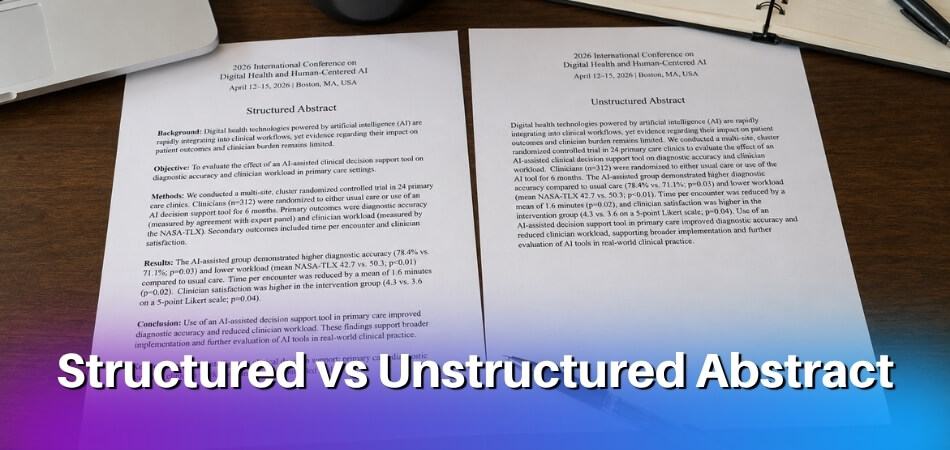
Long structured abstracts with labelled sections (background, methods, results, conclusions), common in medical conferences and often 250 to 400 words, work like short standalone documents. Sending identical text of that kind to two conferences looks much more like concurrent submission of a full work than sending a 200-word theoretical abstract to a regional and an international audience. The longer and more detailed the abstract, the more seriously most fields treat it as an original submission.
Field-by-Field Rules: STEM, Humanities, and Social Sciences
Norms differ by discipline, and a habit that is normal in one field can look like a breach in another. Use the table as a guide to what to expect, then confirm with the actual call.
| Field | Typical attitude | Watch for |
| Medicine and clinical science | Often strict | Declarations that the work has not been presented or submitted elsewhere |
| Engineering and computing (IEEE, ACM) | Varies by venue | Full papers must not be under review elsewhere |
| Sciences generally | Varies by society | Prior disclosure, journal policy on conference talks |
| Sociology, anthropology, humanities | More permissive | Questions about prior presentation, identical text sent everywhere |
| Economics, quantitative psychology | Varies by venue | Data that will become a journal article |
STEM and Medicine
Medical conferences often have tight rules. Some ask for new and meaningful information and expect you to withdraw one abstract if the same work is accepted at two meetings. Some societies ask you to confirm in the form that the work has not been presented elsewhere, and a false answer can lead to withdrawal. Their rules change by year and by meeting, so read the current guidelines.
Engineering and computing venues. IEEE policy requires that authors submit original work that has not appeared elsewhere and is not under review for another refereed publication, and that they disclose prior publications and parallel submissions. Whether multiple submissions are allowed is left to each IEEE unit, so the conference’s own call controls. A full paper under review elsewhere is a concurrent submission problem. If you submit only an abstract for a talk or poster, some venues are more permissive, but never assume.
Self-plagiarism is taken seriously when the same findings are presented as new at each venue without disclosure. Some calls ask whether the work has been presented before and where, and you should say so.
In STEM, where author lists are long, every listed author is responsible for the submission.
Humanities and Social Sciences
Humanities conferences usually do not treat an abstract as an exclusive commitment. A paper delivered at a regional conference can reasonably be presented at an international one a year later, because the work is understood to be in progress. Even so, identical abstracts sent to several conferences at once, with no tailoring, are viewed poorly. It looks like collecting lines for a CV rather than engaging with each community, so most experienced academics adjust the abstract for each audience.
Social sciences sit in the middle. The field spans qualitative and quantitative traditions with very different publication cultures. Sociology and anthropology follow humanities norms, where presenting the same work at several conferences is normal, while economics and quantitative psychology vary by venue, especially if the data could be published in a journal. The closer your abstract is to a journal paper abstract, the more seriously duplicate submission needs to be taken.
If the findings will become a journal article, check the target journal’s policy on conference presentations before the conference, not after.
Does It Count as Self-Plagiarism?
Not automatically. Self-plagiarism needs deception or a duplicate publication record, not simply giving similar talks. Most ethics guidelines separate submitting an abstract from publishing duplicate work.
If you submit to two regional conferences, present at both, and neither publishes a proceedings paper, you have not put two entries into the scholarly record claiming the same contribution. That is the core concern behind self-plagiarism: misrepresenting how much original work you have produced. It stays clean while you are open with co-authors, are not sending the work to two conferences that both publish proceedings, and no call prohibits concurrent submission.
When it becomes a problem. The line is crossed when abstracts lead to duplicate publications. The ICMJE defines duplicate publication as a paper that overlaps substantially with one already published, and expects authors to disclose related work when they submit. Two proceedings papers on the same contribution create two citable records, which is where ethics frameworks consistently identify self-plagiarism. COPE guidance likewise speaks of redundant publication where papers share the same hypothesis, data or conclusions without full cross-reference. Omitting a disclosure that the form asks for, or presenting old work as entirely new, is an integrity issue rather than a technicality.
Conference first, journal later. The ICMJE does not treat an abstract or poster shown at a scientific meeting as a bar to later considering a complete report, and the same holds for a paper presented but not published in full. Journals still set their own rules. COPE expects journals to publish a policy on whether conference presentations count as prior publication, and suggests authors state in the article that the results were presented, in part or in full, at a named conference. Some journals treat full proceedings papers as prior publication, others accept them when the conference version was preliminary, so check the journal’s policy before submitting anywhere.
Can You Submit an Abstract from a Published Journal Paper to a Conference?
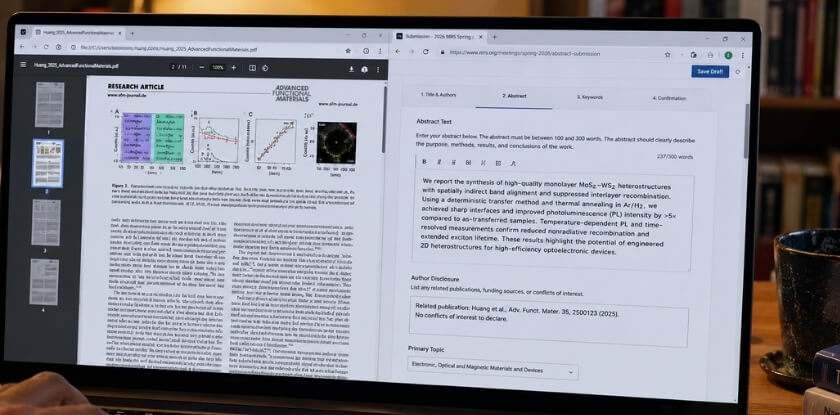
Yes, in most fields, as long as you disclose where the work was published. Presenting a published paper is not a second publication, so it does not trigger the same concerns as sending a manuscript to two journals.
What You Must Do: Disclose the Prior Publication
Tell the program committee where the work appeared. Many submission forms have a prior publication or notes field, so use it and give the paper title, journal and year. Leaving it out can look like passing off published findings as new. Some conferences, MS International among them, require that submitted work has not been previously published, so a published paper may not fit our own call even though it fits others.
When Journals Place Restrictions
Some journals, especially in clinical research, restrict how and where you can present the work afterwards. A few ask you to notify them before a post-publication conference talk, or prohibit releasing certain data while a paper is under review. Check your publication agreement first, particularly for high-impact medical meetings with strict embargo policies.
Using a Journal Paper Abstract Verbatim
Do not paste the journal abstract into the conference form unchanged. Submission systems and similarity tools can flag a verbatim match to a published article. Rewrite it for the conference audience, who are less specialised, have less time and are deciding whether to attend your session. A conference slot rewards a more direct, talk-focused abstract.
Co-Authors and Coordination
If the paper has several authors, tell them before you submit. Some may want to be listed, and one may already be planning to present the same work at another conference. A quick conversation prevents awkward overlaps.
Rules for Submitting the Same Abstract to International vs Regional Conferences
The size of a conference does not change the rules. What matters is whether either call prohibits concurrent submission, and that prohibition normally covers all other conferences, large or small.
When International and Regional Conferences Overlap
Many researchers assume a regional and an international conference have different audiences, so a parallel submission is fine. Sometimes it is, often it is not. If you submit to a regional conference in March and an international one in April while the first review is still running, you may breach both sets of guidelines without realising. Look for the phrase “concurrent submission” in each policy. If you must withdraw from one of them later, do it promptly and before the programme is printed or published. Withdrawing is not a mark against you, whereas presenting duplicate work at two venues without disclosure is.
When the Scale Difference Helps You
Presenting early findings at a regional conference, collecting feedback and then taking a more developed version to an international audience is legitimate and often encouraged. The two abstracts are related but not identical, because the second reflects real changes to the research or framing. This is generally fine across STEM, social sciences and humanities, provided you are transparent. If the form has a prior presentation field, list the regional event. Most committees treat that as standard practice.
The Problem With Submitting Identically to Both
Sending the exact same text to both at the same time, without disclosure, is where integrity concerns start. Even if neither call bans it, the international committee may reject the abstract if it was already accepted and presented elsewhere, particularly if it treats prior presentation as prior publication. Some medical meetings do not accept work already presented at a national or international meeting, so a regional talk can rule out a later submission there. Outside medicine the rules vary, but padding a record with identical talks is a reputational risk.
What Disclosure Looks Like
Write one line in the cover note or the designated field:
A preliminary version of this work was presented at [Regional Conference Name, Month, Year]. This submission reports updated findings.
That sentence protects you. A reviewer may well have attended the earlier talk.
What Are the Rules When You Have Co-Authors?
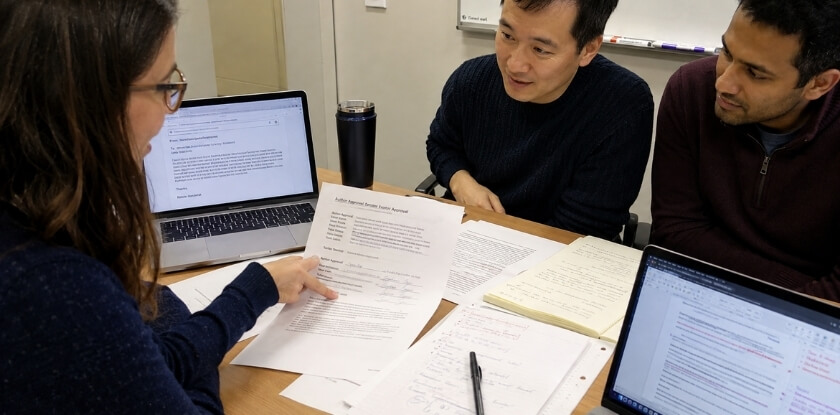
Every co-author must agree to each specific submission, because every listed name shares the consequences. Most submission systems ask the submitting author to confirm that all authors approved the submission. Ticking that box without real consent puts co-authors in an ethically compromised position.
Duplicate Submission Is a Shared Problem
If a committee flags a duplicate submission, scrutiny falls on everyone listed, not only the person who clicked submit. “I didn’t know” is a hard position to defend. In medicine and most of STEM, simultaneous submission to competing venues is treated seriously. Humanities norms are looser, but consent among co-authors is expected in every field. Co-authors have academic reputations tied to the work too, and if a duplicate comes to light they may face questions they cannot answer. Written sign-off before each submission also protects you from being the only person accountable.
Assigning Responsibility Clearly
Decide early who handles submissions and who tracks where the work has gone. A shared document listing each conference, its status and whether the abstract was modified for that venue makes later disclosure easy, because any co-author asked whether the abstract appeared elsewhere can answer accurately.
When Co-Authors Disagree
If one co-author objects to a venue, you cannot override them, since their name is on the work. Resolve the disagreement, submit without listing them (only if their contribution genuinely does not meet authorship criteria for that piece), or skip that venue. Withdrawal after a conflict should be a joint decision as well.
What to Do Before Each Submission
- Confirm consent explicitly. An email or message thread is easier to verify later than a verbal agreement.
- Agree on the abstract text. The version everyone approved must be the version submitted.
- Clarify the disclosure plan. Decide together how to describe any earlier presentation.
- Document the submission. Record venue, date and abstract version.
Risks and Consequences of Duplicate Submission
Duplicate submission is not automatically a career-ending mistake, but the outcome can be serious when it is undisclosed. The usual consequence is simple rejection, often without explanation. Beyond that, the severity depends on the venue and the field.
When a Program Committee Finds Out
Reviewers can serve on more than one committee in the same field, so someone may recognise an abstract they saw elsewhere. A committee that discovers an undisclosed concurrent submission may reject or withdraw the abstract and may treat future submissions from you with more caution. Medical conferences that ask for prior publication disclosure treat omitting it, or presenting the work as entirely new, as a straightforward integrity issue. An abstract that is text-identical to one already published in a journal, proceedings or abstract database may also be flagged by similarity detection before a person reads it. A modest revision and a disclosure note, where the guidelines allow it, is the practical fix.
Your Published Record
If a duplicate gets through and you end up with two conference papers on near-identical work, the problem becomes formal. Some venues require a declaration at submission that the work has not been accepted elsewhere, and signing it falsely leaves you far more exposed than the original decision. Withdrawing after acceptance leaves the organisers with a gap in the programme, so tell them as early as you can.
Regulated Fields and Institutions
Medical and clinical meetings often ask for a signed declaration about earlier presentation, so read it before you tick it. Your institution’s research integrity policy also applies, and it may be stricter than the conference’s.
Best Practices: How to Submit the Same Abstract the Right Way
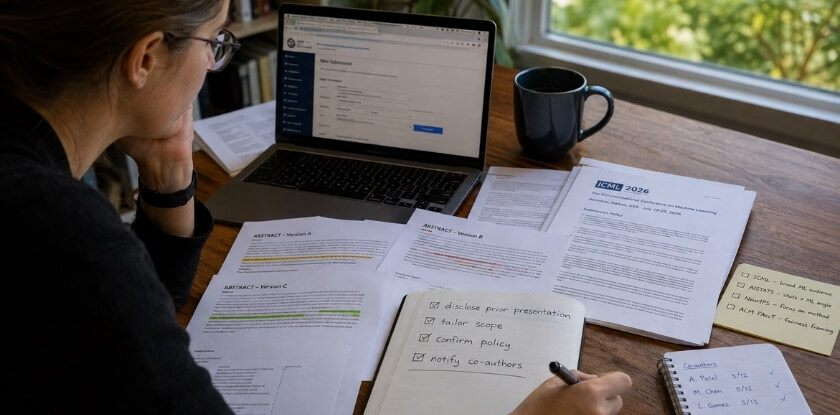
Disclose what you have submitted and where, and revise the abstract so that it represents your current work. Most committees do not oppose the practice. They want enough information to decide.
How to Disclose Prior or Concurrent Submissions
Check the guidelines for a concurrent submission field or checkbox and use it, rather than leaving it blank and hoping nobody notices. If there is no field, add a brief note to the cover letter or comments section, with no need to over-explain or apologise:
This abstract has also been submitted to [Conference Name], scheduled for [Month, Year]. The work has not been previously published as a full paper.
- Timing matters. If an acceptance arrives from the other conference, notify the second one promptly. Withdrawal is a normal administrative step. Sitting on two acceptances without saying so is the real problem.
- Published journal paper. Note the paper title, journal and year. Many conferences allow this with attribution, but none like silence about it.
- Co-authors. If a co-author submits the same abstract independently, both of you carry the risk, so agree on venues and who handles correspondence for each.
How Much Should You Modify the Abstract?
No universal rule requires rewriting an abstract for a second conference, and in many fields an identical abstract is acceptable. The question is whether the target call asks for original work at the abstract stage. There are practical reasons to revise anyway:
- Tailor the framing. Lead with the method for one audience and with applied outcomes for another. This is not disguise, it helps the abstract land with the right people.
- Update for new findings. If the research has moved on, an outdated abstract serves neither you nor the audience.
- Meet the format. Medical calls often want a structured abstract with labelled sections, while a humanities call may want free-form text of about 150 words. Reformatting for the target is expected and not suspicious.
Token changes, such as swapping a few words so the abstract can be called “modified”, satisfy no ethical requirement and do not help you. If it already suits the venue, submit it as it is with proper disclosure. If it needs updating, do a real revision.
How to Withdraw a Conference Abstract
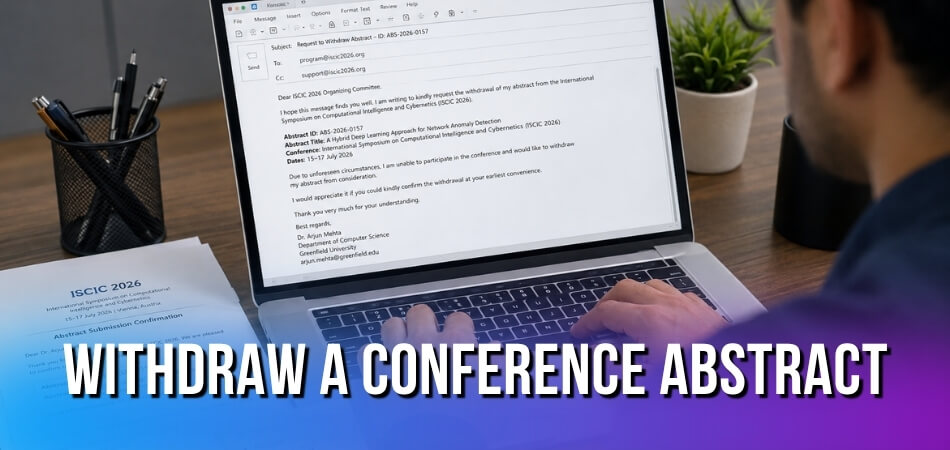
Withdraw by writing to the program chair or using the withdrawal option in the submission system, as early as possible. Withdrawal is a normal step, as long as the organisers hear about it early.
When Withdrawal Is the Right Move
- A concurrent submission conflict. Withdraw from one conference before decisions are announced. Doing it proactively is far less damaging than being caught.
- The research has changed substantially. If the abstract no longer reflects what you will present, withdrawing is more honest than presenting something unrelated.
- Two acceptances on the same dates. This is not an ethics violation, but you can be in only one place, so withdraw from the other once you know. If both calls ban parallel submission, you can keep only one.
- A co-author objects. Lack of consent may require withdrawal to keep good faith.
How to Actually Do It
- Contact the organisers directly. Do not just go silent. Use the contact in the guidelines, usually a program chair or submissions coordinator. Systems such as ConfTool or EasyChair often include a withdrawal option in the portal, so check there first.
- Do it early. Committees build sessions and printed programmes around submissions. If the abstract is already in a preliminary programme, still withdraw and acknowledge the inconvenience.
- Keep the reason short and honest. For example:
I am writing to withdraw abstract [ID/title] submitted to [Conference Name]. Due to a scheduling conflict with another accepted commitment, I am unable to attend and present. I apologise for any inconvenience.
- Get confirmation in writing. Keep the reply in case a question about the submission comes up later.
What Happens After Withdrawal
If the abstract was not yet in proceedings or a printed programme, the withdrawal is usually clean, as though the submission never happened. If it appeared in a printed or online programme, it may stay on the public record, so disclose it when submitting the same abstract elsewhere, as you would any prior presentation.
Common Reasons Conference Abstracts Get Rejected
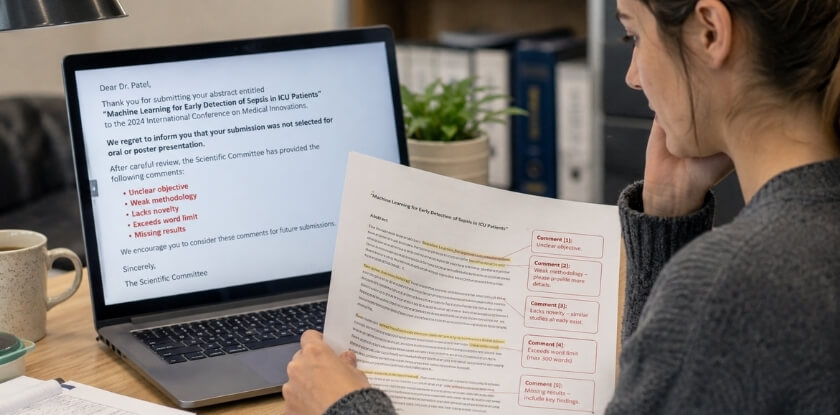
Many rejections have nothing to do with the quality of the research. Duplicate submission and missing disclosure were covered above, and the other common reasons are in the table.
| Reason | What reviewers see | Fix |
| Outside the conference scope | A broad abstract for a narrow technical call, or the reverse | Match the stated themes in the call |
| Unclear research question | Background first, the problem buried | State the problem in the first two or three sentences |
| Vague or missing results | “Results will be discussed” | Give preliminary results or a clear hypothesis |
| Formatting failures | Over the word limit, wrong template, wrong file type | Follow the limits and structure exactly |
| Co-author objection | One author did not approve the submission | Get written consent from all authors |
Some submission systems reject over-length abstracts automatically before review, while others rely on a coordinator to catch the breach. Either way, ignoring the format signals carelessness.
From our experience at MS International: Our author paper submission page accepts abstracts and full papers and asks for original work that has not been previously published. Review is double-blind, and most review decisions are returned within about 10 working days, although complex papers or revision rounds can take longer. Our peer review page says a rejected paper can be improved and submitted again only if it fits the scope and deadlines of another suitable event.
FAQ
Sending one abstract to two meetings gets complicated when both accept it, when co-authors submit without telling each other, or when a slightly updated version starts to look like self-plagiarism.
Can I submit the same abstract to two conferences at the same time?
Only if neither call bans it. Some, such as one SPE conference’s guidelines, allow one conference at a time, while many humanities and social science calls say nothing. Check each call’s submission guidelines before sending anything out.
Do I need to tell a conference that I have already presented this work elsewhere?
Yes, if the form asks, and it is wise to do so even when it does not. A one-line note about the earlier venue and date is standard practice and protects you if questions arise later.
Is submitting the same abstract to multiple conferences the same as self-plagiarism?
No, not automatically. Self-plagiarism involves undisclosed duplicate publication or presenting old work as new. Undisclosed submission to conferences that explicitly prohibit it is a separate breach of the rules.
Can co-authors submit the same abstract without telling each other?
No. Every co-author must agree on where the work is submitted. Submitting for a group without that agreement is an integrity issue, and all listed authors share the exposure.
What if I submitted the same abstract to two conferences and both accepted it?
Withdraw from one and tell its organisers as soon as possible, unless both calls clearly allow it. If both ban parallel submission, tell both organisers. Presenting the same work at both without disclosure is the problem, not the withdrawal.
Does a journal paper abstract count as prior publication?
The published paper does. The abstract alone is not the issue, the underlying work is. Disclose the journal, title and year, and note that some conferences, including ours, require unpublished work.
Are regional conferences treated differently from international conferences when it comes to duplicate abstracts?
Not by the rules. What matters is whether a call prohibits duplicate submission, not the size of the event. Assuming a regional talk does not count is risky.
Does presenting an abstract at a conference stop me publishing the work in a journal?
Usually not, but the journal decides. The ICMJE says journals may still consider an abstract or poster displayed at a scientific meeting as a preliminary report. A full proceedings paper is treated differently by some journals, so read the journal’s policy first.
If my abstract was rejected, can I resubmit it elsewhere?
Yes. A rejected abstract has not been accepted or presented anywhere, so sending it to another conference raises no ethical issue. Improve it using any reviewer comments first.
Can I update my abstract slightly and submit it as a new one?
Not if only the wording changed. Minor edits do not turn the same work into different work. If the research has genuinely evolved, document what is new and explain the link to earlier versions if the call requires disclosure.
Does MS International accept an abstract that is under review elsewhere?
No. Our author paper submission page says papers must not have been previously published or be currently under review by another conference, journal or publication. Wait for the other decision first.
Final Thoughts
Submitting the same abstract to several conferences is not wrong in itself, but the rules vary by call, field and how much the abstract has changed. Read each set of guidelines, disclose prior presentations where the form asks, and tell your co-authors before every submission. Most problems come from skipping those steps.