
Your research paper follows IMRaD format, but does your abstract? Many researchers treat the abstract as an afterthought: a loose summary written in a hurry after the paper is finished. Yet journals, databases such as PubMed and MEDLINE, and the editors who decide what goes out for review all lean on the same logic as the full paper. An abstract is a miniature version of your entire study, and it deserves the same discipline as the paper it represents.
Quick answer: Use IMRaD in an abstract by giving each part one short job. The Introduction states the gap and your purpose, the Methods name the design, sample and measures, the Results give your key numbers, and the Discussion says what they mean. Keep Results the longest part, stay inside the journal’s word limit, and add labels only if the journal asks for a structured abstract.
Last verified against official sources: October 2026.
This guide walks through each of the four parts, how much space to give them, how to adapt the pattern for review and other non-empirical papers, an annotated example, the usual mistakes, and a checklist to run before submission.
| IMRaD part | Its job in the abstract | Typical length |
|---|---|---|
| Introduction (Background) | State the problem, the research gap, and end with your purpose | 1 to 3 sentences |
| Methods | Name the design, participants or data, procedure and main measure | 2 to 4 sentences |
| Results | Report the key findings with real data points, no interpretation | 2 to 3 sentences |
| Discussion (Conclusions) | Say what the findings mean, who should care, and one key limitation, kept short | 2 to 3 sentences |
A structured abstract shows these four parts with labeled headings. An unstructured abstract covers the same ground in continuous prose. Either way the IMRaD logic has to be present, and your target journal’s author guidelines decide which format and which label names you use.
What Is IMRaD Structure and Why Does Your Abstract Need It
IMRaD stands for Introduction, Methods, Results, and Discussion. It is one organizing principle that has shaped how empirical research is written and read across biomedical and scientific literature for decades. The ICMJE (International Committee of Medical Journal Editors) says the text of articles reporting original research is usually divided into Introduction, Methods, Results, and Discussion.

The structure is not new. The US National Library of Medicine (NLM) says the structured abstract formats used in MEDLINE and PubMed were developed in the late 1980s and early 1990s to help health professionals choose clinically relevant articles, to help authors summarize their manuscripts accurately, to support peer review, and to enhance computerized literature searching. That does not mean every journal requires them, so treat the journal’s own instructions as the final word.
Drafting the abstract last is sound, because it has to match the finished paper, and a Springer Nature author guide advises it. The failure is doing it in a hurry after months on the full paper. The result is a vague paragraph that buries the methodology, skips actual numbers, and leaves an editor with no clear sense of what the study found or why it matters. An abstract is not a trailer for your paper. It is a standalone document that has to do the paper’s job in roughly 150 to 300 words.
Why IMRaD Makes Your Abstract Work Harder
Readers scan abstracts before they commit to a full paper, and editors scan them before deciding whether to send a manuscript out for peer review. IMRaD gives both groups what they need, where they expect to find it.
There is a discoverability angle too. PubMed searches abstracts as text, and MEDLINE records carry MeSH (Medical Subject Headings) terms. An abstract that signals its study design, states key findings with specifics, and names its implications gives both a human searcher and any automated indexing tool more to match. IMRaD is not formatting for its own sake. It is a communication tool.
How to Apply IMRaD in Your Abstract: Section-by-Section Breakdown
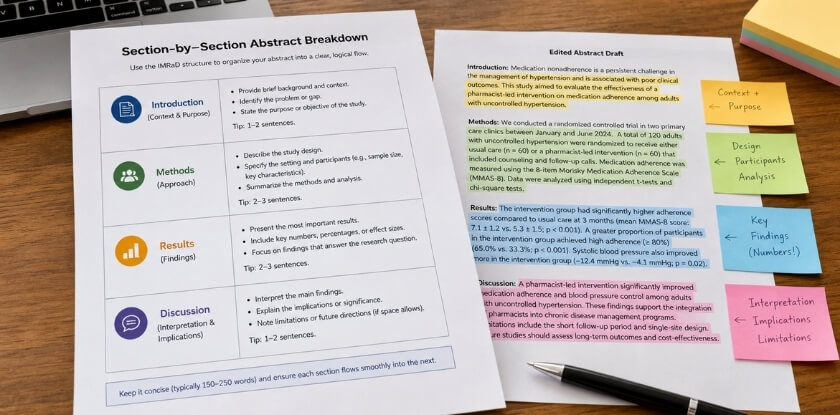
Each IMRaD component has a specific job inside a 250-word abstract, and skipping or botching one is a fast way to lose a reader. The examples below use an invented diabetes study to show what each part looks like.
What to Write in the Introduction Section (Research Gap and Purpose)
Spend one to three sentences here, and answer two questions in quick succession: why does this topic matter, and what specific gap does your study address? The gap is the load-bearing element. Without it, the opening reads like a textbook definition instead of a reason for the study to exist.
A weak opening: “Diabetes is a major global health concern.” True, and useless. A stronger one names the gap directly:
Despite extensive research on glycemic control in adults, the effect of intermittent fasting on HbA1c levels in patients over 65 with type 2 diabetes remains poorly characterized.
End with a one-sentence purpose statement such as “This study aimed to…” or “We investigated…”. In structured abstracts this often appears under a label such as Objective or Background, so check your target journal’s house style before you finalize the wording. Do not cite references in the abstract. State the gap as a factual claim and defend it in the paper itself.
What to Write in the Methods Section (Study Design and Approach)
Many abstracts go thin here: writers say what they studied but skip how. In two to four sentences, cover:
- Study design: randomized controlled trial, cohort study, systematic review, cross-sectional survey. Name it explicitly.
- Participants or data source: who or what you studied, and how many.
- Key procedure or analytical approach: the main thing you did to generate the data.
- Time frame or setting, if it changes how the results should be read.
For empirical research this might read:
We conducted a prospective cohort study of 412 adults aged 65 to 80 with confirmed type 2 diabetes across three urban clinics in Ontario (2020 to 2023). Participants followed a 16:8 intermittent fasting protocol for 12 weeks. HbA1c was measured at baseline, 6 weeks, and 12 weeks using standardized laboratory assays.
Three sentences give design, sample, intervention and measurement, with nothing wasted. For a review or other non-empirical paper the logic shifts to your search strategy, databases, inclusion criteria and the number of studies screened, so the methods are still reproducible in principle (more on this below). Keep jargon to a minimum: if a reader has to decode your methods language, they are not absorbing your results.
What to Write in the Results Section (Key Findings and Data)
Be specific. Vague results weaken an abstract quickly. “Significant improvements were observed” leaves the reader asking how significant, by how much, and compared to what. Include at least one concrete data point, such as a percentage, a mean difference, an odds ratio or a p-value. The ICMJE recommendations ask for main findings with specific effect sizes where possible. Even inside a tight word limit, that number does more work than a paragraph of hedged description.
HbA1c decreased by a mean of 0.8% (95% CI: 0.5 to 1.1) in the intervention group compared to 0.2% in a non-fasting comparison group (p = 0.003). Secondary outcomes showed no significant change in fasting insulin or body weight.
Two sentences give direction, magnitude and comparison, plus a note on what did not change, which is also a finding. If the study produced several outcomes, lead with the primary one and mention at most one or two secondary outcomes. The full paper exists for the rest. A result buried in qualifications is easy to miss.
What to Write in the Discussion Section (Implications and Conclusion)
This part often shrinks to “more research is needed,” which wastes it. A good abstract discussion does three things in tight sequence:
- Interprets the main finding: what does it actually mean?
- Connects to the real world or clinical practice: who should care and why?
- Acknowledges one key limitation, kept to a clause.
The ICMJE recommendations say an abstract should note important limitations, so a short clause is worth its place. You do not need every implication. Pick the one that matters most to your target reader: practice implications for a clinical journal, or what your approach makes possible for a methods-heavy one.
These findings suggest that a structured intermittent fasting protocol can meaningfully reduce HbA1c in older adults, a population typically excluded from fasting intervention trials. If replicated in a randomized design, this could expand dietary management options for patients poorly suited to continuous caloric restriction. The primary limitation is that participants were not randomized to fasting.
That interprets, applies and flags a caveat in three sentences. In a structured abstract this part may be labeled “Conclusions” and the limitation may be left out depending on the template. Requirements vary by journal type, and what suits a clinical journal will not necessarily suit a specialty or humanities journal, so always check.
Word Distribution: How Much Space to Give Each IMRaD Section in Your Abstract
Give most of your words to Results, then Methods, and keep the Introduction short. Many abstracts sit between 150 and 300 words, and if you do not plan how they are divided you end up with a bloated background paragraph and a single sentence where the findings should be.

Someone scanning PubMed is trying to work out whether your study found something useful, so give the findings room. The percentages below are a rough working guide, not a rule from any body, and they assume a 250-word abstract.
| Part | Empirical research (share) | Of 250 words | Review or non-empirical (share) |
|---|---|---|---|
| Introduction / Background / Purpose | 15 to 20% | about 40 | 20 to 25% |
| Methods / Scope / Approach | 25 to 30% | 65 to 75 | 15 to 20% |
| Results / Key findings / Synthesis | 30 to 35% | 75 to 85 | 40 to 45% |
| Discussion / Implications | 15 to 20% | 40 to 50 | 15 to 20% |
If your methods run 100 words and your results 40, something is off. Findings and synthesis should dominate in every paper type.
Why Methods Often Get Bloated
It is easy to over-explain the design: the sample, the setting, the tools, the time frame, every inclusion criterion. That belongs in the full paper. In the abstract, name the study design, sample size, key exposure or intervention, and primary outcome measure. Structured abstracts in PubMed follow this discipline, so read a few in your own field before you write yours.
The Word Limit Is a Design Constraint, Not a Suggestion
Treat the journal’s limit as fixed and work backwards from it. Many journals cap structured abstracts at around 250 words and some allow 350. A Springer Nature author guide says journals often set a maximum of 250 words so that the full abstract appears in indexing services. If you are at 310 words for a 250-word limit, do not trim randomly. Go back to the distribution above: the background is often where the slack is. For comparison, the NIH Project Summary/Abstract for grant applications is limited to 30 lines of text, which is a different document with its own rules.
Check Your Own Distribution Before Submission
This takes five minutes and catches a common abstract problem:
- Paste your abstract into a word counter.
- Mark where each IMRaD section starts and ends.
- Count the words in each section.
- Calculate the percentage.
- If any single section other than Results exceeds 40%, cut it down.
Structured Abstract vs. Unstructured Abstract: Which One to Use and When
Use a structured abstract when the journal requires one or your paper is empirical, and an unstructured one for review, theoretical and humanities work unless the journal says otherwise. Many journals mandate one format, and submitting the wrong type can get a paper returned before a reviewer reads the research. The ICMJE recommendations state that original research, systematic reviews and meta-analyses require structured abstracts, and that the required format differs from journal to journal. Both formats can follow IMRaD. The difference is whether the skeleton shows.
| Structured abstract | Unstructured abstract | |
|---|---|---|
| Layout | Labeled headings such as Background, Objective, Methods, Results, Conclusions | One continuous paragraph, no labels |
| Typical home | Clinical trials, empirical and NIH-funded biomedical papers, systematic reviews | Humanities, many social science and education journals, theoretical and narrative work |
| Typical word limit | Often 250 to 350, because the labels take space | Often 150 to 250 |
| Main strength | Readers jump straight to Results and reviewers judge the method in seconds | Fits papers with no real Methods section without forcing a label onto them |
| Main risk | Labels that do not match what the journal asks for | Harder to write well, since every sentence carries more weight |
What a Structured Abstract Looks Like
Many clinical trials and empirical papers in PubMed use the labeled format. A typical medical-journal version runs:
- Background: one or two sentences on the problem and research gap
- Objective: what the study set out to do
- Methods: study design, sample, and analysis approach
- Results: key findings with actual numbers
- Conclusions: what the findings mean and for whom
Some journals use “Purpose” instead of “Objective,” or “Discussion” instead of “Conclusions.” The logic is identical, but the author guidelines usually specify the exact label names, so copy them exactly. NLM maps the many label variants it sees onto five broad categories (Background, Objective, Methods, Results, Conclusions), which is one more sign the underlying structure is shared.
When Unstructured Abstracts Make More Sense
Review papers, theoretical pieces and other non-empirical papers often have no Methods section in the conventional sense, so forcing a label onto them looks awkward. An unstructured abstract still follows the IMRaD logic: why the research matters, what you did, what you found, what it implies. The structure is implicit rather than explicit, and the transitions must be smooth enough that the reader does not notice the move from one part to the next. That usually takes more editing passes, not fewer.
How to Decide
- Check the target journal’s author guidelines first. Many list the exact abstract structure, sometimes down to a word limit for each labeled section.
- Is your paper empirical? For an experiment, survey, trial or any original data collection, a structured abstract usually serves it better, even if the journal does not require one.
- Is the journal indexed in MEDLINE or PubMed? If so, lean toward structured.
- Is it a review, theoretical or non-empirical paper? Unstructured is usually the better fit unless the journal specifies otherwise. A systematic review is the exception: it has clear Methods (search strategy, inclusion criteria) and Results, so it often warrants labels.
- What does your field expect? A structured abstract sent to a literary studies journal looks odd even if it is perfectly written.
Pasting Labels onto an Unstructured Draft Does Not Work
Some researchers write an unstructured abstract and add the headings before submission, thinking that converts it. It does not. In a real structured abstract each section is tight, discrete and able to stand alone. If your “Results” heading is followed by sentences that also contain background and a recommendation, the structure breaks down even though the heading is there. Treat the two formats as different writing tasks, and know which one you are in before you start drafting. If a journal caps Methods at 50 words per section, you are choosing which details matter most, not describing every variable.
How IMRaD Abstract Structure Works in Non-Empirical and Review Papers
IMRaD still applies to review, theoretical and case-study abstracts, but not word for word. It was built for empirical research, yet much published work is systematic reviews, narrative reviews, meta-analyses, theoretical papers, case studies and methodological proposals.

Pasting a standard IMRaD abstract onto a review goes wrong in two ways. Writers either invent a hollow “Methods” line (“We searched the literature”) or skip the part altogether, leaving the abstract looking structurally incomplete. The fix is to understand what each component does and find its equivalent in your paper type.
| IMRaD part | Systematic review or meta-analysis | Narrative review or theoretical paper | Case study or methodological paper |
|---|---|---|---|
| Introduction | Gap and why this synthesis was needed | The problem, the gap, why this piece exists | Why this case or method matters |
| Methods | Databases, inclusion and exclusion criteria, number of studies analyzed | Scope and framework: what literature, what angle, what boundaries | Case selection rationale, analytical lens, evidence used |
| Results | Effect sizes, ranges, patterns, heterogeneity | Synthesis or argument: patterns, tensions, themes (a theoretical paper may call it Framework or Model) | For a methodological paper, the proposed method itself |
| Discussion | Implications for practice, policy or research | Implications, limits of the existing literature, what future empirical work should address | Validation status, applicability, limitations |
Systematic Reviews and Meta-Analyses
Systematic reviews map almost perfectly onto IMRaD, and many journals require a structured abstract for exactly that reason. In Methods, be specific. “We searched three databases for randomized controlled trials published between 2015 and 2024” tells a reader far more than “We conducted a systematic review of the literature.” Name your databases (PubMed, MEDLINE, Cochrane and so on) and how many studies you ended up analyzing, and report findings without hedging. If the journal requires labels, follow its exact conventions: some use “Data Synthesis” instead of “Results,” and some split Methods into “Data Sources” and “Study Selection.”
Narrative Reviews and Theoretical Papers
With no data collection and no p-value, writers get stuck on what goes in each slot. Read the Methods slot as scope: what literature you drew on, what angle you took, and how you decided what counted, even if informally. You do not need a PRISMA flowchart, but the reader needs a sense of your boundaries. Read the Results slot as your argument: what you conclude from the literature, and what themes emerged. Many journals allow an unstructured abstract for non-empirical work, but writing each part of the paragraph to match an IMRaD component keeps it tight.
Case Studies and Methodological Papers
Case study abstracts often skip a real Methods section because the “method” is just “we examined this case.” Describe the case selection rationale, the analytical lens and the evidence you drew on. That is a study design, even without a control group. Methodological papers, which propose a new framework, scale or procedure, benefit from treating the proposed method as the “Results” and saving Discussion for validation, applicability and limitations.
Word Limits for Non-Empirical Abstracts
The distribution table above shifts for reviews: Methods can shrink when the search was simple, and Results can grow when the synthesis is complex. What does not change is the limit itself. Journals commonly cap abstracts at roughly 250 to 350 words whatever the paper type, and submission systems enforce it, sometimes per labeled section.
One Practical Check Before You Submit
Ask whether a reader knows why you wrote the paper, how you approached it, what you found or concluded, and why it matters. If any of the four is missing or buried, find the sentence that should answer it and make it clearer. That is the whole logic of IMRaD, applied to any paper type.
Annotated IMRaD Abstract Example
The example below is a structured abstract for an empirical paper, followed by an unstructured version of the same content, each annotated. Every detail, including the numbers, is invented for illustration.
The Paper Scenario
Fictional paper title: Effect of Sleep Duration on Working Memory Performance in Graduate Students: A Cross-Sectional Study
It has a defined population, a measurable exposure, an outcome and real data, which is exactly where IMRaD pays off.
Version 1: Structured Abstract (With Labels)
This is the labeled format that many journals indexed in PubMed and MEDLINE use.
Background: Graduate students routinely report sleeping fewer than seven hours per night during academic terms. Short sleep duration has been associated with deficits in prefrontal cortex function, yet its specific effect on working memory in high-cognitive-demand populations remains poorly characterized. (Introduction component. Two sentences: the first gives context, the second identifies the gap. No historical overview, no citations.)
Methods: A cross-sectional survey was administered to 312 graduate students at a single research university between September and December 2022. Participants self-reported nightly sleep duration using a validated 7-day recall instrument. Working memory was assessed using the automated operation span (OSPAN) task. Logistic regression controlled for age, caffeine intake, and academic year. (Methods component. Design, sample size, measurement tools and statistical approach in four sentences, so a reader can judge whether the method is credible.)
Results: Students sleeping fewer than six hours had 2.41 times the odds of a low OSPAN score compared to those sleeping seven or more hours (95% CI: 1.67 to 3.48, p < 0.001). No significant interaction was found between caffeine intake and sleep duration. (Results component. The main finding comes first, with actual numbers. The second sentence reports a null result, which is honest and useful.)
Conclusions: Short sleep duration is independently associated with working memory impairment in graduate students. Universities developing academic support programs should consider sleep health as a modifiable factor affecting cognitive performance. (Discussion component. The first sentence restates the finding as a conclusion, the second states the implication. No hedging and no “further research is needed” filler.)
Version 2: Unstructured Abstract (Same Content, No Labels)
This is the style for journals that do not use labeled sections.
Graduate students frequently sleep fewer than seven hours per night, yet the specific impact of short sleep duration on working memory in this population has not been well established. In a cross-sectional study of 312 graduate students recruited from a research university (September to December 2022), we assessed self-reported sleep duration and working memory performance using the automated operation span (OSPAN) task. Logistic regression controlled for age, caffeine intake, and academic year. Students sleeping under six hours had 2.41 times the odds of a low OSPAN score compared to those sleeping seven or more hours (95% CI: 1.67 to 3.48, p < 0.001). Caffeine intake did not significantly modify this relationship. Short sleep duration is independently associated with reduced working memory in graduate students, suggesting that sleep health deserves attention within academic support frameworks.
It is tighter, but you can still trace Background, Methods, Results and Conclusion through every sentence.
What the Annotation Reveals
- The gap lands in sentence two. Editors and reviewers scan fast, so a buried gap might as well not exist.
- Numbers appear the moment results start. Odds ratios, confidence intervals and p-values make a results sentence credible to a reader comparing your abstract with many others.
- The conclusion does two jobs. It restates the finding as a declarative statement, then moves to the implication. Anything longer eats word limit without adding information.
- The unstructured version does not hide its structure. It is not a free-form paragraph. The IMRaD logic is still there and only the labels are missing.
- Methods runs longest here because the design needs explaining. In this short invented abstract Methods takes more space than Results, but a study with several outcomes would give Results the most room, as in the distribution table above.
Common Mistakes Writers Make in IMRaD Abstracts
Several errors are easy to make, even for researchers who understand IMRaD on paper. None of them needs a rewrite of the paper. They need an honest sentence-by-sentence look at what the abstract is doing.

| Mistake | What it looks like | Fix |
|---|---|---|
| Burying the research gap | “Diabetes affects millions worldwide.” Nothing says what is unknown or contested. | One specific sentence naming the gap. Without it reviewers have no reason to keep reading. |
| Methods that are too vague | “A survey was conducted” is a placeholder. | Answer who, how many, how and where: “A cross-sectional survey of 412 adults with type 2 diabetes across three urban clinics.” A reader should be able to judge the evidence quality without opening the paper. |
| Overcrowding the Results | Reporting every finding, so none is reported clearly. “Participants showed significant improvement.” | Pick the two or three most significant findings, with numbers: “HbA1c levels dropped by 1.4% in the intervention group (p < 0.01).” |
| Treating the conclusion as an afterthought | “Results suggest the intervention may be beneficial.” That is a hedge, not a conclusion. | Say what the findings mean, who they affect and, where appropriate, what comes next, in two or three focused sentences. |
| Ignoring format and word limits | A structured abstract sent to a journal that wants one paragraph, or 80 words over the limit. | Read the author guidelines before you write, not after. Limits range from about 150 to 350 words. |
| Paraphrasing the paper paragraph by paragraph | A mechanical summary of your own paragraphs. | Take a break, then write it from scratch without looking at the paper, and check it against the paper afterwards. What you write from memory tends to be sharper, because you pick out what matters. |
| Wrong tense and undefined abbreviations | “We will examine the effect” for a study that is finished, or an acronym the reader has to guess. | Use the past tense for completed work and spell out each abbreviation on first use. |
From our experience at MS International: Our author guidelines ask that an abstract clearly explain the work’s purpose, method, key findings, significance and relevance to the selected conference, which is IMRaD in different words. Papers go through double-blind peer review and are checked on points that include APA formatting. Authors should also follow the official paper format or template provided by the conference team.
Strategies for Staying Within Word Limits and Adding Keywords Correctly
Write first without watching the count, then cut. Journal abstract limits commonly fall somewhere between 150 and 350 words, which is little room once you have covered all four IMRaD parts, so every word has to earn its place.
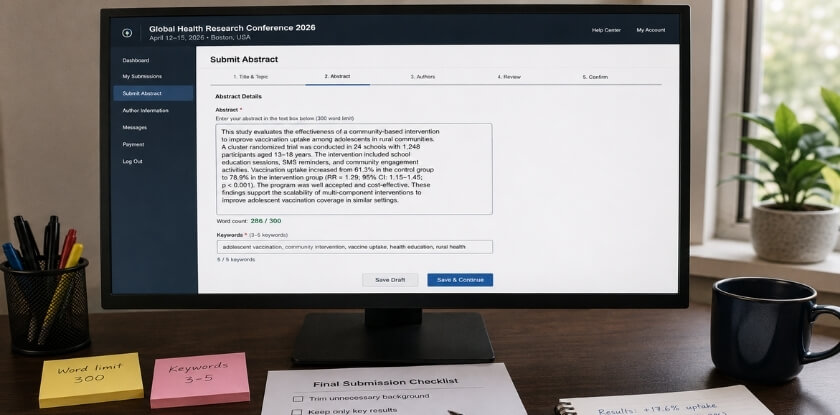
How to Stay Within Your Abstract Word Limit
The most reliable way to trim is to go sentence by sentence and ask whether it adds information or restates something already said. Redundancy is the main culprit, such as the same point in the background and again in the conclusion. A few cuts that rarely hurt:
- Remove hedging phrases. “It was found that” becomes “We found.” “The results of this study suggest that” becomes “Our results suggest.”
- Cut transitional summaries. With explicit labels like Methods or Results, you do not need to open each section by restating which one it is.
- Shorten numbers. “A total of 214 participants” becomes “214 participants.”
- Drop throat-clearing openings. A line like “Background has long been recognized as important in this field” contributes zero information.
Methods tends to balloon, so give only what lets a reader assess credibility: design, sample and primary measure, usually two or three sentences. When a journal specifies an exact limit, count with the journal’s preferred tool or manuscript system, not just your word processor. Some systems exclude the abstract title and others count hyphenated compounds differently, so check the author guidelines. And do not cut so hard that you lose the research gap, the key findings or the main implication. Those three are non-negotiable even in 150 words.
Where and How to Add Keywords to Your Abstract
Keywords are almost always a separate field in a submission system, listed below the abstract and usually outside the abstract word count (confirm in your journal’s guidelines). The words inside your abstract still matter for discovery, because databases search abstract text, so core concepts that appear clearly in it are easier to match. Do not spend abstract words repeating your keywords verbatim, though. Use that space for content.
For the keyword list itself, which is usually a small set whose exact size the journal specifies, follow these practical rules:
- Do not just repeat your title. If the title says “randomized controlled trial of cognitive behavioral therapy in adults with insomnia,” using “randomized controlled trial” and “insomnia” as your only keywords adds little. Add synonyms, related concepts, population subgroups and methodological terms.
- Use controlled vocabulary where the journal requires it. Some biomedical journals ask for MeSH terms. The MeSH browser at NLM is free and shows whether your term is a recognized heading or a synonym that maps to another one.
- Match what researchers actually search. Broad terms get lost in noise and very narrow terms get missed. Aim for specific enough to be targeted, common enough to appear in several related searches.
- Do not paste abstract sentences into the keyword field. Journals will ask you to revise it, and it does not help indexing.
For a study of structured abstract formatting, good keywords might be “structured abstract,” “abstract writing,” “IMRaD structure,” “scientific reporting” and “journal submission guidelines,” not “abstract” alone, which is far too broad. Also check the formatting rules: some journals want lowercase, others capitalize, and some want MeSH terms only.
IMRaD Abstract Self-Review Checklist
Print this or paste it into a document and go through it line by line before you submit. It works for structured and unstructured abstracts. First, print your own abstract and ask of each sentence which IMRaD component it belongs to. If it does not fit cleanly into Background, Methods, Results or Conclusion, cut it or rewrite it until it does.
Introduction / Background
- [ ] Does the opening sentence establish the topic without restating the paper title word for word?
- [ ] Is the research gap clear, meaning what specifically is unknown or unresolved, not just “X is important”?
- [ ] Is the gap stated in one or two sentences, with no citation numbers?
- [ ] Does the opening lead naturally into why the study was necessary?
Methods
- [ ] Does the abstract name the design outright, instead of saying only that a study was done?
- [ ] Does a reader know who the participants or data sources were, and roughly how many?
- [ ] Have you named the primary outcome measure or analytical approach?
- [ ] Is anything buried in a run-on sentence? If it takes more than three lines, it is probably too dense.
- [ ] For reviews, have you stated the databases searched (for example PubMed, MEDLINE) and the date range?
Results
- [ ] Are key findings stated with actual numbers, not “significant improvement” or “notable increase”?
- [ ] Do the results directly answer the question implied in the introduction?
- [ ] Is any p-value or confidence interval specific (for example p < 0.01, 95% CI: 1.2 to 3.4)?
- [ ] Is everything reported also supported in the paper itself?
- [ ] Is this the longest section of the abstract? It should be.
Discussion / Conclusion
- [ ] Have you stated what your findings mean, not just what they are?
- [ ] Is there a practical takeaway or recommendation, even a brief one?
- [ ] Have you avoided overstating? “This study suggests” is usually more accurate than “This study proves.”
- [ ] Is a significant limitation mentioned in one sentence?
- [ ] Does the final sentence give a reader a reason to read the full paper?
Overall Abstract: Format and Submission Checks
- [ ] Are you within the word limit? Check again after edits, because counts drift.
- [ ] If a structured abstract is required, do your subheadings match the journal’s wording exactly (for example “Objective” instead of “Introduction,” or “Conclusions” in the plural)?
- [ ] If the abstract is unstructured, does the text still follow the IMRaD order?
- [ ] Are keywords listed separately below the abstract, using the controlled vocabulary the journal expects where it asks for one?
- [ ] Can every sentence be traced to a section of the paper? Nothing in the abstract should be a surprise.
- [ ] Does the abstract make complete sense read in isolation, without the paper open?
One Final Read
Read your abstract out loud, slowly. You will catch things your eyes skip on a screen, and if a sentence makes you pause, rewrite it. Done right, the abstract is also your first pitch to an editor, the thing they read before deciding whether to send the paper for peer review at all.
FAQ
IMRaD in an abstract raises its own puzzles, such as where keywords go, whether limitations belong, how to fit the research gap into a short space and how to proceed if a journal skips IMRaD headers.
Does every abstract need to follow the IMRaD structure?
No. IMRaD fits empirical research with a clear method, data and results. For a review, theoretical or methods-only paper it bends: “Methods” may become “Scope” or “Approach.” The logic of context, what you did, what you found and why it matters still holds. Check the journal’s author guidelines.
What does IMRaD stand for, and how does it apply to an abstract?
Introduction, Methods, Results and Discussion. In an abstract each gets one short job: the gap and purpose, the design and sample, the key numbers, and what they mean. Journals may label these Background, Objective, Methods, Results and Conclusions.
What’s the difference between a structured abstract and an unstructured abstract in terms of IMRaD?
A structured abstract uses explicit headers so the IMRaD sections are visually separated. An unstructured abstract runs as one paragraph but should hit the same four beats in roughly the same order. PubMed and MEDLINE index both, and your target journal decides which you use.
How strict is the word limit for abstracts?
Treat it as a hard ceiling. Limits commonly fall between 150 and 350 words, and a Springer Nature author guide says journals often set 250. Submission systems often enforce the limit, and going over suggests you did not read the guidelines.
Can I mention limitations in the abstract?
Yes, briefly, and the ICMJE recommendations say an abstract should note important limitations. One short clause in the Discussion or Implications part is usually enough, such as “findings are limited to adult outpatient populations.” If the journal’s template has a Limitations header, use it.
Where exactly should keywords go, inside or outside the abstract?
Outside, usually. Keywords normally sit on their own line below the abstract, not inside the text. Still write the abstract so the most important concepts appear naturally in it, because indexing and database searches read the abstract text as well as your keyword list.
Will a well-structured IMRaD abstract help people find my paper?
It can help. PubMed searches abstract text, so a clear abstract with specific design, findings and terms gives both people and indexing tools more to match. No structure guarantees visibility in search or AI-generated summaries.
How do I handle the research gap in a very short abstract?
Keep it to one sentence at the end of the Introduction part, such as “However, no studies have examined this in low-income adolescent populations.” You do not need to review the literature. You only need to signal the gap clearly enough that the reader sees why the study was needed.
My journal doesn’t use IMRaD headers. Should I still use IMRaD order?
Yes. The order of background and gap, method, results and implications is what helps comprehension and indexing. Headers are just formatting, and an unstructured abstract that follows IMRaD in sequence reads more clearly than one that jumps around.
Is IMRaD structure required for journal submission, or just recommended?
It depends on the journal. The ICMJE recommendations say original research, systematic reviews and meta-analyses require structured abstracts, and many clinical and biomedical journals follow that. For humanities, social sciences or interdisciplinary journals it is usually a best practice. The Instructions for Authors page overrides any general advice, including this article.
What should an abstract for an MS International conference include?
It should clearly explain the work’s purpose, method, key findings, significance and relevance to the selected conference. That is the IMRaD logic in different words. Submitted work must be original and not published or under review elsewhere, and review is double-blind.
Conclusion: Next Steps After Writing a Journal-Ready Abstract
Once the abstract is structured, sized and checked against your target journal, a few last steps are worth taking.
Check the Requirements Once More
Pull up the journal’s author guidelines one more time. Not because you have not read them, but because abstract requirements change: word limits shift, and some journals have moved from unstructured to structured abstracts over the years. Confirm the current version before you submit, and place keywords right after the abstract in the format the journal specifies.
Get a Second Set of Eyes
Ask a colleague who has not read your paper to read only the abstract for 90 seconds, then ask what the study did, what it found and why it matters. If they cannot answer all three, something is missing. This is a sense check, not a peer review, but it works because your abstract must communicate to clinicians, policy people and systematic review authors who know nothing about your study design.
Keep a Copy of the Pre-Submission Version
Save your original abstract separately before you change anything during peer review or copyediting. Reviewers sometimes ask for more detail in the Methods or Results, and you will need to know what changed and why for your revision letter. It also helps if you later adapt the abstract for a conference submission or a preprint, where word limits and formatting expectations differ.
Use Your Abstract as a Writing Diagnostic
After submission, compare the abstract with the full paper. Every claim should be traceable to a specific section. If the abstract says the intervention reduced symptoms by 34%, that number must be in your Results. If it says you identified a gap in pediatric dosing, that gap must be in your Introduction. This catches ghost claims, statements that entered the abstract during drafting but never made it properly into the paper. Editors and peer reviewers may notice them.
One Final Thought
Writing a clean IMRaD abstract gets faster with practice. The first time is slow, as you wrestle with word limits and decide what counts as a key finding versus background. By your third or fourth you will know where the friction points are for your type of research. The structure is not a constraint. It is the reason your abstract gets read.