
Your abstract is 380 words and the submission deadline is tomorrow. Is that too long? Possibly not, because some calls allow 300 to 500 words. But the only number that counts is the one printed in the call for abstracts you received. If the organizers set a 250-word limit, 380 words can get your submission rejected before a reviewer reads a single sentence.
Quick answer: Most conference abstracts run 150 to 300 words: about 150 to 250 for posters, 200 to 300 for oral talks, and up to 500 in the humanities. Extended abstracts are a separate format of roughly 500 to 1,000 words. The call for abstracts always overrides these ranges, and if it names no limit, aim for 250 words.
Last verified against official sources: October 2026.
Conference Abstract Length
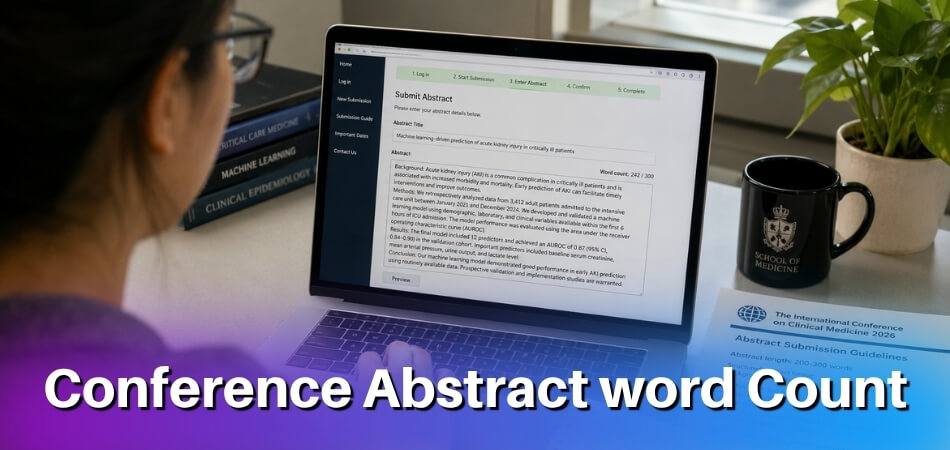
Most conference abstracts fall between 150 and 300 words, and 250 words is a safe target when you have not yet seen the call for abstracts. The exact number depends on the submission type and the field, so use the table below as a guide and then check the call.
| Type or field | Typical word count | What to know |
| Poster abstract | 150-250 | The poster carries the visual detail, so the abstract only frames the work. |
| Oral presentation abstract | 200-300 | Humanities and social science calls sometimes allow up to 400. |
| Extended abstract | 500-1,000 | Used by some STEM and computing conferences; may include figures or references. |
| STEM, engineering, computing | 150-250 | Tight structure: problem, method, result, implication. |
| Medical and clinical | 250-300 | Usually structured (Background, Methods, Results, Conclusions); some portals set a limit per field. |
| Social sciences | 200-300 | Qualitative and mixed-methods work may need the upper end for a short methods note. |
| Humanities | 300-500 | The argument needs room; a few calls allow more for certain submission types. |
These are ranges that conferences commonly use, not rules. Individual organizations differ even within one field, so assuming the norm can cost you. Many calls also set one limit for oral and poster submissions alike, so the poster and oral rows show common patterns, not a requirement.
When the Call for Abstracts Sets the Rule
If the conference publishes a specific limit, that number overrides every general range, including the ones above. Check the call before you write a line, not after you have drafted something you are attached to.
Some portals treat the word count as a recommendation. Others set a hard word or character ceiling and block the submission automatically. If no limit is stated at all, aim for 250 words: it is acceptable at almost every conference and leaves room for background, objective, methods, results and significance. Whatever the cap is, finish a little under it, so that a last-minute edit does not push you over.
Why the Numbers Differ
Length expectations come from disciplinary habits, the submission format, and how organizers plan to use the abstract. Reviewers may read many submissions, STEM abstracts follow a compact structure, and humanities arguments often cannot be compressed without losing the point. For comparison, the APA Style abstract guide says to limit an abstract to 250 words, and the IEEE Author Center asks for a single paragraph of up to 250 words with 3 to 5 keywords. These are rules for papers, so a conference call can still set a different number.
Oral Presentation vs. Poster Presentation Abstracts
Oral abstracts are usually longer than poster abstracts. A 15 to 20 minute talk has to be supported by a developed argument, so program committees want enough detail to judge that. A poster abstract summarizes a visual display, so reviewers look for a clear topic, approach and finding rather than a fully developed argument.
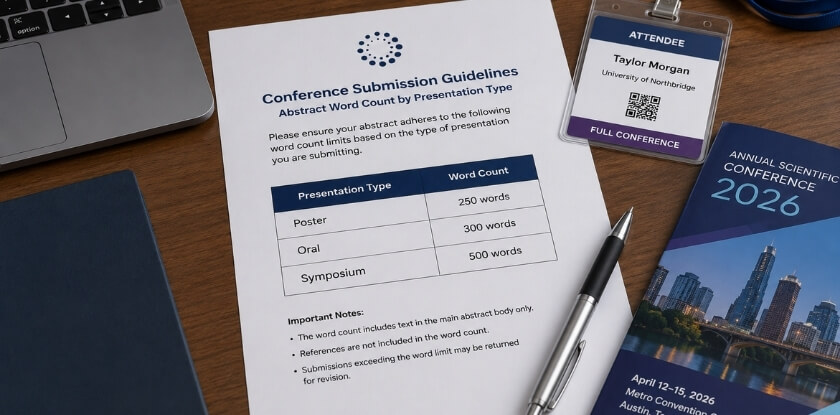
Some conferences use one limit for both formats and let the committee sort submissions into oral or poster slots afterward. Others ask you to choose a format and apply a different limit to each. If the call does not say, email the organizing committee rather than guessing.
Conference Abstract vs. Journal Abstract: Key Differences
A conference abstract is a proposal, while a journal abstract summarizes a finished paper, so the two should not be swapped without editing. Many researchers submit a lightly edited journal abstract to a conference and wonder why it is rejected.
What Each One Does
A journal abstract accompanies a finished paper. Editors use it to decide whether to send the manuscript out for review, and readers use it to decide whether to download the article. Because the paper exists, it can state final results precisely. Word counts are strict within a journal, commonly 150 to 250 words, often in a fixed structure.
A conference abstract asks a program committee for a slot, whether a 20-minute talk or space on a poster wall. Reviewers read it before any final paper exists, sometimes before the research is complete. They want to know whether the work fits the theme, would interest the audience, and is at the right stage to present. You can report preliminary findings or frame a question without answering it fully.
Presenting an abstract at a meeting does not usually block a journal paper later. The ICMJE recommendations say they do not prevent a journal from considering a complete report that follows a preliminary report, such as an abstract or poster displayed at a scientific meeting. The reverse case works differently: some conferences do not accept work that is already published, so read the call’s rule on prior publication before you reuse a journal abstract.
Side by Side
| Journal Abstract | Conference Abstract | |
| Typical word count | 150-250 words | 150-500 words, depending on format and field |
| Structure | Often mandatory (labeled sections) | Varies by conference |
| Timing | Accompanies a finished paper | Submitted before the presentation, sometimes before the paper |
| Primary reader | Editors, peer reviewers, scholars | Program committee, conference attendees |
| Revision after submission | Yes, through peer review | Often none, though some conferences ask for a final version after acceptance |
Medical journals usually require labeled sections (Background, Methods, Results, Conclusions). Conference abstracts vary more. Medical conferences often ask for the same labels, humanities and social science conferences frequently accept one flowing paragraph, and STEM conferences fall in between.
Rewriting a Journal Abstract for a Conference
Do not paste a journal abstract into a conference form. The emphasis and framing usually need to shift. A journal abstract might say:
We analyzed 412 patient records and found a statistically significant reduction in readmission rates (p < 0.01).
For a conference, the same finding needs more context about why it matters to this audience:
Analysing 412 patient records, we found a statistically significant drop in readmissions (p < 0.01). We discuss what this means for discharge planning in community hospitals and what we will demonstrate in the session.
If the call says 300 words and you submit 280 with a clear structure, that is solid. If you paste in a 200-word journal abstract that never says why the work matters to this conference’s audience, you weaken your chances for no good reason.
How Abstract Length Affects Acceptance
Length does not decide acceptance by itself, but ignoring the limit or missing the expected depth both hurt. Reviewers notice quickly when an abstract is bloated past the limit or trimmed until it answers none of the basic questions. Acceptance rates for abstracts vary widely between conferences, so treat any single figure with caution.
Going Over the Word Limit
Many submission systems either cut your text at the limit or block the submission before it reaches a reviewer. If one lets it through, the reviewer sees that you did not follow the call, and in a competitive review that is an easy reason to cut you.
Padding is a separate problem. An abstract that fits the count but spends half of it on background reads as thin. Reviewers respond to density: method, result and significance packed clearly into the space given.
Falling Short of the Expected Length
A very short abstract in a field that expects 250 to 300 words suggests either that the work is not yet developed or that the submission was not taken seriously. A 120-word abstract sent to a call that allows 300 leaves out the interpretive or methodological detail reviewers look for.
How Format Changes the Picture
- Oral abstracts get extra scrutiny because the committee is projecting how the work will fill the slot. A vague or very short abstract gives them no confidence there is enough content.
- Poster abstracts may have a lower allowance, but brevity alone does not win. A clear question, approach and finding are still needed.
- Structured abstracts make gaps visible. A 200-word structured abstract where Results is a single sentence looks incomplete even though the total is within range.
What Reviewers Actually Notice
Reviewers are not counting words by hand. They read for completeness and fit. An abstract that says what was done, why it matters and what was found reads as competent whether it has 248 or 261 words.
Length becomes a problem when it points to a deeper one: too many words usually means the argument is not focused, and too few usually means the evidence is not there yet. The limit is a constraint that forces clarity, so work with it.
Before submitting, also check whether the title and keywords are counted separately. Some systems count everything in the field, which can turn a 250-word abstract into one the system reads as 310.
How to Cut Down an Abstract That Is Too Long
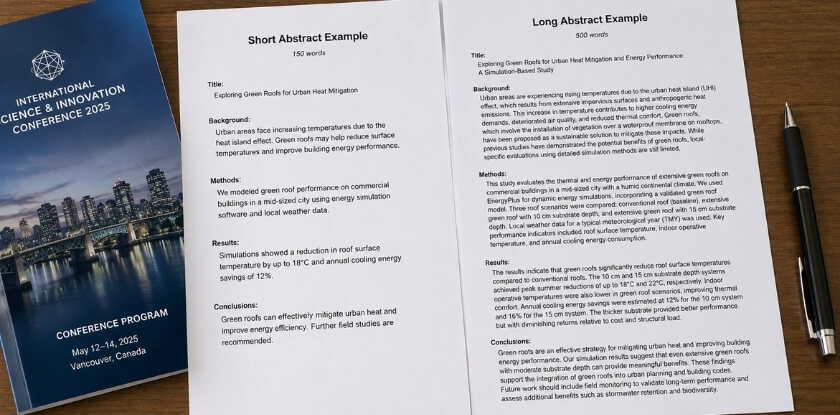
To cut an abstract, remove background first, then tighten methods, results and conclusion in that order. Most researchers find they are 80 or 100 words over, and trimming a sentence here and there rarely fixes it cleanly.
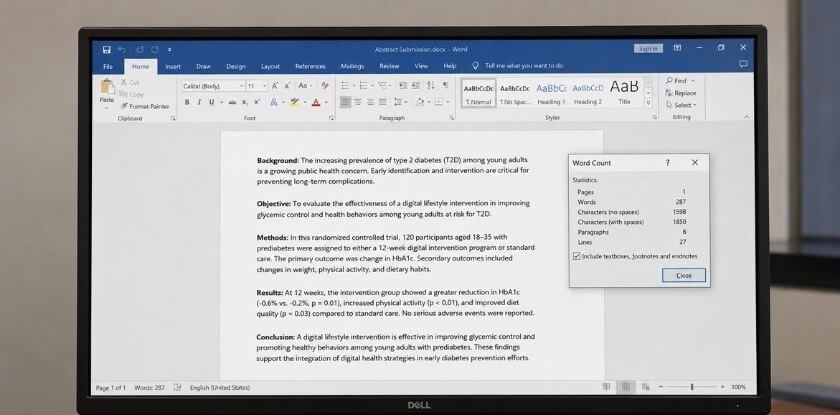
Find What Is Eating Your Word Count
- Background that belongs in the introduction. One sentence of context is usually enough, and at many STEM and medical conferences even that can go if the title makes the topic clear.
- Hedging language. “It appears that,” “the results seem to suggest” and “it may be possible that” add words, not meaning. If your findings are preliminary, one qualifier is enough.
- Method described twice. Once in passing and once in a dedicated sentence is an easy-to-miss source of extra words. Keep the clearest version.
- Results listed twice. Pick one place to state each result.
- A closing sentence that restates the title. “This study therefore investigated X” adds nothing after an opening that said exactly that.
A Practical Cutting Sequence
Work through the abstract in this order rather than editing line by line from the top.
- Background. It inflates the most and costs the least. In a structured format, keep one to two sentences.
- Methods. Reviewers of an oral abstract care what you did, not an exhaustive account of how. A poster abstract needs even less because the poster carries the detail.
- Results. Keep the two or three findings that support your conclusion. The rest can live in the presentation.
- Conclusion. Reduce it to one clear claim. Many abstracts end with two sentences saying the same thing at different levels of generality, so keep the more specific one.
Here is the same abstract before and after that process:
Before (about 320 words, shortened here): Urban professionals face rapid labour market change, and career transitions have become an important topic across the social sciences. Previous research has looked at many aspects of this question. In this study, we conducted semi-structured interviews with 24 participants in three cities to examine how urban professionals manage career transitions. It appears that networks may play a role…
After (about 245 words, shortened here): Career transitions are rarely studied from the worker’s side. We conducted 24 semi-structured interviews with urban professionals in three cities to examine transition strategies. Participants who relied on informal networks changed fields faster than those who used formal channels. We argue that employers’ hiring practices, not workers’ skills, explain most of the difference.
When You Are Still Over the Limit
The problem is usually structural: you are trying to summarize the paper instead of communicating the core contribution.
- Reframe around one argument. An abstract is not a miniature paper. It should answer what you did, what you found, and why it matters to someone at this conference. A sentence that serves none of those can go.
- Check for double-weight sentences. “We interviewed 24 people in three cities, using a semi-structured guide, in order to find out how urban professionals in the social sciences move between careers” becomes “We ran 24 semi-structured interviews with urban professionals to examine career moves.” Fewer words, same information.
- Keep the limit in view. Paste the word count rule above your draft so you keep checking against it.
If You Are Under the Limit
Do not pad with more background. Add whichever of purpose, method, result or significance is missing, since that is what reviewers look for. If you cannot fill even a minimum length with those four, the work may not be ready for this call.
Abstract Length and Submission Checklist
Run this checklist once for every submission, even if you have submitted to this conference before. It takes about five minutes.
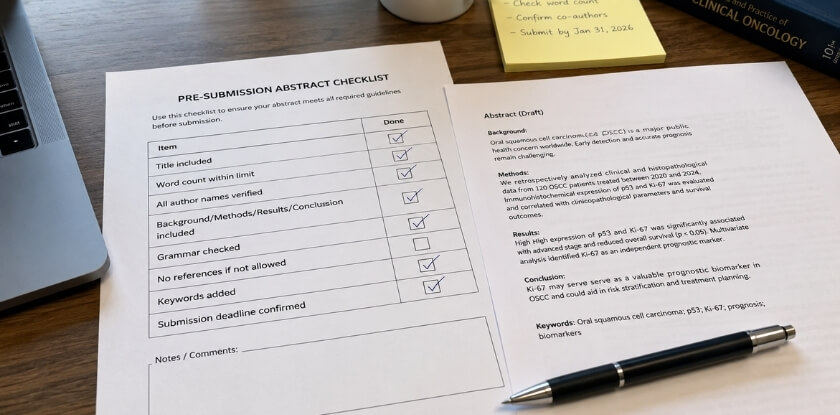
Word Count and Format
- Check the exact current limit. Limits change between conference cycles, so do not rely on your memory of last year. Count after removing the title, author line and keywords, unless the guidelines say to include them.
- Confirm words or characters. Some portals count characters, sometimes including spaces. Test it in the submission form.
- Verify the format type. If the call asks for a structured abstract with labeled sections, unlabeled paragraphs may fail the first screening. Match the structure to your field: a medical abstract without Results reads as incomplete, and a humanities abstract laid out like a clinical report feels out of place.
- Look for a minimum. It is less common, but some conferences flag abstracts well below the limit as underdeveloped.
- Check the keyword rules. Use the conference’s keyword list if it provides one, and note any cap on the number of keywords (the IEEE Author Center, for example, asks for 3 to 5). Do not repeat title words as keywords; choose adjacent concepts such as methods, populations or frameworks.
Content
- Background is no more than two sentences, and the method takes one clear sentence.
- At least one concrete result or finding is stated, and the conclusion matches the scope of the findings.
- One sentence says directly what the work adds, finds or argues that earlier work does not.
- The title and abstract match. If the title promises a comparison but the abstract describes one case, reviewers will notice.
- For an oral slot, expect reviewers to want a complete argument. Poster abstracts sometimes stop at methodology, but many conferences now apply the same standard to both.
Final Polish
- Read it aloud once. If you stumble over it, a reviewer will too.
- Watch the passive voice. One or two passive constructions are fine, but an abstract that is entirely passive is vague about who did what.
- Have someone outside your research group read it. A fresh reader spots jargon and gaps you have stopped seeing.
- Confirm the deadline and time zone. Portals usually close at a specific time, often in the host city’s local time. Missing by 20 minutes because of a time zone mix-up is a poor way to lose a slot.
- Save a local copy after submitting. Systems go down and confirmation emails get filtered, and you may need the exact text later.
From our experience at MS International: Our author submission page says an abstract should clearly explain the work’s purpose, method, key findings, significance and relevance to the selected conference. Review is double-blind, so keep author names and affiliations out of the abstract text. Submitted work must be original and must not be previously published or under review elsewhere, and authors should follow the official paper format or template provided by the conference team.
FAQ
Word or character limits, whether the title and keywords count, separate oral and poster limits and going over the limit are the length details that catch authors out.
How long should a conference abstract be?
Most conference abstracts are 150 to 300 words. Poster abstracts sit near 150 to 250, oral abstracts near 200 to 300, and humanities calls sometimes allow up to 500. The call for abstracts is the only authoritative source.
Is there a standard word count across all academic fields?
No, there is no universal standard. Medical conferences often ask for about 250 to 300 words in a structured format, while humanities conferences may allow 300 to 500 words of flowing prose. Follow the specific call.
Does the word count include the title and keywords?
It depends on the conference, and there is no universal rule. Some calls say “excluding title and keywords”; others count everything in the field. If the call is silent, count the whole field to stay safe, or email the organizers.
What happens if my abstract exceeds the word limit?
Many online systems cut it off mid-sentence or refuse the submission. Where a person reviews it, an over-length abstract suggests you did not follow instructions, which can hurt your chances before the content is read.
Do oral and poster abstracts have different length requirements?
Sometimes, but many calls set one limit for both. Others ask for a shorter abstract for posters and a longer one for oral talks. Check whether the call distinguishes between submission types before you cut anything.
Can I reuse a journal abstract for a conference?
Only as a starting point. Rewrite it for the conference’s limit, structure and audience, and check the conference’s rule on previously published work and the journal’s reuse terms first.
Are limits counted in words or characters?
Both exist. Most calls state a word limit, but some portals cap characters, sometimes including spaces. Check the submission form and test it before the deadline.
Do references count in an abstract?
Abstracts normally do not include references. Extended abstracts are the exception and may allow figures and references. Follow the call, and if it does not say, leave them out.
What is the biggest mistake with abstract length?
Writing at the maximum length by default. Longer does not signal more rigorous work. A focused 200-word abstract that states the problem, method and finding will usually beat a padded 300-word version that buries the contribution.
Final Thoughts
Read the call for abstracts first and treat its limit as fixed. If it gives none, aim for 250 words, cut background before anything else, and make sure what remains states what you did, what you found and why it matters. Comparing your draft with a worked conference abstract example from your field, such as humanities, STEM or nursing, shows how those parts fit a set word count.