Not sure what a conference abstract should look like on the page? Here are the templates and worked examples to copy from.
Quick answer: A conference abstract template has a title, background, objective, methods, results, conclusion, implications and keywords, and calls usually set a limit between 150 and 500 words, with 250 common, so trim the templates to yours. Humanities papers use the same content as one paragraph or a few short ones. Below you get copy-ready structured and unstructured templates, a layout for uploaded abstract files and six worked examples. Always check the call for papers, because word limits and required headings differ.
Templates save time only if you fill them with specifics: a sample size, a named method, a real number. This guide gives you the templates and an upload layout, help choosing between them, six worked examples across fields, then a fill-in method with a self-score, the difference between an abstract and a proposal, learning objectives and a checklist.
What Should a Conference Abstract Include?
A conference abstract is a self-contained summary of your work that tells reviewers what you studied, how, what you found and why it matters. Limits vary by call, commonly from 150 to 500 words, and 250 words is a common cap. With so few words, I cut any sentence that does not tell the reviewer something new.
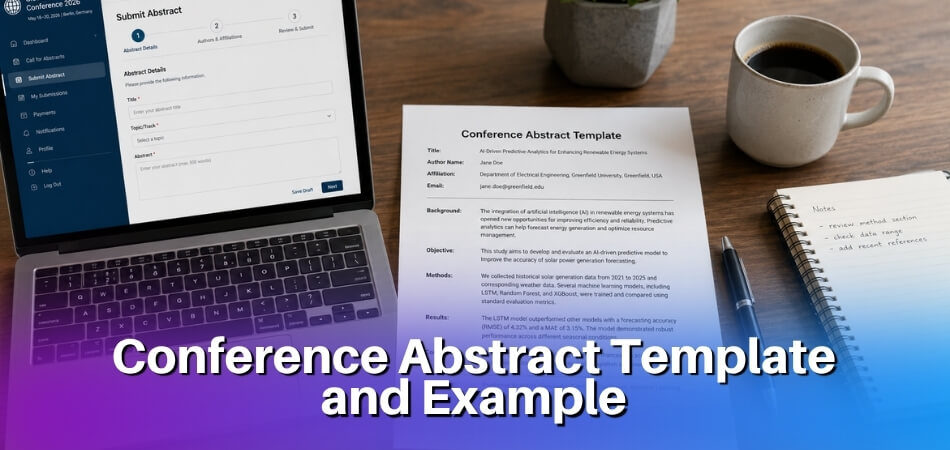
Whatever the format, a complete abstract answers four questions: What is the problem? What did you do? What did you find? Why does it matter? If one is missing, reviewers may score it down. The labelled version splits these into sections:
- Background: one or two sentences on the problem or knowledge gap.
- Objective: a clear statement of what you set out to do or test.
- Methods: how you did it, in enough detail to judge the approach.
- Results: your actual findings with key numbers. “Results will be presented” can lead reviewers to mark an abstract down.
- Conclusion: what the findings mean in plain terms.
- Implications: how the work changes practice, policy or future research.
Credentials such as CEN or CPEN usually go in the author information fields of the portal, not in the abstract text. Follow the form if it says otherwise.
Structured Abstract Template (Copy-Ready)
Use the structured template when the call lists section headings, which is typical for scientific, nursing and health conferences. Replace the bracketed text with your own content. The word counts are rough guides that add up to roughly 230 to 340 words before trimming, so cut towards your call’s limit (250 is common); the call may count the title too.
| Section | Rough length | What to put in it |
| Background | 40 to 60 words | The problem or gap |
| Objective | 20 to 30 words | The specific aim, in one sentence |
| Methods | 60 to 80 words | Design, setting, sample, analysis |
| Results | 60 to 80 words | Main findings with numbers |
| Conclusion | 30 to 50 words | Direct answer to your question |
| Implications | 20 to 40 words | What readers should do with it |
Title: [Full abstract title: concise and specific; use plain words wherever they are as precise as the technical term]
Background: [State the problem or the clinical or research gap. One or two sentences is usually enough. What existing knowledge or practice prompted this work?]
Objective: [One sentence stating exactly what you aimed to do, determine or evaluate. Name the outcome you were after; “explore” or “examine” with no outcome reads as vague.]
Methods: [Study design, setting, sample size, data collection and analysis method, with timeframes. For health submissions, name the clinical setting and any instruments used.]
Ethics: [Only if the call asks: the approving committee and reference number, or one sentence on why approval was not needed. Some portals use a separate field for this.]
Results: [Main findings with specific numbers, percentages or effect sizes.]
Conclusion: [What your results mean. Answer your research question directly.]
Implications: [What practitioners, policymakers or researchers should do with this finding.]
Learning Objectives (only if the call asks): [2 to 4 bullets, each starting with an action verb such as identify, apply, evaluate or implement.]
Keywords: [3 to 5 terms] Word limit: [Insert the conference’s stated limit and track against it before submission]
This layout suits scientific and STEM abstracts, and conferences with peer-reviewed proceedings often want the same structure.
Unstructured Abstract Template (Narrative Format)
An unstructured abstract is one flowing paragraph, or a few short ones, with no labelled headings. It is standard in the humanities, social sciences and many interdisciplinary conferences, and it reads like an argument, not a report. The same information still has to be there, woven together, and reviewers still look for each element. Limits vary by call, and some humanities calls allow up to 500 words.
Title: [Your abstract title. A common humanities pattern is “Hook phrase: topic in its context”.]
Abstract body (within your call’s limit, often 150 to 300 words; shorter calls are common in computer science)
[Opening sentence: state the problem, debate or gap your work addresses, in terms the field will recognise at once.]
[Next one or two sentences: summarise the existing conversation or scholarship you respond to. One or two author-date references are fine if the call allows citations.]
[Approach: which archive, corpus, dataset or fieldwork you used and how you analysed or interpreted it. Name your theoretical framework here if it is central.]
[Main finding or argument: your core discovery in plain, direct language. Reviewers read dozens of abstracts in a row, and dense jargon slows them down.]
[Closing sentence or two: the significance for the field, the discipline or practice, and why it belongs on this programme. Many humanities abstracts end with one line on what the paper will do, such as “In this paper, I argue that …”]
Keywords: [3 to 5 terms] Word limit: [Insert the conference’s stated limit and track before submitting]
After drafting, I read it back and ask whether a reviewer could find the objective, method and findings within thirty seconds. If one is buried or missing, I revise before the grammar check.
Short Version for Tight Word Limits
When the limit is tight, one sentence per element is enough. Fill in the five sentences below, then add detail only if words remain.
This study [tests / measures / compares] [topic or problem].
It aims to [one specific aim].
Using [method, sample or source], we [what you did].
The results show [main finding, with a number if you have one].
This matters because [contribution to the field or to practice].
Abstract Page Layout: Title, Authors and Affiliations
Some calls ask you to upload the abstract as a file instead of pasting it into a form, and then the page layout matters as much as the text. My first step is to look for the conference’s own Word or LaTeX template, because it overrides any general layout, including the one below. For the title itself, I aim for the topic plus, where it fits, the main finding or setting; a colon split such as “Topic: context” works in most fields.
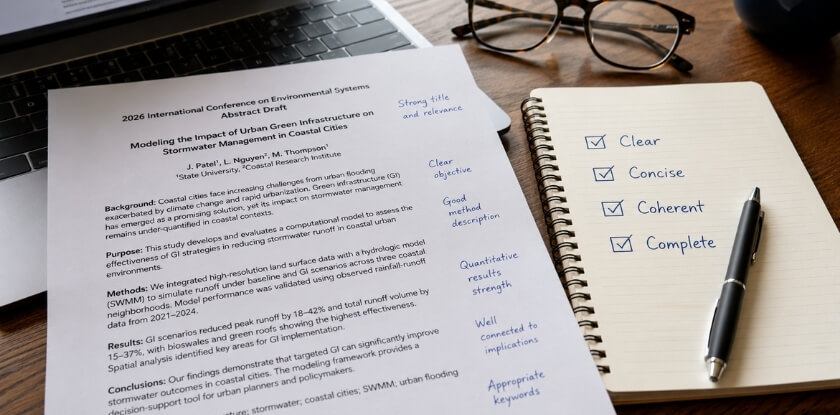
[Abstract title]
Last name, A.A.1*, Last name, B.B.2
*Email address of the presenting author
1Department, institution, city, country
2Department, institution, city, country[Abstract text]
Keywords: [3 to 5 terms]
The number after each name points to an affiliation line, and the asterisk marks the person who will present. Calls set the fonts and margins themselves. The ARCPaC26 abstract template on Aarhus University’s conference site, for example, asks for a Times New Roman title in 16 point, authors in 12 point, affiliations in 10 point and body text in 12 point, at most 500 words, left and right margins of 2.5 cm, top and bottom margins of 3 cm, justified single-spaced paragraphs and 8 point spacing between paragraphs. If the review is blind, leave the author and affiliation lines out of the uploaded file unless the call says otherwise.
Which Template Fits Your Conference?
Use the structured template if the call names section headings; use the unstructured one if the call only gives a word limit. The conference often decides for you, so I read the submission guide in full before choosing.
| Your submission | Template | Why |
| Medicine, nursing, most STEM | Structured | Reviewers often score section by section, so a missing label can cost points |
| Quantitative or mixed-methods research | Structured | The results must be clearly visible |
| Quality improvement or clinical case study | Structured | Defined intervention and measurable outcome |
| Humanities, social sciences, arts | Unstructured | The argument does not follow a linear research sequence |
| Theoretical, interpretive or practice-based work | Unstructured | Labels like “Methods” would distort it |
| Interdisciplinary conference | Follow the call | If it is silent, check past abstracts or ask the committee |
Look in the call for these items before you paste anything into a template:
- Whether the format is required or only suggested.
- The exact heading names. Some calls replace “Methods” with “Design” or add “Implications” or “Learning Objectives”.
- The word limit and what it counts, such as title and author details.
- Formatting rules, such as plain text only or no citations.
Some conferences accept both formats, depending on whether you submit empirical research or a theoretical paper. If the portal gives you labelled boxes, the format is structured; if it gives one free-text box, write an unstructured paragraph. If the guidelines say nothing about format, look for a previous year’s accepted-abstract book or sample submissions on the conference website. If you cannot find one, email the programme committee. Submitting an unstructured abstract to a call that requires headings can get it rejected before review.
Conference Abstract Examples
These six examples cover the main situations: qualitative humanities work, empirical STEM research, a nursing quality improvement project, a review paper, work in progress and a computer science paper written as one plain paragraph. I picked them because each needs a different decision about labels, numbers and tense. All sample data are invented for illustration, so do not cite them. Notice how scope, tone and technical detail shift across fields.
Example 1: Humanities and Social Sciences (Unstructured, Qualitative)
Notice how this one moves from context to argument to significance without a single label.
Title: “Performing Grief Online: Digital Mourning Practices and the Negotiation of Authentic Sorrow in Facebook Memorial Groups”
Grief has always been shaped by the social contexts in which it is expressed. The rise of digital memorial spaces on platforms such as Facebook has introduced new arenas for mourning that sit uneasily alongside established cultural scripts for loss. This study examines how bereaved individuals negotiate authenticity and social expectation when expressing grief in public-facing online memorial groups.
Drawing on eighteen months of digital ethnography across four Facebook memorial groups and forty semi-structured interviews with active participants, this research explores how users calibrate emotional expression to perceived community norms. Participants frequently described monitoring their own posts for signs of “too much” or “too little” grief, suggesting that online mourning is governed by informal but powerful affective rules. These dynamics reproduce offline hierarchies of grief, such as who is permitted to mourn publicly and whose loss is recognised, while also creating space for marginalised mourners, including estranged family members and online-only friends, to claim visibility.
The findings complicate frameworks in digital sociology that treat online self-presentation as primarily strategic or performative. Mourners in this study engaged in genuine emotional labour, but within constraints that were socially constructed and algorithmically reinforced. Notifications, reaction buttons and post-visibility settings all shaped how grief was performed and received.
This paper contributes to scholarship on digital death studies, online community formation and the sociology of emotion. It has implications for social media platform design, grief counselling practice and policy discussions around digital legacy.
This runs about 240 words. The research question, method, key finding and implications all appear, and nothing is labelled: the argument carries the reader.
Example 2: STEM (Structured, Empirical)
Reviewers of STEM abstracts expect precision: sample sizes, named methods, quantified results.
Title: “Microplastic Accumulation in Riparian Soils Along Urban Waterways: A Comparative Analysis Across Three Drainage Catchments”
Background: Microplastic contamination in freshwater systems is well documented, but soil accumulation patterns in riparian zones next to urban drainage catchments remain poorly characterised, particularly across varied land-use intensities.
Objective: To quantify microplastic concentration and polymer composition in riparian soils across three urban catchments with different land-use profiles (residential, commercial and mixed industrial) and to identify spatial predictors of elevated accumulation.
Methods: Soil cores (0 to 30 cm depth) were collected from 72 sites across three catchments during the 2023 wet season. Microplastics were extracted by density separation and characterised by Fourier-transform infrared spectroscopy (FTIR). Land-use data came from municipal GIS records. Statistical analysis used generalised linear mixed models in R v4.3.1.
Results: Microplastic concentrations ranged from 1,240 to 18,760 particles/kg dry weight. Mixed industrial sites showed concentrations 4.2 times higher than residential sites (p < 0.001). Polyethylene (41%) and polypropylene (28%) were the dominant polymers. Proximity to stormwater outfalls was the strongest spatial predictor (β = 0.67, 95% CI: 0.54 to 0.80).
Conclusion: Land-use type and proximity to stormwater infrastructure are significant determinants of microplastic burden in urban riparian soils. Targeted remediation should prioritise industrial catchment zones.
Implications: These findings inform urban stormwater management policy and support calls for microplastic-specific monitoring in environmental impact assessments.
Keywords: microplastics; riparian soils; urban stormwater; land use
This is roughly 210 words. The results give real numbers instead of “a significant difference was found”.
Example 3: Nursing and Health (Structured, Quality Improvement)
Nursing abstracts need to speak to clinical practice. If the conference offers nursing continuing education contact hours, which BCEN accepts towards recertification of credentials such as CEN and CPEN, reviewers also check that the abstract connects to learning objectives and practical takeaways for bedside nurses, not only researchers.
Title: “Reducing Paediatric IV Infiltration Rates in a High-Volume Emergency Department: Outcomes of a Nurse-Led Quality Improvement Initiative”
Background: Peripheral IV infiltration in paediatric emergency patients causes pain, treatment delays and potential tissue injury. At a paediatric emergency department with over 28,000 annual visits, infiltration rates averaged 14.3% over a 12-month baseline period.
Objective: To evaluate the impact of a standardised nurse-led IV insertion and monitoring bundle on paediatric peripheral IV infiltration rates over a six-month intervention period.
Methods: A pre/post quality improvement design was used. The bundle included a structured vein selection algorithm, a standardised securement protocol and two-hourly visual assessment documentation. All ED nurses (n = 64) completed a two-hour competency module before implementation, with no change to staffing levels. Data came from the electronic health record, and a chi-square test compared pre- and post-intervention rates.
Results: Infiltration rates fell from 14.3% to 6.1% (p < 0.001) over six months, a 57% relative reduction. Documentation compliance reached 91% by month three. No significant difference was found between day and night shifts after implementation.
Conclusion: A structured, nurse-led bundle offers a clinically meaningful and statistically significant reduction in paediatric IV infiltration without additional staffing.
Implications for Practice: Emergency nurses can implement evidence-based IV monitoring bundles within existing workflows. The findings apply to vascular access competencies and to professional development goals in quality improvement leadership.
Learning Objectives: Attendees will be able to (1) describe the components of a structured paediatric IV monitoring bundle, (2) evaluate whether a vein selection algorithm suits high-acuity paediatric patients and (3) lead a unit-based QI initiative using pre/post data collection.
With learning objectives this runs about 240 words, not counting the title. The implications are written for the certification audience, not a generic clinical readership, and that fit matters when reviewers judge relevance to attendees.
Example 4: Review Paper (Structured, Literature-Based)
A review abstract has no sample, so the “methods” are the search and selection. State the databases, the date range and how many studies you included, then give the pattern you found.
Title: “Peer Feedback in Undergraduate Writing Courses: A Narrative Review of Studies from 2015 to 2024”
Background: Peer feedback is widely used in university writing courses, but reports of its effect on revision quality are scattered across disciplines and settings.
Objective: To summarise what published studies show about the effect of structured peer feedback on undergraduate revision quality, and to identify gaps for future research.
Methods: We searched ERIC, PsycINFO and Scopus for peer-reviewed studies published between 2015 and 2024 and screened 312 records. Thirty-eight studies met the inclusion criteria and were coded for feedback format, training given to students and outcome measure.
Findings: Of the 24 studies that trained students to give feedback with a rubric, 19 reported improved revision quality, against 5 of the 14 studies without training. Evidence on long-term writing gains was thin, and most studies came from a single course and term.
Conclusion: Structured, rubric-based peer feedback appears worth adopting, but multi-term studies are needed.
Replace the invented counts with your own exact numbers; reviewers read the screened and included figures as a sign of how thorough the search was.
Example 5: Work in Progress (Structured, Preliminary Results)
When data collection is not finished, say so plainly and report what you have. Label preliminary numbers as preliminary, and never present projected findings as confirmed outcomes.
Title: “Remote Onboarding and Early Job Satisfaction in Small Firms: Preliminary Findings from a Mixed-Methods Study”
Background: Small firms increasingly onboard staff remotely, yet little is known about how this affects satisfaction in the first three months.
Objective: To compare early job satisfaction between remotely and in-person onboarded employees in firms with fewer than 50 staff.
Methods: A survey of new hires at 12 firms (target n = 150) is combined with follow-up interviews. Data collection is ongoing and will close in March 2027.
Preliminary results: Among the first 61 responses, remote hires reported lower satisfaction with manager contact (mean 3.4 versus 4.1 on a five-point scale). These are early survey numbers, so the difference has not yet been tested for significance.
Expected contribution: Survey results with significance tests and the first interview themes will be complete before the conference and will inform onboarding practice in small firms.
Some calls accept this kind of submission only for posters or a work-in-progress or late-breaking track, so check the call before you submit.
Example 6: Computer Science (Unstructured, Empirical)
Many computer science and engineering calls are the exception to the STEM row in the table above: they ask for one plain paragraph with no labels. The structure is still there, but the numbers carry it: the problem, the method, the measured gain and the cost of that gain.
Title: “Pruning Attention Heads for Faster On-Device Speech Recognition”
Speech recognition models that run on phones must balance accuracy against memory and battery use. Transformer models reach high accuracy, but their attention layers are expensive on small devices. We propose a pruning method that removes attention heads with low contribution scores during fine-tuning and then retrains the remaining heads for two epochs. On a public English speech benchmark, pruning 40% of the heads cut inference time by 31% on a mid-range phone, while word error rate rose from 7.8% to 8.1%. Memory use fell from 310 MB to 205 MB. Against two published pruning baselines, the method gave a lower error rate at the same speed. It needs no new hardware and fits into existing fine-tuning pipelines, which makes on-device recognition practical for lower-cost phones.
This runs about 125 words without the title. The trade-off is stated as numbers (inference time down 31%, word error rate up 0.3 percentage points), which is what a reviewer in this field looks for first.
How to Turn a Template Into Your Abstract
My method: fill the template in section order, draft long and then cut.

- Write one sentence first. If you cannot say in a sentence what your work demonstrates, you are not ready to fill in the template. An abstract that tries to make three claims usually supports none of them well, so pick one.
- Pick the template that matches the call (see the table above) and choose a topic that genuinely fits the conference theme. Reviewers notice an abstract written for another venue and lightly adjusted. For a nursing or health audience, frame the work around clinical impact, not method alone, and check whether the scoring gives weight to specialty alignment.
- Fill the sections in order. Background in one or two sentences without a literature review; the objective as a direct aim; methods specific enough to judge rigour, including the sample size even when it is small (leaving it out raises more questions than a modest number); results with the outcome measure, direction and a number; conclusion and implications that say what the findings mean, not just what they are.
- Check the word limit and what it counts. The Background and Methods are usually where sentences restate each other, so cut down an abstract that is too long by removing background first, then tightening methods, results and conclusion.
- Revise for plain language. Read it aloud, define or replace jargon (reviewers sometimes come from adjacent fields), keep past tense for completed work and present tense for conclusions, and run a grammar check last.
Self-Score Against Reviewer Criteria
Many committees score relevance to the theme, clarity of the objective, soundness of method, quality of results, significance and writing. If the link to the theme is not visible in the first two sentences, reviewers often assume it is not there. Rate your draft honestly on each, and spend revision time on the weakest. Weighting differs by field: STEM reviewers lean on methods and results, humanities reviewers on the argument and its stakes. If the conference publishes its rubric, align to it. Also make sure the conclusion does not claim more than your results support; overclaiming is a quick way to lose a reviewer’s trust.
A few habits help reviewers score you:
- Front-load the “why this matters”. The background should establish the stakes quickly, sometimes in one sentence, so the reviewer does not wait for the conclusion to see the significance.
- Stay inside the limit. An abstract that stops at 200 words of a 250 limit is fine if every element is there; one that trails off without results is not, and one that runs to 280 for a 250 limit signals carelessness.
- Keep sections separate. Blending the methods into the results slows reviewers down and often lowers the score, because the labelled headings exist so each part can be judged on its own.
Conference Abstract vs Research Paper Abstract vs Conference Proposal
A conference abstract is written to be selected, a research paper abstract summarises a published paper, and a conference proposal pitches a whole session. In my view, mixing them up is the most avoidable mistake in a submission: it means sending the wrong document, or the right one in the wrong way.
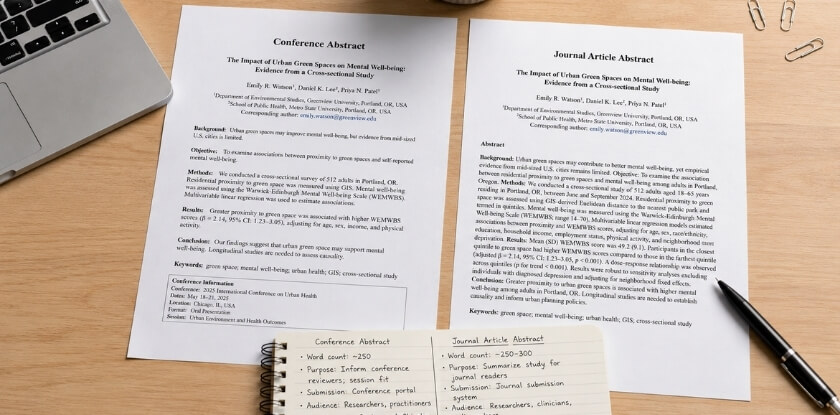
| Document | Purpose | Typical length | Audience |
| Conference abstract | Selection for the programme | 150 to 500 words | Reviewers and programme committee |
| Research paper abstract | Represent a published paper | Often 150 to 250 words | Readers, researchers, databases |
| Conference proposal | Pitch a full session | Set by the call, often longer than an abstract | Programme committee |
A conference abstract is read cold, and its job is selection. A research paper abstract is written after the paper is finished, follows the journal’s format, and must represent the paper faithfully because readers may cite it or use it to decide whether to read the paper. A proposal, common in humanities and education, may add a session outline, presenter bios, references and a description of the format (panel, workshop, poster, paper).
You may need all three over time: an abstract to be accepted, a presentation, then a journal manuscript with its own abstract. If the portal does not make it clear, contact the organisers before the deadline.
Learning Objectives in a Conference Abstract
Learning objectives are statements of what attendees will be able to do after your session, and nursing, healthcare and education conferences are the ones that most often ask for them. They are not your study aims, and I would not reuse the objective line as one. Reviewers may score them, so a vague set can drag down a strong abstract.
A learning objective follows the pattern “After attending this session, participants will be able to [action verb] [specific skill or knowledge]”. Use measurable verbs such as identify, describe, apply, compare, demonstrate, evaluate or develop, and avoid “understand” or “appreciate”. Calls often ask for two to four, and some nursing calls aligned with credentialing set wording rules for continuing education credit, so check the guidelines.
- One skill per objective. If you write “identify and evaluate and apply”, split it.
- Be specific about the takeaway. “Describe three evidence-based interventions for paediatric pain assessment” is reviewable; “understand pain in children” is not.
- Match the actual content. Do not promise skills you cannot deliver in a short talk slot, or generalise from one clinical setting.
- Use the right cognitive level. Bloom’s taxonomy gives a rough guide: original research sits at analyse or evaluate, a literature review at describe or compare, a skills workshop at demonstrate or apply.
- Link them to your sections. If your conclusion names a gap in practice, one objective should say how attendees will use that finding.
For health submissions, the abstract often feeds a continuing education application, so the objectives may also be read by a CE approval body. Dense clinical shorthand can fail that review even when the science is sound. Read each objective aloud and ask whether an attendee could demonstrate it after the session.
Pre-Submission Checklist
Before submitting, I go through content, format, language and portal details. Portals rarely allow changes after the deadline, and some reject entries that exceed the word limit by a few words.
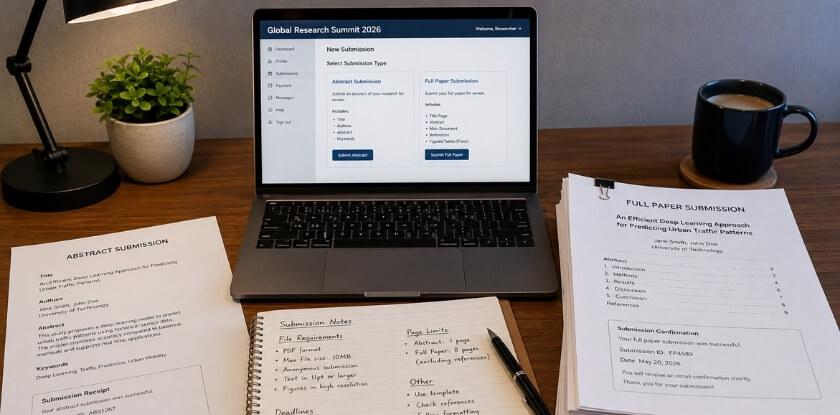
| Check | What to confirm |
| Word count | Exact count in a word processor, and whether title and author details are included in the limit |
| Sections | Every required heading present and named as the call names it |
| Objective | The aim is stated plainly, in its own label or sentence |
| Results | A number, percentage or timeframe instead of “improvements were noted” |
| Conclusion | Says what the findings mean, not a restatement of the results |
| Data accuracy | Every number matches your study data, and terms are used consistently |
| Title and authors | Title matches the portal; co-authors, affiliations and presenting author are correct |
| Ethics statement | If the call asks for one, a sentence naming the approving committee or saying why approval was not needed; some portals use a separate field |
| Blind review | If the review is blind, keep names, affiliations and self-identifying references out of the abstract text unless the call says otherwise |
| Learning objectives | Present if required, in measurable verbs |
| Track and theme | The abstract fits a stated track, not a different field |
| Portal format | Some portals need plain text only; paste a test version before the deadline |
| Deadline | Which time zone it uses; some international conferences use UTC or Anywhere on Earth (AoE) |
| Confirmation | Confirmation email received; if not within a few hours, log in and check, and keep a copy |
From our experience at MS International: For a paper presentation as an author, we accept abstracts, full papers, case studies, review papers and professional presentations, and every submission goes through peer review by our expert team. Work must be original and must not be published or under review elsewhere. An abstract should explain the purpose, method, key findings, significance and relevance to the selected conference. Full papers follow the official template, are expected in APA format and normally run four to twelve pages. Review decisions come within 10 working days.
FAQ
Filling in an abstract template still leaves choices to make: statistics or not, ethics approval, learning objectives, your name under blind review and how a conference abstract differs from a proposal.
What happens if my abstract exceeds the word limit?
It may be cut off at the limit, or the portal may refuse to save it until you shorten it. Check what the count includes, such as the title or section labels, and stay under it.
Is a structured or unstructured abstract better?
It depends on the call, and the portal usually shows which one it wants. Health and STEM calls lean towards labelled sections, humanities and social science calls towards unstructured prose. Follow the call.
Do I need to mention ethics approval in my abstract?
Only if the call asks, which is common for research involving people, patient data or animals. Some calls want one sentence naming the approving committee or explaining why approval was not needed, and some use a separate form field. Check the call.
Should I include statistics in the abstract?
Yes, for research abstracts. A specific result such as “42% reduction”, “n = 210” or “p < 0.05” gives reviewers something concrete to judge, and vague outcome language weakens the abstract.
Do learning objectives belong in every abstract?
No. Nursing and health education conferences often require them, while academic research conferences usually do not. Match what the call asks for.
What is the difference between a conference abstract and a conference proposal?
An abstract summarises completed or in-progress research. A proposal, common in education and humanities, argues why a session is valuable and often adds a session outline.
Can I submit the same abstract to multiple conferences?
Usually not at the same time. Many conferences ask you to confirm the work is not under review elsewhere. Some journals also treat a published conference abstract or paper as prior publication, so disclose earlier presentations and check each policy.
Can I write an abstract before the study is complete?
Some calls accept preliminary or expected results, often for posters. Label preliminary numbers as preliminary and say when the full results will be ready.
How do I know if my abstract was rejected for content or formatting?
Often you will not, because many conferences give no individual feedback. If you are rejected repeatedly, ask a colleague to read it, because unclear writing and formatting errors are common and easy to fix.
Should my name appear in an abstract for blind review?
Not in the abstract text. Blind review usually means names and affiliations go in the submission form fields only, so keep self-identifying references out of the body unless the call says otherwise.
When should I start preparing my abstract?
My rule is at least two weeks before the deadline. A strong abstract usually takes several drafts, and you need time for a colleague’s review and a final checklist pass.
Final Thoughts
Pick the template that matches the call, fill every section with a specific fact, and stay inside the word limit. I always ask someone outside the project to read it before submission, because they notice the missing number or unclear aim that I would read past.