
A conference abstract can fail even when the research behind it is solid. The selection committee reading your submission may be going through dozens or hundreds of abstracts in a single sitting, and if yours buries the point, hides the method or never says why the work matters to this particular conference, it may not make the cut, however good the study is.
Writing a conference abstract is a different skill from writing a journal abstract, and the gap catches researchers off guard. A journal abstract is written for readers who have already decided to open the paper. A conference abstract is a pitch to a committee that needs a reason to say yes. The word limit is tighter, the framing has to work harder, and the opening sentence carries much more weight. A STEM conference with a structured empirical format and a humanities panel that rewards a sharp central argument both expect specific work from the abstract, and neither matches what a journal abstract does.
Quick answer: To write a conference abstract, follow five parts in order: the research problem, the purpose and significance, a short method, your key findings or central argument, and your contribution to the field. Keep to the word limit in the call for abstracts, which varies widely (150 to 500 words is a common range, and 250 is a frequent cap), and match the structure the conference asks for. Finish with a fit check against the call.
Fact-checked by the MS International Editorial Team. Last verified against official sources: October 2026.
What Are the Key Steps to Write a Conference Abstract?
The key steps are to read the call for abstracts, decide what the abstract must prove, draft the five parts, match the format to your field, revise for fit, and submit early. The limit is set by each call and often falls between 150 and 500 words, which is not much room to persuade a committee that your work belongs on the program, whether as an oral presentation, a poster or a workshop session.
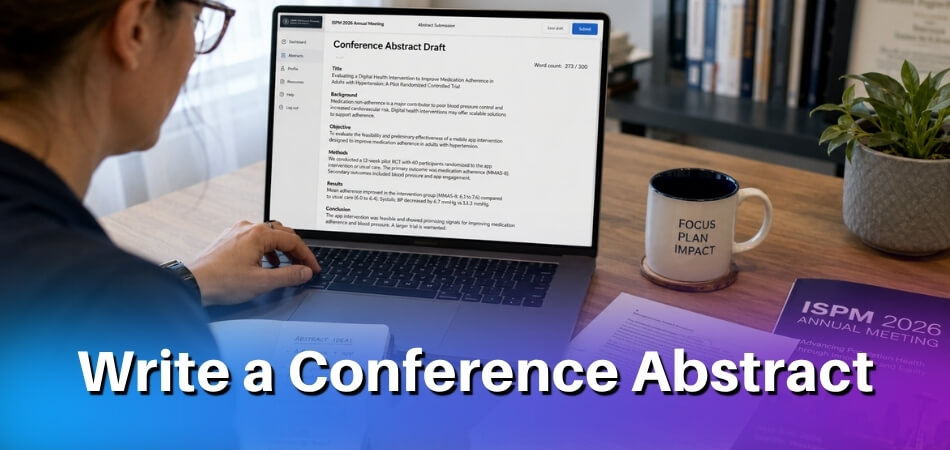
Step 1: Read the Call for Abstracts Before You Write a Single Word
Every submission starts with the call for abstracts. Check the word limit, the required structure, whether a template is provided, and whether the conference wants separate oral and poster abstracts. Submitting 400 words to a portal that expects 250 can disqualify you, and the portal often will not even accept the text.
Step 2: Identify What Your Abstract Must Prove
Before drafting, be clear on what you are actually claiming. For empirical research in STEM or the social sciences, that means knowing your research problem, your method and your findings. For humanities work, you are usually presenting a central argument and the evidence or texts that support it. These are not interchangeable structures, and mixing them up is one of the fastest ways to end up with a weak abstract.
Step 3: Draft the Five Parts in Order
Good abstracts in any discipline cover five parts: the problem, the purpose and significance, the approach, what you found or argue, and the contribution. The emphasis shifts by field. The next section takes them one at a time and builds a full example.
Step 4: Match the Format to the Discipline
STEM conferences often require labeled sections (Background, Methods, Results, Conclusion). Humanities and many social science conferences use flowing prose, and a labeled abstract can signal unfamiliarity with the field’s norms. If you are unsure which applies, look at abstracts from the previous year’s program. Many conferences post them publicly.
Step 5: Revise for Fit, Not Just Quality
A polished abstract that does not speak to the conference’s themes is still a weak submission. Go back to the call and check for keywords, thematic tracks and stated priorities. Weave in the conference’s language where it genuinely fits your work, because the committee scores against those criteria.
Step 6: Submit Early and Track Your Deadline
Portals close at the stated time, and many conferences offer no extensions. A draft that is nearly ready two days before the deadline is far better than a perfect one still sitting in your drafts folder when the portal closes. The Submitting section below covers portals and timing in detail.
Conference Abstract vs. Journal Abstract: Why the Difference Matters
A conference abstract is a proposal for something you will present, while a journal abstract is a summary of a paper that already exists. Treating them as interchangeable is one of the quieter ways to be rejected before the committee reads past the first paragraph.
A journal abstract sits in front of a published paper. It helps readers decide whether to read on and helps databases index the article. The findings are in and the conclusions are settled, so the abstract is a compressed version of a finished document, often in a structured form such as IMRAD in STEM.
A conference abstract tells the committee: here is what I will present, here is why it belongs at this event, and here is what attendees will get from it. It is judged on potential contribution and fit, not only on the solidity of the results. That is why conference abstracts are often written before the research is complete. Committees understand this. They look for a clear research problem, a credible method and a plausible claim about what the work will contribute.
| Point | Journal abstract | Conference abstract |
| Job | Summarizes a finished paper | Persuades a committee to schedule your talk or poster |
| Length | Set by the journal, with 250 words a common cap | Set by the call, often between 150 and 500 words |
| Audience | Specialists in your subfield | A committee that may include reviewers outside your exact corner of the field |
| Framing | What this paper found | What this presentation will offer the people in the room |
| Tense and certainty | Reports what was found | May state what the research aims to show, if the work is ongoing |
Some calls explicitly ask for learning objectives, which journal abstracts never need. Even when they do not, the implicit question is why someone should be in that room.
If you have already written a journal abstract for the same project, do not paste it into the portal. Read the call, note what the conference says it values, and rewrite from scratch with those criteria in front of you. The research problem or central argument still anchors the piece, but the framing pivots from “what this paper found” to “what this presentation will offer.” The shift is small on the page and significant in how reviewers respond.
How to Write a Conference Abstract Step by Step
Build the abstract from five parts, each doing one job, and give each one only a few sentences. This section takes the parts in order and then shows one complete example, from a weak first draft to a revised version.
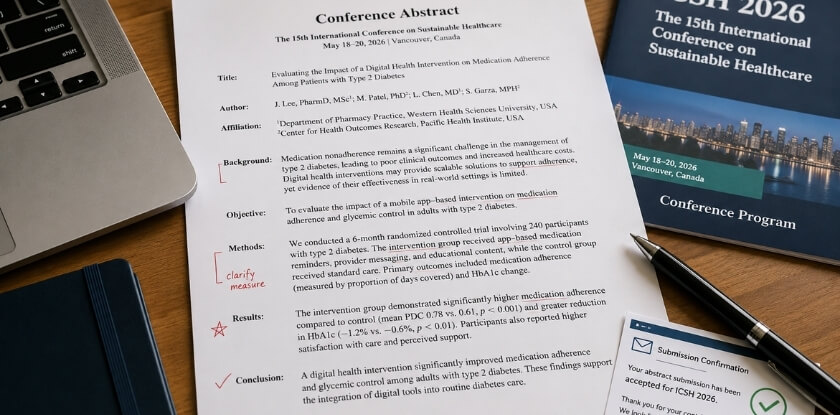
Part 1: State the Research Problem or Question
Your opening sentence sets the frame, so name the gap, the unresolved question or the phenomenon you are examining. In STEM this is often a technical or empirical gap in the literature. In the humanities and social sciences it may be a critical question or a contested interpretive framework.
Avoid a slow build-up of broad disciplinary context. “This paper examines the relationship between X and Y in the context of Z” only announces a topic. “Existing accounts of X have not adequately explained why Y occurs under Z conditions” names a real problem. Two or three sentences are enough. You are not writing the introduction to your paper.
Part 2: Explain the Purpose and Significance
Say what your paper or presentation does in response, in one clear purpose sentence. Then explain why it matters. Significance is not the same as interest: a topic can be interesting without being important. Name the specific gap, the population or domain affected, or the debate you intervene in.
This is also where you align with the conference’s focus. If the call stresses applied outcomes or interdisciplinary work, connect your work to those concerns honestly, rather than copying the call’s wording wholesale.
Part 3: Describe Your Method Briefly
Reviewers of empirical abstracts want to know how you generated your findings. For a quantitative study, name the design, such as a longitudinal survey, a randomized controlled trial or a corpus analysis. For qualitative work, name the approach, such as ethnographic fieldwork, semi-structured interviews or archival research. Humanities abstracts are often lighter on method, so a sentence on your analytical framework or theoretical lens is enough.
The method in an abstract is a signal of rigor, not a methods section. Two to three sentences usually establish credibility without eating into the word limit.
Part 4: Summarize the Key Findings or Central Argument
This is often the hardest part, because you must compress the real intellectual contribution into a very small space. For empirical research, report the main findings plainly and include at least one concrete result where the word count allows. A sentence such as “the intervention reduced processing time across all trial conditions” tells a reviewer far more than “results showed significant improvement.”
For humanities and social sciences, state the claim your paper makes: what position you advance and what your analysis reveals that was not visible before. For both oral and poster abstracts, this is where reviewers decide whether the work is substantive. “Findings will be discussed” tells them nothing. If your results are not final, describe what you expect to show and on what basis.
Part 5: State Your Contribution to the Field
Close by naming what your work adds. This is not a restatement of the findings, but a sentence or two on what they mean for the field. In STEM the contribution might be a new method, a validated model or a result that changes how a mechanism is understood. In the social sciences it might be a new framework, a challenge to an existing consensus or evidence from an understudied population. In the humanities it might be a reinterpretation of a canonical text or of primary material that has not been read this way before.
Think of it as the answer to the question every reviewer silently asks: “So what?” A clear contribution statement answers that question in one line.
A Worked Example: From First Draft to Submission
Here is a typical first draft. It names a topic, but every part is vague.
This study looks at peer-led study sessions in first-year statistics courses. Peer learning is important and many universities use it. We collected data from students and the results will be discussed. The study is relevant to educators.
Now the revised version, built part by part. The study and its figures are invented for illustration only, so do not copy them.
Peer-led study sessions are widely used in first-year statistics courses, yet little is known about whether they help students who start with weak mathematics preparation. This paper tests whether regular attendance is linked to higher final grades for that group. We analysed attendance records and final grades for 212 students across two semesters at one university, using a regression that controls for prior mathematics marks. Students who attended at least six sessions scored about seven points higher than comparable students who did not. The result suggests that targeted peer sessions could close part of the preparation gap, which matters for departments deciding where to spend tutoring budgets.
| Part | Sentence in the revised version | What changed from the first draft |
| 1. Problem | Sessions are widely used, yet little is known about weakly prepared students | A gap replaces “peer learning is important” |
| 2. Purpose and significance | Tests whether attendance is linked to higher final grades | One testable purpose statement |
| 3. Method | 212 students, two semesters, regression controlling for prior marks | “We collected data” becomes a named design and sample |
| 4. Findings | Six or more sessions, about seven points higher | A concrete result replaces “results will be discussed” |
| 5. Contribution | Targeted sessions could close part of the gap | A “so what” for decision makers replaces “relevant to educators” |
The revised version is about 100 words. If the call allows 250, you have room to add a sentence on limitations or on the conference theme. If the limit is 150, drop the budget clause first.
Format and Length: What the Call for Abstracts Actually Wants
The call for abstracts is the real rulebook, and you should check it before writing, not after. Formatting mistakes often start when people write the abstract first and read the requirements second. An abstract that ignores the stated format can be turned away on a technicality before anyone reads the content.
The call typically specifies the word count, required sections, font and spacing (if you submit a document), whether you are applying for an oral or a poster slot, and sometimes a template you must follow. If the portal has a text field with a character counter, that counter is your constraint. If a template is provided, use it exactly.
Structured vs. Unstructured Formats
Structured abstracts use labeled headings (Background, Methods, Results, Conclusion) and are standard in medical, clinical and many STEM fields. Each labeled section has its own word allocation. For a 250-word limit, that might be about 50 words on background, 80 on method, 80 on findings and 40 on conclusions. Do not treat the labels as decorative, because reviewers scan for them.
Unstructured abstracts are a single continuous paragraph with no internal headings. They are the norm in the humanities, the social sciences and many interdisciplinary conferences. You weave the problem, argument, evidence and significance together without labeled scaffolding, so the prose has to carry the structure and needs more careful drafting.
If you cannot tell which format applies, look at abstracts from previous years of the same conference.
Abstract Word Limits and How They Actually Work
Treat the limit as a hard cut-off: 250 words means 250, not 275 with a footnote. Some conferences count the title separately and others include it. Some exclude references and others count them. Check before you draft, because cutting 40 words from a finished abstract is painful.
If the call says “up to 300 words,” aim for 280 to 295. Filling the limit shows you have enough substance, while leaving a little room avoids accidental overages when the portal counts differently from your word processor. Draft longer, then cut, and let findings and argument survive over background and setup.
Many calls set one limit for oral and poster abstracts, while some set a shorter limit for posters. If you submit for both types, check whether you need two versions.
What the APA and IEEE Style Guides Ask For
When a call gives no template, two published style guides show what a formal abstract looks like. The APA Style guide (7th edition) sets a limit of 250 words and a single paragraph, asks the abstract to cover the problem, hypotheses, methods, results and implications, and puts three to five keywords on a line below it. The IEEE Author Center asks for a single paragraph of up to 250 words that is self-contained, with no abbreviations, footnotes, references or mathematical equations, plus 3 to 5 keywords. Either one gives you a safe shape for a first draft, but the conference call always overrides them.
What Else to Check in the Call
- Anonymization requirements. Many peer-reviewed conferences use blind review, so you cannot name yourself, your institution or your ongoing project in the abstract text. This is easy to miss.
- Multiple submission categories. Some calls let you rank your preference for oral or poster. Others ask you to commit to one. Do not assume.
- Keyword fields. Many portals have a separate keywords field. Keywords are not part of the abstract, but they affect which reviewers get your submission. Choose terms that match the conference’s thematic tracks.
- Title. Write it last and make it specific. “Peer-led study sessions and final grades in first-year statistics” tells a reviewer far more than “Student support in higher education.” Check whether the title is entered in its own field.
- Abbreviations and references. Spell out an abbreviation the first time you use it and leave out citations unless the call asks for them, because both use up words that should carry your problem and findings.
- Plain-language summary. Some calls ask for a short lay summary next to the abstract, written for a general reader with no jargon.
- Tracks. For mixed-discipline conferences you may select a track when you submit, and format expectations can differ by track even within one event.
Oral Presentation vs. Poster Abstract: What Changes
An oral abstract must show the work can sustain a full talk, while a poster abstract can be narrower and more exploratory. Most portals ask you to choose a format before you submit, and treating the two as identical weakens both.
| Point | Oral presentation abstract | Poster abstract |
| What the committee decides | Whether the work can sustain a talk | Whether the work invites useful conversation |
| Scope | A clear argument or finding with a narrative arc | Can be narrower: preliminary findings, one method question, a focused case |
| Word limit | Set by the call, and many calls use one limit for both | Some calls set a shorter limit for posters, so check |
| Method detail | Explicit enough to judge credibility | One sentence is usually enough |
| Learning objectives | Required only if the call asks | More often required, and sometimes scored separately |
Oral Presentation Abstract
- Lead with the research problem. Signal immediately why the question matters to an audience sitting in real time.
- Be explicit about method. In STEM and empirical work, reviewers want enough to judge credibility. In the humanities and social sciences, framing the central argument and the interpretive approach serves the same function.
- State findings or argument directly. Phrases like “results will be discussed” are a red flag. If findings are not ready, be specific about what you expect to demonstrate, because vague placeholders suggest the work is not ready to present.
- Tie the conclusion to the audience. End with why this matters to the field, not only to your project. One sentence is enough.
Poster Abstract
Reviewers know a poster is a visual, exploratory format that invites conversation. A poster suits preliminary findings, a specific methodological question or a case study that would not sustain a full talk, and your abstract can reflect that focus without apology. If the poster will rest on a key figure or diagram, say so in a short phrase when the template allows it.
Some conferences, particularly in education, medicine and the social sciences, require poster abstracts to include explicit learning objectives or takeaways. If the template has a field for them, do not skip it.
Panel, Workshop and Symposium Proposals
Some calls take session proposals as well as single abstracts. A panel proposal outlines the overall theme, what each panelist will contribute and how the contributions connect, so it is judged as a set rather than as one study. The limit and the required parts can differ from a single abstract, so read that part of the call separately.
When You Are Submitting to Both
Some conferences let you state a preference for oral while accepting a poster as an alternative. If that option exists, write to the oral standard: concise argument, findings stated, method named. The committee makes the format call, and your job is to give it a reason to accept the work at all.
Discipline-Specific Differences: Science, Social Sciences, and Humanities
Each field has its own norms for what an abstract should emphasize, so an abstract that would sail through at a biology conference can read as thin at a history panel, and the reverse is also true. Knowing the norms first saves you from a submission that is technically complete but out of place.
STEM and Empirical Fields
In biology, chemistry, public health, psychology, economics, engineering and similar fields, the abstract follows a clear sequence of problem, method, findings and a brief implication. Reviewers check whether the method is sound, the findings are specific and the conclusions follow from what you did. Expect sound reasoning to count for more than interpretive flourish.
- State the research problem plainly. In two sentences or fewer, identify the gap or question.
- Be explicit about method. Give sample size, design type, statistical approach and experimental conditions. “Data were analyzed” and “participants were surveyed” are not enough, and “data will be analyzed” weakens the abstract if the work is already done.
- Lead with numbers in your findings. A specific result such as “a 23% reduction in error rates” beats “results were promising” and signals that the work is complete, which matters when reviewers choose between real results and preliminary ideas.
- Keep the language neutral and precise. Use passive voice selectively and avoid interpretive language beyond what the data supports. If the conference uses labeled fields, follow them exactly, because deviating from a structured format can count against you.
Word limits in these fields are often tight, commonly 250 to 300 words, so every sentence must carry information. In a 250-word empirical abstract, expect the method and results to take most of the space.
Humanities and Interpretive Fields
In history, literature, philosophy, cultural studies and related fields, the committee is not looking for a methods section and a p-value. It evaluates the originality of your central argument, the significance of the question and whether your interpretive framework is credible.
Lead with the argument, not the topic. “This paper examines representations of labor in Victorian fiction” is a topic. “This paper argues that Dickens’s treatment of industrial labor in Hard Times deliberately disrupts the era’s dominant rhetoric of self-improvement” is an argument. The second gives reviewers something to evaluate.
Name your grounding. You do not need a methods section, but signal your approach, such as close reading, discourse analysis, postcolonial theory or archival research. It tells the committee whether you fit the panel and whether the work is rigorous.
Describe the stakes. One or two sentences on what the argument revises, opens up or responds to are how reviewers gauge the contribution. A 250-word humanities abstract might spend about 150 words developing the argument and only 30 on the sources or texts.
Mind the tone. Humanities abstracts usually use active voice and full sentences, and read like condensed argument rather than a structured report. Make sure that does not tip into description with no claim.
Social Sciences
Social sciences sit between the two modes. A quantitative political science paper may look like an empirical STEM abstract, while a qualitative sociological study may follow humanities conventions. Read the call’s own expectations on whether methods should be described, and check any previously accepted abstracts the conference makes available. They will tell you more about the expected register than general advice.
Special Cases and Common Situations
Three situations come up constantly: abstracts without final results, calls that require learning objectives, and writing in a second language. Each has a straightforward way through.
Writing an Abstract Without Final Results
Yes, you can write one. This is common when early abstract deadlines arrive while data collection is still under way. Many calls welcome work in progress. What they need is a clear research problem, a credible method and a realistic plan for having results by the time you present.
Be direct about where you are. Instead of faking completed findings, write “preliminary analysis suggests” or “results will address.” Do not leave the findings vague in a way that makes the work seem undefined. If you have pilot data, mention it. If you have a clear hypothesis and a nearly complete dataset, say so.
Check eligibility first: some calls ask for completed work, or for data collection to be finished by the deadline, and some portals do not let you edit the text after you submit. Never describe expected results as if they were findings.
Some portals ask whether results are final. Answer honestly, because submitting as “complete” when it is not can cause real problems at the move from abstract to presentation.
Writing Learning Objectives (Conference-Specific)
Some conferences, particularly in the health professions, education and professional development, require learning objectives in the abstract. Journal abstracts never ask for them, so this can catch researchers off guard.
Learning objectives describe what an attendee will be able to do or understand after your session, using an action verb plus a specific outcome: “Participants will be able to identify three barriers to…” or “Attendees will understand the distinction between…” Keep them concrete. “Participants will gain an appreciation for the topic” suggests you have not thought through the content. Two or three focused objectives read better than four or five general ones. If the call requires verbs from Bloom’s Taxonomy, use them rather than guessing.
Tips for Non-Native English Speakers
Non-native English speakers submit strong abstracts all the time, and clear, plain English is enough. A few practical points help.
- Use plain, direct sentences. Complex syntax is harder to proofread and harder for the committee to read quickly.
- Ask a native speaker to review the abstract only, not the whole paper. Focus the review on clarity and grammar, not on changing your argument. Build in time for it before the deadline.
- Use the word limit to your advantage. A tight count means less to go wrong. Unnecessary phrasing is the first thing to cut.
- Check terminology against published abstracts from the same event or a similar one. Field terms are easy to get slightly wrong.
- Keep the register professional in every format. A poster abstract is not more casual than an oral one.
Using a Template or AI Tool to Draft Your Abstract
A template or an AI tool can speed up drafting, but neither replaces your own results and wording. Use them as scaffolding.
When a Template Actually Helps
Many conferences provide an abstract template in the call or the portal. Use it. A template shows the structure the committee expects, so stay inside it. If none is provided, the five parts above give you a structure that fits most empirical abstracts in STEM and the social sciences. A copy-ready structured abstract template puts those parts under labels you can fill in. For humanities and interpretive work the structure is less fixed, but your central argument still has to appear clearly and early.
Using AI Tools to Draft
AI writing tools can help when you are staring at a blank page or struggling to compress a project into 250 words. They are reasonably good at clean prose and a conventional structure. The problem is generic output: a draft will often soften your findings, hedge your claims and flatten the specific contribution that makes a committee pay attention.
Treat any AI draft as a skeleton, not a submission. Go through it sentence by sentence and replace generic phrasing with your actual results, real method and own disciplinary language. If the tool wrote “this study explores,” ask whether you can say “this study finds,” “this analysis demonstrates” or “this paper argues.” Generic AI drafts also miss field-specific conventions, so check the output against the format your field expects.
Tools can paraphrase loosely and quietly alter a method description or add claims you never made, so review every sentence against what you meant. A safer use is at the editing stage, checking clarity and grammar in a draft you wrote yourself, rather than generating a draft and trying to inject your voice afterwards.
Check the conference’s policy on AI tools before you use one. COPE’s position statement (13 February 2023) says AI tools cannot be listed as an author and that authors who use them should say which tool they used and how, while remaining fully responsible for the content. A conference or publisher may add its own rules, so follow the call.
Submitting Your Abstract: Deadlines, Portals, and What Comes Next
Submit at least three days before the posted deadline, paste your text into the portal early, and keep proof of submission. The mechanics can sink a strong abstract.
Reading the Call and Managing the Deadline
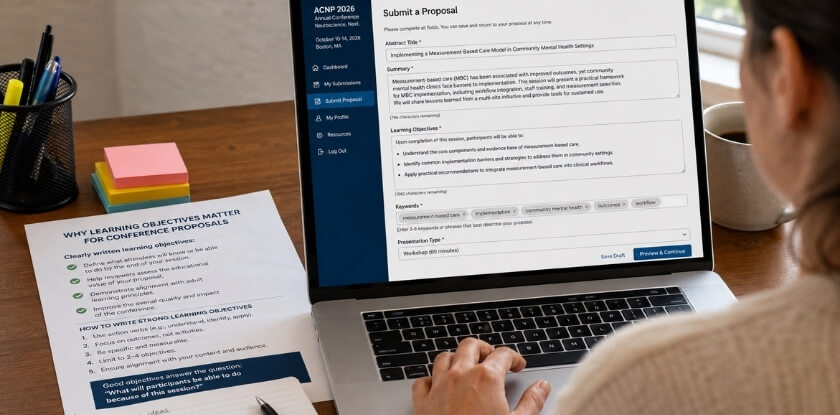
Read the call in full before you open the portal, even if you have submitted to this conference before, because requirements change from year to year: the word limit, the required sections, whether you state an oral or poster preference, and whether the title is entered separately. Some portals enforce structure with separate boxes for background, method, findings and conclusions. Others give you one open box, which leaves the formatting discipline to you.
Many conferences post a single deadline, but some have tiers: an early window, a main deadline and occasionally a late-breaking option for very recent research. Know which applies to you. Late submissions may not be considered at all, and the posted time is often midnight in a time zone that may not be yours. Portals go down, co-authors take time to approve, and formatting that looks fine in your word processor can break in a web form. If the conference requires institutional sign-off or co-author confirmation through the portal, confirm with everyone well in advance.
Navigating the Submission Portal
Portals ask for more than the abstract: your name, affiliation, contact details, presentation format, and sometimes keywords, a subject category or a short statement of interest. Before you submit:
- Paste your abstract as plain text first. Rich text from Word can carry hidden characters that corrupt character counts or break the display.
- Check the word count inside the portal. The portal may handle footnotes, headers or punctuation differently, so catch an overage before you click submit.
- Save a confirmation email or PDF receipt as proof of your submission time.
- Have someone fluent review the other fields if English is not your first language, not only the abstract text.
What the Selection Committee Reviews
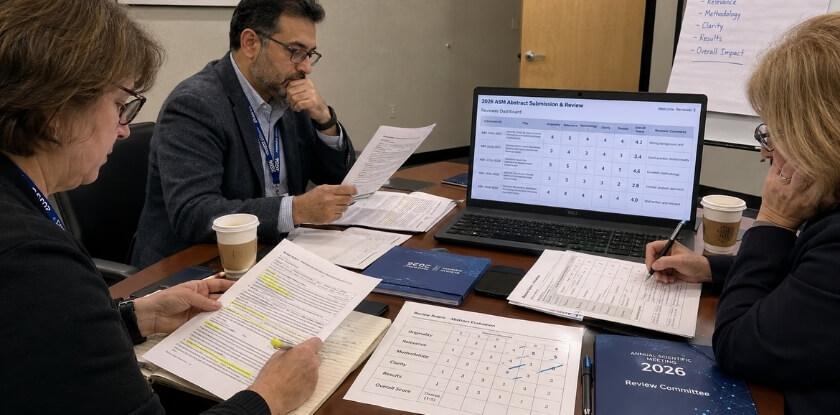
The committee usually sees your abstract without your name and institution, since many conferences run blind review. It looks at whether the problem is clearly stated, the method is appropriate, the findings or argument are substantiated and the work fits the conference theme. A vague opening, an unclear scope or a mismatch with the themes weakens the case. If the call emphasizes applied outcomes, your abstract should name outcomes, not only methods.
After You Submit
You will usually get an automated confirmation right away. Decision times depend on the conference, so check the call for the notification date. Some conferences share reviewer comments and many do not. If comments are offered, read them, because even a short note can help you revise before submitting elsewhere.
If you are accepted, the move from abstract to presentation starts quickly. Some conferences require confirmation within a week, and others soon ask for a full paper draft, a session title or audio-visual requirements. Read the acceptance email carefully and meet its deadlines. Your accepted abstract may appear word for word in the program, so write it with that in mind.
Submitting the Same Abstract to Several Conferences
Submitting one abstract to several conferences at once is sometimes allowed, but each conference has its own policy. Some prohibit concurrent submission, and others only ask you to tell them if the work is accepted elsewhere first. If you adjust the abstract for different venues, keep a clear record of which version went where. Versions are easy to mix up when a deadline is close.
Pre-Submission Checklist
- Word count is within the call’s limit, as counted inside the portal.
- All five parts are present, and the findings or argument are stated, not promised.
- The format matches the call: structured or unstructured, oral or poster.
- Author names and affiliations are removed if the review is blind.
- The wording reflects the conference’s themes where it truthfully fits.
- Someone else has read it, and you have left a day between the last edit and the final read.
From our experience at MS International: We ask an abstract to explain the work’s purpose, method, key findings, significance and relevance to the selected conference, and we ask authors to use the paper format or template the conference team provides. Submissions must be original and not published or under review elsewhere. Review is double blind, so keep author names and affiliations out of the abstract text. After review, authors may receive an acceptance, revision request or rejection decision by email, and accepted papers may be considered for conference proceedings where applicable.
FAQ
Writing your first conference abstract? Unfinished research, limitations, AI writing tools, how selection committees read and a missed deadline all come up, along with what follows acceptance.
How long should a conference abstract be?
There is no universal length: the call you are answering sets the limit. Limits often fall between 150 and 500 words, and 250 is a common cap. The portal usually enforces a hard cut-off, so count inside the portal.
What’s the difference between a structured and an unstructured abstract?
A structured abstract uses labeled sections such as Background, Methods, Results and Conclusions, while an unstructured one is continuous prose. STEM and health sciences conferences often require the labeled format. Humanities and social sciences usually prefer prose.
Can I submit the same abstract to multiple conferences?
Sometimes, but check each conference’s policy first. Some prohibit concurrent submission, and others only want to be told if the work is accepted elsewhere. Tailor each version to that conference’s theme, audience and format, because a generic abstract sent unchanged to five conferences reads like one.
Do selection committees actually read every abstract?
Each submission is normally assigned to reviewers, though how closely it is read depends on the conference and the number of submissions. Your research problem and central argument need to be clear within the first few sentences, so make acceptance easy.
Should I mention limitations in my abstract?
Briefly, in STEM and empirical research. A short note on scope can signal methodological honesty. In the humanities it is less common. If the limitations are substantial, focus on what the work does establish.
What if my research isn’t finished yet?
You can often still submit, but some calls require completed work or finished data collection, so check eligibility first. Describe your method and preliminary findings, and frame your contribution as what the completed work will establish. Do not claim findings you do not yet have.
Is it okay to use an AI writing tool to draft my abstract?
Possibly, if the conference’s policy allows it, so check the call first and disclose the use if it asks. COPE’s position is that AI tools cannot be authors and that you stay responsible for the content. Generic AI prose is the usual weakness.
Are conference abstracts harder for non-native English speakers?
Not necessarily, though a tight word limit and a formal register take care. A colleague’s review for clarity is worthwhile, and many universities offer writing support. Clear, direct English is easier to review than a complex abstract that is hard to parse.
What happens after my abstract is accepted?
You will receive instructions about your slot, oral or poster, plus any extras such as a full paper, an extended abstract or learning objectives. The abstract does not automatically become your talk. It commits you to the argument you described.
What if I miss the abstract deadline?
Your abstract will usually not be considered, because many conferences do not extend and the portal closes at the stated time. Check the call for a late-breaking option. Plan to submit at least three days early.
Final Thoughts
Writing a conference abstract is a small task with real consequences. A well-built 250 words can open the door to an oral slot, a poster or a professional network, and a rushed one submitted the night before the deadline gives the committee less to work with.
Clarity about your problem, method and findings does more work than polished language, and a vague or unsupported argument is harder to fix than imperfect phrasing. Read the call every time, because requirements shift. Then write a draft, set it aside for a day and revise it with fresh eyes before you submit.