

Two tickets can look almost identical at checkout and still lead to very different days at a conference. One puts you on the programme with a slot to present, and the other gives you a seat in the room. Picking the right one before you pay matters, because registration fees are not refundable.
Quick answer: Choose author registration if you want to present your own work: you submit a paper or abstract, pass double-blind review (about 10 working days), then register and present. Choose listener registration if you only want to attend sessions without presenting. Both categories are valid for an invitation letter, both fees are non-refundable, and all MS International events are held in person in the Greater Toronto Area.
Last verified against official sources: October 2026.
Author vs Listener Registration: Key Differences at a Glance
Author registration is for people who present accepted work, and listener registration is for people who attend without presenting.
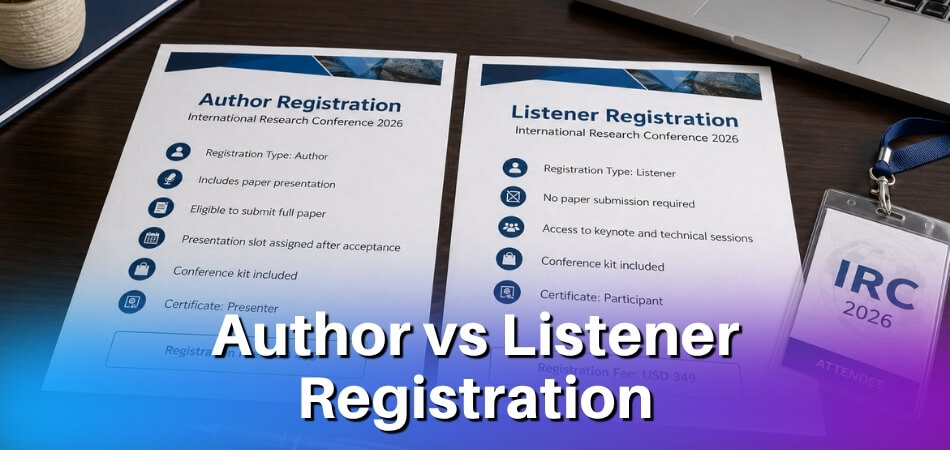
The category decides what you do on the day, what you must do before you register, and what the organiser expects from you. Fees are covered in their own section below, so this table sticks to what changes in practice.
| Question | Author registration | Listener registration |
|---|---|---|
| Who it is for | Researchers, students, academics and professionals presenting their own work | Anyone who wants to attend sessions without presenting |
| Paper or abstract needed | Yes, submitted for review first | No |
| Review | Double-blind, about 10 working days | None, because there is no submission |
| When you register | After your work is accepted | Whenever you are ready, before the event |
| Presenting slot | Yes, in a session at the event | No |
| Certificate | Given after you present | Not mentioned on the business pages, so ask if you need one |
| Invitation letter | Yes, after payment clears | Yes, after payment clears |
| Refund or transfer | Non-refundable, non-transferable | Non-refundable, non-transferable |
| Format | In person, Greater Toronto Area | In person, Greater Toronto Area |
In short, the real dividing line is the paper. If you have work to present and it fits an event theme, the author route is the one that gets you on the programme. If you do not, listener registration is a full, valid way to take part.
What Is Author Registration and How Does It Work
Author registration is the category for people who present their own work, and you complete it after your submission has been accepted.
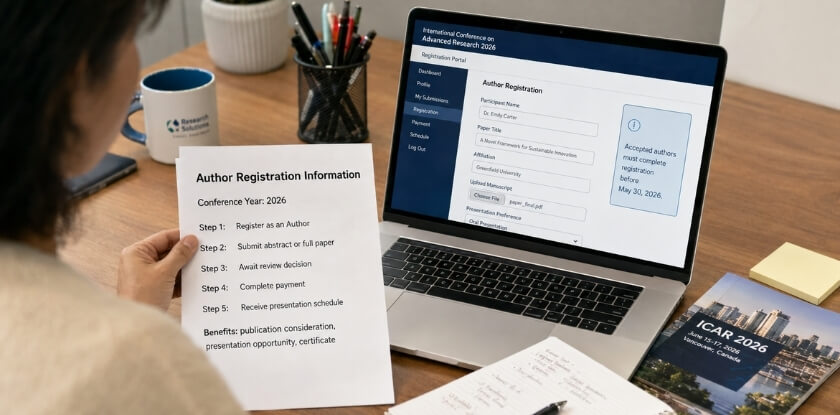
For most applicants, the route onto the MS International programme is the presenting-author track. It has five steps:
- Choose an event whose theme and audience fit your work, and check that event’s submission deadline.
- Prepare a submission: an abstract, full paper, case study, review paper or professional presentation.
- Submit it for double-blind review. Reviewers and authors stay anonymous to each other, and the decision usually comes back in about 10 working days.
- If the decision is acceptance, complete author registration on that event page to confirm your place.
- Attend and present in person in the Greater Toronto Area.
The speaker page says full payment goes in with the submission and is applied to your registration after acceptance. If your work is not accepted, the payment is fully refunded. If you would still like to attend, you can ask to join as a listener without a paper instead, and the organising committee decides whether to allow it.
What You Get as an Author
You get a place in the programme to present your work. The speaker page lists the author benefits as a paper presentation slot, access to all sessions and keynotes, conference materials, a certificate of presentation and invitation letter support. The FAQ page also says accepted work that is presented in person may be considered for the conference proceedings where applicable, and that publication is not guaranteed.
What Happens After You Submit
The review ends in one of four decisions, sent to you by email, with reviewer comments where they apply:
- Accepted: the work meets the event requirements and you can register as an author.
- Accepted with minor revision: small corrections are needed before final processing.
- Revision required: the work needs clearer structure, stronger evidence or better topic fit, and you resubmit within the given timeframe.
- Rejected: the work does not meet the criteria or fits another event better. You can improve it and submit again only where it fits the scope and deadlines of a suitable event.
On the Day as an Author
Arrive at the check-in time in your confirmation email, collect your badge and meet the session coordinator or moderator before you present. Confirm your room, speaking time, presentation order and technical setup, and bring your final slides with a backup copy. The moderator introduces each speaker, and approved speakers receive a certificate after presenting. Check that your name, organisation, position and presentation title are correct before the certificate is prepared.
What Authors Need to Prepare
The submission rules on the author page are specific:
- The work must be original and written in English.
- It must not already be published or under review at another conference, journal or publication.
- Papers follow APA format and the conference template, and full papers normally run four to twelve pages including tables, figures and references.
- Include accurate author details, the affiliation you present under, contact information, title, keywords and the name of the conference you chose.
Limits of Author Registration
Acceptance does not complete your registration. You still have to register as an author before you present. Keynote and invited roles are a different track, so the author ticket is not a shortcut into one. The speaker page also lists typical deadlines of about 120 days before the event for early bird, 30 days for abstract submission and 7 days for standard registration, so check your event page early. Speakers cover their own travel, accommodation, visa and personal costs unless something else is confirmed in writing, so do not assume an honorarium, reimbursement or free registration.
What Is Listener Registration and How Does It Work
Listener registration is for people who want to attend the conference without presenting a paper, and it needs no submission or review.
The steps are short: find the event, fill in the registration form and pay. The FAQ page describes this option as suitable for people who want to gain knowledge, attend sessions, interact with speakers and meet international academics and professionals. Students are welcome too, either to listen or to present their own research under the author route.
When Listener Registration Fits
Listener fits a few clear situations:
- You are early in your research and want to see how a conference runs before you submit.
- You are a practitioner who wants to hear current work in your field and meet the people doing it.
- You missed the submission deadline for an event but still want to attend it.
- You need paperwork for travel, employer approval or academic leave and want to attend as a registered participant.
Limits of Listener Registration
A listener does not present, so there is no speaking slot and no presenter certificate to expect. The pages also do not describe a way to switch from listener to author after you have paid. If you think you might want to present at the same event, ask the organiser before you register, and note that the submission and review step comes first.
Which One Should You Choose: A Decision Guide
Ask one question: will you present your own work at this event?

If yes, and your work fits the theme, you need the author route. If no, listener is the match. The table covers the cases in between.
| Your situation | Better choice |
|---|---|
| You have a finished abstract or paper that fits the event theme | Author: submit it for review first |
| You want to learn and meet people, with nothing to present | Listener |
| Your paper is not ready before this event’s deadline | Listener for this event, or author at a later edition |
| Your employer or sponsor will only support the trip if you present | Author, since a listener does not present |
| You want a keynote or invited role | Contact the organiser first; an author ticket does not create that role |
| You cannot tell which one fits | Ask the organiser before paying |
Can You Do Both?
Each event has its own page, fee and deadline, so you can attend one edition as a listener and present at a later one. The pages do not say whether one person can hold both categories at the same edition, so ask the organiser if you are thinking of it. Do not register twice in the hope that one entry will be adjusted, because duplicate registration caused by the participant is not refunded.
What About Co-Authors Who Will Not Present?
The MS International pages do not say which category a co-author who attends without presenting should choose, so ask the organiser before paying. What the pages do make clear is that each registration belongs to the one person whose details were submitted and cannot be passed on, so every co-author who wants to attend registers and pays under their own name.
What to Have Ready Before You Register
The two categories ask for different things up front:
| Item | Author | Listener |
|---|---|---|
| Work to upload | Abstract, full paper, case study, review paper or professional presentation | Nothing to upload |
| Details to enter | Author names, affiliation, contact details, title, keywords, chosen event | Name and contact details |
| Passport details | Needed for the invitation letter | Needed for the invitation letter |
| Deadline to watch | Submission deadline, then the registration step after acceptance | The registration deadline on the event page |
How Other Conferences Use These Terms
The labels are not unique to MS International. Other academic conferences also separate presenters from attendees, though the second group may be called delegates, participants or attendees. Some define a listener as someone who takes part without presenting or publishing a paper, some price the listener ticket well below the author ticket, and some do not offer invitation letters at all. The MS International FAQ uses “listener or delegate” for people who attend without presenting. Terms and fees differ between organisers, so read the registration rules of each event rather than assuming they match another conference you have seen.
Fees, Refunds and Invitation Letters for Each Registration Type
Both categories follow the same payment rules: fees are non-refundable and non-transferable, and the invitation letter process starts automatically once payment clears.

Current Event-Page Fees
These are the current event-page fees, so check the event page for the edition you want before you pay:
| Category | Fee on event pages |
|---|---|
| Author (Early Bird) | US$499 |
| Author (Regular) | US$599 |
| Listener | US$499 |
The early-bird rate takes US$100 off the regular author fee. The fees can differ by event and by date, and the FAQ page says the exact benefits depend on the category you select.
Refunds and Transfers
Registration fees are non-refundable once payment is completed, with one exception for authors: if a submission is not accepted, the payment is fully refunded. The refund policy lists the reasons that do not qualify, and several apply to this choice: selecting the wrong category, duplicate registration by mistake, a change of plans, not attending, and visa refusal or delay. An exception is possible only in rare cases and only with written approval from the organising committee.
Registrations are also non-transferable. You cannot give your registration, ticket or invitation letter to someone else, and name changes or substitutions are not allowed under normal circumstances. Telling the team you cannot come is only a record, and it does not create a right to a refund or credit.
Invitation Letters
Registered authors, presenters and listeners are all eligible once full payment is made. The letter is issued within 3 to 5 business days after payment clears, and the standard letter is free of charge. A correction fee may apply to changes requested after it has been issued. You will need your full legal name exactly as it appears on your passport, your passport details, and an active email and phone number. A letter can back up a conference visa application, but it is not a visa, and approval and entry stay with the authorities.
Common Mistakes and Things to Keep in Mind
The points below are the easiest to get wrong when the category is chosen in a hurry.

- Choosing by price alone. On the current event pages the Early Bird author fee and the listener fee are the same US$499, but the two tickets lead to different roles.
- Using a nickname or a different spelling. The registration is linked to the personal details you enter, and the letter is built from them. Match your passport.
- Registering for a colleague. A registration cannot be passed to another person, so each attendee registers under their own name.
- Sending the same paper to several places. Submitted work must not be published or under review elsewhere.
- Reading acceptance as a finished registration. After acceptance you still complete author registration before you present.
- Registering without a clear goal. A few minutes spent on what you want from the event (a slot, a seat, or a letter) points straight to one category.
If you are unsure, a short email before paying costs nothing. Here is a sample you can adapt:
Subject: Category question before registration
Hello, I am [Name] from [Organisation]. I would like to attend the [Event name] on [Date]. I have [a draft abstract on topic / no paper to present]. Could you confirm which registration category suits me and what the deadline is for [submission / registration]? Thank you, [Name]
From our experience at MS International: the simple questions asked before payment save the most trouble later. Because registration fees are non-refundable and cannot be moved to another person, we suggest deciding your category first, checking the fee and deadline on the event page, and entering your name exactly as it appears on your passport if you will need an invitation letter.
FAQ: Author vs Listener Registration
Choosing between an author and a listener ticket often hinges on whether you have a paper, what each option costs and whether a certificate or invitation letter comes with it.
What is the difference between author and listener registration?
An author presents their own work after it passes double-blind review, while a listener attends sessions without presenting. Authors submit first and register after acceptance. Listeners just register and pay. Both categories are in person in the Greater Toronto Area.
Do I need a paper to register as a listener?
No. Listener registration has no paper, abstract or review step, and you register and pay for the event you want. The FAQ page confirms that you can attend as a listener or delegate without presenting.
Can a listener get an invitation letter?
Yes, a registered listener with full payment qualifies, just like an author. The letter follows within 3 to 5 business days of payment clearing. It can support a visa application, yet the authorities still decide on the visa and entry.
Do listeners get a certificate?
The MS International pages describe a certificate for speakers after they present but do not mention one for listeners. If you need proof of attendance for an employer or university, ask the organiser before you register.
Are author and listener fees refundable or transferable?
No, both are non-refundable and non-transferable once payment is completed. The exception is an author whose submission is not accepted, whose payment is fully refunded. Picking the wrong category, changing your plans or being refused a visa does not qualify for a refund, and you cannot hand your place to someone else.
How much do author and listener registration cost?
The current event-page fees are US$499 for Author Early Bird, US$599 for Author Regular and US$499 for Listener. Fees can change by event and date, so check the event page before you pay.
How long does the author review take?
Most decisions come back in about 10 working days after submission. Complex papers or revision rounds can take longer. Acceptance is not the same as registration, so authors still complete registration before presenting.
Does an author ticket make me a keynote speaker?
No. A keynote is a separate role that the organising team arranges with invited specialists, and paying the author fee does not create one. Do not assume an honorarium, travel reimbursement or free registration unless it is confirmed in writing.
Can I attend as an author or listener online?
No. MS International conferences are held in person only, at venues in the Greater Toronto Area, and there is no standard virtual option for presenting your work.
Conclusion: Which Choice Is Right for You
If you have original work that fits an event theme and you want to present it, submit it and register as an author after acceptance. If you want to learn, meet people and attend without presenting, listener registration is a full and valid choice. Decide before you pay, check the current fee on the event page, and ask the organiser if anything is unclear.