
Not sure who should write your conference invitation letter, or if it comes only from the organizer? You may have searched and found conflicting answers, and that is understandable. The answer depends on the kind of event (academic or professional), if you need a visa, and if the organizer has a process for issuing letters at all. This guide covers who issues the letter, when to ask, how to ask, and what to do if the answer is no.
Quick answer: The conference organizer issues the invitation letter, usually through the event coordinator or program committee. Most organizers issue it only after your registration or paper acceptance is confirmed. Request it as soon as you have that confirmation, before you submit a visa application. A university or employer can add a separate supporting letter, but it does not replace the organizer’s letter.
Fact-checked by the MS International Editorial Team. Last verified against official sources: October 2026.
Who Issues a Conference Invitation Letter
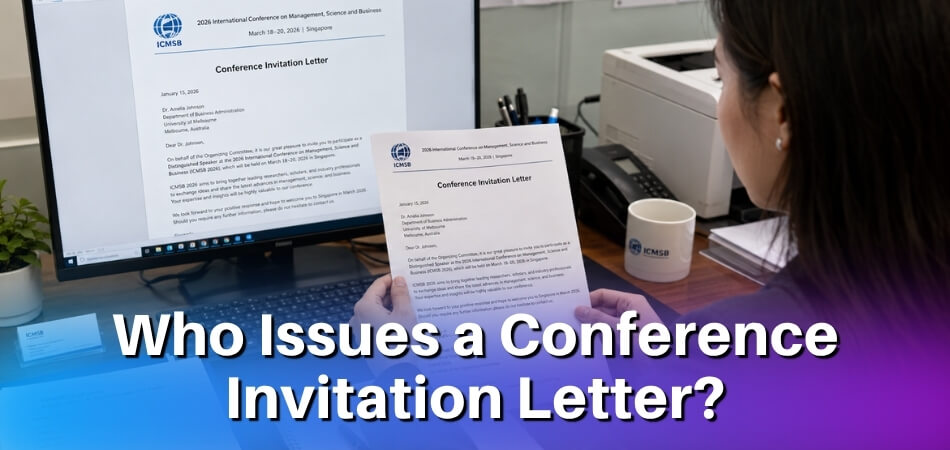
The conference organizer issues the letter. “Organizer” covers several different people depending on the event, and knowing exactly who to contact saves a lot of back-and-forth.
| Who | What they provide | Typical situation |
| Conference organizer or event coordinator | The official invitation letter | Most professional and academic conferences, once registration is confirmed |
| Program committee chair | Invitation or acceptance letter confirming your role | Your abstract or paper was accepted, or you are a speaker |
| University or employer | A separate letter of support or approval | Travel funding, leave, or a visa file that asks for an employer letter |
| Family member | Only a personal host letter, never the conference letter | You are also staying with family |
The Conference Organizer or Event Coordinator
For most professional and academic conferences, the invitation letter comes from the organizing body, typically signed by the event coordinator, the conference chair, or whoever manages registrations and attendee communications. Once you have completed your registration and received a confirmation, you can ask for a formal letter.
At smaller events, one person handles all of this. Larger international conferences usually have a dedicated contact for visa requests, sometimes listed on the website under “Visa Support” or “Invitation Letter”.
Read the organizer’s letter policy on the registration page before you pay. It should say who issues the letter, whether you must register first and how long it takes. Some organizers also state that the letter is not a financial commitment and that they will not contact the embassy for you.
For an Event in Canada
IRCC tells Canadian business and event organizers to give each visiting participant 2 copies of the letter of invitation. If the event is registered with IRCC, the letter should include the event code, and participants should enter that code in their visa application. The letter does not replace the other entry requirements.
The Program Committee
Academic conferences often route these requests through the program committee, especially if you are presenting a paper or speaking. If your abstract was accepted, your contact is typically the program committee chair, who can issue or co-sign a letter confirming your role. The acceptance letter you received is often referenced directly in the invitation letter.
Your University or Employer
For many attendees the organizer’s letter is not the whole picture. A graduate student or faculty member may need a separate letter of support from the university. An employer may need to confirm in writing that your attendance is authorized, particularly if the trip involves travel funding or institutional liability. These are not substitutes for the organizer’s letter. They accompany it in the visa application package.
When to Request the Letter (And at Which Stage of the Process)
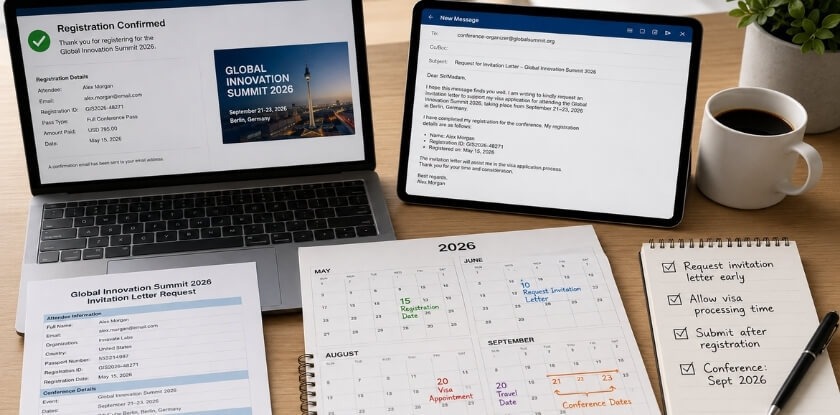
Request the letter as soon as your registration is confirmed or your paper is accepted, and before you submit any visa application. Ask too early and the organizer may have nothing to confirm yet. Ask too late and you risk missing visa deadlines, employer approval windows or university cutoffs.
After You Receive Your Acceptance Letter or Registration Confirmation
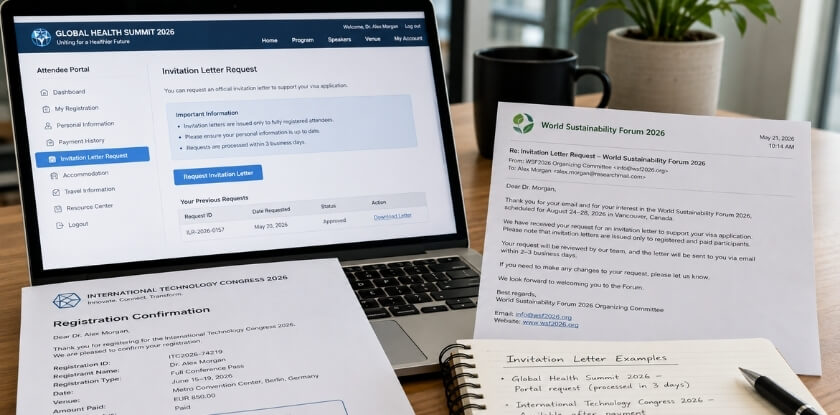
This is the right moment for most attendees. The acceptance letter proves your participation is confirmed. Without it, many organizers will not issue an invitation letter at all, because there is nothing yet to invite you to. A few organizers take an early request through a form and review each one, and approval is not promised. Others will not respond until payment has cleared. Follow the policy on the conference page.
If you are attending as a general participant rather than a speaker, the equivalent trigger is your conference registration confirmation. Once you have paid and received the confirmation email, you can base your request on it.
Based on Your Visa Requirements
If you need a visa, the visa timeline should drive everything. Embassy and consulate processing times vary widely by country and visa category, so check the current time on the official site of the mission you will use. Count backward from your travel date and allow for the full processing window before you book flights. You need the organizer’s letter before you submit the application, so request it well before that date, and ask how long the organizer takes to issue it.
If you travel under the Visa Waiver Program with ESTA, a formal invitation letter usually is not required for entry, but your employer or university may still ask for one before approving travel.
For Internal Approvals
Many attendees need sign-off from a boss or manager, or formal university approval, before they can commit. These internal processes have their own timelines and run parallel to the visa process. If your approval needs a letter from the organizer, request it at the same time as any visa documents. Waiting until the visa paperwork is done can leave you rushed. Ask your employer or university whether the registration confirmation is enough or whether they want a formal letter on the organizer’s letterhead.
A Practical Timeline
The specifics vary, but a workable sequence looks like this:
- Register or submit your paper to the professional or academic conference.
- Receive your acceptance letter or registration confirmation.
- Immediately request the invitation letter from the event coordinator or organizer.
- Submit your visa application to the embassy or consulate once you have the letter.
- Pursue employer or university approval in parallel, not after.
If you are unsure about processing times, ask sooner. Organizers receive these requests regularly. Waiting for the “right” moment usually just creates pressure.
Quick Timing Guide by Situation
| Your situation | Request the letter when | Who to ask |
| Presenting a paper | The acceptance letter arrives and you have registered | Program committee chair or event coordinator |
| General attendee needing a visa | Payment is confirmed, before the visa application | Event coordinator or the visa contact on the website |
| Employer or university approval only | Registration is confirmed, alongside any visa documents | Event coordinator |
| Virtual attendee | When your organization asks for proof | Event coordinator |
| ESTA traveler | Optional, before you fly | Event coordinator |
How to Request an Invitation Letter from the Organizer
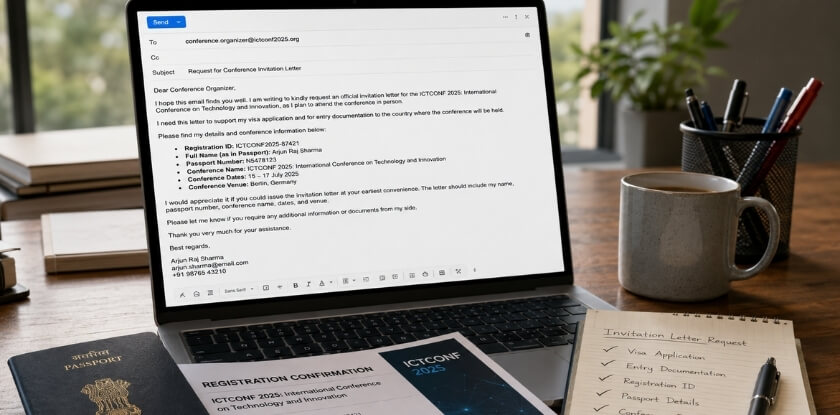
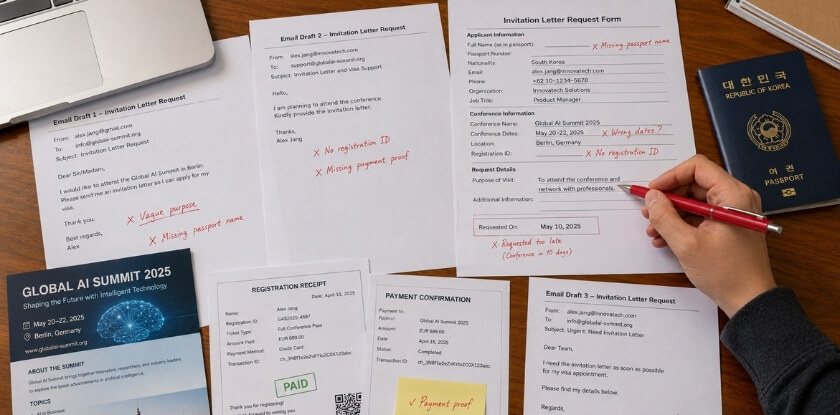
Send a short, complete email to the event coordinator or the contact on the registration page, and put your registration number in the subject line. Many organizers provide a letter once you have registered and paid. What slows things down is an unclear or incomplete request.
Email Template for Visa Purposes
Subject: Invitation Letter Request – Visa Application – [Your Full Name] – [Registration #]
Dear [Conference Organizer / Event Coordinator Name],
I have registered for [Full Conference Name], scheduled for [dates] in [city, country], and I am in the process of applying for a [country] visa to attend. I would be grateful if you could provide a formal invitation letter for submission to the [country] embassy or consulate.
For the letter to satisfy visa application requirements, could you please include the following:
- My full name as it appears on my passport: [Full Name]
- My date of birth: [DD/MM/YYYY]
- My passport number: [XXXXXXXX]
- The conference dates and venue address
- If I am presenting: my paper title and paper ID
- A statement confirming my registration and, if applicable, any fee waiver or financial support
I have attached my registration confirmation for reference. Please let me know if you need anything else from my side. I need to submit my visa application by [your deadline date], so I would appreciate receiving the letter by [date a few days before your deadline].
Thank you for your time.
[Your Full Name]
[Affiliation / Institution]
[Email] | [Phone]
Email Template for University or Employer Approval
This version is for a different reader. You are not writing to a consulate; you are asking your grants office, department administrator, boss or manager to approve attendance, reimburse travel or grant leave. The organizer’s invitation letter is what you attach to this internal request.
Subject: Approval Request – Conference Attendance – [Conference Name] – [Dates]
Dear [Supervisor / Department Chair / Manager Name],
I would like to request approval to attend [Full Conference Name], taking place [dates] in [city, country / online]. I have attached the official invitation letter from the conference organizer confirming my participation.
[If presenting:] I have been accepted to present a paper titled “[Paper Title]” as part of the [session or track name]. The acceptance letter from the program committee is also attached.
The estimated costs are as follows:
- Registration fee: [amount]
- Travel: [amount]
- Accommodation: [amount]
- Total: [amount]
[If funding is available:] I am applying for [grant name / departmental travel fund] to offset part of this cost and will keep you updated on the outcome.
The conference is highly relevant to my current work on [brief description]. I am happy to share a summary or presentation with the team on return.
Please let me know if you need any additional documentation for the approval process. I would appreciate a response by [date], as early registration closes on [date].
Thank you for considering this request.
[Your Full Name]
[Role / Department]
For a virtual or online conference, keep the email largely the same. Some employers are skeptical about leave or budget for remote events, so include the registration fee and a line about what you expect to gain professionally.
What to Do If the Organizer Refuses to Provide a Letter
If the organizer refuses, fall back on your registration confirmation, ask for an acceptance letter instead, or move the request to your university or employer. Some events have a policy against individual letters, and others are understaffed. Either way, you have options.
Use Your Conference Registration Confirmation
This is the first document to fall back on. It shows your name, the event name, the dates and that you have paid to attend, so it is often useful supporting evidence. Embassies and consulates differ on whether they accept it in place of a letter, so check the requirements of the mission you are applying to. It usually works best alongside other documents such as hotel bookings, an employer letter and bank statements.
Ask for a Different Type of Letter
Some organizers will not issue an invitation letter but will issue an acceptance letter, particularly for academic and professional conferences where you are presenting. An acceptance letter confirms that your paper or talk was accepted by the program committee, rather than formally inviting you to attend. Some embassies treat it as strong supporting evidence, but not all do, so check yours. The difference is explained in the section on invitation and acceptance letters below.
If you are presenting, ask the event coordinator or program committee directly for an acceptance letter. They are usually comfortable issuing one because it is a standard part of the submission process.
Request a Letter from Your Institution or Employer
Your university approval office or department head can issue a letter confirming that you are attending a professional or academic conference on behalf of the institution. A letter from your boss or manager stating that attendance is work-related also adds context. These letters do not replace an organizer-issued document, but combined with a registration confirmation they can fill most of the gap.
Check Whether You Actually Need the Letter
For some destinations you may not need one. Travelers from Visa Waiver Program countries do not go through a consulate submission for the United States, so there is no step where the letter would be handed over. Confirm what your destination requires for your passport type before chasing an unwilling organizer.
Consider a Virtual Option
If a visa denial would stop you from going at all, find out whether the conference has a virtual or online option. Remote attendance still lets you join sessions and, if you are a speaker, present your work. It is not ideal, and you should not have to rely on it, but it is a practical last resort when other channels are exhausted.
Escalate Within the Organizing Team
If one contact said no, that does not mean everyone will. Event coordinators sometimes lack authority to issue letters or do not understand what you are asking for. Write to the conference chair, the general chair for academic events, or whoever leads the organizing committee. Explain that you need the letter for a visa application, quote your registration number, and keep the message short. A well-framed second request to the right person often gets a different answer. If nobody replies at all, send one polite follow-up after a reasonable wait instead of several urgent emails.
How to Request Conference Attendance Approval from Your Boss or Manager
Ask your manager as early as possible after your abstract is accepted or your registration is confirmed, with the costs and purpose clear in one message. Managers need time to check budget cycles, arrange coverage and route requests through HR or finance. Giving them several weeks is reasonable; a short deadline puts pressure on them and can create friction. Do not wait until the visa deadline is close.
If you need a visa, the timeline tightens. Your employer’s approval letter may itself be required by the embassy as a supporting document alongside the invitation letter, so a delay on that side can stall the whole application.
What to Include in Your Request
Cover the basics in one concise message so your manager can approve without follow-up questions.
- Name and dates of the conference. Give the full title, city and exact travel dates, not just the event days. Managers need to see the total time you will be away.
- Why you are attending. Say plainly whether you are presenting a paper, attending workshops or representing the organization. “I was invited to present research” lands differently from “I’d like to attend a conference.”
- Costs involved. If you want employer funding, give an estimate upfront: registration, flights, accommodation and any per-diem. If you are covering it yourself, say so, because it removes the budget objection.
- What you need from them. If you need a signed approval letter or a letter on company letterhead confirming your employment status, flag it explicitly. Some visa applications require it, and your manager may not know that.
If Your Manager Needs to Sign an Approval Letter
Some employers have a standard form for conference attendance; others do not. If yours does not, prepare a short draft and ask your manager or HR to review and sign it on company letterhead. The letter typically confirms your employment, states the purpose of travel and confirms you will return to your position after the event. Bring the sample or the embassy’s requirements with you, which saves a rewrite.
Handling Pushback
The usual objections are cost, timing or workload coverage. Address them before they are raised. If the conference offers a fee waiver for presenters, mention it. If the dates overlap with a critical project, propose a coverage plan or remote check-ins.
For academic conferences the approval chain sometimes runs through a department head, a program committee liaison or a university grants office rather than a line manager. Routing your request to the wrong person first can add days of delay. If approval is denied outright, check whether the event offers hybrid or virtual registration, which may satisfy the professional purpose without travel approval or a visa.
Can a Family Member Write a Conference Invitation Letter?
Generally no. A family member cannot issue a conference invitation letter in any official capacity, because the letter must come from an organization with a formal relationship to the event. The same applies when a companion asks for a letter: the organizer typically will not issue one for a family member who is not registered, since the letter is tied to participation. A companion applies with other supporting documents, and the embassy assesses that application separately.
Why Family Members Cannot Issue Conference Invitation Letters
An invitation letter carries weight because it is issued by an accountable party: the organizer, a program committee member, an event coordinator or the hosting institution. A family member did not accept your abstract and did not register you, so they have no standing to vouch for your participation. If a family member writes something calling itself a “conference invitation letter”, an embassy has no reason to treat it as an organizer’s letter, and it can raise questions about the credibility of the whole application.
What a Family Member Can Write
A family member can legitimately write a personal invitation letter or host letter, which is a different document with a different purpose. It is relevant when you are visiting family alongside the conference, or when a relative is providing accommodation. It explains your personal connections and housing arrangements but does not substitute for the organizer’s invitation. For Canada, IRCC says it may ask for a letter of invitation from a person in Canada when you apply for a visitor visa. The writer should tell the truth and plan to keep the promises in the letter, and the letter does not guarantee a visa. If you submit both, keep them clearly distinct: the conference documents (registration confirmation, acceptance letter, organizer’s letter) come from the event, and the family letter covers your personal circumstances.
When the Organizer Is a Family Member
One edge case: a relative genuinely runs the conference or sits on the program committee. If they have an official role, and the letter comes on institutional letterhead, names their position and is issued through the conference’s normal process, it can be valid. The relationship would likely need to be disclosed and the embassy may look more closely. Be transparent rather than hiding the connection.
Do You Need an Invitation Letter for a Virtual Conference?
Usually not. If you attend an online conference from your home country, there is no travel, so there is no visa application and nobody asking for a letter. The usual reason to request an invitation letter is to satisfy a visa requirement, and that does not arise for virtual attendance.
No embassy, no consulate and no immigration officer is involved. Written confirmation from the organizer can still be useful in a few cases, and the organizer will normally issue it for online events when asked. Do not assume they will refuse just because attendance is remote. The exception is a satellite venue or co-located hub event, where you travel and the same rules as an in-person conference apply.
When Documentation Still Matters for Virtual Conferences
- Employer or university approval. Many organizations want a paper trail before approving time off, paying registration or reimbursing expenses. A registration confirmation usually handles this, but some want the program, dates and a description of the event. The event coordinator can often provide a participation or acceptance letter.
- Academic or grant reporting. If you use grant funding, your institution may require proof of participation. The program committee sometimes issues letters confirming a presenter’s accepted submission.
- Professional development records. Licensing bodies or professional associations may ask for evidence of continuing education. A letter confirming your registration and participation dates usually satisfies that.
If you attend virtually from abroad, ESTA is not involved either, because it only covers travel to the United States. For employer or university approval or expense reimbursement, ask the organizer for a confirmation letter or participation acknowledgment. It is a routine request.
Invitation Letter vs. Acceptance Letter: What Is the Difference?
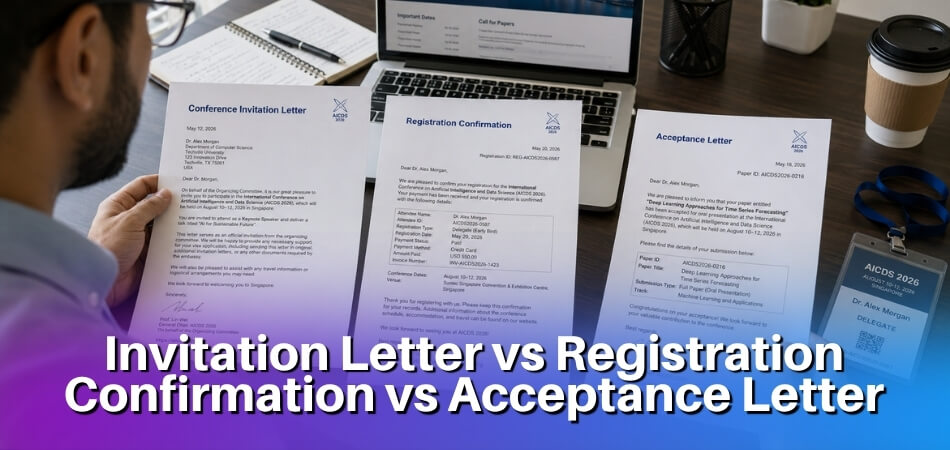
An invitation letter is issued by the organizer to support travel or approval, while an acceptance letter tells you the program committee selected your submission. The two are frequently confused, and that can cause problems when you assemble a visa file or request internal approval.
What Each Document Actually Is
The invitation letter is issued by the conference organizer, event coordinator or program committee. Its audience is external: an embassy reviewing your visa application, or HR and your manager reviewing a travel request. It establishes that a real, scheduled event exists, that you have a legitimate reason to attend and that the organizers recognize your attendance.
The acceptance letter is specific to academic conferences and some professional ones where you submitted a paper, abstract or proposal. It tells you the program committee reviewed your submission and selected it. It is an outcome of peer review, not an administrative document.
Why They Get Mixed Up
Many academic conferences issue the acceptance letter first, and attendees assume it is the document they need for a visa. It is not always sufficient alone. An embassy wants to see that you have been invited to attend the event, not only that your paper was accepted. Some treat an acceptance letter as strong supporting evidence, but they may still expect a formal invitation letter on official letterhead confirming dates, venue and your participant status. At academic conferences the sequence typically runs: acceptance letter, then registration and payment, then a request for the formal invitation letter.
Do You Need Both?
At a professional conference with no submission process you will only have an invitation letter, and that is fine. If you are presenting at an academic conference you may have both, and you can submit both. The acceptance letter shows your role; the invitation letter confirms your registration and gives the organizers’ contact details.
For university or employer approval, the acceptance letter is often more persuasive, since it proves the institution gains recognition from your presentation. For a virtual conference, it still matters when you request time away from work.
Quick Reference
| Document | Issued By | Used For |
| Invitation Letter | Conference organizer / event coordinator | Visa application, employer approval, consulate submission |
| Acceptance Letter | Program committee | Proof of selection, university approval, employer approval |
Both can appear in a visa package, but they are not interchangeable. Know which one an embassy or your institution is asking for before you request or submit either.
Do You Need an Invitation Letter for ESTA and the Visa Waiver Program?
No. ESTA is an online travel authorization, not a visa. If your country participates in the Visa Waiver Program, you apply for ESTA online instead of applying for a visa at an embassy, so there is no consular document checklist. ESTA approval does not decide admissibility: CBP officers do that when you arrive. Attending a professional or business conference is a permitted activity under the program, as long as you are not paid by a U.S. source.
Why You Might Still Want One
Customs and Border Protection officers can ask about the purpose of your visit at the port of entry. If you are attending a professional or academic conference, your conference registration confirmation, and ideally a letter from the organizer confirming your participation, gives a clear, documented answer. This helps most if your travel looks unusual: arriving close to the conference date, staying briefly, or coming from a country that sees more scrutiny. A letter will not override a CBP decision, but it gives concrete evidence that your visit has a specific, legitimate purpose. Carry the documents from the organizer, never a letter from a relative, because that is what actually supports your entry.
What the Letter Should Say
It does not need to be elaborate. A brief letter from the event coordinator or program committee on official letterhead, naming the event, dates, location and your role (attendee, speaker, presenter), is enough. Pair it with your registration confirmation.
Where ESTA Differs from a Visa
For some visas, the invitation letter is on the embassy’s checklist. With ESTA, authorization happens before you travel through an automated system, and the letter comes into play only if an officer asks questions on arrival. So if an organizer says they do not issue letters to ESTA travelers because you do not need one, they are right about the online application. Carrying something at the border is a separate judgment, and for most straightforward trips your registration confirmation is sufficient. Always confirm current ESTA requirements on the official U.S. Customs and Border Protection website, because eligibility rules change.
FAQ
Knowing who signs your conference letter matters as much as when you ask for it, including requests made before registering, an organizer who refuses, and an employer or relative offering to write it instead.
Who is responsible for issuing a conference invitation letter?
The conference organizer issues it, either directly or through the program committee or event coordinator. For academic conferences this is typically the organizing institution or committee chair. For professional conferences it is usually the event management team.
Can I request the letter before I have registered?
Sometimes. Many organizers require a registration confirmation first, but some accept a request before registration through a form and screen each one, so approval is not guaranteed. Some also issue a letter after abstract acceptance. Check the conference’s letter policy.
Is an invitation letter the same as an acceptance letter?
No. An acceptance letter confirms your paper or presentation was selected. An invitation letter is a separate document issued to support a visa application or approval process. You may need both.
Does every visa application require an invitation letter?
Not always. Some countries and visa categories do not require one, and ESTA travelers typically do not need one. Check the requirements of the relevant embassy for your nationality and destination.
What if the organizer refuses to provide a letter?
Use your registration confirmation with the official conference website and program schedule, and ask for an acceptance letter if you are presenting. Embassies differ on what they accept, so check theirs. A letter from your employer or university can also help.
Can my employer or university write the letter instead?
No, not as a replacement. They can write a supporting letter confirming approval and a work- or study-related trip, but for visa purposes the embassy generally wants documentation from the organizer.
Is an invitation letter needed for an online-only event?
No. With no international travel there is no visa requirement. Attendance is usually confirmed through the event platform, though an employer may still ask for a confirmation letter.
How far in advance should I request the letter?
As soon as you have registered and know you need a visa. Each organizer sets its own turnaround, so check the conference page and add that time to your visa timeline. Leaving the request until a few weeks before the event is a real risk.
Who provides the letter for a conference held in Canada?
The event organizer does. IRCC tells Canadian event organizers to give visiting participants 2 copies and to add the event code if the event is registered with IRCC.
Can a relative who is also attending write my invitation letter?
No. A family member’s letter carries no official weight for a conference visa application, because the embassy expects documentation from the organizer. It may work as a personal host letter, but not as the conference invitation.
Final Thoughts
The organizer issues the letter, and the right time to ask is right after your acceptance or registration confirmation. If yours will not, your registration confirmation, the event’s official website and a supporting letter from your employer or university can usually fill the gap. Keep copies of everything and give the embassy more lead time than you think you need.
From our experience at MS International: At our conferences the invitation letter process starts automatically once payment clears, and we issue the letter within 3 to 5 business days. Check that your name and passport details match your registration before you pay. A correction after the letter is issued may cost US$50. If an embassy asks for a notarized letter, we offer one for US$100, which typically takes up to 10 business days and is non-refundable. A letter supports your application but does not guarantee a visa.
Disclaimer: This article is general information, not legal or immigration advice. Visa and entry rules change, so confirm requirements with the official embassy, consulate or government website before you apply.