
A conference invitation gets you through the first door, but the visa officer is thinking about something else entirely: whether you plan to come back. Applicants often know this and still struggle to show it on paper. How you present your ties matters as much as the ties themselves.
Quick answer: To prove strong ties for a conference visa, show documents that make going home the obvious choice: an employer letter with your return date, conference registration, a return ticket that matches the event dates, steady bank statements, and proof of family, property or a business at home. Officers judge the whole file, so every document must tell the same story.
Fact-checked by the MS International Editorial Team. Last verified against official sources: October 2026.
A file can fail even when the ties are real, if the paperwork is incomplete, badly ordered, or says slightly different things when read side by side. A sponsorship letter with one travel date and a flight ticket with another can sink a file that should have passed. This guide covers which documents matter and why, how to present them, what to say at the interview, and what to fix after a refusal.
What Strong Ties Mean, and Why Conference Applicants Must Prove Them
Strong ties are the reasons a visa officer believes you will take the return flight. They are not a formal legal category. They are a judgment the officer makes from whatever you put in front of them.
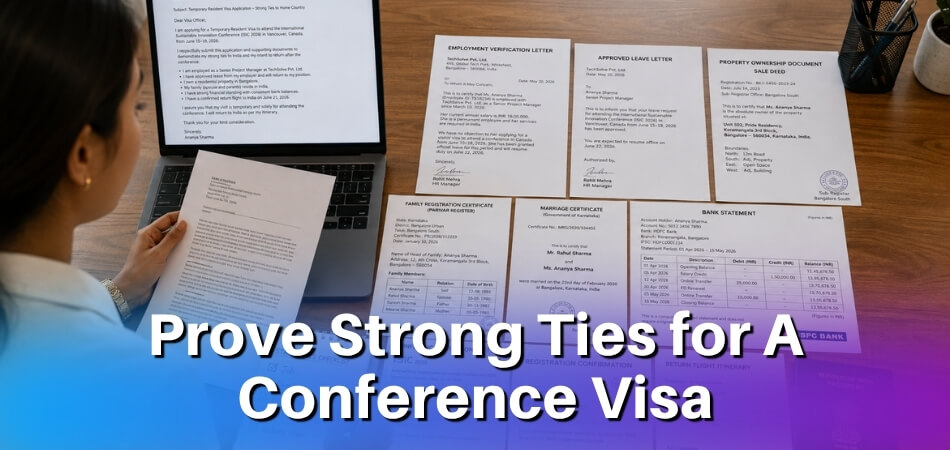
The rule behind it is nonimmigrant intent: you must show your trip is temporary. The burden is on you, not on the officer. For a US visitor visa, the State Department says a refusal under Section 214(b) of the Immigration and Nationality Act means the applicant did not show strong home-country ties that would compel departure at the end of the stay. Other countries use different wording, but the question is the same.
Why a conference trip gets extra scrutiny
A conference attendee is often educated, employed and in contact with peers, employers or collaborators abroad. To an officer, that profile can look like someone who might look for work overseas. That is no reason to panic, but it is a reason to over-prepare.
A bank statement shows you have money. An employer letter shows your job exists. Neither explains why you would leave a conference abroad and go home. Together, with the invitation, registration proof and return ticket, they should show a defined trip with a planned end and a life waiting for you.
How the rules differ by country
- United States: conference attendance is allowed on a B-1/B-2 visitor visa, and the applicant must overcome the presumption of immigrant intent under 214(b). A refused applicant who reapplies pays the visa fee again and should show changed circumstances.
- United Kingdom: you must satisfy the Home Office that you are a genuine visitor who will leave at the end of the stay. There is no set level of funds, and caseworkers look at your financial, family and social circumstances and your travel history.
- Schengen area: apply no earlier than 6 months and at least 15 days before travel, to the consulate that handles your trip. The consulate expects documents on the purpose of your stay, your funds and accommodation, and proof that you intend to return home.
- Canada: the officer must be satisfied you will leave at the end of your authorized stay, and IRCC names a job, a home, financial assets and family as examples of ties. Practical ways to prove you will leave Canada include a job letter with approved leave, funds with a clear source and housing commitments. The visitor visa fee is CAD 100 and biometrics are CAD 85. Once processing starts, IRCC refunds only some fees, so do not expect the money back after a refusal.
Build your file as if the officer has never heard of your conference or your field. That is often close to the truth.
US rules that strong ties cannot override
Two current US rules sit outside the ties question, so check them before you spend time on documents.
- Nationality suspensions. Proclamation 10998 partially suspends B-1/B-2 visa issuance for nationals of 19 countries, including Nigeria, from 1 January 2026. You can still apply, but you may be ineligible for a visa, and strong ties do not change that. Check the State Department’s list for your passport.
- Visa bonds. The B-1/B-2 visa bond program has been permanent since 3 August 2026. Applicants from designated countries can be required to post a bond of $10,000, $15,000 or $20,000 before a visa is issued. A bond is a separate condition of issuance, so you still need to qualify for the visa.
Core Documents to Prove Strong Ties for a Conference Visa
Five document groups do most of the work: the conference papers, an employer letter, the travel booking, financial proof, and evidence of property, family and community ties. Each one answers a different doubt, so a gap in one leaves a gap in the case.
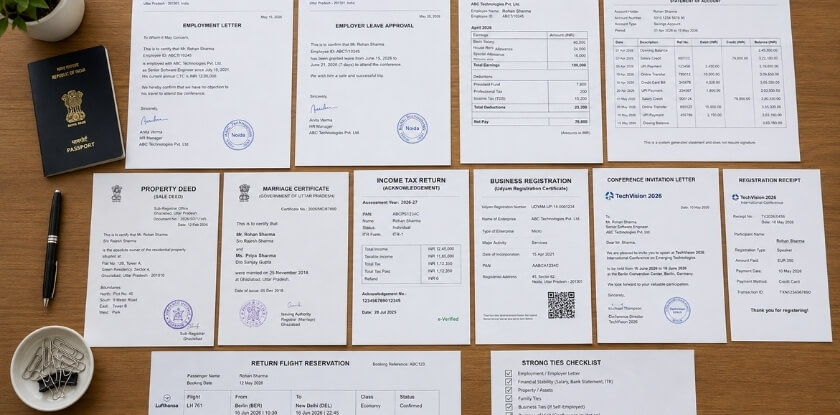
Conference invitation letter and registration proof
You need both. The invitation only says you were invited. Registration proof shows you paid and committed to attend.
The invitation should be on the organizer’s letterhead and include the conference name, dates, location and your full name. If you are presenting or speaking, have that stated, because it gives your trip a clear purpose. For registration, a PDF receipt with your name, the event, the dates and the amount paid is cleaner than a bare confirmation email. If the host is a known association or academic body, say so, so the officer can check the event quickly.
Employer letter with return date
This is often the most persuasive single document. Done well, it answers where you work, why you are going and that you are expected back.
It should be on company letterhead and signed by a named senior person, such as your manager or HR director. It should state your position, how long you have worked there, your approximate salary, that the trip is approved or sponsored, and the exact date you resume work. “Ms. [Name] is expected to resume her position on [date]” does far more than a letter that only confirms you are employed. If your employer pays for the trip, say that too.
Return ticket and hotel booking
Book your return before the interview. A return ticket dated soon after the conference closes shows you planned to leave.
Your itinerary should match the event dates closely. Arriving two days early and leaving three days after invites questions, so be ready to explain any extra days. The hotel booking should show the hotel name, your name and the check-in and check-out dates. If the organizer arranges accommodation, get that in writing. Where you can, use flexible bookings until the visa is approved, though some officers also read a firm booking as a sign of real commitment. Add the conference agenda or program as well, since it shows the event is real and matches the dates on your ticket.
Bank statements and financial ties
Statements serve two purposes. They show you can fund the trip without working illegally, and they show financial roots at home.
Bring 3 to 6 months of statements with regular income visible, and aim for 6 where you can, because Canada’s visitor visa guidance asks for at least 6 months of account details with balances. A large deposit just before you applied looks like a balance topped up to pass a test, and a statement that is several months old can hurt as much as a thin one. Steady, ordinary figures are more convincing than a sudden jump, and when US visa officers evaluate a bank statement, sudden unexplained deposits are a red flag too. If you are paid a salary, add recent payslips. Declared income should match what your employer letter and tax documents say.
Property, family and community ties
Claims like “I have family there” carry little weight. Documents do.
- Property: a title deed, mortgage statement or a signed lease in your name.
- Family: a marriage certificate, children’s birth certificates and school enrollment letters, or evidence that you support a dependent parent or sibling. A spouse or young children at home are a strong signal.
- Community: membership of a professional body, a local course or a volunteer role. These support the stronger documents but do not replace them.
Travel history as supporting proof
Earlier trips show that you have travelled before and came home on time. Bring old passports with past visas and entry stamps, and tickets or boarding passes from earlier trips if you still have them. UK caseworker guidance lists a person’s earlier visits to the UK and other countries among the factors it weighs.
How to Show Strong Ties If You Are Self-Employed or a Freelancer
Self-employed applicants prove ties with business and tax records instead of an employer letter. Officers treat a job you would lose as the main anchor, so you need several smaller anchors that add up.

What to submit instead of an employer letter
- Business registration. A certificate of incorporation, trade license or official registration showing a legal business in your home country.
- Tax returns from the last two to three years. Filed returns, not just income statements, show a financial track record at home.
- Active client contracts. Redact sensitive figures if needed. A contract with deliverables due after your conference dates is especially useful.
- Bank statements. Three to six months with regular income and a healthy balance.
- Invoices and an accountant letter. Invoice history shows ongoing work, and a brief accountant letter can confirm business activity and that you own the business.
- Office lease or utility bills in the business name. A physical presence ties the business to your country.
- A one-page letter from you. On business letterhead, say who you are, what the business does, why you are attending and your return date.
Financial anchors beyond income
Owning property, even jointly, is one of the strongest ties because it cannot be taken abroad. If you do not own any, show savings, pension or investment accounts and business assets. Family and community ties count just as much as for employees: a spouse, children in school, parents you care for, or a role in a professional association.
At the interview
Expect to explain your work clearly. A clean answer sounds like this: “I run my own registered business with active clients here. I am attending this conference to meet speakers in my field, and I return on [date] because I have a client delivery due that week.” Specific, short and believable. Carry a printed checklist of your documents so you can find anything quickly.
The usual mistake is submitting too little. The standard is not higher for you, but each missing document adds uncertainty.
What to Do If You Have No Property or Permanent Job
Having no property or permanent job does not end your application. Officers look for any evidence that your life is anchored at home, and property and employment are only the two most common anchors. Students, recent graduates and contract workers can substitute others.
Students and recent graduates
Your enrollment is your anchor. Get a letter from your institution confirming active enrollment, your expected graduation date and, if true, that missing the coming semester would affect your standing. Add proof of tuition payment, a semester schedule or an upcoming exam date. The more specific, the better.
Contract workers
Ask the contracting company for a letter stating the contract period, that the conference trip is approved and the date you are expected back. Attach the contract if it is not sensitive. If it has renewed several times, include proof of the last two or three renewals, which shows the work continues.
Family and community ties as the main anchor
A spouse, children you support or parents who depend on you are concrete reasons to return, so put paper behind them (see the family documents above). If you are a caregiver, a letter from a relative’s doctor can document that. A letter from a local professional body confirming your active membership, or a board or speaking role at a local organization, adds roots.
Think about what you would actually lose by not returning, write it down, and find the paper that proves it. No single document here replaces a property deed. A modest set of ties, such as an enrollment letter, local bank activity, a defined return ticket and one or two community letters, can be convincing in combination.
Be honest about your situation
Do not pretend to have a permanent job. Officers check, and a discrepancy damages everything else in the file. If asked, say it plainly: “I am on a fixed-term contract until [date], and my employer’s letter confirms I am expected back on [date].” Officers do approve students, contract workers and early-career applicants who bring evidence instead of assumptions.
What to Say About Strong Ties in Your Visa Interview
Keep answers short, specific and consistent with your documents. Many refusals come from applicants who freeze, ramble or say something that contradicts the file. The interview can be very brief, so you need to be ready. Since 1 October 2025 the US has narrowed interview waivers, so expect an interview for a B-1 visa unless you qualify for a narrow renewal exception. Other destinations may decide from the file alone or call you in only when needed, so there your documents must carry the story.
The officer already has your papers. The interview tests whether your story is consistent and whether you understand your own situation. If your letter calls you a senior analyst and you cannot explain what your team does, that is a problem.
Common questions and how to answer them
“What is the purpose of your trip?”
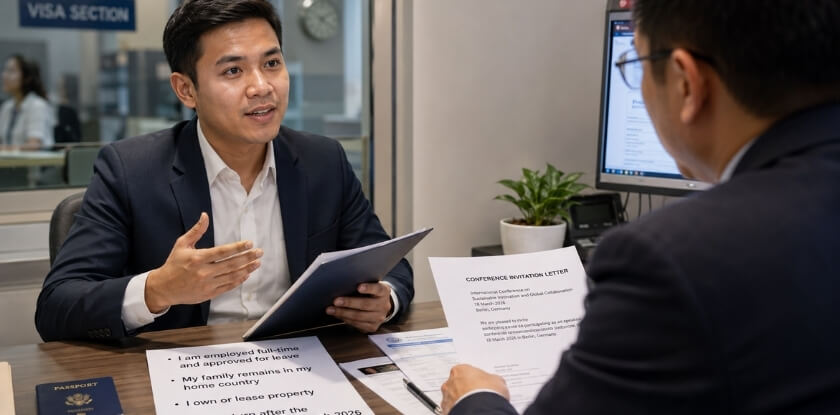
Name the conference, give the dates and give your reason for going. Bad answer: “I want to attend an international conference for professional development.” Better answer: “I am attending [Conference Name] in Chicago from March 10 to 13. My company is sending me because we are evaluating new procurement software, and two vendor sessions relate to a project I lead.”
“Why should we believe you will return?”
Answer with specifics, not promises. Mention what is waiting for you: a project deadline, a team, a client. Then family, then property or financial obligations if they apply. One sentence per reason is enough. Concrete obligations land harder than “I love my country”.
“Who is paying for this trip?”
If your employer sponsors you, say so and refer to the sponsorship letter. If you pay yourself, say that and connect it to your bank statement. Self-employed applicants should explain briefly what they do and why the event helps their work.
“Do you have family outside your home country?”
Answer honestly. If a sibling lives abroad, say so, then point to the family ties that anchor you at home.
Staying natural
Mention your documents as part of a plan you made, for example your return ticket when asked about your return, not as a memorized list. Answer what is asked and stop. Silence after a complete answer is fine, and filling it with extra words is how people contradict themselves. Do not volunteer details that raise new doubts, such as plans to visit a friend, unless asked. Keep your papers in order and within reach, speak clearly and make eye contact.
If the officer seems skeptical
Stay calm. A skeptical question does not mean a refusal is coming. If they doubt the conference, explain the organizer, the industry and who attends. If they doubt your job, describe your daily role and the project you are returning to finish. If you have a weak spot, such as no property or four months in your job, do not invent strength. Point to what you do have, like a family tie, a client contract or a lease. Do not argue if the officer pushes back; acknowledge the concern and return to your evidence.
Common Mistakes That Weaken Your Strong Ties Case
The most damaging mistakes are inconsistency and vagueness, not missing ties. Small errors in how you present a case can undo genuinely strong ties.
Documents that do not connect
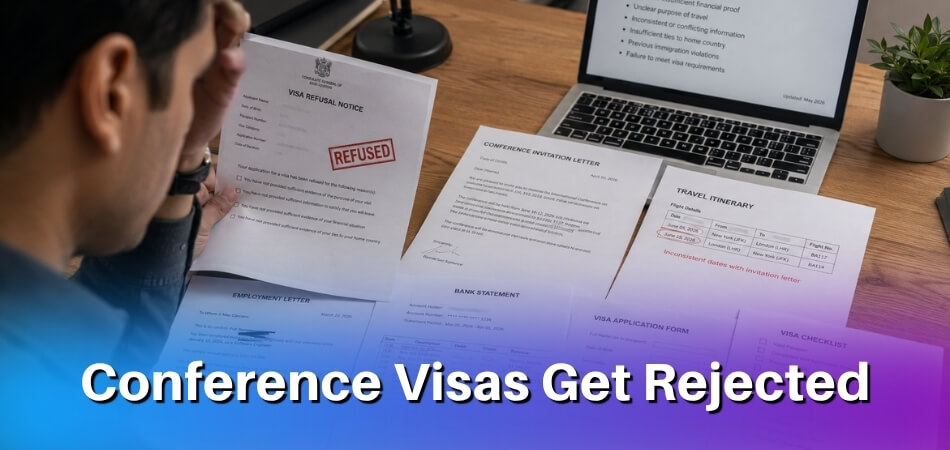
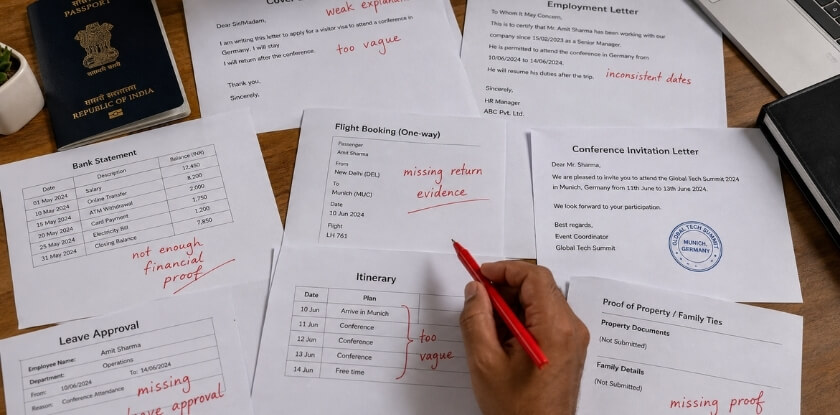
Officers read many files and will not build your story for you. If your employer letter gives leave dates that differ from your ticket, and your hotel booking covers another window, the file looks careless at best. The invitation, registration, itinerary and ticket should all show the same event and dates. The same goes for roles: a data science conference, a letter calling you a marketing coordinator and an online profile showing something else will raise questions, even if each is innocent. Before you submit, read the whole package as a skeptical stranger would.
Generic employer letters
A letter saying only that you are employed and the company supports your application is nearly useless. It should name the conference, your title, your length of service, your approved leave and your return date, signed by a named person with a title.
Leaving out property, family or community ties
Some applicants focus only on the professional side and forget the rest. You do not need a notarized certificate to mention that you care for a parent or that your children are in school at home. Back it up with whatever exists, such as a school enrollment letter, and do not leave it out because it feels too personal.
Over-explaining
Some applicants answer one question and then add “I promise I will return, my whole family is there, I love my country.” That sounds anxious and rehearsed. Answer directly and let the officer ask for more.
Applying too late
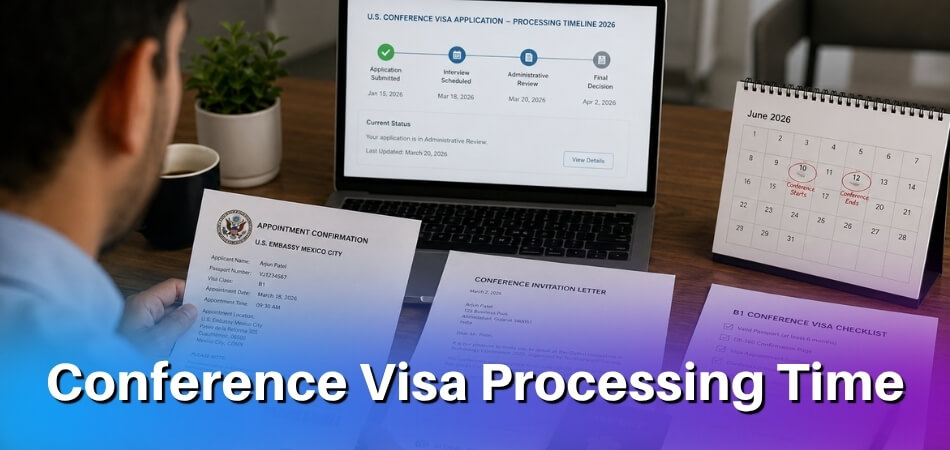
A last-minute application leaves no room for extra document requests or a rescheduled appointment, and you could miss the conference. Apply as early as the embassy allows. For a Schengen visa, that means no earlier than 6 months and at least 15 days before travel, and processing can take longer than 15 days if more checks are needed. Check your consulate’s own page for its timing.
Conference Visa Denial: Reasons and Next Steps
Refusals often come from a small set of fixable problems, and weak proof of nonimmigrant intent is the central one. The officer was not convinced you would go home, even if you submitted every listed document, because the overall picture matters more than the count.
Why visas get refused
- Weak financial proof. Unstable funds, or money the officer did not believe was yours.
- Weak employment proof. A vague letter with no role, leave approval or return date.
- No obligation at home. No dependants, property or ongoing contract.
- Inconsistent documents. An itinerary of five days with a ticket booked for twelve.
- A questionable conference. A generic invitation or an event with a thin online presence.
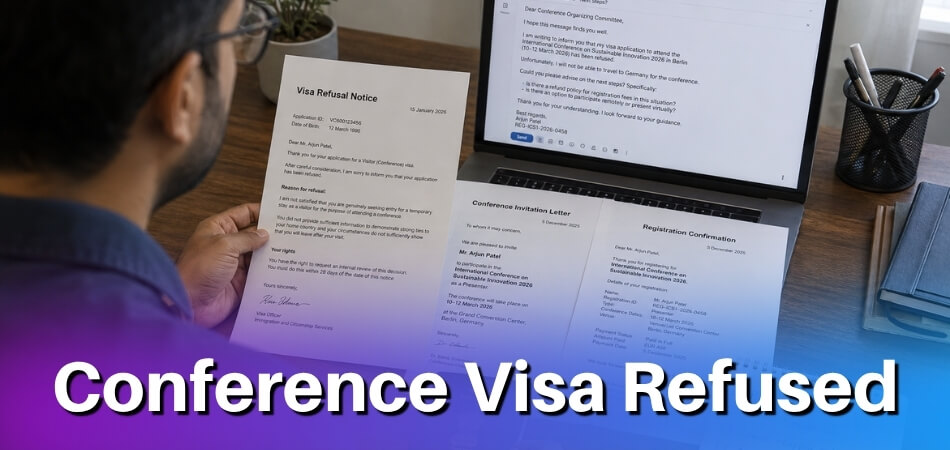
Read your refusal notice against your application and ask what you did not prove clearly. Some notices are specific and many are vague, but your answer shapes the next step. For Canadian visitor visas, IRCC has included the officer’s decision note with refusal letters since 29 July 2025, so read it for the officer’s reasoning.
Can you reapply?
Usually yes, but not with the same file. Fix the gap the officer saw. For the US, a new application means paying the fee again and showing significant changes since the last one. In Canada, IRCC advises applying again only if your situation has changed significantly or you have new information that addresses the reason for refusal, and the fees are paid again.
If your statements were the issue, submit three to six months this time. If your employer letter was thin, get a new one with your designation, salary, confirmed leave dates and a statement that your position continues. If family ties were undocumented, add the certificates and proof of dependants. Self-employed applicants should add client contracts, invoiced work, tax filings and proof of who funds the trip. Applying with more lead time and a stronger financial picture also helps.
When to get advice
After two or more refusals, ask whether a conference visa is the right category. Some events fit other visitor or business categories, and an immigration lawyer is worth paying at that point.
Does timing matter?
Sometimes the refusal has little to do with the documents. Applying close to the conference date looks rushed, and applying while your account is temporarily low looks risky. If you can reapply with a stronger financial picture and more lead time, wait for that.
What not to do
Do not leave out information that hurt you last time. If your last application disclosed it, omitting it now is misrepresentation, which is far worse than the original problem. Do not pressure your employer to inflate your salary or title, because a mismatch with your tax records will end the application. A refusal is usually a documentation problem, not proof that the system is broken.
Conference Visa Strong Ties: Complete Document Checklist
Use this table as your pre-submission check. Skip rows that do not apply to you, but if one applies and is missing, the officer will notice the gap.
| Document | Who Needs It | Priority |
|---|---|---|
| Employer letter (title, leave dates, return date) | Employed applicants | High |
| Conference invitation letter | All applicants | High |
| Conference registration proof | All applicants | High |
| Return flight ticket | All applicants | High |
| Hotel booking | All applicants | High |
| Bank statements (3 to 6 months) | All applicants | High |
| Salary slips (last 3 months) | Employed applicants | High |
| Tax returns | Self-employed, freelancers | High |
| Business registration | Self-employed applicants | High |
| Client contracts and invoices | Freelancers | Medium |
| Accountant letter, office lease or utility bills | Self-employed applicants | Medium |
| Sponsorship letter | Applicants whose employer or institution pays | Medium |
| Property ownership documents or lease | Property owners and renters | Medium |
| Marriage certificate | Married applicants | Medium |
| Birth certificates and school enrollment | Parents with dependents | Medium |
| Dependent care documents | Those supporting a parent or sibling | Medium |
| Conference agenda and day-by-day itinerary | All applicants | Medium |
| Professional license or membership certificate | Licensed professionals | Low to Medium |
| Old passports and past visas | Applicants who have travelled before | Low to Medium |
| Community membership proof | All applicants | Low |
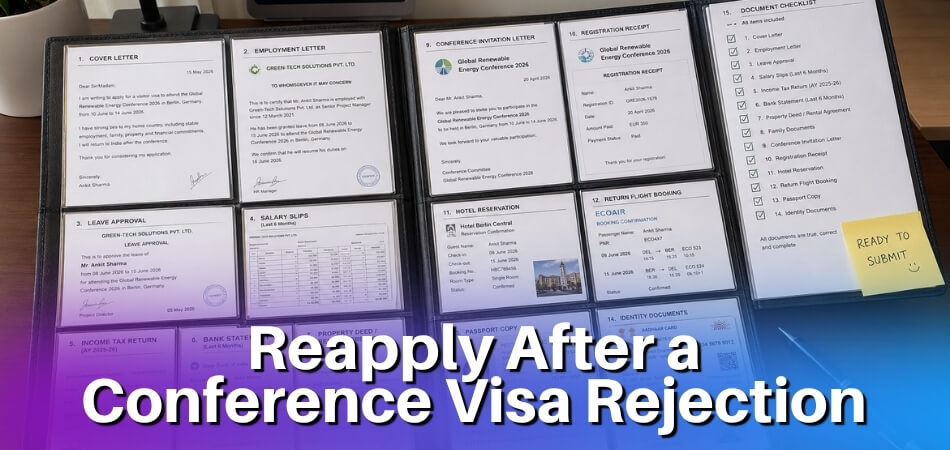
Put the papers in the order an officer would want them: professional ties first, then financial, then family and community. Clear labels and a logical order matter, because a bank statement buried on page 17 might as well not be there.
From our experience at MS International: our invitation letter is issued within 3 to 5 business days after payment clears, and a US$50 administrative fee may apply to corrections after it is issued. Check that the conference dates and your details match your employer letter and ticket before you submit. Our conferences are held in person in the Greater Toronto Area. An invitation letter supports your application, but it does not guarantee a visa.
FAQ
Freelancers, applicants with no property at home and anyone whose employer letter leaves out salary face specific doubts about ties, alongside how much a return ticket proves and whether originals or copies go to the interview.
Do I need to show strong ties for every type of conference visa?
Yes, for visitor-type visas. There is no separate conference visa: the US treats conference attendance as a B-1/B-2 visit, and the UK, Schengen and Canada also expect you to show you will leave after the event. The category changes, but the burden stays on you.
How many documents do I need?
There is no magic number. Officers want a coherent picture, not a stack. Three strong, consistent documents, such as an employer letter, bank statements and a return ticket, beat ten weak ones.
What counts as strong ties to my home country?
A job or business, dependants, property or a lease, ongoing study and financial commitments such as a mortgage all count. No single item decides the case, because officers weigh the whole picture. Show the ties that really apply to you.
Can strong ties get me a US B-1 visa if my country is on the suspension list?
No. A nationality-based suspension applies to your passport whatever your ties. If your country is on the State Department list, the officer may be unable to issue a B-1 visa even to a well-documented applicant.
My employer letter does not mention my salary. Is that a problem?
It can be. A letter that confirms only your title gives the officer nothing financial to work with. Ask HR to add your salary, start date and a statement that you are expected back after the conference.
I am a freelancer. Can I still prove strong ties?
Yes, but you need to build the case piece by piece. Combine signed client contracts, recent invoices, business registration, tax filings and bank statements with regular income. No single document carries the weight of an employer letter.
Will a return ticket alone prove I will come back?
No. A return ticket only shows you made a booking, and officers know refundable tickets are easy to buy. It helps as one part of a complete picture.
What if I own no property and have no family at home?
You can still qualify. A stable job, client base, lease, community role, professional membership or ongoing education all count. Be specific: a documented lease and six months of payslips carry more weight than saying you are “settled”.
Does a short conference make the visa easier?
Slightly, because the temporary nature of the trip is obvious. But a three-day event with weak financial ties can still be refused. The length gives context, and your ties make the argument.
Should I bring originals or copies to the interview?
Bring both. Originals show authenticity, and copies are what you hand over if the officer wants to keep anything. Follow the specific embassy or consulate instructions exactly.
Do visa officers read every supporting document?
Not always, and some only skim. Put your most important documents first, label them and keep a logical order so the key proof is easy to find.
If I was refused once, can I reapply for the same conference?
Yes, but only if something has changed. The same documents will give the same result. Fix the specific weakness, then reapply with a short note explaining what is different.
Final Thoughts: Proving Strong Ties Is a Game of Preparation
Officers look for one thing: a believable reason for you to go home after the event. Your job is to make that reason obvious before they have to ask. Start with the baseline of employer letter, invitation, registration, ticket and hotel, add steady bank statements, and include property and family ties if you have them. Self-employed applicants need equally specific substitutes. Then read the file for consistency, and go to the interview ready to confirm what is already in it.
Disclaimer: this article is general information, not legal or immigration advice. Visa rules and fees change, and each case is decided by the visa office. Check the official government website for your destination before you apply.