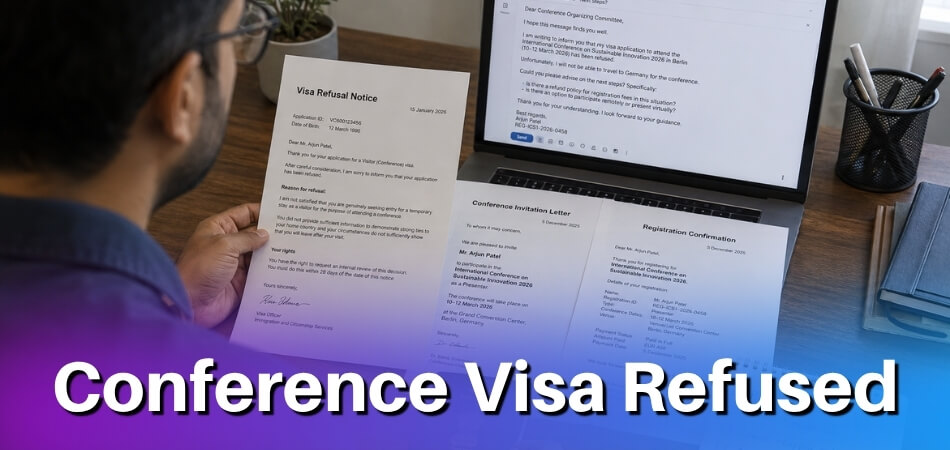

Opening a refusal letter right after you committed to a conference is a hard moment. The next step matters more than the first reaction, and the pull to reapply immediately is strong. A calmer plan gives your second application a real chance.
Quick answer: To reapply after a conference visa rejection, read the refusal reason, fix that exact problem with new evidence, and file a fresh application with a new cover letter. The US, Canada, the UK and the Schengen states set no fixed waiting period for visitor visas, but reapplying within days with the same papers usually fails. Allow several weeks to build a stronger file.
Fact-checked by the MS International Editorial Team. Last verified against official sources: October 2026.
Your conference visa was refused, and the flight, the paper or the session you prepared for months is now in doubt. A refusal is not the end. In most cases it points to something the officer needed to see and did not. The usual mistake is reapplying fast, with the same documents, and hoping for a different officer.
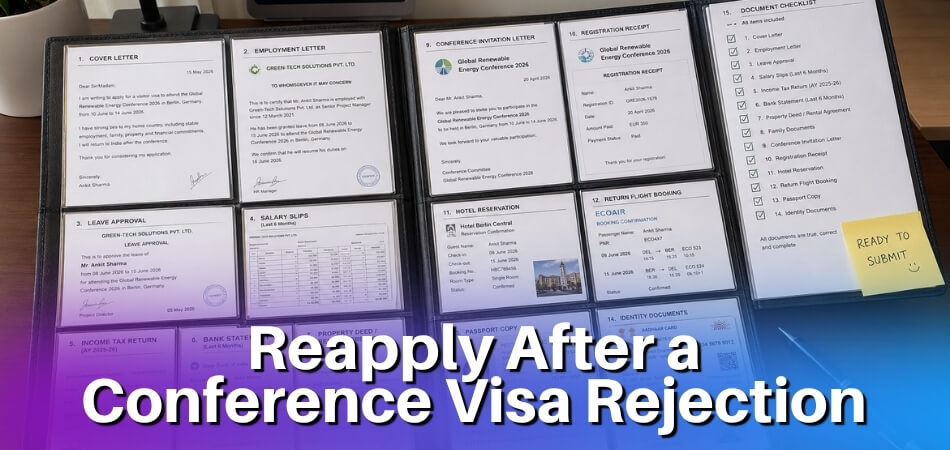
This guide covers the reapplication itself: what to change, how long to wait, which conference documents to rebuild, and how to write the new cover letter. The first days after a refusal, and the general causes of conference visa refusals, are separate topics.
Read Your Rejection Letter First: Why You Cannot Reapply Without Knowing the Reason
Your refusal letter tells you what the officer relied on, and every document you add should answer it. If the letter is vague, work out the likely concern from your interview and from what your original file looked like. If you lost a US refusal letter, you can still recover the refusal details before you reapply.
From our experience at MS International: We issue invitation letters for our in-person conferences in the Greater Toronto Area. A letter is issued within 3 to 5 business days after payment clears, and it names the participant, conference title, date, location, registration category and organizer details. It supports a visa application but does not guarantee approval. Because the letter names the conference and its date, a reapplication for a different conference needs a letter for that event, and a US$50 administrative fee may apply to corrections requested after a letter has been issued. Registration fees are non-refundable, including after a visa refusal, so settle your reapplication plan before you pay for a later event.
What the Typical Refusal Grounds Mean for Your Next File
Conference refusals usually fall into a few groups. Each one calls for a different fix, so do not treat them as one problem.
| Ground in the letter | What the officer doubted | What to change |
|---|---|---|
| Purpose of travel not established | That the event is real or that you are really going | Specific invitation letter, registration receipt, full program, role confirmation |
| Insufficient ties to home country | That you will leave after the event | Employment letter with approved leave and return date, property, family, study commitments |
| Insufficient funds | That you can pay for the trip | Several months of statements, payslips, a clear sponsor letter |
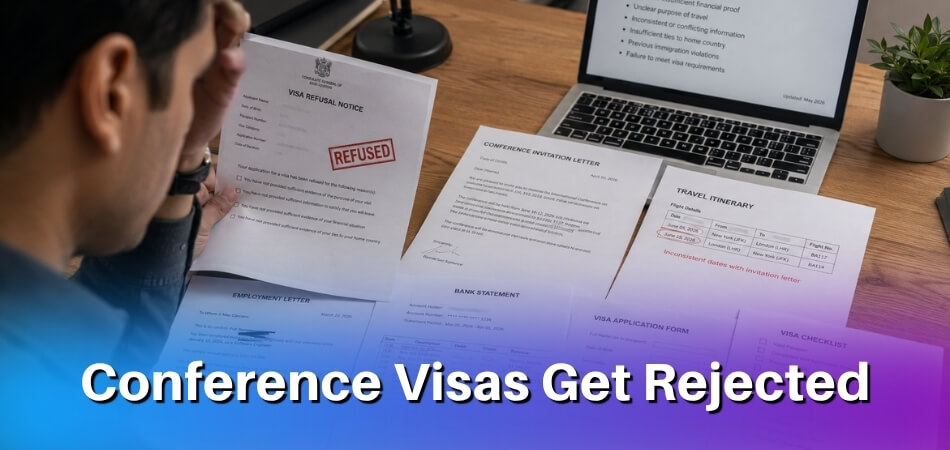
| Inconsistent documents | That the story holds together | Match dates, names and amounts across every document |
| Travel history or intent to immigrate | Past overstays, or a plan to stay | Stronger ties, a plain explanation of any past problem, possibly a lawyer |
For a US refusal under Section 214(b), the officer was not convinced you intend to return home. The refusal is brief and tells you little else, so you have to rebuild the likely concern yourself. Canadian refusal letters can also be short and checkbox style.
Reading Schengen, UK and Other Refusal Letters
Schengen refusal forms tick numbered grounds taken from the Visa Code. A ground such as “the purpose and conditions of the intended stay were not justified” is Article 32(1)(a)(ii). In a conference case it usually means the event documents were weak, or the link between your job and the event was unclear. A separate ground covers insufficient means of subsistence. Do not mix the two up, because the fixes differ.
UK Visas and Immigration letters usually list each requirement you failed to meet. Read every point separately, because several can be stacked together.
Practical steps for any letter:
- Copy every cited ground word for word.
- Look up what each code or provision means on the issuing government’s site.
- Check whether the letter mentions a review, an appeal or a waiting period.
- Remember the officer may have listed only the main concern.
If you applied as a named speaker or presenter, say so first in the new file. A confirmed role explains why you must attend in person, and a refusal letter will not always show whether the officer understood it.
How Soon Can You Reapply? Waiting Periods by Country
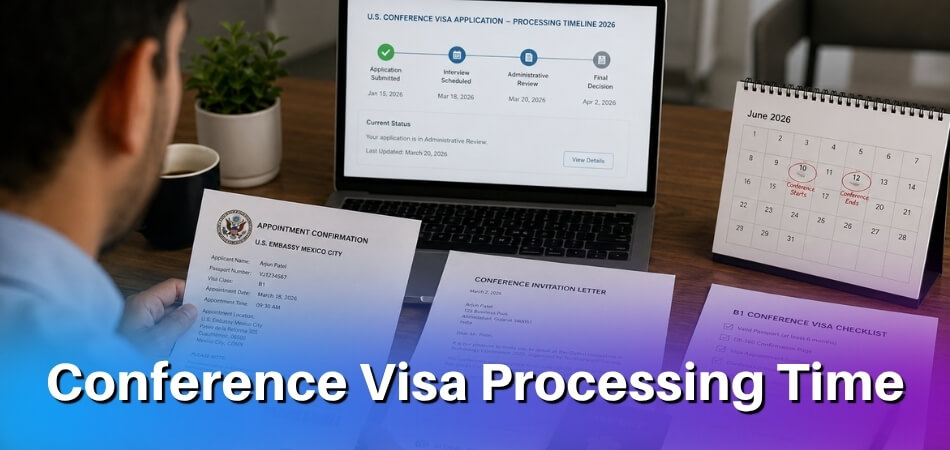
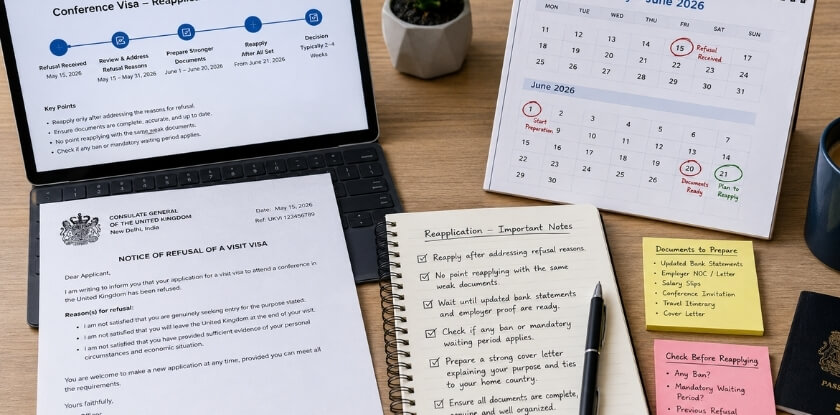
For visitor visas, the US, Canada, the UK and the Schengen states have no fixed waiting period after a refusal, so you can legally reapply at once. Reapplying before you have something new to show usually gives the same result.
Waiting Periods and Review Options: Schengen, US, UK and Canada
| Destination | Fixed waiting period | Previous refusal on record | Appeal or review for a visitor visa |
|---|---|---|---|
| Schengen | None | Yes, in the visa system; a past refusal must not lead automatically to a new one (Visa Code Art. 21(9)) | Right to appeal under Art. 32(3), run under the national law of the deciding state |
| United States (B-1) | None | Yes, the officer sees it | No appeal; apply again with a new DS-160 and a new fee |
| United Kingdom (Standard Visitor) | None | Yes | Usually no appeal and no administrative review for applications made outside the UK; the letter says what applies |
| Canada (visitor visa) | None | Yes, IRCC keeps it | No appeal; judicial review at the Federal Court is possible but strict on time and usually needs a lawyer |
Schengen. You can reapply the next day, but a file that looks the same will probably meet the same answer. If the letter cited funds or ties, those exact points must now be stronger. If the date allows, four to eight weeks is a sensible planning window. That is our rule of thumb, not an official figure. It is enough time to collect better statements, a fuller employment letter and a reissued invitation.
United States. The State Department says you may reapply after a 214(b) refusal if you have new information or your circumstances have changed significantly. You need a new DS-160, a new application fee and a new interview. The earlier refusal stays on record, and because a previous refusal rules out the interview waiver, expect to attend in person. After a 214(b) refusal, a quick return with the same background will most likely fail again. Wait for a real change, such as a new job contract, a property document or dependents you can show, and bring it with you.
A 221(g) refusal is different. It usually means the officer asked for more documents or processing, not that the application was judged on its merits, so follow the instructions on your slip before you start a new application.
Since 6 September 2025, most nonimmigrant visa applicants are expected to book at a US embassy or consulate in their country of nationality or residence, so moving the application to another country is generally not a way round a refusal.
United Kingdom. There is no set wait, and the decision letter is detailed, so write your new cover letter against its numbered points. Your letter will say whether any review right applies.
Canada. You can apply again immediately, but officers will see the earlier refusal. IRCC says to reapply only if your situation has changed or you have new information that answers the refusal reasons, for example a different purpose of travel or a change in your job or finances. Since 29 July 2025, IRCC has sent an officer decision note with most temporary resident visa refusal letters, so read the note and the letter together. If the reasons stay unclear, a lawyer or a regulated Canadian immigration consultant (RCIC) can help you read the gap. Before you refile, check what improves your odds of getting a Canada visitor visa.
If You Are From a Country on a US Restriction List
In 2026 the US has two rules that change the picture for some nationalities. Presidential Proclamation 10998 partially suspends B-1/B-2 visa issuance for nationals of 19 countries, Nigeria among them, from January 1, 2026. A visa bond of USD 10,000, 15,000 or 20,000 (paid through Pay.gov with Form I-352) became a permanent program on August 3, 2026 for listed countries, again including Nigeria. The list can change, so check it before you pay.
If your country is covered, a stronger file may not be the only thing that decides the result. Check the current list and exceptions on travel.state.gov before you pay for a new appointment.
Why You Should Still Wait, Even Without a Rule
No mandatory wait does not mean reapply today. A file that arrives days after a refusal with near-identical documents tells the officer either that you do not understand the refusal or that you hope someone will overlook it.
Time lets you build something different. Three months of bank statements look steadier than one. A presenter confirmation replaces an attendee confirmation. HR can write an employment letter that names your approved leave dates and your return date.
Watch the event date as well. If the conference is six weeks away, the pressure to send a rushed file is real. Ask the organizer whether you can join online while you prepare a stronger application for a later event.
Conference-Specific Documents You Must Strengthen for Your Reapplication
Conference paperwork should answer one question: why is this person going, and why will they come back? Rebuild the invitation letter, registration proof, program and role confirmation so they agree with each other and name you.
Invitation Letter: What Makes It Strong and What Makes It Weak
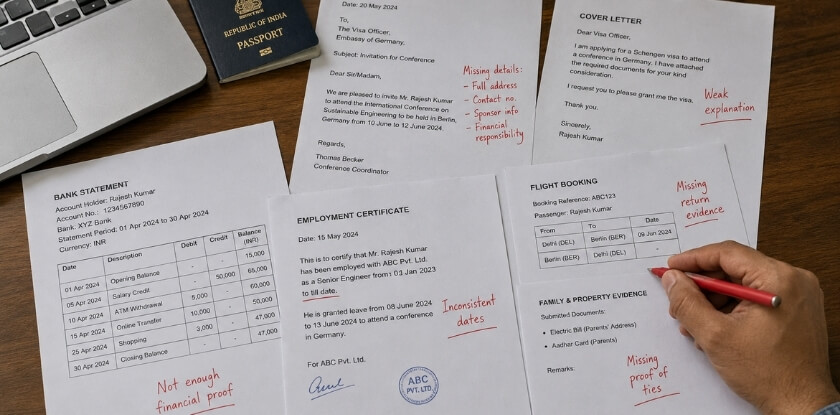
A weak letter is one or two generic lines on letterhead: “We are pleased to invite [Name] to attend [Conference].” It tells the officer almost nothing.
A strong letter names you and your role (speaker, panelist, workshop leader or delegate), the exact dates and venue address, and, if you are presenting, the paper or session title. It says who organizes the event and how large it is. It is signed by a named person with a title and contact details an officer can check. Officers do sometimes call or email.
Things that hurt your case: no name, no dates or venue, a signature with no title, and no organizer contact. If your first letter had any of these, ask for a reissue. Explain that you are reapplying after a refusal and say exactly which detail needs to change.
Registration Proof, Program Schedule and Presenter or Attendee Confirmation
These three work as a set, so check them against each other.
- Registration proof: your name, event name, dates, and a confirmation number or receipt. A paid receipt shows more commitment than a free sign-up. Add the paperwork if your employer paid.
- Program schedule: send the full program if you can, with tracks, keynotes and sessions. It shows the event is structured and real.
- Presenter or attendee confirmation: a separate written note of your role, such as an accepted abstract, a chaired session or delegate registration. If the conference system did not produce one, email the program committee and ask.
Dates must match everywhere. An invitation that says June 12 to 14 next to a registration that says June 13 to 15 can be enough for a refusal.
Getting Help from the Organizer or Host Institution
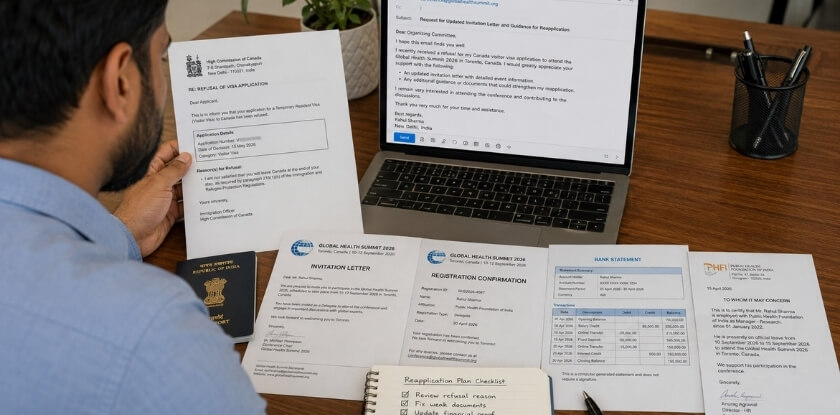
Organizers handle visa problems regularly, so ask plainly. Tell them you were refused and are reapplying, then request:
- A reissued invitation letter with full details.
- A supporting letter from the host university, professional body or company confirming the conference is genuine.
- Anything that proves your role: abstract acceptance, session assignment, speaker listing.
Check the conference site for a visa support contact and use it instead of a general inbox. If the organizer already has a template letter, use it as written. Those templates exist because they have worked before. For university-hosted events, a department letter carries weight with Schengen and UK officers.
What to Do If Your Home Country Ties Are Weak
Weak ties to your home country are a frequent reason a conference application fails. The fix is documents that show a clear, believable reason to be back on a plane after the event, not just a bank statement and a short letter.
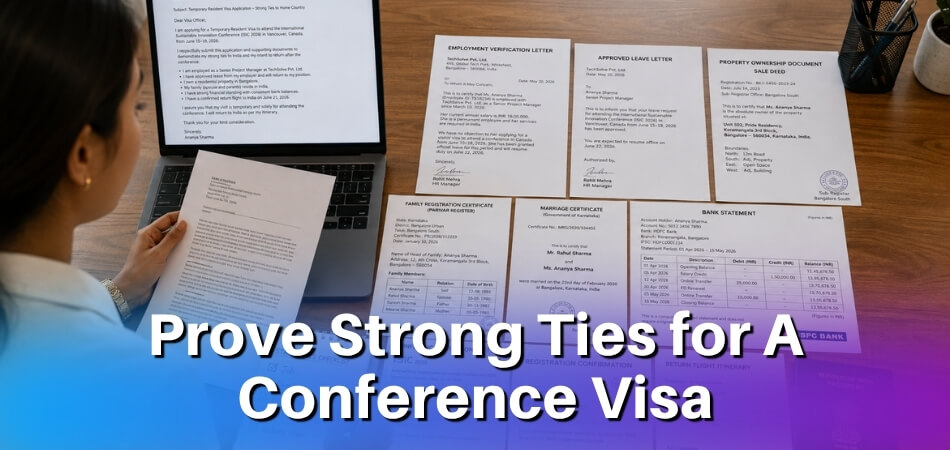
Ways to Strengthen Ties: Employment Letter, Property and Family
Start with the employment letter. A weak one says only that you work there and may attend the conference. A strong one confirms your position, salary and length of service, states that leave is approved for exact dates, and gives your return date. HR or your manager should sign it on letterhead. If you are self-employed, ask your accountant or professional body to confirm your business registration and client commitments.
Property helps. Include a title deed or land registry document, a mortgage statement, or a signed lease that runs past the conference dates.
Family ties are often underestimated. A marriage certificate, children’s birth certificates or a short factual letter about dependent parents is enough. Keep it plain. Students should get a letter from the university confirming enrollment, expected graduation and any exams or thesis deadlines after the conference.
How Strong Your Financial Proof Needs to Be
Officers look for a pattern: steady income, stable savings and no sudden jump. One large deposit just before applying is a red flag. As a general practice, include three to six months of statements. None of the four destinations publishes a single minimum balance for a conference trip, so the test is whether the trip is affordable for you without strain.
- Bank statements for the last three to six months, not just the latest month.
- Payslips for at least three months.
- Employment confirmation with salary, matching the employment letter.
- Sponsor letter if an employer or institution pays, listing what is covered: flights, accommodation, registration, daily costs.
- Funding proof for a grant, scholarship or speaker honorarium, from the organizer or host institution.
The documents must agree. A payslip showing one salary and a bank balance that never reflects it will be noticed.
Writing a New Cover Letter for Your Reapplication
The new cover letter has one job: show that the problems from the first application are gone. Write a fresh letter, keep it factual, and answer the stated refusal reason with named documents.
Address the Previous Refusal Directly
Do not pretend the refusal did not happen. Officers can see your history. Open with one short paragraph, for example: “My previous application for a Schengen visa was refused on [date]. I understand the concern was [reason]. I am reapplying with additional documents that address it.”
Then say what is new, and name the documents. If funds were the issue: “I have enclosed six months of bank statements, a letter from my employer confirming my salary, and a conference grant letter covering travel.” If ties were the issue: “I have enclosed an updated employment letter with my return date, proof of property ownership and details of my family responsibilities.”
If you were given no detailed reason, address the ties question head-on. Do not argue with the earlier decision. You are not appealing, you are reapplying, so the tone should be calm and forward-looking. Where the reasons were stated clearly, answer them one by one in short paragraphs.
Explain Why You Must Attend and When You Will Return
If you are presenting, say so in the first three lines, with the conference name, city, dates and your role: “I am scheduled to present a paper titled [title] at [Conference] in [City] on [date]. I am the lead author and my attendance is required for the oral session.” Summarize your presenter or attendee confirmation in the letter itself and mention the enclosed invitation letter and registration proof.
For the return, be specific. Give the end date of the conference and your return flight date. Say what you are going back to: a job, ongoing research, a class that starts the following week. For example: “My employer has approved leave from [date] to [date]. I am expected back at work on [date], as the enclosed employment letter confirms.” Academics can add a dissertation defense, a teaching commitment or a grant milestone.
Keep the whole letter to one page: two short paragraphs on the refusal and what changed, two on the conference and the return, and a closing line listing enclosures. Longer reads as anxiety.
Declare the Earlier Refusal Truthfully on the New Form
If the application form asks whether you have been refused a visa before, answer yes and give the details. A disclosed refusal is only a past decision. An untrue answer can become a misrepresentation finding. In Canada, IRCC says misrepresentation can make you inadmissible for five years. In the US, a misrepresentation finding is a permanent ineligibility unless a waiver is granted.
Common Mistakes to Avoid When Reapplying for a Conference Visa
Most people refused twice repeat the same errors as the first time. The common ones are sending identical documents, fixing the wrong problem, rushing, and mixing up an appeal with a reapplication.
Submitting Identical Documents or Ignoring the Reason
Adding one bank statement to the old file is not a reapplication. Every document you submit should respond to something in the refusal letter.
Applying Too Soon or Skipping the Context in Your Letter
A generic cover letter that never mentions the earlier refusal reads as if you did not notice it.
Treating an Appeal and a Reapplication as the Same Thing
A review or appeal challenges the original decision, while a reapplication is a fresh submission. For most conference travelers a clean reapplication is faster, so check the table above and your letter before you spend money on any review route.
Vague Conference Documents and the Wrong Visa Category
A payment receipt alone, or an invitation that does not state your role, is too thin. Ask for a confirmation that names the conference, dates, location and a contact who can verify you, and attach your abstract or session title if you present.
Some applicants repeat the same category when another fits better. If you are unsure, ask a consultant or lawyer, or check the destination’s official category pages before filing.
What to Do If You Have Been Rejected More Than Once
After a second refusal, stop and change the approach before you file a third time. Check whether a review route exists, consider paid professional help, and ask the organizer about online participation.
Check Whether an Administrative Review or Appeal Option Is Available
Appeal and administrative review are different, and neither exists everywhere.
- Schengen: applicants have a right of appeal, but it is run under the national law of the state that made the final decision. Deadlines and courts differ, so use that state’s embassy instructions and not a general guide.
- United States: there is no appeal. Under consular nonreviewability the officer’s decision stands, and your real option is a new application with materially different evidence.
- United Kingdom: Standard Visitor refusals made outside the UK usually carry no appeal or administrative review. If your letter names a review right, follow its deadline exactly.
- Canada: there is no appeal for temporary resident applications. Judicial review at the Federal Court exists, but it needs permission and has short deadlines, and it checks the process, not the merits. It rarely makes sense for a conference trip.
When to Get a Visa Consultant or Immigration Lawyer
Two refusals is a reasonable point to pay for help. A consultant can audit your file and spot gaps you are too close to see. A lawyer is worth the cost with prior violations, ties that are hard to prove, or a category that sits between conference attendance and work. Nobody can promise approval, and anyone who does should be avoided. IRCC states that hiring a representative does not increase your chances or change a previous decision, so pay for an audit of the file, not for a promise.
To find someone, ask the organizer or a host university for names. In the UK, check the OISC register. In the US, look for AILA-member attorneys. In Canada, use a licensed RCIC or lawyer. If money is tight, a paid one-hour review of your refusal letters is still useful.
Online Conference Attendance as a Fallback
This is not giving up. Some conferences offer virtual or hybrid attendance, and the conference website or the organizer will say whether yours does. If it does, contact the organizer at once and ask whether your registration can move to the online option and whether remote presentation is allowed. Not every event can do this. MS International conferences are held in person in the Greater Toronto Area, so ask us directly about your options, and note that registration fees are non-refundable.
It also helps your next application, because attending virtually this year is evidence of continued engagement you can mention in a later cover letter.
Final Checklist Before You Submit Your Reapplication
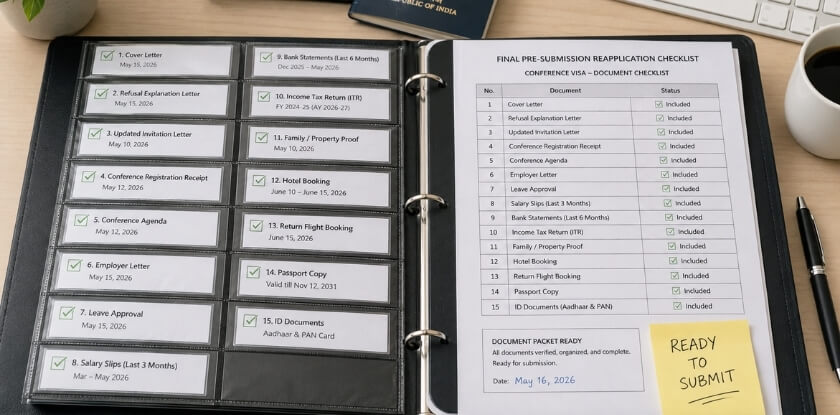
Before you file, confirm that each change answers a refusal reason, that all documents agree, and that the cover letter is new. If any item below is a no, wait and fix it first.
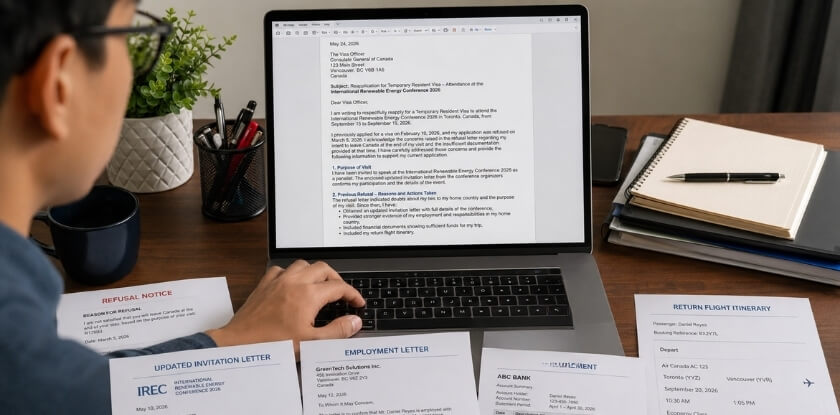
- Refusal letter: every new or changed document answers a stated ground.
- Conference documents: registration proof, signed invitation letter with contacts, full program, and presenter or attendee confirmation, with matching dates.
- Funds: statements are recent (ideally within the last 30 days), cover several months and show no sudden deposit; payslips and any sponsor letter included.
- Cover letter: new, one page, factual, with the refusal acknowledged.
- Timing: you checked the destination’s current rules and the real situation changed since the refusal.
- Review route: you checked whether a review or appeal applies, and that you are not mixing it up with reapplying.
- Backup plan: you know what online options the organizer offers.
Finally, read the whole packet as an officer seeing it for the first time. Does every document support the same story? If something feels off to you, it will to them.
Disclaimer: This article is general information, not legal or immigration advice. Visa rules, fees, and processing times change. Confirm the current requirements on the official government website of the country you are applying to (for example travel.state.gov, canada.ca, gov.uk or the destination’s Schengen embassy) before you apply.
Frequently Asked Questions (FAQ)
Planning a second attempt after a conference visa rejection? Timing, whether to update your documents, appeal versus reapplying and how to mention the earlier refusal in a new cover letter all need a decision first.
Can I reapply for a conference visa immediately after rejection?
Yes, you can file again straight away. The better question is what has changed since the refusal. A reapplication without new or stronger evidence is likely to fail again, and officers can see your earlier refusal.
Does a conference visa rejection permanently hurt my chances?
No. Schengen rules say a previous refusal must not lead to an automatic refusal, and each application is assessed on its own facts, though officers can see the earlier one. Repeated refusals with no change make it harder, and a misrepresentation finding can bar you for years.
Do I need to use the same conference documents or can I update them?
Update them. If your invitation was vague, ask the organizer for a specific one naming your role and dates. If your registration proof was a payment screenshot, request a formal confirmation. Fresh, detailed papers beat the same file resent.
What if the conference has already happened by the time I can reapply?
Then do not apply for that event. Ask the organizer about recordings or virtual access, and use the time to prepare a stronger file for the next edition.
Should I hire a visa consultant or immigration lawyer?
Not always. After two refusals, or if the reason is vague or complex, paid help can audit the file, and a lawyer helps most with past violations. IRCC says a representative does not raise your chances by itself. For a first refusal with a clear reason, you can often fix the file yourself.
Is a conference invitation letter enough on its own?
Rarely. It shows you were invited, not that the event is real or that you will return home. Pair it with registration proof, the program, your role confirmation, and evidence of ties and funds.
Can I appeal instead of reapplying?
It depends on the country. The US and Canada have no appeal for visitor visas, and UK Standard Visitor refusals outside the UK usually have none. Schengen allows appeals under national law. Your refusal letter states the route. For most conference trips, reapplying is faster.
Will explaining my rejection in the new cover letter hurt me?
Not if you do it calmly. Acknowledge the refusal, say what has changed and name the new documents. Do not argue with the earlier decision, and answer any form question about earlier refusals truthfully.
What’s the most common reason conference visa applications get rejected?
Weak ties to the home country and thin or inconsistent documents are frequent reasons. Officers need to believe you will leave after the event, so an employment letter with leave dates, property or family proof matters most. The conference purpose can be genuine and the file still fails if you look like a flight risk.
What if I can’t get updated documents from the organizer in time?
Try the host institution. A letter from your employer, your registration receipt and the public program can partly fill the gap. It is not ideal, but a complete, honest file beats a polished one with missing parts.
Conclusion: A Rejection Is Feedback, a Reapplication Is a Second Attempt
A refusal usually follows a pattern: weak ties, thin funds, a generic cover letter, or an invitation that does not confirm your role. These are fixable. Go back to the refusal letter, tie every change to it, and write the cover letter as a short argument, not a request.
If you have been refused twice, paid help or an online option is a practical next step. Rejections are common, and so are successful reapplications. The difference is whether the applicant understood the reason and actually fixed it.