
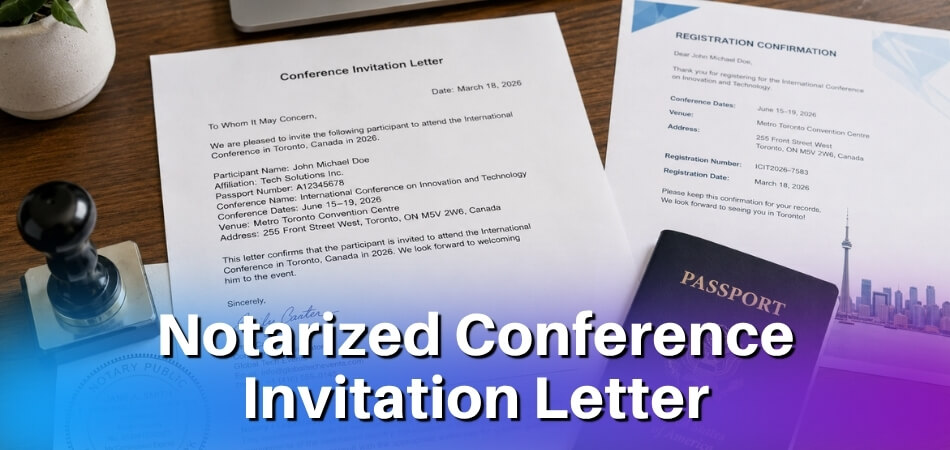
Not sure whether your conference invitation letter must be notarized? Many applicants assume a notary stamp is mandatory and that the consulate will reject the letter without it. For most destinations that assumption is wrong, and chasing a stamp you do not need adds cost and delay.
Quick answer: No, a conference invitation letter usually does not need to be notarized. The U.S. and the UK do not list notarization for conference visitors, and Canada says only some visa offices may ask for it. Notarization matters only when a specific embassy or visa office asks for it, so check your own checklist first.
Fact-checked by the MS International Editorial Team. Last verified against official sources: October 2026.
This article shows what each major destination asks for, the narrow cases where notarization helps, how to get a letter notarized, and a template you can adapt.
Country-by-Country: Where Notarization Is Required and Where It Is Not
Notarization is not a blanket rule for any major destination. It depends on the country and sometimes on the individual visa office.
| Destination | Notarization | What the letter should show |
|---|---|---|
| USA (B-1/B-2) | Not required. The State Department says a letter of invitation is not needed to apply for a visitor visa. | Letterhead, signature, event dates, location, your role, who pays |
| Schengen countries | Varies by country and consulate. France’s business-visit page does not mention it. | Participation, event details, who covers accommodation and fees, a contact number |
| UK (Standard Visitor) | Not listed in the GOV.UK supporting documents guide, which asks for an invitation letter from the event organiser. | Event, your role, travel dates, which costs are covered |
| Canada (visitor visa) | Only if your visa office asks for it. IRCC says some offices may ask for a notarized letter. | Conference name, dates, location, your participation, financial support |
| Other countries | Some explicitly ask. Follow the embassy checklist. | Whatever the mission lists |
USA (B-1/B-2 Visa)
The U.S. does not require a notarized conference invitation letter. The State Department’s visitor visa page lists attending a professional or business conference as a permitted activity and says a letter of invitation is not needed to apply. Consular officers focus on your ties to your home country and the purpose of the trip.
If you do bring a letter, it should be on official letterhead, signed by an authorized representative, and specific about the event dates, location, your role (speaker, attendee, panelist) and who is covering costs. A visa officer can ask for more documents at the interview, and a notarized letter will not hurt, but it is not a formal requirement. For applicants with limited travel history, some immigration attorneys suggest having a notarized version ready as a precaution. That is advice from practitioners, not an official rule.
Schengen Countries
Schengen states set their own document lists, so no single notarization rule covers all of them. France’s page on business visits, on the EU immigration portal, asks for a request letter or invitation from your correspondent in France that accurately describes the activity, purpose, duration and location of the seminar or conference. It lists admission cards to the event, or a commitment by the inviting organisation to cover your costs, as alternatives. It does not mention notarisation. A strong letter confirms your participation, the event details and who covers accommodation and fees, on letterhead with a contact number the consulate can verify.
Individual consulates keep their own checklists, and requirements can differ even within the same visa category. Some applicants report that a notarized letter helped at certain posts, but that is anecdote, not published policy. Check the website of the consulate where you file, for example the German or French post, and follow it.
UK (Standard Visitor Visa)
The UK does not list notarization for a Standard Visitor Visa. GOV.UK’s guide to supporting documents says that if you are attending a business event or conference, you should provide a letter of invitation from the organiser of the event. The same guide lists “notarial certificates” among documents that are less useful as evidence in visit applications. The invitation should say what you will do in the UK, the reason for the visit and whether any costs are met. You must also show that the visit is genuine, that you will leave at the end of your stay and that you can pay your costs.
The UK process is document heavy, and officers assess the credibility of the whole application. A poorly written letter from an organization that is hard to verify online can create more risk than a missing notary stamp. A registration receipt is not a substitute either, because a registration confirmation only proves you paid and hold a place, while the invitation letter proves a host wants you at the event.
Canada
Canada does not make notarization a general rule for conference attendance. IRCC’s letter of invitation page for business visitors says some visa offices may ask for the letter to be notarized, and tells the host to contact the Canadian visa office for the visitor’s country to find out. Some websites claim offices almost always require it, but IRCC’s own wording is “some”, so it depends on your office’s checklist. A letter from the event organizer helps show your purpose of visit, but IRCC says it does not guarantee a visa. You also need to show ties to your home country.
The letter should confirm the conference name, dates, location, your participation and any financial support. For applicants assessed as higher risk, some consultants recommend notarizing as a precaution, even though IRCC does not make it a general rule. Processing guidelines are updated periodically, so verify the current requirements on the IRCC website before you submit. If your checklist asks for notarization, get it done. If it does not, extra stamps will not strengthen the file.
Other Countries with Consular Discretion
Some countries explicitly ask for notarized supporting documents, and this article does not cover every country’s rule. Treat any country not covered above as “ask the embassy”. Where the checklist is silent, the officer reviewing your file decides what to request, so ask the mission before you pay for a stamp. A notary fee is usually small compared with a refused application, so if you cannot get an answer, notarizing is a low-cost precaution. The embassy or consulate’s published checklist takes precedence over any general guidance, including this article.
Notarized vs Non-Notarized Letter: What Is the Difference and How Much Does It Increase Your Risk of Visa Rejection?
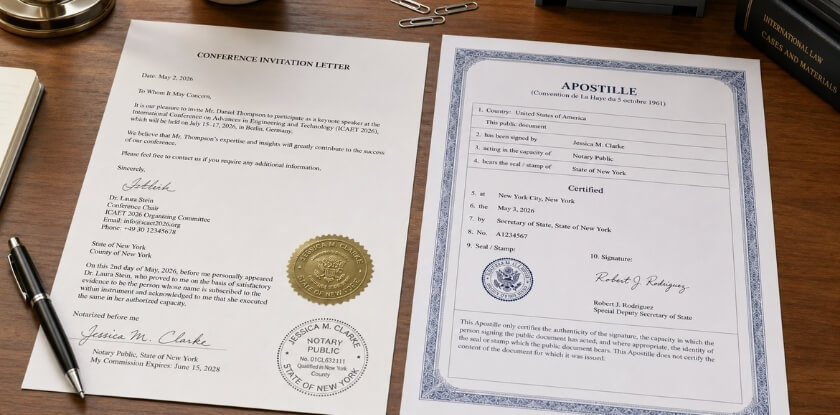
A notarized letter has the same content as a normal one. The only difference is that the signer appeared before a licensed notary public, who certified the signature and added an official seal.
What Notarization Actually Verifies
Notarization does not prove that the conference is real, that you are a genuine scholar or that you will return home. It only confirms that the person who signed was who they claimed to be at the time of signing. Consular officers know this. A notarized letter from a fake conference is still fraud, while an unnotarized letter from a verifiable institution carries real weight on its own.
Does Skipping Notarization Raise Your Rejection Risk?
It depends on whether the destination asks for it.
Where it is not required (for example the U.S. and the UK), a plain letter on letterhead is standard. Submitting a notarized version is unlikely to change the outcome, but failing to submit a clear, professionally written letter will.
Where it is required, a missing notarization is a gap in your documents. The office can ask you for it, which delays the file, or decide on an incomplete application.
The bigger risk in both cases is a weak letter. One that lacks your name, the conference dates, the location, your role and the organization’s contact details gives the officer a reason to doubt the invitation whether or not it is notarized. Notarization cannot rescue a vague letter. A seal also does not correct a misspelled name or a wrong date, so fix any error in your invitation letter first.
| Your situation | Notarize? |
|---|---|
| Embassy or visa office checklist lists a notarized letter | Yes, always |
| Checklist asks only for an organiser’s letter on letterhead | No, a clear signed letter is enough |
| Checklist is silent and the country is not covered above | Ask the embassy first; notarize if they say it helps |
| Letter is vague or from an organization that is hard to verify | Fix the letter first; a seal will not repair it |
The Practical Rejection Math
If your letter is strong, specific and issued by a recognizable institution, leaving out notarization where it is not required will not change your rejection risk. If your letter is weak or vague, notarization will not save it. The calculation changes only when the destination’s official guidance lists notarization as a required document. Missing a required document is a different matter from choosing a simpler format for an optional one, and that rejection is real and avoidable.
Cost and Time Considerations
Getting a letter notarized adds some friction to your process. The cost is usually low, so if you have asked the office and cannot get an answer, notarizing is a reasonable precaution. If you work from a notarized letter template provided by the organizer, confirm it meets your destination’s rules, because a format that suits one visa system may not suit another.
The practical rule is simple. Check the official site for your destination, find out whether notarization is listed, and act accordingly. If the site is silent, ask the office before paying for a stamp.
The Notarization Process: Cost, Timeline, and Online Options
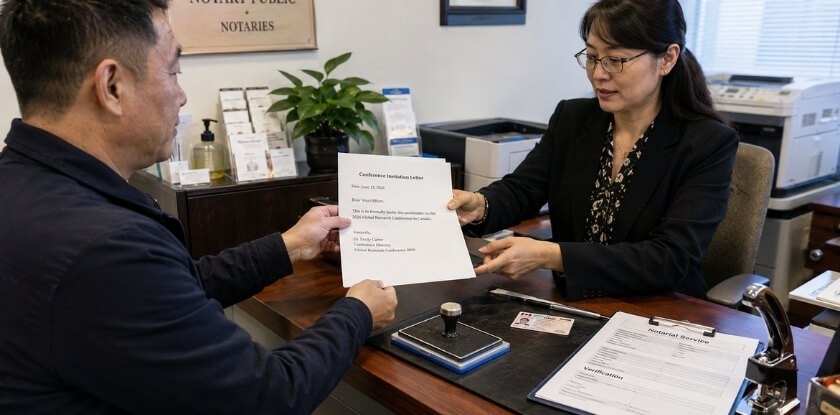
If your destination requires notarization, a simple in-person job can finish in a day, but legalization can add weeks.
| Route | Cost | Time |
|---|---|---|
| In-person notary (bank, UPS store, independent notary) | Usually a small flat fee per document; some banks offer it free to account holders | Often the same day |
| Mobile notary | Higher, especially with travel | By appointment |
| Online notary | Comparable to in-person | Hours, sometimes minutes |
| Apostille or embassy legalization | Separate fee on top | Days to weeks |
| MS International notarized letter | US$100, non-refundable, excludes embassy and visa fees | Up to 10 business days |
How Much Does Notarization Cost?
Fees vary by country and method. In the U.S., a bank, a UPS store or an independent notary usually charges a small flat fee per signature or document, and a mobile notary charges more, sometimes much more if travel is involved. If the document also needs an apostille or embassy legalization, those are separate fees on top of the base cost. Outside the U.S., many countries fix notary fees by law, while others let notaries set their own rates. Check the current fee schedule with your local notary office or chamber of commerce, because figures in articles go out of date quickly.
How Long Does Processing Take?
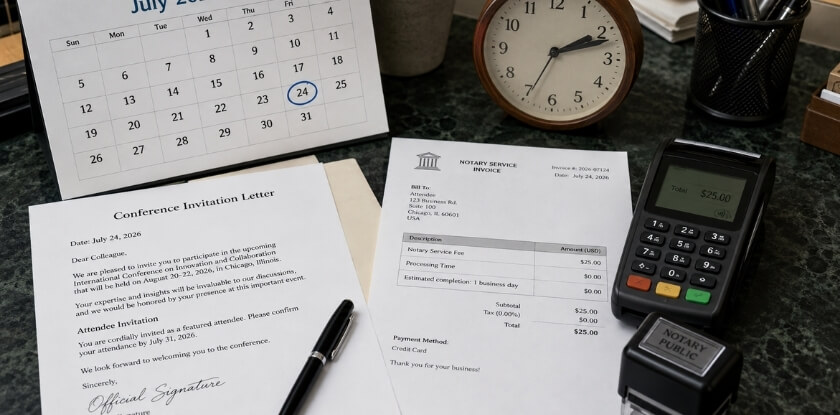
A straightforward in-person job is quick: you bring the document and valid ID, the notary witnesses the signature and applies the seal. The delay usually comes after that. If the consulate also wants legalization or an apostille, or an extra embassy stamp, that step can add days or weeks and has its own queue. Build in lead time before your visa appointment and check the consulate’s current processing times on its official site.
Notarization vs Apostille
A notary stamp is not an apostille. Notarization is an act by a notary public, such as witnessing a signature. Global Affairs Canada describes an apostille as a type of authentication certificate accepted by member countries of the Apostille Convention, which confirms that a public official’s signature and seal are genuine so the document can be recognized abroad. For a conference invitation letter, an apostille matters only if the authority you are applying to asks for one.
Does Online Notarization Actually Work?
Online notarization, where a notary verifies your identity by video call and applies a digital seal, is legal in the United States and a growing number of other countries. For visa purposes, acceptance is not universal. Some embassies accept digitally notarized documents, others require wet ink and a physical seal, and some officers may be unfamiliar with the format.
Sign the letter only in front of the notary, whether at the desk or on the video call. Do not assume acceptance just because the format is legally valid in your home country. Ask the specific consulate before you rely on an online notary. If the guidance is silent and notarization is a known requirement, the safer path is traditional in-person notarization.
Getting a Notarized Letter from MS International
Notarization is not required for conference participation at MS International. If you are connected to one of our conferences, for example as a registered participant, you can request a notarized invitation letter for US$100, and the request may be reviewed based on your registration status. The fee covers preparation, review, coordination and notarization support, and it is non-refundable once submitted, even if the visa is denied or the letter goes unused. Not every organizer offers notarized letters, so ask yours before you rely on one. Requests are processed in up to 10 business days after the details and payment are received, and delivery by courier can take longer. Our standard conference invitation letter is a separate document, issued within 3 to 5 business days after payment clears, and a US$50 fee may apply to corrections requested after it is issued.
From our experience at MS International: Our standard invitation letter is a separate document, and the notarized letter is an optional service for people who specifically need it. Enter your name and passport details exactly as they appear on your passport, because our team may contact you if details are missing or names do not match. Check your embassy’s checklist first and request the notarized version only if it asks for one.
Sample Notarized Conference Invitation Letter Template
Below are two templates: one with notarization language for destinations that expect it, and one standard version without it. Choose the one that fits your destination based on the requirements above.
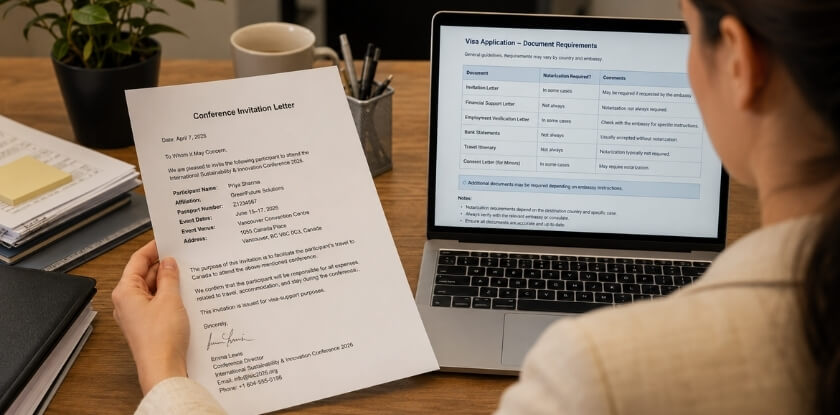
Notarized Conference Invitation Letter (Full Template)
Use this when your consulate or visa office has asked for an authenticated letter.
[Organization Letterhead] [Full legal name of organization] [Street address, city, country, postal code] [Phone number] [Official email address] [Date]
To: Visa and Consular Affairs Section Embassy/Consulate of [Country Name] [City, Country]
Re: Conference Invitation Letter for [Full Name of Attendee], Passport No. [XXXXXX]
To Whom It May Concern,
I am writing on behalf of [Organization Name], a [describe the organization briefly, e.g., registered nonprofit research institute / international professional association] headquartered in [City, Country]. We are the organizing body for [Full Official Name of Conference], scheduled to take place from [Start Date] to [End Date] at [Venue Name and Address].
We formally invite [Full Name of Attendee], a citizen of [Attendee’s Country], holding passport number [XXXXXX] (issued [issue date], expiring [expiry date]), to attend this conference in the capacity of [presenter / delegate / panelist / attendee]. [He/She/They] will be presenting a paper titled “[Paper Title]” in Session [X] on [Date].
The conference registration fee of [amount] has been paid in full. [Or: All conference-related expenses, including registration, accommodation at [Hotel Name], and a per diem of [amount] per day, will be covered by our organization.] [Or, if self-funded: The attendee will bear all personal travel and accommodation costs independently.]
[Attendee’s full name] is expected to arrive on [arrival date] and depart on [departure date]. The total duration of stay is [X] days. We confirm that the purpose of this visit is strictly professional and conference-related.
Should you require any additional documentation or wish to verify our organization’s status, please contact us directly at [email address] or [phone number].
Yours sincerely,
[Signatory Full Name] [Title / Designation] [Organization Name] [Date]
NOTARIZATION BLOCK
State of [State/Province] County/Region of [County]
On this [day] day of [Month], [Year], before me, [Notary Public’s Full Name], a Notary Public duly commissioned in and for the State/Province of [State/Province], personally appeared [Signatory Full Name], known to me to be the person whose name is subscribed to the foregoing instrument, and acknowledged that [he/she/they] executed the same for the purposes therein stated.
[Notary Public Signature] [Notary Public Printed Name] [Commission Number] [Commission Expiry Date] [Notary Seal / Stamp]
Standard Conference Invitation Letter (No Notarization)
Use this for destinations where notarization is not a stated requirement. It carries the same core information without the notarial block.
[Organization Letterhead] [Full legal name of organization] [Street address, city, country, postal code] [Phone number] [Official email address] [Date]
To: Visa and Consular Affairs Section Embassy/Consulate of [Country Name] [City, Country]
Re: Invitation to Attend [Conference Name] for [Full Name of Attendee]
To Whom It May Concern,
[Organization Name] cordially invites [Full Name of Attendee], passport number [XXXXXX], to attend [Full Official Name of Conference], taking place from [Start Date] to [End Date] at [Venue Name], [City, Country].
[Attendee name] will participate as a [presenter / delegate / invited speaker] and is scheduled to [describe participation: present a paper / chair a session / attend plenary sessions]. The conference brings together professionals and researchers in [field/industry] from [number] countries.
Conference registration is confirmed. [Include one sentence on financial arrangements: self-funded, or covered by the organization.] The expected travel period is [arrival date] to [departure date].
We support this visa application and confirm that the visit is solely for the purpose of attending this professional event. For any verification or additional information, please contact [contact name] at [email] or [phone].
Sincerely,
[Signatory Full Name] [Title / Designation] [Organization Name] [Date]
Frequently Asked Questions (FAQ)
Whether a consulate wants a notary stamp depends on the country, so this part deals with online notarization, its cost and timing, emailed letters and how notarization differs from an apostille.
Does a conference invitation letter need to be notarized?
Usually not. Notarize only if your embassy or visa office checklist asks for it, as IRCC says some Canadian visa offices may.
Which countries actually require notarization?
None of the U.S., the UK, Canada or France makes it a general rule for conference visitors, though IRCC says some Canadian visa offices may ask. Some other missions do, so check the website of the embassy where you apply.
Will a notarized letter improve my chances of getting a visa?
Not by itself. A notary confirms who signed the letter, not that the conference is real or that you will return home. The officer weighs the whole file, and a seal cannot fix a vague letter or weak ties.
Can I get a letter notarized online?
Often yes, but acceptance varies. Online notarization is legal in the U.S. and a growing number of other countries, yet some embassies require wet ink and a physical seal. Confirm with the consulate before you rely on it.
What happens if I submit a non-notarized letter and the consulate wanted one?
Your application may be delayed while the office asks for the missing document, or it may be decided on an incomplete file. If the official checklist asks for notarization, do not skip it to save time.
How much does notarization cost and how long does it take?
It varies by location and service. In-person notarization at a bank or UPS store is often done the same day and is usually inexpensive, and online platforms are comparable. Check current rates with the service you use.
Is a conference visa different from a tourist visa for this purpose?
Yes, the category matters. A U.S. B-1 covers business and conference travel, while a B-2 covers tourism. Applying under the right category with a letter that clearly states the conference purpose, dates and your role matters more than notarization.
Can the organizer just email me the letter?
Often yes, but check your embassy’s checklist. A signed PDF on official letterhead is the usual format for a standard letter. A notarized version needs the signature witnessed by a notary, in person or on a recognized online platform, so an emailed scan alone is not notarized.
Is a notarized letter the same as an apostille?
No. An apostille is a separate certificate that confirms a public official’s signature and seal are genuine for use in Apostille Convention countries, and a notary stamp alone does not provide it. Request one only if the authority asks for it.
Does MS International offer a notarized invitation letter?
Yes, as an optional service. It costs US$100, takes up to 10 business days and is non-refundable. It supports your application but does not guarantee a visa.
Conclusion
The answer depends on where you apply. For the U.S., the UK and Canada, a clear letter on official letterhead is usually enough, while some visa offices, including some Canadian ones, may ask for a notarized copy. Schengen states set their own lists. Read your own embassy or visa office checklist before you finalize documents, because requirements change and what worked for a colleague last year may not apply to you.
Disclaimer: This article is general information, not legal or immigration advice. Rules and fees change, and visa decisions are made only by the relevant embassy, consulate or immigration authority. Always confirm requirements on the official website before you apply.