
You have one invitation letter and more than one application to file: several family members, a second try after a refusal, or a second country. Rules on reuse are rarely spelled out, so this guide sets out what is allowed, what is risky and when you need a new letter.
Quick answer: One invitation letter can support several visa applications only when it names every applicant and matches one trip, for example a family travelling together. Each person still files their own application. A letter should not be reused for another country, a later trip, or after it was questioned. Some countries set a validity period, so ask for a fresh, recently dated letter.
Fact-checked by the MS International Editorial Team. Last verified against official sources: October 2026.
What Decides Whether One Letter Can Be Reused?
A letter can be shared only if it still describes the trip you are applying for, and the safest rule is one letter, one trip, one group of named applicants.
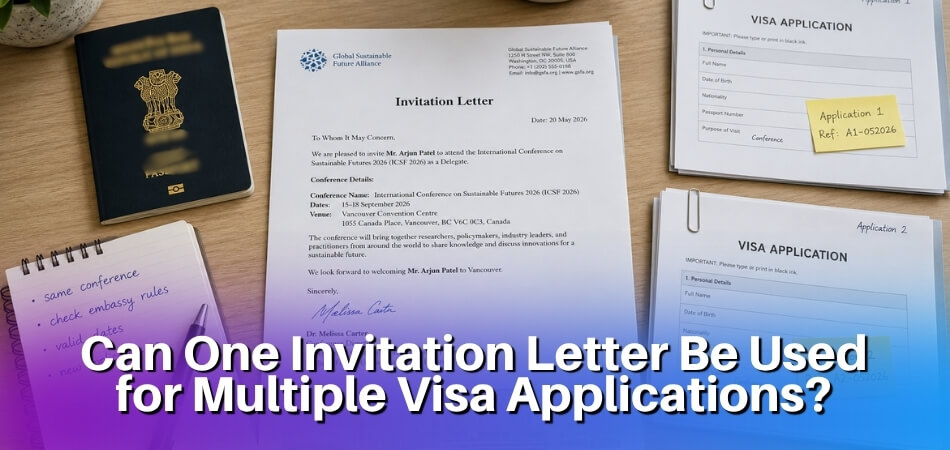
An invitation letter names a person, a purpose and travel dates. Hand the same letter to a second consulate, or use it months later for a new trip, and an officer is likely to see a mismatch. A suspicious document can weaken a file even when everything else is solid. Four things decide whether a letter holds up:
| Factor | Reuse is safer when | Reuse is risky when |
|---|---|---|
| Names | Every applicant is named in full | It says only “and family” or names one person |
| Dates | Travel dates are still current | The dates have passed or shifted a lot |
| Specificity | It matches the trip, address and purpose | It is a generic template for a different trip |
| Visa type | It fits a single trip, or a multiple entry request that explains ongoing ties | It was written for a different visa or country |
A notarized letter carries a fixed date and signatory, so using it for a later application period can look like a reused document. The legal weight of a letter does not come from the paper alone. Officers judge it against your dates, your other documents and your whole file.
What Is an Invitation Letter and What Role Does It Actually Play in the Visa Process?
An invitation letter is supporting evidence that tells a consulate who invites you, why and for how long. It does not decide the application.
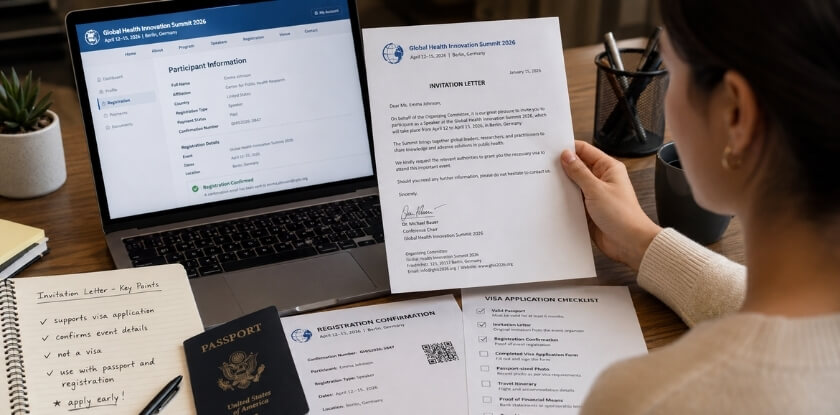
For a visitor visa it goes into the document package with bank statements, an employment letter and an itinerary. Some countries have their own forms that replace or add to a freeform letter, so check which one your destination expects.
Does an Invitation Letter Guarantee Visa Approval?
No. Canada’s immigration department (IRCC) states that a letter of invitation can help but does not guarantee a visa, and that officers make their own assessment of each applicant. The officer weighs your finances, ties to home, travel history and reason for the trip. A well-written letter cannot cancel out weak bank statements or an unexplained employment gap. The opposite also holds: when you say you are visiting family and have no letter at all, an officer may want that link shown another way, so include one where it fits your visa type.
How Does an Immigration Officer Evaluate an Invitation Letter?
An officer asks whether the letter makes sense next to the rest of your file. A letter that says two weeks while your funds and flights suggest six months, or an inviter address that differs from the host’s own documents, will be noticed.
- The inviter. A host who can show status and means adds credibility. An unverifiable contact does the opposite.
- Detail. Dates, itinerary and accommodation help. “I would like to invite my friend” does very little.
- Template language. Legal wording the host could not have written, or factual errors about you, draw scrutiny.
For a multiple entry request, ongoing ties such as a relative who regularly hosts you carry more weight than a one-off invitation that looks written only for the application.
When Can the Same Invitation Letter Be Used More Than Once?
It can be used again for family members who apply together, and sometimes after a refusal, but not for a later trip or a different country. Each case below has its own limit.
Using the Same Letter for Separate Applications for Different Family Members
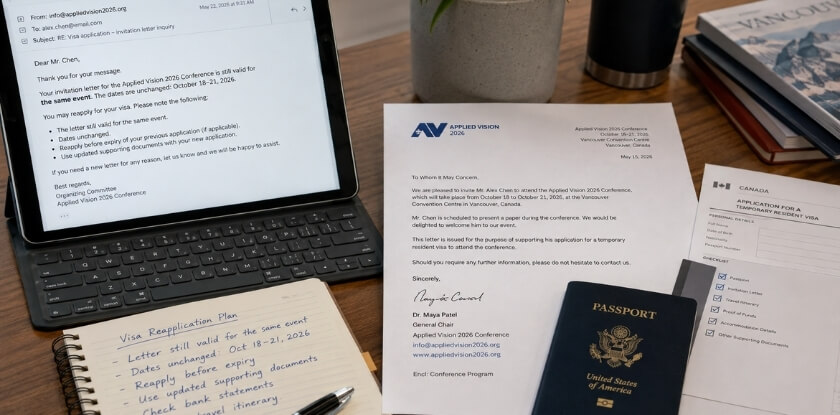
Yes, one letter can cover a family if it names every applicant, states each person’s relationship to the host and confirms the host will accommodate them all. This is the most legitimate form of sharing.
Each person still files an individual application. For a US visitor visa, each applicant completes their own DS-160 form and attends their own interview. List full names, dates of birth and passport numbers if you can. A letter that says “my family” without names is vague. If the letter is notarized, ask the notary whether the notarization covers every named person or only the first one. Where family members have different travel histories or finances, separate letters can serve them better.
Can You Reapply with the Same Letter After a Visa Rejection?
Technically yes, because the refusal was of the application and not of the letter, but only if the letter is still accurate and current. Check why you were refused before deciding.
Official guidance points the same way. The US State Department says that after a finding of ineligibility you may apply again, but you must file a new application and pay the fee again, apart from refusals where only missing documents are needed. IRCC says reapplying with the same information will likely not change a refusal, so address the reasons given in your refusal letter.
- Refusal was about other documents (funds, ties, travel history): the letter can be reused if its dates are still valid and it was not questioned.
- Travel dates have passed: you need a new letter.
- Refusal doubted the host, the purpose or the letter itself: do not resubmit it. Get a new, corrected letter.
A new letter must carry updated dates if your plan moved because of the refusal. Appeal routes are narrow. The State Department says there is no appeal for a refusal under section 214(b), so you reapply with additional information or significant changes in your circumstances. IRCC has no formal appeal for a refused visitor visa either and points to a judicial review at the Federal Court only if you believe the decision was unfair. For most readers, a fresh application with a corrected letter is the practical option.
For Canada, read the refusal letter and the officer decision note that comes with most temporary resident refusals before you ask the host to change anything. They show whether the letter, the funds or your ties were the problem.
Multiple Entry Visa vs Single Entry: How the Letter’s Role Differs
For a single entry visa the letter is tied to one visit, so once the trip happens or the visa expires unused, it has done its job. There is nothing to reuse.
For a multiple entry visa, the letter supported the original application only. You do not present it again on every entry, because the visa itself grants permission to travel. Validity and number of entries depend on your nationality and visa type. If the visa lapses and you apply again, the new application is treated as fresh, so expect to need an updated letter. A first-time multiple entry request can be helped by a host who credibly explains a pattern of returning home. Some hosts add wording such as “open for visits within the next 12 months”, which gives the officer a reason for a multi-trip grant but does not guarantee one.
Rules That Vary by Country and Visa Type
Each country judges the letter against its own checklist, so acceptance in one country means nothing in another.
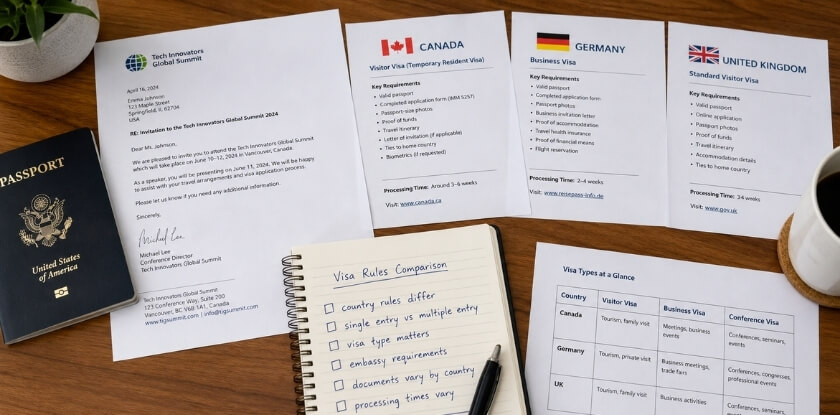
| Destination | Is a letter required? | Reuse point to know |
|---|---|---|
| USA (B visa) | Not a mandatory document | Each applicant files a separate DS-160; a refused applicant files a new application and pays again |
| Canada (visitor visa) | IRCC may ask for one; it does not guarantee approval | Some visa offices ask for notarization, so check your own visa office |
| Schengen area | Depends on the consulate | You lodge one application at the consulate that handles your main destination |
| UK and Australia | Check the official visitor visa page for your visa type | Letter should match each named applicant and be current |
USA (B1/B2 Visitor Visa): Can Two Applications Be Submitted at the Same Time?
Two family members can apply at the same time with one shared letter if it names both. A letter addressed only to John does not cover Mary, even if they are married.
Since 1 October 2025 most nonimmigrant visa applicants need an in-person interview, with a narrow exception for some B-1/B-2 renewals. The interview is where the letter is tested, so expect questions about its origin, your relationship with the host and why the dates line up as they do. A letter from an earlier cycle that you already used for a trip is finished. Get a new one for the next application. A specific personal letter also carries more weight than a generic template printed from a website.
Schengen Area Rules for Short-Stay Visa Applications
The Schengen rules send your application to the consulate of your main destination, so one letter is not meant to support two parallel applications to different member states. The European Commission says that if you visit several Schengen countries, you apply to the country where you will spend the longest time, and to the first country you enter if the stays are equal.
For a single-trip application, the letter must match the dates, destination and purpose. Five copies of a letter naming only Marco Rossi, submitted for five different people, will not work. Rules for the invitation itself are national and differ: Denmark’s immigration service, where its invitation form is used, asks for a separate invitation for each person invited, while Germany’s Federal Foreign Office says the invitation needs no special form but a host who pays the costs must also sign a formal declaration of commitment. Check the checklist of the consulate you apply to. A host who writes in the local language is usually fine, but an English or certified translation avoids confusion when you apply from outside Europe. Hosts are often asked to show proof of their residence status, and an inconsistency between the letter and those papers can prompt follow-up questions.
Other Countries: UK, Canada and Australia in Brief
UK: a letter can name several family members, but each applicant needs documents that support their own situation. If relatives have different travel histories or finances, separate letters often serve them better, and reusing an old letter for a new application is unlikely to help.
Canada: a temporary resident visa or an eTA depends on your passport. If two siblings visit the same host, one letter naming both is cleaner than two identical letters. The host should be ready for questions, since IRCC notes that the inviter must write in good faith and mean the promises made in the letter. Signing it does not make the host legally responsible for the visitor in Canada. Dates matter, and a letter written in January for a March trip but submitted in October will raise questions. For business guests, IRCC asks the company to give each visitor two letters, one to submit with the visa application and one to show when entering Canada, so a second copy for arrival is expected and is not reuse for another application.
Australia: a letter is supporting evidence, so if you include one it should be current and relevant. A two-year-old letter works against you. Sponsored family visits may need separate forms from the Department of Home Affairs.
2026 Rules a Letter Cannot Change
A letter, however well written and however many people it names, does not override a country-level measure. Check the official notice for your nationality or country of residence before you order more letters.
| Measure | What it means for your letter |
|---|---|
| US Proclamation 10998 (from 1 January 2026) | It fully or partially suspends visa issuance for nationals of listed countries, including B-1/B-2 visitor visas for some. A letter does not lift the suspension, so read the State Department notice for your nationality first. |
| IRCC Ebola measures (to 27 November 2026 unless extended) | Applications from people whose last country of residence is the DRC, South Sudan or Uganda are processed but not finalized. Citizenship alone does not decide it, and a letter does not change the pause. |
| US in-person interviews (from 1 October 2025) | Most nonimmigrant applicants must attend an interview, so each family member is asked about the shared letter in person. |
Legal Validity and Time Limits of an Invitation Letter
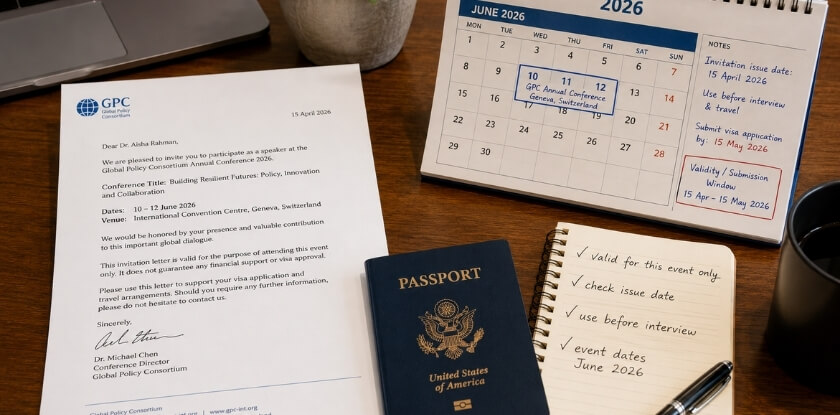
Does an Invitation Letter Need to Be Notarized or Apostilled?
Usually no, but it depends on the country and sometimes on the office. A notarized letter is a private document confirmed by a notary, not an affidavit.
For a US visitor visa, a letter does not have to be notarized, though some hosts do it to show seriousness. IRCC says some Canadian visa offices ask for notarization, so ask your office. An apostille authenticates public documents such as birth certificates and court orders. It is rarely relevant to a private invitation letter and can look odd. Business letters from a foreign company may need notarization when they confirm financial responsibility, and the embassy’s own checklist will say so. Follow that checklist, not a third-party blog.
How Soon Should You Use the Letter After It Is Issued?
As soon as possible, because a stale letter looks inconsistent and some countries do set a limit. Denmark’s immigration service, for example, says an online invitation is valid for six months from the day it is submitted. Where your destination states no period, treat a figure such as “three months” from a blog as practice, not law, unless your embassy states it.
Ask the host to reissue it with a new date if your submission is delayed. When one letter covers a family, all applications should go in close together so it still looks current for every file. If your dates shift, get an updated letter. A letter showing March 10 to 25 when you apply for a May trip will confuse the file even if everything else is in order.
What to Do If Your Invitation Letter Is Rejected or Considered Too Weak
A questioned letter is a fixable problem, but you need to know why it was flagged first.
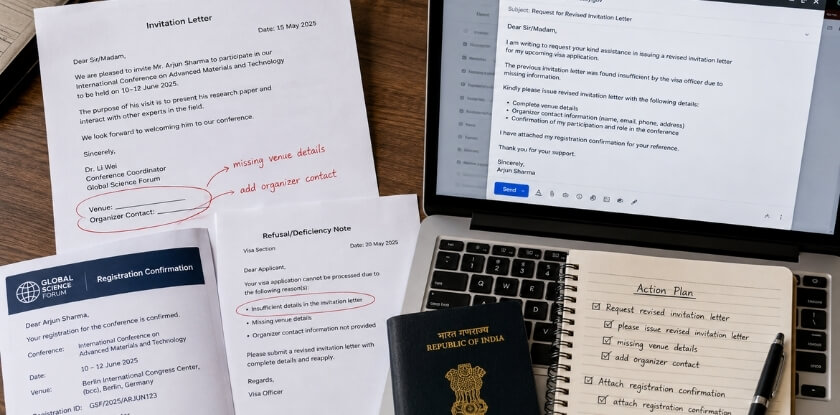
Why Invitation Letters Get Rejected
Letters are rarely rejected at random. The reason is usually one of these:
- It is vague, with no dates, address or statement about who pays.
- The host’s name, address or status cannot be verified.
- It is old, or the dates no longer match the trip.
- It conflicts with other documents, such as a letter saying two weeks and a flight booking showing three.
- It lacks notarization where the embassy asks for it.
For a US B1/B2 application the letter is not mandatory, but a weak one can hurt more than none.
What “Too Weak” Actually Looks Like
A weak letter reads: “I invite my friend to visit me in Germany.” It gives no duration, no accommodation address, no host residence details and no word on costs. A strong one gives the host’s full name, address and legal status, the applicant’s full name and date of birth, exact dates, the accommodation address and a clear line on financial responsibility. Specific letters work better than short, vague ones.
Steps to Fix It
1. Ask for the reason. Not every office explains, but some give a written reason. If the letter is cited, you have your answer.
2. Have the host write a new letter. Do not patch the old one. The new letter should close the specific gap: missing dates, no financial statement or a vague relationship.
3. Add supporting documents. Include the host’s proof of residence, an ID or passport copy, bank statements if they pay, and evidence of the relationship such as photos, emails or earlier visits.
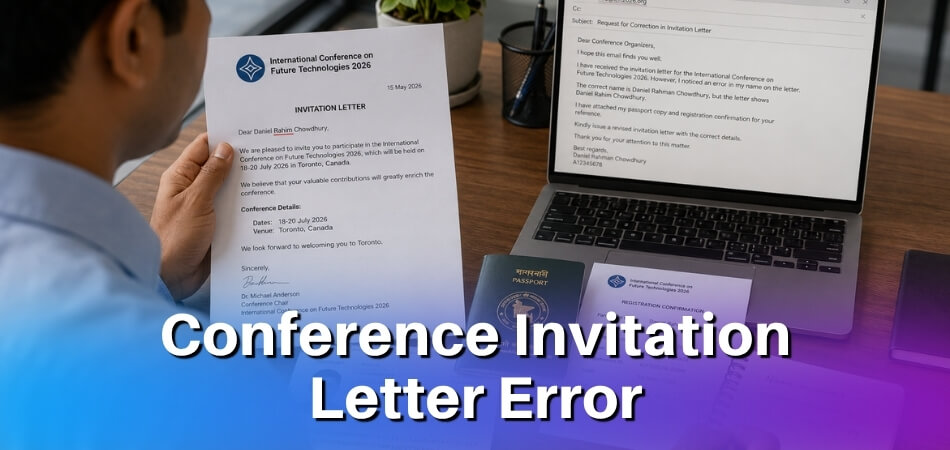
4. List every family member by name. If the first letter named only the main applicant or used phrases like “and family”, the fix is simple: the host writes a new letter listing every applicant by full name. A visa officer reviewing a file for four people needs to see all four names.
5. Notarize only if required. If your visa office asks for it, a plain letter will not be accepted however well it is written.
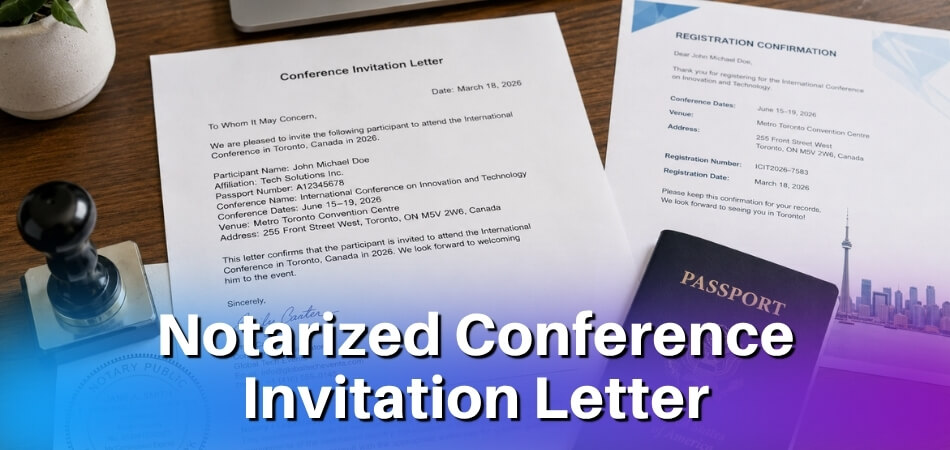
From our experience at MS International: A conference letter is issued for the specific registered participant, conference, date and location stated in it, so it does not cover another person or another conference. Our letter is issued within 3 to 5 business days after payment clears, and a US$50 fee may apply to corrections after it is issued, so check your name, passport details and dates before you register. If you need a notarized version, it costs US$100, takes up to about 10 business days and is non-refundable.
Frequently Asked Questions (FAQ)
Reusing a single invitation letter raises its own doubts, such as whether it can go to two embassies, cover family members applying together, or still serve after a first visa refusal.
Can the same invitation letter be used for two separate visa applications at different embassies?
Generally no. Each embassy judges documents against its own checklist, and some issuers, such as universities, ask for a separate request per consulate. If you apply to two countries, ask the host for a separate letter for each, with dates and purpose that match.
Can one invitation letter cover multiple family members applying together?
Often yes, if it names every applicant, but each person still files their own application. List each person’s full name, relationship to the host and passport number. Some countries, such as Denmark, ask for one invitation form per person, so check the embassy’s guidance first.
Does an invitation letter expire?
It depends on the country. Denmark’s online invitation is valid for six months from submission; where your destination states no period, an old letter can still look stale. Ask the host for a recently dated one, and get a new one if your dates changed.
Can I reuse an invitation letter if my visa was rejected the first time?
Sometimes. Reuse it only if the refusal was about other documents and the letter’s dates are still accurate. The US needs a new application and a new fee, and IRCC expects new information. If the letter was questioned, was too vague or is out of date, have it rewritten first.
Does an invitation letter need to be notarized or have an apostille?
Usually not. A signed letter on plain paper or letterhead is typically enough for a visitor visa. If the embassy or visa office asks for notarization in its checklist, follow that exactly.
Can a letter written for a multiple entry visa be reused for each trip?
You do not resubmit it for each entry, because the visa itself covers re-entry. You may need a fresh letter if the visa expires and you apply again, or if your travel purpose has changed.
What if my host abroad cannot write an invitation letter in English?
Check the embassy’s language rules first. If the letter is not in an accepted language, attach a certified translation. A letter the officer cannot read is worse than none.
Is a digital or emailed invitation letter acceptable?
Usually yes, a printed copy of an emailed letter is common practice unless the checklist asks for an original. Make sure the print is clear and shows the host’s contact details so an officer can verify it.
Conclusion: One Letter, Used the Right Way
One letter can cover a family that applies together, provided it names everyone and matches the trip. Do not carry it to another country, another trip or a second application without checking that the dates and details are still true. If in doubt, ask the host for a short, recently dated letter and check your embassy’s checklist.
Disclaimer: This article is general information, not legal or immigration advice. Visa rules and fees change and each application is decided by the relevant government, so confirm requirements with the official embassy, consulate or immigration website before you apply.