A business and management audience is rarely one audience. The professor next to you is checking your identification strategy, the consultant behind her wants to know what a manager should do on Monday, and both will tell you if they are not convinced.
Quick answer: To present research at a business and management conference, build the talk around one finding and one managerial implication, show your results with one chart per message, and keep company names and data out of the slides unless you have written permission. Rehearse the methods questions, because sample, causality and generalisability are the points a sceptical listener will test.
Last verified against official sources: October 2026.
Below you will find how to structure the slot, present survey, panel or case results, write the implications slide, handle company data, cite on slides, work with a discussant and answer methods questions.

What Makes a Business and Management Talk Different?
Your listeners want two things at once: evidence they can trust and a reason to care in practice. A talk that has only the first reads like a methods seminar, and a talk that has only the second sounds like a sales pitch.
Management research sits between disciplines, so the room can mix people from strategy, marketing, finance, operations, human resources and from companies. Each group hears your terms differently. “Performance” means profit to one listener and employee output to another, so say which one you measured in the first minute.
Plan the talk around three questions that the audience will silently ask:
- What is the problem, and who has it? (a manager, a firm, a market)
- What did you do, and how do I know it is not an accident of your sample?
- What should someone change or stop assuming because of it?
If your slides answer those three in order, the rest is detail.
How Long Is Your Slot and How Should You Structure It?
Check the programme or your acceptance email first, because slot lengths differ between events and sessions. For a sense of the range, the EURAM 2026 conference page says authors in its competitive paper sessions get 10 minutes in a four-paper session or 15 minutes in a three-paper session, with a discussant (where one is assigned) taking about 5 to 10 minutes. George Mason University’s writing centre says a conference presentation runs from 10 to 20 minutes depending on the conference, and the IEEE Author Center gives the same 10 to 20 minute range. Treat these as examples, and use the figure your organiser confirms.
The same writing centre suggests budgeting about one to two minutes per slide and, for a 20-minute talk, around 5 minutes for questions. Divide your time by that rate and you have your slide count before you open the software. If questions are held inside your slot, your talk is shorter than the slot.
In the same email or programme, look for the admin that can catch you late: whether your author registration is complete, whether slides are due before the event, and what equipment the room has. Then start the talk as a new document, separate from the paper, and record one rehearsal on your phone so you can hear where you ramble.
Once you know the number, plan backwards. The table below shows one way to split a 15-minute slot; scale it up or down in the same proportions.
| Part | Minutes | What it must do |
|---|---|---|
| Problem and hook | 2 | Name the managerial problem and the gap in what is known |
| Contribution and theory | 2 | State your question, hypothesis or proposition in one sentence |
| Data and method | 2 | Sample, measures, design, only what is needed to trust the result |
| Results | 5 | Two or three findings, each with one chart |
| Managerial implications | 2 | What a decision maker should do differently |
| Limits and next step | 1 | One honest limitation and what you would do next |
| Buffer | 1 | Room for a slow start or a technical hiccup |
At the short end of the range, choose one finding and one chart and let the rest go to the question period. The IEEE Author Center puts the aim well: get people interested in your work rather than explain all of it.
The paper has a literature review, hypotheses, robustness checks and a long discussion. The talk has none of that space. Cut the literature review down to the single gap you fill, move robustness tests to a backup slide, and keep the full tables for the question period. The paper is what people read afterwards; the talk only has to make them want to.
How Do You Present Survey, Panel or Case Results?
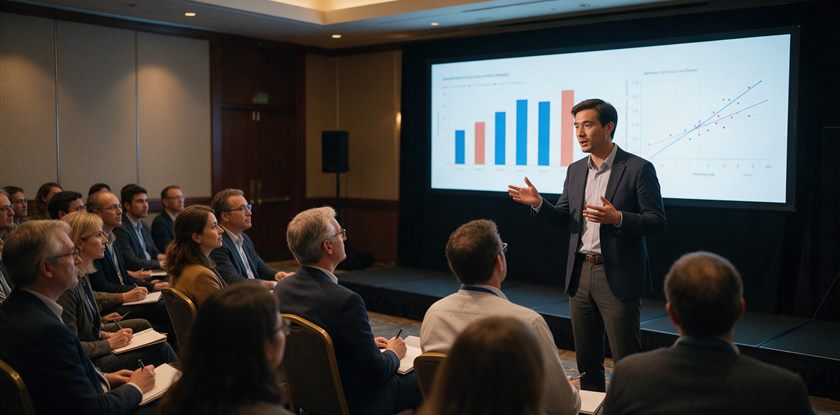
Lead each result with its meaning, then show the evidence. “Firms that trained managers saw lower turnover” is the message; the chart is the proof. Put the message in the slide title as a full sentence and let the chart carry the numbers.
One chart, one message
Give every results slide a single chart and a single takeaway. If you need two comparisons, use two slides. Label axes in plain words, state the unit, and mark the effect you want people to see with a colour or an arrow instead of reading every bar aloud.
Say how big, not only how significant
A practitioner cannot act on “p < 0.05”. Give the size of the effect in terms a manager recognises: a difference in percentage points, a change in days, a gap in score on a scale people know. Then say how uncertain it is.
Match the method to what you show
- Survey data: state the number of respondents, the response rate if you know it, and who was left out.
- Panel or archival data: state the years covered, the number of firms and the main control variables.
- Case studies: state how many cases, how they were chosen and what sources you used (interviews, documents, observation). Show a short quote or a timeline instead of a table.
Do not hide a weak spot in the sample. Naming it yourself, with one sentence on why you still think the result holds, earns more trust than waiting for a questioner to find it.
How Do You Write the Managerial Implications Slide?
Write it as a decision, not a summary. The implications slide should tell a specific kind of manager what to do, what to stop doing, or what to question in an assumption they hold.
Weak: “These findings have implications for human resource management.”
Better: “If your training budget is fixed, put it into first-line supervisors before senior staff; that is where the effect in our data was largest.”
A useful test is to say the sentence to a colleague from a company. If they ask “so what do I do?”, rewrite it. Keep to your evidence, too. Say “our data suggest” where you have one sector, one country or one year, and leave out advice your study cannot support. An overclaim costs you trust with both academics and practitioners.
Whether you need a separate slide depends on the audience. A session aimed at managers and practitioners will expect one, while in a technical academic session you can fold the implications into your conclusion. Check the call for papers or the session description. Two or three implications are enough for a short slot. Put the strongest first, in case time runs short.
Can You Show Company Data and Case Material?
Only what you are allowed to show. Before you put a company name, a screenshot of an internal report or an interview quote on a slide, check what your data agreement, your ethics approval and your employer allow.
- Ask the organisation in writing whether it may be named. If you promised anonymity during fieldwork, keep it, and describe the firm by type and size (“a mid-sized logistics company”) rather than by name.
- Remove details that identify a firm indirectly: a rare product, a small town, exact headcount, a distinctive job title.
- Round or index sensitive figures (revenue, margins, salaries) if the agreement permits sharing the pattern but not the numbers.
- If you are a practitioner presenting your own employer’s project, get sign-off from the person responsible before you submit the slides, not on the morning of the talk.
- Do not read out personal data about named employees or customers, even if it was in your dataset.
Rules differ between universities, companies and countries, so these are habits, not a legal checklist. If you are unsure, ask the organisation and your research office.
How Should You Cite Sources on Your Slides?
Use short author-date citations on the slide and put the full references on a final slide. If the event or your university names a style for slides, follow it; if neither does, use the author-date style of your paper so that slides and paper match.

| Situation | What to do |
|---|---|
| Idea or finding from another study | Put (Author, Year) on the slide in small type, and say the author’s name aloud |
| Chart or table copied from a source | Add the source line under it, and get permission if it is not open or your own |
| Your own data | Write “Source: author’s survey, 2026” with the real year and sample size |
| Company report or industry data | Cite the report with the organisation as author and the year |
| Full reference list | One slide at the end, or in a backup slide, in the style the event asks for. A one-page handout or the speaker notes can carry the same list |
Cite the original study, not a textbook or a slide deck that repeats it. Do not paste a full reference onto every slide; it crowds the chart and nobody reads it. If a questioner asks for a source, the reference slide is your answer.
What Happens in a Paper Session and With a Discussant?
Formats vary by event, so ask the chair or read the session description rather than assuming. In a standard paper session, several presenters speak in turn and questions follow either after each talk or after the last one. Some sessions also have a chair, who keeps time, and sometimes a discussant, who comments on the papers.
EURAM 2026 is one documented example. Its conference page describes competitive sessions with three or four papers in 90 minutes, an optional discussant who gives constructive feedback, and open discussion with the audience for the remaining time. Its paper development sessions work differently: the other authors in the session present and discuss each paper. The same page says accepted authors must keep to the time limits set by the organisers and the session chair. Other events set their own rules, so check yours.
If you have a discussant:
- Send your paper early if you are asked to, and send a complete draft, even if it is rough, so the discussant can read it before the session.
- Take notes while they speak and thank them for the strongest point before you respond.
- Answer the substance of the comment, not the tone. If the criticism is fair, say so and say what you would change.
- Keep your reply short, so the audience can still ask questions.
How Do You Answer Methods Questions in Q&A?
Answer in three steps: acknowledge the concern, say what you did about it, and say what remains open. Causality, sample and generalisability are the natural challenges to any empirical result, so prepare a short, honest answer to each before you arrive.
Endogeneity and causality
If your design cannot prove cause, do not pretend it does. Name the likely source of the problem (an omitted variable, reverse causality, selection into your sample or measurement error), then say what you did to reduce the problem (a control, a lagged measure, an instrument, a comparison group) and what it cannot rule out.
That is a fair point about reverse causality. We used [lagged measure or method] to reduce it, but with observational data I cannot rule it out entirely, and I would treat the result as an association that supports the theory rather than as proof.
Sample and generalisability
Our sample is [number] firms in [sector and country], so I would not claim it holds everywhere. The mechanism should apply to similar firms, and testing it in [another setting] is the next step.
Practitioner questions
Practitioners will want to know “would this work in my company?”. Answer with the conditions: the size, sector and setting in which you saw the result, and what you would check first before acting on it.
In our data this held for [type of firm]. If your situation is different in [specific way], I would run a small pilot before changing anything.
When you do not know
Say so plainly and offer a next step. “We did not measure that, so I cannot say from our data; my guess is X, and I would want to test it” is stronger than a vague answer that sounds sure.
What Should You Do on the Day?
Rehearse aloud, test your files before the session, and talk to the room rather than to the screen. Day-of problems are small and avoidable if you prepare.
- Rehearse with a timer. Do at least two full rehearsal runs out loud, one of them in front of a colleague who does not work in your sub-field. If they cannot say your finding back to you, simplify it.
- Prepare for a hard stop. Organisers and chairs enforce the time limit, so know which slide you would skip first if you are told you have two minutes left.
- Bring two copies. Keep your slides on a USB drive and in cloud storage, and a PDF version in case fonts or animations fail on the room computer.
- Check the room. Arrive early enough to test the connection and see whether the chart colours are readable on the projector.
- Look at people. Glance at your slide to cue yourself, then turn and speak. Notes are fine; a script read from the page loses the room.

Nerves are normal, and a well-rehearsed first minute is the best cure. Learn your opening sentence so well that you can say it without looking at anything, and the rest tends to follow.
How Do You Network With Practitioners After the Talk?
Stay for the rest of your session, then talk to the people who asked questions. A question can be an invitation: the person who asked may have a similar project, a data source, or a problem in their company.

- Say what you could offer, such as a short summary for managers or a copy of the paper, not only what you want.
- Ask practitioners what they would need to see before acting on a result like yours. The answer often shapes your next study.
- Offer academics a specific follow-up: a dataset question, a possible co-author, a session to propose next year.
- Write the same day. Send a two-line note that reminds them of the conversation and promises one concrete thing.
If you want a journal article from the work, treat the conference as a test run: revise the paper using the comments, then choose a journal and follow its own rules. Write down every comment you received in the Q&A and in the corridor, sort them into “fix in the paper” and “future work”, and revise before you send the paper anywhere else. Check the journal’s own rules on work that has already been presented before you submit.
From our experience at MS International: For most applicants, the route to our in-person conferences in the Greater Toronto Area is the presenting-author track: submit work for review and register after acceptance. Submissions go through double-blind review, which normally takes about 10 working days, and the decision is an acceptance, revision request or rejection. Full papers should normally run four to twelve pages, in APA style unless the event gives a different requirement, and the work must not be published or under review elsewhere. Keynote and invited-speaker roles are arranged separately with the organizing team and are not obtained by buying an author ticket. Speakers cover their own travel, accommodation, visa, transportation and personal expenses, and speaking creates no entitlement to an honorarium, speaker fee or travel reimbursement unless MS International has agreed otherwise in writing. On the day, the moderator introduces you and presentation lengths may vary, so your speaker confirmation and the final programme are the official sources for your slot. Accepted papers may be considered for conference proceedings where applicable.
FAQ: Presenting Business and Management Research
When your slides turn to a case study, concerns shift to naming the company, adding a managerial implications slide and answering a pointed question about endogeneity.
How long should a business conference presentation be?
Use the length your organiser confirms. As examples, EURAM 2026 gives 10 or 15 minutes per paper depending on the session, and George Mason University’s writing centre says 10 to 20 minutes. Plan to finish a minute early, because overrunning cuts into questions.
Should I include a managerial implications slide?
Yes if the audience includes managers or practitioners; in a technical academic session you can fold it into your conclusion. Write it as a specific recommendation for a type of manager, based only on what your data show.
Can I name the company in my case study?
Only with written permission from the organisation, and within your ethics approval and data agreement. If you promised anonymity, describe the firm by size and sector instead.
How do I answer a question about endogeneity?
Acknowledge the concern, name its likely source (omitted variable, reverse causality, selection or measurement error), say what your design does to reduce it, and state what it cannot rule out. Do not claim an effect your method cannot support.
Do I need full references on my slides?
No. Put short author-date citations on the slides and the full reference list on one slide at the end. Use the style your event asks for; if it names none, use the style of your paper.
Can I present remotely at an MS International conference?
No standard virtual option exists for speakers. All MS International events are held in person at venues in the Greater Toronto Area, so plan to attend.
Conclusion: One Finding, One Decision, One Honest Limit
A strong business and management talk gives the room one finding it can trust, one decision it can act on and one limitation it can respect. Confirm your slot, build the structure around it, get permission for any company material, and rehearse the methods questions out loud before you travel.