
Your paper got accepted, and for about a day it feels wonderful. Then the practical question arrives: how do you turn a long written argument into a talk that a room of historians, sociologists and literary scholars can follow?
Quick answer: To present at a social sciences or humanities conference, check first whether your session expects a read paper or a spoken talk, then cut your paper to one argument that fits your time slot. Write for the ear, keep slides sparse, protect participants’ anonymity when you show quotations, rehearse aloud against a timer, and prepare for questions about your theory and method.
Last verified against official sources: October 2026.
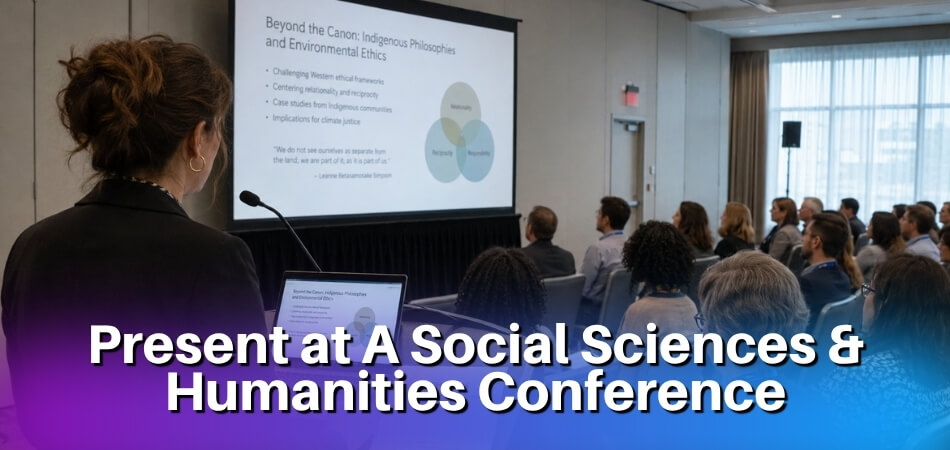
Paper Accepted: What to Do First
Start by separating the paper from the talk, then find your time slot, choose one takeaway and set a rehearsal timeline. Do these four things in the first week and the rest of the preparation gets much easier.
Separate the Conference Paper From the Talk Immediately
Your conference paper and your oral presentation are not the same document. A journal article is built to be read slowly, re-read and annotated. A talk is heard once, in sequence, by people who cannot scroll back.
Open a new file called “talk draft” and keep it apart from the paper. You will pull ideas from the paper, but you will not simply read it aloud.
Figure Out Your Time Slot First
Before you touch a slide, find out how long you have. Slots vary a lot between events, and Q&A is sometimes inside the time and sometimes held after the whole panel. Check your acceptance email and the programme, or ask the panel organiser. Confirming it in writing costs one email and can save you from a nasty surprise.
Published guidance from societies shows how wide the range is:
| Source | What it says |
|---|---|
| American Sociological Association (ASA), 2026 annual meeting | Paper sessions run 90 minutes. With a commentator, each paper gets 19 minutes for three papers, 15 for four and 12 for five. Without one, 22, 17 and 14 minutes. |
| Modern Language Association (MLA), 2027 annual conference call for proposals | Each session is allotted a maximum of 45 minutes including Q+A. Panels are limited to three people including the moderator, and sessions are live and in person. |
| American Historical Association (AHA), annual meeting speaker information | Most sessions last 90 minutes, and presentations and comments should end 30 minutes before the scheduled finish to leave time for discussion. |
| Digital Humanities 2016 presenter guidelines (ADHO) | A long paper gets 20 minutes plus 5 to 10 minutes of questions, with chair warnings at 15 and 19 minutes. |
These are examples of what societies publish, not a standard. The programme for your own event decides.
For planning, use a pace of about 125 words per minute, which is close to the ASA’s 2026 guidance of about two minutes per double-spaced page. Some guidance assumes slower delivery: the AHA’s speaker information reminds presenters reading a prepared text that one hundred words take approximately one minute. Record yourself reading a page and count your own pace. At 125 words per minute a 15-minute slot holds roughly 1,900 words and a 20-minute slot roughly 2,500; at 100 words per minute, roughly 1,500 and 2,000. All of these are far less than a full paper.
Identify the One Thing You Need the Audience to Remember
Not three things. One. What single claim, finding or reframing do you want someone to still be thinking about on the train home? Write it in one plain sentence without academic hedging. Every example and every minute of the talk either supports that sentence or it is a candidate for cutting. It feels brutal, and it is the most useful editing decision you will make.
Set a Realistic Timeline Before Anything Else
If the conference is eight weeks away, you can do this properly. If it is three weeks away, the order stays the same and each step gets shorter.
| Week | What to do |
|---|---|
| 1 | Decide the core argument and a bare outline |
| 2 to 3 | Build minimal slides |
| 4 | First full rehearsal alone, out loud, recorded on your phone |
| 5 to 6 | Revise from what you heard and tighten the opening |
| 7 | Two or three more rehearsals, at least one with a real listener |
| 8 | Rest, travel preparation and the conference-day checklist |
Get Practical Admin Out of the Way Early
In the week after acceptance, deal with the logistics so they do not ambush you later.
- Complete your author registration if the event asks for it after acceptance.
- Check whether you must send slides in advance (some events ask for them a couple of days ahead).
- Find out what AV equipment is provided and whether you need a PDF backup. The ASA’s 2026 guidance warns that not every room has a projector.
- Add the room and session time to your calendar, with a buffer before it for setup.
- Book travel and accommodation. Rooms near academic venues fill early.
A Note on Academic Networking Before the Conference
If you know who is on your panel or chairing it, read their recent work. Even brief familiarity makes the Q&A feel like a conversation, and it gives you something real to say when you introduce yourself before the session.
From Conference Paper to Oral Presentation: Making the Transition
A spoken talk keeps your question, argument and key evidence, and drops most of the rest. Cutting more than half of the paper is normal, not a failure.
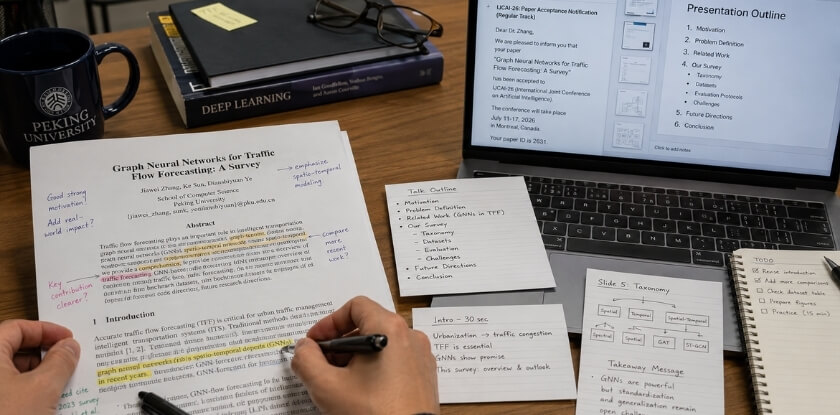
Paper vs. Presentation: Where the Core Difference Lies
Readers control the pace of a paper. They re-read a dense paragraph and flip back to check a definition. A listener cannot. Long subordinate clauses, stacked citations and hedged qualifications that work on the page become almost impossible to follow aloud, because the ear takes in information differently from the eye.
Time is the other difference. A 20-minute slot cannot carry the argument load of a full paper. Think of the talk as a single thread pulled from the fabric of the paper, with one central argument and one clear direction. Everything else stays offstage.
What to Keep and What to Cut in a Short Talk
Your audience needs to know what question you ask, why it matters, what approach you took and what you concluded. That is the skeleton.
| Keep | Cut or compress |
|---|---|
| The core argument, stated within the first two minutes | Extended literature review (you are not teaching a seminar) |
| Two or three pieces of evidence that best support it | Methodological detail beyond what justifies your claims |
| Theory or method in a few sentences | Footnote-level nuance (save it for Q&A) |
| Findings and what they mean | Sub-arguments that could be separate talks |
| One or two implications, or an honest note on what the work leaves open | Long direct quotations (paraphrase, or show a short excerpt) |
A rough shape that works for many talks: context, then the argument, then most of your time on evidence or analysis, then implications. One possible split for a 15 to 20 minute slot is about two minutes of context, one minute on the argument, most of your time on evidence or analysis, and two minutes on implications. Treat it as a starting point, not a rule. You do not need to reproduce the paper’s section order.
After drafting, ask of each section whether it changes the audience’s understanding of the core argument. If it does not, it is not pulling its weight.
Opening Hook: How to Capture Your Audience in the First 30 Seconds
People are still settling in when you begin. The standard opening, “my paper is entitled X and I will argue Y”, is procedural and signals that the next 20 minutes will be too. A hook creates a question in the listener’s mind before you answer it. Four approaches work well in these fields:
- A specific, strange or counterintuitive fact from your case that makes people ask where you are going with it.
- A short quotation that creates tension: one line from a primary source that contradicts what we assume or sharpens your problem. Avoid opening with a theorist’s quotation, which rarely warms a cold room.
- A direct question your talk will actually answer, posed as an invitation rather than a rhetorical flourish.
- A 30-second story about friction: the archival find, the interview answer that did not fit. Listeners from other disciplines anchor to a concrete moment far more easily than to an abstract framing.
Avoid the slow wind-up of three slides of context before you say anything that matters. Nerves push academics to over-explain early because it feels safe, but it only delays the moment people start listening.
Reading a Paper Aloud or Speaking from Notes
Both are accepted in these fields, and the right choice depends on your discipline, the association and the session. Look at the programme and at the other presenters on your panel before you decide.
| Style | Where it tends to fit | How to do it well |
|---|---|---|
| Reading a written paper | Panels where precise wording carries the argument, such as close reading in literature, history and philosophy | Write for the ear: short sentences, signposts, repeated key terms. Mark pauses and look up at the end of each paragraph. |
| Speaking from notes or slides | Sessions built on data, interviews or fieldwork, such as sociology, political science, anthropology and communication | Know the arc of the argument and the order of the evidence. Use slides for data, not as a script. |
| Mixed | Interdisciplinary events | Write out the opening, the core claim and the conclusion. Speak the middle from notes. |
Associations differ in writing. The AAPOR 2026 speaker guidelines tell presenters not to read the paper and to speak from notes, and the 2016 Digital Humanities guidelines ask for the paper’s main points rather than a line-by-line reading. In a 1996 essay in the AHA’s Perspectives on History, Michael C. Coleman argued for speaking from a structured plan instead of reading. The AHA’s current speaker information accepts prepared texts and suggests sharing a copy of your talk, notes or outline with the audience.
A read paper is not a license to be dense. Text that delights a reader loses a listener, so rewrite it: cut parenthetical asides, split long sentences and say the main claim twice in different words. If you are the only person on a humanities panel speaking without a script, some audiences will like it and some will find it jarring, so judge the room.
If you read, keep a finger on your place, rehearse eye contact at paragraph breaks and time the full text aloud. Words on a page take longer to say than most people expect.
Should I Memorize My Entire Talk?
Not word for word. Memorized delivery is brittle, because one missed word can lose your place. Know your argument well enough to explain it without notes, and keep speaker notes with headings or short phrases.
Panels, Chairs and Discussants
Many sessions are panels of several short papers, led by a chair or moderator. Some also have a discussant (some societies say commentator) who responds to the papers after they have been given. Check the programme to see which applies to you.
Your preparation changes slightly for each role:
- Chair or moderator: keeps time and introduces each speaker. Ask how time warnings are signalled, since some chairs use cards and others use gestures.
- Fellow panelists: read their abstracts beforehand. If their work connects with yours, a single sentence linking the two can make your talk feel part of a conversation.
- Discussant or commentator: if you have one, send your paper early. The ASA’s 2026 guidance asks authors to send it early enough for the commentator to read all the papers together, and the AHA’s speaker information sets 1 December for sending papers to the chair and commentator. Expect comments on how your paper connects to the others and what it leaves open. Treat the comments as a gift, thank the discussant and answer the strongest point, not every point.
- Audience: expect people from neighbouring disciplines, so keep your terms accessible.
Stay for the other papers on your panel if you can. It helps the session, and you will often spot who the engaged questioners are.
Building Your Slides: How to Use PowerPoint or Other Tools Effectively
Slides are cues for the audience, not a transcript of your paper, so every slide should have a job. Ask whether it orients the audience, shows a relationship that is hard to say aloud or breaks down a process. If it does none of those, it may not need to exist.
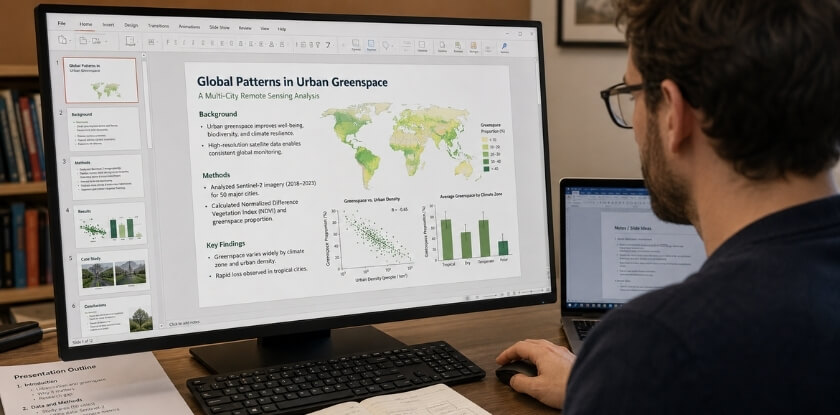
PowerPoint is the safest choice because AV teams expect it. Keynote works if you bring your own adapter, but export a PowerPoint or PDF backup. Google Slides is handy for last-minute edits, but check the fonts on an unfamiliar screen.
As practical defaults rather than official rules, use large body text, high-contrast colours and put your name, paper title and affiliation on the opening slide. Panels fill with people who arrive mid-session and need to know who they are watching. Keep even your most complex slide to about four chunks of information; if you need a fifth bullet, you need a second slide.
Humanities vs. Social Sciences Presentation Style: Key Differences
These are tendencies, not rigid categories.
In literature, history, philosophy and cultural studies, slides when used at all are often sparse: a key quotation in large text, an archival image, a map or painting under discussion. The spoken language carries the argument, and the slides give context.
In sociology, political science, anthropology and communication studies, data visualisation matters. A table of survey results, a chart from your analysis or a network diagram needs to be on screen, because listeners cannot hold those numbers in their heads from a verbal description. Interview and ethnographic work sits in between: a few well-chosen excerpts and one clear diagram of your themes usually do more than a wall of text.
At an interdisciplinary event, aim for the middle. Write out the core argument clearly, do not read every sentence, and use slides to anchor concepts and show data without imitating a quantitative deck if your argument is interpretive.
Make Your Talk Accessible
Plan for accessibility from the start. The ASA’s 2026 guidance asks presenters to use large type and minimal text, describe images and charts aloud, and use the microphone even in small rooms. The AHA’s speaker information asks presenters to describe images in visual aids, give a copy of the talk to any sign-language interpreter and speak clearly without turning away from the audience. AAPOR’s 2026 guidelines advise avoiding animations and transitions, which can cause problems for screen readers. If you need an accommodation yourself, ask the organisers early, because societies set deadlines for requests.
Quotations, Qualitative Evidence and Participant Anonymity
Show short quotations rather than long blocks, and never put a participant’s identity on a slide unless they agreed to it. Qualitative and archival evidence is the heart of many talks in these fields, but it needs more care on screen than it does on the page.
- Keep excerpts short. One or two lines on a slide, with the rest said aloud or paraphrased. Long quotations quickly turn slides into walls of text.
- Attribute every excerpt. Add a small source line (author and year, archive, or an interview code), and say the source aloud too.
- Protect participants. If your research involved people, use the pseudonyms or codes approved in your ethics review, and check that small details such as job title, place or an unusual event do not identify someone in a small community. Canada’s Tri-Council Policy Statement (TCPS 2, 2022), Article 5.3, says researchers shall not disclose identifiable information when sharing findings without participants’ consent, and shall take reasonable measures to avoid inadvertent identification of individuals or groups. Follow the terms of your own ethics approval.
- Name people only with consent. Some participants choose to be named, but agree it in writing first. TCPS 2 (2022), Article 5.1, says participants may waive anonymity, but where other members of the group object because identification could cause harm, researchers shall keep anonymity for all members of the group.
- Take care with photographs and recordings. Faces, voices and screenshots of social media posts can identify people even when names are removed. Leave them out unless you have clear permission, the same rule that applies to classroom photos at education conferences.
- Handle archival and sensitive material respectfully. Say where it comes from, and consider a short content note before showing distressing material.
Qualitative talks also need a sentence or two on method: who you spoke to or what you read, how you chose it and how you analysed it. A listener who hears only the best quotation will wonder whether it is typical.
Explaining Theory to a Mixed Audience
Give each theoretical term one sentence of context and move on. A theory-heavy argument is where many talks lose a mixed room, not because the audience is slow but because they do not share your vocabulary.
You know your framework inside out. The historian in row three may never have met your strand of feminist geography or your application of Bourdieu to digital media. The fix is not to dumb anything down but to slow down when a term is not in common circulation. For example: “I’m drawing on practice theory here, the idea, broadly, that social structures are reproduced through repeated, habitual action rather than conscious rule-following.” That is enough. You have not written a textbook entry, only given listeners something to hold.
- Choose two or three concepts that are genuinely central and give each a slide or a clear visual moment: a large quotation, a simple diagram, or three words that name what you are doing.
- Do not show a genealogy. A list of fourteen theorists tells the audience only that you have read a lot. Name the two or three whose frameworks you actually use.
- Attach theory to a case. A text, an event, a dataset or a community gives the theory somewhere to stand while the audience finds its footing.
- Run a neighbour test. Could someone from a neighbouring discipline follow your core argument without the background? If not, add scaffolding one step at a time.
Interdisciplinary Audiences Need Context, Not Just Names
Mixed rooms need context for people, not only terms. If you cite a scholar from a niche corner of your field, add a short phrase such as “an anthropological linguist whose work on language socialization…” so half the room is not left behind. Listing three or four field-specific terms in advance, with a one-sentence gloss for each, also reduces Q&A anxiety.
Citation and Referencing: How to Credit Sources During Your Presentation
Slides need a short source note, not a full citation, and the full list belongs on a final slide. Presenters either cram citations onto every slide or skip them and look careless in front of an audience that knows the literature.
You Don’t Need Full Footnotes on Every Slide
An author surname and year in small text at the bottom, such as (Author, Year), is usually enough in author-date styles like APA. If you rely on one text across several slides, cite it where you first introduce the idea and move on. If the event or your discipline expects Chicago notes or another style, follow what the event says.
When to Put the Full Reference
Put the full entries on a references slide at the end, in the style the event requires. Audiences may photograph this slide, so keep it legible, and split it across two slides rather than shrinking the text. Have your full bibliography ready in case someone asks after the talk.
Saying It Out Loud
Attribute landmark claims and direct quotations aloud, and do it naturally:
“As [Author] argued in 2026…” “There is a well-known study by [Author] and [Author] that showed…” “This draws on [Author]’s work on affect.”
The audience gets the attribution and you keep your pace.
Visuals and Images
Credit any image, map, photograph or chart that is not your own, in a small line directly beneath it on the slide: Image: [archive or collection], 2026 or Source: [organisation], [report title], 2026. It takes five seconds and its absence is noticed.
What About Unpublished Work?
You can reference your own forthcoming work. In APA style, a work accepted but not yet published is cited as “in press” in place of the year. A draft or a manuscript under review keeps the year it was written, with a bracketed status after the title, such as [Manuscript submitted for publication], in the reference entry. Personal communications such as emails or unrecorded conversations are cited in the text only, with the person’s initials, surname and the date. For someone else’s unpublished work, such as a paper you heard at another conference, ask permission before citing it publicly.
A Quick Rule of Thumb
If you used a source in the written paper, give it at least a passing acknowledgment in the talk. Stripping all attribution to keep slides “clean” is not the answer either: citations show that your argument stands on something solid, and someone will probably ask about your sources in Q&A.
Rehearsal and Time Management: Getting Ready Before You Take the Stage
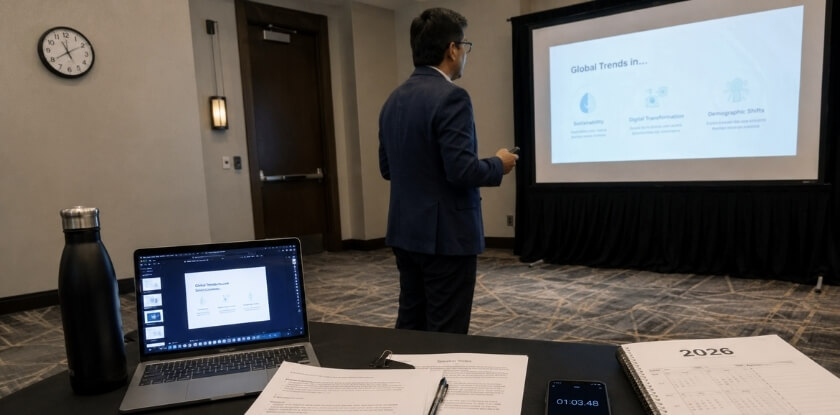
Rehearse aloud, standing up and against a timer, at least several times before the event. Under-rehearsing is easy: skimming your notes once or twice can feel like enough. Rehearsal also calms nerves, because your mouth has already said the words.
How Many Times to Practice and How to Do It Right
Aim for several full out-loud, timed runs. Silent reading in your head is faster than speaking, so you may think a 15-minute talk is fine and then discover it takes much longer. The ASA’s 2026 guidance suggests reading the paper aloud once all the way through and editing until you finish a minute early, since people usually read faster alone than at a podium. Chairs will cut people off mid-sentence, and you will lose your conclusion.
- First runs: keep your notes close and learn the shape of the argument.
- Middle runs: try with only slide headings as prompts. The places where you get stuck show which transitions need work.
- Later runs: record yourself. You will catch filler sounds, dropped volume at sentence ends and too much looking at the screen.
- At least one run in front of a person: a colleague or a friend who knows nothing about your field is a good stand-in for a mixed audience. Ask them to throw hard questions at you afterwards.
If you can, rehearse in a room of similar size. Projecting your voice across a half-empty seminar room feels different from speaking in your kitchen.
Practical Techniques for Keeping to Your Time Limit
- Work backwards from your confirmed limit and your own words-per-minute figure.
- Rehearse with a dedicated timer you can glance at without breaking delivery.
- Mark time checkpoints in your notes, for example “7:00” beside the third section.
- Decide your cut points in advance: the example you can drop and the paragraph that is least essential. The ASA’s 2026 guidance notes that skipping sections on the fly wastes time and looks unplanned, so make that choice cold, in rehearsal, not at the podium.
- If you consistently finish a few minutes early, slow down rather than adding filler. Early is better than late, but far too early suggests you cut too much or rush.
- Ask the chair for a one-minute warning. It also gives you a partner in the room.
Stage Fright and Nervousness: How to Manage Them
Nerves are normal and the aim is not to remove them but to get through the first minute intact. Even experienced professors feel them in the corridor outside the room. Anxiety before you start and anxiety while speaking need different fixes.
Before You Walk In
Eat something and move around on the morning of your talk. Low blood sugar and two hours of sitting rigid are a reliable recipe for a blank mind. Get to the room early and stand at the front while it is empty, so the audience becomes rows of chairs rather than an abstract threat. Write your first two sentences on a small card, word for word, so you never stare into the void wondering how to begin. Trust the muscle memory your rehearsal built.
It also helps to reframe the audience. The people in the room came because they are interested in your topic and want you to do well. They are colleagues, some of them nervous about their own talks later that day.
While You’re Speaking
Nervousness peaks in the first minute or so. Slow down, because nervous speakers rush, and when you feel the urge to speed up, pause and breathe. Look at one person for a full sentence, then another. If you lose your place or blank on a word, do not apologise or fill the silence with noise: pause, glance at your notes and continue. You are reporting something you found out, not performing, and you know this material better than anyone in the room.
The Interdisciplinary Audience Problem
Not knowing who understands your vocabulary can make you second-guess every sentence. Much of the stage fright at conferences is really Q&A anticipation, so prepare your glosses and your likely questions and the worry shrinks.
What to Do If It Gets Bad
If your voice shakes, keep going; it usually steadies within a minute. If your heart races, slow your speech and breathe from the stomach. If you blank completely, “let me check my notes for a moment” is fine. Avoid apologising repeatedly, announcing that you are nervous or rushing to finish early, which wastes the time your acceptance earned you. Accept imperfection in advance: you will probably stumble on a word, and nobody will care as much as you do. The goal is a clear argument, not an unshakeable look.
Delivering Your Presentation on Conference Day: A Step-by-Step Walkthrough
Arrive early, test your setup and then talk to the audience instead of reading your slides. The ASA’s 2026 guidance suggests arriving about ten minutes before your session and AAPOR’s 2026 guidelines 15 minutes, so allow more if you must load slides or find an unfamiliar room. Those two habits separate a forgettable talk from a memorable one.
Check the Venue and Setup in Advance
- See where the laptop and clicker are and whether the microphone is fixed, handheld or clip-on (and who attaches it).
- Open your actual file and click through the first slides. Do not assume the room machine has your fonts or will play your embedded media, and check the projector is not cutting off slide edges.
- Test the clicker’s range from the back of the room.
- If there is a confidence monitor on the floor, find out whether it shows slides or notes.
- Note the room size. A seminar table of twelve and a lecture hall of four hundred need different pacing and projection.
- Talk to the AV technician about microphone gain, feedback risk and who to flag if the display fails. They have seen everything go wrong and are not your enemy.
- Keep your presentation in at least three places: your laptop, a USB drive and cloud storage you can reach from your phone.
Talk to Your Audience: Do Not Read Your Slides
Slides are a visual anchor, not a script. When you turn to the screen and read bullets aloud, people read faster than you speak and start checking their phones. Know the arc of your argument so each slide is just a cue.
- Eye contact: pick two or three people at different points in the room and move between them naturally.
- Projection: speak so the back row does not strain. Acoustics vary a lot between rooms.
- Pace: speed up slightly over background your audience likely knows, slow down on the key claim and pause after it. Silence is not a mistake.
- Reading on purpose: if a dense passage or a long quotation needs precision, read it from the notes or slide. That is fine when it is a choice and not a habit.
- Level: speak as if the audience is intelligent but not specialist in your exact subfield. That avoids both under-explaining and over-explaining.
- When something small goes wrong: a slide will not advance or a phone rings, so acknowledge it briefly and keep the thread of your argument.
The Q&A Session: Strategies for Handling the Hardest Part
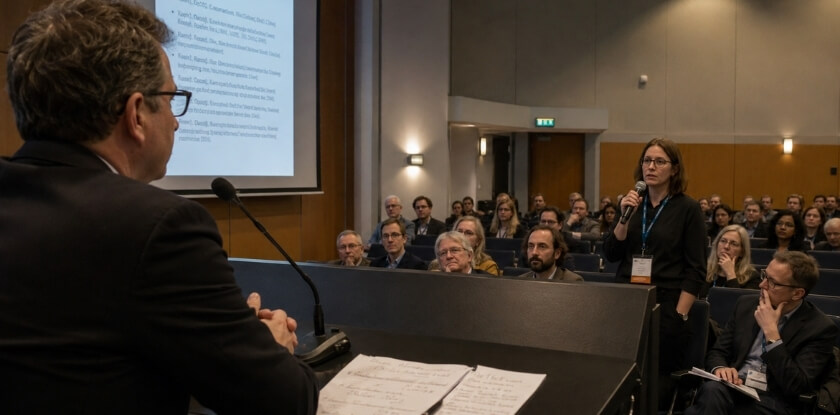
Prepare your likely questions in advance, answer the substance of each one briefly and be honest when you do not know. For many academics, the Q&A is the part that keeps them up the night before, and in these fields the questions can be pointed fast.
Anticipate Likely Questions in Advance
After your rehearsals, ask what a skeptical colleague would push back on. Methodological choices are fair game: why this sample, this period, this archive, this framework rather than another. A single case study invites a question about generalizability, and a non-mainstream framework will need defending. In humanities and theory-led talks, expect “what about the counter-reading?” or “how does this relate to X’s argument?”, and in qualitative work, “how did you decide what counted as a theme?” or “how do you know this participant is typical?”.
Write down ten possible questions, not to script answers but to have thought through your positions. Thirty minutes spent on this is time well used. Mixed audiences add another layer: a historian presenting to sociologists generates questions that feel obvious to the asker and catch you off guard. Ask your rehearsal listener to throw their hardest ones at you.
How to Respond to Difficult or Aggressive Questions
Some questions are critiques with a question mark on the end. Do not panic, do not get defensive and do not argue in public.
- Buy a few seconds by paraphrasing: “So you are asking whether my interpretation accounts for X?” It confirms you understood and is a courtesy to the room.
- Answer the substance, not the tone. If they found a real gap, say so. If you disagree, say so without heat: “I’d push back slightly on that framing, my argument is actually…” When a challenge comes from another discipline, “That’s a really interesting framing, my own approach starts from X, but I can see how your reading would push back on that” buys time and sounds like a scholar in dialogue.
- Keep it tight. Roughly two minutes per answer, since the Q&A belongs to the whole room.
- Redirect gently if a question is really about the asker’s own research: “That’s outside what I’m presenting today, but I’d love to talk about it afterwards.”
- Close the exchange if it keeps escalating. Say once that you will take the next question and offer to continue afterwards. The chair is there to keep the discussion productive.
- Treat a comment as a comment. “Thank you, that’s a useful point to sit with” is a complete response.
Saying “I Don’t Know”: When and How to Do It Gracefully
“I don’t know” is a legitimate academic answer. The wrong version sounds like a collapse. The right version sounds like honesty: “That’s outside what I’ve looked at directly, and I don’t want to speculate without grounding.” Other options:
- “I haven’t encountered that in the literature I’ve drawn on, but it is worth tracking down.”
- “I’m still working through that and don’t have a settled view yet.”
- “I’d need to look more carefully before I could give a useful answer.”
Avoid guessing confidently. A wrong confident answer is remembered, especially in small fields. If a question opens a new direction, say so: “That’s a direction I hadn’t considered; it might change how I frame the next stage.” You can also offer to follow up by email, which is a natural start to academic networking. Write down questions you could not answer, because they are often the most useful ones for your next draft.
What to Do After Your Presentation: Publication and Networking

Turn the feedback into a journal article and follow up with the people you met within a week. Do not let the paper sit in a folder.
The Path from Conference Paper to Journal Article
A journal article is a different animal from a conference paper. Reviewers expect a fuller literature review, a tighter argument, more engagement with counterpositions and consistent referencing, so you are rebuilding rather than reformatting.
- Find the journals. Look at where the papers you cited were published. Check word limits, submission guidelines and open-access status. For an interdisciplinary talk, decide between a disciplinary journal and one that crosses fields.
- Use the Q&A. If three people asked the same question, your argument has a gap. Fix it before you submit.
- Check the rules on prior publication. Many journals will not consider work already published elsewhere, and rules on conference proceedings differ. Read both the conference’s and the journal’s terms before you commit.
- Set a deadline. Revising into a journal-ready draft takes real time alongside other work. Put a submission date in your calendar.
Effective Ways to Network at a Conference
The best connections usually happen when you stop thinking about networking and talk about ideas.
- Before you go, pick two or three people whose work is relevant to yours and read something they wrote. “I read your piece on X and wondered about Y” opens a conversation. “I’m a big fan” closes it.
- Stay after your talk. If someone asked a good question, find them at the coffee break.
- Carry something to share: a business card or a QR code to your university profile or a repository page where the paper is available.
- Attend sessions outside your specialty and ask a question from the floor.
- Follow up within a week with a short email that references something specific. Do not pitch or ask for favours.
Presentation Checklist by Stage
Use this table as a quick reminder at each stage.
| Stage | Key actions |
|---|---|
| One week before | Confirm slot, room, panel and chair. Do a full timed run, finishing a minute or more under your limit. Prepare a one-page handout if you plan one. Charge laptop and clicker and pack the right adapter. |
| Day before | Rehearse the opening again. Pack business cards, a printed copy of your slides as notes and a USB drive. Email yourself the file and upload it to cloud storage. Sleep. |
| Morning of the conference | Eat, arrive early, meet the chair and AV technician, load the slides. Sit in on part of a neighbouring panel if you can. |
| During the talk | Start on time, glance at the opening slide, then look up. Move slides deliberately, watch the clock, cut a point rather than rush your conclusion, slow down on technical terms and cite landmark sources aloud. |
| Q&A | Listen to the whole question before forming an answer, paraphrase, keep answers short, admit uncertainty. |
| After the talk | Exchange contacts, note corrections the audience flagged, thank the chair, send promised papers or reading lists within 48 hours, and save the final slides. Give yourself a break before the next panel. |
From our experience at MS International: All of our conferences are held in person at venues in the Greater Toronto Area, and for most applicants the route is the presenting-author track: submit work for review and register after acceptance. You may submit an abstract, full paper, case study, review paper or professional presentation. Keynote and invited roles are arranged separately, and buying an author ticket does not create one. Submissions use APA style unless the event says otherwise, must be original and not published or under review elsewhere, and go through double-blind review, with decisions in about 10 working days (complex papers or revision rounds can take longer). Full papers should normally be four to twelve pages. Presentation lengths may vary, so your speaker confirmation and the final conference programme are the official sources for your slot. The moderator introduces you before your talk, and a speaker certificate is given after you present. Speakers cover their own travel, accommodation, visa, transportation and personal expenses, and participation creates no entitlement to an honorarium, speaker fee or travel reimbursement unless MS International has agreed otherwise in writing. Accepted papers may be considered for conference proceedings where applicable.
FAQ
Reading the paper aloud versus talking to slides is the first choice humanities presenters face, followed by worries about interview quotations, an unfinished paper, hostile Q&A and the discussant’s role.
How long should my conference presentation be?
It varies by event, so check your programme first. Published examples run from 12 to 22 minutes per paper (ASA 2026 sessions), and Q&A may be inside that time or after the panel. If you have 20 minutes, plan for about 18, since running over irritates both the chair and the audience.
Do I have to read from my conference paper word for word?
No. Check your event’s guidance, because it differs by association: AAPOR’s 2026 guidelines say not to read, while the AHA accepts prepared texts. If you do read, rewrite the paper for the ear. If you speak from notes, speak to the argument, not the text.
How many slides should I use?
Fewer than you think. A common rule of thumb is no more than about one slide per minute, so 12 to 15 slides is plenty for a 15-minute talk, and many humanities talks use far fewer. Blank space on a slide is not wasted space.
Can I use images, maps, or charts in my humanities presentation?
Yes, if they are relevant. A historical map, a painting or a chart can anchor an abstract argument. Credit anything that is not your own in a small line under the image, and get permission before showing identifiable people.
Can I show interview quotations on my slides?
Yes, if you keep them short and protect identities. Use the pseudonyms or codes approved in your ethics review, check your consent wording, and remove details that could identify a participant. Name someone only if they agreed in writing.
What if someone asks a question I genuinely can’t answer?
Say so honestly. “That is outside what my research covers, but it is a good direction” is a perfectly acceptable answer. Audiences respect honesty more than a confident guess. You can also offer to follow up by email.
How do I handle hostile or aggressive questions during the Q&A session?
Stay calm and do not match the energy. Restate the question neutrally, answer its methodological or theoretical substance, and hold your position without heat. If it is really a statement, thank the person and move on.
Is it okay to present at a conference if my paper isn’t fully finished?
It depends on the event. Some conferences accept works in progress and others require the full paper before the event, so read the call for papers and send what it asks for. Your acceptance email should say what is due and when.
Do I need to list full references on my slides?
No. Author and year on the relevant slide is enough, with full entries on a final references slide if you wish. If someone wants your reference list, offer to email it, which is also an easy way to continue the conversation.
What does a discussant do at a conference panel?
A discussant responds to the papers on a panel, linking them and raising questions. The chair introduces speakers and keeps time. Some societies call the role commentator, and papers must reach them in advance, so ask the chair for the deadline.
What if I’m presenting to an interdisciplinary audience that doesn’t know my field’s terminology?
Define key terms early and briefly, in one sentence each, such as “By X, I mean…”. Do not assume shared vocabulary. This prevents confusion without slowing your talk.
What should I do if my technology fails on conference day?
Switch to your backup: a PDF on a USB drive and a copy in cloud storage. If the slides fail entirely, you can still deliver the core of the talk, because your argument should not live or die on a slideshow.
Can presenting at a conference help with academic publishing?
Often, yes. Live questions can sharpen your argument, reveal gaps and point you toward literature you missed. Many conference papers become journal articles, but check the prior-publication rules of the conference and of your target journal first.
Conclusion: A Great Presentation Is Not Just a Paper, It Is a Conversation
The paper proves your argument in full, and the talk invites people into it. Once you accept that, worrying about what you leave out fades, because you are selecting, not summarising.
Nerves shrink with repetition, not confidence, and rehearsal is what bridges the first talk and the tenth. A hard question is not an exam; it means your work is in dialogue. After the conference, send the email to the person who asked the interesting question, and start the journal revision while the feedback is fresh.