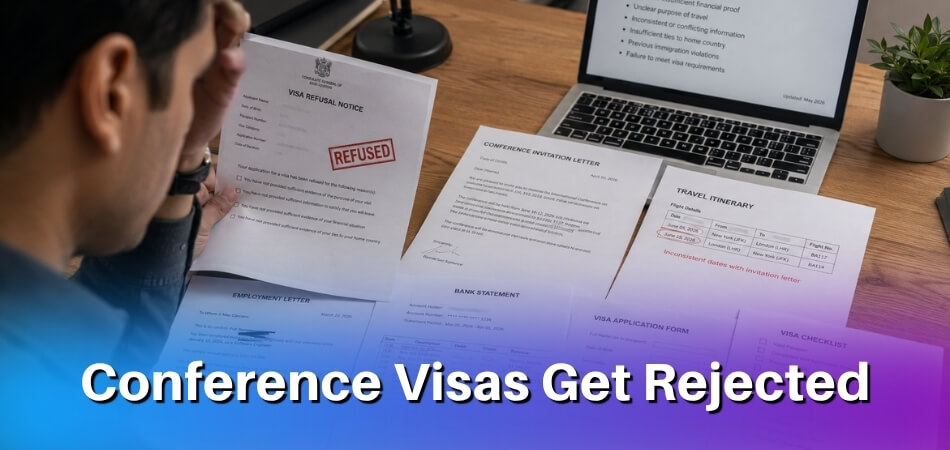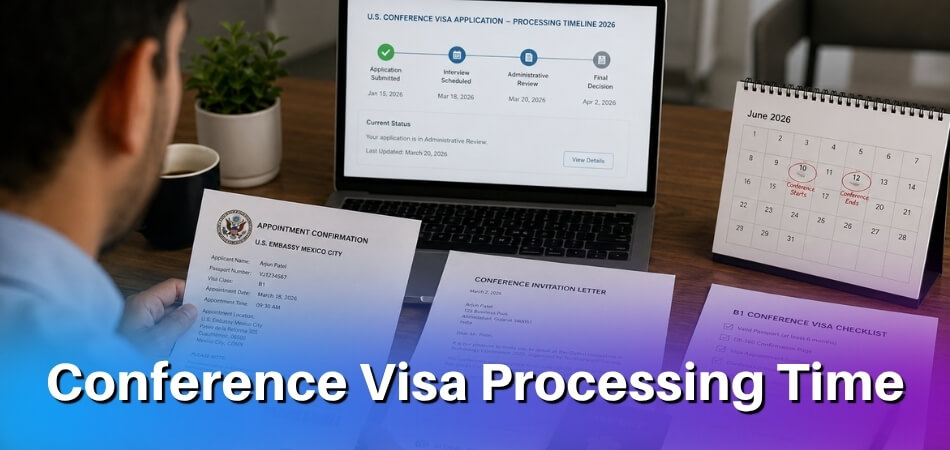
Your conference paper got accepted. Your flight is booked. You’ve paid the registration fee, arranged accommodation, and told your department you’re presenting. Then the visa office said no — and gave you a form letter that explains almost nothing.
It feels arbitrary. It isn’t. Conference visa rejections follow a pattern that most applicants never see coming, because nobody tells them what consulate officers are actually looking for. Whether you’re applying for a B-1 visa to the US, a Schengen visa for a European conference, a UK Standard Visitor Visa, a Canada visitor visa, or an Australia subclass 600 visa, the decision comes down to the same core question: does this person have strong enough ties to their home country to guarantee they’ll come back? Most refusals — across every country — trace back to four or five completely predictable documentation and credibility gaps.
Quick answer: Why conference visas get rejected and how to fix it
Conference visas are most commonly rejected because of weak proof of ties to the home country, an incomplete or inconsistent document package, insufficient funds, or a conference invitation letter that doesn’t hold up to scrutiny. Under INA Section 214(b), US Embassy officers presume every B-1 applicant intends to immigrate unless proven otherwise — a standard many other countries mirror informally. To avoid rejection: get a detailed invitation letter from the host institution or conference organizer, attach your registration fee receipt, show a return ticket and travel itinerary, provide three to six months of bank statements, and support everything with an employment letter, enrollment certificate, or property ownership documents that prove you have a life to return to. If you’ve already received a visa refusal letter, reapplying with the same file almost never works — you need to identify the specific gap, rebuild your evidence, and in some cases consider virtual conference participation while your situation stabilizes.
That roadmap covers the short version. The rest of this guide breaks it down country by country, walks through every document on the checklist, shows you how to prepare for a visa interview, and tells you exactly what your next move is if you’re already holding a rejection.
Why Conference Visas Get Rejected — The Top Reasons
Visa officers reject conference visa applications every day for reasons that are entirely preventable. Most applicants don’t find out what went wrong until they’re holding a refusal letter with a vague one-liner on it. Here’s what’s actually happening behind that decision.

Insufficient Proof of Ties to Your Home Country (INA Section 214(b) Explained)
This is the single biggest reason conference visas — especially B-1 visas to the US — get denied.
INA Section 214(b) is a clause in US immigration law that essentially says: every visa applicant is presumed to be an intending immigrant unless they prove otherwise. The burden of proof sits entirely on you. The visa officer at the US Embassy isn’t looking for reasons to approve you — they’re looking for reasons to believe you’ll actually come home after the conference ends.
What counts as proof of ties? Strong examples include property ownership documents in your name, a permanent employment contract with a local employer, an enrollment certificate if you’re a student, family dependents who are staying behind, or a business registered in your home country. Weak examples include a rented apartment lease or a vague letter from your employer that doesn’t confirm your job is waiting for you.
The same logic applies to the Schengen visa, the Canada visitor visa, the UK Standard Visitor Visa, and the Australia subclass 600 visa. The terminology differs, but every single one of these systems is trying to answer the same question: will you leave?
If you’re early in your career, young, unmarried, and have no property — you’re not in an impossible position. But you need to work harder on every other part of your application to compensate.
Weak or Incomplete Financial Documentation
Officers want to see that you can pay for your trip without needing to work illegally abroad. Simple enough in theory. In practice, a lot of applicants submit bank statements that raise more questions than they answer.
A bank statement that shows a sudden large deposit two weeks before the application? Red flag. Officers see this constantly — it’s called “loan washing” and it doesn’t work. Your bank statement needs to show consistent, regular income over at least three to six months, not a last-minute cash injection.
The amount matters too. A conference in London or Paris for five days needs to be backed by funds that realistically cover flights, accommodation, meals, and incidentals — not just the bare minimum. Check the specific country’s financial threshold guidelines before you apply.
If someone else is sponsoring you — your institution, your employer, or a family member — you need a proper sponsor letter, not just an informal email. The sponsor letter should state the relationship, confirm they’re covering specific costs, and ideally include their own bank statement or financial proof. A sponsor letter without supporting financials is almost useless.
Errors in the Conference Organizer’s Invitation Letter
A bad conference invitation letter is a surprisingly common reason for rejection. And most applicants have no idea there’s a problem because they didn’t write it — the conference organizer did.
The letter needs to be on official letterhead, signed by a named representative of the host institution or conference organizer. It should state your full name (matching your passport exactly), the exact name and dates of the conference, the venue address, what your role is — presenter, attendee, panelist — and ideally the registration fee receipt or a reference to it.
Generic letters that just say “we invite you to attend our conference” without specifics will hurt you. Officers need to verify that the event is real and that your attendance is legitimate.
If the letter doesn’t include the conference website URL, a contact number for the organizer, or any detail about the program, ask the organizer to revise it. Most will, once you explain what you need. A one-page official letter with specific details is worth ten pages of other supporting documents.
Incomplete Travel Itinerary or Unclear Purpose of Visit
Your travel itinerary isn’t just your flight booking. It’s the document that shows an officer the complete picture of your trip — where you’re going, why, for how long, and where you’re staying each night.
A return ticket is mandatory. Not “pending” or “planned” — booked and confirmed. Without it, you’re essentially telling the officer you haven’t committed to coming back.
Your itinerary should include your outbound and return flights, hotel bookings for every night of your stay, the conference schedule (or a link to it), and any additional travel days explained clearly. If you’re visiting two cities, explain why. If you’re arriving two days before the conference starts, account for that time.
Vague purpose statements are a problem too. “Attending a conference” is not enough. Your cover letter should specify: the conference name, your paper title if you’re presenting, why attending this specific event matters for your work or research, and what you’ll be returning to. Short and specific beats long and generic every time.
No Travel History or a Prior Visa Refusal on Record
No travel history doesn’t automatically mean rejection. But it does mean you have less credibility to lean on, and officers know it.
If you’ve never held a visa to any country before, your application is under more scrutiny. Every other document needs to be airtight — employment letter, financial records, invitation, property ownership documents — because there’s no prior visa approval to suggest you’ve been trusted before and returned as promised.
A prior visa refusal is more complicated. Most visa forms ask directly whether you’ve been refused before, and lying is far worse than the refusal itself. Disclose it. Then address it. Attach a brief explanation — factual, not defensive — of what changed since the last refusal. If your financial situation has improved, show that. If your ties to your home country are stronger now, document it.
One refusal doesn’t close the door. But applying again with the exact same application that got refused? That will.
Virtual conference participation has become a legitimate fallback option if refusals stack up, but it shouldn’t be your first plan. A physical visa approval record, built gradually, is one of your most valuable assets as a conference traveler.
Rejection Rates and Strictness by Country — A Comparative Overview
Rejection rates for conference visas vary wildly depending on which country you’re applying to — and more importantly, why that country rejects applicants. The same application that sails through in Germany might get flagged in France. Understanding how each country thinks about conference visitors changes how you build your application.
USA (B-1 Visa) — INA 214(b) Presumption and Common Rejection Patterns
The US is uniquely harsh in one specific way: INA Section 214(b) legally presumes you’re an immigrant until you prove otherwise. That burden is entirely on you. Every single B-1 visa applicant for a conference starts from a position of suspicion.
The US Embassy doesn’t publish overall visa rejection rates by category, but State Department data consistently shows refusal rates above 30–35% for applicants from countries like Nigeria, Pakistan, Bangladesh, and Ghana. For conference-specific B-1 cases, the officer is looking for one thing above all else — do you have a reason to go back home?
Common rejection patterns for conference applicants:
- Weak ties to home country. No property ownership documents, no stable employment, no family dependents — officers see this as a flight risk. Young graduate students get hit hardest here.
- Vague conference documentation. A generic conference invitation letter that just says “you are invited to attend” isn’t enough. Officers want to see the conference program, your specific role (presenter, attendee, session chair), and the host institution’s legitimacy.
- Insufficient financial evidence. A bank statement showing a sudden large deposit before the application looks fabricated. Officers prefer consistent balances over time.
- No registration fee receipt. If you’ve actually paid to attend, show it. Unregistered attendees get questioned heavily.
The interview at the US Embassy is your only real shot to address these. Officers ask direct questions: Who’s paying for the trip? What does your employer do? What happens to your job if you stay? Have your employment letter ready and know your answers cold.
One more thing — if you’ve been refused before under 214(b), that refusal follows you. Applying again with essentially the same documents gets you the same result.
Schengen Countries — Which Nations Have the Toughest Standards
The Schengen visa is technically one system, but enforcement is anything but uniform. Each member state’s consulate processes applications according to its own internal culture, and the rejection rates prove it.
According to Eurostat data, the Schengen-wide refusal rate sits around 10–12% overall. But break it down by country and you see the real picture. France consistently runs refusal rates above 15%, sometimes touching 20% for certain nationalities. Norway and Sweden sit well below 5%. Germany is strict but predictable — they follow their checklist methodically, which actually works in your favor if your documents are solid.
The toughest Schengen states for conference applicants, in practice:
- France — High refusal rates, especially for applicants from Francophone Africa. The consular interview (where required) can feel like a cross-examination. Your travel itinerary and return ticket are scrutinized closely.
- Spain — Known for requesting extensive financial documentation. A bank statement showing three to six months of consistent income is standard. A sponsor letter from your institution helps significantly.
- Netherlands — Strict on the conference invitation letter format. They want the conference organizer’s official letterhead, your name, the event dates, and a specific statement about your role.
Germany is actually more applicant-friendly than its reputation suggests, as long as your paperwork is complete. Switzerland, despite not being in the EU, participates in Schengen and tends to process applications quickly with relatively low refusal rates.
The critical mistake most applicants make with Schengen: they apply to the country of the conference but their itinerary includes several other member states without planning the main destination carefully. If the conference is in Vienna but you’re flying into Paris and spending five days there first, Austria’s consulate may not even be the right place to apply — longest stay or primary destination rules determine that.
Canada, UK, and Australia — How Each Approaches Conference Visa Applications
These three countries each have distinct systems, distinct priorities, and meaningfully different refusal patterns.
- Canada processes conference visitors under its general visitor visa stream, also called the Temporary Resident Visa. Canada doesn’t have a dedicated conference category — you’re just a visitor who happens to be attending an event. That means your conference invitation letter and registration fee receipt help contextualize the trip, but the fundamental assessment still revolves around ties to your home country and intent to return. Canada’s overall visitor visa refusal rate hovers around 30–35% depending on nationality. IRCC (Immigration, Refugees and Citizenship Canada) relies heavily on the digital application, and unexplained gaps or inconsistencies in your history trigger flags automatically before a human officer even sees the file.
- UK Standard Visitor Visa applicants often underestimate how document-intensive the process is. The UK explicitly allows conference attendance under its Standard Visitor route, which is helpful. But the Home Office guidance is clear — you must show you have sufficient funds, that the conference is legitimate, and that you’ll leave at the end of your permitted stay. Employment letter, bank statement, and an enrollment certificate (for students) are non-negotiable. Refusal rates for UK visitor visas from South Asia and Sub-Saharan Africa frequently exceed 20–25%. The UK also specifically looks at whether you’ve had previous UK or US visas — if you have a clean US B-1 history, mention it. It genuinely helps.
- Australia’s subclass 600 visa (Visitor visa, Tourist stream or Business Visitor stream) is used for conference attendance. The Business Visitor stream is technically more appropriate if you’re presenting or participating professionally. Australia’s processing is relatively transparent — they publish guidance on what evidence to submit, and if you follow it closely, the process is manageable. Refusal rates are lower than the US or Canada for most nationalities, but Australia is particularly alert to health insurance and financial capacity. They also look hard at your travel history. If you’ve traveled internationally before and returned home each time, that works strongly in your favor.
None of them have a special “conference visa.” You’re always applying under a broader visitor or temporary resident category. The conference documentation (invitation, registration receipt, program schedule) serves to explain and legitimize the trip — it doesn’t create a separate visa class. Treat it as supporting evidence, not the centerpiece.
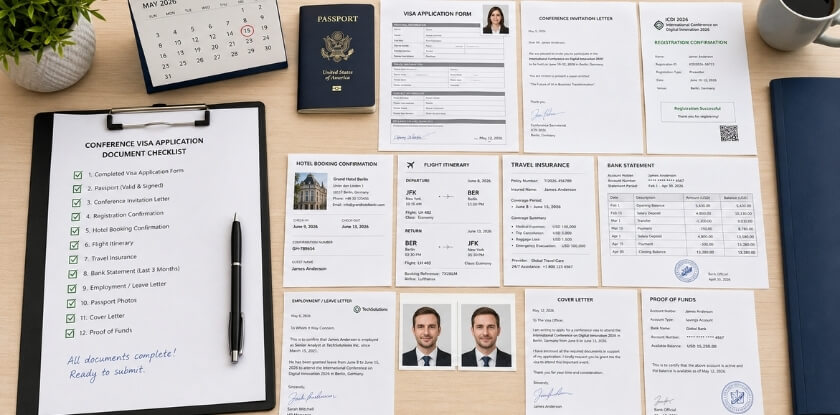
Complete Application Checklist to Avoid Rejection
Most conference visa rejections aren’t random. They happen because applicants submit incomplete files, provide vague financial evidence, or fail to show they have real reasons to go home after the conference ends. Fix those three things and your chances improve dramatically.

What to Obtain from the Conference Organizer and Host Institution
Start here. Without the right paperwork from the conference itself, everything else you submit is harder to validate.
- Conference invitation letter — This is non-negotiable. A proper invitation letter from the conference organizer should include your full name (exactly as it appears in your passport), the conference name, dates, venue address, and a brief statement of why you’re attending — presenting a paper, chairing a session, or simply participating. Generic “we invite you to attend” letters raise flags. Specificity matters.
- Acceptance letter (if presenting) — If you’re presenting a paper or poster, get a separate acceptance letter from the program committee. It confirms you have an active role, not just a ticket.
- Official conference program or agenda — A publicly available program with your name listed or your session scheduled adds credibility. Print it. Include the URL.
- Host institution letter — If a university or research institute is affiliated with the event, get a letter from them too. The host institution should confirm the event’s legitimacy and, if applicable, state that they’re covering any costs. This is especially useful for US B-1 visa and UK Standard Visitor Visa applications.
- Registration fee receipt — Pay the registration fee before you apply. Then include the receipt. It proves you’re committed to actually attending, not just using the conference as a pretext.
Email the conference organizer directly and ask if they have a standard visa support letter template. Many international conferences handle this constantly and will send you exactly what embassies expect.
Financial Proof — Bank Statements, Sponsor Letters, and Registration Fee Receipts
This is where a lot of applications fall apart. Officers need to see that you can fund the trip without working illegally — and that you’re not so financially desperate that you’d overstay.
Bank statements — Three to six months of statements is the standard range most embassies expect. For a Schengen visa, three months is the minimum; for Australia’s subclass 600 visa or the Canada visitor visa, six months gives you a stronger case. Statements should show consistent income or savings, not a sudden large deposit right before you applied. A lump-sum cash injection the week before your application looks like it was staged — because often it is.
The balance you need depends on destination and trip length, but as a rough benchmark: enough to cover accommodation, meals, and transport for your entire stay, with some buffer. Don’t drain your account to pay the registration fee right before you pull the statements.
Sponsor letter — If your employer, university, or a funding body is covering the trip, you need a sponsor letter on official letterhead. It should state exactly what they’re paying for — flights, accommodation, per diem — and confirm you’re employed or enrolled. The letter should be signed and dated. Vague sponsorship letters (“we support the applicant’s travel”) get ignored. Specific ones (“we will cover return airfare of approximately USD 1,200 and hotel accommodation for five nights”) carry weight.
Registration fee receipt — Yes, this appears again. It belongs in both the conference organizer section and the financial section of your file. It’s direct evidence of a financial commitment to the event.
Funding letter from your institution — If your department is funding you, include the formal funding approval letter in addition to the sponsor letter. US Embassy officers reviewing B-1 visa applications and Schengen consulates both respond well to institutional documentation that traces exactly where the money is coming from.
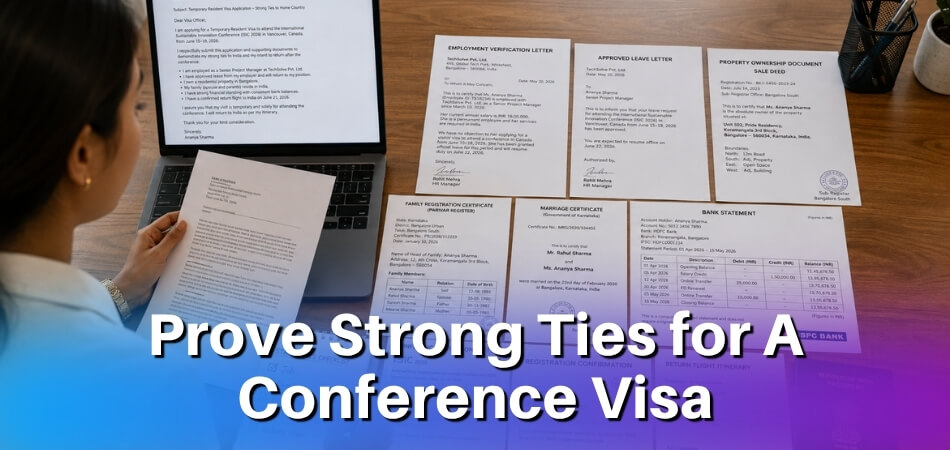
Home Country Ties Documents — Employment, Enrollment, Property, and Family
Under INA Section 214(b), the default assumption for a US visa is that you intend to immigrate unless you prove otherwise. Most other countries operate on a similar presumption. Your job is to demonstrate that you have real, concrete reasons to return home.
Employment letter — If you’re employed, get a letter from your HR department or direct supervisor. It should state your job title, length of employment, that you’ve been approved for leave during the conference dates, and that your position will be waiting for you when you return. This is probably the single most effective tie document for working professionals.
Enrollment certificate — Students: get this from your registrar’s office. It should confirm your current program, expected graduation date, and enrollment status. A letter from your thesis supervisor confirming your ongoing research is also useful.
Property ownership documents — A land title, property deed, or mortgage statement shows you have assets anchoring you to your home country. Not everyone has these, but if you do, include them.
Family ties — A marriage certificate, birth certificates for children, or even evidence that you’re a primary caregiver (dependents registered in your name) can support your case. Officers don’t always ask for these explicitly, but they help paint a picture of someone with obligations at home.
Business ownership or tax registration — Self-employed applicants should include their business registration certificate and recent tax filings. This shows you have an ongoing livelihood that requires your presence.
Don’t submit every document you own. Be selective. Choose the three or four strongest tie documents for your specific situation and present them clearly.
Travel Itinerary and Confirmed Return Ticket
Return ticket — Buy it before you apply if you can. A confirmed return ticket is direct evidence that you’ve planned to leave. Some applicants hesitate because tickets are expensive and non-refundable, but most embassies — particularly the US Embassy and Schengen consulates — expect to see one. If booking a fully refundable ticket isn’t affordable, at minimum provide a flight itinerary with a booking reference (not just a screenshot of a search result).
Travel itinerary — Create a day-by-day breakdown of your trip. Conference Day 1, check-in at hotel, Day 2, opening keynote and workshops, Day 3, your paper presentation, Day 4, departure. It doesn’t need to be elaborate. It needs to be clear, consistent with the conference program, and match your visa validity request.
Hotel bookings — Include confirmation emails or booking references for the entire stay. If someone else is arranging accommodation (the host institution, for example), get a letter confirming that.
Visa duration request — Only ask for what you need. If the conference runs four days and you want to arrive one day early and leave the day after, request a seven-day visa. Requesting a six-month visa for a four-day conference raises an obvious question about what you’re planning to do with the remaining time.
Keep your itinerary and your visa application dates perfectly consistent. A mismatch between your planned travel dates and your hotel bookings or return ticket is a simple administrative error that can generate a refusal. Check all dates three times before submitting.
How to Get a Visa When You Have No Travel History
No stamps in your passport is one of the most frustrating situations to be in. Officers want evidence you’ve returned home from previous trips. If you’ve never traveled internationally, you have none. But this doesn’t make you unapprovable — it just means you need to build your case differently.

Why No Travel History Hurts You
Visa officers use past travel as a proxy for behavior. If you went to Germany last year and came back, that’s evidence you don’t overstay. Without that, they have to rely entirely on your ties to home — your job, your family, your property, your financial obligations. Those ties need to be exceptionally well-documented.
The US specifically evaluates you under INA Section 214(b), which presumes you intend to immigrate unless you can prove otherwise. No travel history means one less thing working in your favor. The UK Standard Visitor Visa and Australia subclass 600 visa work from similar logic — past compliance with visa conditions is the gold standard, and you don’t have it yet.
This isn’t fatal. It’s just a different problem.
What Actually Substitutes for Travel History
Think of it as building a profile that screams “I have reasons to go back home.”
Employment documentation matters more than anything else. An employment letter alone isn’t enough. Get one that includes your salary, your role, your length of service, and — critically — a statement that you have approved leave for the conference dates and are expected to return. Ask your HR department to be specific. “Mr. Ahmed has been employed with us for 4 years and holds a permanent position as Senior Engineer with a monthly salary of $1,800” is worth ten times more than “To whom it may concern, this employee works here.”
Property ownership documents are powerful. If you own land, a house, or an apartment, include copies of the title deed or land registration. This is physical proof you have something to come back to.
Family ties carry real weight. A marriage certificate, children’s birth certificates, elderly parents in your care — include brief explanations of dependents who rely on you.
Financial ties work too. A bank statement showing consistent salary deposits over 6–12 months tells a clearer story than a large lump sum sitting in an account. Officers are suspicious of accounts that suddenly swell before an application. Gradual, consistent income over time looks honest.
For students, an enrollment certificate from your university plus a letter from your supervisor or department head confirming your conference participation and expected return to complete your degree is the backbone of your application.
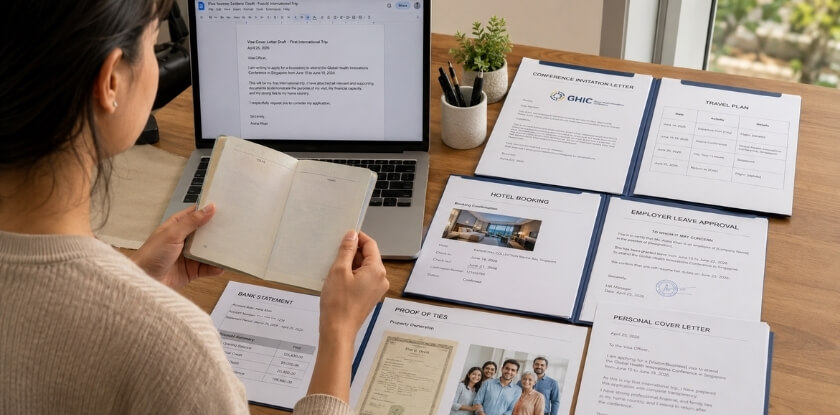
Build the Conference Side of the Application Carefully
Without travel history, every document needs to be airtight. The conference invitation letter from the host institution or conference organizer should name you specifically, give the conference dates and location, and confirm your role — whether you’re presenting a paper, attending sessions, or both. Generic invitation letters are a problem. Request a personalized one.
Include your registration fee receipt. It shows financial commitment and confirms you’re a legitimate attendee, not someone using the conference as a cover story.
Your travel itinerary should match your conference dates exactly. Don’t arrive three weeks early or plan to stay two weeks after the event ends. Officers notice when the trip duration doesn’t align with the stated purpose. A return ticket booked close to the conference end date demonstrates you’re going for the event, not for anything else.
For US B-1 Visa Applications
If you’re applying through a US Embassy with no prior US travel and no international travel at all, expect additional scrutiny. Prepare for the interview as if you need to explain every document verbally.
Practice answering: “Why should we believe you’ll come back?” Your answer should be specific. Not “I love my country.” Something like: “I have a permanent job at [company], I’m a co-owner of property with my spouse, and my children are enrolled in school here. I have a return flight on [date] and a presentation scheduled on [date] at the conference.”
Bring originals of everything, even if they asked for copies. Bring your sponsor letter if a company or institution is funding your trip. If you received a grant, include that documentation too.
For Schengen Visa Applications
The Schengen visa system shares information across member states. First-time applicants applying to Germany, France, or the Netherlands with no prior Schengen history face the same wall. The fix is the same — ties to home, conference documentation, financial evidence.
One extra thing that helps for Schengen: if your country has a bilateral agreement with EU states or if your national currency is strong relative to the Euro, mention your financial capacity clearly. A bank statement showing you can cover your costs without needing to work in Europe takes away one objection.
For Canada Visitor Visa
Canada’s system is online-based and uses an algorithm before a human officer ever looks at your file. No travel history combined with a low-income country of residence can result in an automatic flag. The counter to this is volume — more supporting documents that establish ties, financial stability, and a clear conference-specific purpose.
Include the conference organizer’s letter, your registration fee receipt, your employment letter, and your return ticket. If your employer is covering costs, include a sponsor letter from them on company letterhead. If your university is paying, include a letter from the research office or department.
The One Thing First-Time Applicants Keep Getting Wrong
They apply as if one document is enough. It isn’t. No travel history means you’re asking the officer to take a risk on an unknown quantity. Your job is to make that risk feel as small as possible by providing multiple, independent sources of evidence that all tell the same story: you have a specific reason to attend this conference, you have concrete ties to your home country, and you have a confirmed plan to return.
Virtual conference participation is sometimes suggested as an alternative after a rejection. It’s a reasonable fallback — you can still present your research or attend sessions remotely. But if attending in person matters for your career or networking, a rejection isn’t necessarily the end. A reapplication with stronger documentation, or an application for a country with a lower rejection threshold, is worth considering.
Start building your paper trail now. If you know six months in advance you’ll need to apply, open a consistent savings account, document your employment, and get any property ownership paperwork updated. The application isn’t just about what happens when you submit — it’s about the story your life tells on paper.
Consulate Interview Preparation — Common Questions and How to Answer Them Effectively

What the USA Embassy Typically Asks in a Conference Visa Interview
The B-1 visa interview is short. Usually 5 to 10 minutes. But those minutes can make or break your application.
The consular officer’s entire job in that window is to figure out whether you’re a genuine temporary visitor or someone who plans to stay. Under INA Section 214(b), you’re presumed to be an immigrant until you prove otherwise. That’s not paranoia — that’s the actual legal standard you’re working against.
Here are the questions you’re almost certain to face:
“What is the purpose of your visit?” Don’t say “I’m attending a conference.” That’s too thin. Say the conference name, the city, the dates, and what you’re doing there — presenting a paper, chairing a session, attending as a delegate. Specificity signals legitimacy.
“Who is sponsoring your trip?” Know exactly who’s paying for what. If your university is covering it, say that. If you’re self-funded, say that too — but then you need your bank statement to show you can actually afford it. If a sponsor letter exists, you should know what it says without reading it.
“Do you have ties to your home country?” This is the big one. “Ties” means reasons to go back. Employment letter, property ownership documents, family, an ongoing academic program — anything that anchors you home. Vague answers here are where applicants lose interviews. If you have a job, say where, say your position, say when you return to work.
“Have you attended this conference before?” If yes, say when and where. It strengthens your pattern as a legitimate conference-goer. If no, that’s fine too — don’t volunteer anxiety about it.
“When is your return flight?” Know the date. Know the flight. Don’t fumble this. Your return ticket should already be booked, and you should be able to state the date without pulling out your phone.
A few practical points worth knowing:
Bring physical copies of everything — conference invitation letter, registration fee receipt, travel itinerary, sponsor letter if applicable, bank statements. The officer may ask to see something. Having it in your hand matters.
Don’t volunteer information you weren’t asked for. Answer the question. Stop. Wait. Nervous over-talking is a red flag, even if everything you’re saying is true.
If English isn’t your first language, practice your answers out loud in English beforehand. Not to memorize a script — to get comfortable with the vocabulary. There’s a difference between knowing the answer and being able to say it under mild pressure.
The US Embassy doesn’t just assess your documents before the interview. The officer is reading you. Confidence without arrogance. Direct answers without rehearsed-sounding speeches. That’s the tone you’re going for.
If you get a visa refusal letter after the interview, it will usually cite 214(b). That’s a generic catch-all. You can reapply — but only after something about your profile has actually changed. Coming back with identical documents a month later almost never works.
No Interview for Schengen? How to Let Your Documents Answer for You
Most Schengen visa applicants don’t sit in front of an officer and answer questions. The file goes in, an officer reviews it, and the decision comes back. That’s actually harder in some ways. Your documents have to do all the talking.
Think of it this way: every question a US Embassy officer would ask you out loud, a Schengen officer is asking silently while reading your file. The answers need to be in the paper.
- The conference invitation letter has to be airtight. It should come from the conference organizer or host institution, be on official letterhead, and include the event name, location, dates, your name, and why you’re attending. Generic letters that could apply to anyone are easy to dismiss.
- Your travel itinerary needs to match your requested dates exactly. If the conference runs June 3–6 and you’re asking for June 1–8 to account for travel, the itinerary needs to explain those buffer days. An unexplained gap reads as inconsistency.
- Financial proof matters more than people expect. Bank statements covering the last 3 to 6 months are standard. The balance needs to reflect that you can cover your trip without strain. If your account looks nearly empty, a registration fee receipt showing the conference fee is paid helps — it reduces the cost burden you need to demonstrate.
- Your employment letter or enrollment certificate should confirm you’ll be returning. Not just that you work somewhere, but that you have approved leave for specific dates and are expected back. Some employers don’t include that last part. Ask them to.
- Property ownership documents, if you have them, can be included. They’re not mandatory, but for applicants from countries with higher rejection rates, they help establish that you have something concrete to return to.
A common mistake: treating the Schengen application like a form-filling exercise. The cover letter — which many applicants either skip or write in two sentences — is where you explain the whole picture in plain language. What the conference is, why you’re attending, where you’re staying, when you’re coming back. Keep it factual. One page is enough.
Virtual conference participation has created a complication worth knowing about. Post-2020, some conference organizers now offer hybrid formats. If you’re applying for a visa to attend the in-person version, make sure your invitation letter explicitly states in-person attendance. An ambiguous letter that doesn’t specify physical presence has contributed to Schengen refusals because officers couldn’t confirm the trip was necessary.
One more thing. Schengen applications go through the embassy of the country where you’ll spend the most days — or the first country of entry if days are equal. Make sure you’re applying to the right embassy. Sending a valid file to the wrong member state embassy causes delays that are entirely avoidable.
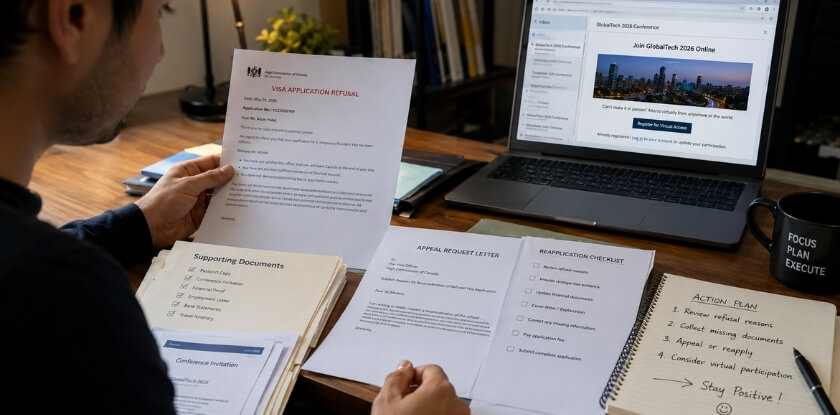
What to Do After a Rejection — Appeal, Reapply, and Virtual Alternatives
A visa refusal isn’t the end. It feels like it, especially when you’ve already paid registration fees and booked time off work. But most rejections are fixable — if you understand exactly what went wrong and respond to it directly.

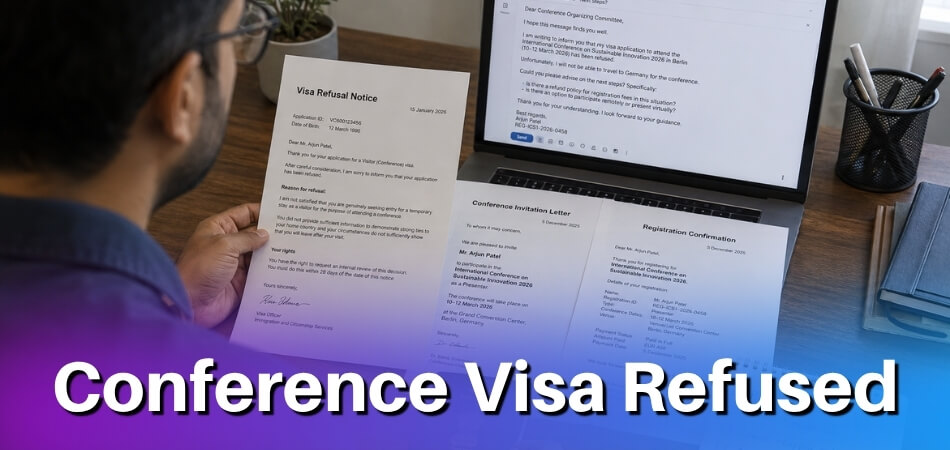
Reading Your Rejection Letter and Understanding the Refusal Reason
This is where most people make their first mistake. They get the visa refusal letter, feel defeated, and either ignore it or skim it. Don’t.
Read it carefully. Then read it again.
For a B-1 visa refusal from the US Embassy, the letter will almost always cite INA Section 214(b). That’s the legal basis for refusing anyone who hasn’t overcome the presumption of immigrant intent. The language sounds generic, but the underlying reason is specific to your file — your officer saw something (or the absence of something) that triggered concern. A weak bank statement, no property ownership documents, an unclear employment letter, a travel history that didn’t exist. The letter won’t spell this out in plain language, but you need to read between the lines.
Schengen visa refusals are actually more informative. EU embassies are required by the Schengen Borders Code to give you a reason from a standardized checklist. Common boxes that get ticked include “purpose and conditions of the intended stay were not substantiated” or “your intention to leave the territory of the Member States before the expiry of the visa could not be ascertained.” Both of these tell you exactly what to fix.
For the UK Standard Visitor Visa, refusal notices are usually more detailed than US ones. UKVI will typically tell you which document failed to satisfy them — maybe your bank statement showed irregular deposits, or your ties to your home country weren’t convincing.
Australia subclass 600 visa refusals come with a delegate’s decision letter. It will reference specific criteria under the Migration Act that weren’t met.
Keep every version of your refusal letter. If you reapply, you’ll need to reference it directly in your new application to show you’ve addressed the issue.
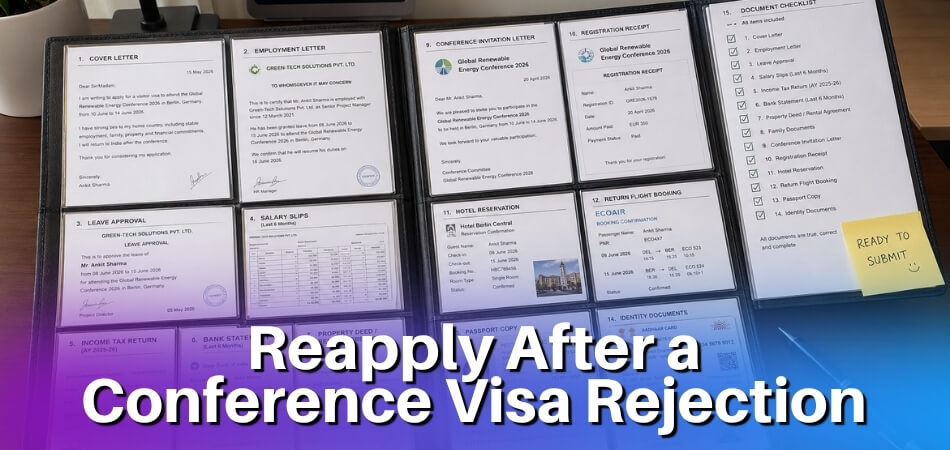
The Right Time to Reapply and How to Build a Stronger Application
There’s no mandatory waiting period for most visa categories after a refusal. You can technically reapply the next day. But reapplying immediately with the same documents is almost always a waste of money and time.
Give yourself at least four to eight weeks minimum. Enough time to actually fix what was wrong.
Here’s what a stronger reapplication looks like in practice:
Address the refusal reason head-on. If your bank statement showed low or inconsistent funds, get a new one that reflects a healthier balance — and attach a covering letter explaining your financial situation clearly. If the problem was lack of ties to your home country, gather property ownership documents, an updated employment letter on company letterhead, or an enrollment certificate if you’re a student.
Strengthen your conference documentation. A vague conference invitation letter is one of the most common weak points. Ask the conference organizer or host institution to reissue it with specific details: your name, the dates, your role (speaker, presenter, attendee), and the conference’s full name and location. Add a registration fee receipt if you paid. Include the full travel itinerary with a confirmed return ticket.
Add a cover letter that responds directly to the refusal. Don’t pretend the previous application didn’t happen. Acknowledge it briefly, state what’s changed, and make it easy for the reviewing officer to see the improvements.
For Canada visitor visa reapplications, include a sponsor letter if a Canadian institution or host institution is supporting your attendance. That adds weight that a solo application often lacks.
One practical note: if your refusal was based on something structural — like you genuinely have no travel history, no stable employment, or minimal savings — reapplying quickly won’t help. The underlying situation needs to change first.
Is It Still Possible to Get a Visa After Three Rejections?
Yes. It’s harder. But yes.
Three rejections don’t permanently blacklist you from a visa. What they do is create a pattern that future officers will see and scrutinize. You need to be honest with yourself about why each rejection happened.
If all three were for the same underlying reason — say, inability to demonstrate strong ties to your home country — then a fourth application with the same profile will almost certainly fail too. Something in your actual circumstances needs to change: a new job, property ownership, family ties that can be documented, additional travel history built up through other countries.
Some practical approaches that have worked for applicants in this situation:
Start with easier visa destinations to build a travel history. A Schengen visa from a country with higher approval rates (Germany and France tend to be stricter; some Eastern European Schengen states are known to be more approachable for first-time applicants) can help establish that you return home as promised.
Consider getting legal advice before a fourth application. An immigration consultant or lawyer who specializes in the specific country’s visa system can review your file and give an honest assessment. This costs money, but less than another filing fee and flight cancellation.
For US B-1 applications specifically, a fourth refusal under INA Section 214(b) doesn’t change your eligibility to apply — but you should only go back when something materially different about your application can justify it.
Be realistic. Some applicants in certain circumstances — very early career, minimal savings, first international travel, no property — face structural barriers that take time to overcome. That’s not a permanent state. It’s a timeline problem.
If You Cannot Get a Visa — Remote and Virtual Participation Options for the Conference
A lot of conferences, particularly academic and professional ones, now have formal remote participation tracks. This isn’t just a pandemic-era workaround — it’s become a permanent feature of many major events.
Contact the conference organizer directly and early. Explain your situation honestly. Most organizers have dealt with visa refusals before and have a process. You may be able to:
- Present remotely via video — Zoom, Teams, or whatever platform the conference uses. Your slides and talk get delivered live or recorded in advance.
- Submit a pre-recorded presentation that plays during your session slot, with a short live Q&A window if the time zones work.
- Publish in the conference proceedings regardless of physical attendance. For academic conferences especially, the paper is often the primary output anyway.
- Request a refund or credit on your registration fee. Many conferences have explicit policies for visa refusal situations — show them your visa refusal letter and they’ll often work with you.
Virtual conference participation also solves one practical problem: it preserves your professional relationship with the conference and the host institution. If you’ve built a relationship with the organizers, that can actually help future years’ applications — you have a documented history of engagement with the event.
One thing worth doing regardless: ask the organizer for a letter confirming your remote participation. It’s another document that demonstrates your genuine connection to the conference, and it can support your visa application the following year if you plan to attend in person.
Rejection is a setback. It’s not a verdict.
Avoiding Conference Visa Rejection — Final Checklist and Key Recommendations
You’ve read through the reasons visas get refused, the country-by-country breakdowns, and the interview prep. This section pulls everything into one place — a final pass before you hit submit.

Think of this as a pre-flight check. Not glamorous. Just necessary.
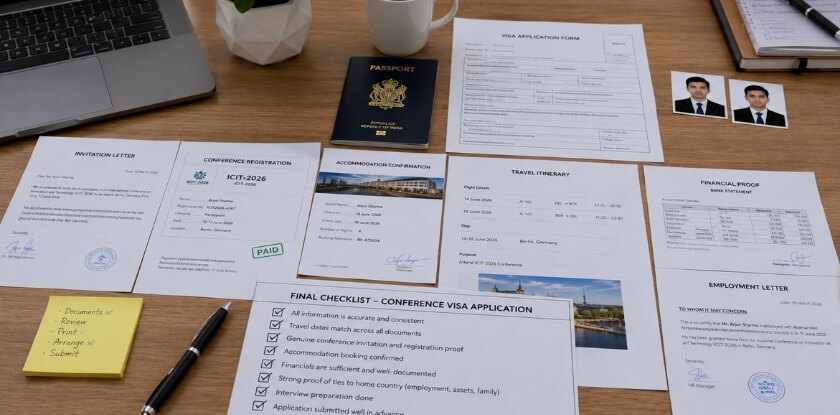
The Documents That Actually Matter
Every applicant knows to include a passport. Fewer people pay attention to how those documents are presented together.
Your conference invitation letter from the host institution or conference organizer needs to be specific. It should name you, name the event, give the exact dates, and state your role — presenter, attendee, panel chair, whatever applies. A generic “we invite you to attend” letter is nearly useless. It doesn’t tell the officer why you specifically are going.
Your bank statement should cover at least three months, not just the current balance. Officers want to see regular income activity. A single large deposit right before the application raises flags. Consistency matters.
Include your registration fee receipt. It’s proof you’ve actually committed to the conference financially. A lot of applicants forget this one.
The return ticket and travel itinerary go in together. Your return flight should land before your visa expires — that sounds obvious, but mismatches happen more than you’d think.
For the B-1 visa to the US, also include your employment letter (on official letterhead, signed, with your salary and leave approval stated explicitly) and ideally property ownership documents or financial ties that directly counter the presumption under INA Section 214(b). The burden is on you to prove you’ll leave.
For a Schengen visa, the same documents apply, but make sure your travel itinerary accounts for which country is your primary destination — that determines which member state’s embassy processes your application.
For the UK Standard Visitor Visa, Canada visitor visa, and Australia subclass 600 visa, an enrollment certificate matters if you’re a student. If you’re employed, the employment letter carries most of the weight.
Quick Final Checklist
Run through this before submitting:
- [ ] Passport valid for at least 6 months beyond travel dates
- [ ] Conference invitation letter — specific, signed, on official letterhead
- [ ] Registration fee receipt
- [ ] Bank statements — minimum 3 months, showing regular activity
- [ ] Employment letter with salary, leave approval, return-to-work date
- [ ] Sponsor letter (if someone else is covering costs — must match bank evidence)
- [ ] Return ticket booked and dated clearly before visa expiry
- [ ] Travel itinerary matching the visa type and dates
- [ ] Property ownership documents or other ties to home country (wherever applicable)
- [ ] Enrollment certificate (students only)
- [ ] Photos meeting exact spec for that specific country’s requirements
- [ ] Application form double-checked — no blank fields, no inconsistencies between form and documents
One inconsistency — a travel date that doesn’t match the letter, a sponsor letter that doesn’t match the bank statement — can be enough. Officers aren’t looking for problems. But when something doesn’t line up, they notice.
A Few Things Worth Getting Right
Apply early. Six to eight weeks before travel for US Embassy appointments in many countries. Schengen applications should go in no later than four to five weeks out. Canada and Australia can run even longer. Don’t let the deadline force a rushed application.
If you’ve had a refusal before, address it. Don’t ignore it and reapply with identical documents. The visa refusal letter tells you exactly what was missing or unconvincing. Fix that specific thing.
If the conference goes online or hybrid, check whether virtual conference participation is documented. Some applicants have used this as a fallback after refusal — it’s a real option, not a consolation prize.
Keep copies of everything you submit. If the consulate loses a document or questions something, you want to be able to respond immediately.
That’s really it. There’s no trick. Strong ties to home, proof of the event, financial evidence that adds up, and a consistent story across every document. Applications fail when those pieces contradict each other or when one of them is missing entirely.
Get the basics right. Most approvals aren’t complicated.
FAQ
Can I apply for a conference visa without a formal invitation letter?
Technically, some embassies won’t reject you solely for lacking one — but in practice, it’s a serious weak spot. The conference invitation letter is one of the first things officers look for when screening B-1 visa or Schengen visa applications. Without it, you’re essentially asking them to take your word that a legitimate event exists. Get the letter. If the conference organizer doesn’t issue them automatically, email and ask directly.
How far in advance should I apply?
At minimum, six weeks before the conference. Three months is better. US Embassy appointments alone can take weeks to schedule, and processing times fluctuate. Don’t assume because a visa took two weeks for your colleague that it’ll take two weeks for you.
Does attending a virtual conference help my case if I was previously rejected?
It can. Participating in a virtual conference shows genuine academic or professional interest in the field, which you can document and reference in a future application. It’s not a replacement for a strong financial or ties-to-home argument, but it does add credibility to your purpose statement.
My visa was rejected under INA Section 214(b). Does that affect future applications?
Yes and no. A 214(b) refusal isn’t a permanent black mark, but it does mean the officer found insufficient evidence you’d return home. Every future application needs to directly address that gap — stronger bank statements, better employment letter, property ownership documents, whatever ties you can demonstrate. The visa refusal letter itself will tell you what was missing, so read it carefully before you reapply.
Is a bank statement always required?
For almost every country, yes. The US, Schengen zone, UK Standard Visitor Visa, Canada visitor visa, and Australia subclass 600 visa all want to see financial evidence. Three to six months of statements is standard. The exact threshold varies by destination and trip length, but showing you can fund the trip without working illegally is non-negotiable.
What if my employer won’t write a sponsorship letter?
You have two options. One: apply on personal funds and demonstrate that through your own bank statement. Two: have the host institution or conference organizer issue a sponsor letter confirming they’re covering costs. Either works. What doesn’t work is submitting an application with no financial explanation at all.
Can a student get a conference visa?
Yes. Students get these visas regularly, especially for academic conferences. The enrollment certificate covers your ties-to-home question partially — you have a degree to finish, which gives you a reason to return. Pair that with a strong conference invitation letter, registration fee receipt, and return ticket, and the application is genuinely competitive.
Do I need to show a return ticket before I have a visa?
This is a real catch-22. Most embassies want to see travel itinerary evidence, but booking a non-refundable ticket before visa approval is risky. The practical solution is a confirmed but refundable booking, or a flight itinerary printout (some travel agencies provide these specifically for visa purposes without full payment). Check whether the specific embassy accepts this — many do.
What’s the difference between a conference visa and a work visa?
A conference visa (typically B-1, Schengen, or equivalent visitor category) covers attendance, presenting a paper, and networking. It does not cover getting paid by a local employer, providing services for a fee, or anything that looks like local employment. If you’re being paid by the host institution beyond expense reimbursement, that’s a different visa category entirely.
My conference was canceled after I got my visa. Do I need to inform the embassy?
You’re not legally required to in most cases, but you should not use the visa to travel for unrelated tourism and claim it was for the conference if questioned. If you reapply later, be honest about what happened. Officers can and do cross-check travel records with conference dates.
Conclusion — The Answer Is Not to Fear Rejection, But to Prepare for Approval
Most visa rejections aren’t random. They’re predictable. And that means they’re preventable.
Officers at the US Embassy, UK Visas and Immigration, or any Schengen consulate aren’t trying to catch you out. They’re looking for one thing: confidence that you’ll leave when you’re supposed to. Every document you submit — the conference invitation letter, bank statement, employment letter, return ticket, registration fee receipt — exists to answer that one question before the officer even has to ask it.
The problem is that most applicants treat the application like a formality. They gather the bare minimum, skip the cover letter, and hope for the best. Then they’re surprised when they get a visa refusal letter citing INA Section 214(b) or a vague Schengen “insufficient justification” note.
Don’t do that.
If you’re applying for a B-1 visa, a Canada visitor visa, an Australia subclass 600 visa, or a UK Standard Visitor Visa, the standards are high — and they should be. These consulates process thousands of applications. Yours needs to be clear, complete, and coherent. The conference organizer or host institution should be named. Enrollment certificates or property ownership documents should be included if they strengthen your ties to home. Your travel itinerary should make sense from start to finish.
A weak application doesn’t just get refused. It creates a record. Future applications carry more scrutiny because of it.
That’s why the preparation matters more than the outcome. Build the file properly the first time.
If you’ve already had a refusal, that’s not the end. It’s a data point. Read the visa refusal letter carefully. Understand what specifically triggered it — missing sponsor letter, unclear funding source, no proof of ties. Then fix exactly that, and reapply with a stronger package. Virtual conference participation is a real option in the meantime, not a consolation prize.
Thousands of researchers, academics, and professionals attend international conferences every year without incident. They’re not luckier than you. They just submitted better applications.
You can too. Start with the checklist. Work through the documents. Know your answers before you walk into the interview room. The conference seat is already reserved for you — your job is just to show up with the right paperwork.