
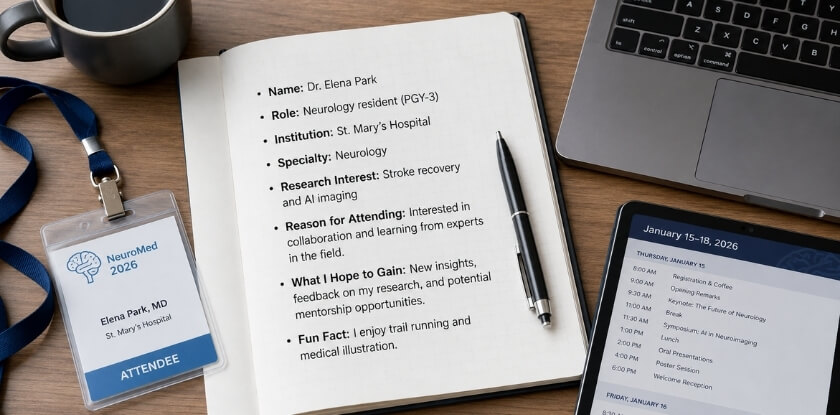
You have about half a minute to tell a stranger who you are, and a conference badge only shows a name and an institution. It never says what you actually work on. A short, planned introduction fills that gap and gives the other person something to ask about.
Quick answer: To introduce yourself at a medical conference, say a greeting, your name, role, institution, specialty and reason for attending, then end with a question. Keep it to 20 to 40 seconds. A simple version: “Hello, I’m Dr. [Name], a [role] at [institution]. I’m here for the sessions on [topic]. What area do you work in?”
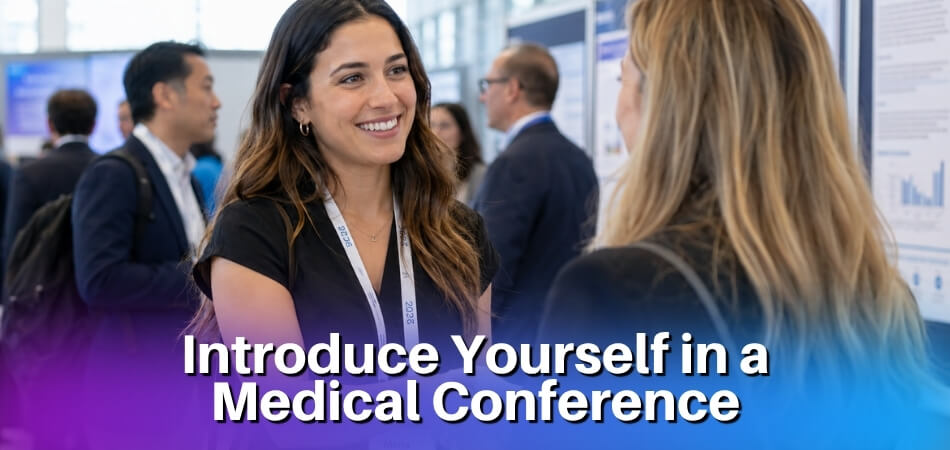
Medical conferences bring together doctors, nurses, researchers, medical students, healthcare managers, public health professionals, exhibitors, speakers, and policy experts. People meet many attendees within a short time, so your introduction should be easy to remember. You do not need a perfect speech. You need a flexible line that sounds natural and fits the moment.
What Should a Medical Conference Introduction Include?
A medical conference introduction should include your greeting, name, professional role, institution, specialty, purpose for attending, and a simple invitation to continue the conversation. These details give the listener enough context without overwhelming them.
| Part | What to include | Keep it to |
| Greeting and name | A polite hello and your name, said clearly | One short sentence |
| Role | Doctor, resident, nurse, researcher, student, manager | One role |
| Institution | Hospital, clinic, university or organization | One line |
| Specialty or focus | The topic you want to talk about | One clear sentence |
| Purpose | Why you are at this conference | One reason |
| Conversation cue | A question or follow-up line | One question |
Greeting and Name
Start with a polite greeting and say your name clearly. Use a calm voice and speak slowly enough for the other person to catch it.
Examples:
- “Hello, I’m Dr. [Surname].”
- “Good morning, my name is [Full Name].”
- “Hi, I’m [First Name] [Surname]. Nice to meet you.”
If your name is often mispronounced, say it clearly and confidently. Your name is the first detail people try to remember, so do not rush it.
Medical Role or Professional Title
Next, mention your role. This could be doctor, resident, medical student, researcher, nurse practitioner, registered nurse, public health professional, healthcare administrator, or policy analyst.
Examples:
- “I’m a pediatric resident.”
- “I work as a clinical researcher.”
- “I’m a registered nurse in a cardiac unit.”
- “I’m a healthcare quality improvement manager.”
- “I’m a final-year medical student.”
Titles are a personal choice. Some clinicians say “Dr.” with their name, while others simply state their role and let the badge do the rest. Use only the title you actually hold, and keep this part simple. Your role gives the listener immediate context, so avoid long explanations at the beginning.
Institution or Organization
Mention your hospital, clinic, university, research center, or healthcare organization when relevant. This helps others place your professional background and may create common ground, especially when attendees come from different countries, institutions, or specialties.
Examples:
- “I’m based at [Hospital Name].”
- “I study at [University Name].”
- “I work with a public health research team in [City].”
Specialty or Focus Area
Your specialty or area of interest tells people what topics matter to you. At a medical conference, this is one of the most useful parts of your introduction because it leads straight to discussion. Keep it to one clear sentence, since too much technical detail makes the introduction hard to follow.
Examples:
- “My focus is preventive cardiology.”
- “I’m interested in emergency medicine and trauma care.”
- “My research looks at hospital infection control.”
- “I work on healthcare policy and patient access.”
Pick the topic most relevant to the conference or the person in front of you. A specific line such as “My current focus is improving follow-up care for patients with diabetes” is easier to discuss than “I work in many areas of internal medicine.”
Purpose for Attending
A good introduction also explains why you are at the conference. This gives the other person a clear way to respond.
You may be attending to:
- Learn about new research
- Present a poster
- Attend workshops
- Meet professionals in your field
- Explore collaboration opportunities
- Understand healthcare policy updates
- Learn about new medical tools or technologies
Examples:
“I’m here to attend the sessions on antimicrobial resistance.”
“I’m presenting a poster on stroke recovery outcomes.”
“I’m hoping to meet others working in medical education.”
Conversation Cue
End your introduction with a question or follow-up line. It shows that you are not only presenting yourself but also interested in the other person.
Examples:
- “What brought you to this conference?”
- “Are you also working in this area?”
- “I’d be interested to hear your view on this topic.”
Quick Formula for Introducing Yourself at a Medical Conference
The easiest formula is a fill-in sentence you can adjust in seconds:
Hello, I’m [Name], a [Role] at [Institution]. My work focuses on [Specialty or Interest]. I’m here to [Purpose]. What area are you focusing on?
Example:
“Hello, I’m Dr. [Name], an internal medicine specialist at [Hospital]. My work focuses on chronic disease management, especially diabetes and hypertension. I’m here to learn about integrated care models. What sessions are you attending?”
This structure works because it is short, complete, and flexible. Drop the institution or the purpose when you need a faster version, and add a second sentence about your work when the person asks for more. Even a medical conference welcome speech opens the same way, with the speaker’s name and role in one short line.
Step-by-Step Guide to Introducing Yourself Professionally
To introduce yourself professionally, follow a simple flow: greet, say your name, explain your role, mention your institution, add your specialty, share your purpose, and ask a relevant question. The details of each part are above, so this section covers how to deliver them.
Start With a Polite Greeting
Begin with a greeting that fits the setting. “Hello,” “Good morning,” or “Nice to meet you” works in almost any conference setting. Add a smile, maintain natural eye contact, and offer a handshake if appropriate.
Your greeting sets the tone. If you sound rushed or distracted, the introduction may feel awkward. A calm greeting makes you appear approachable.
Say Your Name Clearly
Say your full name in a clear voice. At a busy conference, people hear many names in one day, so clarity matters. Even if you are wearing a name badge, say your name instead of assuming the person has read it.
Example:
“Hello, I’m Dr. [Name].”
Put It Together in One Breath
Say role, institution, focus and purpose as one flowing statement, not as a list. Do not give your full career history, and finish with a question that invites the other person to speak. A complete version may sound like this:
“Hello, I’m Dr. [Name], an emergency medicine physician at [Hospital]. My main interest is trauma care and rapid response systems. I’m here for the sessions on emergency preparedness. What area are you focusing on at this conference?”
Medical Conference Self-Introduction Examples for Different Situations
Different conference moments need slightly different introductions. Keep the same core details but adjust your tone and length. In every setting, describe your work in general terms and leave out anything that could identify a patient.
Networking Break
Networking breaks are friendly but still professional.
Example:
“Hello, I’m Dr. [Name], a pediatrician at [Hospital]. My current focus is child nutrition and preventive care. I’m here for the pediatric health sessions. What topics are you following today?”
Q&A Session
During Q&A, keep your introduction brief and move quickly to your question. Keep the question itself to one or two sentences so the speaker has time to answer and others in the queue get a turn.
Example:
“Good afternoon, I’m Dr. [Name], a cardiology fellow at [Hospital]. Thank you for the presentation. Could you explain how this approach might work in smaller hospitals with limited diagnostic support?”
Panel Discussion
In a panel discussion, your introduction may be heard by a larger audience, so keep it clear and relevant. If you are the one introducing the panelists as moderator, that is a different task with its own wording.
Example:
“Hello everyone, I’m Dr. [Name], a public health researcher focusing on rural healthcare access. I’m glad to join this discussion and share what we have learned from community-based programs.”
Before Your Own Presentation
If a session chair or moderator introduces you, give them a short version in advance: your name and how to pronounce it, your role, your institution and one line on the talk. Once you are at the lectern, thank the chair and go straight to why the topic matters, rather than repeating your background.
Illustrative example of a note for the chair:
“[Name] (pronounced [phonetic spelling]) is a [role] at [Hospital or University]. Today [he/she/they] will present [one-line topic].”
Poster Presentation
When presenting a poster, introduce yourself and summarize the main topic quickly. Share results at group level only, never details that could point to a single patient.
Example:
“Hello, I’m [Name], a neurology resident. My poster is about recovery patterns among younger stroke patients. We looked at early rehabilitation outcomes and practical follow-up needs.”
Workshop
In a workshop, mention what you hope to learn or contribute.
Example:
“Hi, I’m Dr. [Name], a family medicine physician. I work with patients managing diabetes and hypertension. I’m hoping to pick up practical team-based care strategies from this workshop.”
Industry Booth
When visiting a booth, be direct about your role and interest.
Example:
“Hello, I’m Dr. [Name], a cardiology specialist. I’m interested in portable imaging tools for rural clinics. Could you explain how your device supports point-of-care use?”
Informal Lunch or Coffee Break
In informal settings, keep your tone relaxed.
Example:
“Hi, I’m [Name], a pediatric resident. I came mainly for the child immunization sessions. Which talks have you enjoyed so far?”
How to Introduce Yourself Based on Who You Are Speaking To
A strong introduction matches the person you are speaking with. Use the same core details, but change your tone, focus, and level of detail.
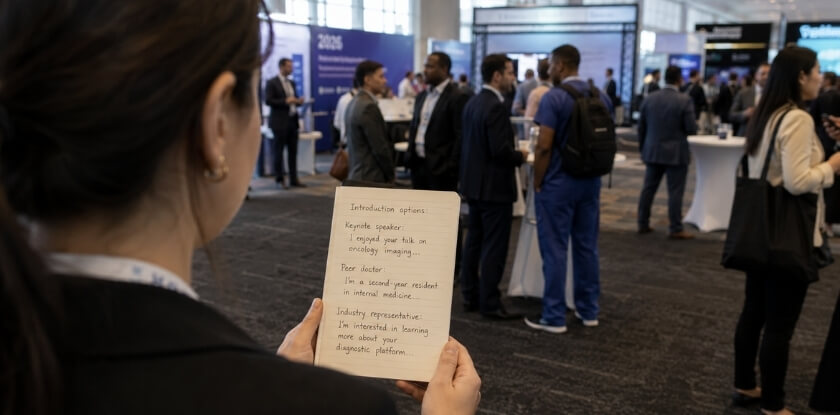
Senior Doctors
When speaking to senior doctors, address them by title and surname, and be respectful, brief, and specific.
Example:
“Good afternoon, Professor [Surname]. I’m Dr. [Name], an internal medicine resident at [Hospital]. I attended your session on chronic disease management and found your points on follow-up care very practical. May I ask your advice on improving patient adherence in outpatient settings?”
This works because it shows respect, gives context, and connects directly to their expertise.
Researchers
When speaking to researchers, focus on shared academic interests, methods, findings, or possible collaboration.
Example:
“Hello, I’m Dr. [Name], a clinical researcher focusing on infection control. I was interested in your findings on antimicrobial stewardship. My current work looks at prescribing patterns in medical wards, so I’d be glad to hear more about your approach.”
Medical Students
When speaking to medical students, keep your tone friendly and encouraging.
Example:
“Hi, I’m Dr. [Name], a pediatrician working in community child health. I’m here for the sessions on preventive care. Are you exploring pediatrics, or are you still looking at different specialties?”
Peers
With peers, use a balanced tone that is professional but relaxed.
Example:
“Hi, I’m Dr. [Name], a cardiology fellow at [Institute]. I’m focusing on preventive cardiology and came for the sessions on early risk assessment. Are you also working in cardiology?”
Sponsors or Exhibitors
When speaking to exhibitors, be clear about what information you need.
Example:
“Hello, I’m Dr. [Name], a family medicine physician. I work in outpatient chronic care, and I’m interested in tools that help monitor diabetic patients between visits. Could you explain how your platform supports follow-up?”
Speakers After a Session
Start by acknowledging the presentation, then ask one focused question.
Example:
“Thank you for your presentation, Dr. [Surname]. I’m Dr. [Name], a public health physician working on vaccination outreach. I found your point about community trust useful. Could I ask how your team measured patient engagement?”
How to Make Your Introduction Sound Natural
To sound natural, prepare the key points but avoid memorizing every word. A good introduction should feel confident, not robotic.
Use simple professional language. Instead of saying, “My work concerns multidisciplinary therapeutic optimization,” say, “I work with patients managing diabetes and other chronic conditions.” Medical conferences include people from many specialties, so not everyone knows your technical terms. Use plain wording first, then add detail if the other person shares your background.
You should also match your tone to the setting. A Q&A introduction should be formal and direct, while a lunch introduction can be warmer and more relaxed.
Formal example:
“Good afternoon, I’m Dr. [Name], an oncology fellow. Thank you for the presentation. Could you clarify how the trial group was selected?”
Informal example:
“Hi, I’m [First Name]. I’m an oncology fellow. I really liked the session on treatment planning. Which talk did you attend before lunch?”
Practice flexible versions of your introduction:
- 10-second version: “Hi, I’m Dr. [Name], a cardiology resident interested in preventive heart care.”
- 30-second version: “Hello, I’m Dr. [Name], a cardiology resident at [Heart Center]. My main interest is preventive heart care and early risk detection. I’m attending to learn more about new screening approaches.”
- Conversation version: “Hi, I’m [First Name]. I’m in cardiology and mostly interested in prevention. Which sessions have you found useful so far?”
This method helps you feel prepared without sounding rehearsed.
Add One Detail People Can Remember
After a day of hearing “I’m Dr. X, a fellow at Y, working on Z,” introductions start to blur. One specific detail, such as the problem you are trying to solve or what drew you to your field, gives the listener a way to remember you as “the one who works on [problem].” Keep it short and professional.
Illustrative template:
“I’m [Name], a [role] at [Hospital]. I moved into [specialty] after [one-line reason], and now I’m working on [specific problem].”
Prepare Before the Conference
Look through the program and the recent work of speakers you hope to meet, so you can say in one line how your work connects to theirs. Then say your introduction out loud a few times. Speaking it aloud shows where you stumble or slip into filler words such as “um” and “like.”
What to Say After Introducing Yourself
After introducing yourself, ask a relevant question, refer to a session, or connect the conversation to a shared interest. This keeps the discussion active.

Good follow-up questions include:
- “What area of medicine do you work in?”
- “Are you involved in clinical practice, research, or both?”
- “Which session has been most useful for you?”
- “Are you presenting anything here?”
- “Have you attended this conference before?”
You can also refer to the event:
“The speaker raised an interesting point about telemedicine. Do you see that working in your setting?”
If you discover a shared interest, mention it briefly:
“It sounds like we both work with chronic disease management. We are facing a similar follow-up challenge in our clinic.”
When speaking with someone experienced, ask for advice:
“What would you suggest for someone starting research in this area?”
If the conversation is useful, move toward follow-up:
“It would be great to stay connected. May I follow up by email after the conference?”
The goal is a balanced exchange. Do not keep talking only about yourself. Give the other person space to share their work and opinions.
Dos and Don’ts of Medical Conference Introductions
The main dos and don’ts are simple: be clear, respectful, concise, and interested in others. Avoid long explanations, rushed speech, and exaggerated claims.
| Dos | Don’ts |
| Speak clearly and calmly | Do not speak too fast |
| Use professional body language | Do not look distracted |
| Keep details relevant | Do not share your full career history |
| Ask about the other person | Do not dominate the conversation |
| Prepare flexible lines | Do not memorize a stiff script |
| Offer contact details when appropriate | Do not force follow-up with everyone |
| Be honest about your background | Do not exaggerate achievements |
| Re-introduce yourself to people you met earlier | Do not assume they remember your name |
| Describe cases in general terms | Do not mention anything that could identify a patient |
Good body language includes natural eye contact, open posture, a polite smile, and attentive listening. Avoid checking your phone while speaking. These small habits make your introduction feel more professional.
Patient privacy matters even in casual chat. Hallways, lifts and coffee queues are public, so talk about patient groups and outcomes, not individual people, and share only what your institution and ethics approval allow.
Also, avoid exaggerating achievements. It is fine to mention a poster, project, or award if relevant, but do not overstate your experience. A modest, specific statement sounds more credible.
Instead of saying:
“I’m one of the leading experts in this field.”
Say:
“My recent work focuses on improving follow-up care for patients with heart failure.”
The second version is more professional and easier to discuss.
How to Handle Follow-Up Questions After Your Introduction
After your introduction, answer follow-up questions with clear, focused, and honest responses. You do not need to give a perfect answer. You need to understand the question and respond directly.
Listen before answering. If someone asks, “What kind of patient group did your study focus on?” they are asking about the population, not your entire research background.
A focused answer would be:
“Our study focused on adult patients recovering from mild to moderate stroke, mainly during the first three months after discharge.”
Keep responses concise. If the person wants more detail, they will ask another question.
Use short examples when helpful:
“We use scheduled follow-up calls for high-risk patients, especially those with diabetes and hypertension. Our team contacts patients who miss appointments within a few days to reduce gaps in care.”
Be honest if you do not know something:
“That’s a good question. I don’t have the exact data with me, but I’d be happy to check and follow up after the conference.”
Finally, ask a return question:
“How has your team approached this issue?”
“Have you seen similar results in your setting?”
This keeps the conversation active and balanced.
Why a Strong Introduction Matters at a Medical Conference
A strong introduction matters because it shapes first impressions, helps people understand your background, and creates openings for networking and collaboration. Conferences are full of short interactions, and if your introduction is unclear, people may not know how to connect with you.
For example:
“Hello, I’m Dr. [Name], a respiratory medicine specialist working on asthma control in primary care.”
This is stronger than:
“Hi, I work in medicine and I’m here for the conference.”
The first version gives the listener a specific topic to remember and respond to. A line such as “My research looks at antibiotic prescribing patterns in outpatient clinics” may lead another attendee to introduce you to someone working on antimicrobial stewardship. That is how research discussions, mentorship, poster feedback, and workshop connections can begin.
Preparation also builds confidence. When you already know your basic structure, you spend less time worrying about what to say and more time listening, learning, and taking part. Professionalism is not only about your title. It is also about how clearly you communicate and how respectfully you listen.
What to Do After Meeting Someone at a Medical Conference
After meeting someone, organize their details, send a short follow-up message, mention the conversation you had, and stay connected professionally.
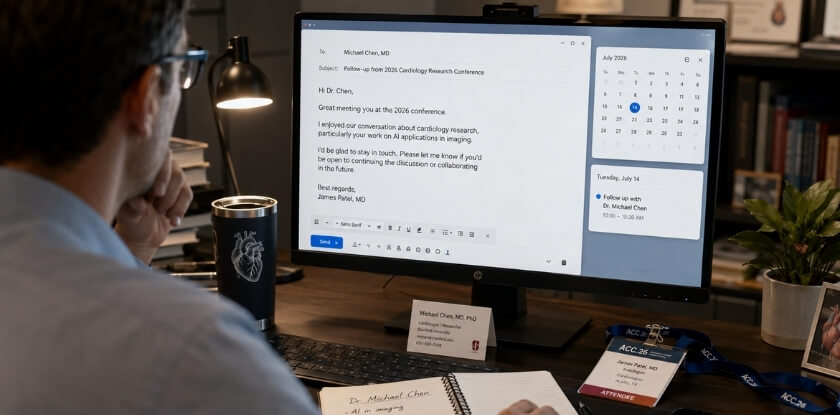
Start by collecting names, business cards, email addresses, institutional details, or professional profile links. Add a short note so you remember the context later.
Examples:
- “Met after cardiology session”
- “Presented poster on stroke rehabilitation”
- “Discussed rural healthcare access”
- “Interested in diabetes follow-up project”
Send a follow-up while the conversation is still fresh. Keep it brief and specific.
Example:
“Dear Dr. [Surname], it was a pleasure meeting you after the session on patient safety. I enjoyed our discussion about reducing medication errors in outpatient care. I would be glad to stay connected and continue the conversation when convenient.”
If you promised to share a paper, poster, summary, or contact, send it soon. This builds trust and shows professionalism.
You can also stay connected by sharing occasional updates, asking focused questions, or congratulating them on relevant work. Do not message too often without a clear reason. Professional relationships grow best when communication is useful and respectful.
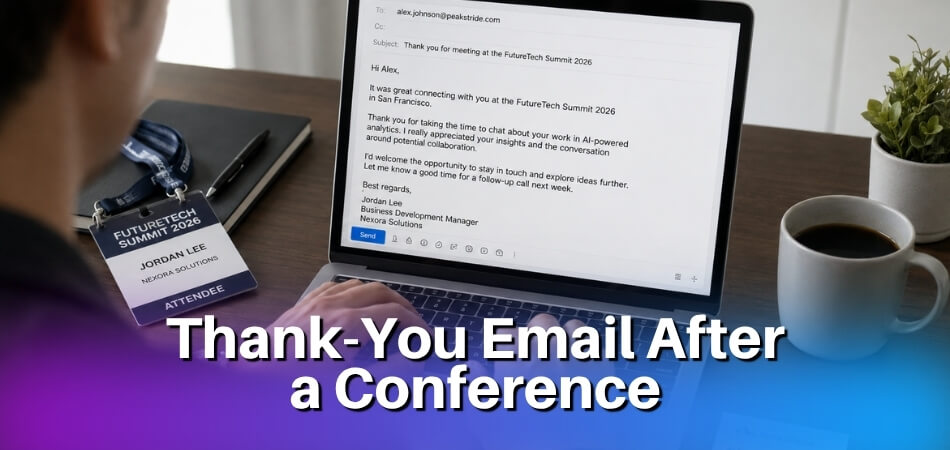
Sample Follow-Up Message After a Medical Conference Introduction
Subject: Great Meeting You at [Conference Name]
Dear [Dr./Professor/Mr./Ms. Last Name],
It was a pleasure meeting you at [Conference Name] during [session, workshop, poster discussion, networking break, or event]. I enjoyed our conversation about [specific topic], especially your thoughts on [specific point].
I would be glad to stay connected and continue the discussion when convenient. If helpful, I can also share [paper, project summary, poster details, resource, or contact information] related to what we discussed.
Thank you again for your time. I look forward to staying in touch.
Best regards,
[Your Full Name]
[Your Professional Title]
[Your Institution or Organization]
[Your Email / Phone / Professional Profile]Short version:
Subject: Nice Meeting You at [Conference Name]
Dear [Name],
It was nice meeting you at [Conference Name]. I enjoyed our discussion about [topic] and would be happy to stay connected.
Best regards,
[Your Name]
Common Mistakes to Avoid When Introducing Yourself
Mistakes to avoid include making the introduction too long, giving vague details, waiting for someone else to start the conversation, and sharing information that could identify a patient. A long introduction can overwhelm the listener.
Too long:
“Hello, I’m Dr. [Name]. I completed my medical degree several years ago, then worked in different departments, then became interested in cardiology, and now I’m involved in several clinical and academic projects…”
Better:
“Hello, I’m Dr. [Name], a cardiology resident focusing on preventive heart care. I’m here to learn more about early risk detection.”
Vague:
“I’m in healthcare and interested in many areas.”
Better:
“I’m a public health researcher focusing on vaccination access in rural communities.”
Connect your introduction to the event as well. Instead of only saying, “I’m Dr. [Name], a pediatrician,” add a purpose: “I’m here for the sessions on preventive child health.”
Waiting to be introduced is easy to slip into as a student or trainee, but it can come across as lack of interest. Start the conversation yourself: a short hello at a poster or after a session is normal at a medical conference.
Patient details are another trap. “I had a patient last week with a very rare reaction, and he…” is a story about a real person, even without a name. Describe the pattern instead: “We see many patients with late-presenting heart failure.”
From our experience at MS International: our conferences are in person at venues in the Greater Toronto Area, so introductions happen face to face, between sessions and at check-in. Attendees include presenting authors and registered listeners who attend without presenting. At each event the moderator introduces every speaker before the presentation. Check that your name, organization, position and presentation title are correct, because those details go on the speaker certificate given after presenting.
FAQ: Introducing Yourself at a Medical Conference
Meeting colleagues at a medical conference means judging how long to talk, whether to mention research or achievements, speaking up in a Q&A and whether a patient case belongs.
How Long Should a Medical Conference Introduction Be?
A medical conference introduction should usually be 20 to 40 seconds long. A fuller pitch about your work or career goals can run up to about a minute if the other person asks for more. For a Q&A session, keep it shorter and move quickly to your question.
Should I Mention My Current Research or Project?
Yes, if it is relevant. Mention one short line, such as, “My current research focuses on reducing hospital readmissions among heart failure patients.” Avoid explaining the full project unless asked.
How Do I Introduce Myself as a Doctor?
Say your name, specialty, workplace, and main clinical interest. For example: “I’m Dr. [Name], a general practitioner at [Clinic]. My work focuses on chronic disease management.”
How Should Medical Students Introduce Themselves?
Medical students should mention their name, study stage, institution, and interest. Example: “Hi, I’m [Name], a final-year medical student at [Medical College]. I’m interested in emergency medicine and trauma care.”
Is It Okay to Mention Achievements?
Yes, but keep it brief and relevant. Mention one poster, award, publication, or project if it connects to the conversation. Avoid listing several achievements.
Should I Use Humor?
Light humor may work in informal settings, but it should be careful and professional. If unsure, keep the introduction warm, simple, and respectful.
What Body Language Should I Use?
Use natural eye contact, open posture, a polite smile, and attentive listening. Avoid crossing your arms, checking your phone, or looking distracted.
How Do I Introduce Myself During a Q&A Session?
Say your name, role, and institution if relevant, then ask your question. Start with “Thank you for the talk, I’m [Name] from [Institution],” then ask a single, specific question about the method or the results.
What Should I Say If I Feel Nervous?
Use a simple prepared structure: name, role, focus, and purpose. Speak slowly, keep it short, and ask the other person a question to reduce pressure.
Should I Exchange Business Cards?
Yes, when there is a clear reason to continue the conversation. A natural line is: “It would be great to stay connected. May I share my contact details?”
Should I Re-Introduce Myself to Someone I Met Before?
Yes. Say your name and where you met, for example: “Hi, I’m [Name], we spoke after the [topic] session yesterday.” People meet many attendees in a few days, so a quick reminder saves them an awkward moment.
Can I Mention a Patient Case When I Introduce Myself?
No. Describe your work in general terms, such as the patient group or condition, and never share details that could identify a person. Keep any case discussion to what your institution allows.
Conclusion
Introducing yourself at a medical conference becomes easier when you follow a clear structure and adjust it to the situation. When people ask, how do you introduce yourself in a medical conference, the answer is simple: greet politely, say your name clearly, explain your role, mention your focus, share your purpose, and invite the other person into the conversation.
This approach works for networking breaks, Q&A sessions, poster presentations, workshops, panel discussions, booth visits, and informal conversations. With a little preparation and natural delivery, each conference interaction can lead to a useful discussion, a research contact, or a lasting professional relationship.