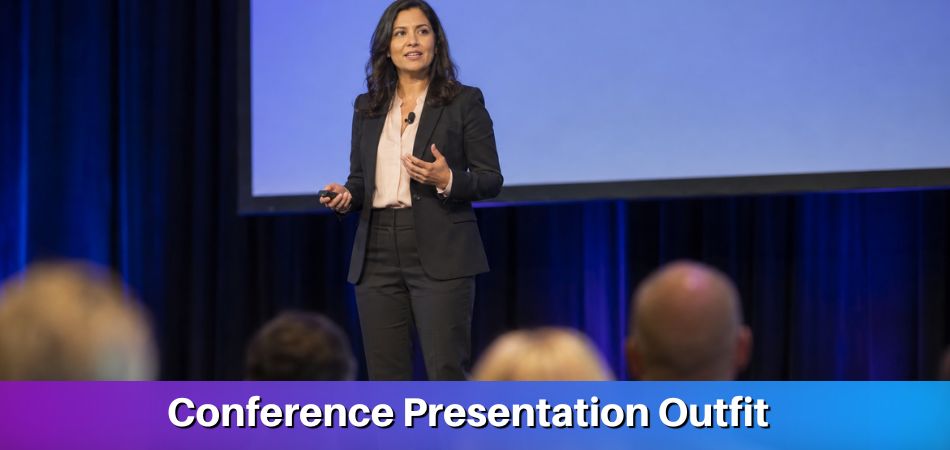

Ask ten academics what to wear to a conference and you will get ten different answers, most of them vague. “Business casual” means a blazer and chinos to one person and a pressed polo to another, which is how experienced researchers end up second-guessing their suitcase the night before they travel. Outdated guides tell you to dress like you are interviewing at a law firm, while colleagues in the arts department show up in curated vintage.
Quick answer: For an academic conference, smart casual to business casual is the safe default: clean trousers or dark jeans without rips, a collared shirt or neat blouse, a blazer or cardigan, and comfortable closed-toe shoes. Presenters dress one step smarter than the crowd. Your field matters too: STEM often runs more casual, humanities and social sciences can sit slightly smarter, and arts events allow more personality. If the event publishes a dress code, follow that first.
What to Wear to an Academic Conference
The short version: dress one level above what you would wear to teach or work in your department on an ordinary day. If you wear jeans to the office, wear chinos or trousers to the conference. If you already wear business casual daily, keep it there or nudge it slightly smarter.

That rule covers most situations, but field matters a lot. A biology conference and a fine arts conference follow different unspoken norms, and a full suit at either can look oddly formal rather than respectful. Fields that skew formal, such as law, economics and some humanities, call for smart professional, while fields that skew casual, such as many STEM and arts conferences, are fine with smart casual plus a blazer for presenters. The host institution’s culture and the region of the conference play a part too, and a large international meeting can run more formal than a small local workshop.
The Core Dress Levels to Know
Academic conference attire sits on a spectrum with four practical positions, from most relaxed to most formal.
| Level | Where it fits | What it looks like |
| Casual-leaning smart casual | Small workshops, design conferences, arts events where creative dress is welcome | Relaxed pieces worn with care. Overly formal clothes would feel out of place. |
| Smart casual | Many STEM conferences, workshops and relaxed evening events | Well-fitted trousers or a midi skirt, a neat blouse or collared shirt, clean leather shoes or polished loafers. Nothing wrinkled. |
| Business casual | Many humanities and social sciences conferences, large interdisciplinary meetings, any event with industry sponsors or recruiters in the room | Structured trousers, a button-down shirt or a top-and-jacket combination, a blazer that is optional but useful. Clean and polished. |
| Smart professional | Presenting, chairing, receiving an award, a conference dinner or ceremony | A blazer does real work here: blazer and trousers, a structured dress, or a well-cut suit. A tie is optional. |
What This Looks Like by Role
Your role at the conference shifts the expectation noticeably.
| Role | Aim for | Why |
| Attendee | Smart casual | You have the most flexibility. Choose comfort for long days on your feet, but keep everything clean-cut and intentional. |
| Student or early-career researcher | The smarter end of your field’s norm; smart professional when presenting | You are still building your reputation, so it helps not to look visibly underprepared. This is not about overdressing to impress. |
| Faculty chairing a session | Smart professional | You are the face of the session. The hoodie-and-jeans combination you wear to a departmental seminar can signal that you have not read the room. |
| Presenter | At least one tier above the general attendee crowd | You are standing in front of a room, and the impression forms before you have said a word. A blazer, a structured dress or a neat jacket works. |
| Poster presenter | Business casual rather than purely smart casual | You are visible for extended periods and often talking with senior faculty and potential collaborators. |
Virtual and hybrid attendance has its own rules, covered in the virtual section below.
A Practical Starting Point
If you are unsure and have no time to research the field, this combination works: well-cut trousers or a structured skirt, a clean pressed top, a blazer you can take off, and comfortable closed-toe shoes. That outfit functions at a biology conference, an engineering conference, a humanities panel and a social sciences keynote without drawing attention for the wrong reasons. If you can, dress a little smarter on your first morning, notice what other attendees wear, and adjust on later days.
The General Dress Code: Business Casual as Your Baseline
Academic conference dress codes rarely come with a printed rulebook, and “business casual” means different things to different people. Treat it as your floor, and build field-specific and role-specific adjustments on top of it.

What ‘Business Casual’ Actually Means for Conferences
In a conference context, business casual is the dressed-up version of your everyday clothes: polished enough to be taken seriously, relaxed enough that you are not in a suit at a poster session in July. In practice, that translates to this:
- Tops: A button-down shirt (tucked or untucked), a blouse, a clean crewneck or fine-knit sweater, or a structured polo. No graphic tees, no hoodies.
- Bottoms: Chinos, well-cut trousers, a midi skirt, or dark well-fitting jeans (straight or slim cut, no rips). Avoid anything that reads as weekend-casual, such as cargo shorts, athletic joggers or heavily distressed denim.
- Footwear: Loafers, clean leather shoes, block-heeled boots, ballet flats, or smart sneakers (clean, minimal branding). Not running shoes or flip-flops.
- Layers: A blazer or cardigan is usually a good addition. Conference rooms are often air-conditioned hard, and a layer also signals effort.
Fit matters as much as the items themselves. A well-fitting chino-and-blouse combination reads more professionally than an ill-fitting dress shirt. If you are unsure, aim for clothes that look intentional, as if you made a decision that morning rather than grabbed whatever was on the floor.
Smart Casual vs Smart Professional: When to Step It Up
Smart casual is slightly more relaxed than business casual, and smart professional is a clear step toward formal.
Smart casual gives you more flexibility. Think dark jeans with a blazer, or a knit dress with ankle boots. It suits attendees who are not presenting, evening networking events with a relaxed tone, and arts and design conferences. The key is that the outfit still looks deliberate. Smart casual is not an excuse for underdressing.
Smart professional is what you reach for when the stakes are higher: presenting a paper, chairing a session, receiving an award, or attending a formal dinner or an event tied to a prestigious institution. For men, that usually means a suit, or a blazer with dress trousers. For women, a blazer dress, a structured suit, or a formal blouse with wide-leg trousers all land in this range. For non-binary academics, structured separates, fitted jumpsuits or monochrome suiting read as polished without being gendered.
The clearest signal to step up is your role in the program. Presenters are the visible face of their research while they speak, so dressing at the upper end of the room’s general standard is appropriate, while an attendee at the same session can sit comfortably in business casual. If you are unsure which tier fits your day, look at the program: keynote speakers and panel chairs often dress at the smart professional level, which can give you a reference point for the top of the room.
The 3-3-3 Packing Tip for Conference Clothes
The 3-3-3 idea is a packing tip, not an official rule: plan three outfits for three kinds of conference moments, and build each from three pieces that work together. It keeps your bag manageable on a multi-day conference where you may present, attend sessions and go to an evening reception, sometimes in the same 12-hour stretch. (You may also see a simpler version: three tops, three bottoms, three pairs of shoes.)

| Outfit slot | Moment | What to pack |
| Outfit 1: presenting or chairing | Formal | Your highest-stakes slot. Lean toward smart professional: a blazer over a structured shirt or blouse, dress trousers or a well-cut dress, clean shoes. The exact interpretation varies by field (see the next section), but keep it a half-step sharper than everything else you bring. |
| Outfit 2: active attendee | Functional | Sessions all day, corridors, coffee between panels. Smart casual works: dark jeans or chinos with a collared shirt or neat sweater, or a midi dress with flats. Nothing that reads as “I just got off a flight,” even if you did. |
| Outfit 3: social or evening event | Social | A conference dinner, drinks reception or informal gathering. Often stylish but relaxed in the humanities and more casual in STEM. Swapping one key piece, such as a different jacket or smarter shoes, can signal the shift from day to evening. |
Build each outfit around a neutral base (navy, grey, black, camel) for at least two of the three pieces, and let the third carry color or pattern. The goal is interchangeability. If you can swap the blazer from outfit 1 into outfit 2, you save bag space and have a backup if something gets a coffee stain on day two. Darker shades hide small spills and creases better than pale ones, and a stain-remover pen in your bag handles a spill when you have no laundry access.
Think through which days and events actually require a different look before you pack anything, and map the outfits against your real schedule. If you are not presenting at all, you can reassign outfit 1 to a formal panel or keynote day where you want to make a stronger impression.
Dress by Field: STEM, Humanities, and Arts Norms
Dress norms vary more by discipline than most people expect. What reads as professional at a molecular biology symposium can feel stiff at a theatre studies conference, and the reverse is also true.
| Field | Baseline | Presenter step-up |
| STEM and sciences | Smart casual, or business casual when sponsors or recruiters are present | A blazer is optional for attendees but a solid choice when presenting or chairing. |
| Humanities and social sciences | Business casual, with more room for personal expression | A dress jacket, a well-cut dress or a sharp blazer. Lean toward smart professional when you do not know the room. |
| Arts, design and creative fields | Smart creative: polished and intentional, with room for visual identity | Wear something that feels like you, considered and put together. |
STEM and Sciences (Biology, Engineering, etc.)
Think clean chinos or dark trousers, a collared shirt or neat blouse, and closed-toe shoes. Biology and engineering conference attire follow largely the same logic: functional, clean and professional without being formal. A suit would look out of place at many computational biology poster sessions, and a hoodie would look underprepared. Fieldwork and lab culture tend to push norms slightly more casual, so smart casual works well here: dark jeans with a pressed blazer and a clean blouse, or slim-cut chinos with a structured top. Save the suit for presentation day.
If your conference includes lab tours or hands-on workshops, factor that in when packing. Closed-toe shoes are not just a dress code matter, because some venues require them for safety.
Reliable outfit options: for women, trousers with a structured blouse, or a midi dress with a cardigan. For men, a well-fitted Oxford shirt with dark trousers, or dark jeans with a clean button-down or a well-fitted polo, which is standard at many engineering and computer science events. For non-binary attendees, structured separates in neutral or muted tones, with minimal fuss. A blazer adds credibility without going overboard, especially if you are presenting.
Humanities and Social Sciences
The dress code typically sits between smart casual and business casual, with noticeably more room for personal expression than in STEM. You will see tweed jackets alongside statement earrings, turtlenecks with blazers, and the occasional bold print that would look eccentric at an engineering conference but fits right in here.
“Expressive” does not mean “anything goes.” A history or sociology conference still expects you to look put-together. Jeans are generally fine if they are dark, well-fitted and paired with something polished on top, such as a blazer or a structured top rather than a casual tee.
Social sciences conferences also attract a mix of academics and policy professionals, so erring toward smart professional pays off when you present. Accessories matter more here than in STEM: a structured bag, a scarf or thoughtful jewelry fits the culture.
Arts, Design, and Creative Disciplines
Attendees routinely wear bold colors, interesting textures and clothes that reflect their own practice. That does not mean dressing for a gallery opening every day. Comfort and practicality still apply on multi-day programs.
Conforming to a strict business casual template can actually read as a lack of engagement with the field. Creative academics and practitioners are expected to have a point of view, and your outfit is part of it. For presenters, appearance counts as part of the presentation in a way it does not at a biochemistry symposium. Treat that as an opportunity, not a pressure.
Students and early-career attendees sometimes default to overly conservative choices at arts conferences out of nerves. A little more risk is appropriate here. If you have always wanted to wear that color-blocked blazer or a more expressive silhouette to a professional event, an arts and design conference is probably the place.
Presentation Day vs Regular Conference Day
Dress differently on the day you speak. Sitting in the audience on a Tuesday afternoon is a very different situation from walking up to the podium on Wednesday morning, and treating every day the same is an easy dressing mistake.
When You’re Presenting
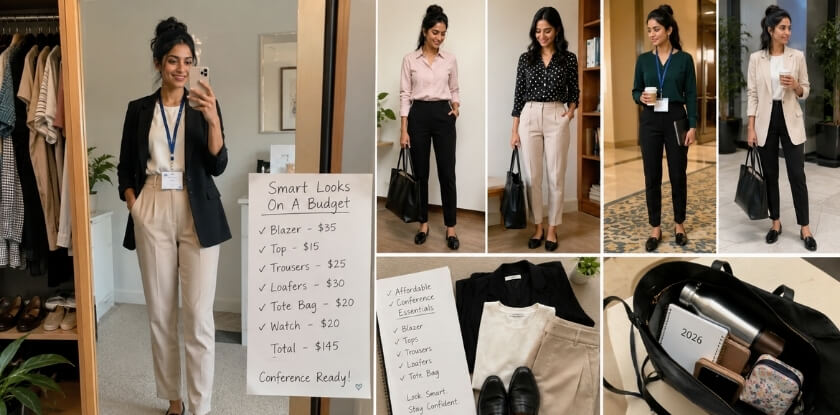
On presentation day, dress one level above the usual attendee wear at that conference. If the field runs casual and attendees wear jeans and a clean shirt, move to smart casual or smart professional. If the conference already expects smart casual, go smart professional. People are looking at you specifically for the length of your talk, and you want them focused on your research, not distracted by a wrinkled shirt.
A few things matter specifically on presentation day:
Fit and proportion. Clothes that fit well read as confident in front of a room. Avoid anything oversized, too tight, or prone to riding up when you gesture at a slide.
Color and pattern. Think about what is behind you. A navy or charcoal blazer reads clearly against most backdrops, while light grey against a white screen or pale wall tends to wash out. Busy patterns, such as a bold geometric blouse or a heavily patterned tie, can look sharp in person but create visual noise on a projector feed or a recorded or streamed talk. Solid colors and subtle textures read better.
Comfort over the full duration. You may be in that outfit from early setup through your afternoon slot and a Q&A that runs long. Wear something you can stand and move in for hours. A shoe that looked fine in your hotel room will show clearly when you are shifting your weight at a podium for half an hour. Extremely high heels are practical in concept and painful at a podium, and flat or low-heeled shoes let you stand without visibly shifting your weight. Your audience notices discomfort before you do.
Accessories and the microphone. Keep them simple. A watch is fine. Stacked bangles, long beaded necklaces and heavy jewelry that catches cables or makes noise when you lean forward are worth leaving at home. If you are wearing a lapel mic, you need a collar, waistband or lapel to clip it to, so factor that into your outfit.
When You’re Just Attending
Regular conference days are more relaxed. Smart casual covers most situations: clean trousers or well-fitted jeans (depending on the field), a neat top or shirt, and shoes that are not beaten-up sneakers. You will be sitting for long stretches and possibly walking a campus or convention center, so comfort is a legitimate factor, not a compromise.
“Attending” can still include networking lunches, poster sessions and impromptu conversations with people you have been emailing for two years, so do not dress so casually that you feel caught off guard. A practical approach is to keep a blazer or structured jacket within reach. Carry it, put it on for a keynote or an evening event, and skip it during back-to-back panels. It costs nothing extra in your luggage and gives you real flexibility.
Evening Events and Conference Dinners
Dinners, receptions and award ceremonies often call for stepping up from your daytime look. A full outfit change is not usually necessary: a fresh shirt, a blazer and smarter shoes are enough. Looking like you made an effort matters in social settings, where a lot of professional relationship-building happens.
Check the program in advance. Some dinners are explicitly formal (especially in law, medicine and some humanities fields), and others are casual drinks at a bar. Knowing which one you are walking into lets you pack rather than improvise.
What NOT to Wear to an Academic Conference
The “what not to wear” list is often more useful than the “what to wear” list, because the mistakes are specific and avoidable.
Anything Too Casual for a Public Room
Jeans get a pass at many STEM conferences and informal humanities workshops, but they need to be clean and dark-wash and paired with something polished on top. Ripped jeans, cargo shorts, gym shorts and joggers are out regardless of field. The same goes for t-shirts with slogans, band names or university humor, even if everyone at your institution wears them daily.
Flip-flops and slide sandals worn with athletic socks are a recurring misstep when travel clothes carry straight into the conference. Comfortable footwear is fine. Visibly beach or gym footwear is not.
Anything That Reads as Underdressed for Your Role
A graduate student attendee and a faculty member chairing a session are held to different standards, and the same hoodie-and-jeans you wear to a departmental seminar can look careless in the second case. This matters more in humanities and social sciences conferences, where dress norms correlate more visibly with professional status. In arts and design, creative dress is expected and appreciated, but that is not the same as careless dress.
If you are presenting, interviewing, or networking with people who might hire you, dress one tier above the median attendee. It is not about formality for its own sake. It is about being taken seriously before you have said a word.
Anything Too Formal for the Specific Event
Overdressing is a real risk in some fields. A full suit at a casual biology field day or a laid-back digital humanities unconference can make you seem out of touch with your own discipline’s subculture. Check the conference website, look at photos from previous years, and ask a colleague who has attended before.
Virtual and Hybrid Conference Dress Code
For a virtual or hybrid conference, dress as you would in person from roughly the chest up, in solid mid-tone colors, and add a blazer when you present. You are still being seen by colleagues, hiring committees and potential collaborators, so the stakes do not drop because you are on a screen.
Virtual Conferences
The camera frames you from roughly the chest up, which shifts everything. Your lower half is invisible, but a suit jacket over pajama pants is not a workable strategy, because the way you are dressed carries into how you sit and speak, and experienced attendees notice.
Keep color camera-conscious. Stark white blows out under most laptop cameras, and deep black can flatten against a dark background. Medium tones such as navy, slate, burgundy, forest green and camel read cleanest on screen. Avoid fine stripes and tight herringbone, which create a moire shimmer that is distracting on video.
Dress to your field’s norms, not below them. If your field expects smart casual in person, wear smart casual on camera. A STEM attendee can wear a neat button-down or a clean crew-neck sweater, and a humanities or social sciences presenter should aim for the level they would wear to a departmental talk. Do not overshoot either: a stiff, fully formal top against a casual home background can look odd, and smart casual or smart professional usually lands better on video.
Presenters still dress up. If you are on a panel or delivering a paper, treat your visible framing exactly as you would treat an in-person presentation, with the same norms applying. A blazer signals preparation even through a screen.
Grooming and background matter as much as clothes. A well-ironed shirt against a cluttered, badly lit corner still looks unprofessional. Use a plain wall or a tidy bookshelf, and light your face from the front, not from behind.
Hybrid Conferences
At hybrid events some attendees are in the room, some are on screen, and the two groups can see each other. If you attend in person, dress as you would for a fully in-person event. The presence of remote participants does not soften that, and if you present, dress for the room rather than for Zoom. The camera captures whatever the room sees, and in-person attendees should not feel they are watching a remote presenter who dressed for a video call.
If you attend remotely while others are physically present, resist the temptation to dress down. You may appear on a shared screen in the room, so a ballroom full of people could be looking at you while a presenter speaks. Dress at least one level above what you would wear to a casual Zoom meeting.
Camera placement at hybrid venues is often unflattering. Wide-angle room cameras sometimes catch remote attendees in a small tile on a large display, and high-contrast outfits, strong horizontal stripes and very shiny fabric tend to look worse there. Solid, medium-toned clothing holds up better across screen sizes. If you switch between in-person and remote sessions, pack a blazer or polished layer you can put on quickly. It is the fastest way to shift your register without a full outfit change.
Accessories and Grooming for Video
Large dangling earrings can cause noise interference with some microphones. Glasses with strong reflective coatings can catch ring lights and obscure eye contact, and adjusting your light angle usually fixes that. Keeping your hair back or away from your face reads more clearly on camera than in person.
Accessories, Shoes, and Grooming Tips
Shoes, bags and grooming round out the picture. At an academic conference, where you are often meeting potential collaborators or interviewers for the first time, small details carry real weight.
Shoes
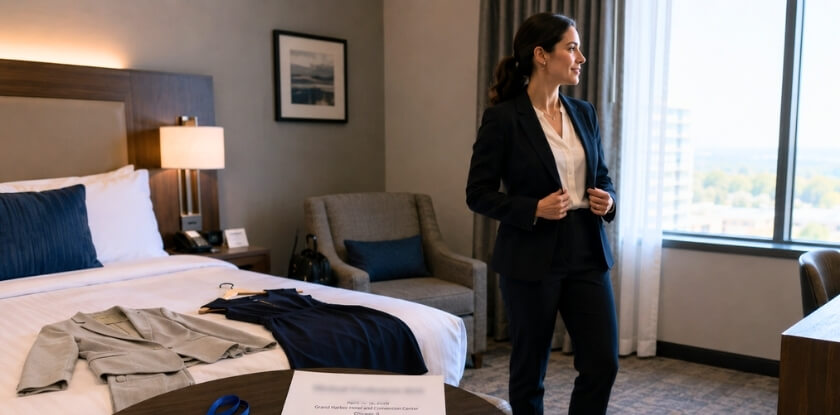
Choose comfortable, polished shoes that you have already worn in, because you will be on your feet for long stretches: standing during sessions, walking between rooms and crossing poster halls. Comfortable shoes are not a concession in any field. They are what gets you through back-to-back sessions, poster halls and networking events.
Comfort is non-negotiable for multi-day events. Smart leather oxfords or loafers, block-heeled pumps or pointed flats hit the right note without punishing your feet by day two. Brand-new shoes are a bad idea. If you have not worn them for at least a few full days beforehand, do not debut them at an event where you will be standing for hours.
Match the formality of your field. STEM conferences tolerate clean leather sneakers or minimalist trainers with trousers, and clean white sneakers can pass there and at social sciences conferences, though they still read as casual at more formal events. Humanities and social sciences conferences skew slightly more conservative: dress shoes, low heels, loafers (leather or suede), plain-toe oxfords or minimalist Chelsea boots. Arts and design conferences are the one context where bolder footwear reads as intentional rather than careless.
Avoid sandals and open-toe shoes unless the event is in a genuinely warm climate and the dress code signals casual. Even then, they tend to undercut an otherwise polished look on presentation day.
Bags and Accessories
Accessories serve a practical function first. You are carrying a laptop, a notebook, printed abstracts and possibly a poster tube, and style should follow from that. A structured bag, a simple watch and understated jewelry support a professional impression without competing with your work.
A structured tote or slim laptop bag in a neutral color works for almost every academic context. Avoid oversized backpacks in session rooms, where they create noise and bulk as you move past seated attendees.
Keep jewelry minimal. A watch, a simple necklace or small earrings read as professional (see the presentation day section for jewelry that causes microphone noise).
A lanyard and conference badge are usually provided, but how you wear them signals attention to detail. Keep the badge visible and right-side up, because people read your name and institution at every handshake.
A subtle leather cardholder or slim wallet is worth having on hand. You will exchange business cards or tap phones for contacts more often than you expect.
Grooming
Grooming at an academic conference comes down to looking intentional rather than formal. You do not need a salon appointment, but you do need to look like you prepared. Visibly unkempt hair, strong fragrance or unironed clothes undercut an otherwise solid outfit. The goal is to be remembered for what you said, not what you were wearing.
Hair should be clean and styled in a way you can maintain across two or three days. If your hair is longer, a backup option for day two (a clip, a tie) is practical, because travel humidity and rushed mornings will happen.
Facial hair should be tidy. A well-kept beard is entirely appropriate. Three days of unintentional stubble on presentation day looks like you forgot.
Fragrance should be light or skipped entirely. Sessions pack people into close rooms for hours. Heavy perfume or cologne is a genuine irritant for some attendees, and in smaller seminar-style sessions it is hard to ignore.
Nails, if visible during a presentation, should be clean. Neutral or understated polish tends to read best in formal settings. Bold colors are a personal call based on your discipline’s culture.
What to Wear on Travel Days To and From the Conference
Choose clothes that are comfortable enough for transit and polished enough that you could walk into the venue without changing. Travel days are their own category: you move through airports, train stations or parking garages with luggage for hours, then walk straight into a registration hall or an opening reception.
What Actually Works
You do not want to arrive crumpled, and you do not want six hours on a flight in a structured blazer and dress shoes. The answer sits in the middle.
Wrinkle-resistant fabrics are your best friend. Travel outfits should be wrinkle-resistant or easy to steam in a hotel room. Ponte trousers, jersey-knit blazers and merino wool tops travel well and look presentable on arrival. Cotton wrinkles badly in a carry-on, so save it for days when you are already at the hotel. A linen suit that wrinkles badly in transit is a real problem if you present on day one. Wearing your most structured blazer on the plane rather than packing it flat is worth the mild awkwardness at the airport.
Check the forecast and the venue. Look up the weather at your destination and whether you will walk between buildings or outdoors, then choose breathable fabrics or an extra layer to match.
Layer strategically. A cardigan or lightweight blazer over a solid top lets you remove the layer on the plane and put it back on before you land. It also leaves you one step from looking conference-ready if your checked bag is delayed.
Footwear matters more on travel days than any other. Comfortable shoes that can pass as smart casual, such as leather loafers, clean white trainers for arts or tech conferences, or low-heeled ankle boots, mean you are not limping through the welcome reception because you wore formal shoes for twelve hours of transit.
Avoid anything that reads as purely athleisure. Leggings, hoodies and slide sandals are fine for a long-haul flight if you change at the hotel, but they will not work if you go directly from arrival to a conference event. A clean pair of dark-wash jeans and a structured top is a better baseline.
Men’s and Women’s Travel Outfit Options
For men, slim chinos or dark jeans with a merino crewneck or a button-down shirt (untucked is fine) is the standard. Add a casual blazer if you want to feel more put-together, though it is not required.
For women, ponte or stretch trousers with a blouse or structured tee work well. A midi wrap dress in jersey is also a strong option: comfortable on a plane and intentional at an evening reception.
For non-binary academics, the same logic applies. Prioritize wrinkle resistance and fit, and pair a well-fitting trouser in a travel-friendly fabric with a clean top.
One Bag, One Decision
If your travel is long or you have a layover, keep your presentation outfit and a change of clothes in your carry-on rather than relying on checked luggage. A single swap of a fresh shirt and clean shoes can be the difference between feeling ready and feeling like you have just survived a red-eye. This matters most for presenters whose first slot is on day one.
Pack your conference accessories (badge holder, notebook, a simple scarf or pocket square if that is your style) where you can reach them easily. Small details pulled together quickly after a flight do most of the visible work.
Academic Conference Outfit Ideas
These outfit formulas are field-flexible, and you can adjust the formality up or down depending on whether you are presenting, attending or joining a hybrid event.

Women’s Outfit Ideas
| Outfit | Why it works |
| Well-cut trousers with a structured blouse | Trousers in navy, charcoal, stone or black with a tucked-in blouse in a solid or subtle print is probably the most reliable conference outfit. It reads as smart professional without being stiff and travels well. Add a blazer for presentations or panels. |
| A midi dress with a blazer or cardigan | Midi shirt dresses or wrap dresses in muted tones work across STEM, humanities and social sciences conferences. The layer keeps the look polished and adds warmth for cold conference rooms. |
| Wide-leg trousers with a knit top | A fitted ribbed or merino knit tucked into wide-leg trousers in a neutral or earthy tone looks considered without being overdressed. It suits arts and design conferences and social sciences settings. |
| A suit in a softer color | Dusty pink, sage green or warm camel can work if your field leans formal (a medical conference, an economics symposium, a law faculty event). Navy and charcoal remain the safest choices. |
For footwear, low-heeled ankle boots, loafers and block-heeled pumps are all practical. Choose something you can stand in for three hours.
Men’s and Non-Binary Conference Outfits
The old binary of “suit or business casual” has relaxed considerably, and academic conference dress norms leave a lot more room regardless of how you present.
| Outfit | Why it works |
| Chinos and a button-down, with or without a blazer | The default smart casual baseline for most academic conferences. Fit matters more than brand: chinos in stone, navy or olive with a plain or lightly patterned button-down read as universally appropriate. Add a blazer and you are presentation-ready. |
| A lounge suit in a softer fabric | Cotton blends and other lighter-weight suits in lighter colors suit warm venues and can work at humanities and social sciences conferences. They are cooler than wool and project quiet seriousness without a full business ensemble. Linen wrinkles easily, so steam or iron it before you wear it. |
| Turtleneck or mock-neck with well-cut trousers | A fitted turtleneck in charcoal, burgundy or cream looks deliberate at arts and design conferences and some humanities events. It also works as a presentation outfit when you want to skip the standard blazer-and-tie formula. |
| For non-binary attendees: structured separates | Build around fit and fabric quality rather than gendered garment categories. Structured blazers over wide-leg trousers, co-ord sets in muted tones and relaxed-tailoring pieces in good fabrics all land well. The principle is the same as for everyone: polished enough that your ideas get the attention, not your outfit. |
From our experience at MS International: Our conferences are held in person at Greater Toronto Area venues, and the event pages state no dress code, so the advice in this guide is general guidance rather than a rule of ours. You do not have to present to attend, since registered listeners are welcome, and the attendee advice applies to them too. Arrive at the check-in time in your confirmation email and collect your badge at check-in. Presenters bring slides in the requested format with a USB backup, and the moderator introduces each speaker. Presenters receive a certificate after presenting.
FAQ: What to Wear to an Academic Conference
Before you pack for an academic meeting, think through jeans, what poster presenters wear, dressing up for the conference dinner and repeating outfits across days.
Is business casual always safe for an academic conference?
Usually, yes. Business casual works at most academic conferences. The exceptions are arts and design events, where something more creative is often expected, and formal award dinners, where smart professional fits better. If the organizers publish a dress code, follow it.
Can I wear jeans to an academic conference?
Sometimes. Dark, well-fitted jeans without rips, worn with a blazer or smart top and clean shoes, are acceptable at STEM conferences and some social sciences events on days you are not presenting. Avoid them on presentation days, and skip them at humanities conferences with formal dress norms.
Do I need to dress differently if I’m a presenter?
Yes, one step up from what you would wear as a regular attendee. If attendees are in smart casual, presenters should aim for smart professional. You are at the front of the room and people are looking at you for an extended period.
What should a poster presenter wear?
Business casual is the safe choice, leaning slightly smarter than a regular attendee. You are on your feet for a long stretch and talking with senior faculty and potential collaborators, so pair a neat top and a layer with very comfortable shoes.
What should early-career researchers or PhD students wear?
Lean toward the smarter end of your field’s norm. Smart casual is a safe floor, and smart professional is appropriate when you present. The point is not to overdress to impress but to avoid looking visibly underprepared in a room where you are still building your reputation.
What do non-binary academics typically wear to conferences?
There is no single answer. Structured trousers, blazers and clean minimal footwear work across most fields regardless of gender presentation. Match the formality level of your field and go slightly smarter on presentation day.
Are there dress norms for online-only conferences?
A polished top and good lighting are the baseline. Solid mid-tone colors photograph better than busy patterns. You do not need to dress head to toe, but what shows on screen should look deliberate, not like you forgot you had a meeting.
What should I wear if my field has no clear dress code?
Smart casual with one slightly more formal piece is a reliable default. Look at photos from the previous year’s conference if they are on the event website or social media, which will tell you more than any general advice.
What should I wear on the travel day to a conference?
Wear comfortable clothes that still look polished: wrinkle-resistant trousers, a removable layer, and shoes that pass as smart casual. Keep your presentation outfit in your carry-on in case checked luggage is delayed.
Should I dress up more on the first day of a conference?
Yes, a little. Start slightly smarter on day one, see what other attendees wear, then adjust. On the day you present, still go one step above the crowd.
Should I dress up for the conference dinner?
Usually a little, yes. Step up from your daytime look with a fresh shirt, a blazer and smarter shoes. Check the program first, because some dinners are explicitly formal and others are casual drinks.
Is it okay to repeat outfits across conference days?
Yes. A three-day conference does not require three completely different outfits. The 3-3-3 packing tip exists for this reason: a few versatile pieces that combine in multiple ways let you look varied without packing a full wardrobe.
Does conference attire vary by country or region?
Yes, it can. Local custom and climate matter, and a large international meeting can run more formal than a small local workshop. Check the event website, look at photos from previous years, or ask a colleague who attended before, especially for a conference abroad.
Do conference accessories matter?
Yes, small details count. A worn-out bag, scuffed shoes or overpowering fragrance can undercut an otherwise solid outfit. Keep accessories clean, minimal and functional, especially if you are carrying a laptop and conference materials all day.
Does MS International set a dress code?
The MS International conference pages do not state a dress code. If you are unsure, ask the organizers before you travel, and use the field and role guidance above as a general guide.
A Simple Plan Before You Pack
Know your field’s norms, dress one notch above your audience on presentation day, and pack for comfort on travel days. The goal is to look like someone who takes the work seriously, which leaves people free to focus on what you are actually saying.