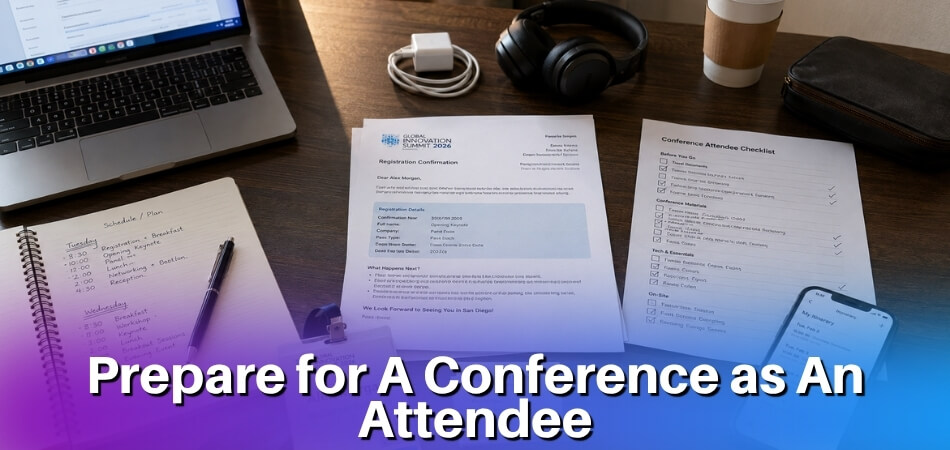
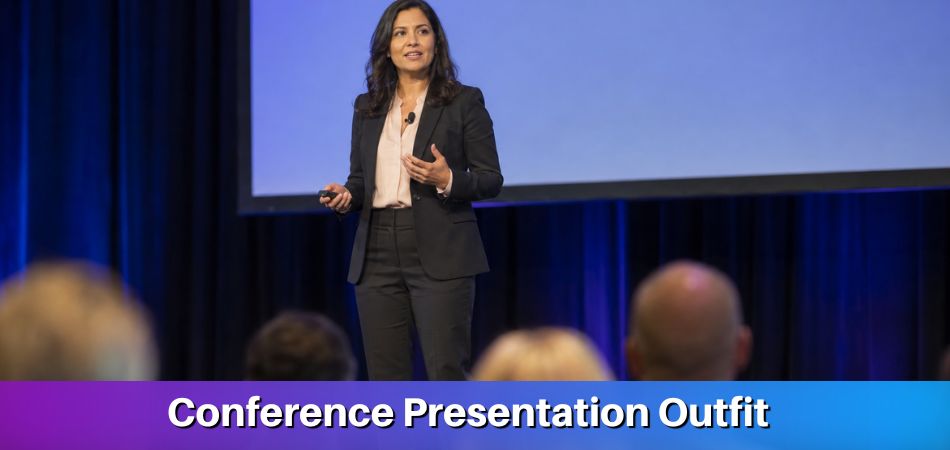
What to wear to a scientific conference sounds like a small question until you picture a PhD student at a first poster session and a keynote speaker walking into the same room. The right answer is not quite the same for both, and getting it wrong in either direction leaves you feeling out of place for the whole day.
Quick answer: Business casual is the safest default at a scientific conference: trousers or a skirt, a collared shirt or blouse, clean closed-toe shoes, and a blazer you can take off. Physics, computer science, and engineering meetings can run more relaxed, and medical meetings more formal. Dress one step up when you give a talk, and put comfortable shoes first for poster sessions.
What Do People Wear to a Scientific Conference?
Business casual is the safest default: chinos or fitted trousers, a collared shirt or blouse, a blazer if you want one, and comfortable closed-toe shoes. Skip the hoodie and athletic wear, and keep the formal suit for a keynote or a high-profile event. That baseline travels across fields.

Beyond the baseline, context matters. A computational biology meeting has a very different feel from an anthropology association meeting, and your outfit should follow the room. There is no single dress code for scientific conferences. A 2018 ASBMB Today article on its annual meeting notes that some conferences expect business attire, some business casual, and some are very casual, and that dress codes are often not stated. If the programme gives dress guidance, follow it. If it does not, look at photos from previous years on the conference website or social media, or ask a colleague who has attended. What past attendees wore is a clearer signal than any general rule.
When “Business Casual” Is Vague
The phrase means different things in different rooms. A 2017 University of Connecticut undergraduate research blog post describes a student who dressed carefully for a conference listed as business casual and found other attendees in jeans and band T-shirts. Her conclusion was that you can be overdressed, and that asking people who had attended before would have settled it. The ASBMB article takes the opposite starting point: dress more formally on day one, then adjust to what others wear. Both point to the same habit. When in doubt, dress slightly more formally than you think you need to, because it is easier to take off a blazer than to wish you had brought one, and match the room from day two.
How the Level Changes During the Day
Business casual is the baseline, and you adjust around it depending on what you are doing.
| Situation | Dress level | What it looks like |
|---|---|---|
| Oral presentation or invited talk | One step up | Blazer on, polished shoes, an outfit that feels deliberate |
| Poster session | Baseline, comfort first | Blazer optional, smart flats or cushioned shoes you can stand in for hours |
| Workshop or breakout session | Relaxed end of the baseline | A neat pullover or tidy blouse is fine |
| Drinks reception or networking evening | Smart casual | Blazer over a casual shirt, or a simple dress |
| Formal conference banquet | Dressed up | Suit, cocktail dress, or equivalent. Check the event listing if there is any doubt |
Business Casual Explained for a Conference
Business casual at a conference sits between a job-interview outfit and a relaxed Friday at a professional office. Many scientific conferences do not publish a formal dress code, so this unwritten standard is what you are working with.

What Works and What Does Not
The range is broad: fitted trousers, midi skirts, smart dresses, chinos with a button-down shirt, or blouse-and-trousers combinations, with leather shoes or smart flats. A blazer adds polish without becoming too formal. Add one for a talk or drop it for a poster session and you are still appropriate.
What does not work: athletic wear, flip-flops, slogan T-shirts, or anything visibly wrinkled from your suitcase. These read as inattentive rather than relaxed.
Why This Is the Starting Point
It looks serious and approachable at the same time, and both matter. People form an impression the moment you walk into the registration hall, especially if you are early-career, and your appearance can shape how your credibility is read before you speak. It is also practical: you will walk more than you expect, sit through long sessions, and may go from a poster session to a dinner in the same clothes.
Fit, Color, and Condition
Fit matters more than price. A well-fitted pair of chinos from a budget shop looks more professional than an expensive suit that does not sit right on the shoulders. Iron things and check for loose buttons.
For color, build on neutrals such as navy, gray, black, and stone, then add one or two pieces with color or pattern if that suits you. A rich tone like emerald, rust, or burgundy is memorable without being loud.
Dress by Field: STEM, Medical, and Humanities Are Not the Same
Field culture shapes dress more than people expect. A plasma physicist and a medical anthropologist may both present peer-reviewed work in the same week, but they will not pack the same bag. Treat the table as general patterns, not rules, because norms also change with the meeting, the organiser and the country.
| Field | Usual look | Example |
|---|---|---|
| Physics, computer science, engineering | Relaxed end of business casual | Clean shirt and trousers, a jacket optional |
| Lab and life sciences | Between STEM and clinical, smart casual for talks | Neat shirt or blouse, blazer for presentations |
| Earth sciences with field trips | Business casual in the hall, practical outdoors | Smart layers for sessions, boots and weather gear for the excursion |
| Medical and clinical | More formal | Conservative separates, polished shoes, blazer for presenters |
| Social sciences and humanities | Smart casual with personality | Interesting knitwear, colored blazers, statement accessories |
Physics, Computer Science, and Engineering
These fields can run casual by academic standards. Dark jeans, chinos, and button-down shirts (sometimes untucked) and clean sneakers can all fit, and a blazer is optional. A clean, well-fitting outfit reads as professional without a jacket, but wrinkled or worn clothes are a distraction.
Tech-adjacent and industry-heavy conferences can skew even more casual, so read the program and sponsor list: an industry-heavy event can look different from a pure-academia one.
If you are presenting for the first time, one step more polished than the people around you is a reasonable choice. You do not yet have the reputation to pull off total informality, and a neat blazer over a plain shirt shows you take the moment seriously.
Lab and Life Sciences
Biochemistry, cell biology, and genomics sit somewhere between STEM and clinical medicine. Lab-culture casualness exists, but presentations and networking events nudge people toward smart casual. If your work crosses into clinical application or involves pharma and biotech sponsors, dress toward the more professional end.
If the program includes a lab tour, wear what the host asks for. Labs set their own safety rules, and closed-toe shoes and long trousers are a sensible default when you have not been told otherwise. Ask the host or the organizers beforehand rather than guessing on the day.
Earth Sciences and Fieldwork
Earth science meetings often include a field trip or outdoor session. Pack a second, practical set for that day: sturdy closed shoes or boots, layers, and rain or sun protection that suits the forecast. Keep your session outfit separate, because boots and trail dust do not belong at a talk.
Medical and Life-Science Clinical Meetings
Medical conferences can run more formal, and first impressions may carry more weight in hierarchical settings where the audience includes senior clinicians, administrators, and journal editors. Expect conservative colors and polished shoes, with suits possible on the main presentation days. A shirt and tie, with a blazer for presenters, is a safe choice for men, and fitted trousers or skirts, blouses, or structured dresses suit women. If you represent a hospital or clinical institution, lean formal whatever your role. If you are early-career, err toward polished, and check the meeting’s own attendee guidance if it has any.
Social Sciences and Humanities
Humanities conference fashion has more room for self-expression: structured blazers in unusual colors, interesting fabrics, vintage pieces, bold accessories. The practical rule is to look intentional, since a well-chosen outfit with some personality shows you care about the cultural side of your field. A generic business outfit will not hurt you but may look like you wandered in from a law firm.
Dress by Role: Student, Senior Researcher, and Keynote Speaker
Your role shapes what you wear almost as much as your field does. Dressing for your position shows you understand the room.

PhD Students and Early-Career Researchers
The standard sits in business casual: clean chinos or fitted trousers, a collared shirt or blouse, and shoes that are not trainers. Conference organizers, potential supervisors, and hiring committees may be in the room, so avoid extremes. Jeans, a hoodie, and scuffed sneakers can make it harder for senior researchers to take your work seriously, while a stiff formal suit when nobody else wears one reads as awkward.
Make sure your outfit has pockets or pairs with a bag that does not look like a school backpack. For a talk, go a notch above what you would wear on the exhibition floor: a blazer over a clean shirt, or a smart dress with structured shoes.
Plan for fit. Wear clothes that fit off the rack or that you can alter, and that you have already worn. Do not debut brand-new shoes or an untested waistband on the day you present.
Professors and Senior Researchers
Expectations shift once you are a named speaker, a session chair, or a well-known face in your field. Senior attire does not need to be stuffy, but it should project settled authority. A reliable uniform works: good trousers, a quality shirt or blouse, perhaps a blazer. Seniority shows by itself, so you do not need to overdress. At networking events you have more room for personal style, and a distinctive scarf or well-chosen color helps people remember you.
Keynote Speakers
A reasonable rule is to dress one level above your audience. If the room is business casual, go smart business. Fit and condition matter more here, because people watch you for an hour and speakers may be photographed, recorded, and shown on large screens. A more formal blazer, structured dress, or suit earns its place.
Think about the stage. Bright lights wash out pale colors, and a microphone clips onto a lapel or collar, so avoid chunky necklaces, scarves, or fabrics that rustle. Against slides, dark clothing can look better than white or cream.
What Women Should Wear to a Scientific Conference
Women have a wide range of silhouettes and fabrics, which gives real flexibility once you know what works.
Standard Outfit Ideas
Fitted trousers with a blouse or structured top. This is the most reliable combination. Trousers in navy, charcoal, black, or camel with a plain or subtly patterned blouse work for panels, talks, and networking without any change.
A blazer as a layering anchor. It makes a simple outfit look intentional and solves the “conference room is freezing, outdoor lunch is not” problem in one piece.
Midi and sheath dresses. A knee-length or midi dress in a solid color or quiet print is appropriate and can be more comfortable than trousers for a full day. Pair it with a blazer or structured cardigan.
Footwear. Scientific conferences involve poster halls, shuttle buses, and exhibition floors. Block heels, loafers, leather flats, and low ankle boots all work. Save stilettos for a brief keynote appearance, if at all. For poster sessions flats are not a compromise, they are the sensible choice.
Petite and Plus-Size Outfits
Fit affects how professional an outfit looks more than any style rule.
For petite women, proportion is the main thing to check. Full-length wide-leg trousers need precise hemming on a shorter leg, so cropped or straight-leg cuts that end at the ankle are easier to wear. Same-tone outfits create a longer line without heels, and a blazer that ends at the hip is easy to pair with most trousers. Petite ranges are cut with the proportions built in, not just shortened.
For plus-size women, the priority is fit over size. A well-fitted blazer in a larger size looks sharper than an ill-fitting smaller one. Wrap dresses adjust at the waist. Structured fabrics such as ponte, crepe, and thick cotton blends hold their shape through a long day better than jersey or thin polyester. An open cardigan, a long blazer, or a column dress is a simple layer that reads as polished.
For both, the best investment is tailoring. Getting trousers hemmed or a blazer taken in at the sides is usually inexpensive and makes a real difference.
What Men Should Wear to a Scientific Conference
Chinos or dress trousers, a collared shirt, and clean shoes that are not trainers are the default for men. A blazer is optional but useful: it pulls the look together and gives you a place for a lanyard, a pen, and a folded program.
A full suit and tie can look stiff at a relaxed STEM meeting, unless the dinner asks for formal attire. Jeans and a T-shirt are fine for sitting in the audience at a casual event but feel underpowered if you present. Solid colors or simple patterns work best for a talk, because loud prints pull attention to your collar and away from your slides. Dark trousers with a light shirt look good under conference lighting.
A blazer and chinos is a dependable range for a senior researcher, and a full suit can suit an international or interdisciplinary audience. A tie is more likely to fit a medical meeting than an engineering or computer science event, so if you are unsure, bring one you can remove during a break. For a formal conference dinner, dress trousers, a collared shirt, and a blazer are the minimum, and a tie suits an invitation that says “formal.”
For poster sessions, a well-fitted polo or open-collar shirt without a blazer is fine. Loafers, clean leather trainers, or cushioned dress shoes beat stiff oxfords you have not broken in. A navy blazer works over almost any combination, which makes it the most versatile item to bring. A slim tote or small crossbody keeps documents and a charger within reach, and a backpack suits travel days more than a formal evening.
If Neither Heading Fits
The women and men headings above are shortcuts, not rules. Choose what matches your gender expression and the formality of the event, using the same building blocks: trousers or a skirt, a shirt or blouse, a layer you can add or remove, and supportive shoes. If you want to check how formal an event will be, ask the organizers, who can answer dress questions for their own event.
Poster, Oral, and Networking: Does the Occasion Change the Outfit?
Yes, but in small ways. You can wear roughly the same outfit all day, and that is usually fine. Deliberate adjustments matter mainly for your own talk or poster slot.
Oral Presentations
You will stand in front of a room, sometimes under harsh overhead lighting, for the length of your slot. Avoid busy patterns, fine stripes, and high contrast near the neckline, which distort on slides and on any recording. Solid, medium tones hold up better. A white shirt against a white slide background makes you vanish from the shoulders up in photos, and a deeper color separates you cleanly. If you are nervous you may run warm, so wear layers you can remove beforehand, and never wear stiff new shoes.
Poster Sessions

You will stand for long stretches, sometimes in a crowded hall with poor ventilation, talking to a rotation of strangers. Comfort comes first, and a relaxed approach to poster session attire is legitimate. Comfortable, professional footwear is non-negotiable: flat boots, clean loafers, or low block heels. Standing in heels while you explain your methodology repeatedly will leave you miserable by hour two.
Wear something you feel confident in, because you will be pitching your work constantly. A blazer is still reasonable if the room is air-conditioned, but a neat, well-fitted top without one is also fine in many STEM and humanities settings. The 2018 ASBMB Today article suggests a blazer over a dress shirt or blouse for poster sessions, and avoiding running and gym shoes.
Networking Events
Conference networking events are often held in the evening at a hotel bar, restaurant, or external venue, and the tone is semi-formal to smart casual. Do not go fully casual just because the event is just drinks. Evening receptions rarely come with a specified dress code, which is why people overthink them. If the event is at the conference hotel after sessions, your daytime outfit is almost always appropriate. At a separate venue like a restaurant or gallery, the expectation shifts slightly toward smart casual: swap the blazer for a cleaner one, change your top, or switch your shoes. Nobody expects formalwear, only someone presentable who can hold a conversation.
Presenting in the Morning and Dining in the Evening
You do not need two outfits, only one with interchangeable pieces: a blazer that works for both, a second top, and shoes that suit both settings. Put a clean blouse or shirt in your bag and change in five minutes before the evening event.
Summer Conference Dress Code
The professional standard does not drop in summer, but how you meet it has to flex. A blazer that works in a climate-controlled hall in November becomes uncomfortable in July when you haul a poster tube across a sun-baked campus.
Choose Fabrics First
| Fabric | Good for | Watch out for |
|---|---|---|
| Linen and linen blends | Trousers and blazers for talks and networking, the most breathable choice | Wrinkles, so pack a small steamer or use the hotel iron |
| Cotton poplin and chambray | Shirts and blouses that sit flatter than linen and handle humidity | Light colors show sweat |
| Moisture-wicking technical fabrics | Long poster sessions in poorly ventilated halls, especially at casual STEM meetings | Choose cuts that look like cotton |
| Polyester-heavy blends | Little | They trap heat and show sweat marks quickly |
Summer Adjustments
Summer conference attire follows the same role logic as any other season, with practical changes. Early-career researchers can lean into the relaxed summer atmosphere without dropping professionalism: a cotton dress or linen-blend blazer over a smart top suits both a poster session and a reception. Clean trainers or loafers can replace formal shoes if the venue allows. Presenters should still dress one level above the audience, in a light-colored structured blazer over a breathable base. Some presentation halls are heavily air-conditioned, so carry the blazer in and put it on before you go up. Keynote speakers do not get to dress down because it is warm, so avoid anything that looks like you came from brunch. Senior researchers can relax a little at informal evening events, but daytime sessions and official receptions still call for smart business casual in lighter fabrics.
Travel and Packing for a Scientific Conference
Pack with the 3-3-3 rule: three bottoms, three tops, and three pairs of shoes. Everything mixes, nothing is wasted, and your bag stays manageable. It works because a scientific conference has a predictable rhythm, with sessions, your own talk or poster slot, and a long day on your feet.
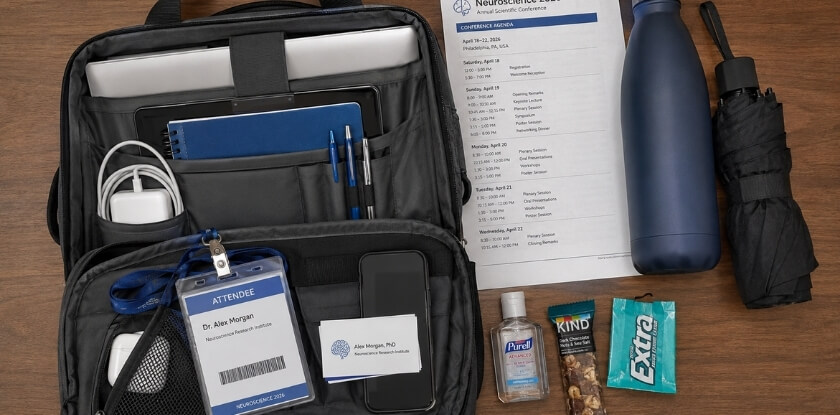
Applying the Rule
Map your days before you pack. A typical three- or four-day conference has one formal evening event, two or three full days of sessions, and at least one long stretch at a poster or walking between rooms. Check the venue’s climate and the forecast too: a cold hall or a wet walk between buildings changes what you need to carry.
- Bottoms. Two neutral trousers or skirts (navy, gray, black, dark khaki) and one more dressed-up option if you are presenting.
- Tops. One more formal piece for presentation day, such as a button-down, structured blouse, or clean knit, and two simpler ones. A plain white or light top pairs with nearly every bottom.
- Shoes. One pair you can wear all day without thinking, one smarter pair for your talk or the dinner, and a flat or low heel that crosses both.
A navy blazer worn at three conferences over two years is a better investment than three separate conference outfits bought in a rush, and a navy blazer, two pairs of well-fitted trousers, and four or five shirts can cover many conferences. If you travel carry-on only, the rule also limits toiletries and accessories. If you bring a printed poster, a tube usually travels as hand luggage, but airline rules vary, so check yours.
Choosing the Bag
A tote stuffed to bursting, a backpack with fraying straps, or a tiny clutch that cannot hold a notebook all create small but real impressions.
A poorly packed bag can undermine an otherwise polished appearance, and it sends a signal as clearly as your shoes. A structured laptop bag, a slim tote, or a well-made messenger bag works at a scientific conference. A clean, structured backpack can suit STEM meetings, while a briefcase-style bag can read better at medical or formal academic events. The test: can it hold a laptop, notebook, water bottle, and spare layer without looking overstuffed?
What to Pack in the Bag
| Item | Why it earns its place |
|---|---|
| Business cards or a QR code to your academic profile | Networking happens fast, and you should not fumble for your phone |
| Notebook and pen | Batteries die and apps crash, and it works in a basement room with no Wi-Fi |
| Portable charger | Photos of poster boards, notes, and navigation drain a phone all day |
| Reusable water bottle | Saves buying bottled water; check whether the venue has refill points |
| Spare professional layer | A blazer, light cardigan, or structured scarf for overcooled rooms |
| Stain remover wipes | One coffee spill at the morning break can ruin a white shirt for the day |
| USB drive and printed abstracts | Keep presentation materials in your bag, not in your hotel room |
What to Leave Behind
A bag that is heavy by 10 a.m. is a burden by 4 p.m., especially if you stand at your poster for hours or walk between buildings on a large campus. Leave the full-size toiletry kit and the extra pair of shoes at the hotel. The goal is a bag light enough to carry all day and organized enough that you find what you need in thirty seconds.
Budget-Friendly and Sustainable Conference Outfits
A professional conference outfit does not need a big budget, and buying fewer, better pieces is also the more sustainable choice.
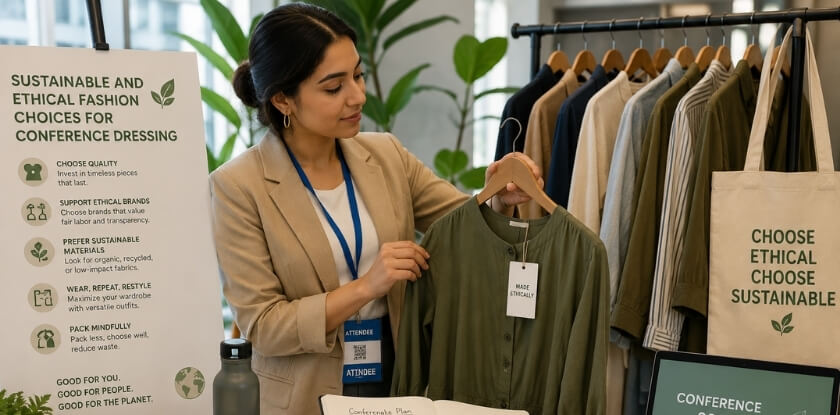
Build Around Neutrals
A navy blazer, gray or charcoal trousers or a skirt, and two or three plain tops in white, cream, or soft blue mix and match without effort. You are buying five or six items that work together, not a conference wardrobe. This costs less than buying outfit by outfit, and it fits the 3-3-3 packing above. Before you buy anything, go through your own wardrobe with your schedule in mind. You may be able to cover it with what you already own.
Where to Shop
Thrift and consignment stores are worth a look, and a blazer that cost a lot new can turn up there at a lower price. Sizing is inconsistent, so try things on or check measurements when buying online. High-street basics are hit-or-miss, so stick to classic cuts rather than trend pieces. End-of-season sales can yield good blazers and dress trousers, and shopping a season ahead helps if you know a conference is coming.
For petite and plus-size women, look at dedicated petite and extended-size workwear lines, which are sometimes discounted. A tailor can hem trousers or take in a blazer, which can cost less than buying several ill-fitting items.
For a keynote or a formal dinner, renting a suit or dress is a real option that may cost less than buying and creates less waste.
If the Budget Is Very Tight
If you are a PhD student or early-career researcher with almost nothing to spend, focus on one strong outfit: a well-fitting blazer, one clean blouse or button-down, and fitted trousers or a midi skirt. It carries you through a talk, a poster session, and a dinner with small swaps, like a different top or a scarf or tie.
Ethical Choices Worth Knowing

Fabric matters more than brand. Natural fibers like organic cotton, linen, and Tencel breathe well, while polyester traps heat and crumples. Buying fewer pieces and wearing them often is usually the lower-waste choice, and a secondhand item you will actually wear beats a new “ethical” one you do not need.
Wash less often, use cold water, and air-dry. A blazer worn for three conference days needs spot cleaning and airing, not a full wash each time.
Avoid single-trip purchases. The airport blazer or the emergency conference polo can end up in a donation bag within months. If your institution covers conference clothing, ask whether a secondhand or rental option qualifies under its expense policy.
Virtual and Hybrid Conference Dress Code
For a virtual conference, dress the top half professionally in the business casual range, and treat hybrid events like in-person ones. You are not dressing down just because you are at home, and first impressions form fast through a screen. An early-career researcher presenting a paper remotely should look at least as polished as they would at a poster session.
Fully Virtual Conferences
The camera sees a narrow slice from the shoulders up, so the visual impact of your outfit is concentrated there.
- Solid colors read better. Small stripes, herringbone, and tight checks vibrate or blur on video. Navy, burgundy, gray, or forest green looks clean.
- Dress the top half properly. A blazer or neat collared shirt from the waist up is the standard approach. You may have to stand up unexpectedly or your camera angle may shift.
- Avoid bright white near your face. It can blow out the exposure on cheaper webcams. Off-white, cream, or light gray photographs more kindly.
- Match the background. Against a plain light wall, a dark or mid-tone top adds contrast. Against a cluttered or virtual background, a more structured top compensates.
Hybrid Conferences
Hybrid events create an awkward mix: some people dressed for a full conference day, others logging in from home, and both groups visible to each other. If you attend in person, dress as you would for any in-person event.
If you are speaking to a hybrid audience, treat the session like a formal oral presentation, because remote viewers cannot read the room the way people in it can. Conference AV setups can have harsh overhead lighting and fixed wide-angle shots, so busy patterns, very light tops, and shiny fabrics look odd. Fitted, coordinated business casual suits a mixed academic and industry audience.
From our experience at MS International: Our conferences are held in person at venues in the Greater Toronto Area, and our event pages do not mention a dress code. Check-in details come in the confirmation email. Presenters collect a conference badge at check-in and meet the session coordinator or moderator before their scheduled presentation, and our presenter guidance asks them to keep a backup copy of the presentation on a USB drive.
FAQ: What to Wear to a Scientific Conference
From a PhD student’s first poster to a keynote talk, scientific meetings raise dress decisions about jeans, comfortable shoes and poster versus oral presentation outfits.
Is business casual really expected at scientific conferences?
Business casual is the safest default, but it is not a rule. Many meetings publish no dress code, and norms vary by field and event. STEM meetings can run more relaxed than medical ones, though a hoodie and ripped jeans are a risk almost anywhere.
What should a PhD student wear to a conference?
Business casual: fitted trousers or a skirt, a collared shirt or blouse, and clean shoes. A few solid, unwrinkled pieces do the job, you do not need to spend a lot, and a blazer is worth adding for your own talk.
Does the dress code change for a poster session versus an oral presentation?
Slightly. For an oral presentation, dress one step up because you are visible and being evaluated. A poster session is more conversational, so business casual works, and comfortable shoes matter most because you will stand for hours.
What do people wear at medical conferences?
Medical conferences can lean more formal than STEM events. Business professional or polished business casual is a safe choice, especially at clinical or specialty meetings, and a blazer is rarely out of place.
Can I wear jeans to a scientific conference?
Sometimes. Dark, unripped jeans in good condition can work at informal or social events and at some tech or computational meetings. For the main sessions and your own presentation, wear proper trousers or a dress.
What should a keynote speaker wear?
Dress one clear level above the general audience, whatever the room is wearing. The outfit should be polished, well-fitted, and free of anything distracting, so the audience focuses on what you say.
What should I wear to a summer conference?
Wear lightweight fabrics such as linen or cotton blends in professional cuts. Keep the silhouette tidy even if the material is breathable, and avoid sleeveless tops as your only layer in formal sessions. A light blazer or cardigan handles air-conditioned rooms.
What counts as appropriate attire for a virtual conference?
Dress the top half as you would for an in-person presentation. A clean top, good lighting, and a neutral background matter more than people plan for, and busy patterns look odd on camera.
Do early-career researchers need to dress differently from senior researchers?
There is no hard rule, but early-career researchers can lean slightly more conservative because they are establishing credibility among people who do not know their work yet. Senior researchers have more room to dress down without it reading as unpreparedness.
Are there dress codes specific to humanities conferences?
Humanities conferences can run more expressive and less corporate than STEM events. Creative pieces are welcome, but the baseline is still professional, so think fitted rather than trendy.
Is sustainable or ethical clothing appropriate for a conference?
Yes, sustainable clothing is completely appropriate. It does not cost you professionalism, and a well-cut secondhand blazer looks the same as any other blazer.
What shoes work best for a multi-day conference?
Low-heeled or flat shoes with good support. Conferences involve far more walking and standing than people expect, and smart leather flats, loafers, or low block heels look professional while staying comfortable.
Is there a dress code at MS International conferences?
Our event pages do not mention a dress code. Our events are held in person in the Greater Toronto Area, and check-in details arrive in your confirmation email.
Choosing Your Outfit: A Simple Rule
Match the room, then add comfort. Look at your field, your role, and the event format, and pick clean, professional clothes you can stand and move in. The outfit that makes you forget you are wearing it is usually the right one.