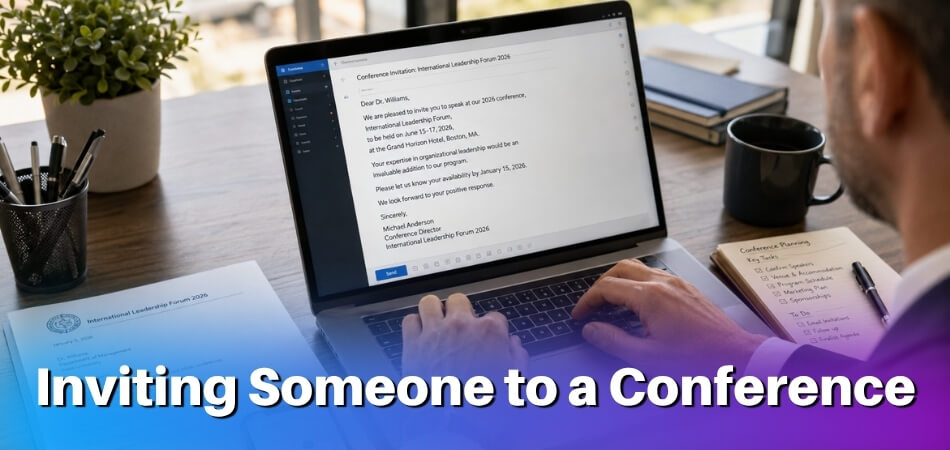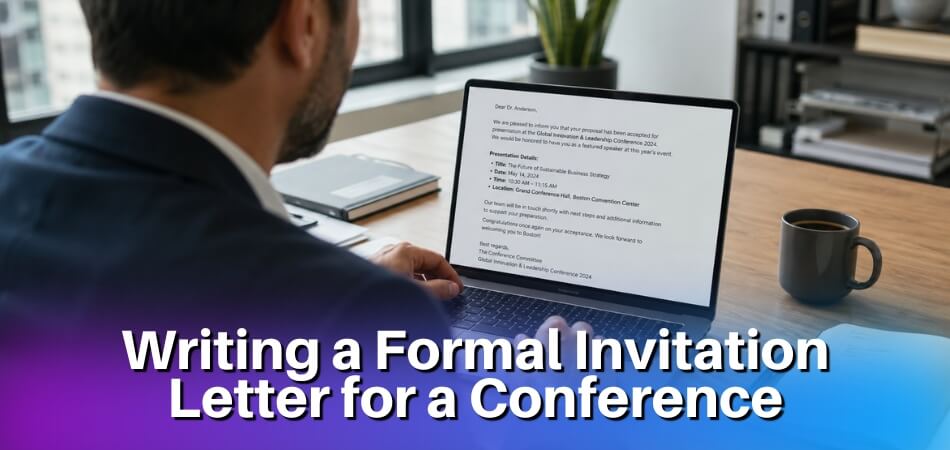

Saying no to an invitation is a small skill that most people never practise. The awkward part is rarely the refusal itself. It is finding words that stay friendly without costing you a useful contact.
Quick answer: To decline a conference invitation, reply within 48 hours with a short email that thanks the sender, says clearly that you cannot attend, gives one line of reason if you like, and leaves the door open for next time. Reply faster for paid, sponsored or last-minute invitations, and offer a colleague or a later date when you can.
You open your inbox and there is a conference invitation, neatly formatted and sometimes flattering. You cannot go. The schedule is packed, the timing is bad, or you simply do not want to. Then the hesitation sets in, and the reply gets pushed to “later”.
That pause is where most of the damage happens. People either sit on the invitation for days or send a vague excuse that sounds exactly like one. The sender notices both. A good decline is quick, warm, brief about the reason and open to the future, and the same formula works for most situations. Bosses, last-minute invitations and sponsored seats each need a small adjustment, which the sections below cover.
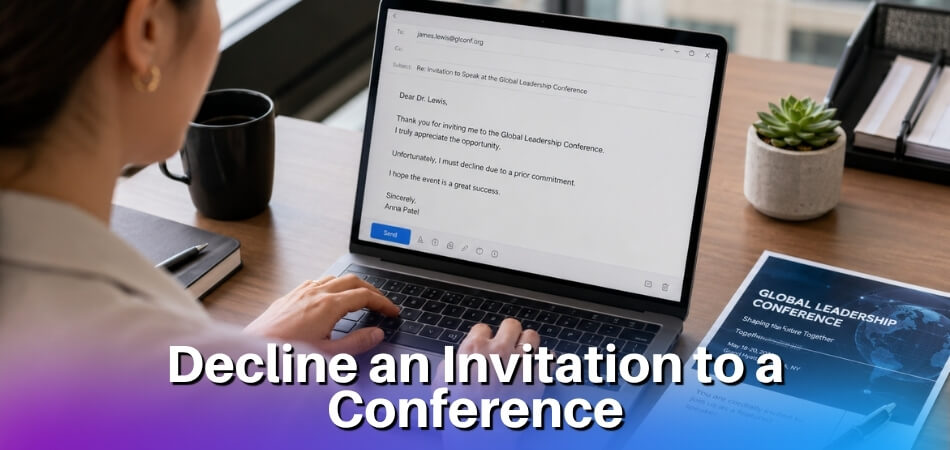
What a Good Decline Includes
A good decline has three parts: a thank-you, a clear no, and a forward-looking line. A short reason is optional but usually warmer than leaving it out. Declining is never the rude part. Ignoring the invitation is.
- A thank-you. Gratitude in professional writing is not fluff. It sets the tone straight away.
- A clear no. “I won’t be able to attend” leaves nothing to chase. “I’m not sure I can make it” makes the organizer wonder whether to follow up.
- A brief reason. Schedule conflict, budget, prior commitment. One line is enough.
- Forward-looking language. Something like “I’d love to be considered next year” keeps the relationship intact without overpromising.
You do not need a long apology, an excuse that sounds invented, or five paragraphs justifying a simple no. Organizers respect honest and brief. What they do not respect is being left hanging, because they need to finalize speaker slots, meal counts and seating. A prompt decline is the considerate move. The table below shows how the same formula shifts with the situation. Each row is explained in its own section.
| Situation | Reply | Best channel | What to add |
|---|---|---|---|
| External organizer or vendor | Within 48 hours | Short email | Thanks, clear no, one-line reason |
| Peer or close colleague | Same or next day | Message or short email | Casual tone, offer to hear how it went |
| Boss or senior colleague | Same day, or ask for a few hours | Conversation first, short email after | Specific reason, a way to contribute |
| Paid or sponsored seat | As soon as you know | Acknowledge the cost, offer to hand over the seat | |
| Last-minute invitation | Same day | Email or call | Short and warm, no long apology |
| Invitation to speak or present | Within 48 hours | Thanks for the invitation, clear no, a colleague or a later edition |
Why Declining Professionally Matters
How you decline is remembered longer than the fact that you declined. The sender, whether a vendor, client, colleague or senior figure in your field, will recall the tone and the timing.
A badly worded refusal can quietly damage a relationship you spent months building, and so can a non-reply. Most people avoid saying no because it feels awkward, then put it off until they can no longer reply gracefully.
The stakes are higher with certain invitations
If a boss personally extended the invite, a casual “can’t make it” over chat will not do. If a sponsor has earmarked budget with your name on it, going silent is genuinely disrespectful because they may have turned down another attendee for you. If someone bought you a ticket, your decline needs to come quickly so they can reallocate the seat.
What it costs when you get it wrong
The organizer may assume you are not interested and stop inviting you. A vendor might deprioritize your account. A networking contact might quietly move on. None of that is catastrophic alone, but it adds up. Saying no is legitimate. The only question is whether you do it in a way that keeps the door open or closes it. Handled well, a decline often strengthens the relationship, because people remember who handled a “no” with care.
How to Decline a Conference Invitation via Email
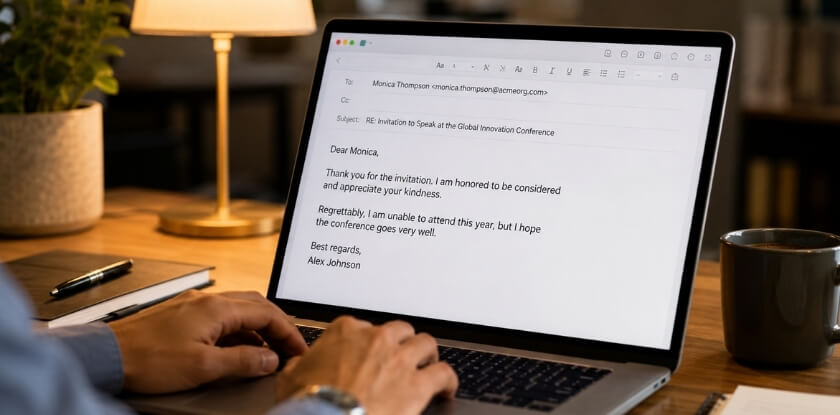
Email is the most common channel, and the structure matters more than you might think: reply fast, thank them, say no clearly, add a short reason, offer something, and close warmly. A poorly written decline can come across as dismissive even when you did not mean it that way.
Step 1: Reply promptly (within 24 to 48 hours)
Organizers work to deadlines: seating, catering, speaker schedules and sponsorship headcounts. The faster you reply, the easier their job is. A late decline is almost as bad as none, and waiting three days to say no is a quiet way of saying you did not care enough to answer. If the invitation was last-minute, reply the same day. A personal rule helps: every conference invitation gets an answer within 48 hours. If the invitation names a reply-by date, that date comes first. If you need longer to decide, send a short holding reply now (Template 11 below) instead of staying silent.
Step 2: Start with gratitude
Thank them for thinking of you and, if the conference really is interesting, say so briefly: “Thanks so much for the invite. The lineup this year looks really strong.” One sentence is plenty. A paragraph of compliments before the point makes the decline feel more awkward, not less. Reply on the original thread with “Re:” in front of the subject line, so the organizer can match your answer to the invitation at once.
Step 3: State the decline clearly
Say it directly: “Unfortunately, I won’t be able to attend.” Avoid “I’m not sure I’ll be able to make it” or “Things are a bit uncertain on my end.” Declining politely does not mean declining ambiguously, and a vague answer sends the organizer back to chase you.
Step 4: Give a brief, optional reason
You do not owe a detailed explanation, but a short reason removes any sense that you are being dismissive. “I have a prior commitment that week that I can’t move” works. For a paid conference with a budget problem, “The timing doesn’t work financially for us right now” is honest and enough. Keep it to one sentence, two at most. Leaving the reason out entirely can feel a little cold, especially from a boss or senior colleague.
Step 5: Offer an alternative or show future interest
This is the part most people skip, and it is the part that protects the relationship. Options include suggesting a colleague, asking to stay on the list for next year, proposing a short call on the topic, or offering to share the event with your network. Example: “If it’s helpful, I’d be happy to share the event details with a few people in my network who might be a great fit.” It costs you nothing and keeps goodwill intact.
Step 6: Close on a positive note
Keep the closing short and warm: “Hope the conference goes really well. I’d love to hear how it went.” With someone you know well, “Looking forward to catching up another time” is enough. A decline is not a rejection of the person, and the closing is where you make that clear.
How to Decline a Conference Invitation Verbally or In-Person
When the invitation arrives in a hallway or a meeting, say thanks, be honest, and keep it to one or two sentences. If you are unsure, ask for time instead of committing or refusing on the spot. Face to face, tone, body language and eye contact do work that words alone would do in writing.
When your boss or senior colleague invites you directly
Many people dread this one: your manager mentions a sponsored conference and half expects a yes. Do not panic, do not over-explain, and do not say yes just to escape the discomfort. If you need time, say so:
“Thanks for thinking of me. I’d need to check my schedule before committing. Can I get back to you by end of day?”
You have shown gratitude, not said no yet, and bought time to answer properly. If you already know you cannot go, be honest but brief:
“I appreciate the invite. I’ve got a schedule conflict that week that I can’t move, but I’d love to see the materials if they’re shared afterward.”
Asking for notes or recordings signals that you are still interested in the content, just not able to be there.
When you are put on the spot in a group
Someone announces a paid conference in a team meeting and looks straight at you. Keep it short and offer something useful:
“Sounds like a great event. I won’t be able to make this one, but I’m happy to help whoever’s going prepare questions or review takeaways afterward.”
You have declined cleanly, kept it small, and given something back.
When someone pushes a last-minute trip in person
Someone’s first pick cancelled and now they are standing in your office asking if you can fly out Thursday. Be direct, because vagueness reads as dismissive:
“I genuinely wish I could, but a last-minute trip doesn’t work with what I have on this week. Let me know how it goes, though.”
The last sentence keeps the relationship intact without forcing enthusiasm for an event you are declining.
Tone and body language
Staring at your laptop while declining someone’s invitation reads as indifferent. Look at the person and keep your tone warm but straightforward. Avoid piling on apologies, stalling in a way that sounds like a maybe, and making it seem like the event itself is the problem. You are declining one event at one time, not rejecting the person.
Should you follow up in writing?
Often yes. After a verbal decline to a senior colleague, an external organizer or a possible partner, send two or three lines that restate your thanks and confirm you cannot attend. The note creates a record, because verbal declines are easily forgotten or misremembered. For a hallway chat with a coworker, leaving it verbal is fine.
How to Decline a Last-Minute Conference Invitation
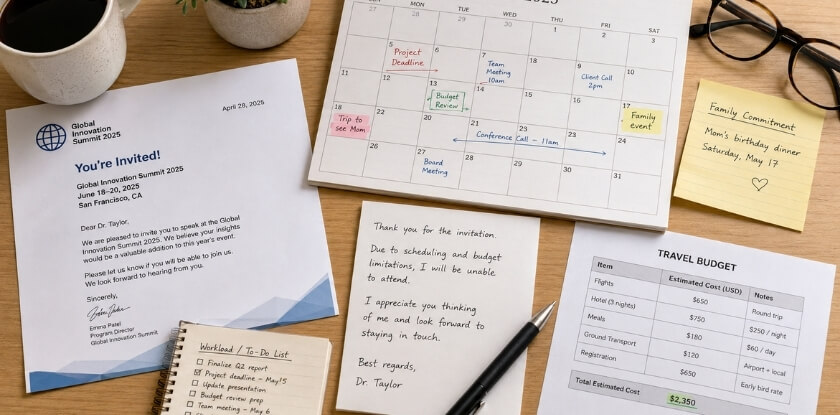
You are allowed to say no, and you should do it the same day. Nobody is owed a yes because they did not plan ahead. A rushed or cold reply can still leave a bad impression, so keep it quick, warm and honest.
Why it feels harder than it is
Part of the awkwardness is wondering whether you should have known earlier. Was the invitation lost in your inbox, or did the sender only think of you now? You do not need to work that out. A short reply is appropriate, since the sender already knows the timing is tight.
What works and what does not
What works:
- Acknowledge the invitation right away
- Say honestly that the timing does not work
- Show interest in a future edition only if you mean it
- Send it fast, because they may need to adjust logistics
What does not work:
- Pretending you “just saw” the email when you did not
- A long apology that reads like an excuse list
- Ignoring it and hoping nobody notices
Be specific about the conflict. “I have [specific commitment] that I can’t reschedule” is more convincing than “I’m just really busy right now”. If the request comes from your boss, call or walk over instead of emailing, and give them the chance to accept the no or help you find a workaround. Sometimes the answer is “no worries”, and sometimes it is “actually, this one matters, can we sort it out?” Either way you handled it like a professional. A ready-to-send email for this case is Template 3 below.
How to Decline a Conference Invitation from Your Boss or a Senior Colleague
You can decline your boss, but it needs more care and a specific reason. When a manager invites you, you are not only turning down an event. You may be turning down a signal that they wanted you there and saw it as part of your growth, and a careless no can read as disinterest in your own development.
What to do before you say no
Pause and think through a few questions:
- Is this really optional, or only framed that way?
- Is the company paying? If so, your threshold for declining should be higher.
- Did your boss arrange the invitation or have their name attached to it?
- Do you have a concrete reason, or is it more of an “I just don’t want to go”?
If the reason is vague, sharpen it first. “I have a scheduling conflict” is fine. “I just feel a bit busy” is not.
How to frame the decline
Lead with genuine appreciation, because people can hear the difference between real and performative thanks. Keep the explanation to a sentence or two and show you are not dismissing the opportunity casually. A version that works in most cases is Template 2 below.
When your boss organized it
If your manager arranged the conference, secured your spot or is presenting there, saying no carries more weight, so acknowledge it: “I know you put effort into arranging this, and I genuinely hate to decline.” Said sincerely, it shows you understand the dynamic and not only your own calendar. Give them enough notice to fill your place or adjust expectations. Late declines here are much harder to recover from.
Spoken or written?
If your relationship with this person is mostly in-person, a face-to-face or phone decline feels more respectful in a hierarchical setting. Follow up with a brief note to confirm and keep things documented.
How to Decline a Paid or Sponsored Conference Invitation
Decline as early as you know, and acknowledge the money. When someone has already paid a registration fee, a travel stipend or a sponsored seat, your no can leave them out of pocket. That does not stop you from declining, but it means moving faster and with more care.
The timing problem
Once you know you cannot go, the clock is running. Cancellation windows differ by event and ticket type, so check the terms, but a few days of delay can cost the organizer or sponsor real money if they miss the cutoff. Even if you are only 70% sure, tell them early: “I may not be able to attend. Can you hold off confirming my spot?” That is far better than silence followed by a last-minute drop.
What to say
Do not dance around the financial side. A sponsor put money into getting you there, and a message that ignores it reads as tone-deaf. Thank them, say you cannot attend, tell them early so they have time to transfer or cancel, and offer to help reassign the spot. Template 4 below follows this structure.
When your employer or a professional body is paying
You are now managing internal expectations too. You do not owe a full breakdown of your personal situation, but vague excuses land badly when money is involved. “A scheduling conflict has come up that I wasn’t able to resolve” is fine. “Something came up” is not. If you can, suggest a replacement: “I can’t go, but I think [colleague’s name] would be a great fit and is available.” That turns a problem into a solution and shows you still care about the event’s success.
From our experience at MS International: our registration fees are non-refundable once payment is completed, and exceptions are considered only in rare cases with written approval from the organizing committee. Our refund policy also says that informing us of non-attendance does not create an automatic right to a refund, credit, transfer or rescheduling. If you have registered for any event, read its refund terms before you write, and still tell the organizer early so they can plan.
How to Suggest an Alternative or Recommend Someone Else
Offer something useful in place of your attendance: a name, a resource or a different format. It shows good faith and keeps the relationship intact. Not every situation calls for it, but if you want to support the organizer or the person who invited you, this is how to do it without overcomplicating things.
Recommending a colleague
This is the most practical option. Do not just drop a name; give the organizer a reason to follow up: “I won’t be able to make it, but my colleague Sarah Chen covers this topic regularly and has spoken at similar events. I’d be happy to connect you both.” Before you do:
- Ask your colleague first. Do not volunteer someone who has not agreed. It puts them in an awkward spot.
- Only recommend someone genuinely qualified. Sending an organizer someone who is not ready for the platform is no favor.
- Offer to make the introduction yourself. A warm intro carries more weight than a forwarded email address.
Template 5 below is a ready version.
Suggesting a different format
Sometimes you cannot do the full conference but are open to something smaller: a 30-minute virtual Q&A, a contributed article for the program, or a recorded message. This only works if you mean it. An alternative offered as a polite deflection, with no intention of following through, is worse than a clean no. If you do mean it, be specific: “I can’t commit to the full day, but if a short remote session suits your agenda, I’d be glad to join for 20 to 30 minutes on [specific topic].” A concrete offer respects the organizer’s time far more than a vague “let me know if there’s anything else I can do”.
How to Follow Up After Declining and Keep the Relationship Intact
Send a short, forward-looking note once the event has passed. Most people send a polite refusal and go silent. A brief follow-up signals that your no was about circumstances, not about the person or the opportunity.
Send a short note after the event
Two sentences are enough: “Hey Sarah, hope the conference went well last week. I kept up with the sessions on LinkedIn and it looked like a great lineup. Would love to hear how it went when you have a moment.” It shows you were paying attention and did not simply vanish.
Engage with the event online
If the conference had a hashtag, a LinkedIn page or posted session recaps, leave a comment or share a takeaway. It costs nothing, most people skip it, and it backs up the fact that your conflict was genuine and your interest real.
Reconnect with the host
If someone personally invited you, especially a boss, senior colleague or sponsor, follow up with them directly and ask what came out of it. Ghosting after you decline can leave them wondering if they did something wrong, and a quick check-in removes that.
Reaffirm interest, and only if you mean it
Turn a closed door into an open one with one direct line: “I’d really like to attend next year if the timing works. Could you keep me on the list?” Then follow through. A short message six months later, such as “Is your annual event coming up again? I’d like to be considered this time”, turns a previous decline into a real connection. If you do not plan to attend in future, do not say you do. Organizers remember who showed up and who kept saying “next time”.
Keep track of what you declined
Keep a running note, even in a task manager, of invitations you turned down, especially ones from sponsors, clients or senior colleagues. When a related opportunity comes up you can refer to it naturally: “I had to skip the Edinburgh event last spring, but I’d love to make up for that by attending this one.”
What not to do
Do not repeat your apology in the follow-up, and do not send a follow-up that is just another apology dressed up as small talk. Keep it forward-looking: what happened at the event, what you are interested in next, and how you can stay connected.
Ready-to-Use Email Templates for Declining a Conference Invitation
Here are 12 templates for the most common situations. Use them as starting points, not word-for-word copies. Adjust the tone to your relationship and swap in real details, because a template with a specific reason and a real name always lands better than a generic one.
Template 1: General polite decline
Use this for most invitations from external organizers or professional acquaintances. It includes the optional line about recordings, which works well when the reason is a schedule conflict.
Subject: Re: Invitation to [Conference Name]
Hi [Name],
Thank you for the invitation to [Conference Name] on [date]. I appreciate it.
Unfortunately, I have a prior commitment on that date that I can’t move, so I won’t be able to attend this time. I hope the event goes well, as the agenda looks genuinely interesting. If a recording or any materials are shared afterward, I’d love to take a look.
Please keep me in mind for future events.
Best,
[Your Name]
Template 2: Declining a boss or senior colleague
The tone stays professional but warm. Acknowledge the effort, give a clear reason, and show you still value the opportunity.
Subject: Re: [Conference Name] Invitation, Thank You
Hi [Name],
Thank you for including me in the invitation to [Conference Name]. It means a lot that you thought of me.
After looking at my current commitments, I don’t think I could give it the attention it deserves. [Specific reason, for example: “I’m in the middle of the Q3 project rollout and the timing doesn’t allow for it.”] I wouldn’t want to attend and not be fully present.
I’d love to be considered for something similar in the future, and if it would help, I’m happy to suggest a colleague who might be a strong fit.
Thank you again.
[Your Name]
It does not grovel. Direct but respectful is the right register with someone senior.
Template 3: Declining a last-minute invitation
Be gracious without letting people assume this is a stock reply every time they invite you with 48 hours’ notice.
Subject: Re: [Conference Name], Short Notice Response
Hi [Name],
Thanks for reaching out about [Conference Name]. It sounds like a great event.
I’m afraid I can’t make it work on such short notice. I’ve got [brief reason, for example: “back-to-back commitments this week”] and wouldn’t be able to give it proper attention.
I hope it goes really well. If you can loop me in a bit earlier next time, I’d genuinely love to participate.
Best,
[Your Name]
The last line is not passive-aggressive. It is honest about what you would need to say yes.
Template 4: Declining a paid or sponsored invitation
Someone spent money or put their reputation behind the invitation, so be warmer and more specific, and tell them early.
Subject: Re: Sponsored Invitation to [Conference Name], With Thanks
Hi [Name],
Thank you so much for sponsoring my attendance at [Conference Name]. I’m genuinely grateful you considered me.
I’ve thought about it carefully, but I won’t be able to attend this time. [Reason, for example: “The dates fall during a period where I’m committed to another project and I can’t travel.”] I wouldn’t feel right accepting the sponsorship without being able to commit fully.
I wanted to tell you as early as possible so you have time to arrange a transfer or cancellation. I’d also be glad to recommend someone who would get a lot out of it and represent [your organization/field] well. Just let me know if that would help.
Thank you again, and I hope the conference is a success.
Warmly,
[Your Name]
Template 5: Declining and recommending a colleague
Use this when you cannot attend but know someone suitable who has agreed to be named.
Subject: Re: [Conference Name], Unable to Attend
Hi [Name],
Thank you for thinking of me for [Conference Name]. Unfortunately, I’m not able to attend due to a prior commitment.
I’d like to recommend [Colleague Name]. They have been working closely on [relevant topic] and would bring a lot to this conversation. I’m happy to make an introduction if you’d like.
I hope the event goes really well.
Best,
[Your Name]
Template 6: Informal decline to a colleague or peer
Not every decline needs to be formal. Between people who already work together, a short friendly message is better, and too much formality can feel cold.
Subject: Re: [Conference Name]
Hey [Name],
Thanks for the invite! I really wish I could make it, but I’m swamped that week ([brief reason, for example: “product launch timing is brutal”]). Not going to be able to pull it off.
Hope it’s a good one. Let me know how it goes!
[Your Name]
Template 7: Declining as a student or early-career researcher
Cost and timing are real limits early in a career. Say so plainly and ask about the options that make attendance possible next time.
Subject: Re: Invitation to [Conference Name]
Dear [Name],
I was glad to receive your invitation to [Conference Name].
Unfortunately, I am unable to attend this year because the travel and registration costs fall outside my current funding. I would be grateful to hear about any student rates, travel grants or volunteer roles for future editions.
I hope the conference is a great success.
Kind regards,
[Your Name]
[Program/Institution]
Template 8: Declining because travel is not possible, with an online option
Use this when travel, documents or timing rule out going in person but you would still like to take part online.
Subject: Re: [Conference Name], Attending Online Instead
Dear [Name],
I appreciate the invitation to [Conference Name], but I cannot travel to [City] for the event this time.
If the conference offers online access or recorded sessions, I would be glad to join that way. Please let me know if that is possible and what registration it requires.
Thank you for your understanding.
Best regards,
[Your Name]
Template 9: Declining a vendor or sales event invitation
A vendor event invitation is often a sales step. A short, courteous no is enough, and you can ask to be taken off the list if the topic is not relevant to you.
Subject: Re: Invitation to [Event Name]
Hi [Name],
Thank you for the invitation to [Event Name]. It is not a priority for our team at the moment, so I will not be attending.
[Optional: Please remove me from future invitations for this event series.]
Best regards,
[Your Name]
Template 10: Withdrawing after you already accepted
If you said yes and now cannot go, tell the organizer as soon as you know, take responsibility, and ask about the cancellation or transfer terms.
Subject: Withdrawal from [Conference Name]
Dear [Name],
I am sorry to let you know that I can no longer attend [Conference Name] on [Date], although I had confirmed my place. [Brief reason, for example: “A work commitment has come up that I cannot move.”]
Please let me know what the cancellation or transfer terms are for my registration. If a colleague could use my place, I am happy to arrange that with you.
I apologize for the inconvenience and hope to take part in a future edition.
Kind regards,
[Your Name]
Template 11: Asking for more time before you decide
Use this when you are not ready to say yes or no. It acknowledges the invitation and gives the organizer a date, which is better than silence. When the answer later turns into a yes, follow the steps to accept a meeting invitation formally.
Subject: Re: Invitation to [Conference Name]
Dear [Name],
Thank you for the invitation to [Conference Name]. I am interested, but I need to check [my schedule / funding / approval from my manager] before I can confirm.
I will give you a firm answer by [date]. If you need a reply sooner, please tell me and I will do my best.
Best regards,
[Your Name]
Template 12: Declining an invitation to speak or present
Use this when you are invited to speak, present or join a panel and cannot. A speaking slot is harder to fill than a seat, so reply quickly and offer something concrete.
Subject: Re: Invitation to speak at [Conference Name]
Dear [Name],
Thank you for inviting me to speak at [Conference Name] on [date]. I am honored that you thought of me for the program.
Unfortunately, I am unable to accept because [brief reason, for example: “I have a prior commitment on those dates”]. I am sorry to miss it.
If it would help, I can suggest [Colleague Name], who works on [topic] and has agreed to be named, or share [slides / a short written summary] ahead of the event. I hope the conference goes very well and would welcome being considered for a future edition.
Kind regards,
[Your Name]
[Affiliation]
Whichever template you use, send it promptly. Sitting on a decline for two weeks and then sending a polished email still signals disorganization.
Common Mistakes to Avoid When Declining a Conference Invitation
Most mistakes are not about saying the wrong thing but about saying nothing, or saying it at the wrong time. The steps above cover the basics, so this list keeps only the traps that are easy to miss.
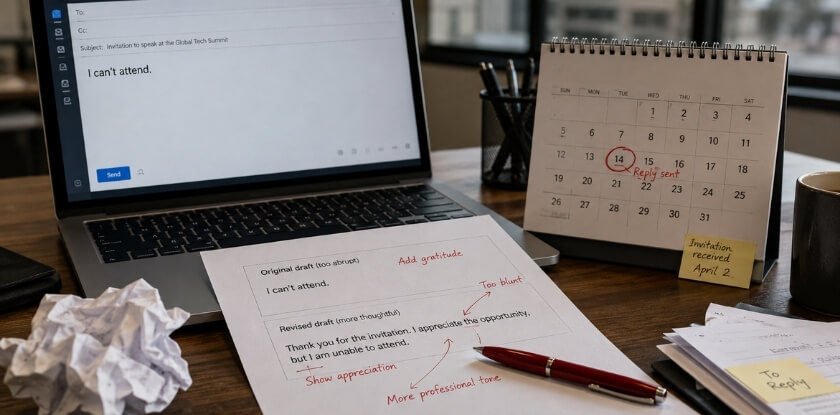
- Letting it sit while you “think about it”. Two weeks later the organizer has moved on, but also remembers that you left them hanging. Even a late one-line decline beats silence, because no response is still a response and a bad one.
- Over-explaining or over-apologizing. Four paragraphs of justification and three apologies feel performative and make things more awkward for the recipient. Say sorry once, briefly, mean it, and move on.
- A generic thank-you. “Thanks for thinking of me” reads like an auto-reply. One specific line, such as why the event sounds worthwhile, lands better. Someone may have advocated for your inclusion.
- A tone that sounds annoyed. “I can’t attend” is technically fine but can read as curt, depending on what surrounds it. Read the message out loud before sending, and if it sounds irritated, revise it. Warmth is usually word choice, not extra words.
- A closed door by accident. A message with no warmth or forward-looking line is a hard stop. A phrase like “I’d love to be considered for next year” shows your no is situational, not personal.
Frequently Asked Questions (FAQ)
Saying no to a conference without burning bridges comes down to timing, whether to give a reason, suggesting a colleague and a later change of heart.
Is it rude to decline a conference invitation?
No, declining is a normal part of professional life. What matters is how you do it. A timely, honest and respectful reply is never rude, while ignoring the invitation or cancelling at the last second without explanation is what damages relationships.
How soon should I respond to a conference invitation?
Reply within 24 to 48 hours, or by the reply-by date if the invitation gives one. Organizers need headcounts, speakers need to plan panels, and sponsors have logistics to manage. Even a no helps them if it comes quickly.
What is a good reason to give for declining?
A schedule conflict or prior commitment is the simplest and most widely understood reason. Travel, budget or a topic outside your role also work if they are true. “I have a prior commitment that day” is enough, and you do not owe a breakdown of your calendar. With someone close you can be more specific, but you are not obliged to.
Can I decline without giving a reason?
Yes, a reason is optional, and a short, polite no is enough. It may come across as slightly cold, depending on the relationship. A brief, warm reason softens the decline without oversharing. Aim for one sentence, not a paragraph.
Is it okay to decline a sponsored or paid conference invitation?
Yes. Someone else covering the cost does not create an obligation to attend. Be gracious, acknowledge the gesture, and tell them as early as possible so they can reassign the seat, but do not let guilt push you into a commitment that does not work.
Should I suggest someone else if I cannot go?
Only if the person is a good fit and has agreed to be named. A poor match reflects on you. The right recommendation, though, is a helpful gesture the organizer will appreciate.
What if I declined but now want to attend?
Contact the organizer, explain honestly and ask if a place is still available. Availability changes and people understand that. Just do not make a habit of it with the same organizer.
What if I want to attend but genuinely cannot?
Say so plainly, for example: “I’d really like to attend, but I’m not available that day.” That tells the organizer your no is about timing, not interest, and it keeps the door open for the next edition.
How do I decline without hurting my professional reputation?
Reply promptly, thank them sincerely, give a brief honest reason and, if it is true, say you would welcome future invitations. That combination leaves a good impression even though the answer is no.
What if I need more time before I decide?
Send a short holding reply now that says when you will give a firm answer, for example by Friday. A dated reply is better than silence. Template 11 is a ready version.
How do I decline an invitation to speak?
Thank them for the invitation, say clearly that you cannot speak, and offer a colleague, your slides or a later edition if you can. Reply within 48 hours. Template 12 is a ready version.
Do I need to send a follow-up email after declining?
Not always. For a formal invitation to a major event, or after any verbal decline to someone senior, a short note is worth sending. For a casual invite it is optional. Judge by how significant the relationship is.
Final Thoughts: Saying No Without Closing Doors
Saying no to a conference invitation is not a big deal. People do it all the time, and what they remember is how you did it. Be direct, be kind, reply quickly, and close on a forward-looking note, ideally with a colleague’s name or a later date if you can offer one. Pick the template that fits your situation and send it today.