
Have a conference paper but not sure where or how to list it on your CV? This article covers placement, entry formats and the status labels to use for co-authored papers, posters, oral presentations, workshop papers and short papers, with notes for PhD students and freshers.
Quick answer: To add a conference paper to your CV, list it in a Publications section (or a Conference Papers section if you have no journal articles yet). Give all authors in the published order, the title, the full conference name, year, location and a DOI or URL if one exists, in one citation style throughout. Mark unpublished papers honestly as accepted, forthcoming or under review.
Last verified against official sources: October 2026.
The Core Rules for Adding Conference Papers to Your CV
Put each conference paper in a dedicated Publications section, use one citation style for every entry, and state the status of the paper truthfully. Almost every other question about conference papers on a CV comes back to these three rules. If a job advertisement, grant form or department supplies its own CV template or instructions, follow those first.

Where to Put Them
Conference papers belong in a dedicated Publications section on your academic CV. If you have several types of publications, split it into sub-sections: journal articles, book chapters and conference papers listed separately. A PhD student or fresher with only one or two publications can group everything under a single Publications heading.
A Selected Publications section is acceptable for a long record, but only use that label if you are genuinely curating a highlight list rather than listing everything.
The Basic Format
Use a consistent citation style throughout your CV. APA and MLA are both widely used in academic CVs, though some fields prefer Vancouver, Chicago or IEEE. Pick one and apply it to every entry. List entries in reverse chronological order, newest first. The exact templates are in the format section below.
Always include a DOI if the paper has one. If there is no DOI, a stable URL is acceptable. For an accepted paper that has no DOI yet, leave that field out until the proceedings are online.
How to Label the Status
Published papers need no special label. Accepted, in press, submitted and under review papers each need an honest label, as set out in the section on pending and forthcoming papers below. Never list a paper as accepted before it is officially accepted.
Oral Presentations, Posters, and Workshops
Not every conference contribution is a full peer-reviewed conference paper, and your CV should show the difference.
- An oral presentation without a published paper goes in a separate Presentations or Conference Presentations section, not in Publications. If the same work is also a published paper, list the paper once under Publications and add the talk separately only if it was a distinct presentation, such as an invited talk.
- A conference poster follows the same logic. List it under Presentations unless the poster was part of a published proceedings volume.
- A workshop paper or short paper that was formally published in a proceedings volume does belong in Publications, with “(workshop paper)” or “(short paper)” after the title.
- If only an abstract was accepted and no paper was written, call it an abstract. You can add the word “abstract” to the bracket description, for example [Conference presentation abstract].
Co-Authored Papers and Conference Level
List co-authored papers exactly as they appear in the publication, in the same author order. The details are in the co-authored section below. A paper from an international conference generally carries more weight than one from a local conference, but you do not need to label either. If the conference name is unfamiliar outside your region, add the city and country or the organising body.
Where and How to Place the Conference Papers Section on Your CV
Choose a heading that matches what is actually in the section, then decide whether it stands alone or sits under Publications. Reviewers scan before they read, so a conference paper buried under a vague heading loses impact.
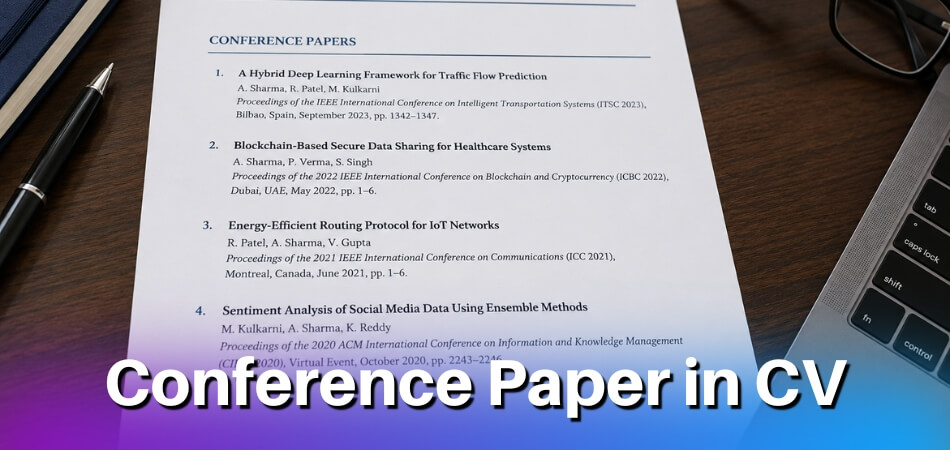
What to Name the Section: Conference Papers, Presentations, or Publications
The heading signals what is inside, so it should be accurate.
| Heading | Use it when |
|---|---|
| Conference Papers | Everything listed is a written paper accepted to a conference: peer-reviewed papers, short papers or workshop papers. |
| Conference Presentations | The list includes oral presentations, posters or invited talks where no paper was published in proceedings. If the work was not peer-reviewed or published, this heading is more honest. |
| Publications | You want one umbrella section for journal articles, peer-reviewed conference papers and book chapters. Common for mid-career and senior academics. |
| Presentations and Publications | You have both published papers and informal presentations, but not enough of either for separate sections. |
If you have several kinds of output, for example three journal articles, two peer-reviewed conference papers and four posters, split them. An early-career researcher with only conference output should label the section for what it is. Do not use “Publications” as a heading if everything listed is unpublished or under review, because that gives a misleading impression.
Should It Go Under Publications or Stand as a Separate Section?
If you have only conference papers and no journal publications yet, a standalone “Conference Papers” section keeps your work visible without implying a broader record than you have. For a fresher or early PhD student this is usually the right call.
If you have a mix of journal articles and conference papers, group them under a general “Publications” section with sub-headings such as “Peer-Reviewed Journal Articles,” “Conference Papers” and “Conference Posters.”
Switch to “Selected Publications” once the full list becomes too long for the application. Make the selection strategic: lead with your strongest peer-reviewed conference papers and international contributions, not just the most recent ones.
The Correct Entry Format for Each Paper: APA and MLA
Use APA if your field is in the sciences or social sciences, and MLA if it is in the humanities. Either way, give enough information that someone could find the paper or confirm it exists.
APA Format With Examples
APA is the more common choice on academic CVs in psychology, education, communication and most social sciences. APA 7 treats a talk or poster as a presentation: the full conference dates go in the date, and a short description such as [Paper presentation], [Poster presentation] or [Conference presentation] goes in square brackets after the title. Published proceedings are cited like a book chapter or a journal article. Check the current APA Style conference pages if your department is strict about punctuation.
A presented paper that was not published in proceedings:
Okafor, J. T., & Reyes, M. L. (2022, September 14). Predicting dropout rates using early LMS engagement data [Paper presentation]. 14th International Conference on Educational Technology, Amsterdam, Netherlands.
A peer-reviewed conference paper published in conference proceedings:
Okafor, J. T., & Reyes, M. L. (2022). Early LMS engagement data as a predictor of dropout. In S. Park & L. Hoffman (Eds.), Proceedings of the 14th International Conference on Educational Technology (pp. 112-119). EdTech Press. https://doi.org/10.xxxx/xxxxx
A conference poster:
Chen, W. (2023, April 20). Visual attention patterns in bilingual reading [Poster presentation]. International Conference on Reading Research, Toronto, Canada.
The bracket label does the work. It is also useful when your CV mixes several types of entry, since the reader knows at a glance what each one is.
MLA Format With Examples
MLA is standard in literature, language and the wider humanities. For two authors, only the first is written last name first. The pattern for a presented paper is author, title in quotation marks, conference name in italics, date and location.
Lindström, Anna. “Silence as Resistance in Post-Colonial Fiction.” Annual Conference on Postcolonial Literature, 9 Nov. 2021, Chicago, IL.
A co-authored version looks like this:
Vega, Carlos, and Anna Lindström. “Reading Absence in Migrant Poetry.” International Conference on Migration and Literature, 12 Mar. 2022, Baltimore, MD.
If the paper appeared in published proceedings, treat it like a chapter in an edited book:
Lindström, Anna. “Silence as Resistance in Post-Colonial Fiction.” Proceedings of the Annual Conference on Postcolonial Literature 2021, edited by J. Carter and P. Mehta, Example Academic Press, 2022, pp. 45-53.
For a workshop paper or short paper presented in a smaller session within a larger conference, the format stays the same. You can add the session title in parentheses after the paper title if it helps, though this is not required.
Should You Add a DOI or URL?
Yes, when one is available. A DOI is the most stable identifier for a paper in published proceedings and makes your entry easy to verify. A URL is acceptable when no DOI exists, particularly for proceedings hosted online by the conference.
In APA, the DOI is written as a full link at the end of the entry, such as https://doi.org/10.1234/example.2022.0045. In MLA, add the DOI or URL at the end followed by a period.
- If a paper is on ResearchGate or Academia.edu but not in official proceedings, point to the official proceedings page or conference archive instead.
- If a paper has no DOI and no stable URL, leave the link out. Do not link to a draft PDF on your Google Drive.
- For a PhD student or fresher, even a single peer-reviewed entry with a proper DOI signals real scholarly output. Format it correctly and let it stand on its own.
Entries in a Selected Publications section use the same citation format as a full list. Only the section label changes.
How to Present Different Types of Conference Papers
List full papers, posters, workshop papers and oral presentations separately, because each carries a different weight. A peer-reviewed full paper is not the same as a poster, and a workshop paper sits in a different category from a main-track talk.

Conference Paper vs. Conference Poster
Keep these in separate sub-sections rather than lumping them under one “Conference Presentations” heading. A conference paper, especially a peer-reviewed one, involves formal submission, review and usually publication in proceedings. A poster is a visual display at a session, often with lighter or no peer review. Mixing them undersells the paper and overstates the poster.
Use distinct headings such as Conference Papers (Peer-Reviewed) and Conference Posters, and flag each poster with a label:
Smith, J. (2022). Adaptive learning in multilingual classrooms [Poster presentation]. Annual Symposium on Applied Linguistics, Barcelona, Spain.
If you have presented only one poster alongside several papers, skip the separate section and list it under a broader “Conference Contributions” heading with the label kept.
Workshop Paper or Short Paper
Workshop papers and short papers are usually peer-reviewed, but through a lighter process than full papers, and they are shorter in scope. PhD students often have these before they have a record of full papers.
List them in their own sub-section, Workshop Papers / Short Papers, if you have more than one or two. With only one, include it in your main conference papers section and add “(short paper)” or “(workshop paper)” after the title.
Jones, R., & Patel, A. (2023). Clustering methods for low-resource NLP tasks (short paper). Proceedings of the Workshop on Computational Linguistics for Minority Languages, 45-51. https://doi.org/10.xxxx/xxxxx
How to Separately Note an Oral Presentation
An oral presentation is a distinct credential from simply having a paper in the proceedings. Some accepted papers are presented as posters, while others are selected for oral presentation, which can signal higher interest from the programme committee. If yours was selected for oral presentation, say so.
You can do this inside the entry. In APA the bracket can also read [Paper presentation] when the CV mixes several entry types:
Chen, L. (2021). Teacher identity formation in post-colonial education systems [Paper presentation]. International Congress of Educational Research, Seoul, South Korea.
The other approach, more common on an academic CV, is a separate sub-section titled Oral Presentations or Invited Talks and Oral Presentations, listed after your conference papers. It works well if you have several and want them to stand out.
If the paper is accepted but not yet presented, add the status in the entry, for example “(accepted, oral presentation)”, or “in press” if the proceedings are not out. Do not upgrade an accepted paper to a published one before it is.
International vs. Local Conference: Difference in Weight and Presentation
An international conference usually has a competitive, peer-reviewed process with reviewers and attendees from several countries, while a local or regional conference may have a lighter review and a narrower audience. Neither is wrong to list, but they signal different things to a hiring committee or PhD admissions panel.
Why the Distinction Matters
For a fresher or early PhD student, even a local conference paper shows scholarly engagement and is worth including. As your record grows, you can move local papers into a secondary tier or drop them from the main Publications section, keeping the most competitive venues at the top.
How to Structure the Weighting
Group papers by scope under clear sub-headings, so reviewers can judge your record at a glance without you inflating a regional presentation.
| Sub-section | Placement and notes |
|---|---|
| Peer-Reviewed International Conference Papers | First. Full citation format with DOI or URL where available. Add [Paper presentation] or [Poster presentation] if relevant. |
| National or Local Conference Papers | Next, in a separate sub-section. Same citation format; the placement itself shows their standing. |
| Workshop Papers and Short Papers | Last, or folded into the national group if the workshop was attached to a larger conference. Legitimate output, but most reviewers treat it as lighter than a full paper. |
Avoid one undifferentiated list. A reviewer scanning quickly may assume every paper had the same review standard, which can backfire if they later find out some did not. On a Selected Publications list, which is common on longer CVs, stick to international peer-reviewed papers and say a full list is available on request or on your academic profile page.
Formatting Entries for Each Type
The citation format barely changes with prestige. What changes is the detail. For a high-profile international conference, include the full conference name (not just an acronym), the location and the year, and for papers in published proceedings add the editors, page range and publisher.
For a local conference without formal proceedings, a short entry is enough:
Author, A. (Year). Title of paper [Paper presentation]. Name of Conference, City.
You do not need a DOI if no proceedings were formally published, and you do not need to apologise for that.
A Note on International Conferences with Weak Review Processes
Not every conference labelled “international” runs a rigorous peer review. Low-quality and predatory conferences exist, and a paper from one can weaken your CV if a reader recognises the venue. If you are unsure, check whether the proceedings appear in established indexing databases and whether faculty in your department have published there.
If you did present at such a venue, you can still list it, but mark it as presented rather than implying a competitive selection, for example [Presented, not peer-reviewed]. Accuracy protects you.
How to List a Co-authored Conference Paper on Your CV
List all authors in the same order as on the paper, with yourself where your name actually appears. The author order is a professional record, so do not rearrange it because it is your CV.

Author Order Matters
If you were the third author on a paper at an international conference, list all authors in that sequence. Quietly moving yourself to first position misrepresents your contribution. A correct co-authored entry, with the candidate’s own name in bold:
Patel, R., Singh, A., & Okonkwo, J. (2023, June 8). Predicting urban flood risk using machine learning models [Paper presentation]. International Conference on Climate Adaptation, Vienna, Austria.
Bolding your own name helps a reader find it in a long author string. The same author order applies when you list a co-authored conference paper on LinkedIn.
When You Are the First Author, and When You Are Not
As first author, the order already shows you led the work, so you need no extra note. If your field expects it, you can add [peer-reviewed conference paper] after the entry.
A co-authored paper where you contributed substantially is still legitimate evidence of research activity. If your contribution needs clarifying, which can matter in grant applications or promotion cases, add a brief note after the citation, such as (contributed data analysis and co-wrote Sections 3 to 5). If the paper itself says “equal contribution,” you may repeat that note. Do not add it if the paper does not.
How Many Co-authors Should You List?
List all of them, as they appear on the paper. There is no convention for cutting a long author list on a CV the way citations sometimes use “et al.” A reader needs the real list to assess the collaboration and your position in it. If your discipline has a norm for “et al.” in CV entries, follow it. When in doubt, list everyone.
Forthcoming and Under Review Co-authored Papers
A co-authored paper that is accepted but not yet published follows the same format, with “in press” where the year would normally appear.
Singh, A., Patel, R., & Okonkwo, J. (in press). Flood risk prediction in rapidly urbanizing regions. Proceedings of the International Conference on Climate Adaptation.
A paper still waiting for a decision stays out of the main list and goes under “Manuscripts Under Review”, as set out in the section on pending papers below.
A Note for Freshers and Early-Career Researchers
If your only publications are co-authored, include them. A co-authored peer-reviewed conference paper is a real credential, and collaboration is the norm in most disciplines. Present the entry accurately and be ready to explain your specific role in an interview or cover letter.
How to Highlight a Peer-Reviewed Conference Paper on Your CV
State the peer-review status explicitly, either in the sub-section heading or in the entry. Search committees and grant reviewers scan quickly, and “peer-reviewed” is one of the clearest quality signals.
Why the Peer-Reviewed Label Matters
A paper accepted after review by domain experts, often in a blind process, is a different thing from one accepted at a conference with no vetting. Leave the label out and the CV does not show the difference. It matters most for PhD students and early-career researchers whose lists are still building.
Where to Add the Label
The phrase fits after the conference name or directly after the title. Pick one placement and use it throughout.
Sharma, R., & Patel, N. (2023). Attention mechanisms in low-resource NLP. Proceedings of the Annual Conference on Computational Linguistics (pp. 214-221). Peer-reviewed.
In MLA you can work it into the container field or add it after the page range. Write it out in full, “Peer-reviewed” or “Peer-reviewed conference paper.” An abbreviation like “PR” means nothing outside your subfield. If the entries sit under a sub-section headed Peer-Reviewed Conference Papers, do not repeat the phrase in each entry. The heading does that work.
Subsection Titles That Signal Peer Review
Useful headings are “Peer-Reviewed Conference Papers,” “Refereed Conference Proceedings” and “Selected Publications (Peer-Reviewed).” Avoid invented labels like “Top-Tier Conferences.” That reads as self-promotion, and the definition varies by field. Describe the process, not your judgment of the outcome.
Handling Accepted and Forthcoming Peer-Reviewed Papers
A paper that passed review and was accepted belongs on your CV even before it is published.
Okafor, L. (in press). Cross-cultural variation in disaster communication. Proceedings of the International Conference on Risk Communication. Peer-reviewed. Accepted March 2024.
For papers still under review, the outcome is unknown, so do not label them peer-reviewed yet.
When the Conference Has a Known Acceptance Rate
In some fields, particularly computer science, acceptance rates are treated as a proxy for selectivity. If the venue publishes the acceptance rate for your year on its own site, you can add it at the end of the entry, for example (Acceptance rate: xx%). Do not estimate it or round it in your favour.
Peer Review and the Format of Presentation
A peer-reviewed paper does not always become an oral presentation. Some venues accept papers as posters or short papers, and the peer-review label still applies because the presentation format does not change the review process. If you list both, say which is which:
Mbeki, S. (2022). Sentiment drift in financial news corpora. Proceedings of the International Conference on Text Retrieval 2022 (pp. 87-94). Peer-reviewed oral presentation.
Mbeki, S. (2023). Domain adaptation benchmarks for sentiment models. Proceedings of the Annual Workshop on Text Analytics 2023. Peer-reviewed poster presentation.
From our experience at MS International: our conferences are held in person in the Greater Toronto Area, review is double-blind, and decisions (acceptance, revision request or rejection) are sent by email, with most review decisions returned within about 10 working days. Accepted papers presented in person may be considered for conference proceedings where applicable, so do not assume your paper is in a published proceedings volume. Until you hold written confirmation, list it as a paper presentation, with the conference name, city and date, and do not name an indexing database or a publisher that the conference has not confirmed.
How to Present Conference Papers as a Fresher or PhD Student
If you are early in your career, list every paper that was accepted and presented, mark its status honestly, and keep the section short and correctly formatted. Your conference papers are often the strongest evidence of scholarly output you have.
If You Are a PhD Student
PhD students are expected to have a growing record, and conference papers are a respected part of it. List them in a Publications section, with sub-sections if you have journal articles, conference papers and posters. Do not lump everything into one undifferentiated block.
- Peer-reviewed papers go first. If the conference used double-blind review, you can add “(peer-reviewed)” or “(refereed)” after the entry.
- Accepted and forthcoming papers belong on the CV. Use “In press” in place of the year, or add “(accepted, Month Year)” at the end.
- Under review papers are a judgment call. Some students list them to show activity. If you do, label them “(under review)” and never present them as accepted. List a paper only if it has genuinely been submitted, not just drafted.
- Add the DOI or URL where available. For papers on institutional repositories or the conference website, a URL is acceptable.
If You Are a Fresher (No Prior Research Experience)
A fresher with even one conference paper has a real advantage. Create a Publications or Conference Presentations section, placed after your education and above your skills list, rather than burying the paper under coursework. One well-formatted entry with the full title, conference name, location and date reads better than a vague mention in a cover letter.
If you presented a poster, write “(Poster Presentation)” at the end of the entry. Poster presentations are valid outputs, so there is no need to dress them up. If you co-authored the paper with your supervisor, keep their name and the order as published. Academic readers know how co-authorship works.
A short paper or workshop paper from a student-track session still counts. Label it, for example “(Short Paper, Student Track)”, and give the full conference name. A local peer-reviewed conference paper is better than nothing, and both local and international ones belong on a starting CV.
What to Skip (for Now)
Papers you have submitted and not heard back on are optional; if you list them, keep them under “Under Review”. Do not list drafts you have not submitted anywhere. Do not include papers from workshops that had no review at all, unless the event was affiliated with a recognised conference. Do not create a Selected Publications heading for one or two entries. Call it Conference Papers or Publications and list what you have. One strong, correctly formatted entry from a peer-reviewed conference tells an admissions panel more than a long list of weak inclusions.
Rules for Listing Pending, Accepted, or Forthcoming Papers on Your CV
Use the label that matches the real status of the paper, put it in the same position in every entry, and keep unconfirmed work apart from confirmed work. These situations are normal for PhD students and early-career researchers, and each is handled slightly differently.

| Status | Label to use | Where it goes |
|---|---|---|
| Published in proceedings | None, cite normally | Main list |
| Accepted, proceedings not yet out | “in press” (APA); “forthcoming” or “accepted for publication” in other styles | Main list or a Forthcoming / In Press sub-section |
| Submitted, decision pending | “under review” or “submitted”; in APA, [Manuscript submitted for publication] after the title | Separate Under Review sub-section |
| Written, not submitted anywhere | “in preparation” (junior CVs only) | Usually leave it off |
“Accepted” or “Forthcoming” Papers
If your paper is formally accepted but not yet in the proceedings, you can and should list it. Use the same citation style as for a published paper, but replace the year with in press in parentheses. APA uses “in press”; “forthcoming” appears in other styles, so pick one term and keep it across the CV.
Smith, J., & Patel, R. (in press). Title of the conference paper. Proceedings of the International Conference on Applied Linguistics. Publisher.
“In press” tells the reader the paper cleared review and acceptance. It is a real credit, just not yet in print.
Papers “Under Review”
If you have submitted a paper and are waiting, you can list it, but be precise. In APA, put the status in a bracket after the title, not in the date:
Smith, J. (2026). Title of the paper [Manuscript submitted for publication].
Naming the venue is optional, and some academics leave it out until the paper is accepted. Never leave out the status. Presenting an under-review paper as published or forthcoming is misrepresentation, and an application reader can check it. Keep these in a separate sub-section such as Papers Under Review, and update the status when it changes.
“Pending” Papers Without a Submission Target
Leave truly unsubmitted work off your CV. A thin publications section makes padding tempting, but it reads as inflated, and one accurately listed peer-reviewed paper carries more weight than three “in preparation” entries. If your field accepts it and the CV is junior-facing, use in preparation and remove it once you have real accepted papers to replace it.
Separate Your Statuses Clearly
When you have a mix, split the Publications section into Published Conference Papers, Forthcoming / In Press and Under Review. This makes the CV transparent and lets a committee see at once what is confirmed.
What to Do When You Have a Large Number of Conference Papers
Curate. A long list of papers is a good problem, but a CV that lists every paper in full can overwhelm a committee and hide your strongest work. The right method depends on your career stage and the application.
Curate Into a “Selected Publications” List
If the papers no longer fit comfortably in one or two pages, switch to Selected Publications and choose those that best show your range, impact and recency. There is no fixed rule on length. Prefer peer-reviewed papers over workshop papers, and international venues over local ones. Add a line such as Full list of publications available on request, or a link to your Google Scholar profile, so reviewers know the list is curated.
Create Sub-Sections by Type
Group a large, varied output by type: Peer-Reviewed Conference Papers, Workshop Papers and Short Papers, Conference Posters and Oral Presentations. This suits faculty and fellowship applications, where committees want to see the nature of your contributions as well as the volume.
Use a Full Appendix or Supplementary Page
Some academics in high-publication fields attach the complete list as an appendix and keep only the most relevant papers in the main CV, if the application allows supplementary material. PhD students with a modest list should not do this, since it can make a short list look thin. It is a strategy for mid-career researchers and above.
Keep Formatting Tight to Save Space
Abbreviate conference names consistently. Writing out a long proceedings title in full for twenty entries eats space. Use standard abbreviations where they exist, or give the short form in parentheses on first mention.
Drop the DOI or URL for older or lower-stakes entries. A DOI on every paper is ideal, but if space is tight, keep it for your most cited or most recent work. For the rest, conference name and year are enough to verify.
Use a hanging indent. It keeps long entries readable and lets a reviewer scan author names and conference names quickly.
Do Not List Every Forthcoming or Pending Paper
If several papers are under review or in press at once, list the strongest one or two as under review or forthcoming. Several pending papers at once can read as speculative padding. Accepted papers with a confirmed venue are always safe.
Should You Include Rejected or Withdrawn Papers on Your CV?
Generally no. A CV entry is a credential claim, so it needs an accepted, completed or documented outcome behind it.
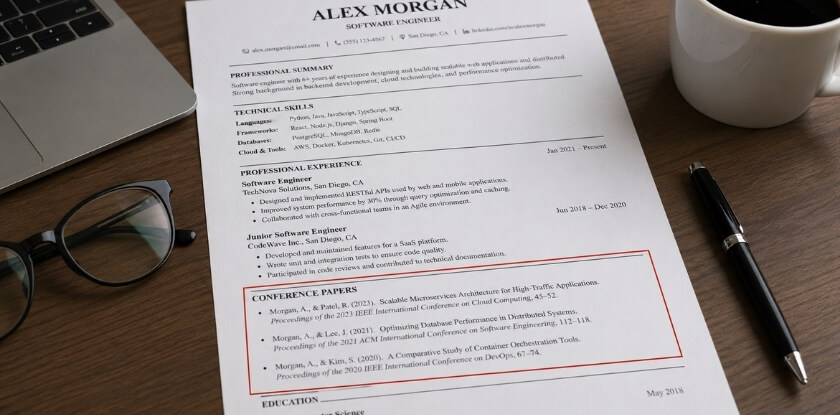
Rejected Papers
A rejected paper should not appear on your CV. Peer review is confidential, and listing a rejected submission implies a validation that does not exist. Committees expect every entry in Publications to be work that was accepted and presented or published.
Some researchers keep a personal “shadow CV” or CV of failures, a private record of rejected papers and unsuccessful grants. It has gained visibility as a transparency exercise, but it has no place in a standard academic CV sent to employers.
Withdrawn Papers
It depends on why the paper was withdrawn. If it was accepted and you later withdrew for logistical reasons, such as a scheduling conflict, lost funding or a co-author issue, it still passed peer review. Some academics list it with a note like “(accepted; withdrawn prior to presentation)” or “(accepted; not presented)”. That is honest and defensible, though the conservative choice is to leave it off unless the acceptance adds real weight. If you pulled it before any acceptance decision, it counts for nothing on a CV. Leave it out.
What About Papers Under Major Revision?
A paper rejected by one conference and resubmitted to another is listed as “under review” only if it has genuinely been resubmitted. Do not list papers you plan to revise and resubmit in the future. That is aspirational, not a real submission.
If a rejected paper shaped your thinking or led to a later accepted piece, mention it in a cover letter or personal statement, where narrative context belongs.
FAQ
Listing conference papers on a CV means choosing between Publications and Presentations, handling forthcoming or unpublished work, page numbers, location, DOIs and APA versus MLA.
Do I need to list the page numbers for a conference paper?
Yes, for published conference proceedings, include page numbers if they exist. If the paper appears only as an abstract or the proceedings were not formally published, you can leave them out.
Should I put the conference location in the entry?
Yes, it is good practice, especially for international conferences. City and country help readers gauge the scope of the event.
What if my paper was presented but the proceedings were never published?
List it under Presentations, not Publications, with the title, conference name, location and date, and [Paper presentation] after the title in APA. If the paper was accepted into proceedings that have not appeared yet, label it “in press” instead.
Can I include a paper I submitted but haven’t heard back on yet?
Yes, as “under review” in a separate sub-section, never among published papers. Naming the venue is optional. Take the entry off if the paper is rejected.
Is a conference poster treated the same as a conference paper?
No. A poster is a different contribution from a paper. List it in its own sub-section or label it [Poster presentation], and keep it under Publications only if it was published in a proceedings volume.
Do I need a DOI for every entry?
No. Include a DOI or URL if one exists, since it adds credibility. If neither is available, omit it rather than linking to a general conference page.
How do I cite a forthcoming paper in APA format?
Use “in press” in place of the year, because “forthcoming” is not an APA term: Author, A. (in press). Title of paper. Proceedings of the Conference Name.
Should a co-authored paper go in my Publications section?
Yes. List all co-authors in the published order and do not drop names to make it look sole-authored.
Should conference papers go under Publications or Presentations?
Publications if the paper appeared in published proceedings, especially peer-reviewed ones. Presentations if it was only presented.
Does it matter whether I use APA or MLA?
Yes, to the extent that your field has a norm. APA is standard in social sciences and education, MLA is common in the humanities. Pick the one for your discipline and use it consistently.
If I only have one conference paper, should I still create a whole section for it?
Yes. One entry still merits a labeled section, whether “Conference Presentations” or a broader Publications section. A single peer-reviewed paper is worth making visible.
How should a PhD student handle papers that are still in progress?
List accepted or forthcoming papers with an honest status label. Leave out papers that are only at draft stage with no submission, since they raise questions about your judgment rather than strengthen the CV.
Conclusion
Your conference papers are real scholarly work, and your CV should show them accurately. Put each entry in the right section, format all of them in one style, and flag the status of anything not yet published. The same three principles of clarity, honesty and consistency apply to a PhD student building a first CV and to a senior researcher with a long record.