
That small “Affiliation” box on a registration form looks easy until you have two employers, a brand-new job, or no employer at all. What you type there can end up on your badge, your certificate and the author line of your paper.
Quick answer: Affiliation is the organization or professional status you attend a conference under, such as a university, a company, or “Independent Researcher.” Write your role and the official organization name, for example “PhD Candidate – Example University.” Keep it short and current, because it can appear on your badge, program and certificate.
What Affiliation Means in a Conference Registration Form
In a conference registration form, affiliation shows the organization or professional status linked to your participation. It gives context to your name and helps the event team place your registration in the right category. Dictionary.com defines affiliation as the state of being affiliated or associated, so on a form it means the organization or status you are formally connected with.
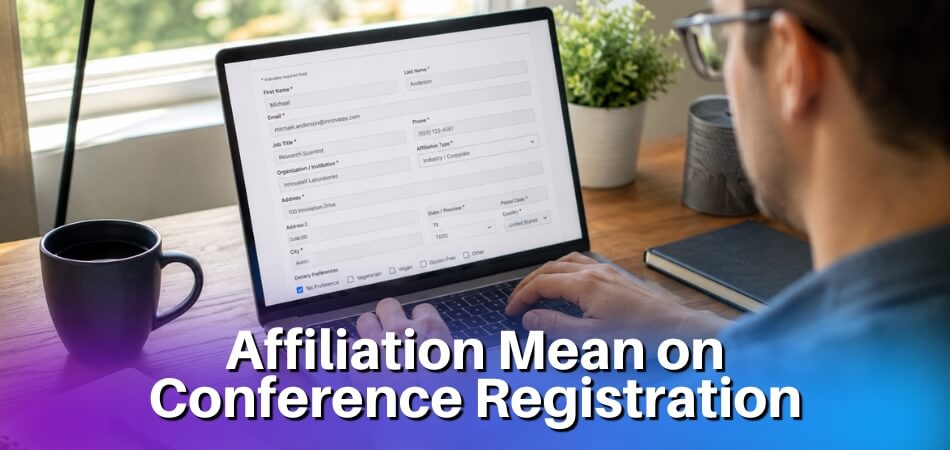
Affiliation is not limited to a workplace. It can also refer to a university, research group, association, government office, NGO, or independent professional identity. The best answer depends on your current role and the reason you are attending. A clear entry saves you from explaining your background in a long introduction.
For example:
| Attendee Type | Possible Affiliation |
| Student | University or college |
| Researcher | Research institute or university department |
| Employee | Company or organization |
| Government worker | Department or agency |
| NGO worker | Non-profit organization |
| Freelancer | Self-employed or independent professional |
| Independent attendee | Independent participant or independent researcher |
What Should You Write as Your Conference Affiliation?
You should write the official name of the organization, institution, or professional status that best represents you at the conference. Keep it short, accurate, and easy to understand.
A useful format is:
Role or Title – Organization Name
You can add a department only when it improves clarity. Avoid adding long descriptions, personal slogans, or unnecessary details.
Basic Format to Follow
A strong conference affiliation usually follows one of these formats:
| Situation | Format |
| Student | Degree/Status – University Name |
| Faculty | Title, Department – University Name |
| Researcher | Role – Research Institute |
| Employee | Job Title – Company Name |
| Government | Role – Department or Agency |
| NGO | Role – Organization Name |
| Freelancer | Profession – Self-Employed |
| Independent | Independent Researcher or Individual Participant |
Examples:
- PhD Candidate – Sample University
- Assistant Professor, Department of Economics – Northfield University
- Policy Analyst – Ministry of Health
- Independent Consultant
What to Include and What to Leave Out
Include information that helps others understand your professional or academic background.
You may include:
- Your current role
- Your department, if relevant
- Your official organization name
- Your city or country, if the form asks for it
- Your independent professional status, if you have no organization
Avoid including:
- Nicknames
- Internal office codes
- Informal abbreviations
- Long job descriptions
- Old organizations that no longer represent you
- Multiple unrelated roles unless the form allows them
For example, “Marketing Lead – ABC Solutions” is clearer than “Marketing person from ABC office team.”
Name, Title and Affiliation Are Different Fields
Registration forms often split your details into separate boxes, and each box has its own job.
| Field | What goes in it | Example |
| Name | Your full name, as it appears on your ID or passport when the event asks for that | [Your Full Name] |
| Title or designation | Your role | Assistant Professor |
| Organization or affiliation | The organization or status you attend under | Example University |
If the form has a title field, put “Dr.” or your role there rather than in the name box. If it has only one affiliation box, use the Role – Organization format above.
Short vs Long Affiliation Versions for Badges and Programs
Some conference badges have limited space, and a long affiliation may be cut off automatically so it looks incomplete. Prepare a short version and a full version, and do not try to fit your whole resume into the box. If you hold several roles, choose the most relevant one.
For a physical badge, short and clean wording usually works better. For a conference program, abstract book, or digital profile, a longer version may be acceptable. If a badge has a character limit, drop the department first and keep the role and organization.
| Long Version | Short Version |
| PhD Candidate, Department of Mechanical Engineering – Example University | PhD Candidate – Example University |
| Assistant Professor, Department of Environmental Studies – Sample University | Assistant Professor – Sample University |
| Program Coordinator, Community Health Projects – Community Aid Society | Program Coordinator – Community Aid Society |
| Senior Assistant Coordinator for Strategic International Academic Program Development – Department of Global Studies – Example University | Program Coordinator – Example University |
A shorter badge line is better than a long one that gets cut off.
Conference Affiliation Examples by Attendee Type
The best affiliation depends on whether you are a student, employee, researcher, independent participant, or representative of an organization. Below are practical examples for common conference registration situations. The organization names are samples only, so replace them with your own.
Student Affiliation Examples
Students should usually mention their academic status and institution.
Examples:
| Situation | Affiliation Example |
| Undergraduate student | Undergraduate Student – Riverside University |
| Master’s student | M.Sc. Student – Lakeside University |
| PhD student | PhD Candidate – Example University |
| Student presenter | Graduate Researcher – Sample University |
| Intern student | Research Intern – Northfield University |
If your department is important to the conference topic, you can include it:
PhD Candidate, Department of Physics – Example University
Faculty or Researcher Affiliation Examples
Faculty members, lecturers, and researchers should usually include their title and institution.
Examples:
- Lecturer – Harbour University
- Assistant Professor – Northfield University
- Research Fellow – Institute for Policy Studies
- Postdoctoral Researcher – Westfield University
- Associate Professor, Department of Management – Bayview University
For academic conferences, department names may be useful. For general professional conferences, the title and institution may be enough.
Corporate or Industry Affiliation Examples
Corporate attendees should normally write their role and company name.
Examples:
- Marketing Manager – ABC Consulting
- Senior Analyst – Example Bank
- Software Engineer – Example Software Ltd
- Business Development Executive – Sample Technologies
- Operations Lead – ABC Logistics
Use the official company name instead of casual short forms, unless the short form is the widely recognized official brand name.
Government Employee Affiliation Examples
Government attendees should mention their role and department, agency, or ministry.
Examples:
- Policy Advisor – Provincial Government
- Public Health Officer – Regional Health Agency
- Program Analyst – Ministry of Education
- Environmental Officer – Department of Environment
- Research Coordinator – National Statistics Office
If the form separates “organization” and “job title,” put the department or agency in the organization field and your role in the title field.
NGO or Non-Profit Affiliation Examples
For NGOs and non-profit organizations, use your official role and the organization name.
Examples:
- Program Coordinator – Community Aid Society
- Community Outreach Officer – Children First Foundation
- Project Manager – Open Rights Network
- Volunteer Coordinator – Neighbourhood Housing Trust
- Research Associate – Policy Action Network
If you are a volunteer, you can still list the organization if you are attending in that role.
Independent, Freelancer, or Self-Employed Affiliation Examples
If you are not attending on behalf of a formal organization, you can use an independent professional label.
Examples:
- Independent Researcher
- Independent Consultant
- Freelance Designer – Self-Employed
- Self-Employed Data Analyst
- Individual Participant
- Independent Public Health Professional
This is better than leaving the field blank. It tells the organizer that you are attending as an individual.
Multiple Affiliation Examples When Allowed
Some conferences allow more than one affiliation. If they do, place the most relevant one first.
Examples:
- Research Fellow – Policy Institute; Lecturer – Riverside University
- PhD Candidate – Example University; Consultant – Independent
- Project Lead – ABC Foundation; Volunteer Advisor – Youth Health Network
How to Choose the Right Affiliation for a Conference
Choose the affiliation that best matches your role, purpose, and identity at that specific conference. The right choice is not always your newest title or biggest organization. It should reflect why you are attending.

Match the Affiliation With Your Reason for Attending
Ask yourself why you are going to the conference.
If you are presenting research from your university, use your university affiliation. If your company is sending you, use your company affiliation. If you are attending for personal learning, you may use your current professional status or independent affiliation.
Examples:
| Reason for Attending | Best Affiliation |
| Presenting academic research | University or research institute |
| Attending for employer training | Company or workplace |
| Joining as a government representative | Department or agency |
| Participating as a consultant | Self-employed or consulting business |
| Attending personally | Independent participant |
Use the Official Organization Name
Use the formal name of your organization whenever possible. This avoids confusion and makes your badge look more professional.
For example:
| Less Clear | Better |
| LU Dept | Lakeside University |
| S Univ | Sample University |
| Dept Bio | Department of Biology |
| My company | ABC Technologies |
| ABC HQ Team | ABC Technologies |
| Health office | Ministry of Health |
| Gov Health Unit | Ministry of Health |
| Volunteer group | Community Aid Society |
Choose the Most Relevant Affiliation if You Have More Than One
Many people have more than one role. You may be a student and a freelancer, or a researcher and a part-time lecturer. In that case, choose the affiliation most connected to the event. The same choice decides which role leads your conference bio.
For example, if you are presenting a university research paper, your university should likely be listed first. If you are attending a business networking conference for your consulting work, your professional or self-employed affiliation may be more relevant.
If the form allows only one affiliation, do not force several into it. Ask yourself:
- Which organization is connected to your presentation?
- Which role explains why you are attending?
- Which affiliation matches your registration category?
- Which identity should appear on your badge?
Ask the Organizer When Your Situation Is Unclear
If your situation is unusual, ask the conference organizer before submitting the form. A quick clarification can prevent badge errors and registration confusion. The special cases further down and the email template at the end cover the usual questions.
Affiliation vs Institution vs Sponsorship: Key Differences
Affiliation, institution, and sponsorship are related conference terms, but they do not mean the same thing. Affiliation is about your connection. Institution is the organization itself. Sponsorship is financial or event support.
| Term | Meaning | Example |
| Affiliation | Your personal connection to an organization or status | Assistant Professor – Northfield University |
| Institution | The official organization name | Northfield University |
| Sponsorship | A company or group supporting the event | Sponsored by [Company Name] |
What Institution Means
Institution usually means the organization itself, especially in academic or research settings, such as Example University. It does not always include your role. In research papers or abstract submissions, institution names are often used to identify where authors are based.
What Sponsorship Means
Sponsorship means an organization supports the event with funding, services, visibility, or partnership. A sponsor is not automatically your affiliation unless you personally work for or represent that sponsor.
For example, a conference may be sponsored by a technology company, but that does not mean every attendee is affiliated with that company.
What If You Do Not Have a Formal Affiliation?
If you do not have a formal organization, you can write “Independent,” “Independent Researcher,” “Self-Employed,” “Freelancer,” or “Individual Participant.” This is acceptable for many conferences.
Not every attendee comes from a university, company, or institution. Some people attend to learn, network, present personal work, or explore opportunities independently. Some events also have an attendee or listener category for people who want to attend without presenting, and that category does not need an institution.
When to Use “Independent”
Use “Independent” when you are not representing a company, university, or organization.
Good examples include:
- Independent Researcher
- Independent Scholar
- Independent Consultant
- Independent Participant
This tells organizers that you are attending as yourself.
When to Use “Self-Employed” or “Freelancer”
Use “Self-Employed” or “Freelancer” when you work independently in a professional field.
Examples:
- Freelance Writer – Self-Employed
- Self-Employed Marketing Consultant
- Freelance Data Scientist
- Independent Graphic Designer
This gives more context than simply writing “N/A.”
If You Are Between Jobs or Unemployed
If you left a job and have not started a new one, do not list the old employer as your current one. Use an honest label such as Independent Professional or Independent Researcher, or ask the organizer whether you may name your most recent role. If the event has a category for unemployed attendees, choose the label that fits it.
How to Add Professional Context Without an Organization
If the form allows a longer entry, you can add your area of work.
Examples:
- Independent Researcher – Public Health
- Self-Employed Consultant – Digital Marketing
- Freelance Developer – Web Applications
- Individual Participant – Education Policy
Keep it short. The goal is to explain your background, not write a biography.
Why an Independent Affiliation Is Still Acceptable
An independent affiliation does not make your registration weaker. It simply shows that you are attending without representing a formal organization.
What matters most is that your information is honest, clear, and relevant. A clean independent label is better than borrowing an unrelated organization, and better than leaving the field empty, which can make your registration look incomplete.
Why Conference Organizers Ask for Affiliation
Conference organizers ask for affiliation to identify attendees, manage records, prepare badges, organize sessions, confirm eligibility, and support networking. It helps them run the event more smoothly.

Badge Printing and Attendee Identification
Your affiliation often appears below your name on your badge. This helps people quickly understand your background.
A badge with:
[Your Name]
Research Fellow – Westfield University
is more useful than a badge with only a name. It gives people an easy starting point for conversation.
Registration Categories and Eligibility
Some conferences have different registration categories, such as:
- Student
- Academic
- Industry professional
- Government representative
- NGO participant
- Speaker
- Exhibitor
- Independent attendee
Affiliation helps organizers place you in the correct category. It may also support student pricing, member rates, or special access where applicable, and it can change your badge type or the messages you receive. Some events set different rates for students, members or unemployed attendees and may ask you to confirm your status.
Session Planning and Audience Segmentation
Organizers may use affiliation data to understand who is attending. If many attendees are from healthcare, education, engineering, business, or research, that can help shape session planning and communication. This does not mean every event customizes the program based on affiliation, but the information can help organizers understand the audience better.
Networking and Attendee Directories
In an attendee directory or event app, people may search by organization, field, or background. A clear affiliation helps participants find relevant contacts and decide whether to start a conversation with you.
Communication, Logistics, and Event Records
Organizers may use affiliation to send relevant messages, prepare certificates, maintain attendee records, or manage check-in details.
For example, student presenters may receive different instructions than industry exhibitors. Speakers may need program updates. Government attendees may require separate documentation. Accurate affiliation helps reduce mistakes and supports smoother check-in.
Benefits of Writing an Accurate Affiliation
An accurate affiliation improves how you are listed, recognized, and approached during the conference. It helps avoid confusion and gives others a clearer reason to connect with you.
Creates a More Professional First Impression
A specific affiliation looks more polished than a vague entry. It shows that your registration details are complete and properly presented.
Compare these examples:
| Weak Entry | Strong Entry |
| Student | M.Sc. Student – Harbour University |
| Company | Marketing Manager – ABC Group |
| Research | Research Assistant – Health Policy Institute |
The stronger versions give useful context without adding unnecessary detail.
Helps Other Attendees Understand Your Background
At conferences, people often read badges before starting conversations. Seeing “PhD Candidate – Example University” or “Marketing Manager – ABC Group” tells them your field and role at a glance, which makes introductions feel more natural in networking sessions, workshops, and panel discussions.
People also connect through shared fields, institutions, industries, or research interests. For example, a public health researcher may be more likely to approach someone whose badge shows a related university department, health agency, or research institute.
Reduces Confusion in Conference Records
Incorrect affiliation can create problems in registration records, certificates, presenter lists, and programs.
For example, if you list an old organization, your certificate or session profile may show outdated details. If you leave the field blank, your badge may look incomplete.
Common Mistakes to Avoid When Writing Your Affiliation
Typical affiliation mistakes include using unclear abbreviations, listing outdated organizations, adding too much information, or leaving the field blank. A good entry should be accurate and easy to read.
Using Nicknames or Unclear Short Forms
Avoid short forms that only your local group understands, and internal acronyms that people outside your organization will not recognize. Write the full name or a clearer version, as in the table of better names above. Common abbreviations may be acceptable if they are official and widely recognized, but clarity should come first.
Listing an Outdated Organization
Use your current affiliation unless there is a specific reason to use a previous one, such as presenting research completed at that institution. If you recently changed jobs or schools, update the organizer as soon as possible.
Special Cases: What Affiliation Should You Use?
Special affiliation cases should be handled with honesty, clarity, and relevance. When the answer is not obvious, choose the affiliation that best matches your role at the conference.

If You Changed Jobs After Registering
If your organization changes before the event, contact the organizer and ask them to update your registration. This helps ensure your badge, certificate, and attendee profile are accurate.
Rules on changes differ by event, so ask as early as you can. A simple message is enough. Include your full name, registration ID if available, old affiliation, and new affiliation.
If Your Research Was Completed at a Previous Organization
If you are presenting work completed at a previous university, company, or institute, it may be appropriate to list that organization, especially in the program or abstract.
You may also mention your current affiliation separately if the form allows it. In a paper or abstract, the place where the work was done usually matters most.
Example:
Former Research Associate – ABC Institute; Current Affiliation: Westfield University
If space is limited, ask the organizer which format they prefer.
If You Are Attending Personally, Not on Behalf of Your Employer
If your employer is not sending you and you are attending for personal learning, you may write:
- Independent Participant
- Attending in Personal Capacity
- Self-Funded Participant
- Independent Professional
This can be useful if you do not want the event to suggest that your employer officially represents your attendance.
If Your Organization Should Not Appear Publicly
Some attendees may not be allowed to display their employer name publicly. In that case, avoid guessing. Ask the organizer whether you can use a general label such as:
- Independent Participant
- Private Sector Professional
- Government Professional
- Attending in Personal Capacity
The best wording depends on the event’s rules and your organization’s policy.
Email Template to Ask Organizers About Your Affiliation
Email the organizer if you are unsure which affiliation to list, have several roles, have changed organizations, or need privacy around your employer name. Here is a simple template you can adapt.
Subject: Question About Affiliation for Conference Registration
Hello [Organizer’s Name],
I am completing my registration for [Conference Name] and would like to confirm the best way to list my affiliation.
My current situation is: [briefly explain your role, organization, or independent status].
I am considering one of the following options:
- [Option 1]
- [Option 2]
Could you please let me know which format is most appropriate for the registration form, badge, and conference record?
My registration ID, if needed, is [Registration ID].
Thank you for your help.
Best regards,
[Your Full Name]
From our experience at MS International: Our author submission guidance asks for accurate author details, including affiliation, and the speaker application form has separate fields for organization and designation next to a full name taken from your passport. The invitation letter is issued within 3 to 5 business days after payment clears. It supports a visa application but does not guarantee approval. If incorrect organization, spelling or passport details are provided, a US$50 correction fee may apply and the correction may delay the letter, so check them before you submit. Approved speakers receive a certificate, and the speaker page asks them to check their name, organization, position and presentation title before it is prepared.
FAQ: Conference Affiliation
Filling in the affiliation field leads to doubts about fees, listing two institutions, what students or unaffiliated people should write and fixing a wrong entry after submitting.
What is the purpose of affiliation in conference registration?
Affiliation tells organizers which organization or status you attend under. They use it for your badge and program, your registration category and fee, and attendee records.
Can my affiliation affect registration fees?
Yes, at some events. A conference may set different rates for students, members, unemployed attendees or staff of partner institutions, and may ask you to confirm your status before applying the rate.
Can I change my affiliation after submitting the form?
Usually, yes. Email the conference organizer as soon as you know. Policies differ by event, and changes are easier before badges, certificates, and programs are finalized.
Should I use my current or previous affiliation?
Use your current affiliation on the registration form and badge. List a previous organization only when your presentation or research was done there, as in a paper or abstract. If both matter, ask whether the conference allows two.
Can I write two affiliations?
Only if the form allows it. If not, choose the one most relevant to the event, presentation, or registration category.
What happens if I enter the wrong affiliation?
A wrong affiliation may appear on your badge, certificate, attendee profile, or conference program, and it can confuse organizers and other attendees. Correct it early if you notice a mistake.
Do organizers verify affiliation?
Some do, for discounts, student rates, speaker records, or special categories. Others rely on the information you provide, so enter accurate details from the beginning.
Is affiliation the same as job title?
No. A job title describes your role, while affiliation describes the organization or professional identity connected to you. “Research Assistant” is a title and “Westfield University” is an affiliation. Together, they make a complete badge line.
What should students write as affiliation?
Students should usually write their study level and institution, such as M.Sc. Student – Lakeside University or PhD Candidate – Example University. A department can be added if it is relevant.
What should I write if I am unemployed or unaffiliated?
Write Independent Participant, Independent Researcher, or a similar honest label. Do not list a former employer as current, and do not leave the field blank if the form requires an answer.
Does the affiliation affect my MS International invitation letter?
Indirectly, yes. The letter is prepared from the details you give at registration, and incorrect organization or passport details may lead to a US$50 correction fee and delay the letter. Check them before you submit.
Conclusion
Affiliation may look like a small field, but it shapes how you are presented at the event. The best choice honestly reflects your role, organization, or independent status at the time you register.
Before you submit, check the spelling, keep the wording badge-friendly, and make sure it matches your reason for attending. If you are unsure, ask the organizer first.