
Having the credentials is one thing. Knowing what to put in a few lines when a speaker bio form is sitting empty on the screen is another. Length, person, achievements and personal touches are the usual sticking points.
Quick answer: A conference speaker bio is usually written in third person and runs about 50 to 150 words, unless the organizer gives a limit. It opens with your name, current role and organization, adds one or two achievements that relate to your session topic, and may end with one short personal detail. Always follow the word count on the form.
What Should a Conference Speaker Bio Include?
A conference speaker bio is a short professional summary that tells organizers and attendees who you are and why you should speak on this topic. Organizers use it for the event website, the printed program and, sometimes, the introduction read aloud before your talk. Getting it right the first time means fewer edit requests later.
The core elements are the same for almost every format:
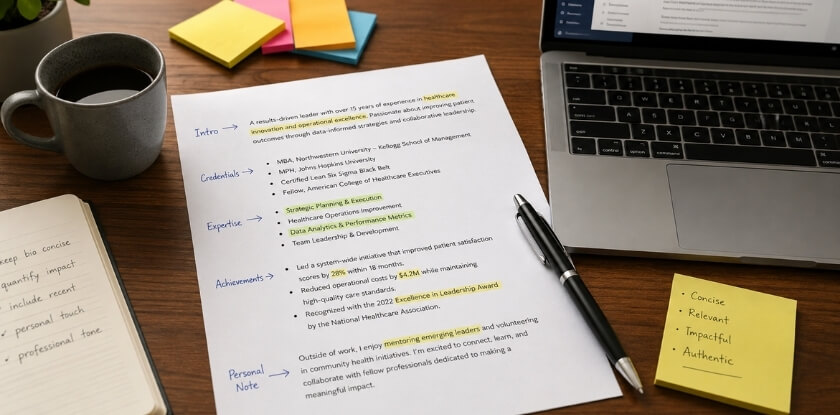
- Your full name and current title. Add the organization, institution or company you represent. For an academic bio, that means your department and university.
- Your expertise as it relates to the session. Describe what makes you qualified for this talk, not everything you do.
- Relevant speaking experience. One line naming a few conferences, publications or credentials is enough. A full list is not needed.
- One brief personal detail. A location or a side project that connects to your work makes the bio read like a person wrote it.
Format and Length
Bio lengths vary by event, and the organizer’s word count always wins. When no limit is given, these are sensible targets. They are habits, not official rules.
| Version | Approx. length | Typical use | What to keep |
|---|---|---|---|
| Short | 50 to 75 words | Printed program, conference app, schedule page | Name, role, organization, one credential, topic |
| Standard | 100 to 150 words | Speaker bio form, event website, email | Adds relevant achievements and speaking experience |
| Long | 150 to 250 words | Academic submissions, speaker pages with more room, your master copy | Adds publications, research focus, background |
If you are unsure, about 100 words is a safe default. Academic bios often run toward the longer end because affiliations and publications carry more weight there. Online bios sometimes display next to a headshot in a sidebar, so the first two sentences need to carry the message.
What to Prioritize
Lead with what qualifies you for this specific talk, then add broader credentials, then the personal detail last. Organizers may skim, and if your topic relevance is not clear in the first sentence, it may be missed.
An email bio, sent to an organizer outside a form, follows the same order. Add a one-line subject context at the top, because it arrives without a form field to label it.
What Makes a Conference Bio Different from Other Bios
A conference bio has one job: give organizers and attendees enough context to trust that you belong on that stage, on that topic. That is a narrower brief than your LinkedIn summary, your website about page or your press kit bio, which serve other readers.
It Is Written for a Program, Not a Profile
Organizers are building an event program, a website listing and an introduction for the person at the microphone. They need text that plugs straight in: concise, in the third person, and focused on the angle that fits the theme.
Your LinkedIn bio may be in first person with a warm tone, which suits that platform. On an event page, “I help founders build better teams” feels out of place, while “[Name] helps founders build better teams” drops into a program without editing.
Third Person or First Person?
Use third person: “[Name] leads…” rather than “I lead…”. Organizers paste the bio into several places and may read it aloud, and nobody wants to change pronouns on the fly. If you submit in first person, someone has to rewrite it, or they may pull a bio from your website or LinkedIn that does not represent you as well. If the form asks for first person, follow the form. If it gives no guidance, default to third person, present tense.
Topic Relevance Drives the Edit
The biggest difference from a general bio is specificity. You are presenting the slice of your career that explains why you should speak on this topic at this event.
If you are speaking on supply chain resilience at a logistics conference, a decade in brand marketing is not what the bio needs. Two years running operations during a shipping disruption is. Every line should earn its place by telling the audience why you can speak on this subject.
- Professional affiliation. Your current title and organization set context immediately. A senior policy analyst at a public health institute carries different weight at a healthcare conference than the same person’s side work as a podcast host.
- Speaking experience. If you have spoken at comparable events, name one or two. It tells organizers you understand the format.
What a LinkedIn Bio Carries That a Conference Bio Does Not
LinkedIn rewards personality, career narrative and breadth. A conference bio strips most of that away. A personal detail is worth including only when it does specific work: if you are speaking on resilience and you rebuilt a business after a serious setback, that backstory earns its place. If it is only humanizing filler, it belongs on your website, not in a 120-word program entry.
That is also why pasting a bio you have used for years rarely works. Parts that do not connect to the session topic usually come out, and a sentence framing your angle on the session usually goes in.
How to Write a Conference Bio Step by Step
Bios go wrong when they are written from the speaker’s point of view instead of the reader’s. Organizers and attendees do not want a life story. They want to know why you are the right person for this topic, right now.
Step 1: Lead with Your Current Role and Affiliation
Open with your title, your organization and enough context to make both meaningful. “[Name] is a senior product manager at [Company]” does more work than “[Name] is an experienced product manager with over a decade in fintech.” The first is grounded and checkable. The second is vague in a way that makes readers slightly less confident.
If your affiliation is complex, for example you consult independently and also hold an adjunct post, lead with the role most relevant to the conference topic and mention the other later. For an academic bio, the institution and department usually come first, and academic organizers expect that.
Step 2: Connect Your Work to the Conference Topic
Your bio needs a bridge between what you do and what the conference is about, and one sentence usually handles it. If you are speaking about demand forecasting, make clear that your daily work touches demand forecasting, not just “operations broadly.”
For online or virtual events, this matters more. Attendees may choose sessions in advance based on the speaker bio, so a vague link can cost you listeners before you say a word. If space allows, close with one sentence that names what the session covers and who it is for.
Step 3: Add One or Two Specific, Relevant Achievements
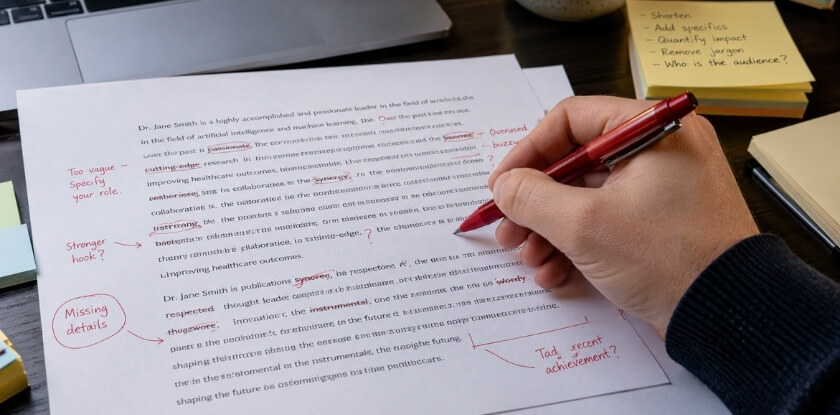
Generic claims such as “has worked with large companies” or “is a thought leader” tell organizers nothing. Pick one or two achievements tied to the topic and state them plainly: “led a customer retention program at [Company]” beats “has extensive experience in customer success.” Add a number only if you can back it up.
For an international audience, recognizable institution names and concrete outcomes matter more than titles, because people unfamiliar with your organization will anchor to what they can understand, such as a country, a project or a measurable result. Two strong achievements beat a paragraph of general credentials.
Step 4: Include One Personal Detail
A small detail makes a bio easier to remember: a city, or an outside interest that is genuinely relevant. If you are speaking at a food industry conference and you farm on weekends, that is worth a sentence. If you like hiking, leave it out unless it connects to your talk. One detail is enough, since extra ones read as filler and use up words that should explain why your session is worth attending.
Step 5: Check the Length and Read It Aloud
Match the word count on the form, using the table above if none is given. Then read the bio aloud. Long strings of credentials, abbreviations and compound titles sound awkward when spoken, and the person introducing you will thank you for simplifying them. Finally, confirm it is in third person, as covered earlier.
Conference Bio Examples for Industry, Academic and Student Speakers
Examples make the decisions easier. The samples below use placeholders in square brackets. Replace every one with your own details, and do not copy the wording, because organizers may recognize templates.
Industry Speaker Bio (About 100 Words)
This is the version most speaker bio forms ask for. It is long enough to establish credibility and short enough to paste without editing.
[Name] is the founder of [Company], which helps mid-sized manufacturers reduce inventory costs through demand forecasting and supplier diversification. [Name] has spent [number] years working across automotive, consumer electronics and food distribution, with clients in [regions]. [Name] speaks at operations and procurement events on [topic 1] and [topic 2], and has presented at [Conference A] and [Conference B]. [Name] holds a [certification] and a [degree] from [University], and is based in [City]. At this year’s conference, [Name] will focus on building resilient supplier networks without raising procurement overhead.
The sample covers affiliation, expertise, speaking experience, credentials and a direct tie to the session. That is the full checklist for a standard bio.
Short Bio (About 50 Words)
Programs, apps and schedule pages rarely have room for a full bio.
[Name] is the founder of [Company] and a [certification] holder with [number] years in supply chain consulting. [Name] speaks on [topic 1] and [topic 2] at operations conferences and is based in [City].
The short version names the company, one credential, the topic area and the location. It is easier to trim a long bio down to this than to stretch a short one, so write the long version first.
Academic Speaker Bio
Academic bios shift toward institution, research area and publications, rather than client outcomes. They open with affiliation and title instead of a punchy first line.
Dr. [Name] is an Associate Professor of [Field] at [University], where [Name] teaches [courses]. Their research focuses on [specific research area], with particular attention to [sub-topic]. The work has been published in [Journal A], [Journal B] and [Journal C]. Dr. [Name] is a co-investigator on [funded project, if any] and holds a PhD from [University]. This presentation draws on [stage of the study, for example the first two years of fieldwork] and will be most relevant to [type of researcher or practitioner].
Publication venues are named explicitly because that is how academic audiences judge credibility. The research area is specific enough that delegates can tell at once whether the session is relevant to their work.
Student or First-Time Speaker Bio
If you have never presented before, leave out the speaking experience line and let your study or work carry the bio. Organizers care more about whether you know the topic than whether you have a stage history.
[Name] is a [degree] student in [field] at [University]. Their research looks at [topic], using [method]. Before returning to study, [Name] worked as a [role] at [organization] and developed a particular interest in [related area]. At this conference, [Name] will present early findings from [project] and welcomes questions from researchers working on [related theme].
A bio like this is credible because the work is real and the session content is named. Naming the session content in the final sentence also signals that you have prepared actual material, which matters more to organizers than a speaking history.
Virtual or Online Conference Bio
A virtual bio is built the same way as a standard one, as the sample below shows. The only change is a closing line about format, because attendees are often in different time zones and need to know what to expect.
[Name] is a cybersecurity consultant and founder of [Company], specializing in third-party vendor assessments for financial services firms. [Name] has advised institutions in [countries] on regulatory compliance, penetration testing frameworks and post-breach vendor review, and has spoken at [Event A], [Event B] and several virtual summits. [Name] also writes [newsletter or publication, if relevant]. At this online conference, [Name] will present a live [length]-minute session on vendor risk scoring, followed by a live Q&A open to registered attendees across time zones.
The last sentence is the only change for the virtual format, since it tells attendees what to expect. For a pre-recorded session, swap it for something like: “[Name]’s session is available on demand throughout the conference period, with a live Q&A on [date].” The rest of the bio does not need to change because the event is online.
Bio Format by Placement: Program, Website, and Email
Where your bio appears changes what it has to do. A printed program bio is skimmed in seconds by someone sitting in an audience. A website bio is read by attendees deciding whether your session is worth their time. An email bio lands in an organizer’s inbox while they are building a run sheet.
Program and Event Guide Bios
Program bios run short, often 50 to 75 words, because print space is limited and attendees use them for quick orientation. Open with your name, current role and the one credential closest to your session, then close with a line about what the audience will take away. There is no room for career history or anecdotes.
A spoken introduction should be just as short, written for a room instead of a page. If the form gives a word count, hit it precisely. Organizers using layout software often cut from the end without asking, so an over-long bio loses its last sentence.
Event Website Bios
Website bios have more room, often 100 to 200 words, and readers are making a decision about your session. Your speaking experience, specific expertise and fit with the theme should all be visible. Include your affiliation, two or three credentials that establish authority on the topic, and a line on what you have worked on or published. A single humanizing line at the end, such as where you are based, keeps the profile from reading like a résumé.
Email Speaker Bios
When an organizer asks you to paste a bio into an email, the reader may be copying it into a spreadsheet or forwarding it to a moderator. Paste it as plain text in the body of the message, with no formatted documents or PDFs unless they asked for one. If you have more than one length, send a short and a longer version, clearly labeled, so they can grab whichever fits. For international events, add your country or time zone if it matters for logistics.
Photo and Contact Details
Forms often ask for a headshot and a profile link beside the bio. Send a clear, recent photo in the format the form requests, and use the same name and title as in the bio text. Add an email address or profile link only if the organizer asks for one, because published bio text is public. A personal phone number or home address does not belong in a bio.
Virtual and Online Conference Bios
The same text may appear on the event website, inside the video platform’s speaker profile and in a pre-event email to attendees. Each has different display limits, so ask the organizer upfront what sizes they need.
What Conference Organizers Actually Look For
It is easy to assume organizers read every bio closely. Treat it as closer to triage: an organizer working through many submissions may scan for a few signals, and a bio without them can be flagged for follow-up.
Proof That You Fit the Session Topic
The first thing checked is whether your credentials connect to the event’s theme. A strong publishing record means little at a healthcare policy conference unless the bio draws a line between your work and that context.
- Make the connection explicit. Do not expect organizers to infer it. “[Name] has spent eight years researching supply chain disruption, with a focus on pharmaceutical distribution” lands better than a generic list of roles and companies.
- Avoid credential overload. They need enough to answer one question: is this person credible on this topic, for this audience?
Bio Length That Fits Their Format
Organizers work within layout limits: the website may support 150 words, the printed program 75, and a registrant email 50. A requested length is not a suggestion. Submitting 300 words when 100 were asked forces someone to cut it, and the cuts will not always land where you would choose. Where you can, submit a short, a standard and a longer version, which gives flexibility and shows you have done this before.
Verifiable Professional Affiliation
Your title, organization and role anchor your credentials and give organizers something concrete for promotional material. Use your current affiliation, not your most impressive one. A former post at a well-known organization can be mentioned briefly, but an outdated current role misleads organizers and creates awkward moments if a registrant looks you up. For an international event, add your country or region when it adds context.
What Organizers Are Not Looking For
A few things slow down review or create extra work:
- Résumé-style bios. Titles and dates in a list do not work for public-facing placements. Organizers have to translate them into prose first.
- No hint of speaking experience. Even one line saying you have spoken at similar events, or taught the subject, reassures them that you will not need hand-holding on stage.
- Generic bios. An academic bio should have academic framing. An online-event bio might briefly mention remote presenting experience. Small adjustments show you took the submission seriously.
Common Mistakes That Undermine an Otherwise Good Bio
These are predictable traps, and they are the main reasons a bio gets rewritten, shortened or moved down the program. Writing in first person is the easiest to fix and is covered above. These are the others.
Leading with Credentials That Do Not Connect to the Topic
Mismatched credentials waste the first sentence. If you are speaking about remote team management and the bio opens with a decade of financial auditing, you have lost the reader. Lead with what is relevant.
Job titles without context do little as well. “Chief Innovation Officer at [Company]” tells an organizer almost nothing. One extra clause saying what the company does and how your role relates to the session solves it.
Ignoring Length Guidelines
A 400-word bio sent to an event that asked for 100 signals that you did not read the brief, and it creates work for the organizer. Treat the form’s word count as a hard limit.
Burying the Speaking Experience
A bio can save speaking experience for the last sentence, after a long list of qualifications. For organizers judging whether you will hold a room, that belongs near the top. A reference to a few relevant panels or sessions adds credibility fast.
Newer speakers should omit the experience line instead of padding it. Listing a single webinar or internal presentation can read as thin. Focus on your subject expertise and let the proposal carry the weight. Organizers know that every speaker starts somewhere.
Packing in Too Much Personal Detail
Two or three personal details added just to seem approachable usually have the opposite effect. Space is limited, and a sentence about your love of hiking takes room that should explain why your session is worth attending. Stay with the single relevant detail from Step 4.
Forgetting the Tone of the Event
A bio for an online tech audience can afford a slightly conversational register. A formal academic bio should stay measured and precise. Neither is wrong; the mistake is applying one to the other. Look at how the event describes itself and how other speakers are framed, and that is usually enough to calibrate.
How to Adapt and Reuse Your Bio for Different Conferences
A strong bio written once is good. A system for adapting it quickly is more practical, because speakers who appear at several events across industries and formats find that one static bio rarely fits all of them.
Keep a Master Bio on File
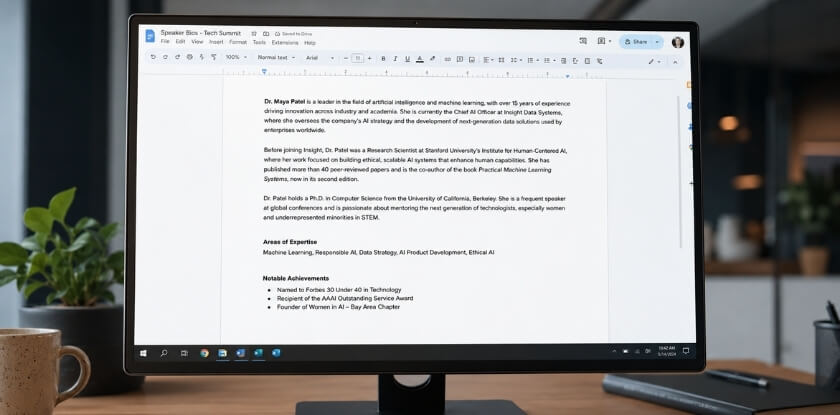
Write a longer version of about 200 to 250 words that captures everything potentially useful: current role, affiliation, credentials, speaking experience, topics and one or two personal details. This is your source document. Save the 50 to 75 word and 100 to 150 word versions beside it, label each by word count, and you will be editing down when a form arrives, not starting from scratch. Do not simply cut a long bio off mid-sentence. Each short version should read as complete on its own.
Match the Bio to the Conference Type
Different events call for different framing, even when the credentials stay the same.
| Event type | Lead with | Watch out for |
|---|---|---|
| Academic | Institution, research focus, relevant publications | Connect the research to the talk explicitly |
| Industry or professional | What you have built, led or solved; job title and company | One line of speaking experience helps |
| Virtual or online | Topic relevance in the first sentence | Attendees skim between browser tabs, so keep language accessible |
| International | Broadly recognizable credentials, neutral tone | Regional jargon and acronyms that will not travel; add location, such as “based in [City] and working mainly with [region]” |
Change the Focus Without Rewriting Everything
If you speak on supply chain strategy at one event and workplace culture at another, the bio should not be identical. The facts about you stay, but the order and emphasis shift. Pull forward whichever part of your background fits the session: your affiliation if that is the strongest credential for the audience, or a specific project if it is more compelling than your title. Usually this means reordering a sentence or two and swapping in one specific detail.
Keep Your Name and Details Consistent
Decide how your professional name appears in bylines, speaking credits and introductions, and use it identically in every version. If you use a middle initial professionally, use it everywhere. Small inconsistencies are easy to avoid and make republished material look careless.
Flag What Changes Regularly
Job titles, company names, research positions and recent publications go stale fast. Review your master bio every few months instead of only when a new form arrives. An outdated affiliation on a conference website can quietly undermine your credibility with organizers who research their speakers.
From our experience at MS International: Our speaker agreement says a short professional biography may be requested for your speaker profile, alongside your name, title, organization and photo. Speakers are asked to tell us promptly if their name, title or organization changes before the event, so keep your bio current. Our events are held in person in the Greater Toronto Area, and the moderator introduces each speaker, so a bio that sounds natural when spoken is a safe choice.
FAQ: Writing a Conference Bio
Writing your speaker bio raises choices about length, first or third person, a short and a long version, the closing personal detail and whether to add a photo or email.
How long should a conference speaker bio be?
Usually 50 to 150 words, unless the organizer sets a limit. Stick to the word count on the speaker bio form. Organizers paste bios directly into programs and websites, so going over creates extra work for them.
Should a conference bio be written in first or third person?
Third person, unless the form says otherwise. Programs, websites and speaker introductions display or read the bio as-is, so “[Name] is the founder of…” fits more naturally than “I am the founder of…”
What if the conference does not give any bio length guidelines?
Aim for about 100 words. That is enough to cover your credentials, your affiliation and why your topic matters, without padding. Offering a shorter 50-word version as well gives the organizer an easy option.
Do I need a different bio for an academic conference than for a professional one?
Yes. An academic bio leads with institution, research area and publications. A professional bio leads with your role, practical experience and the problem you help people solve. The audiences are judging different things, so the structure differs.
Can I use the same bio for a virtual conference as for an in-person event?
Usually yes, since the content can stay the same. Check whether the platform shows a shortened version with a “read more” link, because the first two sentences then carry the weight. Add a closing line about the session format if relevant.
What goes in a speaker bio when I am new to speaking?
Lead with your professional or academic expertise, not speaking history. Your job title or studies, your specialization and the specific angle of your talk are what organizers need. Speaking experience helps, but it is not the only way to establish credibility.
How do I handle the personal detail at the end of my bio?
Use one sentence, such as where you are based or a relevant outside interest. It humanizes the bio without taking space from your credentials. If it does not connect to your work, treat it as optional and drop it first when the word count is tight.
Should I write different bios for different conferences?
You do not need a brand-new bio each time, but adjust the framing to match each event. Pull forward the background most relevant to that audience and topic. One generic bio pasted everywhere often feels slightly off, and organizers notice.
What if the organizer asks for both a short bio and a long one?
Write the long version first, then cut to the short one by removing supporting detail and keeping core credentials and topic relevance. The short version should read as complete on its own, not as a truncated copy of the long one.
My bio will be read aloud as a speaker introduction. Does that change how I write it?
Slightly. Read it aloud before you submit and simplify anything that sounds awkward when spoken, such as long strings of credentials, abbreviations or compound titles. The person introducing you will find it easier to deliver.
Should I put my email address or photo in a conference speaker bio?
Only if the organizer asks. Send a recent headshot in the requested format, and add a professional email or profile link only when the form requests contact details, because published bio text is public. Keep private phone numbers and home addresses out.
Can a conference organizer use my bio on its website?
At MS International, yes: according to the speaker agreement, your approved professional details, including your biography, may appear on the website, conference materials and official social media pages.
Before You Submit Your Bio
A conference bio does one small job: it tells organizers and attendees who you are and why you are speaking on this topic. Keep it in third person, match the length to the form, and make sure every credential connects to your talk. Update it before each event instead of sending the same generic version everywhere.