
A nursing conference bio is only a few sentences long, yet organizers, moderators and attendees may read it before they ever hear you speak. A handful of small choices decides whether it reads as clear and credible.
Quick answer: To write a bio for a nursing conference, open with your full name and credentials, then add your current role, workplace, nursing focus, one achievement, and one line linking your work to the conference theme. Stay within the organizer’s word limit, and use 100 to 150 words if none is given.
Last verified against official sources: October 2026.
A nursing conference bio is a short professional profile that helps organizers, attendees, moderators, and fellow nurses understand who you are and why your background matters. It should not read like a full resume. It answers three questions: Who are you? What do you do in nursing? Why are you relevant to this conference?
What Is a Nursing Conference Bio?
A nursing conference bio is a brief introduction used to present a nurse, speaker, panelist, student, researcher, educator, or award recipient at a professional nursing event. It usually includes the person’s name, credentials, current role, nursing specialty, achievements, and connection to the conference topic.
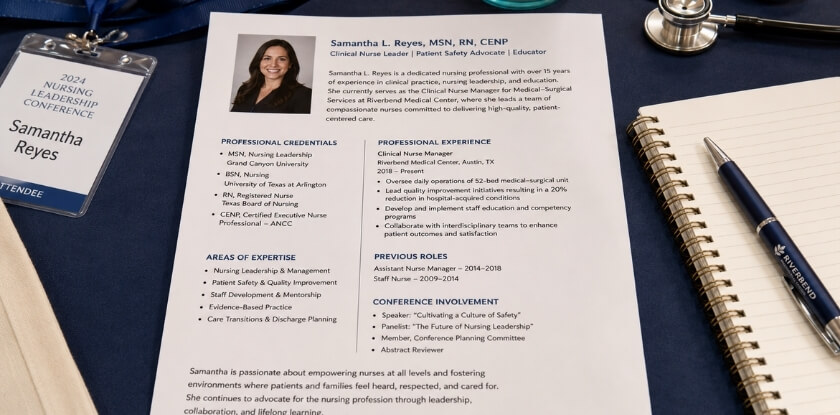
The purpose is to give readers a quick but meaningful view of your professional background, so they can judge your credibility before they attend your session, read your poster, meet you at the event, or see your profile in the conference program.
Why Nursing Conference Bios Matter
A bio creates a first impression before people meet you, and what you wear to a healthcare conference adds to it in person. It can show your clinical experience, leadership role, research interest, teaching background, or contribution to patient care.
A clear bio can help you:
- Introduce yourself professionally
- Show your nursing credentials and expertise
- Connect your work to the conference theme
- Build trust with attendees or organizers
- Support networking with other healthcare professionals
- Make your session, poster, or panel role easier to understand
Where Your Nursing Bio May Appear
Your bio may be reused in several places before and during the event, so it should be accurate, polished, and easy for organizers to copy.
Common places include:
- Conference website
- Speaker profile page
- Printed event program
- Mobile conference app
- Poster session listing
- Panel or workshop description
- Award or honoree profile
- Moderator introduction
- Social media promotion
Because it may appear in different formats, leave out details that do not support your nursing role or conference purpose.
How to Write a Bio for a Nursing Conference
Writing a bio for a nursing conference is easier when you follow a clear order: introduce yourself, show your nursing role, highlight relevant experience, add one proof point, and connect your background to the conference theme. The goal is to help readers quickly see your value as a nursing professional.
Start With Your Full Name and Nursing Credentials
Begin with your full name and the credentials that apply to you, such as RN, BSN, BScN, MSN, MN, DNP, PhD, CCRN, CPN, CNS, or NP. If the conference or your employer has a preferred format, follow it.
The order matters. ONS, summarizing guidance from the American Nurses Credentialing Center (ANCC), recommends the sequence in the table below. Advanced degrees replace the lower degree they build on, so a nurse with a master’s and a doctorate normally lists only the doctorate.
| Position | What goes here | Example |
| 1 | Highest degree (highest non-nursing degree first, then highest nursing degree) | MSN, MN, DNP, PhD |
| 2 | Licensure and state or provincial designations required to practice | RN, NP, CNS |
| 3 | National certifications (nursing certifications first, then non-nursing) | OCN, CCRN |
| 4 | Awards and honors | FAAN |
That gives a line such as [Full Name], MSN, RN, OCN. Canadian nurses often write the same credentials as RN, BScN, MN. Some Canadian nursing groups put RN before the degrees and accept either order, so pick one pattern and use it consistently, and check your provincial or territorial regulator for how the RN title should appear. Certificates, such as a short continuing education certificate, are not credentials and belong on a CV, not after your name.
Mention Your Current Nursing Role and Workplace
After your name, state your current role and workplace. This tells readers your professional setting and area of responsibility.
You may mention whether you work in:
- Clinical care
- Nursing education
- Healthcare leadership
- Research
- Public health
- Patient safety
- Specialty nursing practice
Keep this part simple and factual.
Highlight Your Relevant Clinical, Academic, or Leadership Experience
Add experience that directly supports your role at the conference. A nurse presenting on patient safety, for example, should lead with patient care, quality improvement, or safety-related work.
Relevant experience may include:
- Bedside nursing
- Unit leadership
- Teaching or mentoring
- Clinical research
- Community health work
- Evidence-based practice projects
- Healthcare management
Avoid listing every past role. Choose the experience that fits the conference topic.
Add One Strong Achievement, Research Project, or Professional Contribution
A strong bio includes one proof point that builds credibility. This could be an award, publication, certification, research project, leadership role, quality improvement result, poster presentation, or professional contribution. Choose one achievement that is relevant to the event rather than adding a long list.
Connect Your Background to the Nursing Conference Theme
Your bio should show why your background fits the event. Tie your experience to the session topic, audience needs, or conference theme.
Example:
[First Name]’s work in patient safety and nurse education connects with the conference focus on improving healthcare quality.
This makes the bio feel specific instead of generic.
Include a Brief Personal or Professional Note if Appropriate
A short note can make your bio more approachable. This may be a mentoring interest, community health passion, patient advocacy focus, or a brief reason you care about the topic. Keep it short. The main focus should remain on your nursing background.
Keep the Bio Concise, Clear, and Professional
Use short sentences, accurate details, and a professional tone, and stay inside the organizer’s word limit (the length section below gives targets if none is set). Before submitting, remove repeated details, outdated roles, unrelated hobbies, and anything that does not support your nursing credibility or conference relevance.
What Should You Include in a Nursing Conference Bio?
A nursing conference bio should include the details that prove who you are, what you do, and why your background fits the event. Use this section as a quick checklist before writing or submitting your bio.
| Bio Element | What to Add | Why It Matters |
| Name and credentials | Full name plus relevant credentials such as RN, BSN, MSN, DNP, PhD, NP, CNS, CCRN, CPN, or AOCN | Shows your professional identity and qualifications |
| Current role | Your job title and workplace | Helps readers understand your present nursing position |
| Nursing focus | Specialty, practice area, or professional focus | Shows your area of expertise |
| Relevant experience | Clinical, academic, leadership, research, or public health experience | Connects your background to the conference |
| Proof point | One award, publication, project, presentation, certification, or professional contribution | Builds credibility without making the bio too long |
| Conference connection | A short line showing how your work fits the session, theme, poster, or audience | Makes the bio specific to the event |
| Contact link | LinkedIn, hospital profile, university page, research profile, or portfolio if allowed | Gives attendees or organizers a way to learn more |
If space is limited, prioritize your name, credentials, current role, nursing focus, one proof point, and conference connection. These give readers the clearest picture without turning the bio into a full resume.
Best Structure for a Nursing Conference Bio
The best structure for a nursing conference bio is: opening line, professional background, conference relevance, and closing detail. This keeps the bio organized and easy for organizers to use in speaker pages, event programs, introductions, and session listings.
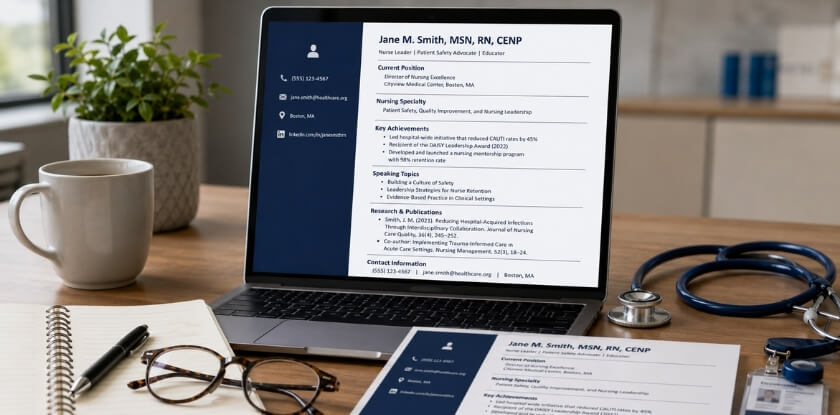
Opening Line: Who You Are
Lead with your identity: full name, credentials, job title, and employer. One look at this line should tell readers who you are professionally.
Example format:
[Full Name], [Credentials], is a [nursing role] at [organization].
You can also include your specialty in the same line if it fits naturally.
Middle Section: What You Do and Why It Matters
Use the middle part to explain your experience, specialty, leadership role, teaching background, research focus, or clinical contribution, keeping it on the conference topic.
This section may mention:
- Nursing specialty
- Years or type of experience
- Clinical practice area
- Research or education work
- Leadership or quality improvement role
- One key achievement or contribution
Relevance Line: How Your Work Connects to the Conference
Add one sentence showing how your background relates to the conference theme, session, poster topic, or audience.
Example:
At the conference, [First Name] will share insights on improving patient safety through nurse-led education and clinical teamwork.
This line helps attendees understand why your bio belongs in the event program.
Closing Line: Personal Touch or Professional Focus
End with a short detail that makes the bio feel complete: a professional passion, mentoring interest, patient advocacy focus, community health commitment, or an approved contact link. It should support your nursing identity, not distract from it.
How Long Should a Nursing Conference Bio Be?
A nursing conference bio is often 100 to 150 words, but the right length depends on how the bio will be used. A printed program may need a shorter version, while a speaker page or detailed presenter profile may allow more space.
| Bio Type | Ideal Length | Best For |
| Short nursing bio | 50–75 words | Program listings, mobile apps, quick introductions |
| Standard nursing conference bio | 100–150 words | Speaker pages, presenter profiles, event websites |
| Longer speaker bio | 200+ words | Keynote profiles, award pages, detailed academic or research bios |
Short Nursing Bio: 50–75 Words
A short nursing bio should include your name, credentials, role, specialty, and one key point about your experience. It suits events with limited space or a quick introduction.
Standard Nursing Conference Bio: 100–150 Words
A standard nursing conference bio is the best choice for most conference websites and speaker profiles. It leaves room for your role, workplace, specialty, achievement, and connection to the conference topic.
Longer Speaker Bio: 200+ Words
A longer speaker bio may suit keynote speakers, award recipients, senior nursing leaders, researchers, or detailed event profiles. Even then, stay on the conference topic and skip minor career details.
How to Choose the Right Length
Follow the conference guidelines first. If no word count is given, use 100 to 150 words. Keep one short version and one standard version ready so you can adjust quickly for different event materials. Too long loses the reader’s attention, and too short gives too little context.
Nursing Conference Bio Examples
Nursing conference bio examples show how to combine credentials, role, experience, achievements, and conference relevance in a short profile. Replace every bracket with your own details and match the wording to the event’s requirements.
Staff Nurse Bio Example
[Full Name], BScN, RN, is a staff nurse on the medical-surgical unit at [hospital]. Day to day, [First Name] handles patient assessment, discharge teaching, and care coordination, and took part in a unit project on [topic, such as patient communication or avoiding care delays]. At the conference, [First Name] will share practical lessons from bedside care.
Nurse Manager Bio Example
[Full Name], MN, RN, manages the [acute care] nursing team at [medical center]. [First Name] leads staff development and workflow changes and works on patient safety with the wider care team. One example is [nurse-led initiative you helped introduce]. The conference session links leadership practice to safer, more efficient care.
Nurse Educator Bio Example
[Full Name], DNP, RN, teaches nursing at [college or university]. Courses include [clinical practice, evidence-based care, or healthcare ethics], and the focus is preparing new nurses for safe, confident practice. At the conference, [First Name] will discuss ways to strengthen clinical education and support early-career nurses.
Clinical Nurse Specialist Bio Example
[Full Name], MSN, RN, CNS, is a clinical nurse specialist in [specialty, such as oncology] at [organization]. [First Name] supports evidence-based symptom management, patient education, and interdisciplinary care planning, and has helped develop [resource, such as patient handouts on treatment side effects]. The session covers ways to improve patient support in specialty practice.
Nursing Student or New Graduate Bio Example
[Full Name], BScN, RN, is a new graduate nurse in the [unit, such as emergency department] at [hospital]. [First Name] is interested in [areas, such as trauma care or rapid assessment] and completed clinical placements in [settings] during the nursing program. At the conference, [First Name] hopes to learn from experienced nurses and add a new graduate view to the discussion.
Nursing Researcher Bio Example
[Full Name], PhD, RN, is a nursing researcher at [institute or university]. The research covers [topics, such as patient safety, nurse staffing, or care outcomes] in [setting]. [First Name] has contributed to [study or publication]. At the conference, [First Name] will present findings on [topic] and what they mean for nursing practice.
How to Match Your Bio to the Nursing Conference Theme
To match your bio to a nursing conference theme, choose the parts of your background that directly fit the event topic, audience, and session purpose. A conference-specific bio is more useful than a general nursing profile because it shows why your experience matters for that event.
Match Your Experience to the Event Topic
Review the conference theme, session title, and audience focus before writing. Then highlight the experience that best supports that topic.
For example:
- For a patient safety conference, mention quality improvement, clinical protocols, or safety training.
- For a nursing education event, mention teaching, mentoring, simulation, or curriculum work.
- For a healthcare leadership conference, mention team management, workflow improvement, or staff development.
- For a research-focused event, mention studies, publications, data, or evidence-based practice.
Focus on the Audience You Will Address
A bio for nursing students may need a different focus than one for nurse managers, researchers, educators, or clinical specialists.
Ask yourself:
- What does this audience need to know about my nursing background?
- Which part of my experience is most useful to them?
- What will my session, poster, or panel add to the conference?
This helps you choose details that are relevant instead of simply impressive.
Highlight Relevant Clinical or Healthcare Outcomes
If possible, connect your nursing work to outcomes, improvements, or practical value, such as patient education, care coordination, staff training, quality improvement, community outreach, or research findings. You do not need to overstate results. A clear and honest connection is enough.
Adjust the Tone for Academic, Clinical, or Leadership Events
The tone of your bio should match the event type. For an academic nursing conference, focus on research, education, publications, presentations, or evidence-based practice. For a clinical nursing conference, focus on patient care, specialty practice, safety, care quality, and hands-on experience. For a leadership or healthcare management conference, focus on team development, operations, staff support, policy, or service improvement.
Who Should Write a Nursing Conference Bio?
A nursing conference bio is usually written by the nurse, speaker, presenter, student, or honoree, then lightly edited by the conference team if needed. The person submitting it should provide accurate details, while organizers may adjust formatting, length, or style for the event program.
Nurses Writing Their Own Bios
Nurses usually write their own bios because they know their experience, credentials, workplace, and achievements best. Before submitting, check that your role, credentials, certifications, and contact details are current.
Speakers, Panelists, and Presenters
Speakers, panelists, and poster presenters usually submit bios that explain why they are part of the session. These should focus on the topic they will discuss, not their full career history. A panelist on patient safety, for example, should highlight safety-related work, quality improvement, clinical education, or leadership experience.
Sessions That Award Nursing Contact Hours
If your session is part of a continuing education activity accredited through the American Nurses Credentialing Center (ANCC), expect a disclosure form beside the bio. The ANCC provider manual, July 2025 edition, asks accredited providers to collect information from planners and faculty about all financial relationships with ineligible companies within the prior 24 months, and to tell learners about the relevant ones before the education starts. Nonclinical sessions, such as leadership or communication skills training, are exempt.
Fill in the disclosure form exactly as asked and keep the bio itself about your nursing background, unless the organizer asks you to combine the two.
Student Nurses and New Graduates
Student nurses and new graduates can write their own bios even with limited experience. Draw on your studies, clinical placements, internships, volunteering, or research interests that relate to the conference, and say plainly that you are early in your career.
Leave RN off until you are registered. Nursing titles are protected by law: in Ontario, for example, only members of the College of Nurses of Ontario can use the titles “nurse”, “Registered Nurse” and “Registered Practical Nurse”, including abbreviations. Name your program and year instead, as in [Full Name], a final-year BScN student at [school], and check your own regulator if you study elsewhere.
Award Winners or Honorees
Award winners or honorees may work with the event team to prepare a polished bio. It should explain the achievement, the nurse’s contribution, and why the recognition matters, and may include leadership, service, research, patient care impact, or professional commitment.
How Organizers May Edit Submitted Bios
Conference organizers may edit bios for word count, formatting, spelling, grammar, and consistency across the program. They should not change important facts without checking with the person who submitted the bio. Submitting a clean version that follows the event’s limit makes editing easier.
Common Mistakes to Avoid in a Nursing Conference Bio
Common mistakes in a nursing conference bio include leaving out key credentials, writing too much, using vague claims, and forgetting to connect the bio to the conference topic. A strong bio is clear, specific, and relevant to the event.
Leaving Out Important Credentials or Role Details
If your name, credentials, current role, or workplace are missing, the bio feels incomplete. Include only accurate and relevant credentials, such as RN, BSN, MSN, DNP, PhD, NP, CNS, or specialty certifications, and list them in a consistent order.
Writing Too Much Like a Resume
A bio should not list every job, degree, training, or responsibility. Summarize the details that matter most for the conference: current role, specialty, relevant experience, and one strong achievement.
Using Vague Claims Without Examples
Avoid phrases like experienced nurse, hardworking professional, or passionate caregiver without context. Support them with a specific role, project, specialty, or contribution. Instead of saying you are experienced in patient care, name your specialty area or the type of care you provide.
Adding Unrelated Personal Details
A short personal note can make your bio warmer, but avoid details that do not support your professional identity or conference role. If you include one, keep it brief and relevant.
Making the Bio Too Long or Too Short
A bio that is too long may lose the reader’s attention, and one that is too short may not give enough context. Check the organizer’s limit first.
Using Too Many Acronyms Without Context
Too many acronyms can confuse readers outside your specialty. Use the important credentials, but avoid overcrowding the first line. If an acronym is not widely understood, write the full term once or leave it out.
Forgetting to Connect the Bio to the Conference
A general bio explains who you are but not why you fit the event. Add one sentence that links your experience to the conference theme, session, poster, or audience.
Skipping Proofreading Before Submission
Spelling, grammar, title, or credential mistakes can make your bio look rushed. Reading it aloud helps you catch awkward wording.
Nursing Conference Bio Template
A nursing conference bio template helps you organize your details quickly while keeping the final bio clear and professional. Use the templates below as starting points, then adjust them to your role, credentials, experience, and conference topic.
Simple Fill-in-the-Blank Template
[Full Name], [Credentials], is a [current nursing role] at [organization/workplace]. [He/She/They] specializes in [nursing specialty or practice area] and has experience in [relevant clinical, academic, leadership, or research area]. [First Name] has contributed to [achievement, project, publication, award, or professional contribution]. At the conference, [he/she/they] will share insights on [topic or session focus]. [Optional: brief professional note or contact link.]
100-Word Nursing Conference Bio Template
[Full Name], [Credentials], is a [nursing role] at [organization], where [he/she/they] focuses on [specialty or responsibility]. [He/She/They] has experience in [clinical area, teaching, leadership, research, or public health work] and has contributed to [achievement, project, publication, or initiative]. [First Name]’s work connects with the conference focus on [theme or topic] by addressing [patient care, education, leadership, research, or healthcare outcome]. At the conference, [he/she/they] will discuss [session topic] for [target audience].
150-Word Nursing Speaker Bio Template
[Full Name], [Credentials], is a [current nursing role] at [organization/workplace], specializing in [nursing specialty or practice area]. [He/She/They] has experience in [clinical practice, nursing education, healthcare leadership, research, or community health] and has worked on [specific project, patient care area, training program, or research topic].
[First Name] has contributed to [achievement, publication, quality improvement project, award, or professional service], reflecting [his/her/their] commitment to [patient care, nursing education, safety, leadership, or evidence-based practice]. At the conference, [he/she/they] will speak about [session topic], with a focus on [main audience benefit]. [Optional closing sentence: professional interest, mentoring focus, or one approved contact link.]
Final Checklist Before Submitting Your Nursing Bio
Before submitting your nursing conference bio, check that it is accurate, clear, concise, and aligned with the event’s instructions. A final review catches the small mistakes that weaken a professional impression.
- Credentials: Are your degrees, licence, and certifications correct, current, and in a consistent order?
- Role and focus: Are your job title, workplace, and specialty up to date?
- One proof point: Did you include one award, project, publication, or contribution, and not a long list?
- Conference connection: Does the bio show why your background fits the session or audience?
- Word count and format: Does it match the requested length and look neat for the program or website?
- Contact link: If included, is it professional and accurate?
A good final test is to read your bio as an event attendee. If it quickly explains who you are, what you do in nursing, and why your background matters to the conference, it is ready to submit.
From our experience at MS International: A moderator introduces each speaker at our in-person conferences in the Greater Toronto Area, so a bio that reads cleanly aloud makes that introduction easier. Spell your name and credentials exactly as you want them said, and keep the bio to a few short sentences.
FAQ: Writing a Bio for a Nursing Conference
Nurses drafting a conference bio ask about credential order, whether a student may use RN, where a conflict of interest disclosure goes and what to write with little experience.
What Makes a Nursing Conference Bio Stand Out?
A nursing conference bio stands out when it is specific, relevant, and easy to read. Include your credentials, current role, specialty, one strong achievement, and a clear link to the conference topic. Avoid vague claims and show your real contribution to nursing.
How Do I Start My Nursing Conference Bio?
Start with your full name, credentials, current role, and workplace. For example: [Full Name], MN, RN, is a nurse educator at [college]. This gives readers immediate context.
In What Order Do I List Nursing Credentials?
List your highest degree first, then licensure such as RN, then national certifications, then awards, following ANCC guidance as summarized by ONS. Some Canadian groups put RN before degrees. Whichever you choose, keep the order consistent and follow the organizer’s style if one is given.
Should a Nursing Conference Bio Be in First or Third Person?
Third person is the usual choice, because the organizer publishes the bio and a moderator may read it aloud. Write “[Full Name], MSN, RN, leads…” rather than “I lead…”, unless the submission form asks for first person.
Can a Nursing Student Put RN in a Conference Bio?
No, not before registration. RN is a protected title; in Ontario only College of Nurses of Ontario members may use “nurse” or “Registered Nurse” and their abbreviations. Describe yourself as a nursing student and name your program, year and school.
Do I Put My Conflict of Interest Disclosure in the Bio?
Usually not. For accredited nursing continuing education, ANCC rules have the provider collect financial relationship information on a separate form and share relevant relationships with learners before the session. Complete that form as asked and keep the bio about your background.
Should I Include Volunteer Work in My Nursing Bio?
Yes, include volunteer work if it connects to nursing, healthcare, patient education, community service, or the conference topic. It can be especially useful for student nurses, new graduates, and professionals involved in community health.
Can I Add Personal Interests to My Nursing Conference Bio?
Yes, one personal detail is fine if it does not distract from your nursing background. A mentoring interest, patient advocacy focus, or community health passion usually works better than unrelated hobbies.
How Formal Should a Nursing Conference Bio Be?
A nursing conference bio should sound professional, clear, and approachable. It should not be overly casual, but it does not need to sound stiff. Use simple language, accurate details, and a respectful tone.
What Should I Write If I Have Little Nursing Experience?
Build the bio around what you do have: education, placements, volunteering, research interests, certifications, and career goals. Never inflate your background to fill space.
Conclusion
Learning how to write a bio for a nursing conference starts with choosing the most relevant details from your nursing background. Introduce your name, credentials, current role, workplace, specialty, and one strong achievement without turning the bio into a full resume.
Focus on the details that connect your experience to the event theme, session topic, poster, panel, or audience. That makes your bio more useful for organizers and easier for attendees to understand. Before submitting, check your credentials, spelling, word count, and formatting.