
Sitting down to format a conference paper is different from knowing what one is. There is the blank document, the call for papers deadline, and the doubts: does methodology come before or after the literature review, how strict is the IEEE two-column layout, and what are double-blind reviewers actually checking?
Quick answer: A conference paper follows the conference’s own template: title and authors, abstract, introduction, literature review, methodology, results, discussion, conclusion and references, all inside a fixed page limit. Download the template first, read the call for papers for citation style and anonymity rules, and cut content rather than shrink fonts when you run over.
Last verified against official sources: October 2026.
What Is a Conference Paper?
A conference paper is a research document written to be presented at an academic or professional conference. You submit it through a formal manuscript submission process, it goes through peer review (sometimes double-blind, so neither side knows the other’s identity), and if accepted it is usually included in the conference proceedings, the official record of the event.
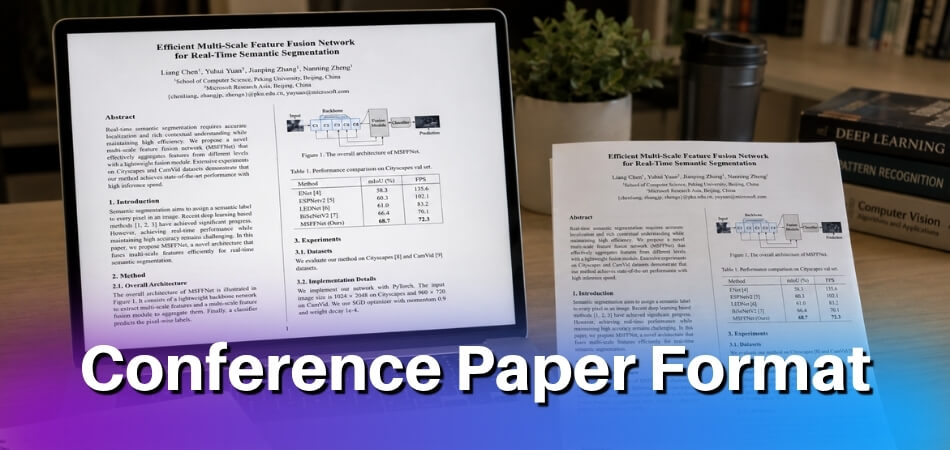
The practical point matters as much as the definition: a conference paper can put fresh work in front of an audience soon after the research is done, while a journal article often takes longer to reach print. That speed is a large part of the appeal.
The venue also shapes the paper. A systems conference expects implementation details and benchmarks. A theory-heavy venue wants proof sketches and formal definitions. Reading the proceedings from previous years of the same conference tells you more about expected style and depth than any generic formatting guide.
When you respond to a call for papers you are staking a claim: here is a problem, here is what we did, here is what it means. The contribution has to be identifiable in a few sentences, usually in the abstract. Reviewers read with a short list of questions in mind: is the contribution new, is the method sound, and does the work belong at this venue? Make those answers obvious, not buried.
Conference Paper vs. Journal Article: Key Differences
A conference paper is shorter, faster to publish and more focused than a journal article, and it is not simply a shortened journal article. The two are structured and reviewed differently, so knowing the differences helps you format correctly from the start.
| Feature | Conference paper | Journal article |
|---|---|---|
| Purpose | Work in progress or a recent study, presented to a live community for feedback | Finished, thoroughly validated research |
| Length | Strict page limit set by the venue (IEEE describes a full paper as 6 to 8 pages) | Usually much longer, with fewer layout limits |
| Layout | Rigid template, often two columns | Journal style guide, usually less strict on visual layout |
| Review | Usually one round inside a fixed window tied to the event date | Often several rounds with the same reviewers, sometimes over months |
| Claims | A finding, method or result that advances the conversation | Higher burden of proof and broader claims |
| Record | Proceedings, often indexed in databases such as IEEE Xplore, ACM Digital Library or Scopus depending on the event | Journal issue, with credit that evaluation systems usually weigh more heavily |
Maturity and Depth
A conference paper can present preliminary results or a proof of concept. A journal article is expected to have full experimental validation, extensive literature coverage and a complete discussion of limitations. A conference paper is also expected to make a narrower claim: it does not have to be the final word on a topic.
The Review Process Differs
Both formats are peer reviewed. Journal articles often go through repeated revision with the same reviewers. A conference paper is usually reviewed once, in a window tied to the conference schedule. A journal rejection can be revised and resubmitted continuously, while a conference has one deadline.
Review models differ. IEEE says most of its publications use single-anonymous review, where reviewers know the author’s identity, and ACM venues that review double-blind add an anonymous option to the template. Check the call for papers, because it affects how you handle affiliations, self-citations and acknowledgments in your draft.
Can You Publish Both?
Yes, but carefully. Many researchers present a conference paper and later expand it into a journal article with more experiments, deeper analysis and a broader scope. Journals that accept this want substantial new content, and some state a minimum share of new material, so check the journal’s policy. Some conferences also state that submitted work must not be under review elsewhere at the same time. Read those policies first, because a violation can mean rejection or removal from the proceedings.
Standard Conference Paper Structure
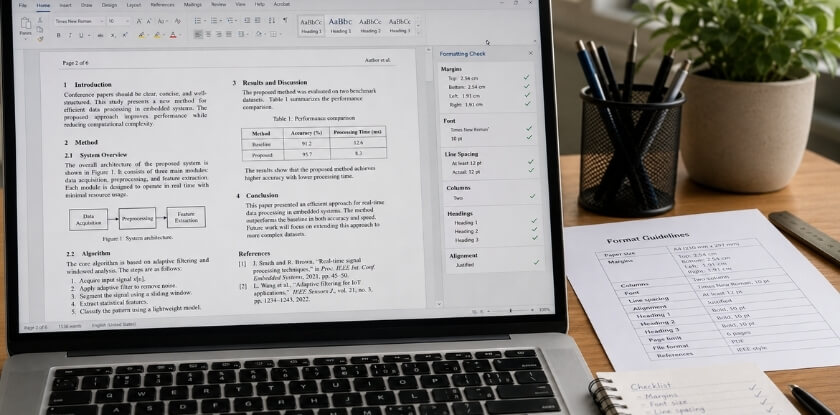
Most conference papers follow the same sequence: title and authors, abstract, introduction, literature review, methodology, results and discussion, conclusion, references. Reviewers read many submissions in a short window, and a paper that departs from the expected order makes their job harder.
| Section | What it must do | Common mistake |
|---|---|---|
| Title and authors | State the specific contribution; list names, departments, institutions, emails | Vague title such as “A Study on Network Performance” |
| Abstract | Summarise problem, approach and findings | Describing what the paper “will” do |
| Introduction | Why it matters, what exists, what you add | Burying the contribution |
| Literature review | Show where your work fits and what gap it fills | Padding with unneeded citations |
| Methodology | Let a peer reconstruct your approach | “Standard techniques were applied” |
| Results and discussion | Findings first, then meaning and limits | Overclaiming |
| Conclusion | Take-home message and useful future work | Replaying the abstract |
| References | Match the required citation style exactly | Mismatch between text and list |
Title and Author Information
Your title is the first thing a program committee member reads. It has to communicate the specific contribution without becoming a paragraph. “Improving Latency in Distributed Sensor Networks Using Adaptive Polling” tells a reviewer exactly what they are getting. “A Study on Network Performance” tells them nothing. IEEE’s guidance for conference papers asks for a title that is specific, concise and descriptive, and advises against filler words such as “new” or “novel”.
Author names, departments, institutions and institutional emails go directly beneath the title, especially in IEEE-style formats. Get these right before submission, because affiliation errors create problems when an accepted paper has to appear correctly in the proceedings. Under double-blind review you remove this block from the submitted manuscript, and some venues ask for the details in a separate form field instead.
Abstract
The abstract is a self-contained summary of the whole paper: the problem, what you did and what you found. IEEE’s guidance for conference papers asks for a single paragraph of up to 250 words that stands on its own, with no abbreviations, footnotes, references or equations, plus 3 to 5 keywords. Other venues set their own limits, and some enforce a strict count, so confirm it in the call for papers.
A structured abstract uses labelled parts such as Background, Methods, Results and Conclusion. An unstructured one covers the same ground in a single paragraph, which is the usual form at IEEE conferences. Either way the content requirements are the same, only the presentation differs. An abstract that says what the paper will do is weaker than one that says what it found: “This paper will investigate…” against “We measured… and found that…”.
Introduction
The introduction does three things: it establishes why the problem matters, explains what has already been tried, and states what your contribution adds. It usually ends with a short paragraph that maps the rest of the paper.
Keep it proportional. As a rule of thumb, in a six to eight page paper it runs about a page, because you are orienting a specialist who already knows the field. State the contribution explicitly, usually toward the end: “This paper proposes X and demonstrates Y through Z” gives the reviewer an anchor for everything that follows.
Literature Review
Not every conference paper has a separate literature review. Some fold it into the introduction, others give it a heading. Check the published proceedings of your target venue to see what is standard.
When it stands alone, its job is to show where your work fits, not to list everything ever written. What is established, where do current approaches fall short, and how does your work address that gap? Fifteen citations where five would make the point add length without showing the gap, so choose sources that directly shape your argument. In a fast-moving field, also check that your sources include recent work.
Methodology
This section explains what you did and why those choices suited the problem. Reproducibility is the standard: a reader in the same field should be able to reconstruct your approach. Cover the research design, data sources or experimental setup, tools, procedures, assumptions and constraints. If a choice could reasonably have gone another way, such as an algorithm, sample size or dataset, briefly explain the reasoning.
Vagueness here leaves reviewers unable to judge the work. Name the techniques, justify the choices and give enough detail to make the work credible.
Results and Discussion
Present findings first, then interpret them. Combining the two works well in shorter papers where results and implications are tightly linked.
Use figures and tables where they genuinely clarify the data. Label them, refer to them in the text and explain each one, because a graph the reader must decode alone adds friction. The discussion says what the results mean, whether they match your expectations and what their limits are. A moderate result explained honestly is more credible than an overclaimed one.
Conclusion
The conclusion is a brief synthesis of the take-home message, not a replay of the abstract. One paragraph is the usual expectation, sometimes two. Include future work only if it is informative: “Future work will explore broader datasets and real-world deployment” helps, a vague list of everything the paper did not do does not. Do not restate the methodology.
References
Your reference list must follow the citation format the call for papers specifies. IEEE conferences use numbered references in order of appearance; ACM venues have their own requirements; some conferences specify Chicago or APA. Wrong format is a small error that still signals carelessness.
Every source in the list must be cited in the text and the reverse. Reference managers such as Zotero or Mendeley handle this and remove most formatting errors before submission.
IEEE Conference Paper Format: Specific Requirements
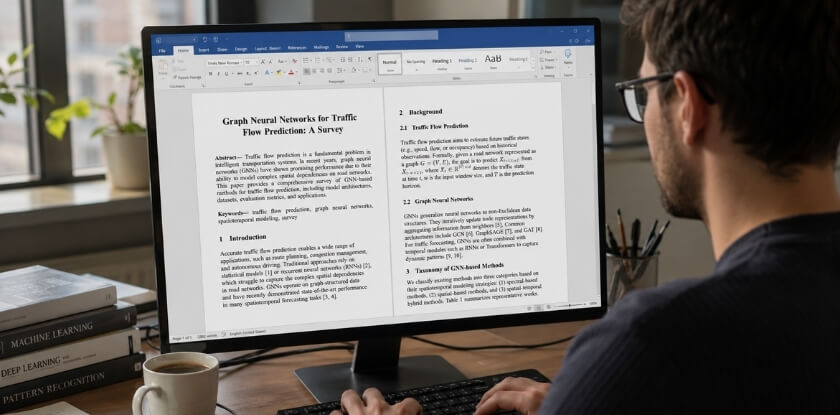
IEEE conference papers use a two-column layout in 10-point Times New Roman, built from IEEE’s official Word or LaTeX template. On US Letter paper the standard IEEE template sets margins of 0.75 in at the top, 1 in at the bottom and 0.625 in at the sides, with two 3.5 in columns and a 0.25 in gap. The title is 24 point, body text 10 point and the abstract 9 point. Individual conferences sometimes change these values, so the template linked from the call for papers always wins. IEEE publishes Word and LaTeX templates through the IEEE Author Center, and the safest approach is to start from one of them instead of copying the look by hand. The exact margins, column widths and spacing are set inside the template, so do not adjust them. Different template versions and A4 or US Letter paper change the numbers, so check any figure you read in a blog post against the template your conference gives you.
Layout and Typography
The title, author names and affiliations span the full page width as one block at the top. After that the two columns begin, and text flows from the bottom of the left column to the top of the right. The title is set larger than the body, centred across both columns. Section headings are small, bold or small-caps depending on the level.
Page Length
IEEE sets limits by paper type and tells authors to find the exact page limits and any extra-page fees on the conference website. Its guidance describes four types: an abstract of 250 words or less, an extended abstract of less than 2 pages, a short paper of less than 4 pages and a full paper of 6 to 8 pages. Work to the page limit rather than a word count, because figures, tables and equations change the count. Going over the limit can lead to desk rejection before review begins.
Abstract, Headings and Numbering
In an IEEE paper the abstract sits in a single block below the affiliations, before the two-column body. The word “Abstract” appears as a run-in label at the start of the paragraph instead of a separate heading.
Sections use Roman numerals (I. Introduction, II. Related Work, III. Methodology), subsections use capital letters (A, B, C) and sub-subsections use Arabic numerals. Level-one headings are centred in small caps, level-two headings are flush left in italics, and level-three headings run in at the start of a paragraph in italics.
First-Page Footnotes and Statements
IEEE’s guidance asks for a funding footnote on the first page when a funder supported the research, giving the funder’s name and grant information. Papers reporting research on human subjects or animals also carry a first-page statement, with one version for work approved by a review board and another for work exempt from review board approval. Use the wording IEEE provides and check the call for papers for anything the conference adds.
Citations, Figures and Equations
IEEE uses numbered citations in square brackets, [1], [2], [3], in the order they first appear, and the reference list follows the same numeric order, not alphabetical. The format differs for journal articles, conference proceedings and book chapters, so keep IEEE’s reference guide open while you build the list. Zotero and Mendeley include IEEE styles.
Figures and tables can span one column or both. A wide results graph or comparison table may need the full width. Figure captions go below the figure and table captions go above the table. Equations are numbered with Arabic numerals in parentheses, right-aligned, and the text refers to them by that number, as in “as shown in (1)”.
Templates and the PDF Check
There are separate IEEE templates for conference and journal papers, so make sure you use the conference version. IEEE offers its conference templates in both Word and LaTeX (the LaTeX version uses the IEEEtran class). Whichever you choose, apply the template’s own styles instead of formatting by hand, because manual changes can break the layout.
Not every conference uses IEEE PDF eXpress, an IEEE-financed tool that converts your file or checks it for IEEE Xplore compatibility. If your conference uses it, you receive an invitation email with a customised link. IEEE lists what it checks:
- The PDF is version 1.4 (Acrobat 5) or later, but not Acrobat 9, X or XI, and it is not a scan.
- All fonts are embedded or subset, so mathematics appears as intended and text is searchable.
- No password or other security settings, no bookmarks or links, and no PDF attachments.
- No crop marks, registration marks, date stamps or timestamps, and the file is not a PDF Package or merged PDF.
If your conference does not use PDF eXpress, you can still run IEEE’s PDF Checker. If a check fails you must fix and resubmit before the deadline, so build it into your timeline.
General Formatting Rules: Margins, Font, Length and Columns
The rules vary by conference, but the logic is the same: your manuscript has to fit cleanly into the proceedings template. Before you write a word, download the official template from the call for papers page and write inside it. Retrofitting formatting at the end wastes hours and introduces errors.
| Element | Typical expectation | Where to confirm |
|---|---|---|
| Body font | Set by the template: IEEE conference templates use 10 pt Times New Roman, and other publishers’ templates use their own fonts | Template file |
| Headings | Bold, in the same serif font or a sans-serif such as Arial or Helvetica | Template file |
| Captions | Smaller than body text, so check the template | Template file |
| Margins | Set by the template; do not shrink them to fit more | Template file |
| Columns | Two columns at most technical IEEE or ACM venues; single column at some workshops and humanities venues | Call for papers |
| Length | A page count, not a word count; IEEE full papers are 6 to 8 pages, other venues differ | Call for papers |
| Citation style | IEEE numbered, author-year, APA or Chicago, depending on the field | Template or call |
| MS International conferences | APA format; full papers normally 4 to 12 pages including tables, figures, references and appendices; use the template from the conference team | Author paper submission page |
Fonts and Margins
These rules are not suggestions: the proceedings publisher enforces them during manuscript submission, and papers that do not comply are returned or rejected. ACM’s guidance for its LaTeX template likewise does not allow changes to margins, type sizes or line spacing, or manual vertical spacing with commands such as \vspace. Never substitute another font because the template’s font looks flat. The uniformity is deliberate: proceedings are typeset in bulk and non-standard fonts break the layout. Do not shrink the margins to squeeze in extra content either. Reviewers notice, and some submission systems flag pages that exceed the allowed text area.
Columns
Technical conferences usually use two columns. Wide figures, tables and equations can span both columns, but use that sparingly, and in LaTeX use the starred figure or table environment. Never force a column break in the middle of a sentence. Some workshops and smaller venues use a single column, particularly when papers are distributed as standalone PDFs, and the call for papers says which applies.
Page Length
Limits depend on the venue and track, as the IEEE and MS International figures above show, and short papers or poster submissions are usually shorter. If you run over, cut content. Do not shrink fonts or tighten line spacing, since exceeding the limit can lead to desk rejection.
References and Citation Style
Apply the required style consistently from the first draft, because mixing styles inside one manuscript is a red flag. With LaTeX, the template’s .bst file formats citations for you, and many technical venues provide a LaTeX template. In Word you format references by hand or use a reference manager that supports the right output style.
The Peer-Review Process and What Reviewers Look For
Conference papers are usually peer reviewed before acceptance, and IEEE requires peer review for the conference papers it publishes. Knowing what they evaluate helps you make deliberate choices about structure, depth and framing.
How Conference Peer Review Works
In IEEE’s description, a Technical Program Committee appointed by the Technical Program Chair reviews the submissions within a fixed window, and the chair is ultimately responsible for every accepted paper. The most common models are single-anonymous review, where reviewers know who you are, and double-anonymous review, where neither side knows the other. Where review is double-blind, you must anonymize the manuscript: remove your name, affiliations and self-identifying references. Citations to your own earlier work can reveal you too, so follow the call for papers on how to cite them.
Confirm the model before finalizing the draft. Submitting an anonymized draft to a single-blind conference is a minor issue. Submitting an identified paper to a double-blind conference can get it desk-rejected without review. Look in the submission guidelines, not the general conference website, since the specific rules are usually in the FAQ or formatting instructions linked from the call.
Reviewers score the paper against the conference’s criteria and the program chairs decide. Selective venues accept only a minority of submissions, so even solid work can be rejected. IEEE lists three possible decisions (accept, accept with revision and reject) and notes that many conferences skip the revision option because the review period is short. Any reviewer comments you receive are useful for revising before your next submission.
What Reviewers Actually Evaluate
Reviewers read against the call for papers, so the first check is whether the work fits the scope. A technically strong paper that does not match the venue’s themes can be rejected quickly. IEEE’s guidance lists what reviewers look for: scope, novelty, validity, data, clarity, compliance with ethical and publication requirements, and advancement of the field. In practice the questions are concrete:
- Is the contribution clear? If a reviewer finishes your abstract and cannot say what is new, that is a problem. State it explicitly.
- Does the work engage with existing literature? A thin review suggests you have not established the gap. You do not need an exhaustive survey, but you must show you know the relevant prior work and explain how yours differs.
- Is the methodology sound? Reviewers check that the methods fit the question, that they are described in enough detail to evaluate, and that the conclusions follow. IEEE’s guidance also says to avoid exaggerating the importance of results.
- Is it readable and well structured? Reviewers have limited time. Unclear organization, undefined jargon or figures that do not connect to the text lower scores. Following the formatting requirements signals that you read the guidelines.
- Does the abstract hold up? It is often the first part a reviewer reads. It should state the problem, approach and main finding, in that order.
What Reviewers Are Not Looking For
Reviewers do not expect perfection. A paper needs to make a meaningful, defensible step forward, and incremental contributions that are clearly framed and honestly scoped get accepted at good venues.
Overselling hurts a paper: calling a narrow evaluation “state-of-the-art” or presenting a preliminary finding as a definitive conclusion. Precise, honest language about what you showed and what remains open is better received.
From our experience at MS International: authors should follow the official paper format or template provided by the conference team. Review is double-blind and typically takes about 10 working days after submission, and the decision (acceptance, revision request or rejection) is sent by email. Work must not be published or under review elsewhere. After acceptance, authors complete the official author registration, and accepted papers may be considered for conference proceedings where applicable. Always confirm current details on the conference page.
Choosing the Right Conference Venue
Pick a venue by scope, standing and timetable, not by topic alone. Submitting to the wrong venue can waste months of work.
Match the Scope, Not Just the Topic
Conferences differ in scope even within one field. A paper on machine learning for medical imaging might fit a general AI conference, a biomedical engineering conference or a medical informatics venue, and each has a different audience, formatting expectations and acceptance rate. Read the tracks or themes in the call for papers, not just the conference name. If your work does not fit at least one stated track, reviewers will notice before they reach your methodology.
Tier and Prestige Matter for Your Career
Conferences vary in how they are regarded, and the ranking differs by discipline. Ask your supervisor or colleagues which venues carry weight in your field.
- Know the acceptance rate. A venue that accepts a small share of submissions is genuinely selective. A high acceptance rate may still be legitimate, but it says less about selectivity.
- Check where the proceedings are indexed. Papers in IEEE Xplore or the ACM Digital Library are indexed and citable in a way many smaller venues are not. If the paper must count toward research metrics, verify where the proceedings end up before you submit.
- Look at past programs. Who presented last year tells you more than marketing copy. Researchers from institutions you respect are a useful signal.
Timing and Submission Deadlines
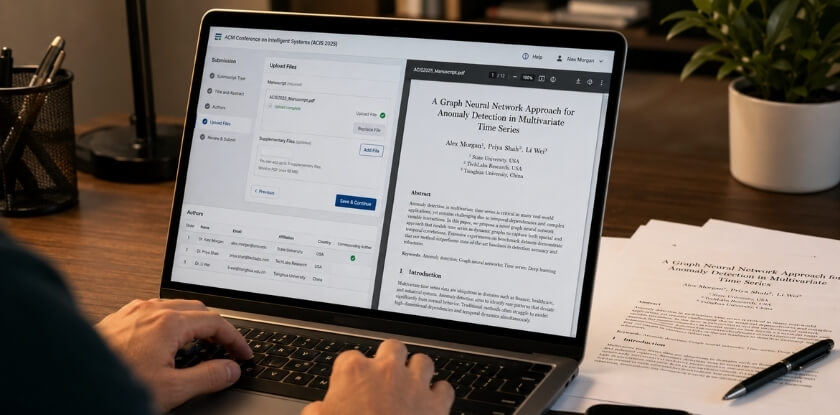
Conference timelines are fixed. Missing the submission deadline by a day often means waiting for the next cycle, which can be a year away. Work backward from the event date: paper deadline, review period, notification, then a camera-ready deadline for the final formatted version, which can fall only a few weeks after notification. Do not assume you can overhaul the paper after you hear back.
Abstract registration deadlines are easy to miss. Some conferences ask you to register the abstract before the full paper is due, and the portal may not accept a paper that skipped that step.
Predatory Conferences
Predatory conferences tend to accept almost anything, charge steep registration fees and produce proceedings that are not indexed anywhere reputable. Early-career researchers under pressure to publish can be easy targets.
Warning signs include a vague or very broad scope, flattering unsolicited emails, no clear information about peer review, and a location or committee that does not hold up to basic checks. If you cannot find papers from the conference cited in legitimate journals, take that seriously. A predatory venue does not just fail to help: it can damage how hiring committees and grant reviewers see your work.
Frequently Asked Questions (FAQ)
Formatting a conference paper is partly about structure and partly about venue rules: full paper, short paper or extended abstract, author affiliations, citation format and the weight the abstract carries.
Do conference papers get peer reviewed?
Usually, but not always. IEEE requires peer review for the conference papers it publishes, and many other conferences review full papers too. Some accept abstracts or workshop talks with only a light check, so read the call for papers or the proceedings front matter.
How long should a conference paper be?
It depends on the venue, and the call for papers states the limit. IEEE describes a full paper as 6 to 8 pages, and MS International full papers normally run four to twelve pages including everything. Exceeding the limit can mean desk rejection.
What is the difference between a conference paper and a journal article?
A conference paper is shorter, written to a tighter deadline and published in proceedings. A journal article usually goes through more revision rounds and covers the literature and discussion in more depth. Both are peer reviewed, but the expected depth and burden of proof differ.
Can I use a conference paper as the basis for a journal submission later?
Yes, it is common practice when the journal version adds substantial new work, such as more experiments or deeper analysis. Check the target journal’s policy before you submit.
What is the difference between a full paper, a short paper and an extended abstract?
A full paper is the complete write-up, a short paper and an extended abstract are shorter summaries, and an abstract is a brief synopsis. Exact lengths are set by each conference, so follow the call for papers.
What citation format should I use?
Whatever the call for papers specifies. IEEE conferences use numbered references in brackets, other fields use APA, ACM or Chicago. If the guidelines are silent, look at papers from previous years of the same conference.
Do I need author affiliations on the paper?
Yes, in most cases. Your institution, department and email appear under the author names on the title page. For double-blind review you submit a version with them removed, but the final published version includes them.
Does formatting really affect acceptance?
Not directly for scientific merit, but reviewers notice a wrong layout, a wrong font or a blown page limit. Sloppy formatting suggests the authors skipped the guidelines, and that impression can colour how the rest of the paper is read.
What is a realistic acceptance rate for conferences?
It varies widely. Selective venues accept only a minority of submissions, while others accept most. Check the conference website for past years’ statistics before you submit to judge how competitive it is.
How important is the abstract for acceptance?
Very. It is often the first part a reviewer reads, so it has to state the problem, approach and main finding. A vague problem statement, no clear contribution and no hint of results puts the rest of the paper at a disadvantage.
What if I miss the manuscript submission deadline?
Many conferences do not accept late submissions. A few allow a short grace period for minor technical problems, but you would have to contact the program chairs directly. Do not count on it.
Conclusion
Format rules exist for practical reasons: proceedings must be typeset consistently, and reviewers need to find your contribution quickly. Start with the call for papers and the official template, follow the page limit and citation style exactly, and your contribution gets the attention instead of the formatting. The research is the hard part, and the formatting should not be.