
A wrong title or a mispronounced name can chill a room in seconds, and a little preparation prevents it. The same habits help on stage, in the hallway and in an email before the event.
Quick answer: To address people in a conference, greet the whole room with inclusive words such as “everyone” or “colleagues”, and address individuals by the title and name they use themselves, such as Dr. [Surname] or Professor [Surname]. Confirm names, titles and pronunciation before the event, mention senior guests first, keep the opening short, and include online attendees.
Last verified against official sources: October 2026.
The Right Way to Address People at a Conference
Start with a professional greeting, recognize key guests respectfully, use accurate titles and names, and speak inclusively to the whole audience. How formal you sound depends on the event, the audience and the role of each person you mention.
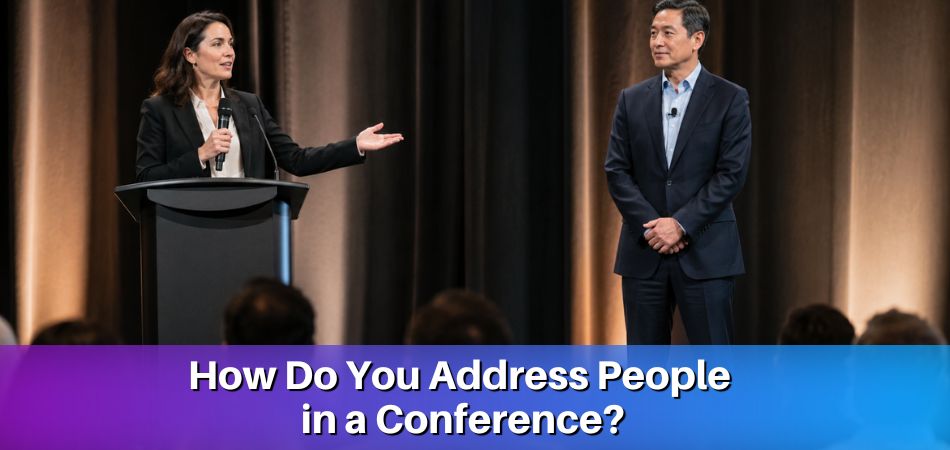
A strong conference address has four parts:
- Greeting: a suitable phrase such as “Good morning” or “Welcome, everyone.”
- Recognition: VIPs, speakers, sponsors, organizers or participants, when relevant.
- Purpose: the conference theme or the reason for gathering, in one sentence.
- Transition: a smooth move to the first speaker, session or activity.
Put together, it can sound like this:
“Good morning, everyone, and welcome to [Conference Name]. We are glad to have our speakers, guests, partners and participants with us. This conference focuses on [Theme], and we expect a productive exchange of ideas. To begin, please welcome [Speaker Name], [Title/Role].”
This format is clear, respectful and easy to adapt. It avoids three common problems: reading a long list of names, sounding too casual, and skipping an important acknowledgment.
What to Consider Before Addressing a Conference Audience
Before you speak, think about the event type, formality level, audience roles and cultural expectations. These four details decide how formal, warm, brief or structured your address should be.
A conference audience may include executives, researchers, students, government officials, sponsors, presenters, media, delegates and remote participants. Your address should recognize this mix without becoming too long.
Event Type and Formality Level
The event type is the first clue for choosing a tone. A government summit, academic symposium, medical congress or diplomatic forum usually calls for formal wording. A startup meetup, marketing workshop or networking event can sound more conversational.
| Level | Sample wording |
| Formal | “Distinguished guests, respected speakers and honored delegates, welcome to [Event Name].” |
| Neutral professional | “Thank you all for joining us for [Event Name].” |
| Casual but professional | “Hello everyone, and welcome. It is good to see you all here.” |
The goal is to sound right for the room. A very casual greeting can feel careless at a formal event, while an overly ceremonial one can feel stiff at a relaxed industry meetup.
Audience Roles and Expectations
People attend for different reasons. Speakers share knowledge, attendees learn and connect, sponsors support the event, moderators guide the discussion, and VIPs may represent leadership or institutions. You can greet several groups in one sentence and still recognize each of them:
“We welcome our speakers, panelists, sponsors, partners, organizing team and every participant in the room.”
When you address one person, use their confirmed name and title. For the wider audience, pick an inclusive term that fits the event: “everyone”, “participants”, “delegates”, “colleagues”, “guests”, “attendees” or “members of the audience”. “Delegates” suits formal or international settings, while “participants” fits workshops and interactive sessions.
Cultural Backgrounds, Titles, and Name Preferences
International conferences bring together people from different countries, institutions and industries, and in many settings a title such as Dr., Professor, Honourable, Ambassador, Dean, Chairperson or Director carries real weight. Before the event, check the official program, the speaker list and any protocol notes, and confirm:
- full names and their spelling
- professional titles and organization names
- pronunciation
- order of acknowledgment
- preferred form of address
If you are unsure, ask privately: “How would you prefer to be introduced during the session?” That is better than guessing, especially when names, titles or naming conventions are unfamiliar to you.
How to Open a Conference Address Professionally
A professional opening should welcome the audience, recognize important people, state the event purpose and lead into the program. It does not need to be long. It needs to be confident, clear and suited to the event.

Formal Opening Lines
Formal openings work best for academic, institutional, government, diplomatic and other high-level events, where hierarchy and titles matter.
“Respected chair, distinguished guests, esteemed colleagues and participants, it is a pleasure to open [Conference Name]. We are grateful for your presence.”
“Honourable guests, keynote speakers, delegates and members of the organizing committee, thank you for joining this important gathering.”
Speak slowly when you mention names and titles, so each person hears their own correctly.
Neutral and Friendly Opening Lines
Neutral openings suit business conferences, seminars, workshops and association meetings.
“Hello everyone, and thank you for coming. Today brings together professionals and participants to discuss [Topic].”
“Welcome to [Conference Name]. We look forward to useful sessions, thoughtful discussion and new connections.”
This tone is professional without sounding stiff.
What to Avoid in the Opening
- listing many names without a purpose
- skipping confirmed titles
- joking before you have read the room
- speaking too quickly or using slang in a formal setting
- apologizing repeatedly for minor delays
A good opening sounds prepared but natural. Write the main points, practice aloud and mark the names clearly in your notes. In a hybrid event you speak to the room and also guide online people through the chat and Q&A tools, so remote attendees belong in the opening too; the virtual and hybrid section below shows how.
How to Address Different People at a Conference
Address people according to their role, seniority, contribution and relationship to the event. A VIP, keynote speaker, sponsor, panelist and attendee should not all be addressed in exactly the same way.
VIPs and Distinguished Guests
Use the official title, full name and role or organization, and mention the most senior guest first when protocol requires it. A simple pattern works: title, full name, role, short welcome.
“We are honored to welcome Dr. [Full Name], [Position/Organization].”
“Please join me in welcoming our distinguished guest, the Honourable [Full Name], [Official Position].”
Do not over-explain their achievements unless the event asks for a detailed introduction. A short, accurate acknowledgment is usually stronger.
Keynote Speakers and Presenters
Introduce a speaker by saying who they are, what they will discuss and why the session matters. A session chair is introduced the same way, but with the session they will lead instead of a talk.
“Our next speaker is Dr. [Full Name], [Position] at [Organization]. Dr. [Last Name] will speak on [Topic], with a focus on [Key Point]. This session matters because [Brief Reason]. Please join me in welcoming Dr. [Last Name].”
For a less formal event: “Next up is [Name], who will share practical insights on [Topic]. Please give [Name] a warm welcome.”
Avoid reading a full biography unless necessary. The audience needs the most relevant details, not every career milestone.
Panelists and Moderators
A panel introduction names the topic, the panelists, the moderator and the discussion format. Use the same form of address for every panelist: if one doctorate holder is introduced as Dr. [Surname], introduce the others the same way, and keep that form through the discussion.
“We now begin our panel on [Topic]. With us are [Panelist Name], [Role/Organization]; [Panelist Name], [Role/Organization]; and [Panelist Name], [Role/Organization]. [Moderator Name], [Role], will moderate.”
If you are the moderator: “I’m [Your Name], and I will moderate today’s discussion. Each panelist will give brief comments first, then we move to audience questions.”
During the panel, address speakers by name so the conversation stays organized:
“[Name], let’s begin with your view.”
“Thank you, [Name]. I’d like to bring [Next Name] into the discussion.”
The Chair at a Formal Meeting
In formal committee-style meetings, speakers address the Chair rather than the room. United Nations guidance on forms of address for its meetings says to use the Chair’s title as given in the conference documents, such as “Mr. Chairman” or “Madam Chair” in large committees, and to open by thanking the Chair for the floor. Other delegations are referred to in the third person; in the most formal settings that becomes “the Distinguished Representative of [country]”. Most academic and industry conferences are less formal, so follow the program or the organizer’s instructions.
Attendees, Delegates, and Participants
Use broad, inclusive words for the general audience, and match the word to the setting:
- Delegates for formal, academic, government or international conferences.
- Participants for workshops and interactive sessions.
- Colleagues when the audience shares a profession or field.
- Everyone for a simple, inclusive tone.
When you invite audience participation, give clear instructions, such as “Please state your name and organization before asking your question” and “Please keep your question brief so we can include more people.”
Sponsors, Exhibitors, and Partners
Thank sponsors and exhibitors with gratitude and professionalism, and keep the recognition tied to the event rather than promotional.
“This event is made possible with the support of our partners, including [Sponsor Names].”
“Please welcome [Name], [Title] at [Company], who will give brief remarks on behalf of our sponsor.”
“Participants are welcome to visit the exhibitor area during the break.”
Sponsors deserve recognition, but the program should still serve the audience first.
Correct Order for Acknowledging Guests and VIPs
The right order depends on the event type, seniority, host organization and protocol. As a general rule, mention the highest-ranking or most formally recognized person first, then speakers, hosts, sponsors, organizers and participants.

| Order | Corporate | Academic | Government, NGO or diplomatic |
| 1 | CEO, president, chairperson or chief guest | Chancellor, vice-chancellor, president or rector | Minister, ambassador, elected official or chief guest |
| 2 | Senior leaders of the host company | Dean, department chair or senior academic leader | Senior government or institutional representatives |
| 3 | Guest executives or partner representatives | Conference chair or organizing committee lead | Heads of NGOs, agencies or partner organizations |
| 4 | Keynote speakers and invited experts | Keynote speakers and distinguished professors | Donors, sponsors and development partners |
| 5 | Sponsors, clients and strategic partners | Researchers, faculty members and presenters | Experts, speakers and panelists |
| 6 | Employees, attendees and support teams | Students, delegates and participants | Delegates, participants and community representatives |
Treat these as safe defaults, not rules. For official events, confirm the exact order with the organizer or protocol team and do not guess. In Canada, the federal government publishes a Table of Precedence that ranks 30 categories of officials (the page shows a revision date of July 2015), and it is a separate document from the forms of address.
When to Mention VIPs
Acknowledge VIPs at major points, not before every session: the opening remarks, keynote introductions, award or recognition moments, the closing remarks, and sessions where their role is directly relevant. Avoid repeating the same long list through the day. A shorter later mention works:
“Once again, thank you to our distinguished guests for their continued support.”
Ready-to-Use Conference Address Templates
Use templates as flexible scripts, not word-for-word lines that must sound identical every time.
Formal Conference Welcome Template
“Good morning, distinguished guests, respected speakers and honored delegates. On behalf of [Organization Name], I welcome you to [Conference Name].
This conference brings together professionals, leaders and researchers to discuss [Main Theme]. I would like to extend a special welcome to [Title + Name], [Title + Name] and all invited speakers. We also thank our organizing team, partners and sponsors for their support.
To begin, please welcome [First Speaker Name], [Title/Role], who will open the first session on [Topic].”
Standard Conference Greeting Template
“Welcome, everyone, to [Conference Name]. Our goal today is to support practical learning and useful discussion around [Theme].
Thank you to everyone who helped organize the program, and to all of you for being here. We will start with [Session/Speaker Name], followed by [Brief Program Note].”
Casual Conference Welcome Template
“Hello and welcome to [Conference Name]. This event is about [Theme], and we hope you leave with useful ideas and new contacts.
Thank you to our speakers, partners and organizers. Let’s get started with [Speaker Name], who will talk about [Topic].”
Panel and Sponsor Templates
For a panel, adapt the moderator lines in the section above and add one sentence on what the session will explore: “This session looks at [Key Issue] from different professional perspectives.” For a sponsor, keep it brief:
“We thank [Sponsor/Company Name] for supporting [Conference Name]. Their contribution helped make today’s program possible.”
Useful Phrases for Common Conference Moments
Prepared phrases help you run the event smoothly without sounding uncertain.
| Moment | Useful phrase |
| Starting the event | “Good morning, everyone. Thank you for joining us for [Conference Name].” |
| Delayed start | “Thank you for your patience. We’re ready to begin.” |
| Introducing a speaker | “Please join me in welcoming [Name], who will speak on [Topic].” |
| Moving sessions | “We’ll now move to our next session.” |
| Announcing a break | “We’ll pause here and resume at [Time].” |
| Returning from break | “Welcome back, everyone. We continue with [Session Name].” |
| Thanking sponsors | “We thank our sponsors and partners for helping make this event possible.” |
| Closing | “Thank you to our speakers, guests, organizers and all participants for your contribution.” |
Moving Between Sessions
Keep transitions short and clear.
“Thank you, [Speaker Name], for that session. Next, we continue with our following presentation.”
“Building on that discussion, the next session focuses on [Topic].”
Announcing and Returning From Breaks
Always include the return time. For online participants, say how to rejoin:
“We are taking a short break. Please be back by [Time] for the next session.”
“For those joining online, the session resumes at [Time]. Please stay connected or rejoin before the next segment begins.”
Closing the Conference
A closing should thank people and signal that the program is complete.
“As we conclude today’s conference, thank you to our speakers, guests, sponsors, organizers and all participants. The sessions gave us useful ideas and good discussion around [Theme]. We appreciate your time, and we wish you a safe trip home.”
For virtual or hybrid events: “Thank you to everyone who joined us online and in person. We hope the sessions were valuable.”
How to Address the Audience During Q&A
During Q&A, address the audience with clear rules, short prompts and polite control phrases. This keeps the session focused, fair and useful.

Setting Q&A Rules Clearly
Explain the process before taking questions. Good instructions cover time, question length, microphone use and online participation.
“We’ll now move into Q&A. Please keep questions brief, introduce yourself before speaking, and wait for the microphone so everyone can hear.”
For formal events: “We will now open the floor. Kindly state your name and affiliation before asking your question.”
Inviting the First Question
Use a warm, direct prompt. If nobody responds, start with a question of your own.
“Who would like to begin? Please raise your hand, and we will bring the microphone to you.”
“While you gather your thoughts, I’ll start with a question that connects to your main point.”
Repeating or Clarifying Questions
Repeat or summarize a question when the room is large, the event is recorded or people are joining online. It helps the speaker answer clearly and keeps everyone aligned.
“For everyone in the room and online, the question is about [Brief Summary].”
“Let me repeat that question so everyone can follow.”
“If I understood correctly, you’re asking about [Brief Restatement]. Is that right?”
Handling Long or Off-Topic Questions
Moderators need to protect the schedule while staying respectful.
Long question: “Thank you for that context. Could you bring it to one clear question?”
Off-topic: “That is an interesting issue, but it falls outside this session. We can discuss it after the program.”
Repeated theme: “Several questions touch on the same theme, so I’ll combine them.”
Tense question: “Thank you for raising that. Let’s keep the discussion constructive and focused on the issue.”
Closing the Q&A
End the Q&A clearly and point people to the next step.
“We have time for one final question.”
“That brings us to the end of Q&A. For questions we couldn’t reach, please connect with the speaker during the break.”
For hybrid events: “Thank you to everyone who sent in questions online and in the room.”
How to Handle Unexpected Conference Situations
Handle unexpected moments with calm language, clear direction and minimal explanation. The goal is to reassure the audience and move forward.
Technical Problems
Use short, steady lines.
“We’re dealing with a brief technical issue. Thank you for your patience while the team fixes it.”
“While the slides are being adjusted, I’ll continue with the main point.”
Online: “There may be a connection delay. Please stay with us while we resolve it.”
If the delay continues: “While we wait, please note any questions for the discussion segment.”
Late Arrivals or Schedule Delays
Do not blame anyone from the stage. For a late VIP, welcome them without comment on the delay.
“We are pleased to welcome [Title + Name], who has just joined us.”
“We’ll adjust the session slightly to stay as close to the schedule as possible.”
Side Conversations or Interruptions
Address distractions politely but firmly.
“May I have everyone’s attention as we continue?”
“Please keep side conversations for the break so everyone can follow the discussion.”
If someone interrupts: “We’ll come back to audience comments shortly. For now, let’s allow the speaker to finish.”
Time Overruns
Use clear time-control phrases, since good timing shows respect for the whole program.
“To stay on schedule, we’ll go directly to the next segment.”
“Thank you, [Name]. I’ll ask you to conclude your point briefly.”
“We’re running slightly behind, so we’ll take one final question.”
Tense Exchanges
If a discussion becomes heated, acknowledge the issue without letting the moment take over.
“This is clearly an important topic. Let’s keep the discussion respectful and focused.”
“We may not resolve this fully here, but it can be continued after the program.”
A good moderator allows meaningful disagreement while keeping the conversation from becoming personal or disruptive.
How to Use Inclusive and Respectful Language
Inclusive language helps people feel recognized, respected and able to participate. It avoids assumptions about gender, background, language ability, seniority or access needs.
Choosing Inclusive Group Greetings
“Ladies and gentlemen” may still fit some formal settings, but broader greetings are often better. Good alternatives include:
- “Good morning, everyone.”
- “Welcome, colleagues and guests.”
- “Distinguished guests and valued participants.”
- “Thank you to all attendees joining us today.”
Using Professional Titles Correctly
If the official program uses a title, use it during formal recognition or introduction. The table below shows common forms. The Canadian forms follow the Government of Canada’s styles-of-address guidance, which lists spoken and written forms separately. Spoken forms are often shorter, and informal forms such as “Mr. Prime Minister” are common in speech but are not official. Conventions differ by country, institution and field, so treat the table as a starting point.
| Person | Form to use | Note |
| Holder of a doctorate (medical, Ph.D., LL.D., D.Sc.) | Dr. [Surname], or “Doctor” | In writing: “Dear Dr. [Surname]:”. Canadian guidance treats these degrees the same way |
| Professor | Professor [Surname] | Use the form printed in the program if a person is both Dr. and Professor |
| Canadian federal or provincial official | The Honourable [Name] | Canada uses “Honourable” and “Right Honourable”; some holders keep the title for life, others only while in office. Ontario guidance allows “The Hon.” in a platform introduction |
| Foreign ambassador in Canada | Your Excellency, or Excellency | Canadians address a Canadian ambassador as “Ambassador” or “High Commissioner” |
| Someone whose title you do not know | Full name and role | Ask privately, and do not guess |
When in doubt, ask: “How would you like to be introduced?” A sample introduction with a title: “Please welcome Professor [Name], [Role] at [Institution].” The same advice covers a speaker who holds both titles: use the form printed in the program, and ask the speaker if the program is silent. When doctors introduce themselves at a medical conference, some use the title Dr. with their name and others simply state their role.
Names, Pronouns, Emails, and Badges
Use the name a person gives you, spelled as they spell it. Do not shorten it or change it to something easier to say, and do not guess gender from a name. In writing, open with “Dear Dr. [Surname]” or “Dear Professor [Surname]” until the person signs off with a first name, then follow their lead. If a registration form or badge has a pronoun field, use what the person chose, and use “they” or avoid pronouns altogether when you do not know. An email signature or badge also tells you how someone presents their own name and title. Government of Canada guidance notes that some people prefer “Mx.” or no title, and that pronouns should be confirmed with the person concerned. In a letter or email where you cannot find the right title, it suggests leaving out the courtesy title and using initials, for example “Dear P. T. Smith”.
Preparing Name Pronunciations
Correct pronunciation shows respect. Before the event:
- Review speaker, VIP and panelist names.
- Mark difficult names phonetically.
- Ask the person or organizer for guidance.
- Practice the names aloud and keep a pronunciation note with your script.
If you are unsure on stage, say: “Please correct me if I mispronounce your name. I want to say it correctly.” If you make a mistake, correct it briefly and continue: “My apologies, [Correct Name].”
Making Your Address Accessible
Accessibility means making the event easier to follow for more people:
- speak at a steady pace and use the microphone
- repeat audience questions
- read key slide points aloud and avoid speaking while facing away
- explain acronyms the first time you use them
- give clear break and Q&A instructions
- use captions or transcripts when available
Respecting Cultural Differences
International audiences may have different expectations about titles, hierarchy, humor and formality. To avoid mistakes:
- check protocol before speaking and use official titles when appropriate
- avoid jokes about sensitive subjects
- keep language clear for non-native English speakers
- avoid idioms that may not translate well
Instead of “Let’s hit the ground running,” say “Let’s begin with our first session.” Clear language works better for a global audience.
How to Address People in Virtual and Hybrid Conferences
Include online and in-person participants equally. Remote attendees should feel like active participants, not observers, so mention them early, repeat questions for them and invite them to contribute.
Welcoming Both Audiences
“Welcome to everyone in the venue and everyone participating online.”
“Thank you to all attendees joining from different locations today.”
Virtual-only: “Welcome to everyone joining online. Please use the Q&A feature to submit your questions.”
A small change in wording helps. Instead of “everyone in this room,” say “everyone joining us today,” and avoid addressing only the room unless you also mention online participants.
Recognizing Remote Speakers and VIPs
Remote guests deserve the same respect as in-person guests.
“We are pleased to welcome Dr. [Name], who joins us online for this session.”
“A warm welcome to [Title + Name], joining us virtually from [Location].”
“[Name], we can see and hear you clearly. The floor is yours.”
Allow a short pause, because virtual speakers may need time to unmute.
Managing Chat and Virtual Hand Raises
Explain how online participants can contribute.
“If you’re joining remotely and would like to speak, please use the raise-hand feature.”
“Our team will monitor the chat and bring online questions into the session.”
For balanced Q&A: “We’ll take one question from the room, then one from the online audience.”
Repeating Questions for Both Audiences
Repeat questions so everyone can follow: “For those online, the question from the room is about [Brief Summary].” This also supports captioners, interpreters and recordings.
Common Mistakes When Addressing People at a Conference
The usual mistakes are wrong names, incorrect titles, long openings, jargon, poor timing and ignoring remote participants.
- Wrong name or title: confirm spelling, pronunciation, title and organization beforehand, and correct yourself quickly if you slip.
- Naming too many people: mention key people individually and the rest as a group, unless protocol requires the full list.
- Sounding too scripted: practice aloud, mark pauses and look up between key lines.
- Jargon: explain acronyms briefly, for example “ESG, which refers to environmental, social and governance factors.”
- Losing control of Q&A or timing: use polite limits, as in the Q&A section above.
Quick Checklist Before You Address a Conference
- Confirm VIP names, titles and pronunciation, and the order of acknowledgment.
- Prepare formal, neutral or casual opening lines to match the room.
- Write short transitions between sessions, and prepare Q&A instructions and closing lines.
- Confirm microphone, captions and accessibility support.
- Keep a printed or digital backup of your script.
From our experience at MS International: Our conferences are in-person events in the Greater Toronto Area. Presenters meet the session coordinator or moderator before their presentation, and the moderator introduces them. The speaker confirmation and the final conference programme are the official sources for your schedule.
FAQs About Addressing People in a Conference
Addressing a room or a single guest gets tricky with ladies and gentlemen, unknown titles, first versus last names, ambassadors, a doctor who is also a professor, and pronouns.
Should I Say “Ladies and Gentlemen” at a Conference?
Only in traditional or highly formal settings; more inclusive options usually work better. Phrases like “everyone,” “distinguished guests,” “valued participants” or “colleagues” sound professional and include the full audience.
How Do I Address Someone If I Don’t Know Their Title?
Use their full name and role, or ask privately before the session: “How would you prefer to be introduced?” Avoid guessing a title such as Dr., Professor or Honourable, because a wrong guess is worse than leaving it out.
Should I Use First Names or Last Names?
Use titles and last names at formal, academic, government or international conferences. First names suit casual or internal events, or when the person has shown that preference. Conventions vary by country and field, so begin formally and adjust if invited.
How Do I Address a Foreign Ambassador or an Official?
A foreign ambassador in Canada is addressed as “Your Excellency” or “Excellency”. Canadians address their own ambassador as “Ambassador”, and federal and provincial officials are usually “The Honourable [Name]”. Confirm the exact style with the organizer’s protocol team.
How Do I Introduce a Speaker Without Reading the Full Bio?
Give their name, role, organization, topic and relevance to the audience in a few sentences, then invite the applause: “Our next speaker is [Name], [Role] at [Organization], who will speak on [Topic].”
What If I Mispronounce Someone’s Name?
Correct it quickly and respectfully: “My apologies, [Correct Name],” then continue the program. Do not make a joke or over-apologize, because that makes the moment more uncomfortable.
What If a Speaker Is Both a Doctor and a Professor?
Use the form printed in the official program. If the program does not say, ask the speaker privately, and keep the same form through the introduction, Q&A and panel.
Should I Ask People for Their Pronouns?
Do not ask the whole room to state pronouns. Use the pronouns shown on a badge or registration form, ask privately when you need to know, and use “they” or avoid pronouns when you do not know.
Final Takeaway: Address People With Respect, Clarity, and Confidence
Greet the whole audience inclusively, use each person’s confirmed title and name, acknowledge senior guests in the right order, and keep every opening short. Check titles and pronunciation before the event rather than on stage. For formal conferences use titles and full names, for business events keep the language polished but natural, and in hybrid events include online attendees from the first sentence.