
An opening speech is the first formal words of a conference, usually spoken by the chair, an organiser, a host or a chief guest. It frames the event, so it needs more than a greeting.
Quick answer: A good conference opening speech welcomes the audience, states the purpose or theme, outlines the agenda, sets the tone and hands over to the first speaker. Length depends on the event: roughly 2 to 3 minutes for a workshop, 3 to 5 for a business conference and 5 to 10 for a large academic or international one. Below are samples for seven situations, a fill-in template and delivery tips.
Conference Opening Speech Example: General and Ready to Use
This general speech suits a wide range of events: welcome, purpose, thanks, agenda, tone, hand-off. Swap in your event name, theme and speaker names and it holds up without structural changes, whether you are opening a professional development day, a regional industry meetup or a multi-day symposium.
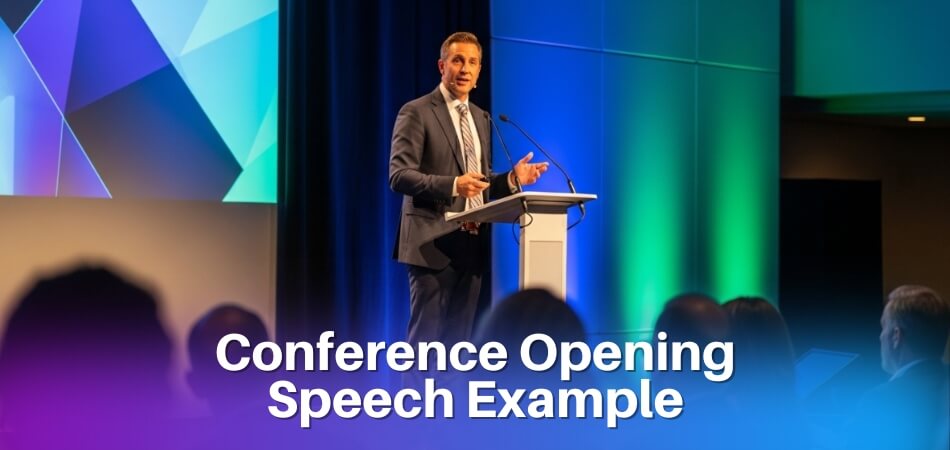
Full Example Speech (Annotated Fill-in-the-Blank Version)
Read through the complete speech first, then use the bracketed placeholders to customize it.
Good morning, everyone. Welcome to [Conference Name].
Thank you for being here. If you travelled across the country or logged in from your desk, being in this room, or on this call, says something about how seriously you take [conference theme or industry topic].
My name is [Your Name], and I will be your host for [today / the next two days / this morning’s session].
We are here because [one or two sentences describing the shared challenge, opportunity, or question the conference addresses, e.g., “the industry is at an inflection point and the decisions we make in the next twelve months will shape the next decade”]. That is not an abstract idea. The speakers you will hear from today have been working inside that problem, and they are going to give you something concrete to take back with you.
Before we get into the program, I want to acknowledge [optional: sponsors, organizing committee, venue, or a specific group being recognized]. Their work made this day possible, and it deserves a genuine thank you.
Here is how the day is structured. We open with a keynote from [Speaker Name], who [one sentence on their background or why their talk matters to this audience]. After that, we move into [brief agenda overview: sessions, panels, breaks]. There will be time for questions, so hold your thoughts and we will get to them.
One thing I want to set as a tone for today: this conference works best as a conversation, not a broadcast. Ask the hard questions. Challenge the assumptions on stage. That is how these rooms produce anything worth remembering.
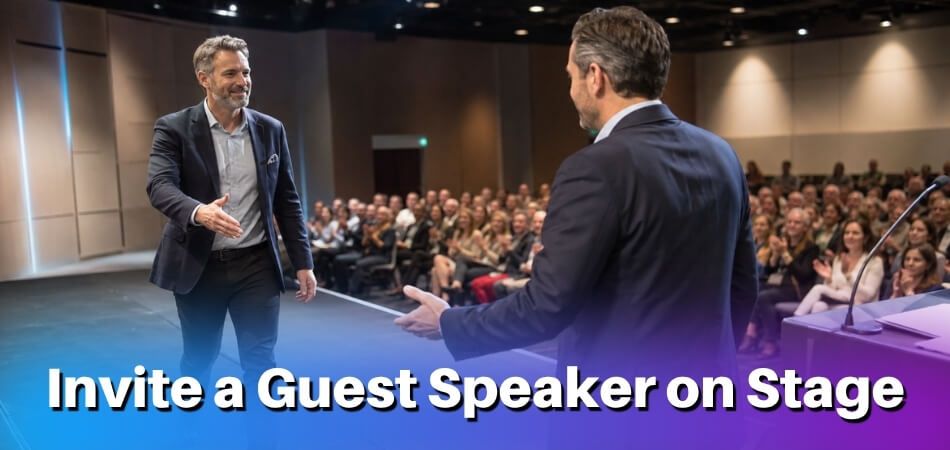
Please join me in welcoming [First Speaker / Keynote Speaker Name].
Quick Fill-in-the-Blank Template (Stripped Version)
If you need something faster, this stripped version gives you the skeleton with nothing extra.
Welcome to [Conference Name]. I’m [Your Name], your host for [time period].
We are gathered today to [purpose, in one sentence]. The speakers, panelists, and fellow attendees in this room represent [relevant community or expertise]. You are in good company.
The agenda for [today / this session] includes [brief overview]. We will wrap up by [end time] and there will be [time / opportunity] for questions throughout.
My one ask: be present. Put the laptops away when you can. The conversations that happen in these rooms tend to be more valuable than the slides.
Now, let’s begin. Please welcome [First Speaker Name].
How an Opening Speech Differs From a Welcome Speech
A welcome speech greets people; an opening speech also states what the event is for and formally starts it. In practice the two overlap and blending them is fine, but knowing which job you are doing changes what you say. If all you need is a greeting, a plain welcome speech is a shorter task than the one described on this page.
| Point | Welcome speech | Opening speech |
|---|---|---|
| Main job | Greet attendees, sponsors and guests | Frame the event and start the program |
| Usually given by | Host, organiser or institution representative | Chair, organiser, host or chief guest |
| Theme | Mentioned briefly, if at all | Explained: why this theme, why now |
| Ending | Thanks and good wishes | Hand-off to the first speaker, or a formal declaration that the conference is open |
Fill-in-the-Blank Conference Opening Speech Template
This template works across conference types, and you can adapt its bracketed fields to your context quickly. It saves you from staring at a blank page the night before your event.
How to Use This Template
Each bracket tells you what kind of information goes there. Some fields are plain substitutions, such as your name or the conference title. Others ask for a real choice, like which rhetorical question fits your audience, or what single thing you want people to remember.
Fill those in before you read it aloud. The speech should sound like you wrote it from scratch, not like you completed a form.
The Template
Good morning / Good afternoon / Good evening, everyone.
Welcome to [Conference Name]. I’m [Your Name], and I will be your [conference host / chair / opening speaker] today.
We have [number] people in this room [or: joining us from across [number] countries / time zones], and every one of you is here because [state the shared purpose or challenge: e.g., “you care about where clinical AI research is heading” / “your organization is facing a serious shift in supply chain strategy”]. That common thread is what makes this gathering worth your time.
[Conference Name] exists to [state the core mission or reason the conference was founded / organized]. This year’s theme, [Theme Title], reflects [one sentence explaining why this theme matters right now, e.g., “a question the field has been circling for years but has not answered clearly yet”].
Over the [next X hours / two days / three days], you will hear from [number] speakers covering [brief summary of topic range, e.g., “everything from foundational research to live case studies from the field”]. We will run [name one specific format element: panel, workshop, roundtable], and we have built in time for the conversations that do not fit on an agenda.
Before that, some essentials: [name any essential logistics: registration, breaks, app or platform if virtual, session timing, Q&A format].
I want to leave you with one question to carry into today. [Insert rhetorical question tied to your theme, e.g., “What would your organization look like in three years if this problem stayed unsolved?” / “What is the one assumption in your field that most people are afraid to challenge?”] You do not have to answer it now. Let it sit with you as you move through the sessions.
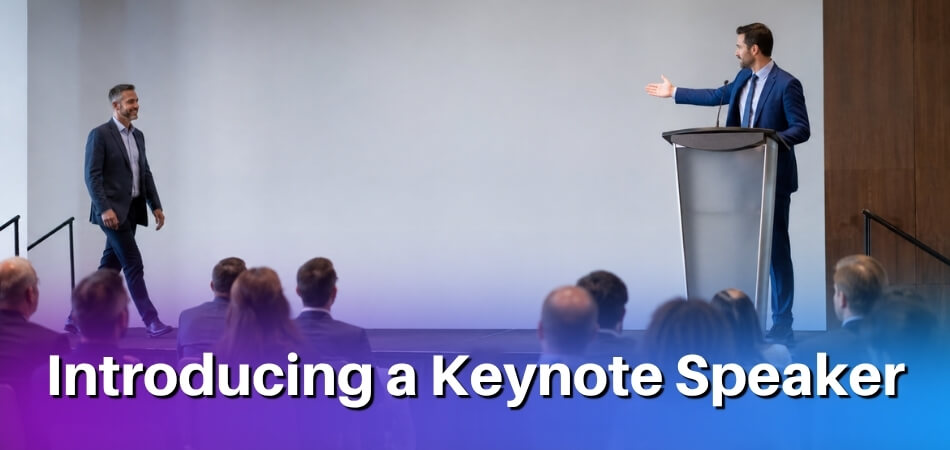
Today’s [keynote / opening session] will be delivered by [Speaker Name], [Speaker Title and Affiliation]. [One sentence about why this speaker is the right person to open: a relevant achievement, a specific contribution to the field, something concrete.] Please join me in welcoming [Speaker Name].
[Optional closing line for the welcome itself:] Thank you for being here, and enjoy the next [X hours / days].
Adapting the Template by Conference Type
The base structure fits most settings. A few adjustments are worth making.
Academic conference. Lean into the intellectual framing. Tie your rhetorical question to an open research problem, and name specific paper tracks or symposia in the agenda. The speaker introduction is more formal here: include institutional affiliation and one notable publication or finding.
Business or corporate conference. Anchor the opening in a real business condition, such as market pressure or an industry shift. The closing call-to-action can be explicit: “Leave today with one decision made” is more useful to this audience than an abstract invitation to reflect.
Virtual or online conference. Add a brief technical orientation right after the logistics line: how to use the chat, how Q&A works, whether sessions are recorded. Keep the welcome tighter than you would in a room, because a long preamble works against you on a screen.
International conference. Acknowledge the geographic spread of the audience without making it purely ceremonial. If interpretation is available, say so. A short phrase welcoming non-native English speakers, plus a deliberate choice to speak clearly and skip idioms in the first two minutes, shows you have thought about who is in the room.
Workshop opening speech. The agenda matters more here than in a lecture-style event. Tell people what they will be doing, not just what they will hear, and replace the standalone speaker introduction with a short framing of how the workshop runs.
More Sample Speeches by Type
Each sample below is written for a specific audience, pace and purpose. A five-minute academic opening reads very differently from a two-minute virtual kick-off or an informal workshop welcome. Adapt the tone and insert your own details.
Short Opening Speech (Under 2 Minutes)
When the program is tight you may have ninety seconds before the first session, and that is enough if no word is wasted.
Good morning, everyone. Thank you for being here.
My name is [Your Name], and I am honored to open [Conference Name]. We have brought together [number] professionals from [field/industry] for a day of honest conversation and practical ideas.
The agenda covers [two or three main themes]. You will hear from speakers who have spent years on these exact problems, and you will have time to meet people who share your challenges.
The next [timeframe] is yours to use well. Welcome.
Academic Conference Opening Speech
Academic audiences expect precision and a clear scholarly purpose. Skip the cheerleading, frame the intellectual problem and let the work speak for itself.
Good morning, and welcome to the [Xth Annual / Inaugural] [Conference Name].
My name is [Your Name], and I serve as [Title] at [Institution]. On behalf of the organizing committee, I am glad to welcome you to [Location / Platform] for what promises to be a rich exchange of research and ideas.
This year’s theme, [Theme Title], was chosen because it sits at a point of genuine tension in our field. We are asking questions that do not yet have settled answers, and that is exactly where scholarly conversation should happen.
Over the next [number] days, you will hear [number] paper presentations, take part in [number] panel discussions, and meet colleagues whose work spans [list of disciplines or regions]. The full program is in your conference booklet and on the event app.
A few acknowledgments: this conference would not be possible without the support of [Funding Body / Sponsor], the tireless work of our program committee, and the generosity of [Host Institution] in providing these facilities.
We open this morning with a keynote address from [Speaker Name], [Title], whose research on [Topic] has [brief, factual description of contribution, e.g., “reshaped how the field approaches X”]. Please give a warm welcome.
Thank you, and I look forward to the conversations ahead.
Business / Corporate Conference Opening Speech
Executives and professionals are busy; they want to know why the event matters and what they are about to do. Keep it grounded in the business reality you all work in.
Good morning. Welcome to [Conference Name / Company Name Annual Conference].
I’m [Your Name], [Title]. It is great to see so many of you here in [City], and I know some of you have travelled a long way. Thank you for making that commitment.
We are meeting at an important moment for [Company / Industry]. [One to two sentences naming a real, specific challenge or shift the audience faces, e.g., “Supply chain pressures have changed how we plan,” or “Customer expectations have moved faster than most of our internal processes.”] That is the honest backdrop for everything we discuss today.
This conference is built around three priorities: [Priority 1], [Priority 2], and [Priority 3]. The sessions are practical. We are here to exchange what is actually working, not just what looks good in a presentation.
You will also have structured time with colleagues from other regions and divisions, because some of the best thinking at these events happens in the breaks.
The program begins in [X minutes] with a keynote from [Speaker Name], who will walk us through [topic]. I will hand over shortly.
Over to the program, then.
Virtual or Online Conference Opening Speech
You cannot read the room online, and attendees are watching from different time zones with different distractions nearby. Your job is to close that distance quickly and give people a reason to stay focused.
Welcome, everyone, to [Conference Name]. I’m [Your Name], your host for today.
Wherever you are joining from, [City], [Country], or somewhere we did not anticipate, thank you for being here. We have attendees logged in from [number] countries, and that range of perspective is one of the strengths of this format.
A few practical notes before we start. Sessions will be [live / recorded and available on-demand]. The chat is open: use it to introduce yourself, ask questions, and respond to speakers. Our moderators are watching and will bring the best questions into the Q&A. If you hit a technical problem, the support link is in your confirmation email and pinned in the chat right now.
Today’s program covers [main themes]. We have built in [number] breaks and networking sessions using [platform feature, e.g., “breakout rooms”], so you will have real chances to connect, not just watch.
In a moment we start with [Speaker Name], who opens on [topic]. Grab your coffee, close the tabs you do not need, and let’s make the next [timeframe] worth your time.
Small Conference or Workshop Opening Speech
A workshop opening is less formal than a plenary speech. The group is smaller, the goals are more specific, and participants usually want to get their hands on the material quickly.
Good morning, everyone, and welcome to [Workshop Name / Event Name].
I’m [Your Name]. There are [number] of us here today, and I think that is exactly the right size for what we are about to do.
This workshop is built around [specific skill, problem, or topic]. By the end of the day, you will have [concrete outcome, e.g., “a working draft of your communication strategy” or “hands-on experience with the facilitation tools we are covering”]. The sessions are participatory, so you will be working, not just listening.
The agenda runs from [time] to [time], with a break at [time] and room at the end for questions and discussion.
I’d like to start with a quick round of introductions. Tell us your name, where you are coming from, and one thing you hope to take away today. We will keep it brief.
Right, to work.
International Conference Opening Speech
An international audience brings real diversity of background and language comfort. Keep the opening clear, measured and free of idioms that do not translate, and acknowledge the global mix in a way that feels sincere rather than ceremonial.
Good morning, and welcome to [Conference Name].
I am [Your Name], [Title / Role], and it is my honor to open this [Xth / inaugural] international gathering on behalf of [Organizing Body / Institution].
We are joined today by delegates from [number] countries across [regions]. Some of you have travelled many hours to be in this room, and I want to acknowledge that directly. Your presence shows how seriously our community takes this work.
The theme of this year’s conference is [Theme]. It was chosen because it reflects a challenge, or an opportunity, that no single country or organization can address alone. The conversations over the next [number] days will cross disciplinary boundaries and national contexts, and that exchange is what makes an international conference valuable.
Some practical matters: simultaneous interpretation is available in [languages] through the headsets at your seat. The full program, including room assignments and speaker bios, is in the printed booklet and on the conference app. If you need help at any point, the organizing team is at the information desk in the main lobby.
We begin with welcoming remarks from [Name, Title, Country or Organization], followed by our opening keynote from [Speaker Name], who will address [topic].
Thank you for being here. I look forward to the work ahead.
Chief Guest or Chair Declaring the Conference Open
At many conferences a senior guest or the chair formally opens the event after the host has welcomed everyone. This form is short, ceremonial and ends with a declaration.
Distinguished guests, delegates, colleagues.
It is a privilege to be asked to open [Conference Name]. Gatherings like this exist because people in [field] choose to share what they know and to question what they think they know.
This year’s theme, [Theme Title], matters because [one sentence on why it matters to this field now]. I hope the next [number] days give you new questions as well as answers.
My thanks go to the organizing committee, to [Sponsor / Host Institution], and to every presenter who prepared work for this room.
With that, I have great pleasure in declaring [Conference Name] officially open.
Ready-to-Use Opening and Closing Lines
A bank of ready lines makes preparation faster, and they drop into many contexts with small changes. They are functional, not filler.
Strong Opening Lines to Start With
Your first sentence sets the register, signals confidence, and tells the audience whether to lean in or tune out. Pick the type that fits your event.
Open with the shared purpose. This works well for academic conferences, business conferences, and international gatherings where people have travelled to be in the same room.
- “Every person in this room chose to be here, and that choice already tells us something important about what we are trying to do together.”
- “We have come from [number] countries, [number] institutions, and [number] different time zones, and we are all here for the same reason.”
Open with a direct statement of what this event is. Clean and confident, and good for corporate conferences and workshops where the audience wants to get moving.
- “Welcome to [Conference Name], three days dedicated entirely to [theme or problem].”
- “This is [Conference Name], and we built this program around one question: [question relevant to your field or industry].”
Open with a rhetorical question. Use this when you want the audience thinking from the first moment.
- “What would it look like if [your field or industry] actually solved [core challenge]? That is what this conference is designed to explore.”
- “How often do we get two full days to step back from the day-to-day and think about where all of this is heading? That is exactly what we have here.”
Open with a practical promise. Tell the room what it will be able to do or use by the end. It gives people a reason to listen from the first sentence.
- “By the time we finish today, you will have [a practical outcome, e.g., “a method you can try on Monday”]. That is what this program is built for.”
Open with a brief, grounding observation. This suits workshop opening speeches and smaller, more conversational gatherings.
- “There is something different about a room full of people who are wrestling with the same problems. You can feel it.”
For virtual and online conferences, avoid anything that assumes shared physical energy, because it does not carry through a screen. Go direct instead:
- “Good morning, or afternoon, or evening, depending on where you are joining from today. Welcome to [Conference Name].”
- “Thank you for making time for this. Logging on to a virtual conference takes a different kind of commitment than showing up in person, and we are glad you are here.”
- “Before we start, type in the chat where you are joining from. We will read a few out.” (An opening prompt on the platform gets people interacting in the first minute.)
How to Close an Opening Speech and Hand Off
The exit is easy to fumble after a good welcome. The hand-off to the first speaker, the next segment or the agenda is part of the job and should feel intentional.
Signal that the opening is ending. Do not just stop talking.
- “Before I hand things over, let me walk you through what we have in store over the next [hours/days].”
- “I will keep the agenda brief, because the sessions speak for themselves, but here is the shape of what we have planned.”
Bridge to the agenda or first speaker. Name the speaker with enough context to show why their perspective matters to this group, not only their title.
- “Our opening keynote comes from someone who has spent [X years] working directly on [relevant area]. [Speaker Name] will set the frame for everything we discuss over the next two days. Please welcome them.”
- “We move now into our first session. [Speaker Name] joins us to open on [topic], and I think you will find it sets the right tone for the conversations ahead.”
Close cleanly when there is no speaker hand-off. If you are moving straight into a session, a break or a group activity, say so plainly.
- “That is all from me for now. Let’s get started.”
- “I will step aside and let the program take over. Thank you again for being here.”
Keep the closing short. If you already asked the audience to engage or bring questions earlier in the speech, do not repeat it at the exit. Say what is coming next and let the conference move forward.
How to Write a Conference Opening Speech (Step-by-Step)
Write it as a series of deliberate choices made before you draft a single word. The eight steps below follow the order in which they actually help.
Step 1: Know Your Role and Audience Before Anything Else
Spend five minutes answering two questions: who are you in this room, and who are they?
If you are the host welcoming 300 delegates to an international conference, your tone differs from a department head kicking off an internal event for 40 colleagues. An academic audience expects precision and a nod to the work being presented. A business crowd wants energy and relevance fast. Your answers shape length, formality, how much humor you can risk and how technical your vocabulary can be.
Step 2: Decide on Your Core Message
Pin down the one thing you want people to carry out the door. An opening speech has a job. Maybe it is to make attendees feel the event was worth travelling for, to frame a theme every session builds on, or to create a sense of shared purpose.
Write that core message in one sentence before you draft anything. If you cannot, you are not ready to write the speech.
Step 3: Open With Something That Commands Attention
The first lines set the tone for everything after. Options include a sharp rhetorical question the audience genuinely cannot answer yet, a short specific story or observation tied to the theme, or a striking piece of data relevant to their work. The lines in the previous section give you wording.
Avoid opening with a long thank-you list or a slow “it is wonderful to see everyone here.” Those openers bleed momentum before you start. Save acknowledgments for after your hook, then move from the greeting to the purpose of the event.
Step 4: Set the Context Without Overloading It
Answer briefly: why are we here, what are we doing, and why does it matter now? Two to three sentences is usually enough.
For an online conference this step carries extra weight, since remote attendees are sitting with ten browser tabs open and the agenda has to anchor them quickly. For a workshop, add a line about expected participation, because workshops ask more of attendees.
Step 5: Handle Logistics and Housekeeping at the Right Moment
Do not open with logistics, but do not skip them either. Breaks, Wi-Fi codes, safety exits and recording notices belong after your context-setting and before the hand-off to the first speaker.
Keep it brief and outline the points mentally so you do not ramble. At a multilingual international conference, confirm early whether interpretation is available and where to access it.
Step 6: Introduce Speakers or the Program Naturally
A speaker introduction should connect to the speech, not be stapled onto it. Link the next speaker to the theme you just outlined: “To dig into exactly that question, I would like to welcome…”
If you cover the full agenda, give the shape of the day rather than a minute-by-minute rundown. “We spend the morning on [theme], break for lunch at 12:30, and finish with a panel at 3pm” is plenty.
Step 7: Close the Opening With a Clear Call-to-Action
In an opening, a call-to-action does not need to be dramatic. “Keep that question in mind as you move through today’s sessions” or “I hope you leave with at least one idea you can use next week” is enough.
The point is to give the audience a posture, a way to be in the room. That separates a tone-setting speech from one that just fills time before the real content. Even a plain “I’d like to invite our first speaker to the stage” closes the loop, because the audience should always know what happens next.
Step 8: Edit for Time
Read the speech aloud and time it, then compare the result with the ranges in the length section below. Cut anything that does not serve your core message. If a sentence is there because it felt good to write rather than because the audience needs it, it goes.
Common Mistakes to Avoid
These traps weaken an opening whatever the type of conference.
Starting with an apology or disclaimer. “I know you are all tired from the travel” or “I will try not to take up too much of your time” and “Bear with me, I’m a bit nervous” signal low confidence before you have said anything meaningful. You are the one setting the tone, so own the room from your first sentence.
Reading from notes without looking up. A welcome delivered with your eyes locked on a page feels transactional. You do not need to memorize it, but you should know it well enough to look up at the opening and closing lines. At a virtual event, eye contact with the camera is your only connection.
Making it too long. Attendees have sessions to get to. If you run past the ranges given below, you are probably repeating yourself or padding with background that belongs in the program guide.
Skipping the agenda. Some speakers go straight into an inspirational story and never say what is happening that day. Even two or three sentences of orientation give the room structure.
Using humor that lands flat. A well-placed rhetorical question can energize a room. A forced joke about the venue’s coffee, or a reference only half the audience understands, does the opposite. At an international event, humor built on cultural shorthand often fails. When in doubt, stay warm and straightforward.
Ignoring the speaker introduction. If you open a multi-speaker event, part of your job is to frame the people who follow. Dropping a keynote speaker’s name with no context wastes the chance. One or two sentences on their background and relevance is enough.
Treating virtual and in-person openings the same. Pauses that feel natural in a physical room can feel like a lost connection over video. Online openings work better slightly more concise, and they should acknowledge that people are joining from different places and time zones.
Forgetting to check pronunciation. At an international conference you will mention names, institutions or places that are easy to mispronounce. Getting a featured speaker’s name wrong in the opening is embarrassing and avoidable, so verify it before you go on.
Delivery Tips (Voice, Body Language, Confidence)
Delivery decides whether the room trusts you in the first minute or spends the next hour mentally checked out. These tips apply to any format.
Voice and Pacing
Slowing down is the simplest improvement, and it usually needs to be more than feels natural.
Control your pace. Nerves make it easy to rush. Record yourself in rehearsal and listen back; if you cannot follow your own points, neither can the audience. Keep a deliberate pace, especially in the opening lines while people are still settling in.
Use pauses deliberately. A two-second pause after a rhetorical question or a key point gives the room time to absorb it. New speakers fill every gap; experienced hosts let moments breathe.
Vary your volume. Dropping your voice slightly for an important line draws people in, and raising it signals energy or a transition. A monotone makes even a well-written welcome feel flat.
Project without shouting. Speak from your diaphragm, not your throat. With a microphone, keep a consistent distance, since drifting away causes volume drops that are hard to follow, particularly on a virtual stream.
Body Language
Physical presence signals confidence before you say a word, which matters at large international events where many attendees are reading you before they have processed your message.
Stand still when you start. Swaying, shifting weight or pacing signals anxiety. Plant your feet, stand straight and face the audience. You can move later, for example toward one side of the room while introducing a key theme, but movement should have a purpose.
Make eye contact across the room. Do not fix on one friendly face or on your notes. Sweep slowly from left to center to right. For an online conference, look into the camera lens, not at your own face on screen.
Keep your hands relaxed. Let them rest at your sides or gesture naturally. Gripping the podium or crossing your arms closes you off. Gestures that match your words, like opening your hands when welcoming attendees or counting on your fingers during the agenda, reinforce what you say.
Smile at the right moments. Not constantly, which reads as forced, but at genuine transitions: welcoming the room, introducing a speaker, landing an opening line about shared experience.
Confidence and Nerves
Everyone feels some nerves before an opening speech. The goal is not to remove them but to stop them showing in your delivery.
Rehearse out loud, not just in your head. Silent reading does not prepare your voice for delivery. You need to hear yourself so your mouth gets used to the phrasing. Do it standing up, ideally in the actual room.
Know your first 30 seconds cold. You do not need the whole speech memorized, but the opening lines should be automatic, because nerves peak as you walk up and look at the room. If you know exactly what comes out first, you settle quickly.
Use the room before you speak. Arrive early. Walk the space, test the microphone and chat with early arrivals. Familiarity makes it feel less like stepping into the unknown.
Adapting Delivery for Different Conference Types
The same speech delivered identically will not land equally everywhere.
In-person business or corporate conference: energy and presence carry the room. You can read the audience in real time; if people look restless, pick up the pace, and if they are engaged, slow down and let key moments land.
Workshop: the tone is more conversational. You are setting up a working session, not commanding a ballroom, so dial back the formal projection and speak as you would to a small group.
International conference: speak clearly at a measured pace throughout, avoid idioms, and pause after complex points so attendees working in a second language can follow.
Virtual or online conference: ambient energy, applause and visible nodding are gone, so you must do more work vocally. Posture and facial expression still count on camera, and pacing matters even more. Look at the camera and speak with slightly more deliberate energy than feels natural, because screens flatten delivery.
How Long Should a Conference Opening Speech Be
Opening speeches run from about two to ten minutes, depending on event size, formality and how much program follows. There is no single universal answer, but the ranges below are reasonable guides rather than fixed rules.
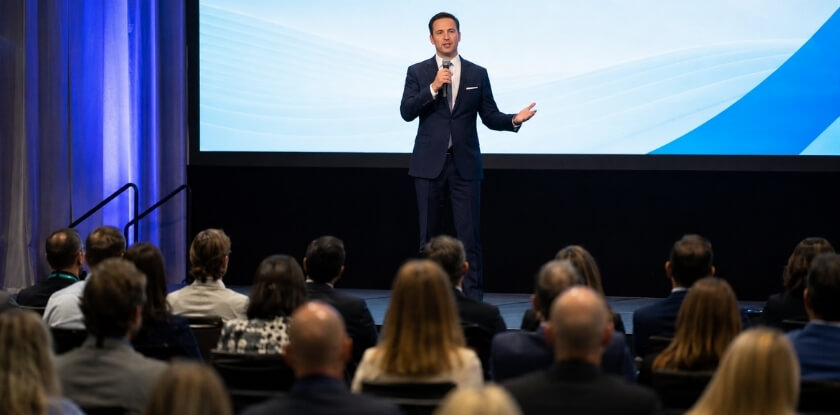
General Guidelines by Conference Type
| Event type | Typical opening length | Why |
|---|---|---|
| Large international or academic conference | 5 to 10 minutes | Travelled audience, sponsors and institutions to acknowledge, ceremonial weight |
| Corporate or business conference | 3 to 5 minutes | Decision-makers want to reach the content quickly |
| Workshop or small internal event | 2 to 3 minutes | The audience knows the context; set the tone, confirm the goal, hand off |
| Virtual or online conference | 2 to 4 minutes | Shorter usually works better on screen, where attention drifts faster |
For corporate events, a tight 3 to 5 minute opening that covers purpose, agenda and one moment of real connection is enough. Cutting a large international opening too short can feel dismissive of the occasion, while at an online event it is wise to keep your preamble tight unless you have strong visual support.
Word Count as a Practical Guide
If you are writing a script, a commonly quoted speaking rate for clear, deliberate delivery is roughly 120 to 150 words per minute. Sources differ slightly, so treat the figures as estimates.
- A 2-minute speech: approximately 240 to 300 words
- A 5-minute speech: approximately 600 to 750 words
- A 10-minute speech: approximately 1,200 to 1,500 words
For most conferences, a script of 400 to 600 words covers the welcome, a brief agenda, a speaker introduction or two and a closing call-to-action, and it lands at roughly three to five minutes at a natural pace.
When to Go Longer
An annual flagship event, a gala conference or a ceremony-style international conference with formal dignitaries can justify a 7 to 10 minute opening. So can a host who must cover sponsor acknowledgments, history or a formal welcome on behalf of an institution. Even then, structure matters. A 10-minute opening that moves through clear sections feels much shorter than one that meanders.
The Practical Test
Read your draft aloud with a timer, because a speech often runs longer spoken than it feels when read silently. Confirm your slot with the chair or organiser first: the time you are given overrides any range in this section. If you are over your target, look at the middle section first, because that is where unnecessary material usually gathers, not the opening or close.
From our experience at MS International: Our conferences are held in person at Greater Toronto Area venues, with no standard virtual speaker option, and the moderator introduces each speaker before the presentation. Presentation lengths may vary, and the speaker confirmation and final conference programme are the official sources for your schedule. For most applicants, the route to our in-person conferences in the Greater Toronto Area is the presenting-author track: submit work for review and register after acceptance. Keynote and invited-speaker roles are arranged separately with the organizing team.
FAQ
Not a confident public speaker but asked to open the event? Tone for an international audience, rhetorical questions, a fill-in-the-blank template and when to finalize the text come first.
What’s the difference between opening remarks and a welcome address?
Opening remarks frame the event (theme, tone, agenda) and start the program, while a welcome address greets attendees, sponsors or guests. The two overlap, and combining them in one speech is perfectly fine.
Does a virtual conference need a different opening speech?
Not in structure, but in delivery. Keep the same elements, acknowledge the online format early, cover technical logistics briefly, look at the camera and keep the preamble tight, since you cannot rely on room energy.
Who should give the opening speech at a conference?
Usually the conference host, chair or organiser, or a senior leader or chief guest who opens it formally. Practice varies by event, and some events open with the keynote instead. Whoever speaks needs authority over the event and a clear reason for it.
Do I need to introduce every speaker in my opening speech?
No. The opening introduces the conference, not every presenter. You may name a keynote speaker or two for context, and full introductions happen when each session begins.
How formal should the tone be for an international conference?
Clear and measured. Audiences include people at different levels of English, so plain language beats eloquent phrasing. Avoid idioms and humor that lands for only one nationality.
How do you start a conference opening speech?
Start with a line that tells the room why the event matters: the shared purpose, a short question or a practical promise. Skip the long thank-you list at the start and give acknowledgments after the hook.
Is it okay to use rhetorical questions in an opening speech?
Yes, used sparingly. One strong question near the start can pull the audience in and frame the theme. Repeating the device starts to feel like a trick rather than engagement.
Should I include a call-to-action in a conference opening speech?
It depends on the event. A business conference benefits from a clear one that attendees can carry through the day. An academic conference or workshop can be looser and focus on intellectual framing. If you want a specific outcome, say it plainly.
What if I’m not a confident public speaker?
Learn your opening line so well you can say it without notes. The first few lines are the hardest, and the rest tends to settle after that. Standing still, making eye contact and speaking at a deliberate pace all signal confidence even when you do not feel it.
Can I use a fill-in-the-blank speech template as-is?
Use it as a starting point, but swap in real details: the actual theme, your genuine reason for holding the event, something specific to this audience. A template that still sounds like a template defeats the purpose.
How early should I finalize my opening speech before the conference?
Aim for a working draft about a week out and rehearse it aloud several times. Time yourself too, because a speech that reads as three minutes can run longer when spoken.
Final Thoughts
A strong opening does not need a perfect script or years of experience. It needs clarity about your audience, a sincere welcome and a clear sense of what the event is for. Use the samples here as a starting point, then rewrite them until they sound like you.