
Planning a trip to a conference in Canada from Nigeria starts with one number: what the visa itself will cost you in naira, and what else will quietly be added on top.
Quick answer: A conference visa from Nigeria to Canada costs CAD 185 in official fees for one person: CAD 100 for the visitor visa plus CAD 85 for biometrics. At early-October 2026 exchange rates, that is roughly ₦172,000 to ₦185,000. Canada has no separate “conference visa”, so you apply for a visitor visa. VFS Global charges, courier, and travel costs are extra.
Fact-checked by the MS International Editorial Team. Last verified against official sources: October 2026.
The CAD 185 is only the government part of the bill. Plan your budget in three parts:
- Official IRCC fees: visitor visa fee and biometrics fee
- Application support costs: VFS Global passport transmission or courier, printing, and a medical exam if IRCC asks for one
- Travel costs: flights, accommodation, local transport, meals, insurance, and conference registration
What Visa Do Nigerians Need to Attend a Conference in Canada?
Nigerian citizens need a Canadian visitor visa, also called a temporary resident visa (TRV), to attend a conference in Canada. There is no separate visa category called a “conference visa”. The phrase simply means a visitor visa where the purpose of travel is a conference, and IRCC treats you as a business visitor: someone who comes for a few days or weeks for a meeting, conference, or trade fair without entering the Canadian labour market.
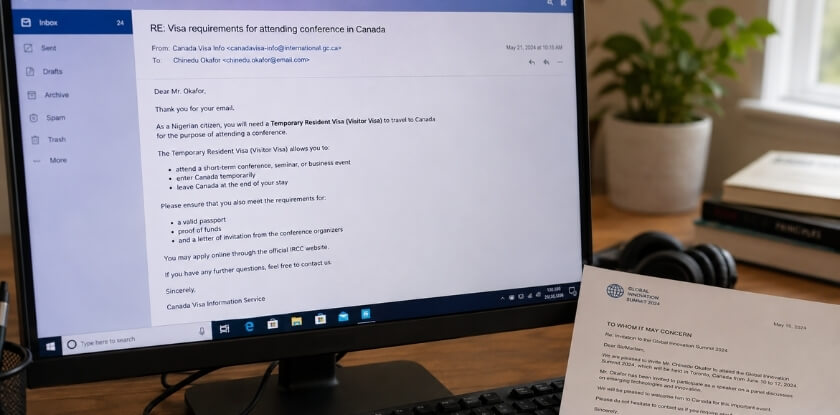
There is no cheaper shortcut: Nigeria is not on IRCC’s list of visa-required countries whose citizens can use an electronic travel authorization (eTA) instead, so the visitor visa is the only route.
This covers attending, presenting a paper, speaking, exhibiting at a trade fair, or representing your employer or university at an event. If the event is registered with IRCC, the organizer will give you an event code to enter on your application.
Your documents should match your role. An attendee shows registration and payment; a speaker or presenter shows the invitation with the session title and date.
Canada Conference Visa Fee Breakdown for Nigerian Applicants
You pay two IRCC fees online when you submit: CAD 100 for the visa and CAD 85 for biometrics. Both appear on the IRCC fee list set by the Government of Canada and are the same in Lagos, Abuja, or anywhere else.
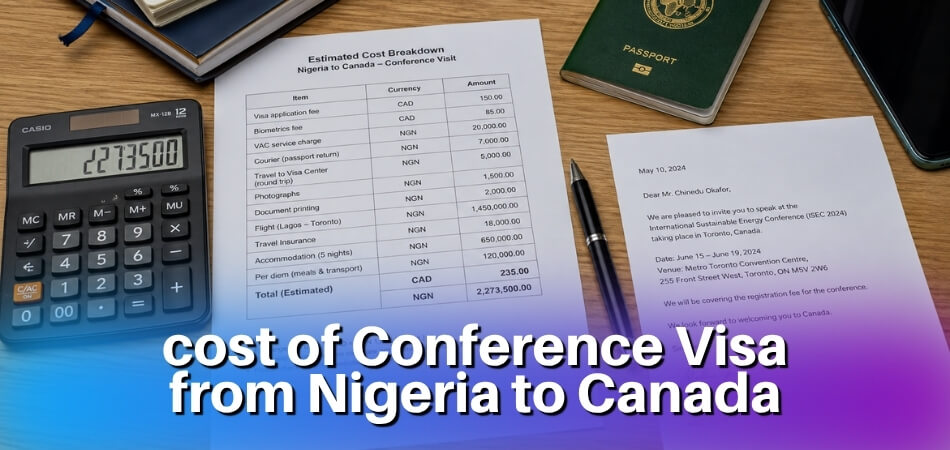
This table shows every cost a Nigerian conference visitor should plan for, who charges it, and where to check the current amount.
| Cost | Amount | Paid to / where to check |
| Visitor visa application fee | CAD 100 per person (family maximum CAD 500) | IRCC, paid online when you apply |
| Biometrics fee | CAD 85 per person (family maximum CAD 170) | IRCC, paid online with the application |
| Minimum official total (one person) | CAD 185 (about ₦172,000 to ₦185,000, October 2026) | Convert on the day you pay |
| Passport transmission or courier return | Varies | VFS Global Nigeria (Lagos or Abuja) |
| Other VAC service fees | Varies; check the current price list | VFS Global Nigeria |
| Medical exam | Set by the clinic; only if IRCC asks | IRCC-approved panel physician |
| Travel health insurance | Depends on policy and length of stay | Your insurer (recommended, not required) |
Visitor Visa Application Fee
The visitor visa fee is CAD 100 per applicant, whether IRCC issues a single-entry or multiple-entry visa. It pays for processing, not for approval. IRCC does not refund it once processing has started, so a refused application means paying again. Do not submit a weak file just to “try your luck”.
Biometrics Fee
Biometrics (fingerprints and a photo) cost CAD 85 per person. After you pay, IRCC sends a biometrics instruction letter, and you book an appointment at the VFS Global centre in Lagos or Abuja. Book quickly: your application does not move forward until biometrics are done. Children under 14 and applicants over 79 do not need to give biometrics for a visitor visa.
How Long Are Biometrics Valid?
Biometrics for temporary resident applications are valid for 10 years. If you gave biometrics for an earlier Canadian visitor visa, study permit, or work permit within that period, you usually do not pay the CAD 85 again, which brings your official cost down to CAD 100. Check your old records before paying.
Family Fee Limits
Families applying together at the same time pay no more than CAD 500 in visa fees and CAD 170 in biometrics fees. This mainly helps when a spouse and children travel with the conference delegate.
Estimated Canada Conference Visa Cost in Nigerian Naira
At early-October 2026 rates of roughly ₦930 to ₦1,000 per Canadian dollar, CAD 185 works out to about ₦172,000 to ₦185,000. This is an approximate figure. IRCC charges in Canadian dollars, so the naira amount moves with the exchange rate.
What you actually pay depends on your card. Nigerian bank cards often apply their own exchange rate and an international transaction charge, so the debit can be higher than the mid-market rate shown on currency sites. Before paying:
- Check the rate your bank or card issuer will use on the day
- Add a buffer of about 10% for bank charges and rate movement
- Ignore naira figures in older articles; they are often far off after recent currency changes
Extra Costs to Budget Beyond the Official Visa Fee
Most of the extra cost comes from the visa application centre, travel to it, and possibly a medical exam. None of these are included in the CAD 185.

VFS Global Service and Courier Costs
Canada’s visa application centres in Nigeria are run by VFS Global in Lagos and Abuja. They take biometrics and handle passports after approval. IRCC’s biometrics fee is paid online, but VFS Global can charge its own fees on top, so check its current Nigeria price list before you book. Charges can apply to:
- Passport transmission when you submit your passport for the visa
- Courier return of your passport to your home or office
- Any extra services the centre offers, such as printing or photocopying
These charges are set by VFS Global, not IRCC, and they change. Check the current price list on the VFS Global Canada Nigeria website before you budget. Courier return is worth it if you live far from Lagos or Abuja, because a second trip to the centre can cost more than the courier.
Documents, Notarization, and Translation
Most Nigerian documents (bank statements, CAC certificates, employment letters) are already in English, so translation is rarely needed. Any document in another language needs a certified English or French translation.
Notarization is not required by IRCC, but some applicants choose it for sponsor affidavits or business records. If the conference organizer’s letter is your main proof of purpose, a notarized invitation letter adds a verifiable signature for an extra fee.
Medical Examination
A conference visitor staying six months or less usually does not need a medical exam. IRCC may still ask for one in some cases, for example if you will work in health care or child care during the visit. If asked, you must use an IRCC-approved panel physician and pay the clinic directly. Do not book an exam unless IRCC instructs you to.
Travel Health Insurance
Insurance is not required for a visitor visa, but visitors pay their own medical bills in Canada, and those bills can be very high. A short policy covering the conference dates plus travel days is usually enough.
Transportation and Personal Preparation Costs
Plan for smaller costs in Nigeria too: transport to the VFS centre (twice if you do not use courier), passport photos, printing, bank statement fees, and time off work for appointments.
Required Documents for a Canada Conference Visa from Nigeria
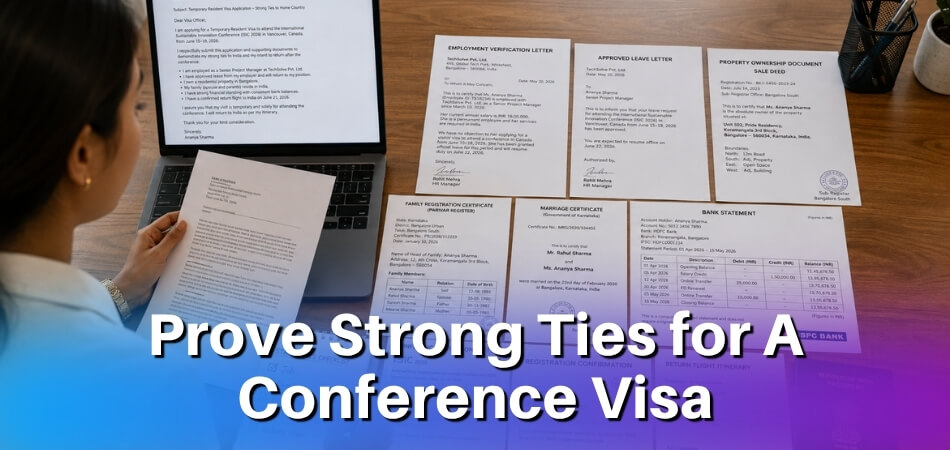
Your documents need to prove three things: the event is real, you can afford the trip, and you will return to Nigeria.
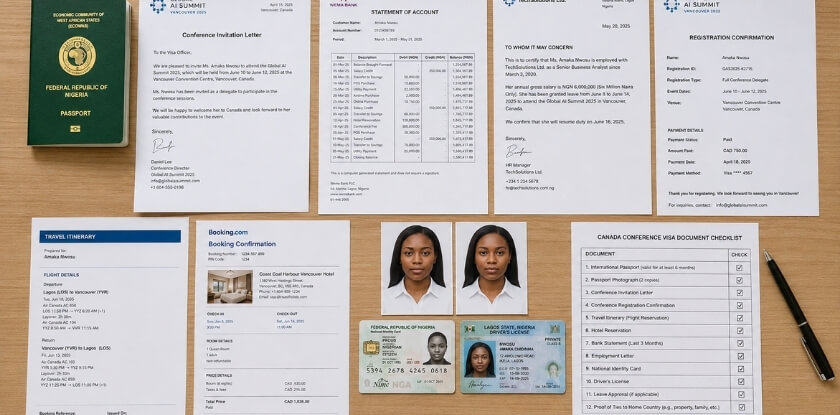
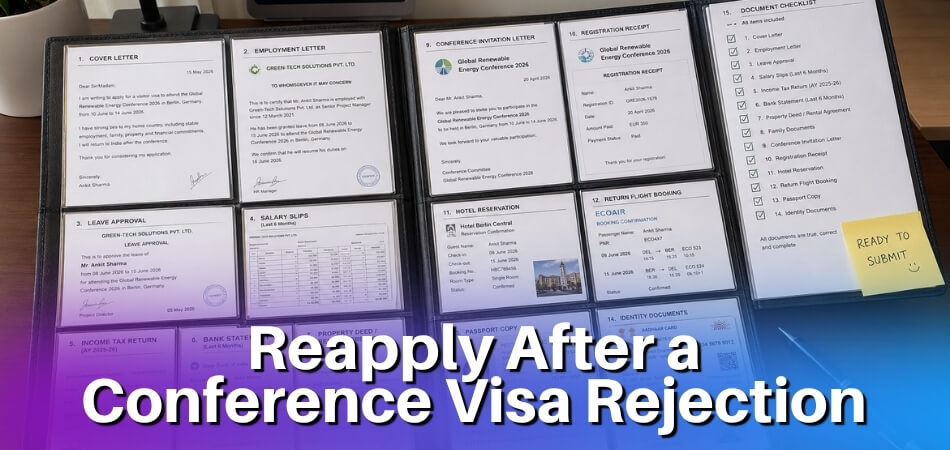
The core set for most Nigerian applicants:
- Passport: valid for your whole stay. A visa cannot be issued past your passport expiry, so renew first if it expires soon. Also check that you have blank pages and that your name is spelled the same on every document.
- Conference invitation letter: your full name, the conference name, dates, venue, organizer contacts, and your role (attendee, speaker, presenter).
- Proof of registration: confirmation email, payment receipt, abstract acceptance, or speaker confirmation.
- Proof of funds: recent bank statements (usually six months) covering flights, hotel, meals, and conference fees. Large unexplained deposits weaken the file.
- Employment letter or business documents: employer letter with position, start date, salary, approved leave dates, and a contact person; or CAC registration certificate, tax clearance, business bank statements, and a few invoices or client letters showing active trading if self-employed.
- Academic or professional proof: university or institution support letter, professional licence, or published paper, if relevant.
- Travel plan: tentative flight itinerary and hotel reservation that match the event dates.
- Sponsor documents: if someone else pays, their letter, bank statements, and proof of the relationship.
A three-day conference with a three-week unexplained stay raises questions, so keep the itinerary realistic. A full conference visa document checklist also adds travel insurance, and the conference invitation letter is what ties your trip to a real event.
How to Apply for a Canada Conference Visa from Nigeria
Nigerians apply online through an IRCC account, then give biometrics at VFS Global in Lagos or Abuja.
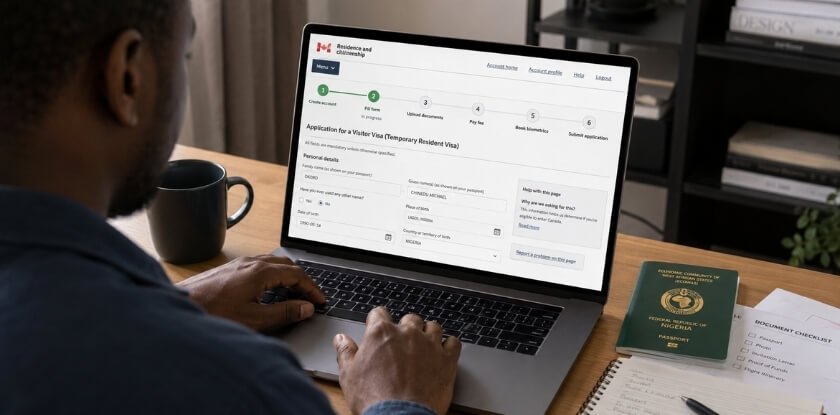
- Collect your documents from the list above. Bank and employer letters can take a week or more.
- Create or sign in to your IRCC account and start a visitor visa application. Make every name, date, and job title match your passport and letters.
- State the purpose as a business visit to attend a conference, and enter the event code if the organizer gave you one.
- Upload clear, complete scans with sensible file names. Blurry or missing pages slow things down.
- Pay the fees online and keep the receipt.
- Give biometrics at VFS Global after you receive the instruction letter.
- Watch your IRCC account and email for requests for more documents, a medical exam, or your passport. When IRCC asks for the passport, submit it at VFS Global or use the courier option. Check your spam folder too, so you do not miss a request.
Processing Time for a Canada Conference Visa from Nigeria
IRCC’s estimate for visitor visas from Nigeria was 87 days on 16 September 2026 and 93 days on 22 September, and IRCC says the estimate includes the time it takes to give biometrics. The figure has been rising and changes often. IRCC says its estimates are not a maximum or a guarantee, so check the current number on its processing times tool before you apply.
Because biometrics, passport submission, and courier return all add time, apply at least four to five months before the conference. Common causes of delay are late biometrics, missing documents, unclear bank records, and slow replies to IRCC requests.
If your event is close and the application is still pending, a well-supported visa expedite request letter can explain the fixed date to IRCC, though IRCC is not obliged to speed it up.
Visa Validity and Duration of Stay in Canada
Visa validity and allowed stay are different things. Validity is the period in which you can use the visa to enter Canada. Allowed stay is how long you can remain after you enter.
A visitor visa can be valid for up to 10 years, but never beyond your passport expiry or 10 years from your biometrics. The officer can also give a shorter validity or a single-entry visa.
Most visitors can stay up to six months per entry, though the border officer can set a shorter or longer period. For a conference, plan your stay around the event dates plus reasonable travel days.
Common Reasons a Canada Conference Visa May Be Refused
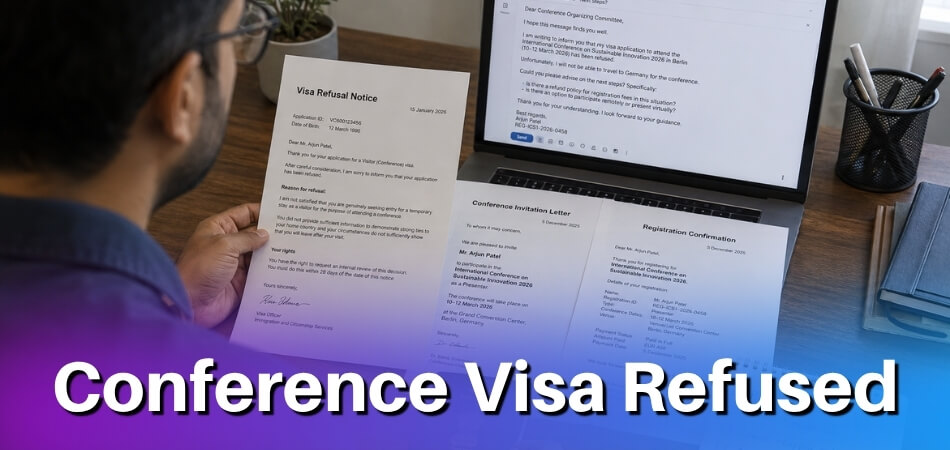
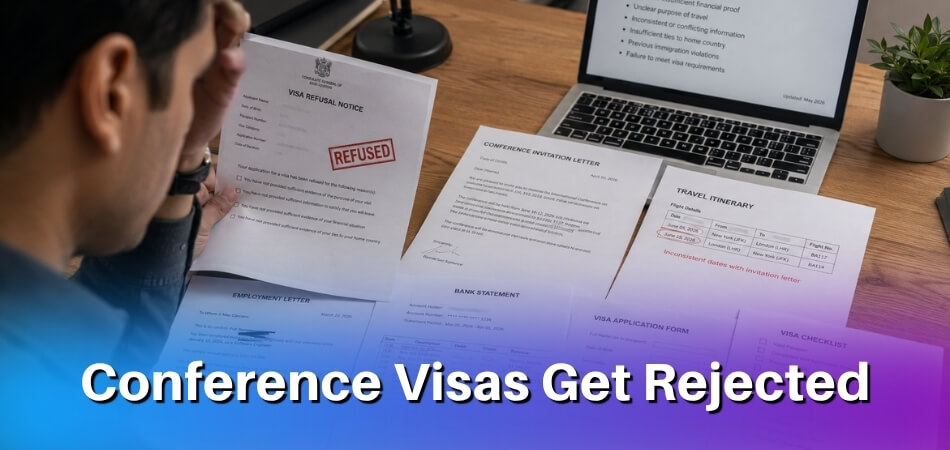
Most conference visa refusals happen because the officer is not convinced you are a genuine temporary visitor who will leave after the event. A refusal does not mean the conference is fake; it means the file did not prove the case.

The usual problems, and how to avoid them:
- Weak or unexplained funds: show steady income and explain any large deposit.
- Unclear purpose: explain what the conference is and how it relates to your job, studies, or business.
- Weak ties to Nigeria: show your job, business, family, studies, or property.
- Inconsistent documents: names, job titles, and travel dates must match across forms, letters, and bookings.
- Weak sponsor evidence: a sponsor letter alone is not enough; include the sponsor’s bank statements and relationship.
- A long stay with no reason: match the trip to the event.
Avoid buying non-refundable flight tickets before approval. A tentative itinerary is enough for the application.
What to Do If Your Canada Conference Visa Is Refused
Read the refusal reasons, fix those specific weaknesses, and only then reapply. Sending the same documents again usually leads to the same result. If you have an earlier refusal or limited travel history, explain it briefly in your application.
A new application means paying the CAD 100 visa fee again. You usually do not pay the CAD 85 biometrics fee again if your earlier biometrics are still within their 10-year validity.
Disclaimer: This article is general information, not legal or immigration advice. Visa rules, fees, and processing times change. Confirm the current requirements on the official Government of Canada website or with a licensed immigration consultant (RCIC) before you apply.
FAQs About Canada Conference Visa Fees from Nigeria
Nigerian applicants paying for a Canada conference visa want to know about refunds, who can pay the fee, biometrics, police clearance and what happens if approval comes after the conference date.
How much is a Canada conference visa from Nigeria?
The official fees are CAD 185 for one person (CAD 100 visa plus CAD 85 biometrics), roughly ₦172,000 to ₦185,000 at October 2026 rates. VFS Global and travel costs are extra.
Is the Canada conference visa fee refundable?
No. IRCC does not refund the visa fee once processing has started, even if the visa is refused. Medical exam fees paid to a clinic are not refunded either.
Do Nigerians always need biometrics for a Canada visitor visa?
Most do. Children under 14, applicants over 79, and people whose earlier biometrics are still within the 10-year validity do not need to give them again.
Can someone else pay my visa fee?
Yes. Another person can pay online with an accepted card. Keep the receipt with your records.
Do I need to buy a flight ticket before applying?
No. A tentative itinerary or reservation is enough. Buy the ticket after approval.
Is travel insurance required for a conference visa?
No, it is not required for a visitor visa. The parent and grandparent super visa is the main case where insurance is mandatory. A short policy is still sensible because medical care in Canada is expensive for visitors.
Can I attend multiple conferences with one visa?
Yes, as long as the visa is still valid. Carry proof of each event and respect the stay period set at the border.
How long does a Canada visitor visa take from Nigeria?
IRCC’s estimate was 87 days on 16 September 2026 and 93 days on 22 September, including the time to give biometrics, plus the passport steps. Apply four to five months before the event.
How long can I stay in Canada after entering?
Usually up to six months, unless the border officer sets a different date.
Can I extend my stay after the conference?
Yes, but approval is not automatic. Apply online for a visitor record at least 30 days before your authorized stay ends. The fee is CAD 100, and you may need to give biometrics unless yours are still valid.
Do I need a police clearance certificate?
Not usually for a short visitor visa. IRCC requires police certificates for permanent residence and asks for them elsewhere only in some cases, such as a declared criminal record. Answer the criminal history questions truthfully, because IRCC can request extra documents at any time.
What happens if my visa is approved after the conference date?
The visa may still be valid for future trips, but you will need a new, genuine purpose and updated documents to use it.
Final Cost Summary
Budget CAD 185 for IRCC fees, add VFS Global and courier charges, convert to naira on the day you pay, and apply at least four to five months before the event.
From our experience at MS International: Registered participants can request an invitation letter, a notarized invitation letter, or a visa expedite request letter for a visitor visa application. We issue the invitation letter within 3 to 5 business days after payment clears, so request it early and check your name and dates before you submit, because corrections after it is issued carry a fee. The letter supports your application but does not guarantee a visa, and our fees are non-refundable, so wait for the visa decision before paying for flights and hotels. Our events are held in person in the Greater Toronto Area, and we have listed over 864 conferences across 11 major Canadian cities.