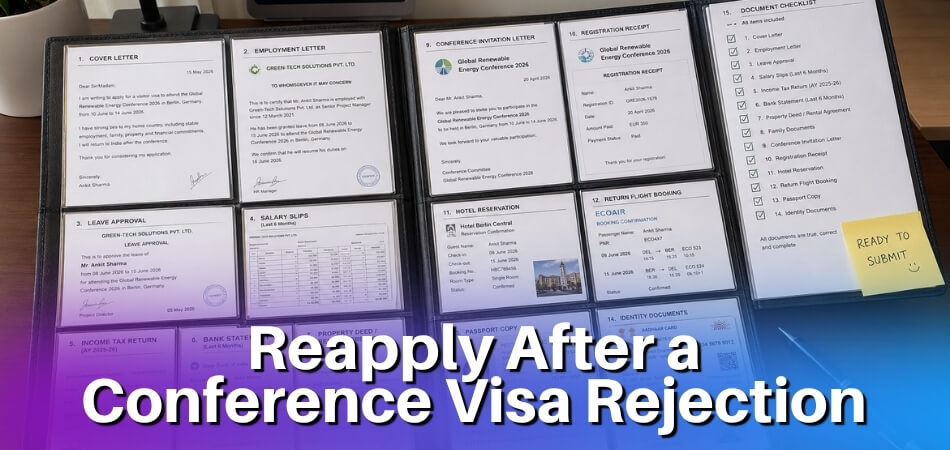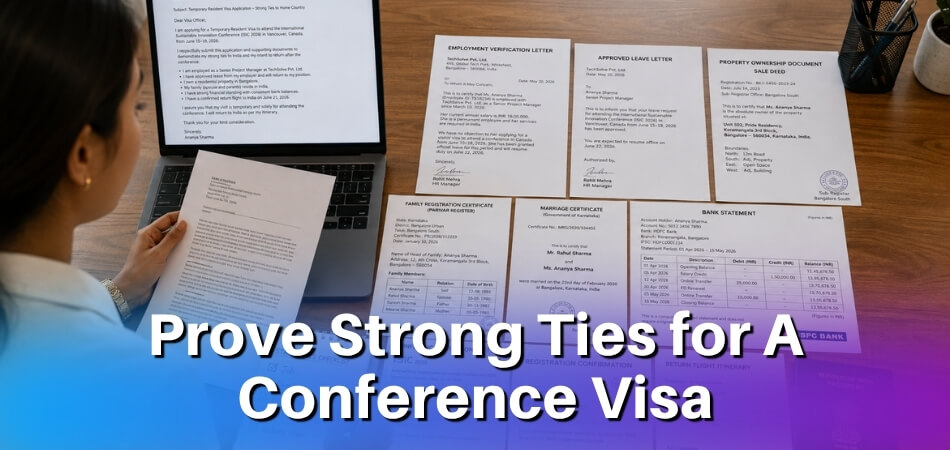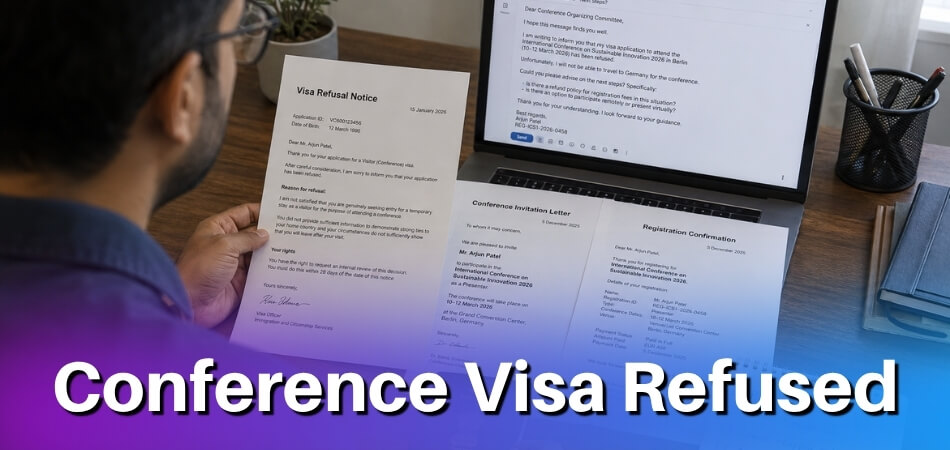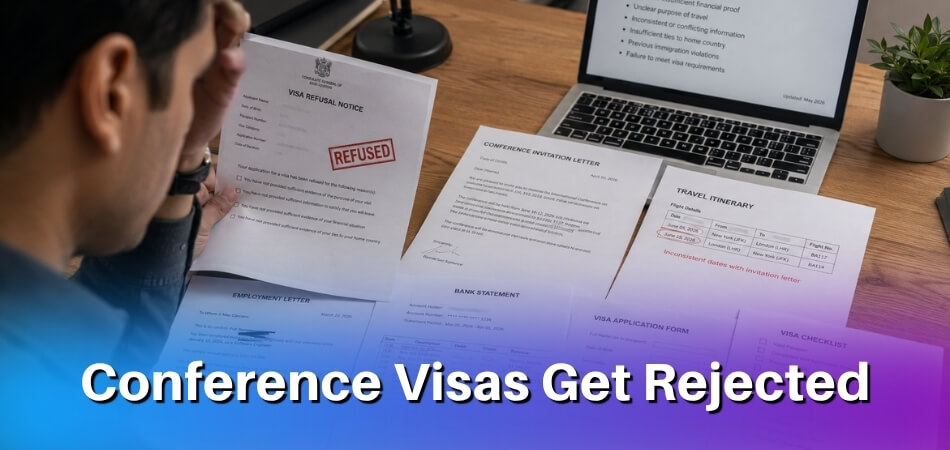

A conference invitation feels like the finish line, but for the embassy it is only the first page. The rest of the file is where plans quietly fall apart, and the gaps are usually small ones. Here is how to build a set of papers that holds together.
Quick answer: For a conference visa you need a valid passport, a conference invitation letter, proof of registration and payment, an employer or sponsor letter, 3 to 6 months of bank statements, hotel and return flight bookings, and travel insurance. Insurance with at least €30,000 medical cover is mandatory for Schengen. The USA adds a DS-160 form and an interview. The UK and Ireland use their own online applications.
Fact-checked by the MS International Editorial Team. Last verified against official sources: October 2026.
You have the invitation letter and now you are staring at the embassy checklist. Most people assume the invitation is enough, then find out at the appointment that the fee receipt is missing, the sponsor letter has no amounts in it, or the registration proof is a phone screenshot. Generic lists cover the basics. They rarely explain how a Schengen application differs from a UK Standard Visitor Visa or a US B1/B2, and those differences decide whether a file is accepted or sent back.
This guide covers the core documents, the conference-specific letters and what they must contain, the differences by destination, multi-country trips, children, processing times, the interview, and what to do after a refusal.
What Documents Are Required for a Conference Visa? The Complete Checklist
The core documents are in the table below. What each embassy adds on top of them is where applications go wrong, and the sections below cover those differences.
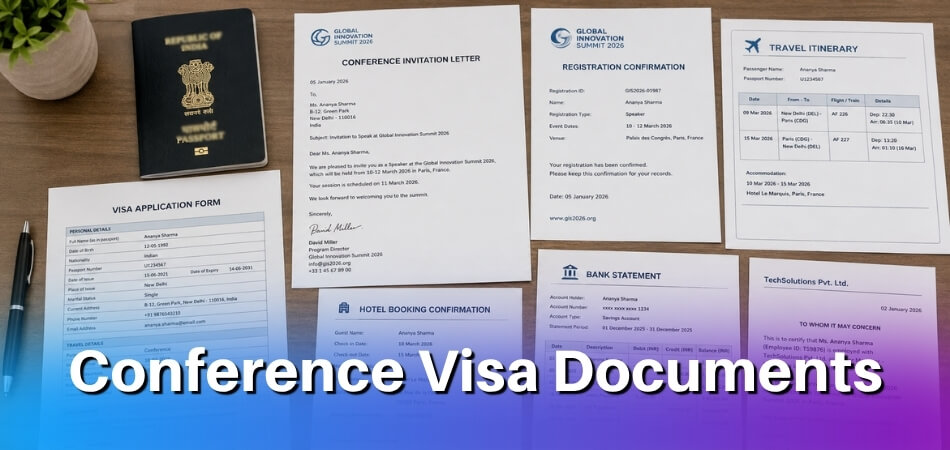
Core Documents Every Conference Visa Application Needs
These apply whatever the destination. Get them wrong and nothing else in the file helps.
| Document | What the embassy wants to see |
|---|---|
| Valid passport | Two blank pages and enough validity. Six months beyond your trip is a safe habit; the Schengen minimum is 3 months after you leave, with the passport issued in the last 10 years |
| Application form and photo | The form for your destination (DS-160 for the USA, online forms for the UK and Ireland, the Schengen form) and a photo that meets that country’s specification |
| Conference invitation letter | Written by the organiser (not an automated email) with your name, event, dates, venue and your role |
| Conference registration proof | The official PDF or confirmation with your name, registration ID and event details. A screenshot is weak |
| Fee payment receipt | Shows the registration is paid. A bank statement line alone is rarely accepted |
| Employer or institution letter | Confirms your job, approved leave, the purpose of travel and your return date |
| Financial statements | Usually 3 to 6 months of bank statements with steady, believable balances |
| Return itinerary | Return flights on paper. A flexible or refundable booking is fine, as long as the dates are real |
| Hotel booking confirmation | A reservation in your name covering every night. A search-results screenshot does not count |
| Travel insurance | Mandatory for Schengen (minimum €30,000). Not required for the UK or USA, but it strengthens the file |
Documents that are not in English or the destination’s official language may need certified translations; the UK, for example, asks for them for anything not in English or Welsh. Add a cover letter that states your purpose, dates and who pays. Add a sponsor letter if a third party covers costs, and a written explanation if you have had a visa refused before. If you are bringing a child, see the minor applicant section below.
Book your biometrics appointment where required, and check that names and dates match across the registration proof, fee receipt and invitation letter. Take the biometrics appointment confirmation with you, because desk staff may ask for it. Start 6 to 8 weeks before travel at the very least. Busy conference seasons slow everything down, and the United States can need several months, as covered in the processing section.
Special Conference-Specific Documents That Most Checklists Leave Out
Passport and bank statements show you can travel. The conference papers show why you are travelling, and a gap here is a common reason for a request for more documents even when your finances are fine.
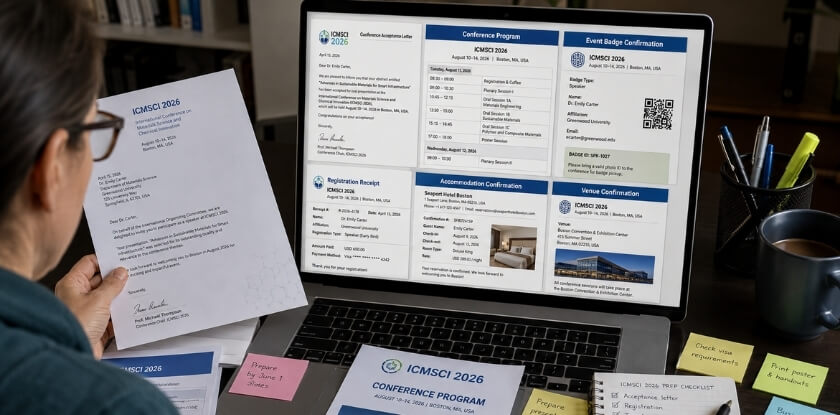
Conference Registration Proof and Fee Payment Receipt
Embassies use these to confirm the event is real, the dates match your travel window and you have committed money to attending. You need two things:
- A confirmation email or PDF from the organiser showing your full name, the event name, dates and venue
- A fee payment receipt showing amount, currency, date and your name
The receipt matters because it shows a financial commitment. Anyone can claim they are attending a conference. A paid registration is harder to fake.
If the event is free, ask the organiser for a short written confirmation that no fee applies. A blank space where a receipt should be looks like something was forgotten. Print everything. Some application centres will not look at documents on a phone screen.
Conference Organiser’s Invitation Letter: What It Must Include
A generic “we invite you to attend” email carries little weight. A useful letter, whether it comes from MS International or any other organiser, contains:
- Your full name exactly as in your passport
- The official name of the conference
- Exact start and end dates, not just a month
- Venue name and full address, with city and country
- A short description of the event and your role: attendee, speaker, panelist or poster presenter
- Whether the organiser covers any costs (accommodation, meals, travel), or whether you are self-funded
- Letterhead, signatory name and title, signature and contact details
- The date the letter was issued
A defined role such as speaker helps with the UK Standard Visitor Visa and the US B1/B2. Ask for a recent letter: one issued many months before your application looks stale. Ireland’s immigration service also expects the letter to say clearly whether the organiser is sponsoring you or you are paying yourself, and a missing line usually triggers a request for more documents.
Employer or Institution Support Letter
This letter shows your employer knows about the trip and that you have a job or academic post to return to. That second point answers the question every visa officer is really asking, which is whether you will leave on time.
A short version works:
To Whom It May Concern,
This letter confirms that [Full Name], holding the position of [Job Title] at [Company/Institution Name], has been granted leave to attend [Conference Name] from [Date] to [Date] in [City, Country].
[Name] has been employed with us since [Start Date] and will resume duties on [Expected Return Date]. We support their attendance at this event.
[Signature, Name, Title, Date, Company letterhead with contact details]
Two short paragraphs are enough. If the employer pays, say so and list what is covered. PhD students and postdocs can ask a department head or supervisor to write it on university letterhead, with enrolment or contract status included. For a US interview, keep a printed copy: it is often the first document an officer asks about.
Sponsor Letter (If a Third Party Pays)
If a company, association, government body or family member pays for any part of the trip, you need a sponsor letter. It is separate from the employer letter because it deals with financial responsibility.
I/We, [Sponsor or Organisation Name], confirm that we will cover the travel and accommodation costs for [Applicant Full Name] for their participation in [Conference Name] from [Date] to [Date] in [City, Country].
This includes [list exactly what is covered: flights, hotel, daily expenses, registration fee].
[Sponsor signature, date, contact details, and official letterhead if an organisation]
Attach the sponsor’s own financial statements. A letter promising funds that nobody can see will not hold up. Three more points:
- A company letter should come from someone with signing authority, such as a director, HR head or finance officer.
- If a private individual in the destination country sponsors you, some consulates ask for a notarised version. Check before you submit.
- For multi-entry applications, say whether the sponsorship covers every trip or only the first.
Whatever the destination, a cost claim that your bank statements do not support gets the whole file examined harder. Be specific about amounts, dates and a named contact. “We are happy to host you” is not a funding statement.
Schengen vs Non-Schengen Conference Visa: Key Document Differences
The country hosting your conference changes your list more than most people expect. Some want specific formats, translations or wording in the invitation letter. The biggest mistake is treating Ireland and the UK like Schengen countries: neither is in the Schengen Area, so a Schengen visa does not cover them.
Schengen Countries (Example: the Netherlands)
For a conference in Amsterdam you apply for a Schengen short-stay visa, with the Dutch embassy or consulate (or its visa centre) in your country. If your trip covers several Schengen countries, apply to the country where you spend the most nights, or to the country of first entry if the stay is equal. The European Commission says to apply no more than 6 months and at least 15 days before travel.
What is specific to Schengen:
- Travel insurance is mandatory. At least €30,000 of medical cover, valid across the whole Schengen Area and for your entire stay. Applications without it are refused.
- Visa fee: €90 for adults and €45 for children aged 6 to 11 at the time of writing. Embassy pages still showing €80 are out of date. Check your consulate’s fee list.
- Itinerary and hotel: refundable bookings are common, but cancel only after the visa arrives.
- Funds: the required daily amount differs by country, so look at the embassy’s own guidance. If you add tourist days to the conference, show you can pay for those too.
- Biometrics: fingerprints and a photo at an in-person appointment.
- Interview: not usual, though an officer can ask for one.
Some consulates check that the conference appears on the organiser’s public website. If it does not, expect extra questions.
Ireland (Not Schengen)
For Dublin you apply for an Irish short-stay visa through the AVATS online system, choosing the Short Stay (C) visa and “Conference/Event” as the reason for travel. It has a separate application, fee and timeline from any Schengen visa. After you create the AVATS application, your passport and documents must reach the Irish application office within 30 days or it will not be processed, and original documents are required, not photocopies alone. The core documents are the same: invitation letter, registration proof, employer letter, financial statements, itinerary and hotel. Irish embassies publish their own processing times and fees by post, and say you can apply up to about 90 days before travel. There is no set minimum amount, but you must show enough money to support yourself in Ireland. Self-employed applicants should expect requests for more detailed financial evidence. If you were ever refused a visa by any country, describe it and include the refusal letter, because leaving it out can itself lead to a refusal. Travel insurance is recommended; confirm the rule for your visa type on the Irish immigration service website.
United States: B1/B2 Visa
There is no conference visa. You apply for the B1/B2 visitor visa, and conference attendance is business travel under the B1 category. You complete the online DS-160 form, pay the visa fee and attend an interview. The interview waiver has been narrowed sharply since late 2025 and now covers mainly renewals of a recently expired visa, so a first-time conference visitor should plan on attending in person.
What to bring:
- DS-160 confirmation page and fee receipt (the State Department lists US$185 for the B1/B2 application fee; check its fee page for any other charge)
- Passport (the US has agreements that waive the six-month rule for some countries)
- Invitation letter and registration proof. The State Department says a letter of invitation is not needed to apply and is not a factor in the decision, but a letter and proof still answer the officer’s questions fast
- Employer letter, naming the conference, who pays and your return date
- Bank statements, especially if self-funded or self-employed
- Return itinerary and a note of where you will stay
You generally apply at the US embassy or consulate in your country of nationality or residence. Insurance is not required. There is no fixed document list as there is for Schengen, and officers have discretion, so your answers count as much as your papers, and the US embassy can check your bank statement if anything looks doubtful. If a US university or company pays, its sponsor letter should state the amount, what it covers and a contact person. Answer the DS-160 question about previous refusals honestly: misrepresentation causes a much bigger problem than a past refusal.
United Kingdom: Standard Visitor Visa
The UK also has no conference visa. You apply online for the Standard Visitor Visa and state a conference or business event as your purpose. You then book a biometrics appointment at a visa application centre, which may be in another country. GOV.UK lists the Standard Visitor visa at £135 for stays of up to 6 months and says the earliest you can apply is 3 months before you travel. Check the current fee before you pay. If your nationality does not need a visa, you may need a UK electronic travel authorisation (ETA) instead.
- Travel insurance is not a required document.
- The invitation letter should be on letterhead and give your name, the dates, the venue and your role.
- The UK does not publish a minimum balance, but it looks for steady finances. A large deposit just before applying draws attention, because officers want money that was already there.
- Include employer and sponsor letters, hotel and return travel, and details of your earlier travel. The form can ask for up to 10 years of travel history, so have the dates ready.
- GOV.UK advises you not to book your travel until you have a decision, so choose refundable bookings.
Payment is the trap. Attending, and speaking without payment, fits the visitor visa. If you will receive a fee or honorarium, it may only be allowed under the “permitted paid engagement” rules, so check the UK government’s visit guidance before you apply. Frequent visitors can apply for a long-term visit visa valid for 2, 5 or 10 years, but you need a clean travel history to get one.
India: A Dedicated Conference Visa
A few countries do have a conference visa category, and India is the best known. Indian missions issue it to people whose only purpose is a conference, seminar or workshop in India, and the stay can include some sightseeing. Typical documents are an invitation letter from the organisers in India and a letter of introduction from your employer or institution. Some applicants also need clearance from Indian government ministries, for example participants from certain countries or events in restricted areas. The organisers in India apply for that clearance, not you, so ask them early. Rules and fees differ by mission, so check the Indian embassy or visa centre that serves you.
Differences at a Glance
| Item | Schengen (e.g. Netherlands) | Ireland | UK Standard Visitor | USA B1/B2 |
|---|---|---|---|---|
| Separate visa needed? | Yes | Yes | Yes | Yes |
| Travel insurance | Mandatory, €30,000 | Recommended | Not required | Not required |
| Interview | Rare | Rare | Rare | Almost always |
| Biometrics | Yes, in person | Yes, where required | Yes, at the application centre | Yes, as part of the appointment |
| Where to apply | Embassy or visa centre | AVATS, then embassy or visa centre | UK government site, then visa centre | DS-160, then US embassy |
Multi-Entry Visa: What to Do When Attending Conferences in Multiple Countries
Back-to-back conferences are common in academia and business, and the visa side gets complicated quickly.
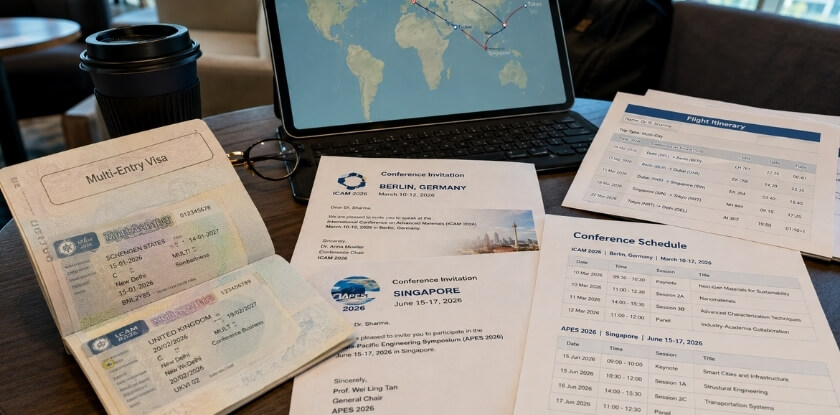
When You Need a Multi-Entry Visa
A single-entry visa is used up when you enter, so it fails if you leave the area and come back. Moving between Schengen countries on one visa is fine: a Dutch conference followed by a German one needs no second visa. The problem comes when you leave the Schengen Area and return. A Netherlands conference, then London, then back to Paris means you re-enter Schengen, and you need a multiple-entry Schengen visa. The same logic applies to a US conference followed by a Canadian one and a return to the US. Canada needs its own application, and for its money evidence IRCC reviews the bank statements you submit rather than your account itself.
Documents to Request Multi-Entry Status
You do not get multi-entry just because your itinerary shows several stops. Ask for it, and back the request with:
- A cover letter that asks for multiple entries and explains why
- An invitation letter or registration proof for each event, one per conference
- A fee receipt for each registration
- A full itinerary covering every leg, including your return home. Gaps raise flags
- Hotel confirmations for each location, with dates matching your entry and exit exactly
- An employer letter that mentions every conference, not just the first
- Bank statements that show you can fund a longer, multi-country trip
Combinations to Plan For
UK plus Europe. The UK visa and the Schengen visa are separate. A trip that includes both means two applications with two sets of documents, each with its own hotel proof and compliant insurance (€30,000 for Schengen).
Ireland plus Europe. Dublin sits outside Schengen, so it is a further separate application, unless your nationality has a special arrangement.
Several US conferences. One B1/B2 visa covers the whole trip, but be ready to explain every conference at the interview. If you leave the US mid-trip and come back, check whether your visa allows multiple entries before booking. If your plans include any international movement, request multiple entries from the start.
Practical Notes
A refused multi-entry request does not always mean the whole application fails. If the reason is weak justification, you can usually apply again with a stronger cover letter. Start multi-entry applications at least 8 to 10 weeks before departure, because parallel applications take time and some countries ask you to attend in person for biometrics more than once.
Additional Documents Required for a Minor or Child Applicant
Bringing a child to a conference is uncommon, but it happens, for example when a presenting parent cannot arrange childcare. The paperwork is meaningfully different from an adult’s, and one missing item can cause a refusal.
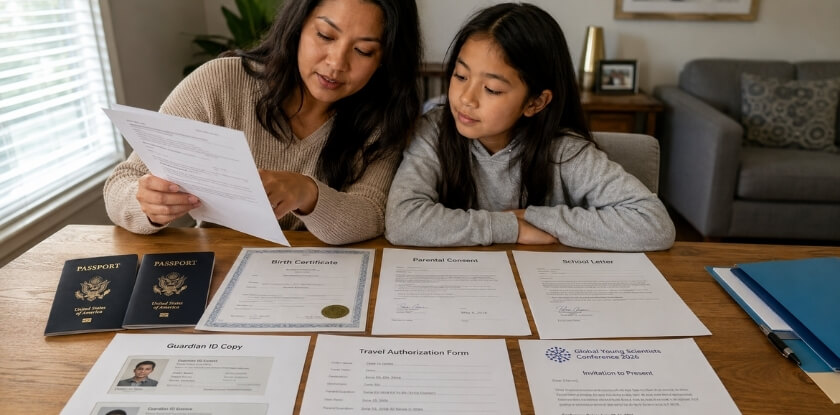
Identity and Relationship
The child needs their own valid passport. Children’s passports often expire sooner than adults’ (five years in many countries), so check the dates. You also need an official copy of the birth certificate, professionally translated if it is not in English or the destination language. For a guardian or grandparent travelling with the child, add legal proof of the relationship, such as guardianship papers or an adoption certificate. An interview may be requested to verify it.
Parental Consent
This is the item people miss. If one parent is not travelling, that parent should provide notarised consent. A plain letter is often not enough. Some countries, the Netherlands and Ireland among them, may also ask for proof of sole custody or a court order if one parent has died or lost parental rights. If both parents travel but only one is named on the application, you may still need a declaration from both. Read the embassy’s guidance on this point.
Support Documents
- School letter: confirms enrolment and approved absence. Not always mandatory, but it shows the child’s ties to home.
- Finances: your statements and any sponsor letter should clearly cover the child’s costs and name the child.
- Hotel and flights: both names should appear on the booking and the tickets.
- Insurance (Schengen): the policy must name the child, cover the whole trip and meet the €30,000 minimum. A policy in the parent’s name does not cover a child.
Biometrics for Children
For a Schengen visa, children under 12 do not give fingerprints. For the USA, age-based rules on fingerprints and interviews have changed recently, so confirm the position on the US embassy page for your country. These thresholds shift, so check them close to your application date.
Put the child’s papers in a separate, labelled sub-packet inside your file. Officers handle high volumes, and an easy-to-find set is less likely to be overlooked.
Processing Time, Embassy Interview Preparation, and Biometric Data
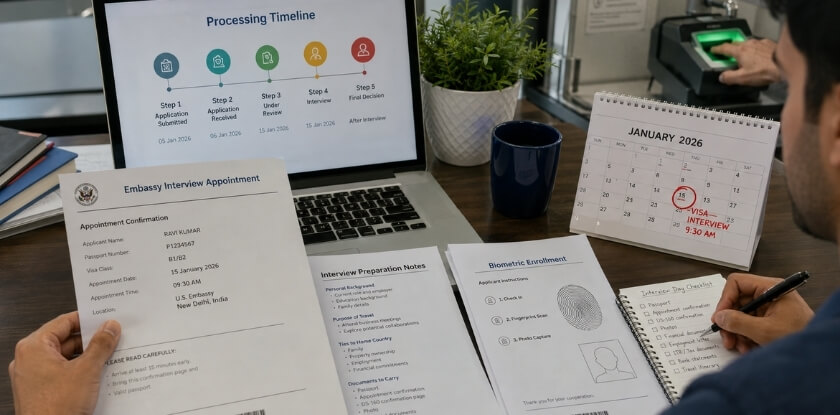
Estimated Processing Time by Country
Do not assume two weeks is enough anywhere. The figures below are general guides, so confirm the current time on the official site of the embassy that will handle your file.
Schengen. The standard decision window is 15 calendar days from a complete application, and it can extend to 45 days in complex cases. Busy periods often push consulates toward the longer end.
USA B1/B2. The wait has two parts: the interview appointment, which can be many weeks or months depending on the post, and the processing after the interview. The State Department publishes wait times for each embassy. Many approved cases move on within days. If administrative processing is triggered, the State Department asks you to wait at least 180 days before asking about it, except in emergencies. For a US conference, apply as early as you can.
UK Standard Visitor. GOV.UK says you usually get a decision within 3 weeks of applying, proving your identity and providing your documents. A paid faster decision may be available at extra cost, so check GOV.UK for current options and fees.
Ireland. Times vary by post and visa type. Look at the processing page of the Irish embassy or visa office that serves you, and apply as soon as the application window opens.
| Visa | Typical decision time (guide only) | Buffer to add |
|---|---|---|
| Schengen | 15 days, up to 45 | 2 to 3 weeks |
| USA B1/B2 | Interview wait plus days to weeks after | Several months |
| UK Standard Visitor | About 3 weeks | 1 to 2 weeks |
| Ireland | Varies by post | At least a few weeks |
One rule applies everywhere: check your passport first. A passport with too little validity can stop the application at intake, before anyone reads your documents.
What Is Asked at the Embassy Interview, and How to Prepare
Schengen, UK and Irish applications usually involve a biometrics appointment, not an interview, although you can be called in. The US B1/B2 almost always requires one. The questions are more predictable than people fear:
- What is the purpose of your visit? One sentence: “I’m attending [Conference Name] from [dates] in [city]. It’s a conference in [my field].”
- Who is paying? Know whether it is your employer, a sponsor or you, and keep the matching letter handy.
- What do you do for work? Keep it simple and the same as your documents.
- Have you been to the US before? Answer plainly.
- Do you have ties to your home country? A permanent job, family, property, ongoing contracts. Think through your answer beforehand.
- What happens after the conference? Point to your return ticket.
The interview is often short, and the officer is checking that your story matches your papers. At a Schengen biometrics appointment, desk staff may review your file before accepting it, and a missing hotel booking, insurance policy or invitation letter can mean rejection on the spot and sometimes a rebooking fee.
A few habits help at any appointment:
- Know your exact travel dates. “Around mid-October” invites doubt.
- Be ready to explain any unusual deposit in your bank account.
- Answer what is asked, in short clear sentences.
If you gave biometrics for an earlier application, they may still be on file, which can smooth the administrative step. The document requirements do not shrink.
What to Do If Your Visa Is Rejected: The Appeal Process
A refusal hurts, especially when you had every document ready. What you do next depends on the country and on the reason in the refusal notice.
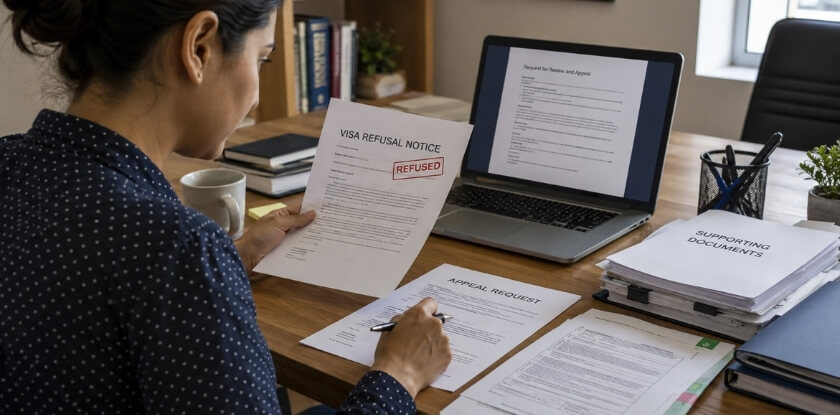
Read the refusal letter slowly. It states the reason, and the reason tells you whether to appeal, reapply or fix one specific gap.
Rights by Country
- Schengen: the notice lists standard refusal grounds, such as insufficient funds, doubts about your return or missing insurance. The Netherlands, for example, uses a form with ticked boxes. Appeals go to the authority named in the letter, and deadlines differ by country, often a few weeks, so read your notice for the exact date.
- USA B1/B2: there is no formal appeal. Your options are to reapply with stronger evidence, or ask for an expedited appointment if there is a genuine time-critical reason.
- UK Standard Visitor: for a visit visa refused from outside the UK there is generally no appeal or administrative review, so a fresh application is the usual route. Your refusal letter states which rights apply.
- Ireland: from 1 June 2026 applicants can no longer appeal the refusal of a short-stay visa, except in cases under the EU Free Movement Directive. A fresh application that deals with the reasons in your refusal letter is the route.
Reapplying or Appealing
For most conference travellers, reapplying is faster and more practical than an appeal, which can drag on past your event. Fix the exact gap the embassy named. If it was funds, add longer bank statements, salary slips and an employer letter covering costs. If it was doubt about your return, add your itinerary, evidence of family and property ties, and an employer letter confirming leave and return to work. Resubmitting the same file is the most common mistake.
Declare the earlier refusal honestly on the new form. Hiding it can lead to automatic refusal and affects future applications. Some countries also flag very quick reapplications.
Special Cases
If you hold a multi-entry visa from one Schengen country and are refused for another, check which embassy had jurisdiction before you reapply. For a minor, keep every minor document in the new file along with the fixes. If you had an interview, think about what went wrong (inconsistent answers, a vague conference purpose, a weak financial position) and practise being short and specific about why you attend, who pays and why you will return.
Keep records of everything you submitted, with dates and notices. They become part of your history if you apply to that country again.
From our experience at MS International: We may need to contact you when a name does not match the passport or details are missing, and that slows the letter down. Our letter is issued within 3 to 5 business days after payment clears, so register and pay before you start the visa file, and check your name and passport details before you send them, because a US$50 fee applies to corrections after the letter is issued. The letter supports a visa application but does not guarantee a visa. Our events are held in person in the Greater Toronto Area.
Frequently Asked Questions (FAQ)
Paperwork gaps tend to show up late, such as a passport that expires in 8 months, a return itinerary that is not a confirmed ticket, documents for a minor and trips covering conferences in several countries.
Do I need a separate conference visa, or can I use a tourist visa?
No. The USA, UK and Schengen area have no separate conference visa: you apply for the standard visitor or short-stay visa and state a conference as the purpose, not tourism. India, for example, issues a dedicated conference visa.
Is a conference invitation letter the same as conference registration proof?
No. The invitation letter comes from the organiser and states who you are, the event and your role. Registration proof is the confirmation (and fee receipt) that shows you actually registered and paid. Many embassies want both.
Does a conference invitation letter guarantee a visa?
No. An invitation letter supports your application by showing the purpose of the trip, but the embassy decides. Your finances, ties to home and travel history count as well.
Does my fee payment receipt matter if I already have a registration confirmation?
Yes. A confirmation shows you signed up, but not that the payment went through, and some consulates want to see the transaction. Attach the receipt as a separate document rather than leaving it inside an email chain.
Can my employer support letter double as a sponsor letter?
Sometimes. If your employer pays, the letter must say so, list what is covered and give a contact person. A line such as “we support their attendance” confirms permission only, not funding.
Do I need travel insurance for every country?
No. Only Schengen visas make it a condition, with at least €30,000 of medical cover. The USA and the UK do not require it, though a policy covering medical care and cancellation is wise for a US trip. Check the Irish immigration service for your visa type.
When should I book the hotel?
Book before you apply, and choose a refundable booking where you can. Embassies want a reservation covering your stay, so a fully paid non-refundable room is a risk if dates move.
What if I attend conferences in several countries on one trip?
You may need a multiple-entry visa or separate visas. Within Schengen, one visa covers all member states, but Ireland and the UK are outside it. See the multi-entry section above.
Does a minor need different documents?
Yes. Add the child’s own passport, birth certificate, parental consent (notarised if one parent stays home), and a custody document where relevant. Insurance and hotel bookings must name the child.
What does biometrics submission involve?
Usually fingerprints and a photo, taken in person at an embassy or visa application centre. You cannot do it remotely. Book early in busy conference months.
If my visa is refused, can I reapply immediately?
Often yes, but it rarely works without changes. Address the reason in the refusal letter first, then submit a stronger file. Appeal rights differ: none in the USA, generally none for UK visitors, none for Irish short-stay refusals since 1 June 2026, and Schengen rules vary.
Is a return itinerary the same as a confirmed ticket?
Not exactly. An itinerary shows your plan; a confirmed ticket is a real booking. Some consulates accept a provisional booking, others want a paid ticket. Check the specific embassy.
My passport expires in 8 months. Is that a problem?
For Schengen, you need at least 3 months after you leave, so 8 months can pass. For other destinations, a passport within 6 months of expiry is risky, and renewing first is safer.
How early should I apply?
Apply as soon as the window opens. Schengen accepts applications from 6 months before travel and the UK from 3 months before. Aim for at least 6 to 8 weeks for either, longer for Ireland, and check the embassy wait time first for the USA.
Final Thoughts: Make Every Document Tell the Same Story
Most conference visa refusals are not about unqualified people. They happen because a document is missing, the funds do not cover the trip, or the invitation letter is vague about dates and purpose. Before you submit, make sure every document shows the same name, dates and funding story, and keep the Schengen, Irish, UK and US rules separate: a route through more than one of them means more than one application, so plan it early.
Disclaimer: This article is general information, not legal or immigration advice. Visa rules, fees, and processing times change. Confirm the current requirements on the official government website of the country you are visiting (for example the US Department of State, GOV.UK or the Irish immigration service) before you apply.