
Planning a trip to a conference in Canada is exciting until the visa question appears. Nobody can promise the exact day a decision will arrive, and the event will not move to wait for you. That is why it pays to understand the process early.
Quick answer: A Canada conference visa usually takes a few weeks, but your own wait depends on your country of residence, biometrics and any extra checks. Look up your country in IRCC’s processing-times tool and apply as soon as your conference registration is confirmed. If you only need an eTA (CAD 7), approval usually comes within minutes.
Fact-checked by the MS International Editorial Team. Last verified against official sources: October 2026.
This guide is about timing for Canada only: which steps use up your weeks, which ones you control, and how early to start before the event.
Most visa-required attendees apply for a Temporary Resident Visa (TRV) as a business visitor. Travelers from visa-exempt countries who fly in may only need an Electronic Travel Authorization (eTA).
How Long Does Each Step of the Canada Conference Visa Process Take?
The wait is more than IRCC’s review time. Your total timeline also includes gathering documents, biometrics, any extra requests from IRCC, and the passport stage after approval. IRCC says its processing time starts the day it receives your complete application, so the weeks you spend gathering documents come on top of its estimate, while the time to give biometrics is already inside it.
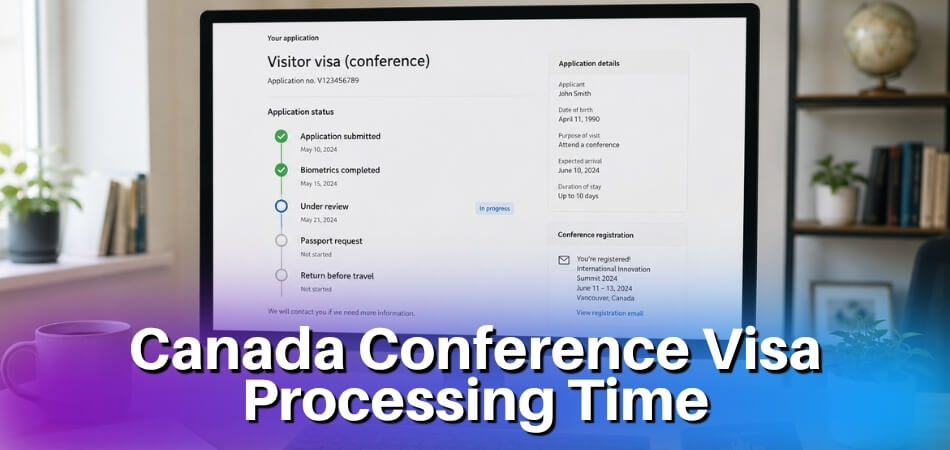
Here is how the steps fit together for a visa-required applicant:
| Step | Who controls the time | What to plan for |
|---|---|---|
| 1. Prepare documents and complete the online application | You | Start once registration is confirmed |
| 2. Submit and pay the fees | You | Pay the biometrics fee together with the application, or you may be delayed |
| 3. Receive the biometrics instruction letter (BIL) | IRCC | Online applicants can get it within about 24 hours of paying |
| 4. Book and attend the biometrics appointment | You and the visa application centre | You have 30 days from the date on the letter |
| 5. Review, eligibility checks and background screening | IRCC | IRCC says most applications take “a few weeks or less”, but this varies by office |
| 6. Decision or passport request | IRCC | Shown in your online account |
| 7. Submit your passport for the visa, then wait for its return | You and the courier or centre | Do not book a flight until the passport is back with the visa |
If your country is visa-exempt, the timeline is much shorter. The eTA is processed online and IRCC says most applications are approved within minutes. Some need documents first, and then you get an email with instructions within 72 hours.
Is There a Separate Conference Visa for Canada?
No. Canada does not have a visa category officially called a “conference visa.” People use the phrase because they are traveling to a conference, seminar, trade event or professional meeting. In immigration terms, visa-required attendees apply for a visitor visa for business visitor activities.
A business visitor comes to Canada for short-term business-related activities without entering the Canadian labor market. IRCC says business visitors usually do not need a work permit, and a stay of more than 6 months or any plan to work in Canada can make you a temporary worker instead. Attending a conference fits when you are not hired by a Canadian employer and not doing paid work. A business visitor may usually attend:
- Conferences, seminars and training sessions
- Business meetings and business discussions
- Trade shows and professional networking events
Do not use this visa to take a Canadian job, perform paid services for a Canadian company, or stay beyond the authorized period. If your conference role includes employment, paid performance or hands-on work, you may need a different authorization. Choosing the wrong purpose can slow down your application or lead to refusal.
Visitor Visa, TRV, eTA or Work Permit: Which One Do You Need?
The document you need depends mainly on your nationality and purpose of travel. You need a visitor visa (TRV) if your passport country is visa-required for Canada. You may need only an eTA if your country is visa-exempt and you are flying to Canada.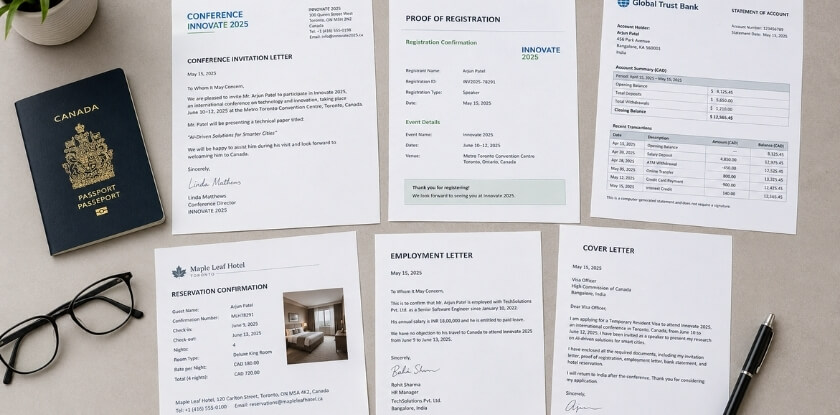
A Temporary Resident Visa, often called a visitor visa, is placed in your passport after approval and lets you travel to a Canadian port of entry. The border officer makes the final decision to let you in. The application is more detailed than an eTA: document review, biometrics, proof of funds, travel history and background checks can all add weeks.
An eTA is electronically linked to your passport and is far simpler. Apply before booking your flight, and still allow a few days in case your case needs extra review. Since 26 May 2026, citizens of Indonesia and Malaysia who meet certain requirements may be able to apply for an eTA instead of a visitor visa when flying to Canada, so check your own eligibility on the IRCC site before you assume you need a visa.
A work permit is usually needed when someone will work in Canada, provide services or enter the Canadian labor market. Most conference attendees do not need one, but some speakers, performers, contractors or paid participants should check their situation carefully.
Two people attending the same event can have completely different timelines because they hold passports from different countries. Confirm which rule applies to your nationality before you plan.
Main Factors That Affect Canada Conference Visa Processing Time
Processing time depends on your personal application and on conditions at the visa office. Even two similar applications may not take the same time.
Country of Residence and Visa Office Workload
IRCC says processing time depends on how many applications it receives from a given country, whether your application is complete, how quickly biometrics and documents are provided, and whether extra security screening is needed. Offices differ in staffing and local procedures, which is why applicants from different countries get decisions at different speeds.
Peak Travel Seasons
Applications often increase before holidays, summer travel, winter breaks and academic terms. When more people apply at once, processing can slow down, so apply well ahead of a busy period rather than in the final few weeks.
Completeness and Document Quality
An incomplete application is one of the most common reasons for delay. Missing forms, blank fields or inconsistent details can make IRCC ask for more information, and the review may only restart once you reply. Blurry, cropped or outdated documents slow down the officer in the same way, because the officer must understand your travel purpose quickly.
Background and Eligibility Checks
Officers review your identity, travel history, purpose of visit, funds and intention to leave Canada. Limited travel history, past refusals, unclear employment or inconsistent documents can mean a longer review. This does not always mean refusal.
What Happens After You Submit Biometrics?
After biometrics, your application continues through review, verification and a decision. Biometrics do not mean your visa is approved. They are one required step, and IRCC cannot finalize most applications without them.
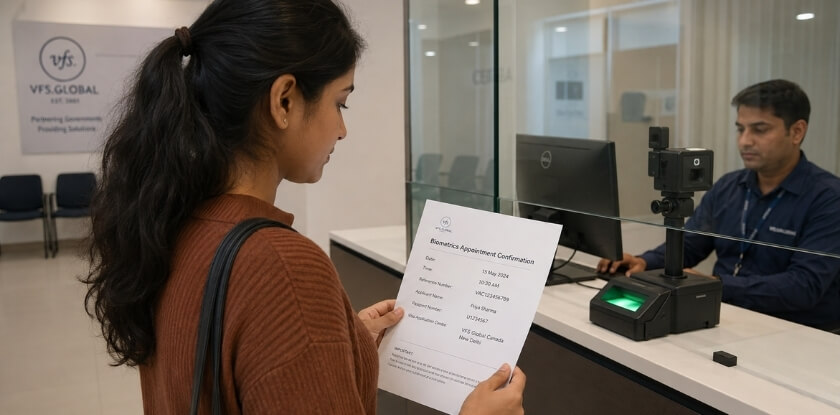
Biometrics are fingerprints and a photo. If you apply online and pay the fee with your application, the instruction letter can arrive within about 24 hours. Book the appointment immediately: you have 30 days from the date on the letter, booking is free, and you must bring the letter and your passport. If the centre has no appointments within 30 days, you can ask IRCC for more time through its web form, with your appointment date and a screenshot of the confirmation if you have booked. Biometrics are generally valid for 10 years, so you may not need to repeat them for a later application.
After that, IRCC may continue checking your identity, travel purpose, funds, conference invitation, ties to your home country, immigration history and security information. You may get a decision with no further requests, or IRCC may ask for more documents, clarification, a medical exam, a police certificate or an interview.
If approved, a letter in your online account asks you to submit your passport. Use the same passport you applied with, because a newer one can delay processing. You cannot travel until the visa is placed in the passport. If refused, you receive a refusal letter with the main reasons.
Documents That Can Help Prevent Canada Conference Visa Delays
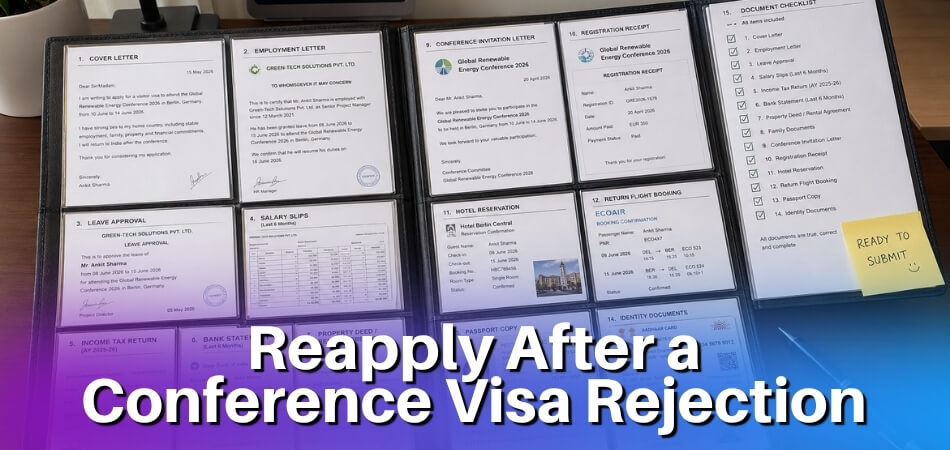
Strong documents do not guarantee approval, but they reduce avoidable delays. Your goal is to make your purpose of travel clear, credible and easy to verify.
Valid Passport
Upload a readable copy with no cropped edges or glare. If your passport is close to expiry, renew it before applying when possible.
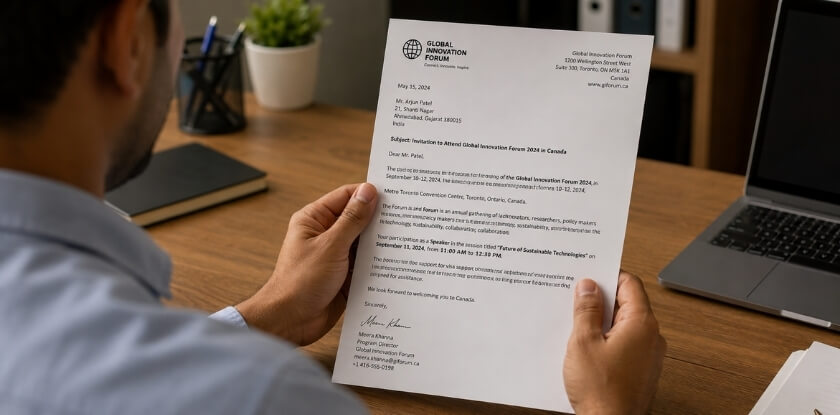
Official Conference Invitation Letter
A conference invitation letter is one of the most important documents for this type of visit. The conference organizer should issue it, not the applicant. A strong letter includes:
- Your full name
- Conference name, event date and location
- Organizer name and contact details
- Your role as attendee, speaker, presenter, guest or participant
- Registration confirmation, if available
- Any event identification number or special event code, if provided
Proof of Registration or Participation
Include your confirmation email, payment receipt, ticket, acceptance letter, abstract approval or speaker confirmation. For academic events, add proof of your accepted paper, presentation slot or poster session.
Proof of Funds
Show you can pay for flights, accommodation, food, local transport, registration fees and emergencies. This may include bank statements, salary slips, business income documents, sponsorship letters or employer support letters. If someone else is paying, include their financial documents and a clear explanation of your relationship.
Travel Itinerary and Accommodation
You do not always need a flight ticket before approval, but a planned itinerary helps: tentative dates, hotel booking or host invitation, and the conference schedule. The address should make sense for the event location. Avoid non-refundable bookings until your visa is approved.
Ties to Your Home Country
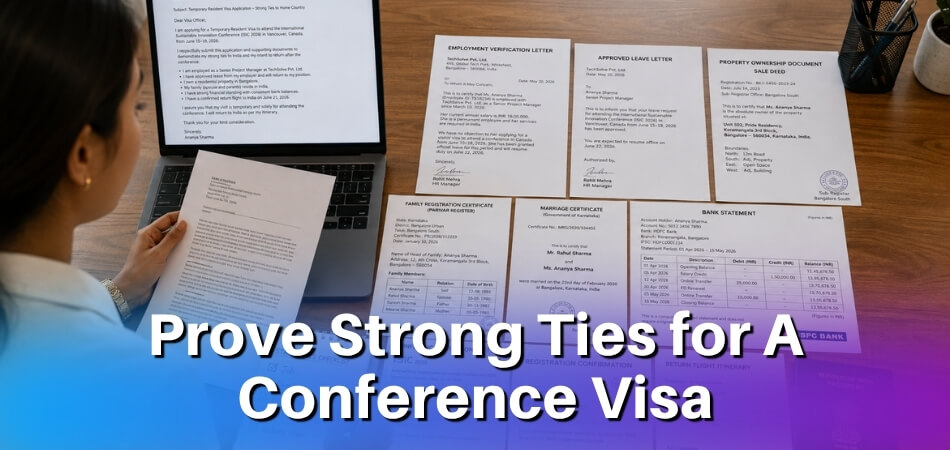
Officers want to see that your visit is temporary. Useful evidence includes an employment letter, school enrollment, business ownership documents, property records, family responsibilities, an approved leave letter or ongoing contracts.
Previous Travel History
Previous visas, entry stamps and travel records support your credibility. Not having a travel history does not automatically mean refusal, but your other documents should then be especially clear.
Cover Letter
Keep it short and cover the essentials: why you are attending, your role, how long you will stay, who is paying, why you will return home, and which documents you included. Make sure it matches your other documents.
Sample Conference Invitation Letter for a Canada Visa Application
A conference invitation letter should be formal, specific and verifiable. It should not sound generic or vague. The organizer should include enough details for IRCC to confirm the event and your participation.
Here is a simple format:
Date:
Applicant Name:
Applicant Address:Subject: Invitation to Attend [Conference Name] in Canada
Dear [Applicant Name],
On behalf of [Organizer Name], we are pleased to invite you to attend [Conference Name], which will take place on [Date] at [Venue Name], [City], Canada.
The event will bring together professionals, researchers, industry leaders, and participants from different regions to discuss [main conference topic]. You are invited to participate as a [attendee/speaker/presenter/delegate] during the conference.
Your registration details are as follows:
- Conference Name: [Conference Name]
- Date: [Event Date]
- Venue: [Venue Address]
- Participant Role: [Role]
- Registration ID: [ID, if available]
Please note that this invitation is issued to support your temporary visit to Canada for conference participation. You are responsible for your travel arrangements, accommodation, visa application, and personal expenses unless otherwise stated.
For verification, our contact details are provided below.
Sincerely,
[Name]
[Position]
[Organization]
[Email]
[Phone Number]
[Website]
Common Mistakes That Slow Down Conference Visa Processing
Small errors create long delays, and most delays come from a file that is unclear or incomplete, not from an ineligible applicant. Beyond the document points above, these mistakes are worth checking before you submit:
- Selecting the wrong travel purpose, or applying for a work permit when a visitor visa fits (or the opposite)
- Using inconsistent travel dates between forms, letter and itinerary
- Uploading files in the wrong format or in the wrong category
- Paying the wrong fees
- Missing the biometrics instructions or ignoring emails from IRCC
Before submission, review every form, date, name, passport number and uploaded file. A careful review can save weeks of back-and-forth.
Can You Speed Up a Canada Conference Visa Application?
There is no guaranteed shortcut, but you can remove preventable delays. The best strategy is a complete, accurate application submitted as early as possible.
Apply Early and Apply Online
Start once your participation is confirmed, not when flights get expensive. Work backwards from the event date: take the estimate for your country (IRCC says it already includes the time to give biometrics), add the passport stage and a buffer for extra requests, and submit before that date. Online applications are easier to track, and you can upload documents and receive messages in your account. Name your files clearly and place them in the right categories.
Book Biometrics the Day You Get the Letter
Your timeline depends partly on how fast you get a biometric appointment, so schedule it immediately after the instruction letter arrives.
Use a Special Event Code if Available
If the conference is registered with IRCC as a special event, the organizer gives you an event code. Enter it on your visa application form so IRCC can identify you as a participant of a registered event. It does not guarantee approval.
Check CAN+ Eligibility
CAN+ can mean faster processing. IRCC says you qualify if you held a Canadian visa in the last 10 years or hold a valid U.S. non-immigrant visa. You are processed under CAN+ automatically, with no separate request, but with a U.S. visa you must include a copy of it. CAN+ is not automatic approval: you still need a complete application with your invitation, funds, travel history, employment or business proof and home-country ties.
Respond Quickly
If IRCC asks for more documents, reply as soon as possible. Delayed responses push the decision further from the conference date.
Possible Costs Related to Faster Visa Preparation or Document Return
You cannot pay IRCC for guaranteed faster approval, but related services may cost extra. The government fees are CAD 100 for the visitor visa and CAD 85 for biometrics per person (a family pays a maximum of CAD 170 for biometrics), and the eTA costs CAD 7. Everything else below is a separate charge.
| Cost Type | What It Covers |
|---|---|
| Visa application fee | Required government fee for visitor visa processing |
| Biometrics fee | Required for applicants who must provide fingerprints and photo |
| VAC service charge | Support services at a Visa Application Centre |
| Courier fee | Passport or document delivery |
| Priority courier | Faster return service where available |
| Consultant or agent fee | Professional help with forms and document preparation |
A consultant can help organize your file, but they cannot guarantee approval or make IRCC decide faster. Be careful with anyone promising guaranteed visas or approval dates.
Canada Conference Visa Processing Time by Location
Processing time varies by country, so check IRCC’s official estimate for yours before you plan travel. Application volume, local office workload, security checks and appointment availability differ everywhere. Applicants in India, Nigeria, the Philippines, the UAE and Kenya, for example, should each look up their own country, because one country’s experience says little about another’s. Even within one country the figure shifts: the Canadian visa processing time from the Philippines moves by days or a week between IRCC updates. If you apply from a country where you live but do not hold the passport, such as a resident of the UAE, include proof of your legal status there along with the conference documents.
How to Use the IRCC Processing-Times Tool
Choose “Visitor visa (from outside Canada)”, select the country you are applying from, then enter your application date. IRCC explains the estimate as how long it expects an application to take if it receives it today, and says it is not a maximum or a guarantee. If you live outside Canada and the U.S. and apply on paper through an embassy, high commission or consulate, add 3 to 4 months for mailing.
If You Live in the Democratic Republic of the Congo, Uganda or South Sudan
IRCC says it is not finalizing applications from these three countries at this time. Its temporary measures were extended on 28 September 2026 until 27 November 2026, and they follow your last country of residence, not your citizenship. People covered cannot travel to Canada even with a previously approved visa or eTA, so a conference before that date is at risk whatever the processing estimate says.
Always Check the Current Timeline
Do not rely on blogs, forums or other applicants. Processing times change often, so check the tool again before booking travel and before you decide how late you can apply.
What To Do If Your Visa Is Not Approved Before the Conference
If your visa is delayed, act quickly but stay organized. A delay does not always mean refusal. The application may still be under review, waiting for checks or missing information.
Check Your Application Status
Log in to your online account and look for messages, document requests, biometrics status or passport request instructions.
Contact IRCC When Appropriate
If your conference is close and the application has passed the expected timeline, submit a case-specific enquiry with your application number, conference date and reason for urgency. Do not send repeated messages every day.
Inform the Conference Organizer
Tell the organizer your visa is pending and ask what their terms allow. Some organizers offer a deferral, a later event date or supporting documentation, and others do not, so read the refund and transfer terms before you pay.
Review Your Bookings and Options
Check whether your flight and hotel can be changed or refunded, and keep all receipts and confirmation emails. This is why non-refundable bookings are best left until the visa is in your passport.
What To Do After Receiving Your Canada Conference Visa
After approval, check your visa and prepare for entry into Canada. Getting the visa is a major step, but you still need to travel with the right documents.
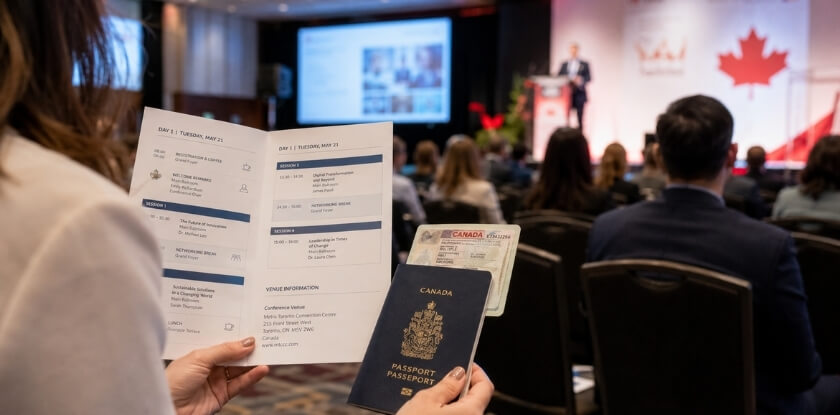
Confirm Visa Details
Check your name, passport number, visa validity and number of entries. If you see an error, contact the appropriate office before traveling.
Book Flights and Accommodation
Once your passport is back with the visa, finalize your travel plans. Try to arrive before the conference begins so you can rest and reach the venue without stress.
Prepare Border Documents
Carry printed or digital copies of:
- Passport and visitor visa
- Conference invitation and registration confirmation
- Conference schedule and hotel booking
- Return ticket or onward travel plan
- Proof of funds
- Employer letter or leave approval, if relevant
A border officer may ask about your visit. Answer clearly and honestly.
Review Entry Rules and Local Transport
Check what you can bring into Canada and whether you must declare money, food or goods. Save the airport-to-venue address offline in case your phone connection fails on arrival.
From our experience at MS International: our invitation letter is issued within 3 to 5 business days after payment clears, so build that wait into your timeline and register before you start the visa application. Corrections after the letter is issued cost US$50, so check that your name matches your passport before you submit your details. The letter supports your application but does not guarantee a visa, and we cannot influence the decision or its speed. Registration fees are non-refundable, including after a visa delay or refusal, and our conferences are held in person in the Greater Toronto Area.
FAQs About Canada Conference Visa Processing Time
Timing a Canadian conference trip means deciding when to apply, whether to buy flights early and how to check progress, with a past refusal, a travel agent filing for you or a side trip to the United States adding twists.
How Can I Check If My Canada Conference Visa Is Being Processed?
You can check your application status in your online IRCC account. Log in regularly for messages, biometrics status, document requests or passport instructions, and check your email too, because a missed IRCC request can delay your application.
How Early Should I Apply for a Canada Conference Visa?
Apply as soon as your conference registration is confirmed. IRCC gives no guaranteed time, so check its processing-times tool for your country, then add the passport stage and a buffer for extra requests; the estimate already includes the time to give biometrics.
Can I Attend a Canadian Conference With a Visitor Visa?
Yes, most conference attendees enter Canada on a visitor visa as business visitors. This suits attending sessions, networking, presenting or joining professional meetings without working for a Canadian employer or being paid in Canada.
Do I Need Biometrics for a Canada Conference Visa?
Yes, most visa-required applicants must give fingerprints and a photo, for a fee of CAD 85. Travelers who need only an eTA, children under 14 and people over 79 are exempt, and biometrics given in the last 10 years may still count.
Should I Buy Flight Tickets Before Visa Approval?
No, it is safer not to buy non-refundable tickets before approval. Include a planned itinerary or tentative dates instead, because decisions and passport return times can be unpredictable.
Can I Stay in Canada After the Conference Ends?
You may stay only for the period allowed by immigration rules and the border officer’s decision. A short visit before or after the conference may be fine, but leave before your authorized stay ends to protect future visa chances.
What Happens If I Previously Had a Visa Refusal?
A previous refusal does not automatically mean a new refusal. Answer honestly about past refusals and address the earlier reasons with stronger documents. Hiding a refusal can damage your credibility.
Can a Travel Agent Submit My Application?
Yes, a travel agent or authorized representative can help prepare and submit it. You are still responsible for the accuracy of every form and statement, so review the full application yourself.
Does Travel Insurance Help With a Canada Conference Visa?
Travel insurance is not usually a core approval requirement. It can still support a well-prepared travel plan and protect you from medical costs, trip interruptions or lost luggage.
Can I Travel to the United States With a Canada Conference Visa?
No, a Canada visa does not allow you to enter the United States. If you plan to visit the U.S. before or after the conference, you need separate U.S. travel authorization.
Final Takeaway: When Should You Apply for a Canada Conference Visa?
Apply as soon as your event participation is confirmed. No single factor controls the timeline, so give yourself room for biometrics, extra requests and the passport stage.
The best strategy is simple: apply early, submit a complete file, and keep your travel plans flexible until your visa is approved.
Disclaimer: This article is general information, not legal or immigration advice. Visa rules, fees and processing times change. Confirm the current requirements on the official IRCC website (canada.ca) before you apply.