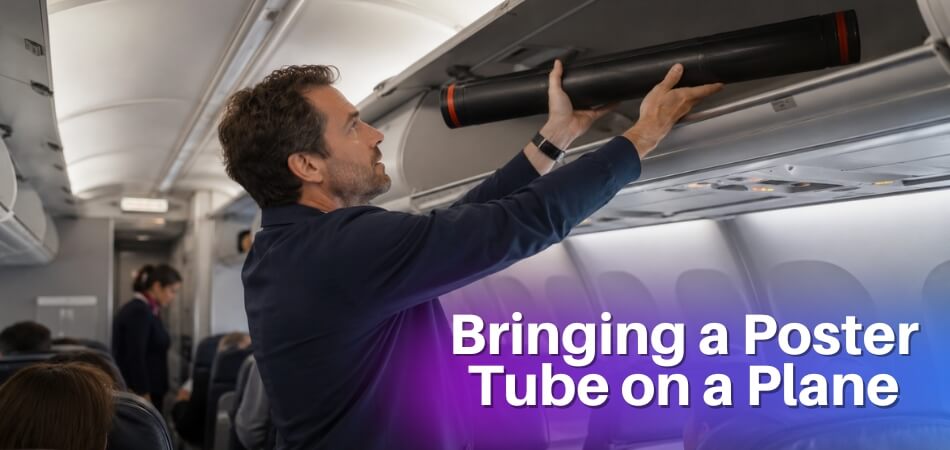
Your poster is printed, your session is close, and the tube is leaning against the door while you wonder if it will survive the trip. Damaged corners, a gate agent who sends the tube to the hold, or a poster that arrives creased can undo weeks of work. A little planning before you leave makes all of that much less likely.
Quick answer: Carry your poster on the plane rolled in a sturdy tube, because university poster guides advise against checking it. Airlines set their own cabin size limits, and your airline decides whether the tube may stay in the cabin, so pack as if it might be gate checked. A fabric poster folded into your bag, or printing at the destination, avoids the tube altogether.
Last verified against official sources: October 2026.
This guide is about the practical side: which format to travel with, how to pack and label it, and what to do if a gate agent refuses the tube. Airline and security rules are summarised here and change, so read your airline’s baggage page before you fly.
Can You Carry a Poster Tube on a Plane?
Yes, you can try to bring a poster tube on a plane, but whether it rides in the cabin or goes to the hold depends on its length and on the airline.
Many poster tubes are 36 inches long or more, so measure yours before you rely on it as carry-on. Airlines publish size limits that apply to every cabin bag, and a long, rigid tube is easy to spot as oversized. Delta’s baggage page, for example, says gate or flight staff may further limit carry-on amounts based on cabin storage and the number of passengers, so the same tube may pass on one flight and be refused on the next.
The Overhead Bin Problem
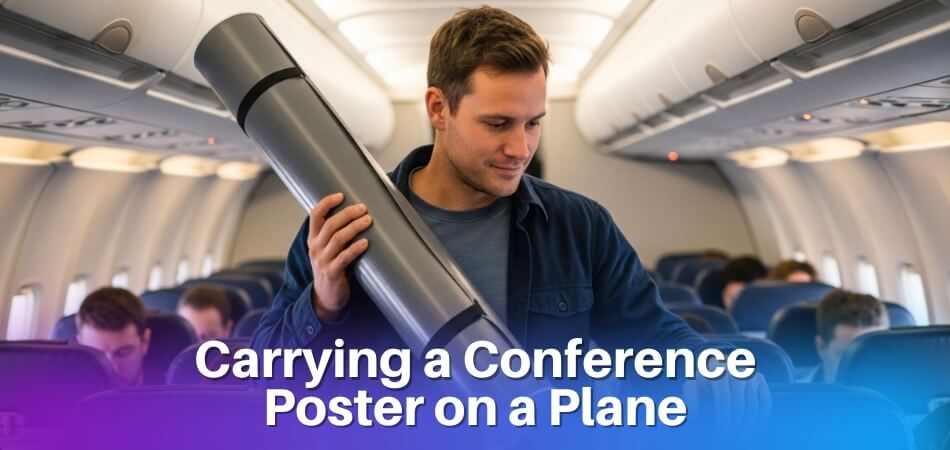
Even when nobody flags the tube at the gate, it has to physically fit. Overhead bin space differs by aircraft, so travellers lay the tube along the length of the bin or stand it upright where the bin allows. That works only if you board early, and smaller regional aircraft may not have room for it at all.
When Gate Checking Is the Right Call
Gate checking is not a disaster. You hand the tube over at the gate or the aircraft door, it travels in the hold, and you collect it on arrival. Where you collect it depends on the airline and the aircraft, so ask the agent when you hand it over. Delta’s page, for instance, says larger items on Delta Connection flights are tagged and loaded in the cargo bin, then returned at deplaning, and that a gate claim tag must be securely attached to the item. The risk is rough handling, so a tube with no padding inside can still dent or crack.
The practical plan for a conference traveller is simple. Bring the tube, expect that it may be gate checked, pack it for that, and have a backup ready: a fabric poster, a print shop near the venue, or a poster shipped ahead.
Carry-On vs Checked Baggage: Which Is Safer for Your Poster?
Carrying the tube is usually safer for the poster, because it stays in your hands, but only if the airline lets it into the cabin. Texas Tech University’s poster tips and the University of Texas at Austin’s poster page both advise carrying the poster on the plane rather than checking it with your luggage. Checking it is easier at the airport, yet recovery options are limited if something goes wrong the night before you present.
To improve your chances of keeping it with you, board as early as your group allows and check the size limit of every airline on your itinerary, including partner carriers on connections. The University of Texas at Austin page also suggests carrying on the clothes you plan to wear when presenting, in case a checked bag is delayed.
Checking a Poster Tube: Risks and How to Reduce Them
A checked tube goes through conveyor systems and is stacked with other bags. A cardboard mailing tube is unlikely to survive that reliably, while a hard-sided plastic or aluminium tube gives much more protection. If you must check it:
- Cap both ends securely and tape over the caps.
- Pad the poster inside the tube, and if you can, nest the tube inside a larger bag with foam pipe insulation around it. A loose tube travelling alone takes the most knocks.
- Attach a luggage tag with your phone number and the venue address.
- Keep your print-ready file in cloud storage so a print shop can reprint quickly if the worst happens.
Travel insurance that covers baggage is worth having. Airline compensation is limited, and paperwork cannot reprint a poster in time for a morning session.
Airline-Specific Poster Tube Policies
Delta’s and Southwest’s carry-on pages set size limits and do not list poster tubes as a special case, so the standard limits apply and gate staff decide in practice. Always read the airline’s own baggage page for your flight, because limits and fees change.
| Airline | Published carry-on limit | What it means for a tube |
| Delta Air Lines | 22 x 14 x 9 inches, with a combined cap of 45 linear inches | A tube of 36 inches or more is over the limit. Gate staff may tag larger items and move them to the cargo hold when cabin space runs short. On Delta Connection flights with 50 seats or fewer, only personal items may be brought onboard. |
| United Airlines | 22 x 14 x 9 inches, including handles and wheels | A rigid tube will not go under the seat. If the agent refuses it, ask for a gate check rather than letting it go into regular checked baggage. |
| American Airlines | 22 x 14 x 9 inches, including handles and wheels | Some American Eagle flights have smaller bins, so expect a possible gate check on connecting flights operated by partner carriers. |
| Southwest Airlines | 24 x 16 x 10 inches, including wheels, handles and attachments | Seats are not assigned, so board as early as your group allows to find bin space. The page says a bag too large to carry on should be checked at the ticket counter before you go to the gate. |
Enforcement varies with the gate agent, the aircraft and how full the flight is. A tube that barely clears may pass on a quiet flight and be flagged on a full or oversold one. If you want certainty for a specific flight, contact the airline before you travel and write down who you spoke to. Utah State University’s engineering lab advises calling in advance when you plan to bring a poster tube on a plane. A refused tube can also mean a checked-bag fee, so check the airline’s current fee page before you fly, and check partner airlines’ rules too, since Delta notes that codeshare partners may differ.
How to Roll and Pack Your Poster So It Arrives Crease-Free
Packing before you leave home matters more than anything you do at the airport. A rigid tube, a loose roll, and a layer of padding prevent most damage.
Choose the Right Tube
Use a hard-sided plastic or aluminium tube rather than a cardboard mailing tube. Cardboard dents, and a single knock against a bin can press a crease straight through to the poster. The University of Texas at Austin page says a cardboard tube is usually enough, with a sturdier plastic tube better if you will present at several conferences; for a flight, the sturdier choice is the safer one.
Diameter matters. A wider tube lets you roll the poster loosely so it holds its shape. Tight rolling into a narrow tube is a common cause of crease lines that will not flatten on the display board.
Check the length before you buy. Many tubes are longer than airline carry-on limits, so decide early whether you plan to stow it overhead or gate check it.
Roll the Poster Correctly
- Print side facing inward. Roll the poster with the printed face toward the centre of the roll, which keeps the ink layer from stretching on the outside curve.
- Use interleaving tissue or glassine paper. Lay a sheet of acid-free tissue over the printed surface before rolling so the ink does not press against the back of the next layer. A print shop can usually give you a sheet.
- Secure with gentle rubber bands or foam clips. Do not tape the poster itself. Loop two or three rubber bands over the roll, or use soft ring clips sold for rolled documents, so the roll holds without being cinched tight.
Pack Inside the Tube and Label It
Wrap the rolled poster in bubble wrap or soft foam sheeting before sliding it in, to cushion lateral impact. Cap both ends and tape the caps, because they can work loose in a crowded bin. Put your name and the venue address on a label inside the tube as well as on the outside, in case the tube ends up on a lost baggage claim. Texas Tech’s poster tips also recommend labelling the tube with your contact information. Pack only the poster in the tube: extra items make the X-ray image harder to read.
If you carry more than one poster, give each its own sheet of tissue. Two bare posters pressed together can scuff or mark each other.
Placing the Tube in the Cabin
Lay the tube lengthwise on top of the other bags and keep heavy bags off it. If the only space is wedged under someone’s rolling bag, ask the flight attendant about a gate check instead. Airlines can usually tag an item at the gate when cabin space runs out.
International Flights: Extra Rules You Need to Know
International trips can bring stricter size enforcement and different baggage rules, so check every airline on your itinerary, not just the long-haul flight.
Carry-On Size Limits Differ by Airline
IATA guidance on cabin baggage is not binding. Each airline sets its own dimensions and weight limit, and some publish smaller sizes than U.S. carriers. Some airlines check bags against a sizer at the gate and refuse or charge for items that do not fit, so a long tube may not be accepted in the cabin. Read the policy of each carrier on your route, including partner airlines on connecting legs.
Customs and Declaration Rules
Customs rules differ by country, so check the destination’s customs guidance for what you must declare when carrying printed material, especially if you bring several copies or a framed display. Keep your acceptance email or abstract notification on your phone in case an officer asks what the poster is for.
If you ship the poster separately, describe it accurately on the shipping paperwork, for example as academic conference material with no commercial value. Vague or wrong descriptions can get a shipment held at customs.
Gate Checking Abroad
Gate checking works differently from airline to airline, and some may ask you to check an oversized item at the counter, where it goes into the hold with ordinary baggage. If that happens, label the tube inside and outside with your name, destination and contact details. If it arrives damaged, report it at the airline desk before you leave the baggage area. For international flights, the Montreal Convention requires a written complaint about damaged checked baggage within seven days of receiving it, and the Canadian Transportation Agency gives the same seven days, but airlines may have shorter internal deadlines, so report it the same day.
When the Tube Is Too Much Trouble
On many international routes, the simplest answer is to skip the tube. A fabric poster, printing at the destination, or shipping ahead are all covered in the sections below. If you do bring the tube, board early and have the backup plan ready.
TSA Security Checkpoint: What to Expect with a Poster Tube
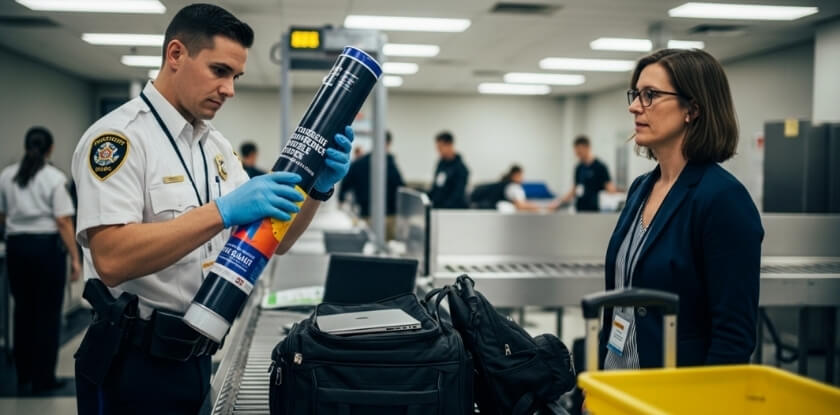
A poster tube goes through the X-ray like any other carry-on, and the final decision on whether an item is allowed through rests with the TSA officer at the checkpoint. A long cylinder can be hard to read on screen, so an officer may look inside. TSA’s “What Can I Bring?” tool on tsa.gov shows whether an item belongs in carry-on, checked baggage, either or neither.
What TSA Officers Actually Do
- Be ready to open the tube. Keep the caps easy to remove, and carry a small roll of tape to reseal it.
- Keep only the poster inside. TSA advises decluttering carry-on bags, because items that clutter the X-ray image can lead to a longer inspection.
- Say what it is. “It’s a rolled academic poster for a conference” takes five seconds and moves things along.
Place a hard tube flat on the belt rather than leaning it against the side of the bin. A soft fabric poster in a flat sleeve is more transparent on screen and is likely to need less explaining.
What TSA Cannot Decide
TSA clears items for security. It does not decide whether your airline lets the tube into the cabin. A tube that passes the checkpoint can still be gate checked if it is over the airline’s size limit, and arguing that TSA already cleared it will not help at the gate. Check your airline’s limits before you leave for the airport.
Screening in Canada
If you fly from a Canadian airport, CATSA runs the screening. CATSA’s carry-on packing page says fragile items should be packed properly inside the carry-on so they do not break, and it points travellers to its “What Can I Bring?” list when unsure. CATSA covers security screening only, so cabin size limits still come from your airline.
Fabric and Foldable Poster Alternatives
If you can choose the format, a fabric or foldable poster removes most of the tube problems, because it travels in a bag with no size dispute at the gate.
Fabric Posters
Fabric posters are printed on lightweight material that folds into a compact bundle and fits in a carry-on or a large laptop sleeve. A Utah State University page suggests fabric for flights with limited luggage space, and says it removes the risk of losing the poster in checked baggage. It also says to use the silk setting on an iron to remove slight creases. The trade-offs are cost and sharpness: a Fourwaves guide to poster paper says fabric costs more to print and may give less sharp text than paper, so check how a text-heavy design looks before you commit. A 2019 University of Colorado Denver page about one fabric printer says printing and shipping typically took one to two weeks, so leave time for it. Check how your venue mounts posters before you order, because fabric posters usually hang from clips, velcro strips or poles, and not every venue provides the same hardware.
Foldable Paper and Board Posters
A foldable poster is printed on a scored, fold-flat material and fits in checked luggage or a large carry-on. The trade-off is visible fold lines. From a distance they rarely matter, but up close they show, so decide based on your institution and your own standards.
Which Option Fits Which Trip
- Short domestic trip, carry-on only. A fabric poster is the cleanest solution. It goes in your bag with your clothes and arrives unwrinkled.
- Long flight with checked baggage. A foldable poster packed flat in a suitcase works well and avoids carry-on size questions.
- No format appeals. Print at the destination or ship ahead, as described in the cost section below.
Fabric and foldable formats will not suit every presenter. Some institutions or events ask for a specific printed format, so confirm what is allowed before you commit.
Cost Comparison: Poster Tube vs Shipping Ahead vs Print Locally
Every option costs something, and prices change often, so get a current quote from the airline, carrier or print shop instead of budgeting from memory.
| Method | What drives the cost | Main risk | Best for |
| Carry-on tube | The tube itself, plus a checked-bag fee if it is refused | Gate check or damage in the hold | Short domestic flights, flexible airlines |
| Checked tube | Airline bag fee plus a sturdier tube | Rough handling, limited compensation | When carry-on size will not work |
| Ship ahead | Carrier rates, speed of service, customs for international | Delay or loss you cannot fix at the airport | Reducing travel stress, no size concerns |
| Print at destination | Shop rates, material, turnaround time | Shop busy or file not print ready | Late changes, international trips, fabric option |
Carrying Your Own Tube
This is often the cheapest option if the tube fits the cabin and you pay no extra bag fee. The hidden cost appears when the tube is refused: you may have to gate check it or pay for a checked bag. Check the airline’s current fee page before you fly.
Shipping Ahead to the Venue or a Nearby Store
Shipping to the venue or a nearby hotel is the most hands-off approach, but it swaps flight risk for delivery risk. Texas Tech’s poster tips note that mailing a poster carries its own risks. Ground and express services differ in price and speed, and international shipping costs more and may need a customs declaration. Ask the carrier for a delivery date in writing, allow extra time for customs, and ship well before you leave so a late design change does not break the schedule.
Contact the venue or organisers first. Confirm they will accept and hold the package, and get the tracking number, the exact pickup location and the hours it is staffed.
Printing Locally at the Destination
Printing near the venue can suit late design changes and spares you baggage and shipping costs. Before you rely on it:
- Call ahead. Not every city has a wide-format print shop near the venue. Confirm the file format they accept (a PDF at full print size is usually the safest) and their turnaround time, and leave a day of buffer.
- Prepare a print-ready file. A poster designed only at screen resolution cannot be fixed by the shop. Ask the shop what resolution it needs.
Which Option Is Worth It
For a domestic trip where you already check a bag, carrying the tube keeps costs low. For international travel, printing locally or shipping ahead can avoid carry-on size trouble and customs paperwork. If your design may change at the last minute, local printing wins: send the final file the night before and collect it on arrival.
Last-Mile: Getting Your Poster from Airport to Conference Venue
Once you land, the next hour or two is when a lot of damage happens, from taxis, shuttles and crowded corridors.
Ground Transport with a Tube
Rideshare or taxi. A long tube rarely stands in a trunk, so lay it diagonally across the back seat and keep it away from a hot window in summer. For a long tube, request a larger vehicle.
Shuttle or bus. This can be the riskiest leg. Racks are shallow and other passengers bump the tube. Hold it across your lap or upright between your knees, and do not put it in the luggage compartment under a row of suitcases.
Train or metro. A tube works fine on trains that run from the airport to the city. At rush hour, stand near the doors and hold it upright so it takes up less room.
At the Conference Venue
Give the poster some time to adjust to the room before you unroll it, especially if it came from a cold hold into a warm building. Unrolling immediately can cause creases.
Check the setup time. Poster sessions usually open the space for mounting before the session starts, so arrive in that window, not at the last minute. Ask in advance whether the organisers supply pins, velcro or clips, and bring your own if they do not.
Moving through a large venue. Big convention centres can mean a long walk through crowds. A shoulder strap on the tube, or a luggage strap looped around the end caps, helps.
If Your Poster Was Shipped Ahead
Confirm pickup before you arrive. Some events use a dedicated package room instead of the main registration desk, and parcels sent to hotels can sit in a back office. Check opening hours so you are not stuck after the room closes. If a local shop is printing for you, call the day before pickup, since busy shops can run behind.
Fixing Creases at the Last Minute
If the poster arrives creased, hang it in a steamy bathroom for a short while without touching water, then re-roll it loosely in the opposite direction and leave it overnight. It will not always be perfect, but it often improves enough to mount. If it is beyond repair, see the next section.
What to Do If Your Poster Gets Damaged
Photograph the damage straight away and report it to the airline before you leave the airport. Then decide whether to repair, reprint or present from a backup.
Document the Damage Immediately
Photograph the poster and the tube it arrived in, ideally in the baggage claim area. The photos establish timing for any claim. If the poster was in checked baggage, report the damage at the airline’s baggage desk the same day and ask for a written report with a reference number. Airline deadlines differ, and waiting can get a claim denied.
Filing a Damage Claim
For international flights, the Montreal Convention limit for destruction, loss, damage or delay of baggage is 1,519 special drawing rights per passenger, in effect since 28 December 2024 according to the Canadian Transportation Agency. How much an airline pays depends on its assessment of the item, so include the print shop receipt with your claim and keep copies of everything. Domestic limits and deadlines are set in each airline’s terms, so read them.
TSA handles claims only for loss or damage during the screening process, and it makes the final decision. Claims are filed on form SF-95 with details such as receipts and flight information. TSA’s claims page says many claims are denied when officers did not open the bag for physical inspection. If the airline caused the damage, claim from the airline.
When the Poster Is Damaged Beyond Use
- Reprint locally. Call a nearby wide-format print shop, confirm it can handle your file, and email your print-ready PDF in advance so it is queued. Some shops offer rush service, though it is not guaranteed at busy times.
- Use a digital backup. Keep the file in cloud storage as well as on a USB drive. Some venues have screens you can use in an emergency, but ask the organisers first.
- Contact the organisers. They may know a local print vendor.
If the Poster Was Carried On
Claims for carry-on damage can be harder to win, because airline terms often treat items you carry yourself differently from checked baggage. If an airline employee made you gate check the tube and it was damaged, report it at once, since a gate-checked bag is in the airline’s hands. If the tube was crushed in the overhead bin with no airline involvement, your best route may be travel insurance. Read your airline’s terms and your policy.
Photograph Your Poster Before You Pack
Take a clear photo of the poster and of the tube before you leave home. If TSA or the airline later damages it, you can show its condition and the timing.
Prevent a Repeat
For future conferences, consider shipping to a store near the venue and collecting it on arrival. That removes airport handling, and quotes will show how it compares with round-trip baggage fees. Confirm the store accepts the shipment.
From our experience at MS International: Our events are held in person in the Greater Toronto Area, so visiting presenters travel to the venue. Our pages do not set a poster size, format or mounting method, so we cannot tell you what to bring. Ask the organisers for the guidelines you receive after acceptance before you print or order a fabric poster, and arrive at the check-in time stated in your confirmation email. Our speaker page also advises presenters to keep a backup copy of their presentation on a USB drive.
FAQ: Carrying a Conference Poster on a Plane
Flying with a printed poster means thinking about carry-on rules, TSA inspection, an overhead bin that is too small and whether shipping or printing at the destination is safer.
Can I bring a poster tube as a carry-on?
Yes, you can try, but the airline decides whether it fits. A tube longer than the airline’s carry-on limit may be gate checked. Measure your tube, read the airline’s size limits, and consider calling the airline before you leave for the airport.
Should I put my poster tube in checked luggage?
Carry it on if the airline allows it. Texas Tech and the University of Texas at Austin both advise against checking a poster. If you must check it, use a hard-sided tube, pad the poster, label the tube inside and out, and keep a print-ready file.
Will TSA make me open my poster tube?
Possibly. A long cylinder is hard to read on the X-ray, and the officer makes the final call, so you may be asked to open one end. Keep the caps easy to remove, carry tape to reseal it, and say it is a rolled conference poster.
What if my poster tube will not fit in the overhead bin?
Ask to gate check it. The tube goes in the hold and you collect it on arrival, though where you collect it depends on the airline. Pad the poster well so a gate check does not damage it. Board early to improve your chances of keeping it.
Is it safer to ship my poster ahead?
Not necessarily. Shipping removes the in-flight risk but adds delivery risk. Use tracking, confirm the venue or hotel will accept the package, and allow extra time for international customs. Always keep a print-ready file as a backup.
Which airlines are strictest about poster tube size?
No source ranks airlines by strictness. Each enforces its own published limit, and enforcement depends on the gate agent and how full the flight is. Read the baggage page of each carrier on your route, including regional partners.
Can I print the poster at my destination instead?
Yes, if the city has a shop with a large-format printer. Send a print-ready file, confirm the paper size and finish, and book the pickup. Call the shop the day before, since busy shops can fall behind.
Do international flights have different rules for poster tubes?
Yes, they can. Each airline sets its own carry-on limits, and some are stricter than U.S. carriers. Read the policy of every airline on your itinerary, including partner carriers on connecting legs.
Do I need to declare a poster tube at customs?
It depends on the country. Check the destination’s customs guidance for printed material, especially if you carry several copies or a framed display, and keep your acceptance email on your phone in case you are asked what the poster is for.
What if my poster is damaged or lost?
Report it at the airline desk before you leave the airport and keep your boarding pass and baggage tags. For international flights, the Montreal Convention requires a written complaint within seven days of receiving damaged baggage. Keep a print-ready file you can reprint nearby.
Are fabric or foldable posters worth considering?
Yes, if your event allows them. A fabric poster folds into a suitcase with no size dispute at the gate and few crease problems, but it costs more and text may look less sharp than on paper. Check the mounting hardware at your venue first.
Final Thoughts
Pick the method that matches your trip: a padded rigid tube for a flexible domestic flight, a fabric poster for carry-on only travel, or local printing or shipping ahead for international trips. Check your airline’s size limits before you pack, label the tube inside and out, and keep a print-ready file you can reprint near the venue. A little preparation is far cheaper than scrambling the night before your session.