
The first few minutes of a conference tell delegates what kind of event they have walked into. Faculty members in the front rows, guests waiting to be acknowledged and presenters with papers still in their bags are all forming an impression before the first session starts. I write guides for conference speakers, and the welcome is the part of a program I least like to see improvised: a weak one loses the room, while a strong one makes every speaker who follows feel the day is worth their time.
Quick answer: An academic conference welcome speech greets the chief guest and the room, thanks the host institution, program committee, reviewers and sponsors, states the conference theme and why it matters to the field, previews the day and hands over to the next speaker. Plan for two to five minutes, about 200 to 750 words at 100 to 150 words per minute, and confirm the exact slot with the organizing committee.
I have written copy-ready scripts below for a general academic conference, a host-university address, a short version, an online event, a student event and an international gathering. Replace the details in square brackets with your own, and cut the parts your slot has no room for. A welcome that fits its slot always beats a complete one that runs over.
What a Welcome Speech for an Academic Conference Should Include
I build every academic welcome on the same sequence, whether the event is a small student conference or a large international one. Only the tone and the depth change. The aim stays the same: by the time you hand over, delegates, faculty members and guests should know why they are here and what happens next.
Here are the parts I build every welcome from, with a rough time for each. They add up to about three minutes, and a longer ceremony simply gives each part more room.
| Part | What to say | Rough time |
|---|---|---|
| Greeting and acknowledgement | Welcome the chief guest, keynote speakers, faculty members and delegates | 20 to 30 seconds |
| Who you are | Your name and role: host, committee chair, dean or session chair | 10 seconds |
| Conference name, theme and purpose | The full event name, the theme in plain words and why it matters to the discipline | 60 to 90 seconds |
| Thanks | Organizers, sponsors, host institution | 30 to 45 seconds |
| Event overview | The sequence of sessions, keynote, panels, workshops | 20 to 30 seconds |
| Close and handoff | A forward-looking line, then the next speaker’s name and role | 20 to 30 seconds |
In my view, four of these parts need the most care.
- Greeting. Keep the roll call tight. A long list of titles stalls the speech before you reach the point, so the order and the number of names are covered in the next section.
- Your role. Say it even if the emcee has just introduced you. Attendees need to know who is speaking, especially if you are not the person on the program they expect.
- Theme. This is the moment participants feel they have arrived. Link the theme to a real disciplinary question and skip the boilerplate about “bringing great minds together”, which is the first line I delete from any draft.
- Thanks. Thank each group once. A second round of thanks in the close makes the speech sound padded, and that time is better spent on the theme.
In What Order Should You Name the Guests?
My rule is to name the most senior person first and the general audience last. I also name only a few people individually, usually no more than three, and greet everyone else as a group. In a short or informal welcome, a general greeting to the room can come first. A typical academic order is the chief guest, then the presiding officer of the host institution (for example the vice-chancellor, president or dean), then the keynote speaker, and then faculty members, delegates and students together.
A salutation built on that order reads: “Our chief guest, [Name and Title]; [Vice-Chancellor/President Name]; our keynote speaker, [Name]; distinguished guests, colleagues and delegates, good morning.” If the host institution has a protocol office or the organizers send a seating list for the dais, their order wins over anything on this page, because rank can differ from one country and institution to another.
Opening an Academic Conference in Canada: Land Acknowledgement
Many events in Canada open with a land acknowledgement, a short statement that recognizes the Indigenous peoples of the land where the meeting takes place. It usually comes before the welcome itself, and it may be read by the host or by the emcee. Ask the organizers early whether one is planned and who gives it, so that it does not catch you by surprise on the day.
The wording depends on the location. The City of Toronto publishes its own on the Indigenous Affairs Office page: “We acknowledge the land we are meeting on is the traditional territory of many nations including the Mississaugas of the Credit, the Anishnabeg, the Chippewa, the Haudenosaunee and the Wendat peoples and is now home to many diverse First Nations, Inuit and Métis peoples. We also acknowledge that Toronto is covered by Treaty 13 with the Mississaugas of the Credit.” For a venue in another city, or on a university campus, use the statement published by that municipality or institution rather than the Toronto text. Practise the names of the nations aloud beforehand, and read the statement at a steady pace before you move on to greeting the guests.
Full Welcome Speech Sample: General Academic Conference
I wrote this sample for a mid-sized general academic conference with faculty members, student delegates, a chief guest and at least one keynote speaker. At about 400 spoken words it takes roughly three minutes at a comfortable pace. If your slot is shorter, cut the housekeeping and the organizers’ paragraph first. The tone is formal but not stiff.
The Sample Script
[If a land acknowledgement is planned, it comes here, before the greeting. Conference host steps to the podium. Pause briefly before beginning.]
[Chief Guest Name and Title], distinguished guests, colleagues and delegates: good morning.
I am [Name], [role], and on behalf of [University/Organization Name] I am privileged to welcome you to the [Number] Annual [Conference Name]. This year the program brings together researchers, educators and practitioners from [number] institutions across [regions/countries].
To our chief guest, [Name and Title]: thank you for making the time to be with us this morning.
To our keynote speaker, [Name and Title], whose work in [field/subject area] has shaped the conversation we are here to continue: welcome, and thank you.
To our distinguished guests on the dais, to the faculty members who supported this event, and to every delegate who travelled from near or far to be in this room: welcome to all of you.
This year’s conference theme is [State the theme]. We chose it because [one sentence on why it is urgent or relevant, for example “the questions it raises sit between three disciplines that rarely speak to each other directly”]. Over the next [number] days you will hear from researchers working at exactly that meeting point.
Today opens with the inaugural address by our chief guest, followed by the keynote lecture and a short break before the first panel session at [time]. The full schedule is in your conference booklet and on the event portal.
A word about the people behind the scenes. A core team has worked on this conference for the better part of [number] months. The program committee reviewed [number] abstract submissions, and the logistics team coordinated travel, accommodation and the venue across several institutions. Please join me in applauding every member of the organizing team.
We also acknowledge [Sponsor/Funding Body Names], whose support funded the travel grants that brought several early-career researchers to this conference for the first time.
A few housekeeping notes: [Wi-Fi, session recording policy, lunch arrangements or other venue logistics, in two or three lines].
Academic conferences exist because no single institution, laboratory or research group holds all the answers. What you share in a corridor between sessions, what you question during Q&A and what you rethink on the flight home is often where the real work begins.
We hope this conference gives you two things: a stage for your ideas, and a room full of people willing to push back on them.
Welcome to [Conference Name]. Our chief guest will now give the inaugural address.
[Conference host introduces the chief guest or moves into the opening ceremony.]
Welcome Speech from the Host University: Dean or Committee Chair
When a university hosts the conference, the welcome often comes from a dean, a department head or the program committee chair. I wrote this version to speak for the institution, so it spends more of its time on the reviewers and the committee, the delegates who are presenting, and the link between the research theme and the host’s own work.
Distinguished guests, colleagues and delegates, good morning.
My name is [Name], and I serve as [Dean/Chair/Role] at [University Name]. It is a pleasure to see our campus used for what a university is for: people testing ideas in front of one another.
This conference received [number] submissions in response to our call for papers on [Theme]. Each one was read by [reviewers/committee members] who gave their time without recognition outside this room. To the reviewers and the program committee, thank you. The standard of today’s sessions is your doing.
To the authors presenting this week, you have already passed the hardest test, which is having your work judged by people who owed you nothing. Those of you attending as listeners are just as welcome. Please ask questions from the floor; they are part of how research gets tested here.
The theme, [Theme], matters to us at [University Name] because [one concrete connection, for example a research centre, a degree program or a local community partnership]. We do not expect this week to settle that question. We do expect it to sharpen it.
Practical details, including room changes and refreshments, are with the registration desk. Questions about the program should go to [Name].
Thank you for choosing to spend these days with us. I now ask [Name], [role], to give the keynote address.
Academic Details That Belong in the Welcome
The sample scripts above already cover the submission count, the reviewers and travel grants. An academic program usually has four more items that delegates want answered early: what happens to their papers after the event, when the awards are given, where the posters are and how the sessions will run. My preference is to settle each of them in one line rather than leave delegates to hunt for it in the booklet.
| Detail | Example line | Check before you say it |
|---|---|---|
| Proceedings or journal plans | “Accepted papers may be considered for [the proceedings / a partner journal], subject to its own review.” | The exact wording the organizers use; never promise indexing or publication from the podium |
| Best paper or poster award | “The best paper award will be announced at the closing session on [day].” | The award name, the session and whether certificates are given |
| Poster session | “Posters are in [room] from [time]; please visit them, because the authors are there to talk.” | The room and time on the final program |
| Session chairs and Q&A | “Session chairs will keep each talk to time, so please hold longer questions for the break.” | The talk length and Q&A time each chair will use |
Pick the details that fit your slot. In a two-minute welcome I keep at most one, usually the award. A five-minute address at an international conference can carry three or four.
Short Welcome Speech for an Academic Conference (Under 2 Minutes)
A short welcome is warm, clear and done in under two minutes, which means about 250 words at most; the sample below is about 115 words, just under a minute. I recommend it for a tight program, or when the organizers have asked you to keep the opening moving.
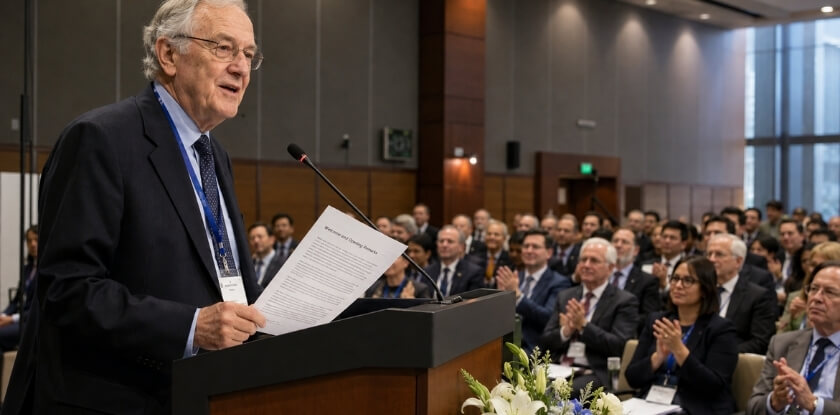
The hard part is knowing what to cut. You still need to acknowledge the guests, name the theme and hand off cleanly to the next speaker, but there is no room for the slow warm-up language that creeps into longer speeches.
What to Keep, What to Drop
I keep four things: a greeting that names the audience, one sentence on why the conference matters, a brief thanks to the chief guest and the organizers or sponsors, and a handoff line. I drop the extended event history, the long list of individual names and any motivational close longer than two sentences. Faculty members and delegates will not feel shortchanged by a concise opening. If I had to cut one more thing, it would be the sponsor names: thank the sponsors as a group and let the program booklet list them.
Sample Script: Short Welcome Speech (Under 2 Minutes)
Good morning, everyone.
Welcome to [Conference Name]. I am [Your Name], and I have the honour of opening today’s proceedings for [University/Department/Organizing Committee].
Faculty members, researchers, students and delegates from [number] institutions are here to take on this year’s theme: [Conference Theme], [one phrase on why it matters now]. The program gives it [number] sessions over [number] days.
A warm welcome to our chief guest, [Name and Title], whose work in [field] many of us know well. Thanks also to our keynote speaker, [Name], and to the sponsors and organizers who made the event possible.
The agenda is full and the work starts now. Please join me in welcoming our chief guest to the podium.
30-Second Version
When the program gives you half a minute, often because the welcome sits between the chief guest’s arrival and the keynote, I keep only the greeting, the theme, one line of thanks and the handoff. At about 65 words, this fits:
Good morning, everyone, and welcome to [Conference Name]. I am [Your Name], [role], speaking for [Organizing Committee/University]. Over the next [number] days, researchers from [number] institutions will work on one question: [Conference Theme]. Our thanks to [Chief Guest Name and Title] for joining us and to everyone who prepared this program. Let us begin. Please welcome [Name], who will give the opening address.
Welcome Speech for a Virtual / Online Academic Conference
Opening a virtual conference is different from standing in a full auditorium. The room energy is not there to carry you, the audience is spread across time zones, and a technical hiccup can break focus in seconds. This section covers fully online events; at a hybrid event, use an in-person script and add the platform notes for remote delegates. My advice is to give the platform notes before the thanks, because people who cannot find the Q&A box are not listening to anything else.
What Changes in a Virtual Setting
Here is what changes in my script when the conference moves online.
- Acknowledge the format. Participants joining from different countries, time zones and home setups should hear that you know where they are. A line such as “from across campus or from the other side of the world” shows that you see them.
- Keep it tighter than in person. A speech that feels right in the room can feel long on a video call. Cut anything that does not serve participants directly; the length table below gives the target.
- Name the platform and the plan. Say where the agenda is, how Q&A works and what to do if the connection drops. This is part of the welcome, not technical housekeeping, and it lets people settle in.
- Speak to the camera, not your notes. Look into the lens when you greet people, and replace “as you look around the room” with “to everyone watching live right now”.
Sample Welcome Speech: Virtual / Online Academic Conference
Good morning, good afternoon and good evening, wherever you are joining us from.
On behalf of [University/Organization Name], I welcome you to [Conference Name], our [annual/inaugural] international academic conference on [Conference Theme].
Delegates are with us from [number] countries. Meeting online means distance does not decide who can take part, and we are glad to have every one of you with us.
A few quick notes before the opening ceremony. The full agenda is under the “Schedule” tab of the event platform. Please send questions through the Q&A feature, and our session chairs will moderate them live. [If the platform has live support: If your connection fails, the support chat in the sidebar is staffed all day.]
Our keynote speaker, [Name], will open the program with a talk on [Topic]. You will also hear from [number] guests, faculty members and researchers from institutions around the world.
To our sponsors, [Sponsor Name(s)], thank you for supporting this year’s program.
The theme, [Theme], cuts across disciplines, and the program reflects that: [one example of two fields meeting in a session].
I hand the floor to [Keynote Speaker Name] for the opening talk.
Welcome Speech for a Student or University Conference
A student or university conference has a different energy from a formal international gathering. The audience is younger, the atmosphere more relaxed and the speaker can afford to be warmer and less ceremonial. It still needs structure: a clear welcome, a nod to the theme, thanks to faculty members and organizers, and a proper handoff. I aim for a tone that is encouraging without being condescending, because the students in the room have worked hard to be there as presenters, delegates or organizers.
What to Adjust for a Student Audience
- Acknowledge student effort specifically. Some attendees submitted papers, travelled on tight budgets or organized the event themselves. “We know how much work this took” lands better than a generic welcome.
- Keep formality moderate. Follow the opening ceremony structure, but use plain, friendly language. Full ceremonial titles for every person can make the audience feel they are at the wrong event.
- Connect the theme to their stage of career. Students are still building a scholarly identity, so tie the theme to early-career questions: what research means, why collaboration matters, where the field is heading.
Sample Welcome Speech: Student/University Conference
Good morning, everyone.
The organizing committee and the Department of [Subject] are happy to welcome you to the [Conference Name], [University Name]’s annual student academic conference.
To participants who travelled from other institutions, welcome. To those presenting your research for the first time today, a particular welcome. We know what it takes to turn an idea into a paper and a paper into a talk.
This year’s theme is [Theme]. It connects to questions many of you are already working on in dissertations, labs and seminar rooms. The sessions put those questions into conversation, and we hope the talk between sessions turns out as valuable as the papers.
We are grateful to our faculty members for guiding the program and to our sponsors for covering the venue and logistics. Our keynote speaker, [Name and Title], opens the program shortly.
The full agenda is in your program booklet, and the organizing team is around all day if you need anything.
Enjoy the conference. Ask the uncomfortable questions and talk to the people whose work surprised you. That is what these events are for.
I now invite [Keynote Speaker Name] to the stage.
When a Student Is Giving the Welcome Speech
At some university conferences a student representative, often the conference chair or a student union officer, delivers the welcome. The script above works for them too, with three adjustments.
- Speak from shared experience. A student host can say what a faculty member cannot, such as how nerve-wracking it is to present in front of peers or how many late nights the organizing committee put in. Details like that bring the room onto your side.
- Don’t over-hedge your authority. Skip “I’m just a student, but…”. You were given the podium because you earned it.
- Introduce yourself briefly. You may not be known to the room. One sentence, such as “I’m [Name], chair of this year’s organizing committee”, is enough before the welcome begins.
Welcome Speech for an International Academic Conference
An international academic conference means delegates from many countries, with different first languages, meeting one another for the first time. The speech has to feel inclusive without becoming formulaic, and it should set a collaborative tone before anyone presents a finding. I use the sample below for a multi-day event with a chief guest, a keynote speaker and institutional sponsors. It runs about two and a half minutes; to fill a four-to-five-minute slot, add the proceedings, award and poster lines from the academic details table.
Sample Script: International Academic Conference
Good morning, distinguished guests, delegates and colleagues.
It is my honour to welcome each of you to the [Conference Name], hosted by [University/Institution Name]. Researchers, scholars and practitioners from [number] countries are in this hall, and that breadth of perspective is the reason to travel for a gathering like this.
We are especially grateful to our chief guest, [Name and Title], whose work on [topic] many of us cite in our own. We also welcome our keynote speaker, [Name], who opens today’s academic sessions. Thank you both for bringing your work to this room.
A conference of this scale needs institutional commitment. [Sponsor/Partner Name] and [Sponsor/Partner Name] made it possible, and faculty members and student volunteers from [Department/School Name] spent months preparing behind the scenes. If you see them in the corridors over the next [number] days, please thank them.
This year’s theme, [Theme], reflects a question that no single research group and no single country can answer alone. That is the case for meeting internationally. Cross-border exchange tends to bring up assumptions each of us carries without noticing, about methodology, evidence and what counts as a meaningful result. A few days of honest discussion will not resolve them, but it often cracks them open in useful ways.
The keynote address follows this ceremony. Session schedules, room assignments and the access links for remote participants are in your delegate packets and on the conference portal.
To those joining online: welcome. Virtual participants can contribute to panel discussions in real time, and we ask speakers in the room to repeat questions from the hall into the microphone so that remote participants can hear them.
On language, presentations are in English[, and interpretation support is listed in your program, if it is offered]. If you have accessibility or language needs that were not covered at registration, please see the organizing team at the registration desk.
I now invite our chief guest, [Name], to deliver the opening address.
What Real Academic Welcome Speeches Do Well
A template gives you the order of a speech. Watching how other hosts open a real event shows you how it should sound. Fourwaves, a conference-management platform, looked at three published welcome speeches from scientific events in a guide by Matthieu Chartier, PhD (updated January 2024). Each one suits a different kind of conference, so pick the one closest to yours before you start writing.
| Speech | Style | What it does well |
|---|---|---|
| Welcome and opening remarks, 2015 COAST/SSEW Symposium | Informal, spoken with a smile and steady eye contact | Explains where the organization came from, asks the audience questions, uses one light joke and gives a preview of new research in the field |
| Welcome speech in IOP Conference Series: Materials Science and Engineering | Formal, suited to an international audience | Welcomes attendees, introduces the keynote speakers, sets out the conference’s origins and goals, and thanks the organizing committee, companies and volunteers |
| Welcoming address by Dale Mullennix | Warm and informal, delivered without notes | Asks the audience questions, says what attendees will gain from the lectures and ends with a personal story tied to the event theme |
Two lessons stand out. Each speech tells the audience why the event exists, not only what is on the schedule. And the two informal speakers talk to the room through questions or eye contact, instead of reading a list of names. A formal international conference will lean toward the second example. If I were opening a smaller symposium, I would borrow one audience question from the first and the closing story from the third, and keep everything else short.
How to Write Your Own Welcome Speech (Step-by-Step)
I write every welcome in the same five steps, and they will give you a solid draft to refine before you step up to the podium. The parts themselves are listed in the first section, so here I focus on how to handle each one.

Step 1: Open with a Greeting and Set the Tone
Your first sentence signals the mood of the whole ceremony, tells the audience who is speaking and gives the room a moment to settle. Keep it direct and warm without being theatrical.
The tone of those first ten seconds carries through. A formal international conference calls for measured, respectful language, while a student conference can be slightly more relaxed. Avoid opening with an apology (“I’ll try to keep this brief…”) or a filler phrase. My advice is to walk to the podium, pause for a second, greet the room and begin.
Step 2: Acknowledge Organizers, Sponsors, and Guests
Take thirty to forty-five seconds to thank the people who made the event possible: organizers, faculty members who built the program, sponsors and distinguished guests. Name the chief guest and keynote speaker by title and name. For sponsors I follow the sponsorship agreement: if it asks for names, name them in one sentence; if not, one collective line is enough.
I write this part last, once the guest list is confirmed, because acknowledgements must be accurate on the day. If there are many faculty members to credit, a brief collective mention (“our colleagues on the organizing committee”) is enough.
Step 3: State the Conference Theme and Purpose
This part deserves the most drafting time. Participants need to know what the conference is about and why the theme matters now. State it clearly and explain it in one or two concrete sentences. Do not read the theme off the brochure and stop there. If the theme is “Resilient Education Systems in a Post-Pandemic Era”, say which questions the conference is trying to answer and why researchers and practitioners have gathered to address them.
For a recurring event, a short note on history tells newcomers where the event comes from: “This is the eighth year we have brought together scholars from across the region, and this year’s theme builds on last year’s sessions.” Keep the whole section to about sixty to ninety seconds. You are framing the day, not delivering a paper.
Step 4: Preview the Agenda
Give delegates a brief map of what to expect, especially at larger events where people attend selected sessions. A high-level preview is enough: keynote addresses, panels, break-out sessions, lunch and special events such as poster presentations or awards. My test for this step is simple: a delegate who hears only your preview should know where to be for the first session and after the first break.
Step 5: Close with a Purpose Line and Hand Off
Send people into the conference with a sense of purpose, not just an administrative wrap-up. I would rather hear one plain sentence about the research in the room than a dramatic quotation that has nothing to do with the theme. If you quote figures such as the number of countries or submissions, take them from the registration list or the program committee the day before so they are exact. Something grounded in the conference’s work is ideal: “The papers you will hear this week were written to be argued with, so please argue with them.”
Then hand off. Introduce the next speaker, describe their role and step aside: “I am pleased to invite our chief guest, [Name and Title], to deliver the opening address.” Pause, gesture toward the speaker and move away from the podium. Do not add a sentence after you have closed, because trailing off makes the handoff awkward.
Welcome Speech vs Opening Remarks: What Is the Difference?
A welcome speech is the fuller, formal address that opens the ceremony, usually between two and five minutes. Opening remarks are shorter and lighter, usually 60 to 90 seconds. There is no fixed definition, and organizers use the two terms loosely, sometimes the other way round, so the split in this section is a working guide. Ask the organizers which one they want, because the answer changes how you write it.
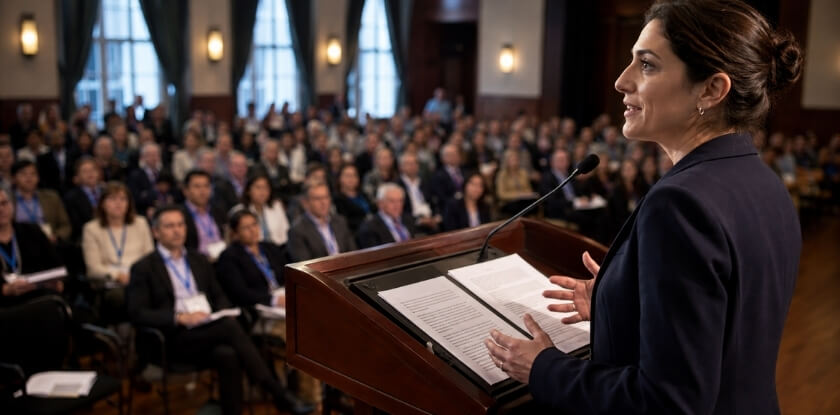
The Welcome Speech
The person giving it is usually the conference host, the department head or a senior representative of the organizing institution. It follows the full sequence described at the top of this page, from the greeting to the handoff. It is the official start of the event: it sets the tone and shows the room that the event is well run. After the welcome, a chief guest may give the formal opening address and declare the conference open.
Opening Remarks
Opening remarks warm up the room and move into the program without formally representing the institution. A session chair speaking before a panel, or an emcee bridging from pre-event networking into the first session, is giving opening remarks. There is no formal acknowledgement sequence and no sponsor mention, and any handoff is a single line. They are conversational and functional.
At a large international conference you often see both: a welcome speech from the organizing committee or university representative, then brief opening remarks from the emcee who introduces the first keynote speaker.
How to Tell Which One You Need
I ask two questions. Are you representing the institution or the event as a whole? Then you are giving a welcome speech and should follow the full structure. Are you simply bridging between program items or introducing a single speaker? That is opening remarks, and they should be short.
At a student conference or a single-day university event the two can merge into one short piece, and I see nothing wrong with that. The label matters less than matching the length and purpose to the context.
Ready Opening Lines and Closing Lines
The lines below are ready to use or adapt. Read them aloud before you commit, because some read better than they sound. For an academic room I lean toward the line that leads with the theme: it tells the audience in one sentence why they travelled.
Opening Lines
They work for formats from a formal international symposium to a departmental student conference.
- Warm and direct: “Good morning, everyone. It is my pleasure to welcome you to the [Conference Name] and to thank you for being here.”
- Lead with the audience: “We have gathered from [number] institutions and [number] countries, and that alone says something about the conversations ahead.”
- Lead with the theme: “The question of [conference theme] is one our field can no longer put off. That is why we are here, and it will drive every session over the next [number] days.”
- Virtual or online conference: “From a campus office or a kitchen table at midnight, welcome. We are glad you carved out the time.”
- Student or university conference: “This conference belongs to you, the researchers and writers who stayed up late to get this work right. Welcome.”
- Formal international conference: “Distinguished guests, faculty members, delegates and participants, a very warm welcome to [Conference Name].”
Closing Lines and Handoff
As I see it, a close has two jobs: land the speech with some energy, and hand control of the event to whoever is next. A weak close usually comes from treating the handoff as an afterthought.
- Motivational close into handoff: “We hope the next [two days / three sessions / full program] give your work the questions and the audience it deserves. It is now my honour to invite our keynote speaker, [Full Name and Title]. Please join me in welcoming [him/her/them].”
- Close with the theme: “The conversations that start in this room rarely stay in this room, and that is the point of gathering. I now hand over to [Name], who will walk us through the day’s agenda.”
- Brief and clean: “Thank you for being here. Please welcome [Name and Title].”
- Virtual conference: “I hope the next few hours feel worth every time-zone adjustment you made. I will now pass to [Name], who will introduce our first session.”
- Student conference: “To every presenter here: you have earned your place at this podium. I now invite [Name] to introduce the first paper of the day.”
How Long Should a Welcome Speech Be?
I plan for 2 to 5 minutes, with three to four minutes as a safe target for an in-person event. Fourwaves and Orvium, which publish conference-speech guides, both say about five minutes, and Vedantu’s template says 3 to 5, so confirm your own slot with the organizing committee. The right length depends on where the speech falls in the program, the type of conference and how many speakers follow you.
The General Rule of Thumb
Two to five minutes is roughly 200 to 750 words. VirtualSpeech’s speaking-rate guide gives 100 to 150 words per minute as a comfortable pace for presentations; your own pace may sit anywhere in that range. Unless the organizers have asked for a short welcome, such as the short or 30-second versions above, or you are giving opening remarks only, under about 90 seconds can feel rushed and dismissive. Past 6 minutes you start eating into time that belongs to the keynote speaker or the opening ceremony.
By Conference Format
Different conference types carry different expectations. These are the targets I recommend.
| Format | Aim for | Why |
|---|---|---|
| Standard in-person academic conference | 3 to 4 minutes | Room to acknowledge the chief guest, welcome delegates, mention the theme and hand off |
| International academic conference | 4 to 5 minutes | More dignitaries and sponsors to thank and a broader audience; rushing feels disrespectful |
| Student or university conference | 2 to 3 minutes | Higher energy, younger audience, a tight warm speech serves better |
| Virtual or online conference | About 2 minutes, 3 at most | Attention is easier to lose on a screen, and organizers watch the clock closely |
| Opening remarks only | 60 to 90 seconds | Set the context, name the occasion and step back |
What Affects Length Beyond Format
- Program position. If you are first on stage and six speakers follow, keep it tight. If the welcome is one of only two or three items before a break, you have more flexibility.
- Number of acknowledgements. Thanking five sponsors, three co-organizers, two guests and a keynote speaker takes time. Trim the list or accept a longer speech. Cramming it all into two minutes produces a breathless, list-reciting delivery.
Pre-Delivery Checklist
A welcome speech can be well written and still stumble if the basics were not checked before the speaker walked to the podium. Run through this list the day before and again on the morning of the event.
The Speech Itself
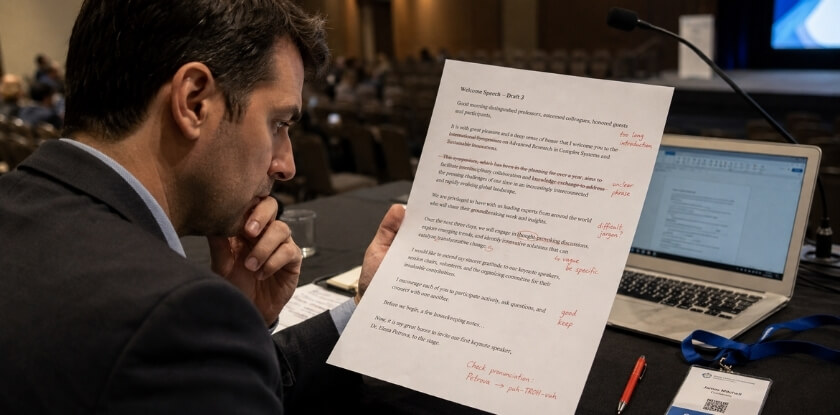
Print a clean copy. Screens glare, lock or die at the wrong moment. Print in a large font with double spacing so you can read at a glance.
Mark your pauses. Draw a slash or circle wherever you need to breathe or slow down, typically after welcoming the chief guest, before introducing the theme and at the end of the remarks. The audience cannot see the marks, and they help under pressure.
Cut anything over your time limit. If the organizers gave you two minutes, time yourself out loud with the actual script, not a mental estimate; on the day, pauses and applause add a few more seconds.
Names and Titles
Verify every name the night before. Check the spelling and pronunciation of the chief guest, keynote speaker and any distinguished guests you will name. If a name is unfamiliar, find a recording of the person saying it, or ask a colleague who knows them. Mispronouncing a chief guest’s name can overshadow the whole opening ceremony.
Confirm titles and affiliations. Professors get promoted, positions change, and keynote speakers sometimes represent a different institution than the one in the original program. A quick email to the event coordinator the day before saves embarrassment.
Logistics at the Venue or Online
Check the microphone setup. Find out whether it is a standing mic, a handheld or a lapel. A standing mic leaves both hands free. A handheld means your script must sit on the podium, or you must know it well enough not to grip two things at once.
Know where you will be standing when introduced. Will you walk on from the side, or are you already seated on stage? Questions this small are the ones that throw you on the day.
For a virtual or online conference, test audio and video on the actual device you will use. Check your background, your lighting and whether the microphone picks up room echo. Log in to the platform at least 20 minutes early.
Handoff and Flow
Know who you are handing off to. After your welcome you will pass to a session chair, the keynote speaker or an MC. Write the handoff line from Step 5 as the last line of your printed copy, with the next speaker’s name spelled the way it is pronounced. A vague handoff leaves the opening feeling unfinished.
Confirm the agenda sequence with the organizers. Programs shift. A sponsor presentation gets added, a speaker arrives late or the order of acknowledgements changes. Walk through the first 20 minutes with the coordinator so your remarks match what happens. Also ask what happens if the chief guest is late: who starts, and the latest time you will wait.
The Final Rehearsal
Read the full speech aloud at least twice, ideally in a room rather than in your head: once the day before and once on the morning of the event. You will catch awkward phrases, places where you run out of breath and lines that read well but sound unnatural. If you can, do one read standing up, because posture and breathing change when you are upright. Nervous speakers often speed up, so the pauses you marked earlier matter most here.
Quick Reference Checklist
- Printed script in readable font, pauses marked
- All names and titles confirmed and pronounceable
- Timed read-through, speech fits the slot
- Microphone type and position confirmed
- Venue arrival at least 30 minutes before the start
- Virtual setup tested on the actual device
- Handoff line prepared and memorized
- Agenda sequence confirmed with organizers
- Two full spoken rehearsals completed
From our experience at MS International: Our conferences are held in person at venues in the Greater Toronto Area, and the moderator introduces each speaker before their presentation, so a welcome that frames the whole event can leave individual introductions to the moderators. Presentation lengths may vary, so the speaker confirmation and the final conference program are the official sources for your slot. Speakers cover their own travel and accommodation unless MS International Conferences Inc. has agreed otherwise in writing, so do not promise anything on the organizers’ behalf from the podium.
FAQ
These questions cover practical problems hosts often raise, from naming sponsors and a chief guest who arrives late to rehearsal and how to address the audience.
How long should a welcome speech be at an academic conference?
Plan for two to five minutes, and confirm the slot with the organizing committee. Three to four minutes suits a standard in-person event, two to three a student conference, and about two minutes an online one.
Do I need to memorize the entire speech?
No. Know the material well rather than the exact wording. A February 2024 Toastmaster magazine article says memorizing a whole speech can make it sound canned and that there is no shame in using notes.
Should I mention every sponsor by name?
Only if the organizers ask you to or the sponsorship agreement requires it. If you do name sponsors, keep it to one sentence listing them.
What if the chief guest or keynote speaker arrives late?
Start on schedule, fill the gap with a short housekeeping note or agenda preview, and adjust the running order rather than waiting in silence. Agree a latest wait time and a backup with the organizers beforehand, tell the audience briefly about the change, and stay calm.
Can I use humour in a welcome speech?
Yes, one light remark can warm up the room if it suits the audience. Fourwaves says light humour is fine where appropriate, and Orvium advises thinking carefully before using it. Tie it to the theme and avoid local references that could alienate international delegates.
How early should I arrive before the opening ceremony?
At least 30 minutes before the event begins. Test the microphone, confirm the running order with organizers and check the pronunciation of any names you will say aloud.
Is a welcome speech necessary for a virtual conference?
Yes. An online conference still needs a clear opening. The speech just needs to be slightly tighter, because attention is easier to lose on a screen.
How do I hand off smoothly to the keynote speaker?
End with one sentence that introduces them by name and role, then step aside or mute yourself (for online events). Add no commentary after the introduction.
What if I’m a student hosting a university conference?
The same structure applies. You do not need to over-formalize it, but you do need to welcome distinguished guests, state the theme and outline what participants can expect. Confident, clear delivery matters more than elaborate language.
Should I address the audience as “ladies and gentlemen” or something else?
“Distinguished guests, faculty members and delegates” works in academic settings and is more inclusive. “Good morning, everyone” is also fine, especially at a student or informal university conference.
Is a welcome speech the same as a vote of thanks?
No. The welcome speech opens the conference and looks ahead to the program. The vote of thanks closes it and thanks the guests, speakers, sponsors and organizers, and it is usually given by a different person, such as the organizing secretary or a delegate.
How many times should I rehearse before delivering?
Two or three full read-throughs aloud is usually enough, in my view. The goal is to sound natural, not performed.
Final Thoughts
Pick your starting point by the room you will face. For a formal multi-day event with a chief guest, start from the international or host-university script. For a departmental or student event, start from the student script. If the organizers have given you a minute or less, go straight to the 30-second version.
Then make it yours. My suggestion is to replace every bracket with a fact you have checked that week, and, if you can get into the room early, time the finished speech once more at the podium itself.