
The first few minutes of a conference decide how the room feels for the rest of the day. At a research conference that room mixes senior scholars, first-time presenters, reviewers and sometimes funders, so the welcome has to work for all of them.
Quick answer: A good welcome speech for a research conference runs about 3 to 5 minutes. Greet the room, name the conference and its research theme, say why the work matters, thank the organizers, reviewers and funders, preview the program in one sentence, and hand over to the first session. Use clear language, because the audience spans disciplines and career stages.
What Is a Welcome Speech for a Research Conference?
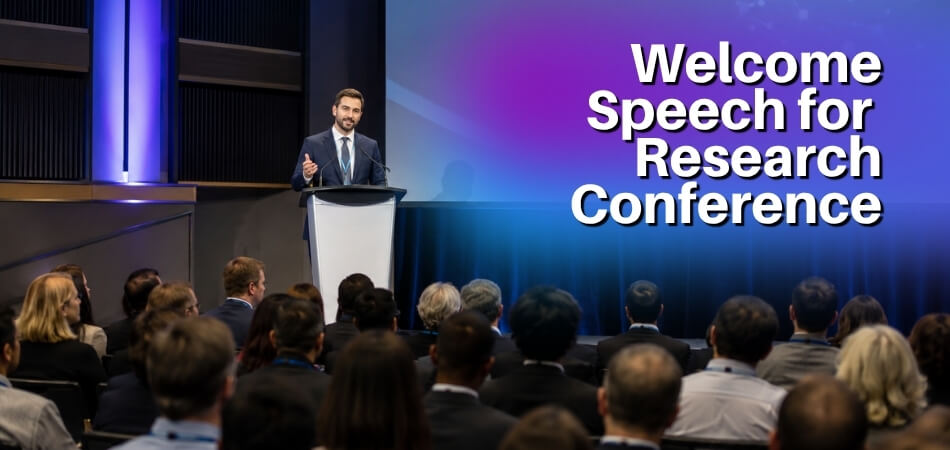
A welcome speech for a research conference is a short formal address at the start of a research-based event. A host, chairperson, organizer, faculty member, student representative or institutional leader may give it. It greets attendees, introduces the purpose of the event and sets the tone for academic discussion. It should make the audience feel respected, explain why the conference matters and prepare everyone for presentations, panels, networking and knowledge sharing.
The speech usually includes:
- A greeting to speakers, guests, researchers, presenters and participants
- The conference topic or theme and the purpose of the event
- Thanks to organizers, reviewers, sponsors, funders, volunteers and attendees
- A one-sentence preview of the program
- A positive closing line
The goal is not to explain every detail of the event. It is to create a welcoming environment where people feel ready to listen, present, question and connect. The speech should be clear, professional, warm and focused, and it should match the audience and the event format without extra detail.
Why the Opening Speech Matters at a Research Conference
The opening speech matters because it sets the first impression and the ground rules for discussion before the keynotes, paper sessions and poster hours begin. It creates order, sets expectations, makes attendees feel included, builds interest in the sessions ahead and gives the event a professional start.
At a research conference it also does a few jobs that a general event speech does not:
- It tells early-career researchers and first-time presenters that questions are welcome.
- It reminds a mixed-discipline room why the work matters, in plain words.
- It credits the reviewers and committee members whose work most attendees never see.
- It names the funders and partner institutions who made the event possible.
Some attendees are senior scholars and others are students, so the speech should bring everyone to one shared purpose: learning from research and exchanging ideas.
How to Write a Welcome Speech for a Research Conference
Start with the audience, define the purpose, then organize the message around welcome, appreciation and research value. Keep it to what the room needs to hear before the first session.
Identify the Audience and Conference Purpose
A research conference may include professors, keynote speakers, graduate students, industry professionals, sponsors, reviewers, delegates and volunteers. The audience sets the tone. A student research day can sound friendly and encouraging, an international conference needs a more formal register, a scientific meeting can lean on evidence and discovery, and a business research event can talk about strategy and practice.
Then settle the purpose. Is the event meant to share findings, discuss open problems, introduce new methods, support collaboration or encourage young researchers? Once that is clear, the speech is easy to write.
Choose the Right Tone and Language
The tone should be professional, respectful and warm: not casual, not cold. Use short sentences and familiar words, because heavy technical detail belongs in the sessions and clear language helps the audience focus on the message. Instead of something complicated, say: “This conference gives us a chance to share research findings and discuss new ideas.” Avoid dramatic claims and jokes that may not suit the room.
Match the register to the room. A large, mixed-discipline or international event suits a more formal address, while a small recurring meeting where people already know each other can sound more relaxed. Either way, balance warmth with formality. “It is an honor to welcome you, and we are pleased to have so many dedicated researchers, presenters and guests with us today” is formal enough for an academic event and still friendly. “This event brings researchers, scholars and professionals together for open academic exchange” works the same way. Also avoid language that sounds copied from another type of event.
Do not assume everyone has the same role. Inclusive phrases help:
- “all participants”
- “researchers from different fields”
- “local and international delegates”
- “members of the research community”
- “speakers, presenters and attendees”
Open With a Warm Greeting
Greet the main groups in the room, respectfully and briefly. For example: “Good morning, distinguished guests, respected speakers, researchers, presenters and delegates. It is a pleasure to welcome you.” This opening is inclusive and formal without being hard to understand.
Introduce the Conference Theme or Research Focus
After the greeting, name the topic so the audience has context.
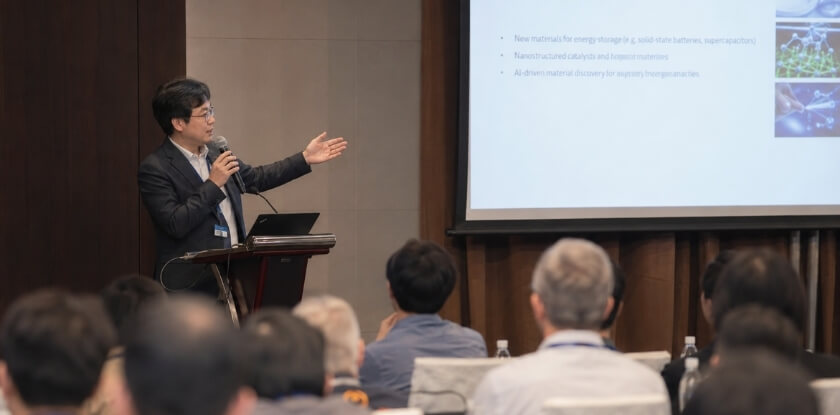
Example: “This conference is about research that travels: from a lab, a clinic or a classroom into questions other people can use.”
If the event has a specific field, adjust the words. A healthcare conference can mention public health and patient care, a technology event can mention data and artificial intelligence, and an education event can focus on teaching and learning. The theme table further down lists more field wording.
Acknowledge Guests, Speakers, Organizers, Reviewers and Funders
A conference needs planning, reviewing, presenting, funding and coordination, so say thank you. You may thank keynote speakers, session chairs, paper presenters, delegates, review committee members, organizing committee members, sponsors and partner institutions, volunteers and support staff, and attendees.
Name the people who carried the most weight and thank the rest as a group, because a long run of names is hard to follow. Check the spelling, title and pronunciation of every name before the day.
Some funders set rules for acknowledgment. For example, SSHRC’s page on acknowledging support (Canada’s Social Sciences and Humanities Research Council, modified January 2026) says grant holders must acknowledge the support verbally and/or in writing, including in conference presentations, and it gives written wording for it. If a grant or sponsor agreement asks for an acknowledgment, follow its wording. One short line is enough: “Our thanks go to the reviewers who read every submission carefully, and to the funders and partners behind this event.”
Preview the Program Briefly
Give a short idea of what to expect without reading the full conference agenda. For example: “Through the day we will hear keynote remarks, research presentations, panel discussions and time for academic networking.” It helps attendees see the flow of the event and builds interest in the sessions ahead. The detail for each talk belongs in its session description in the program, not in the opening speech.
Encourage Questions and Collaboration
A research conference is more valuable when people engage. Invite questions in the room, in the corridor and over coffee, and say that early-career researchers are as welcome to speak as anyone: “Ask the question you were saving for later. Today is the right day for it.” This supports the purpose of a research event: knowledge exchange, professional growth and collaboration.
Close With a Positive Transition
The ending should lead naturally into the next part of the event. For example: “Once again, welcome to everyone. I wish you a productive, inspiring and successful conference.” If another speaker follows, the host can introduce that person right after the closing line.
Structure of the Speech: Key Elements in Order
A complete welcome speech has six core elements: greeting, event introduction, purpose, recognition, engagement message and closing. Use the order below and give each part one or two sentences.
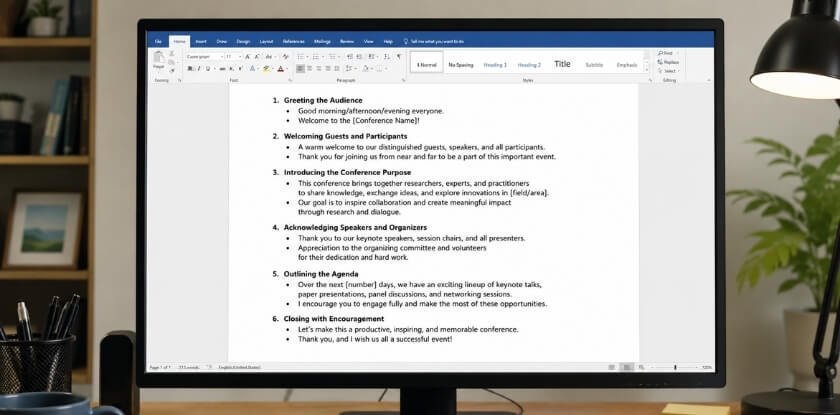
| Step | Purpose | Sample line |
| 1. Formal greeting | Welcomes the audience respectfully | “Good morning, colleagues, guests and fellow researchers.” |
| 2. Event introduction | Names the conference and its main focus | “Welcome to the Annual Research Conference on [topic].” |
| 3. Purpose statement | Explains why the event matters | “We are here to test ideas against evidence and learn from other fields.” |
| 4. Recognition | Thanks the people behind the event | “Thank you to our committee, reviewers, volunteers and partners.” |
| 5. Program preview and engagement | Mentions the main parts and invites participation | “Today brings keynotes, paper sessions and panels, plus time to talk.” |
| 6. Closing transition | Moves into the first session | “Please join me in welcoming our first speaker.” |
These elements help the speaker stay organized and avoid repetition. A longer version of each line is shown in the H3 blocks above, and the finished speeches are in the samples below.
Can You Use a Theme in a Research Conference Welcome Speech?
Yes. A theme gives the speech direction and ties the event to a larger purpose, as long as it matches the conference topic and is easy to understand. A forced theme sounds worse than none.
| Field | Theme idea | Words to draw on |
| Science | Discovery through evidence | discovery, experiments, innovation |
| Healthcare | Research for better care | patient care, public health, clinical research |
| Technology | Innovation for the future | digital systems, artificial intelligence, data, engineering |
| Education | Learning through inquiry | teaching practice, academic growth, student success |
| Business | Research for strategic growth | leadership, strategy, market research |
| Environment | Knowledge for sustainable change | climate research, conservation, responsible solutions |
Mention the theme near the beginning and connect it to the program. Example: “The theme reminds us that research is not only about producing knowledge but also about applying it to real questions.” Field-specific wording makes the speech sound relevant instead of generic.
Should You Add Humor to a Research Conference Welcome Speech?
Yes, light humor can work if it is brief, kind and suited to the audience. It helps people relax, but it should never distract from the purpose of the event.

Safe humor is about shared academic life: long schedules, coffee, deadlines or presentation nerves. For example: “I promise to keep these opening remarks shorter than a literature review.”
Avoid jokes about politics, religion, nationality, gender, appearance, academic rank or sensitive research topics. At international conferences humor can be misunderstood across cultures. If you are unsure, choose sincerity over humor.
How Long Should a Research Conference Welcome Speech Be?
A research conference welcome speech usually runs 3 to 5 minutes, enough to greet the audience, introduce the event, thank key people and start the program with confidence. Confirm the time slot with the organizing committee first, because it varies by event. An events-industry guide (Jaarbeurs, 2025) puts the average speaking pace at 120 to 140 words per minute and a 5-minute speech at about 600 words, which is a handy way to size your draft. The lengths below are typical guidance, not a fixed rule.
| Event Type | Suggested Length |
| Small student research event | 2 to 3 minutes |
| Standard academic conference | 3 to 5 minutes |
| International research conference | 5 to 7 minutes |
| Formal opening ceremony | 7 to 10 minutes |
Shorter is usually better. People came to hear the keynote speakers, presenters and panelists, so the welcome should support the program, not delay it. If time is tight, keep only the greeting, purpose, thanks and closing. Cut long stories, repeated thank-you lines, detailed biographies and full schedule reading.
Research Conference Welcome Speech Samples
Here are six adaptable welcome speech samples for a research conference. Replace the placeholders with your event name, institution, theme and guests, and change the wording so it sounds like you.
Short Welcome Speech for a Research Conference
Good morning, everyone, and welcome to [conference name].
We are here to share findings, ask hard questions and learn from one another’s work. Thank you to our speakers, presenters, committee and volunteers for making this possible.
I hope today brings good discussion, useful contacts and ideas worth carrying into your next project. Let us begin with curiosity and respect.
Formal Welcome Speech for an Academic Research Conference
Distinguished guests, respected keynote speakers, session chairs, researchers, scholars and participants, good morning.
On behalf of the organizing committee, I am honored to welcome you to [conference name]. This event brings together people committed to inquiry, evidence and the advancement of knowledge.
Over the program we will hear expert talks, examine new research and take part in discussions that may lead to future collaboration.
We thank our keynote speakers, session chairs, reviewers, organizers, volunteers and partners. Your time and preparation made this conference possible. May it encourage thoughtful dialogue and research that continues long after these sessions end.
Welcome Speech for an Interdisciplinary Research Conference
Good morning, colleagues from many fields.
Today a biologist may sit beside an economist, and an engineer beside a historian. That mix is the point of [conference name]. Each field brings its own methods and its own questions, and we learn most when we explain our work to people outside our field.
So I have one request. If a term in a talk is unfamiliar, ask about it. Nobody here expects you to know every specialty.
Thank you to the committee and reviewers who built a program across disciplines. Welcome, and enjoy the conversations.
Welcome Speech for Early-Career Researchers and Students
Good morning, and welcome to [conference name].
Presenting research to a room of strangers is hard, and many of you are doing it for the first time. Every poster and paper here took months of work, and it deserves a serious audience.
To our senior colleagues: please ask generous questions. To our early-career researchers: please ask yours too. This room is meant to be a safe place to test ideas.
Thank you to the mentors, supervisors, volunteers and organizers who helped you get here. Good luck, and enjoy the day.
Welcome Speech for an International Research Conference
Good morning, distinguished guests, delegates and researchers, and a warm welcome to those who traveled from other countries.
We are glad to host participants from many countries, institutions and disciplines at [conference name]. Research crosses borders easily, and conversations that start here can turn into joint projects and shared results.
I thank our keynote speakers, presenters, session chairs, committee, volunteers, sponsors and every participant. Your presence gives this conference its value. We look forward to a productive few days.
Welcome Speech That Thanks Reviewers and Funders
Good afternoon, and welcome to [conference name].
Before we begin, two thank-yous. First, to the reviewers. Every paper in today’s program was read closely by people who gave their time without applause, and their comments made the work stronger. Second, to [funder or partner name] for supporting this event.
The next few days hold [number] sessions on [topic]. Please make the most of them: listen carefully, question kindly and meet someone new. Now, let me invite our first speaker.
Delivery Tips and Common Mistakes
The most common mistakes are making the speech too long, using unclear language, reading without looking up and forgetting to thank key contributors. A useful rule: if a sentence does not welcome, inform, appreciate or encourage the audience, it probably does not belong in the opening.
| Mistake | Better approach |
| Speaking too fast | Nervous speakers rush. Pause after key points; it makes the message easier to follow. |
| Reading without looking up | Notes are fine, but keep key points in front of you and make eye contact around the room. |
| Making the speech too long | The opening should not take time from the main program. |
| Irrelevant examples | A cultural-event or business-seminar speech may not fit a research conference. |
| Wrong names or titles | Confirm spelling, title and pronunciation of each guest before the day, and mention only the people the room needs to hear. |
| Forgetting to thank people | Name speakers, organizers, reviewers, volunteers, partners and attendees as groups. |
| Complex language | Academic does not mean difficult. Clear wording works better. |
| Ending suddenly | Close with a positive line that leads into the next session. |
Practice aloud to check timing, pronunciation and flow. Stand with relaxed shoulders, avoid needless movement and smile naturally. If you lose your place, pause calmly and continue; a short pause usually makes a speaker look composed.
Where to Find Strong Conference Opening Examples
Watch real academic events and professional speaking resources for inspiration, then customize the final speech for your own event.
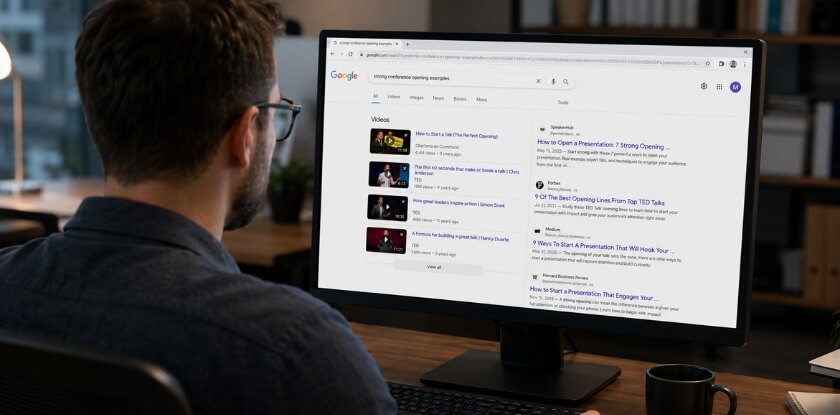
Good sources include:
- Academic conference websites: Many publish recordings of past openings and keynote sessions.
- University event recordings: Useful for research days, symposiums and student conferences.
- Public lectures and TED-style talks: Good for delivery, attention and pacing.
- Speaking podcasts: Helpful for voice, structure and confidence.
- Local seminars and workshops: Live events show how speakers manage the room and move between sessions.
Do not copy a sample word for word. Study the structure, then write a version that fits your conference, audience and theme.
Research Conference Welcome Speech Template
Use this research conference welcome speech template as a flexible starting point, and see the theme table above for field-specific wording:
Good morning/afternoon, respected guests, distinguished speakers, researchers, presenters, delegates and participants.
On behalf of [organization/institution/committee name], I am pleased to welcome you to [conference name]. This conference brings us together to discuss [main research topic/theme], share findings and encourage meaningful academic exchange.
Today we will hear from [keynote speakers/presenters/experts], explore important research questions and join discussions that can support future learning and collaboration.
I sincerely thank [organizers/sponsors/funders/partners/volunteers/reviewers] for their hard work and support, and all participants for contributing to its success.
May this conference lead to productive conversations, new ideas and lasting academic connections. Once again, welcome to [conference name].
From our experience at MS International: Our conferences are held in person in the Greater Toronto Area. Submissions go through double-blind review, and authors register after acceptance. Venue details, the session schedule and presentation timing are sent by email before the event, so the opening speech can stay focused on welcome and thanks.
FAQ: Research Conference Welcome Speech
As the opening speaker at a research conference, you will face decisions on the first line, whom to thank including funders, using notes and greeting guests in several languages.
What should be the first line of a research conference welcome speech?
The first line should greet the audience respectfully and name the event. A simple version is: “Good morning, everyone, and welcome to [conference name], our gathering of researchers from many fields.”
Who should be thanked in the welcome speech?
Thank the organizing committee, reviewers, speakers and session chairs, funders and sponsors, partner institutions, volunteers and attendees. Name only key people and thank the rest as groups. Acknowledge special guests too if the event protocol requires it.
Is it acceptable to use notes while speaking?
Yes. Notes help you remember names, order and key points. Look up often and speak naturally instead of reading every word.
Should all guest names be mentioned individually?
Not always. At a small event, naming special guests may be right. At a large conference, group recognition is usually better unless protocol requires specific names.
Can a welcome speech include a personal story?
Yes, if the story is short and connected to research, learning or the theme. It should not distract from the event.
Should the audience be greeted in multiple languages?
A short multilingual greeting can suit an international research conference. Keep it accurate, respectful and brief.
Should a research conference welcome speech be formal or informal?
It depends on the room. Choose formal for large, international or mixed-discipline events and a lighter tone for small meetings of colleagues. Keep sentences short in both cases.
How should the speaker end the welcome speech?
End with appreciation, encouragement and a clear transition. For example: “Once again, welcome to everyone. I wish you a productive conference and invite you to take part fully in today’s sessions.”
How do you thank funders in a research conference welcome speech?
Name them in one short line, using the wording the grant or sponsor agreement asks for, since some funders set acknowledgment rules. For example: “We gratefully acknowledge [funder name] for supporting this event.” Avoid long lists in the spoken speech; put the full list on a slide or in the program.
Final Tips for Making a Research Conference Welcome Speech Memorable
A memorable welcome speech for research conference is clear, relevant and sincere. It does not need to be dramatic or long. It needs to help a mixed room of senior scholars, first-time presenters and reviewers feel respected and ready. Keep to the time, mention the theme, thank the right people and practice once aloud before you go on stage.