
Look around any conference hall and the first thing you notice on each person is a badge: a name, a colour band, sometimes a ribbon. That small card does more work than it seems, and the type you pick shapes check-in, security and networking.
Quick answer: The main types of conference badges are role badges (attendee, VIP, speaker, staff, sponsor, exhibitor, media, guest) and format badges (paper or cardstock, laminated, PVC, QR code, RFID or NFC, digital, and reusable or eco-friendly). Choose the role system first, then the format that fits your event length, budget, check-in speed and waste goals.
What Are Conference Badges and Why Do They Matter?
Conference badges are wearable credentials that identify participants and control access. Most show the attendee’s name, organization, role, and event branding. Some add QR codes, barcodes, photos, colour labels, or smart technology for check-in.
Badges support several event functions:
- Identification: Attendees can quickly see names, roles, companies, and event categories.
- Networking: A readable name and organization make introductions easier.
- Access control: Staff can check who may enter VIP rooms, speaker areas, workshops, or exhibition halls.
- Security: Misplaced or unauthorized badges are easier to spot.
- Branding: Colours, logos, and lanyards reinforce the event identity.
- Check-in speed: QR codes, barcodes, RFID, and NFC can shorten registration lines.
- Event insights: Smart badges can support attendance reports, lead capture, and session tracking.
A weak badge system causes delays and access confusion. A strong one gives attendees a smoother day and organizers a more manageable workflow.
Main Types of Conference Badges
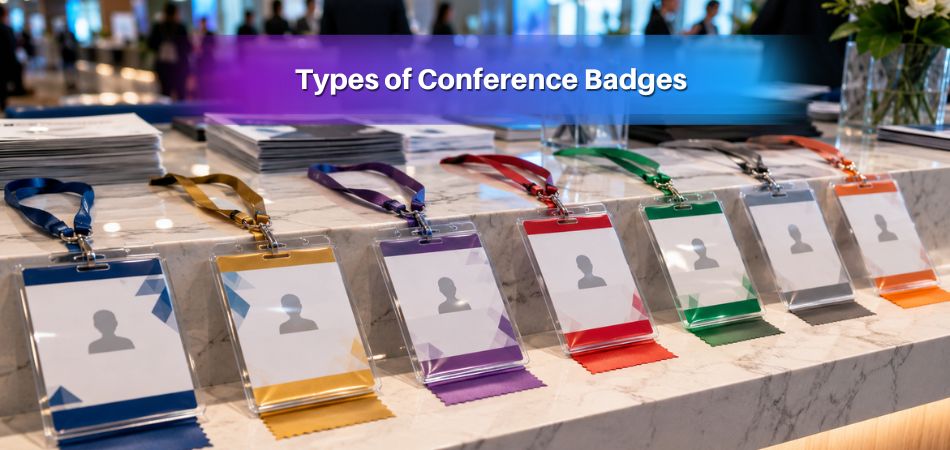
The main badge types follow participant roles: attendee, VIP, speaker, staff, sponsor, exhibitor, media, and guest. The role tells staff and other attendees who someone is and what access they should have.
The table below shows what each role badge usually carries. The colours are examples only, because there is no universal standard. Pick your own scheme and keep it consistent.
| Role | Shows | Example colour or marker |
| Attendee | Name, organization, job title | White or neutral, optional track colour |
| VIP | Name, VIP label, premium access | Gold or a ribbon |
| Speaker | Name, organization, Speaker/Keynote/Moderator/Panelist | Distinct colour plus a ribbon |
| Staff or organizer | Name, team (registration, security, technical) | Bright colour that stands out |
| Sponsor | Company, tier, representative | Tier colour or tier label |
| Exhibitor | Name, company, booth number | Exhibitor label, often with a scannable code |
| Media | Name, outlet, approved access | Press label |
| Guest | Name, date, host, access area | Visibly different from attendee badges |
Attendee Badges
Attendee badges are the standard badge for registered participants. They show the full name, company or institution, job title, and event logo.
These are used most for networking and general admission, so they must be easy to read. A good one may also carry a QR code for check-in, a track colour, or a ticket-level label when access types differ.
VIP Badges
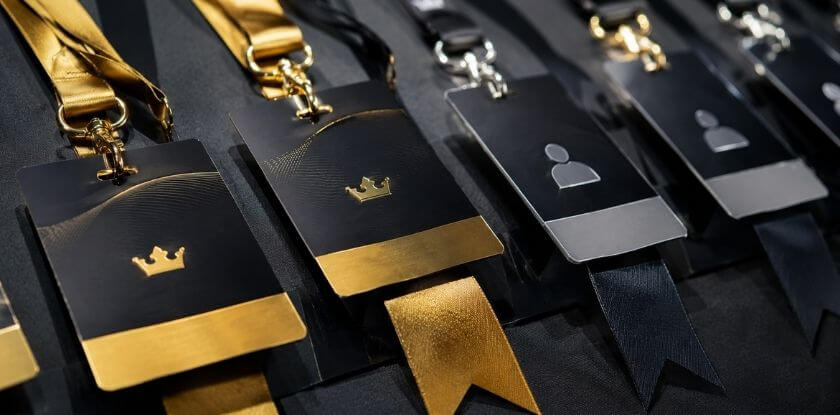
VIP badges identify special guests who receive premium access, priority support, or exclusive privileges. Typical holders are executives, chief guests, high-tier ticket holders, award recipients, major partners, and invited representatives.
A clear label, distinct colour, premium material, or ribbon helps. The goal is not to look flashy but to let staff recognize VIPs quickly.
Speaker Badges
Speaker badges identify presenters, keynote speakers, panelists, moderators, workshop leaders, and session chairs. They help attendees see who leads a session and help staff manage stage or backstage access.
Include the name, organization, and, if useful, the session title, track, or access area. The words Speaker, Keynote, Moderator, or Panelist should be easy to see.
Staff and Organizer Badges
Staff and organizer badges help attendees find people who can give directions, registration support, or technical help. They should be more visible than regular attendee badges.
Common categories are organizer, volunteer, registration team, security, technical support, venue coordinator, and session assistant. Colour coding lets attendees spot a support team across a busy hall, including the volunteers who staff registration and guide people to rooms.
Sponsor Badges
Sponsor badges identify representatives of the companies or organizations supporting the event. They can include the sponsor’s name, logo, tier, representative details, and access permissions.
Keep them uncluttered. A badge may simply read Gold Sponsor, Platinum Sponsor, or Event Partner beside the company name.
Exhibitor Badges
Exhibitor badges are for people representing booths, displays, or organizations in an exhibition area. They are common at trade shows, business expos, career fairs, and academic exhibitions.
Show the person’s name, company, booth number, and exhibitor label. A QR, RFID, or NFC feature can help with lead capture and booth engagement.
Media and Press Badges
Media badges identify journalists, photographers, videographers, and approved press representatives. They help organizers manage press access to sessions, interviews, photo zones, and media rooms.
Show the name, media outlet, role, and approved access level. This matters when an event has privacy rules, restricted interviews, or controlled filming areas.
Visitor or Guest Badges
Visitor or guest badges are temporary badges for people who need limited access but are not full attendees. Examples are invited guests, short-term visitors, delivery support, family members, and venue partners.
Include a name, date, host, and access area. For security, make them easy to tell apart from regular attendee badges.
Conference Badge Types by Format
Badges can also be grouped by format: printed paper, laminated, plastic or PVC, reusable holders with inserts, digital, QR code, and RFID, NFC or smart badges. The format affects durability, cost, sustainability, and event operations.
| Format | Cost level | Durability | Needs technology? | Best for |
| Printed paper or cardstock | Low | Low to medium | No | One-day events, workshops, seminars |
| Laminated | Low to medium | Medium | No | Multi-day academic programs |
| PVC or plastic | Higher | High | Optional (QR, RFID) | Trade shows, corporate events, VIP passes |
| Reusable holder with insert | Low per event after the first | High for the holder | No | Organizations that host events regularly |
| QR code badge | Low | Same as the badge it is printed on | Scanner or phone | Fast check-in and contact sharing |
| RFID, NFC or smart badge | Highest | Medium to high | Readers, software, backups | Large conferences, expos, secure events |
| Digital badge | Varies with the app | Depends on the device | Phone, app, sometimes internet | Hybrid, tech-focused events |
Printed Paper Badges
Printed paper badges are affordable and easy to produce for short events. They suit seminars, small workshops, internal meetings, and one-day conferences.
They can be printed on-site for late registrations. Without a holder, though, they bend, tear, or look worn if used for long events.
Laminated Badges
Laminated badges are printed badges covered with a protective layer. They are stronger than plain paper and work for multi-day conferences, academic programs, and medium-sized events.
The benefit is durability. The drawback is that paper bonded to plastic is hard to recycle.
Plastic or PVC Badges
Plastic or PVC badges are durable, water-resistant, and professional-looking. They suit trade shows, corporate conferences, VIP passes, exhibitor credentials, and events with frequent scanning.
They usually cost more than paper and create more waste if thrown away after one event. Recycled plastic options may reduce the impact.
Reusable Badge Holders with Inserts
Reusable badge holders use a durable outer holder with a replaceable printed insert. This format is ideal for organizations that host events regularly.
Only the insert changes each time. Holders and lanyards can be collected, cleaned, and reused, which lowers long-term cost and waste.
Digital Badges
Digital badges are event credentials shown on a phone, tablet, smartwatch, or event app. They can display names, QR codes, ticket status, access levels, and networking profiles.
They reduce printing and are easy to update. They also depend on devices, batteries, apps, and sometimes internet access, so a printed backup is useful. Not every attendee has a compatible phone, so keep a printed option for them.
QR Code Badges
QR code badges carry a scannable code linked to attendee data, an event app, check-in records, session access, or contact sharing. The code can be printed or digital.
They are popular because they are affordable and flexible. Make the code large and clear.
RFID, NFC, and Smart Badges
RFID, NFC, and smart badges use technology for faster entry, attendance tracking, networking, and lead capture. They suit large conferences, expos, and secure events. They support tap-based access, contactless scanning, booth tracking, and session reporting, and they need readers, software, data planning, and backup systems. The technology section below covers each type.
Printed vs Digital Conference Badges: Which One Works Better?
Printed badges work better for visibility and reliability, while digital badges work better for flexibility, sustainability, updates, and data tracking. Many events use both.
| Feature | Printed Badges | Digital Badges |
| Visibility | Easy to read when worn | May require opening an app |
| Reliability | Works without devices or Wi-Fi | Depends on phone, battery, and system access |
| Updates | Usually needs reprinting | Can often be changed quickly |
| Sustainability | Can create waste | Reduces paper and plastic use |
| Networking | Names are visible instantly | Can include digital profiles |
| Access control | Can use colors, QR codes, or RFID | Can use live app permissions |
| Best for | In-person events and mixed audiences | Hybrid, tech-focused, and app-based events |
For many conferences, the best answer is a printed badge with a QR code, or a digital backup. The name stays visible while the QR code handles check-in, contact sharing, or session tracking.
Common Materials Used for Conference Badges
Common badge materials include paper, cardstock, laminated paper, PVC, PET, rPET, biodegradable materials, wood, bamboo, cork, fabric, and metal. Each has different strengths.
Paper and Cardstock
Paper and cardstock badges are low-cost, lightweight, and easy to print. Cardstock is stronger than regular paper and works well for one-day events or for badges placed inside holders. Lamination adds wear resistance but makes recycling harder, as described above.
PVC, PET, and rPET Plastic
PVC, PET, and rPET badges give a stronger, cleaner finish. They suit professional events, trade shows, and credentials that are scanned often. Choose rPET when recycled content matters to you.
Biodegradable or Compostable Materials
Biodegradable and compostable materials are meant to reduce waste after the event. They are covered with the other eco options in the next section, because they only work with proper disposal.
Wood, Bamboo, and Cork
Wood, bamboo, and cork badges look natural and premium. They are often used for VIPs, speakers, special guests, or eco-conscious events. They can cost more and may not suit large general attendee groups.
Fabric or Cloth Badges
Fabric badges are soft and comfortable but may not show small details clearly. They work better for simple role identification than for detailed text, QR codes, or complex branding.
Metal Badges
Metal badges are strong, premium, and long-lasting. Use them for executives, award recipients, VIP guests, or commemorative credentials rather than for large attendee groups.
Eco-Friendly and Reusable Conference Badge Options
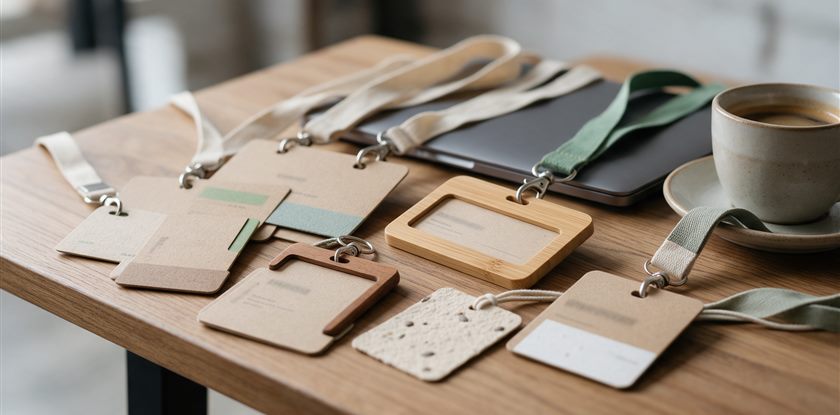
Eco-friendly badges cut single-use waste with recycled materials, compostable options, reusable holders, seed paper, upcycled materials, or greener printing. Sustainability depends on both the material and what happens to the badge after the event.
Recycled Paper Badges
Recycled paper badges are practical, affordable, and easy to print. They suit short events, academic programs, community conferences, and organizers who want a lower-impact option.
Compostable Badge Materials
Compostable badges are designed to break down under proper composting conditions. They work best when the venue has a clear composting system and attendees know where to return them.
Seed Paper Badges
Seed paper badges contain seeds that attendees can plant after the event. They send a memorable sustainability message, but they may not suit detailed printing or heavy scanning.
Reusable Holders and Lanyards
Reusable holders and lanyards cut waste because the same outer parts are used again. Set up return boxes, clean the collected holders, and store them for future events.
Upcycled Badge Materials
Upcycled badges use repurposed materials such as old banners, fabric scraps, or leftover event materials. They can support creative branding and reduce waste, but test samples for readability and comfort.
Eco-Friendly Printing Choices
Eco-friendly printing reduces unnecessary waste and chemical impact. Useful practices include on-demand printing, water-based or soy-based inks, recycled cardstock, local printing, minimal ink coverage, and clear recycling instructions.
How Technology Changes Modern Conference Badges
Technology makes badges more useful for check-in, access control, tracking, networking, and event analytics. It helps most at large events, and only with proper planning.
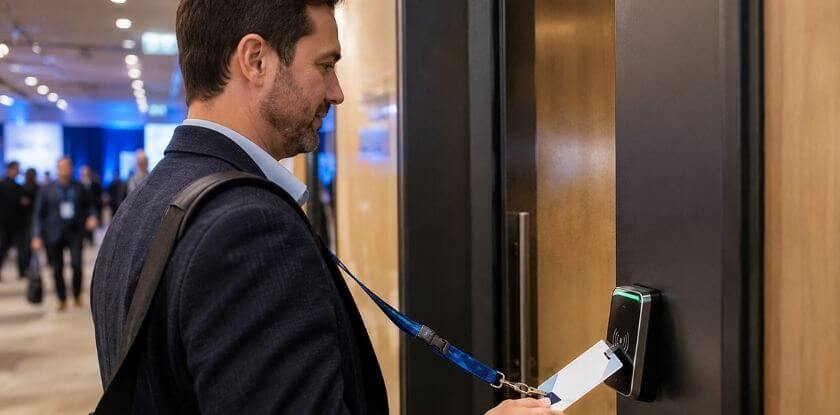
QR Codes and Barcodes for Check-In
QR codes and barcodes let staff scan badges for registration, ticket validation, session entry, and contact sharing. They are affordable and easy to use. A cracked or smudged print will fail to scan, so test first. Check each scan against the registration list instead of trusting what is printed, because a printed code can be copied. A code can also link to personal details, so attendees may want to cover it before posting a badge photo online.
NFC Badges for Tap-Based Access
NFC badges let attendees tap the badge against a reader for access or information exchange. They suit fast entry, booth engagement, and secure rooms, but need compatible hardware.
RFID Badges for Tracking and Entry Control
RFID badges can be detected by readers without direct scanning alignment. They are useful at high-traffic entry points, for session tracking, VIP zones, and exhibition halls.
Bluetooth and BLE Badges for Event Insights
Bluetooth and BLE badges can show organizers movement, booth visits, and crowd patterns. They suit larger events, but private communication with attendees about the tracking is essential.
Smart Badges for Interactive Experiences
Smart badges combine technology with engagement features such as tap exchange, gamification, access control, or app-connected functions. They suit tech conferences, expos, and high-engagement events.
Privacy, Cost, and Technical Limitations
Badge technology adds value, but it also raises privacy, cost, training, and reliability concerns. Explain how data is used, prepare backups, train staff, and collect no more data than you need.
How to Choose the Right Conference Badge Type for Your Event
The right badge depends on event size, duration, audience, budget, access rules, branding, sustainability, and technology needs. Choose the simplest badge that still does the job.

Best Badges for Corporate Conferences
Corporate conferences usually work best with polished printed badges, PVC badges, reusable holders, or QR code badges. These support a professional look, networking, and smooth check-in.
Best Badges for Academic Conferences and Symposia
Academic conferences often work well with cardstock badges, recyclable badges, reusable holders, and QR code badges. Useful details are institution names, presenter labels, session tracks, and abstract links.
Best Badges for Trade Shows and Exhibitions
Trade shows need badges for identification, booth access, and lead capture. QR, RFID, and NFC badges help exhibitors collect approved visitor details quickly.
Best Badges for Workshops and Small Events
Workshops usually need simple printed badges, cardstock badges, reusable holders, or basic QR badges. Advanced technology is rarely needed unless the workshop involves certification, attendance tracking, or paid access control.
Best Badges for Multi-Day and Hybrid Events
Multi-day and hybrid events need durable badges plus digital support. Laminated, plastic, reusable-holder, QR, RFID, and digital badges can all work, depending on the event model.
Key Factors to Consider Before Choosing
Before you decide, review:
- Event size: Larger events need clearer categories and faster check-in.
- Duration: Longer events need stronger materials.
- Access levels: Restricted areas need visible permissions.
- Budget: Smart badges cost more than simple printed ones.
- Audience: Tech-friendly audiences accept digital badges more easily.
- Sustainability: Reusable or recyclable choices reduce waste.
- Data needs: Lead capture and attendance tracking may call for QR, RFID, or NFC.
- Backup plan: Digital systems need a printed or manual alternative.
How to Personalize Conference Badges for Attendees
Badge personalization means adding attendee-specific details, role markers, colours, codes, and access information. It makes the badge more useful and helps networking.

Personalization Ideas for Printed Badges
A printed badge can include:
- Large attendee name
- Company or institution
- Job title
- Role label
- Colour band
- Icon
- QR code
- Track or access detail
- Back-side schedule or map
Keep the design clean. Names and roles should be easier to read than decorations.
Personalization Ideas for Digital Badges
Digital badges can include live profiles, ticket types, digital QR codes, session access, social links, contact sharing, interest tags, and participation achievements. They help when attendee details change after registration.
Using Colors, Icons, and Role Labels
Colours, icons, and role labels let people read a badge category at a glance. Use plain labels such as Speaker, Staff, VIP, Exhibitor, Sponsor, and Media, backed by colours, ribbons, or icons as in the role table above. Avoid too many colours, because that confuses both staff and attendees. Do not rely on colour alone: print the role in words or add an icon, so people who cannot tell the colours apart can still read it.
Adding QR Codes, Schedules, and Access Details
QR codes, schedules, maps, and access details make a badge more functional. Put essential details on the front and secondary information on the back or behind a QR code.
Badge Design Best Practices for Better Visibility and Use
A good conference badge is readable, comfortable, simple, and useful. Design for real conditions: crowded halls, registration lines, networking breaks, and low-light rooms.

Keep Names Easy to Read
The attendee name should be the most visible part of the badge. Use large text, strong contrast, clean fonts, and enough spacing. Test samples before printing.
Balance Branding with Function
Branding should support the event identity without hurting readability. Keep logos, sponsor marks, and graphics controlled. Name, role, and access details stay the priority.
Choose the Right Badge Size
The best badge size is large enough to read but comfortable enough to wear. Small badges look neat but cut networking value. Oversized ones swing, feel heavy, and distract. No official standard sets conference badge sizes, so confirm exact measurements with your printer and holder supplier before ordering.
Make Badges Comfortable to Wear
Badges should be light, stable, and comfortable for long use. Choose soft lanyards, rounded corners, strong clips, and balanced holes. Heavy badges, rough lanyards, sharp corners, and poor clip placement make people take them off.
Common Mistakes to Avoid When Choosing Conference Badges
Common badge mistakes include weak materials, crowded designs, no plan for late changes, no digital backup, no collection plan, and no testing. Weak materials, crowded design, and poor comfort are covered in the sections above. These are the planning mistakes left:
- Ignoring last-minute changes: Late registrations, cancellations, spelling errors, and job title changes are common. Use editable templates, on-demand printing, and blank stock to reduce reprinting stress.
- Skipping backups for digital badges: Battery, app, scanner, or internet problems can stop a digital badge working. Keep printed backups, manual lists, charging support, and trained staff ready.
- Not planning badge collection or recycling: Collection reduces waste, lets you reuse holders, and protects personal data. Place return boxes near exits and separate lanyards, holders, and inserts where possible.
- Having no lost or duplicate badge rule: Decide in advance who replaces a lost badge and how identity is checked, and state that badges may not be lent to someone else. The registration desk is the usual place to handle it.
- Failing to test before printing: Check readability, scan quality, colours, lanyards, badge weight, QR placement, and long names before final production. Small tests prevent expensive errors.
From our experience at MS International: Our events are held in person in the Greater Toronto Area. Your confirmation email states the check-in time, and you collect your conference badge at check-in. Our pages do not describe a specific badge type, so rely on the confirmation email for what to expect on the day.
FAQ: Types of Conference Badges
Badge planning for an event touches on what to print on each badge, attendee photos, color coding for large crowds and digital versus printed formats.
What information should a conference badge include?
A conference badge should include the attendee’s full name, organization, role, and event branding. It may also carry a job title, QR code, barcode, photo, access level, or session track. Keep the name most visible so people can read it easily.
What is the best size for a conference badge?
The best size is large enough to read clearly but comfortable to wear all day. A medium size usually fits names, roles, company details, and a QR code. Small badges reduce visibility, while oversized ones feel awkward.
Should conference badges include attendee photos?
Badges should include photos only when security, identity verification, or restricted access matters. Photos only help if staff compare them with faces at the door, which takes people and time. For casual or low-risk events they are unnecessary, and stored photos add privacy concerns.
How do badge colors help at large conferences?
Colours help large conferences by separating roles, access levels, ticket types, or session tracks. Staff can spot speakers, VIPs, exhibitors, media, and attendees faster. Keep the colour system simple so the meanings stay clear.
Should an event use digital or printed badges?
It depends on the job. Digital wins on quick updates, app features, and attendance data; printed wins when the name must be readable at a glance and nothing can fail. Many events use both: a printed name for face-to-face networking and a digital layer for check-in and contact sharing.
How do conference badges improve networking?
Badges improve networking by showing a person’s name, company, role, and professional context during conversations. That makes introductions easier. QR codes or digital profiles can also help attendees swap details quickly after the meeting.
What are smart conference badges?
Smart conference badges are badges with technology such as RFID, NFC, QR codes, Bluetooth, or app-connected features. They can support check-in, access control, lead capture, attendance tracking, and networking. They work best when the event has clear data or security needs.
How can organizers keep conference badges secure?
Organizers can secure badges with QR codes, barcodes, RFID chips, photos, access labels, and controlled printing. Printing at check-in can reduce misuse, and a rule against lending badges, with a replacement desk for lost ones, closes the gaps. For digital badges, permission settings and secure profile links protect attendee data and restricted areas.
What type of badge is best for a one-day event?
For a one-day event, printed cardstock badges, or paper badges in reusable holders, usually work best. They are affordable and simple to prepare. Add a QR code if you need faster check-in, contact sharing, or basic attendance tracking.
Why should badges be collected after an event?
Badges should be collected to reduce waste, reuse holders or lanyards, and protect personal information. Return boxes near exits make this easy, especially for badges with plastic parts, RFID chips, or QR codes tied to attendee data.
Which Conference Badge Type Should You Choose?
Pick the badge that matches your event’s purpose, size, audience, access needs, and budget. Small events can use printed cardstock or reusable holders, business conferences polished printed badges with QR codes, and trade shows QR, RFID, or NFC badges for lead capture. Sustainability-focused events can choose recycled paper, compostable materials, seed paper, or reusable systems. Before you finalize, scan every code, check comfort, confirm access labels, and prepare backups.