
A welcome speech is over before most people have found their seat, so each sentence needs a job.
Quick answer: A short conference welcome speech lasts 30 seconds to 2 minutes, which is about 60 to 300 words; a one-minute version is roughly 120 to 150 words. In that time, greet the chief guest and the room, say who you are, give the event’s purpose in one or two specific sentences, and hand over to the next speaker by name. Sponsor lists and agenda details belong in the printed program.
I have put ready samples for each format below, two timed scripts for the very shortest slots, a fill-in template, opening and closing lines, and the mistakes that are easiest to miss.
What Should a Short Conference Welcome Speech Include?
I build every short welcome from five things, and none of them needs filler.
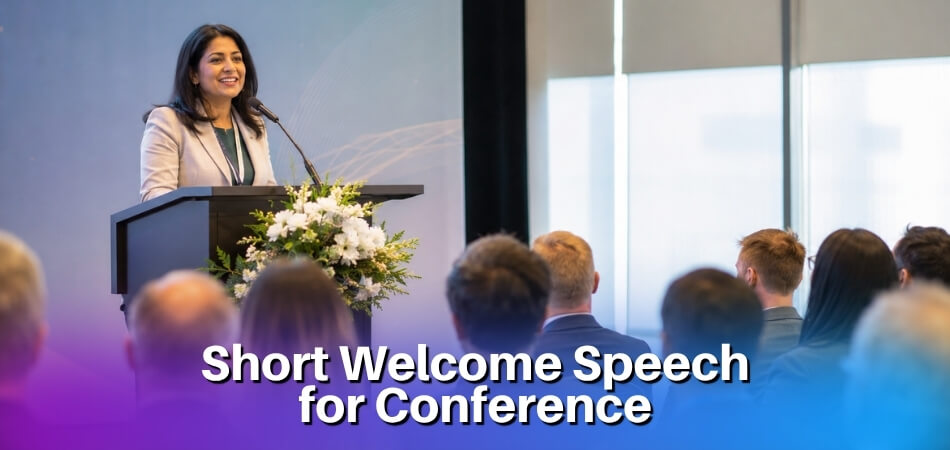
Here is what each one does:
- Greet the room. Acknowledge attendees, speakers, organizers, and any chief guest or guest of honor present. A sentence or two is enough. At a formal event my order is the most senior guest first, usually the chief guest, then the guest of honor, then everyone else together; at a less formal one, a general “Good morning, everyone” can come first. If the organizers send a protocol list, theirs wins.
- Introduce yourself. One line with your name and your role at the event, so people know why you are the one at the microphone.
- State the purpose of the event. One or two plain sentences on what the conference is about and why it is happening now. For an academic or research conference, name the theme or field. For a business conference or corporate summit, name the strategic focus or the problem being addressed.
- Acknowledge the keynote speaker. If the keynote follows you, add one line on why their work matters to this audience.
- Close with energy and hand off cleanly. A closing line tells the audience the formalities are over and the conference has started. Then pass the microphone to the next speaker by name.
The only acknowledgments I treat as required are a chief guest, a guest of honor and a funding body that asked to be named.
One Thing That Separates a Good Welcome from a Forgettable One
Specificity. “We are here to discuss important topics in our field” tells the audience nothing. “We are here to present three years of field research on urban water access, with participants from fourteen countries” gives the room scale and purpose at once. Treat that second line as an example of the style, and use your own real numbers.
The same rule applies at an international, student, or college conference: the more precisely you name the purpose, the more grounded and professional your opening feels.
Short Welcome Speech Sample (General / All-Purpose)
I wrote this sample to suit almost any professional, academic, or community conference. At about 200 words it runs roughly 80 to 100 seconds, covers the essentials, and leaves room for your own names, theme, and context. Read it as a finished model, then adapt it.
The Sample Speech
Good morning, everyone. Welcome to [Conference Name].
My name is [Your Name], and I’m [your role, such as organizing chair, director of programs, or host for today]. On behalf of [organizing body or institution], it is great to see this room full.
We have [number or description, such as over 200 researchers, professionals from 14 countries, or delegates from across the industry] here for what we expect to be a productive [two/three] days. This year’s focus is [conference theme], and the program reflects the depth of work happening in that area right now.
A word of welcome to our chief guest, [Chief Guest Name], [title and affiliation], and our guest of honor, [Guest of Honor Name], [title and affiliation]. Thank you for your time. Thanks also to the organizing committee and the volunteers who spent [weeks/months] making today possible.
Two quick notes: [brief logistics, such as sessions run in three parallel tracks, lunch is on the third floor, or interpretation is available in Hall B]. The full schedule is in your program booklet and on the event app.
Now, to the reason we are all here. I’ll hand over to [Keynote Speaker Name], who will open the program with [one-phrase topic].
30-Second and 1-Minute Welcome Speeches
The conference-type samples further down run about 35 to 55 seconds, and the general one about 80 to 100. For the tightest slots (a chair opening one session, a webinar, or a packed morning with several speakers before the keynote) and for hosts who want an exact length, I keep two counted scripts ready.
30-Second Welcome (about 60 words)
I use this one when a chair opens a single session or the welcome sits between two other items on the program. It keeps the greeting, a one-line introduction, the purpose and the next name.
Welcome, everyone, to [Conference Name]. I’m [Your Name], [your role]. For the next [number] [days/sessions] we will be working on one question: [the conference purpose in a few words, for example how cities can manage water in a hotter climate]. Thank you for making the time to be here. To open the program, please welcome [Speaker Name], [title], speaking on [topic].
1-Minute Welcome (about 130 words)
With a full minute I add a line for the chief guest, one thank-you and one practical note. Anything more can wait for the program booklet.
Good morning, everyone. Welcome to [Conference Name]. I’m [Your Name], [your role], and I’m speaking today on behalf of [Organization].
Over the next [number] days, [number or description of delegates, such as 150 researchers from 12 countries] will work through one question: [the conference theme, stated as a question].
A warm welcome to our chief guest, [Name and Title]. Thank you for joining us. Our thanks also go to the organizing committee and the volunteers who built this program.
One practical note: [the single most useful logistics line, such as where the first parallel session meets or where lunch is served]. Everything else is in your program booklet.
We have a full day ahead, so let’s begin. Please join me in welcoming [Keynote Speaker Name], [title], who will open with [one-phrase topic].
More Samples for Different Conference Types
Each conference type has its own tone. A speech that works for a corporate summit feels stiff at a student conference, and the ceremony of an international forum is too much for a small departmental event. I have written one sample for each, and I give the word count with every one, so you can pick by the time you have. Swap in your details and trim as needed.
Academic or Research Conference
Academic audiences value precision, so I keep this welcome focused on the work being presented and the community it represents. It is about 105 words, which comes in under a minute.
Good morning, and welcome to the [Name] Conference on [Field/Topic], hosted by [Institution or Organization].
We are here to share findings, test each other’s ideas, and challenge what we know about [research area]. The papers and panels over the next [number] days represent months, sometimes years, of careful work, and this is the place to bring that work into conversation.
Researchers have joined us from [regions or institutions, if relevant]. A special welcome to our keynote speaker, [Name], whose work on [topic] has shaped how this field talks about the problem.
Let’s begin. Please welcome [first speaker or next person on the program].
Business / Corporate Conference or Summit
A business audience is results-oriented: they want to know why they are there and what they will leave with. At about 90 words it runs roughly 35 to 45 seconds.
Good morning. Welcome to the [Year] [Company or Industry] [Conference Name or Summit].
This year’s theme, [theme], reflects [one sentence on why it matters to this industry now]. We built this program around [two or three topics from your program, for example supply-chain risk and pricing].
Over the next [time period] you will hear from [number] speakers, take part in [workshops/panels/roundtables], and meet peers facing the same problems you are.
Thank you for being here. Let’s make the time count. [Keynote speaker’s name] opens with [brief description of the talk].
Virtual or Online Conference
Online, people drift away more easily than in a room. My opening for them is a little warmer and more direct about logistics, and at about 90 words it is one of the shortest conference-type samples.
Welcome, everyone, and good [morning/afternoon/evening] wherever you’re joining from. I’m [Name], your host for [Conference Name].
A few quick notes before we start. [If sessions are recorded: Sessions are recorded and will be available to registered attendees afterwards.] Post questions in the chat, where moderators are watching throughout. If something goes wrong technically, the support link is pinned in the chat right now.
Today covers [main topics], across [number] sessions over [time period]. Our first speaker is [Name], joining from [location], who will talk us through [topic].
[Name], the floor is yours.
International Conference
An international audience means varying levels of English, different cultural norms, and delegates who may have traveled a long way. I keep the language plain, and the script asks delegates to speak slowly for colleagues working in a second language. It is about 110 words, just under a minute.
Good morning, and welcome to [Conference Name]. We are honored to have delegates here from [number] countries across [regions or continents].
The problems we are addressing, [briefly name the topic or theme], don’t stop at borders. Bringing those perspectives into one room is the reason we meet in person.
One request: during discussion sessions, please speak clearly and at a measured pace so colleagues working in a second language can take part fully. Interpretation is available for [languages], and materials are provided in [languages, if applicable].
It is a privilege to open this conference for [organizing body]. I’d now like to introduce [next speaker or program element].
Annual Conference
An annual conference has history. I use it, briefly, to give returning attendees a sense of continuity and newcomers a sense of what they have joined. About 100 words, under a minute.
Welcome to the [Number, such as 12th Annual] [Conference Name]. I’m [Name], [Title/Role], and it’s good to see so many familiar faces alongside people joining us for the first time.
Each year this conference brings together [describe audience: practitioners, researchers, leaders in X field] to take stock of where things stand and where they are going. This year’s theme, [theme], reflects a question our community has been wrestling with: [state the question simply].
The program includes [one or two highlights, such as a keynote name, a panel topic, or a workshop]. Have a productive [day/two days/week]. Next up is [next person].
Student or College Conference
Student conferences benefit from a welcome that is energetic but not hollow, so I skip the ceremony and talk to the people in the room. About 95 words, under a minute.
Good morning, everyone, and welcome to [Conference Name], hosted by [College/University/Department].
Students organized this event for students, and that matters. Most presenters today are at a similar stage of their studies, which makes the conversations more open and more exploratory.
We have [number] presentations across [number] sessions, on topics in [fields or themes]. Our faculty guests are here to engage, not to grade, so ask questions, push back on ideas, and use the room.
Thank you to [organizing committee or department] for putting this together. First up is [speaker name], presenting on [topic].
Welcome Speech by Chief Guest or Guest of Honor
The host’s welcome comes first and introduces the chief guest or guest of honor, whose own address follows and carries more weight. They lend the event credibility, say why they accepted the invitation, honor the audience, and connect the theme to their own work.
Below are two samples, one for a formal academic or research conference and one for a business or corporate summit, followed by a template. The two samples run about a minute (roughly 115 to 130 words) and the template about 150 words, so a guest given a longer slot by the organizers has room for a personal line or two. Spend that time on why the theme matters to you, not on more thanks.
Sample: Chief Guest Speech for an Academic or Research Conference
Good morning, everyone.
It is a privilege to stand before so many scholars, researchers, and practitioners. When the invitation to serve as chief guest arrived, I accepted, because the work discussed in these rooms matters to my own field.
[Conference name] has brought together people from [number] institutions and [number] countries.
[If it is true: I had the chance to read several of the abstracts submitted for this event, and they ask the questions this field needs answered.]
My hope is simple: that you leave with at least one idea you hadn’t considered when you walked in, and one new colleague worth staying in touch with.
Thank you for including me. Please welcome our keynote speaker, [name].
Sample: Guest of Honor Speech for a Business Conference or Corporate Summit
Good afternoon.
Thank you to the organizing committee for this honor, and to everyone here for taking time away from your organizations to think and plan together.
[Conference name] is a place where real conversations happen, not just presentations. [If it is true: That reputation is why it draws the people it does, year after year.]
This year’s theme, [insert theme], is one many organizations in this room are dealing with right now.
I won’t take more of your time, because the program is what you came for. Be present today. Challenge the speakers and talk to the person next to you. The best results from a conference like this rarely come from the slides. They come from the conversations the slides start.
Thank you, and have a productive day.
Fill-in-the-Blank Template for a Chief Guest or Guest of Honor Speech
To write one from scratch, I use this template for the core structure:
Good [morning/afternoon/evening], everyone.
Thank you to [organizing body or host] for inviting me as [chief guest / guest of honor] to [conference name]. I’m honored to be part of this occasion.
This conference gathers [audience, such as researchers, industry leaders, or educators] from [scope, such as across the country or around the world] around a shared interest in [theme or field].
[One sentence on why this conference or its theme matters to you personally or professionally.]
I’m confident the sessions ahead will [specific outcome, such as advance the conversation, lead to practical next steps, or start new collaborations]. My one ask of participants: stay curious, and don’t let the formal setting stop you from asking the hard questions.
Thank you. [If the organizers have asked you to open the conference: It is my pleasure to declare [conference name] officially open.] Please welcome [keynote speaker’s name] to begin the program.
Fill-in-the-Blank Welcome Speech Template

A blank page is the hardest part, so this template gives you a structure to fill in and deliver without rewriting from scratch. It works for most conference types. At about 165 words it runs roughly 65 to 80 seconds, and you can stretch it with a brief personal remark or trim it by cutting the optional line.
The Template
Fill in each bracket with detail for your event.
Good [morning/afternoon/evening], everyone.
Welcome to [name of conference], 2026. I’m [your name], [your role or affiliation], and I’m welcoming you today on behalf of [organization].
This [annual/inaugural/regional/international] conference brings together [number or description of attendees, such as over 300 researchers or delegates from 18 countries] to [one-sentence event purpose: why this conference exists and what it is trying to do].
We are glad to have [Chief Guest Name and title] as our chief guest and [Guest of Honor Name and title] as our guest of honor.
Today’s program includes [one or two sessions, themes, or featured speakers, kept to a phrase]. [Optional: one sentence on logistics.]
Before I hand over, thank you to [organizing body, institution, or sponsors] for making this possible, and thank you all for being here.
It is a pleasure to introduce our keynote speaker, [name], who will open the sessions. Please join me in welcoming [him/her/them].
How to Fill It In Well
A few spots are worth handling carefully, because vague answers make the whole speech feel flat. These are the ones I check twice.
- The event purpose statement. Apply the specificity rule from the top of this page. If you are unsure how to phrase it, look for a sentence on the event’s aim in the official conference description and adapt it.
- The attendee description. Take a count or a descriptor from the registration list, such as “over 200 undergraduate researchers presenting for the first time”. “Our distinguished guests” tells the room nothing.
- Names and titles. Check how each person pronounces their name and which title they use, and say every name aloud once before the event. A wrong name or title is the easiest slip to avoid, and the one a room remembers.
- The thank-you. One line covering the organizers or sponsors is enough.
Best Opening Lines for a Conference Welcome Speech
The best opening line is a short, specific one that matches the room’s formality. Your first sentence sets the tone: get it right and the room settles in; open with something generic and you lose part of the audience before the program starts.

I have grouped the lines below by situation. Pick the one that fits your event and adapt it.
Attention-Grabbing Openers
These work when you want the room focused immediately, before any logistics or introductions.
- Start with a bold statement. Tie a real fact or figure to your theme: “There are [number] researchers in this room, and between you, you’ve published [number] papers on this subject. Today we add to that.” A real figure gives the room something concrete to hold on to.
- Open with the event’s origin. “[Number] years ago, a small group of us met in [place] to ask whether a gathering like this was even possible. Today we have [number] delegates from [number] countries. Welcome.” It tells newcomers how far the event has come.
- Use a single, direct question. “What does the future of [your field] actually look like, and who gets to shape it?” Pause, let it land, then move on. A question gets people thinking before you have said anything else.
Formal and Traditional Openers
These suit academic conferences, annual general meetings, international summits, and any event where the tone should stay measured.
- “Good morning, and welcome to the [Conference Name]. We are honored to have you with us today.”
- “On behalf of [Organization Name], I extend a warm welcome to every delegate, speaker, and guest joining us for this 2026 conference.”
- “It is my privilege to open the [Name] Annual Conference. Thank you for being here.”
- “Respected chief guest, [Name]; distinguished guests; colleagues and delegates: good morning, and welcome to [Conference Name].”
These lines are plain on purpose. A formal audience does not need theatrics; it needs clarity and respect for its time, and I would not dress them up.
Warm and Conversational Openers
Better for student conferences, internal corporate events, or any gathering that is collaborative rather than ceremonial.
- “Welcome, everyone. We’ve been looking forward to this day for months, and it’s finally here.”
- “Look around the room. Some of the people you meet today may become your collaborators.”
- “I’m really glad you made it. Some of you traveled a long way, and we don’t take that lightly.”
Virtual and Online Conference Openers
Speaking to the screen directly helps establish presence when you cannot read the room.
- “Good morning, or good evening, depending on where you’re joining us from. Welcome to [Conference Name].”
- “Whether you are watching from an office, a kitchen table, or somewhere in between, we’re glad you’re here.”
- “To everyone who cleared their calendar for this: thank you. Let’s make it worth your time.”
How to Close and Hand Off Cleanly
Close with one sentence, then name the next speaker and step away. The last sentences matter more than most people prepare for, because a fumbled handoff deflates the energy you just built.
End with One Closing Line
After one or two minutes there is nothing to summarize, so I point the closing line toward what is ahead. Sample closing lines:
- “With that, let’s get started. The first session begins in [number] minutes.”
- “I hope today’s conversations stay with you long after you leave this room.”
- “Let’s make the most of the next two days. Welcome, everyone.”
The Speech Handoff
After the closing line, hand off explicitly to whoever is next: usually the keynote speaker, the chief guest, or the master of ceremonies. Do not trail off with something like “So… I guess we can get started” and drift away from the podium. A clean handoff sounds like this:
It’s now my pleasure to introduce our keynote speaker, [Full Name], [Title], who will be sharing [one-phrase topic]. Please join me in welcoming [him/her/them] to the stage.
Two things make it work. First, give the person’s full name and title, because you cannot assume the audience knows who they are. Second, add one phrase about what they will speak on, so listeners know what is coming before the speaker begins. The full biography belongs to the emcee or session chair.
If you are handing off to a master of ceremonies instead, keep it even shorter:
I’ll hand things over now to our MC, [Name], who will walk us through the rest of the program.
At virtual and online events, make the handoff even more explicit, because on a screen the switch between speakers can feel abrupt. Say the next speaker’s name, pause for a beat, then step back or stop your video. The pause signals the change to the audience.
Plan Your Exit Line
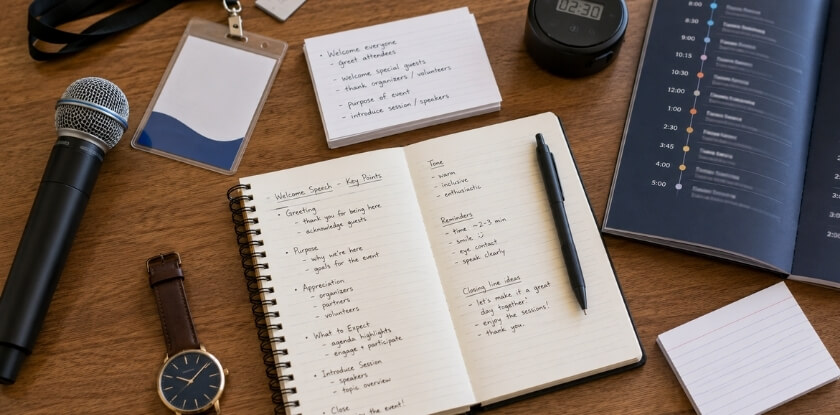
My tip here: write your closing line at the top of your notes, not only at the bottom, and glance at it before you start. Knowing exactly where you are headed keeps you from rambling when the speech starts winding down.
How Long Should a Conference Welcome Speech Be?
Keep it between 30 seconds and 2 minutes for most conferences, with 3 minutes as the ceiling. I hold to that range because the program is waiting on you.
Speaking pace varies from person to person. VirtualSpeech’s speaking-rate guide puts a comfortable presentation pace at 100 to 150 words per minute, and I plan with 120 to 150, the upper part of that range. Nervous speakers tend to talk faster on stage, so count your words and time yourself reading it aloud.
| Length | Approximate words | Best for |
|---|---|---|
| 30 seconds | 60 to 75 | Webinars, a chair opening a single session |
| 1 minute | 120 to 150 | Most conference types, business summits, virtual conferences |
| 2 minutes | 240 to 300 | A formal academic or international opening with guests to greet |
| 3 minutes | 360 to 450 | Upper limit, for example when the organizers ask you to read the protocol list yourself |
Ask the Organizers for Your Slot
Conference-speech guides such as Fourwaves and Orvium suggest about five minutes, and the welcome speech for conference guide on this site gives two to five minutes, both longer than the table above. Treat the time in the program as the real limit. If you are the host, ask the organizing committee how long your slot is before you write anything, and plan to finish a little under it. Speak longer only if the organizers have asked you to carry announcements.
By Conference Type
Different settings pull in slightly different directions. These are the targets I work to.
- Academic and research conferences lean formal. A welcome of up to two minutes is standard, enough to name the institution, acknowledge the chief guest or guest of honor, and state the purpose, and nothing more.
- Business conferences and corporate summits move fast, and executives expect efficiency. Aim for one to two minutes. A long ceremonial opener tells them the day will run late.
- Student and college conferences allow more warmth and energy. You might stretch to two and a half minutes if the room needs rallying.
- Virtual and online conferences need shorter openings than in-person events, because it is easier to drift away from a screen. Aim for about a minute and stay under two.
- Hybrid conferences need one line for each audience: greet the hall and the people online together, and tell online viewers where to post questions.
- International conferences sometimes include a brief protocol acknowledgment of dignitaries or sponsors. If the list is long, let the master of ceremonies read it separately so it doesn’t eat your welcome.
What Happens When You Go Over
A welcome that passes three minutes without a strong reason starts to compete with the keynote introduction and the rest of the program. People check their phones, and the opening stops doing its job of getting the room ready.
If your draft runs long, I cut the organization’s history first, then the detailed agenda summary, since attendees will get both in print or on screen. What stays is one sentence on why the conference exists, a sincere acknowledgment of who is in the room, and a clean handoff line.
Welcome Speech vs. Opening Remarks: What’s the Difference?
A welcome speech opens the door; opening remarks move the room into the program. There is no fixed definition, and many programs use the two terms for the same thing, so check what the organizers mean before you write. This is the split I use.
| Welcome speech | Opening remarks | |
|---|---|---|
| Job | Relational: welcomes and thanks people | Bridging: moves the room into the program |
| Usual speaker | Host organization, institution, department head, or conference chair | Conference chair, master of ceremonies, or lead organizer |
| Length | Under 2 minutes in most programs | Usually short, about 60 to 90 seconds |
| Content | Greeting, thanks, one-line purpose, handoff | How the day will run, logistics, the next speaker’s introduction |
The Welcome Speech
The welcome comes from someone with a formal connection to the event. At an academic or research conference this is often a dean or department head speaking for the institution, as in our samples of a welcome speech for an academic conference. At a corporate summit it is often a senior executive or the event’s lead sponsor. It acknowledges who is in the room and thanks people for coming. It may carry a practical note or two and a one-line handoff to the next speaker, but it does not walk through the agenda or introduce every speaker.
Opening Remarks
Opening remarks do the bridging. If the welcome says “we’re glad you’re here,” the remarks say “here is how today will run.” Logistics and fuller speaker introductions typically live here. The speaker is often the conference chair, the emcee, or a lead organizer who knows the program in detail.
Who Delivers Each One
At smaller events, such as a student conference, a college conference, or a one-day seminar, one person often handles both. That is fine if the speaker knows they are playing two roles and keeps the combined time tight. At a larger international or annual conference, the roles are usually split: the host gives the welcome, then hands off to the emcee or chair.
If you are giving opening remarks, do not re-welcome the audience or thank the sponsors again if someone already did.
Common Mistakes to Avoid
Three mistakes are easy to miss even with a good draft.
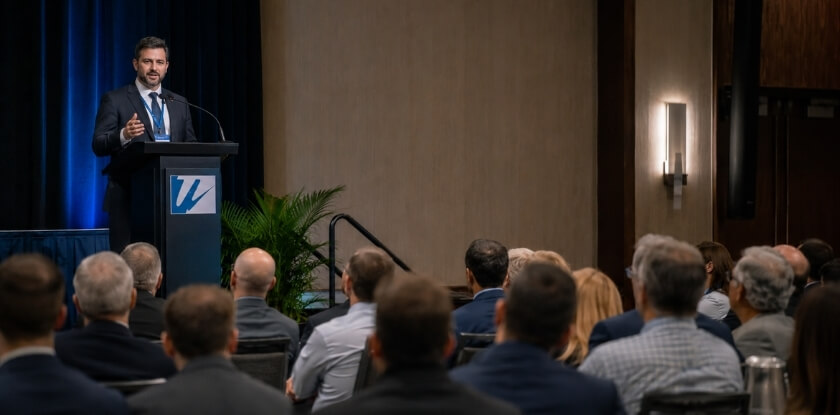
- Reading from a sheet with no eye contact. A few notes are fine. Reading every word with your head down tells the room you are uncomfortable, and the energy drops before the first session. If you need a script, practice it enough to look up regularly.
- Starting with an apology or disclaimer. “I’ll try to be brief” or “I know many of you have traveled far, so I won’t take much time” spends your first seconds on an apology. Start with the welcome, state the purpose, and move on.
- Misreading the room’s formality. A student conference has a different register from a research conference or a formal annual meeting. A jokey tone can feel off at a serious academic event, and stiff ceremonial language can alienate a startup crowd. Match the energy the audience expects.
From our experience at MS International: Our conferences are held in person in the Greater Toronto Area. The moderator introduces each speaker, and presentation lengths may vary, so the speaker confirmation and the final conference program are the official sources for your room, speaking time and presentation order.
FAQ
Short answers to eight common questions about giving a short opening.
Do I need to memorize the welcome speech?
No. Learn the first and last lines well enough to say them while looking at the room, and use bullet points or one notecard for the middle. Reading it word for word is acceptable if you look up at the audience regularly; a well-read script beats a memorized one that stalls.
Can a student deliver the welcome speech at an academic conference?
Yes, if the organizers ask you to. Keep the tone respectful, introduce yourself briefly, and name the conference’s purpose clearly. You do not need to be a seasoned speaker for a short opening.
Is a chief guest speech the same as a welcome speech?
No. The host gives the welcome and introduces the chief guest, who then gives a separate address. That address typically carries more weight; its length depends on the slot the organizers give.
How formal should a corporate summit welcome speech be?
Match the room. A large international summit calls for a polished, formal tone; a smaller internal business conference can be warmer. When in doubt, lean slightly more formal, since it is easier to loosen up mid-event than to recover from starting too casually.
What if I’m hosting a virtual or online conference?
Acknowledge the format directly and keep the welcome tighter than in person. Something like “Wherever you are joining us from, welcome” works better than pretending everyone shares a room. It is easier to lose attention on a screen.
Do I need to introduce the keynote speaker in the welcome speech?
Only briefly, if at all. Name the keynote speaker and give a one-phrase topic as the handoff. A full biography is a separate moment, usually handled by the emcee or session chair.
Can I use humor in a conference welcome speech?
A light, well-placed observation is fine. Avoid prepared jokes, especially at international conferences where cultural references may not translate. If you are not naturally funny under pressure, skip it: a warm, clear welcome does more than a joke that misses.
What’s the fastest way to write one from scratch?
Start from a fill-in-the-blank template. Slot in the conference name, your name, the purpose statement, a line for guests, and a handoff to the next speaker. The structure is done, and you only add the specifics.
Final Thoughts
If you have ten minutes to prepare, spend them on two sentences: the one that says why this conference exists, and the one that hands over to the next speaker. Everything else in a short welcome can be adapted from the samples above. Those two lines are the ones the room will hear clearly, and they are the ones I would never leave to improvisation.