

A guest speaker gave your audience an hour of their time, and now the event is over. You are looking at a blank screen, and everything you type sounds either too stiff or too casual. Event organizers, teachers and students all hit the same wall, and the right words are harder to find than they should be.
Quick answer: A short thank you message for a guest speaker is a brief note, usually one to five sentences, that thanks them directly, mentions one specific thing from their talk, and closes warmly. The specific detail is what separates a thoughtful message from a generic one. The same three parts work for an email, a text, a card or a line read aloud on stage.
This article gives you ready-to-use messages organized by event type, tone and format. Find the section that fits your situation, copy a message, and swap in the details.
Short Thank You Messages for Guest Speaker: Ready to Use
Pick a message, change a word or two, and send it; I would always swap in one detail from the talk first. The first list suits almost any setting. The second is for one-line notes.
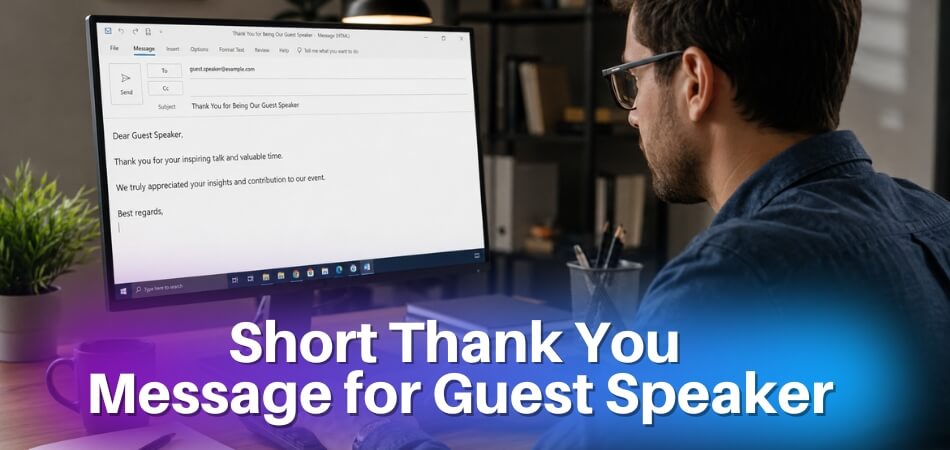
General / All-Purpose Thank You Messages
These work in a greeting card or an email, or when read aloud by the organizer at the close of the session.
- “Thank you for speaking with us today. Your insights were thoughtful, practical, and worth every minute of the audience’s attention.”
- “Thank you for speaking at our event. The way you connected with the audience made a real difference, and we will be using your advice in the weeks ahead.”
- “On behalf of everyone here, thank you for sharing your knowledge and experience. It’s rare to hear a speaker who makes complex ideas feel this accessible.”
- “Your session gave our conference its clearest takeaway. Thank you for preparing so thoroughly and delivering with such clarity and warmth.”
- “We appreciate you giving your time to our event. The students walked away with ideas they’ll actually use, and that’s exactly what we were hoping for.”
- “Thank you for being our guest speaker. Your perspective was fresh, and the questions from the audience afterward said everything about the impact you had.”
- “We’re honored you joined us. Your opening gave every later session something to build on.”
- “Thank you for your generosity in sharing your story with our group. Public speaking takes preparation and courage, and we don’t take that lightly.”
- “Your talk exceeded our expectations. We’re grateful for your expertise and for the genuine enthusiasm you brought to the room.”
- “Please accept our sincere thanks for speaking at today’s event. Your words reached our audience in ways that are hard to put into a single message, but we wanted to try.”
One-Liner Thank You Messages
A brief, direct line often carries more weight than a long one. These suit an SMS, a WhatsApp message, a social media post or a handwritten note inside a card.
- “Thank you for an unforgettable session. Our audience is still talking about it.”
- “Your talk was the highlight of our event. Truly grateful.”
- “Thank you for inspiring our students today. They left with a plan.”
- “We couldn’t have asked for a better keynote speaker. Thank you.”
- “Your energy, your message, your time: thank you for all of it.”
- “Thank you for the story about [moment]. It gave the room something to carry home.”
- “Short on words, big on gratitude. Thank you for speaking with us.”
- “You made our event memorable. Thank you from the bottom of our hearts.”
- “Thank you for showing our audience what real expertise sounds like.”
- “That was one for the books. Thank you for being there.”
- “Our college event was better because you were in it. Thank you.”
- “Thank you for the wisdom, the stories, and the energy you brought today.”
- “A sincere thank you for your time and your incredible talk.”
- “You had the whole room listening closely. Thank you for that.”
- “Thank you for being the kind of motivational speaker who actually motivates.”
Thank You Messages by Event Type
In my view, tone should fit the room. A student thanking a visiting author at a school assembly should not sound like an organizer closing a corporate keynote. Each group below is written for one setting.
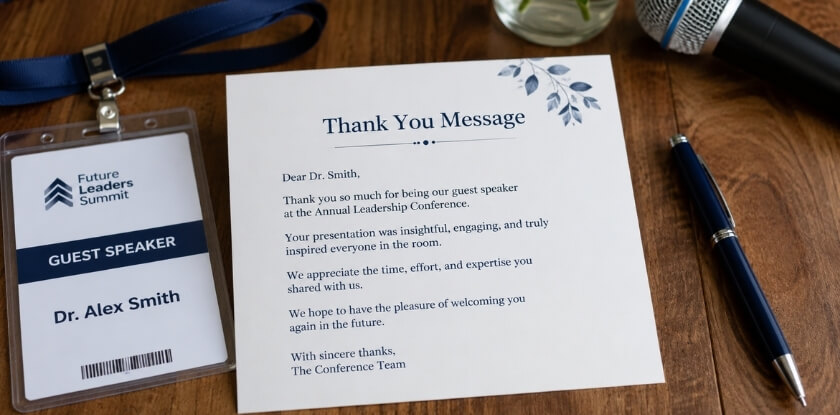
For School or College Event (From Students)
Students often worry that a thank you will come out too stiff or too casual. These sit in a sincere middle ground for a card, a WhatsApp message or a quick announcement.
- “Thank you for coming in to speak with us. Your words gave us a lot to think about, and we genuinely appreciated every minute of your talk.”
- “We’re so grateful you came to our college event. The way you shared your own path made it feel like anything is possible for us too.”
- “On behalf of all the students, thank you for inspiring us today. We hope to have you back soon.”
- “Sir/Ma’am, your talk was exactly what we needed to hear. Thank you for making it so memorable.”
- “We didn’t expect to leave that session feeling so motivated. Thank you for your honesty and for connecting with us the way you did.”
For Corporate or Business Event
Corporate messages should be polished without sounding cold. Keep them professional and specific where you can.
- “Thank you for joining us as our keynote speaker. Your perspective on [topic] sparked real conversations among our team.”
- “We appreciate you sharing your expertise at our business event. Your talk added genuine value to the day, and our attendees have been discussing it since.”
- “On behalf of the entire organizing team, thank you for your insights on [topic]. Your session gave our attendees a clear next step.”
- “Your presentation was one of the strongest of the conference. Thank you for bringing such clarity and depth to a topic our audience cares about.”
- “Thanks again for joining us. The feedback from attendees has been overwhelmingly positive, and your contribution made the whole day stronger.”
For Virtual or Online Event
A speaker on a screen cannot feel the energy of a live audience, so your thank you carries more weight. Acknowledge the format and keep it warm.
- “Thank you for joining our online event from wherever you were in the world. The distance didn’t matter. Your message came through loud and clear.”
- “Speaking to a virtual audience isn’t easy, but you made it look effortless. Thanks for joining us online.”
- “Thank you for speaking at our online event. Virtual events can feel less personal, which is why your effort to connect with our audience meant so much.”
- “Thank you for adapting your session for our online format. Every attendee in that virtual room walked away with something valuable.”
- “Even through a screen, your talk had real impact. Thank you for giving us your full attention.”
For Conference or Keynote Speaker
Keynote speakers set the tone for a whole conference. The thank you should reflect that weight without going over the top.
- “Your keynote set the perfect tone for our conference. Thank you for opening the day with such clarity, energy, and focus.”
- “We’re grateful you accepted our invitation to speak. Your address gave attendees a strong foundation for everything that followed.”
- “Thank you for delivering such a thoughtful keynote. The ideas you shared will stay with this audience long after the conference ends.”
- “On behalf of the entire conference team, thank you. You brought the perspective our event needed, and you delivered it with real skill.”
- “Being the keynote speaker is a responsibility, and you handled it beautifully. Thank you for everything you brought to the stage.”
For Motivational or Inspirational Speaker
These lean warmer, because a motivational speaker connects with the audience on a personal level.
- “Thank you for reminding us what we’re capable of. Your talk hit home for a lot of people in that room.”
- “You didn’t just give a speech. You gave people something to hold onto. Thank you for being such an inspiring presence at our event.”
- “Our audience came in looking for a spark. You gave them a fire. Thank you for every word you shared with us.”
- “Thank you for your openness, your energy, and your message. We’re glad you shared it with us.”
- “Thank you for today. Weeks from now, people will still be thinking about what you said.”
Formal vs Informal Thank You Messages
Use a formal message when the event was professional, or when you do not know the speaker and the setting is not casual, and an informal one when you know them or the event was relaxed. For me, the shift is also one of voice. Formal messages usually speak for the group (the school, the company, the organizing team), while informal ones sound like a person talking, whether you write for yourself or for the group.
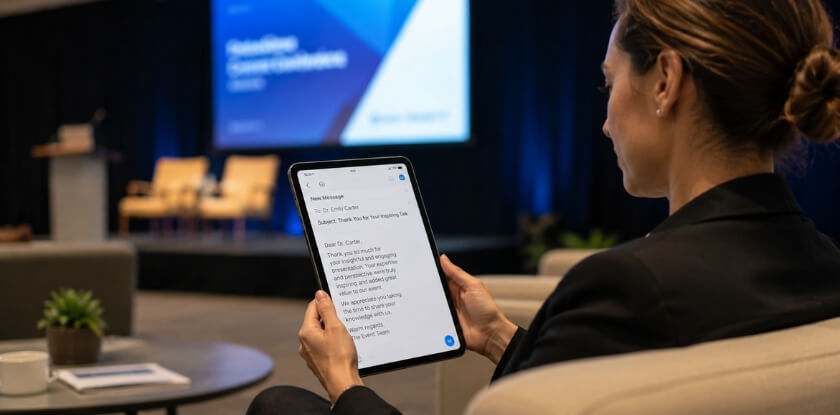
| Tone | Best for | Style |
|---|---|---|
| Formal | Corporate events, academic conferences, speakers you do not know | Full titles, structured, no jokes; sent by email, printed in a program or read aloud |
| Informal | Relaxed events, speakers you already know | Warm, personal, short; WhatsApp or SMS |
Formal Thank You Messages
- Keep it structured. Open with direct acknowledgment, name the event, and mention something specific the speaker contributed. Vague compliments carry little weight in a formal setting.
- Use full titles and names. “Dr. [Surname]” reads more respectfully than a first name alone in a formal email or card.
- Match the register of the event. If the conference was serious, skip the humor and casual asides.
Two examples you can adapt:
On behalf of [Organization Name], I would like to express our sincere gratitude to you, [Speaker’s Name], for your insightful keynote at [Event Name]. Your expertise on [topic] gave our audience a great deal to reflect on, and we are grateful for the time and preparation you invested.
Thank you, [Speaker’s Name], for addressing our students today. Your perspective on [topic] was both informative and thought-provoking. We hope to welcome you back to [School/College Name] in the future.
Informal Thank You Messages
- Skip the formal structure. You do not need a salutation or a formal sign-off. Say what you mean.
- Be specific in a personal way. Name the moment that stuck with you. “That story about your first job failure had everyone leaning in” tells the speaker far more than “your talk was great.”
- Shorter is fine. A two-line WhatsApp message that sounds human beats a paragraph that reads like a form letter.
Some examples:
Hey [Name], just wanted to say thank you for speaking today. That part about [specific moment] got everyone talking. We’re lucky you said yes!
[Name], you were amazing today. The students couldn’t stop talking about it afterward. Seriously, thank you.
Thank you for showing up for us. The timing of your talk could not have been better.
A heartfelt one-liner works well as an SMS to a motivational speaker you know. The same line would feel thin in an email to the keynote speaker at a major industry conference.
Thank You Message Formats: WhatsApp/SMS, Email, Card
My advice is to match the format to the relationship: a text for a quick, personal note, an email for a more formal follow-up, and a card for the most personal touch. The table shows how they differ.
| Format | Length | Best for |
|---|---|---|
| WhatsApp / SMS | One to three short sentences | Informal events, existing personal connection |
| A few short paragraphs at most | Corporate and academic events, formal follow-up | |
| Greeting card | One to three sentences | School events, recognition ceremonies, a speaker who made a real impression |
WhatsApp and SMS Messages
Short, warm and personal works here. You are not writing a letter, so do not fit one into a text.
- “Thank you so much for speaking at our event today. Your insights on [topic] were exactly what our audience needed to hear.”
- “We really appreciated your time and energy today. The students have already started using your advice!”
- “It was a genuine pleasure having you with us. Thank you for bringing so much value to our event.”
- “Quick note to say how much we valued your talk today. Let us know if we can return the favor.”
For an online event, add a line that acknowledges the extra effort: “Thank you for joining us remotely and giving it your full energy.”
Email Format
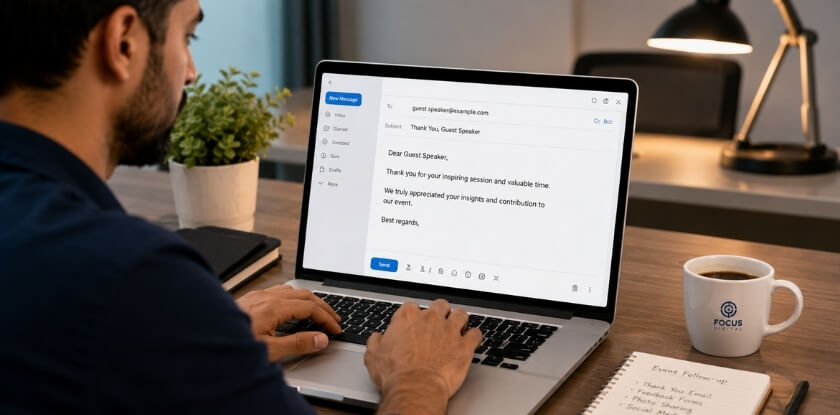
An email gives you more room, but it is not a reason to write five paragraphs. A clean structure that works for most situations:
Subject line: Thank You for Speaking at [Event Name]
Dear [Speaker Name],
Thank you for being part of [Event Name] on [Date]. Your session on [topic] brought real depth to the program, and the feedback from attendees has been very positive.
What you shared about [specific point or story] stayed with people. We heard it come up in conversations well after your session wrapped.
We’d love to stay in touch and hope to bring you back for future events. Please let us know if there’s anything we can do to support your work.
With appreciation,
[Your Name]
[Your Title / Organization]
Thank them in the first sentence and do not bury the appreciation. For a more casual business or college event, drop the formal salutation and sign off with your first name.
Greeting Card
Handwritten is better, but a printed card with a handwritten signature still means more than an email. Short messages that fit well on a card:
- “Thank you for sharing your story with us. You reminded our students what’s possible.”
- “Your line about [idea] is now on our team whiteboard. Thank you.”
- “On behalf of our entire team, thank you for the time you gave our attendees.”
- “It was an honor to have you speak. We hope this is just the beginning of a longer conversation.”
For speakers who cover personal topics, one detail, such as a quote they used or a story they told, makes the card feel personal. If you are an organizer writing for a group, ask a few attendees to sign alongside you, so the thanks comes from the whole room.
Social Post and On-Stage Thank You
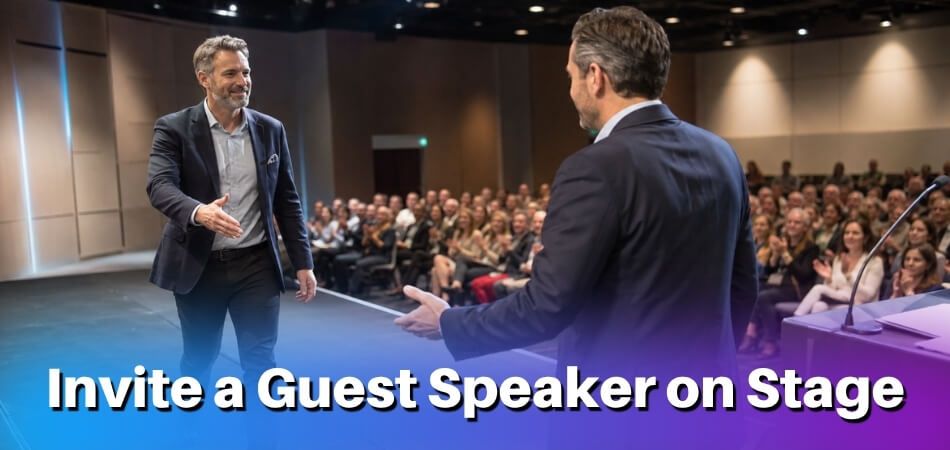
Keep both brief and public-friendly. Say what the talk gave the audience, and leave out anything the speaker would not want shared. Thank the speaker in person before they leave the room, then follow up in writing, because the written note is the one they can keep.
Social post: Thank you to [Speaker Name] for opening [Event Name] with a talk on [topic]. The point about [specific idea] is already coming up in our team chats.
On stage: Please join me in thanking [Speaker Name]. They gave us a clear way to think about [topic], and we will be using it.
How to Write a Short Thank You Message for a Guest Speaker
I find that a good message takes two minutes and covers three things: a direct thank you, one specific detail, and a warm closing line. One sentence each is enough.
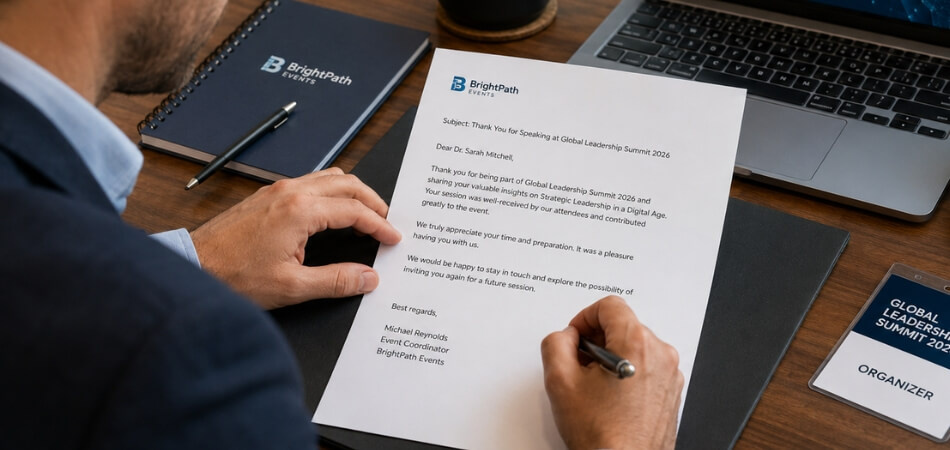
Be Specific About What They Said or Did
Mention something concrete from the talk. If a keynote speaker told a story about failure that your audience connected with, say so. If a motivational speaker gave students a framework they still talk about, name it.
“Your speech was great” reads like a template. “The part where you walked through your early career setbacks gave our students a different way to think about their own” reads like you were in the room.
Keep the Length Appropriate for the Format
An email can take a little longer to read than a text, but should still take well under two minutes. Speakers receive a lot of post-event messages, and shorter and specific beats longer and padded. A WhatsApp message that stretches to six paragraphs is no longer a thank you; it is a recap.
Match the Tone to the Event and the Relationship
Formal events call for formal language. A casual “You were amazing, thanks so much!” suits a friend who spoke at your community gathering, but it reads as unprofessional to a corporate keynote speaker. When in doubt, lean slightly more formal: you can warm up a formal message with a specific compliment, but you cannot take back an overly casual message once it is sent.
Informal situations allow something warmer. If the speaker is known to your group, or it was a casual school event, a conversational tone feels more genuine.
Online events deserve the same care. A speaker who presented remotely put in the same preparation as anyone on a stage.
A Simple Structure to Follow
For the specific sentence, pick one of three things: a point they made, the response from the audience, or how they handled your particular group (students, executives, conference attendees). Then adjust the formality and length to the format.
Gifts Are Optional
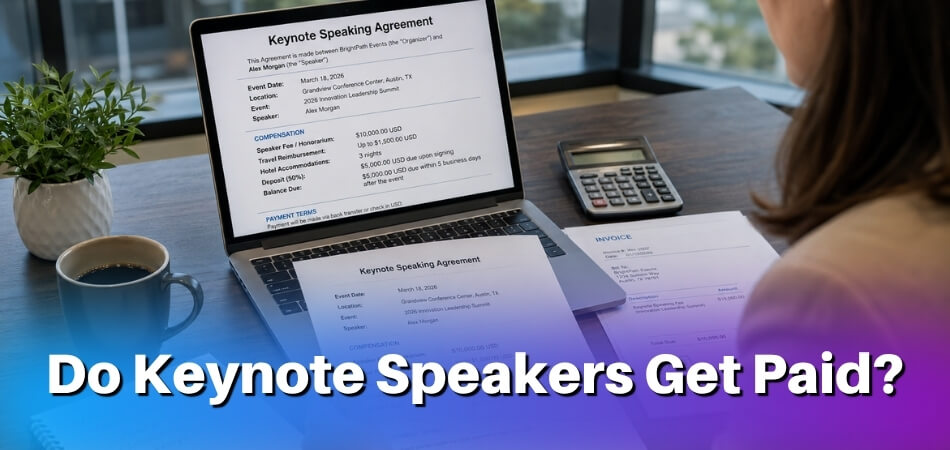
A gift is not necessary. A genuine, specific message matters more, and for a professional speaker who was paid a fee, a gift is not expected. If you do give one, keep it modest and tell the speaker why you chose the gift. A closing line that invites them back, or asks whether they would share feedback on how the event ran, turns a thank you into a working relationship. If you want to quote the speaker or reuse their reply in public, ask first.
Mistakes to Avoid
In my view, a short message can still fall flat if it is rushed. Sending something that could be for anyone is the biggest risk, and the writing tips above cover it. These are the remaining mistakes.
Waiting Too Long to Send It
Send it soon. A thank you that arrives three weeks later reads as an afterthought. For a WhatsApp message or SMS, the same day is best, ideally within hours. For a formal email, roughly 24 to 48 hours is a sensible window, since the energy of the event fades quickly. A handwritten card can arrive a little later, but do not leave it for weeks.
Getting the Speaker’s Name or Title Wrong
Double-check before you send. Misspelling a keynote speaker’s name, or addressing a professor without their title, undercuts the whole message. This matters most for cards and formal emails, because once they are printed or sent you cannot take them back.
Making the Message About the Event Organizer
Keep the focus on the speaker. It is easy to slip into “Our event went so well and the audience loved it” without acknowledging what the speaker contributed. Reflect their effort, their preparation and the value they brought, whether they addressed students or a boardroom.
Using Filler Phrases That Say Nothing
Cut the hollow lines. “Your words truly inspired us” and “we are grateful for your valuable presence” are so overused they have lost meaning. Another stock line is “thank you for taking time out of your busy schedule”.
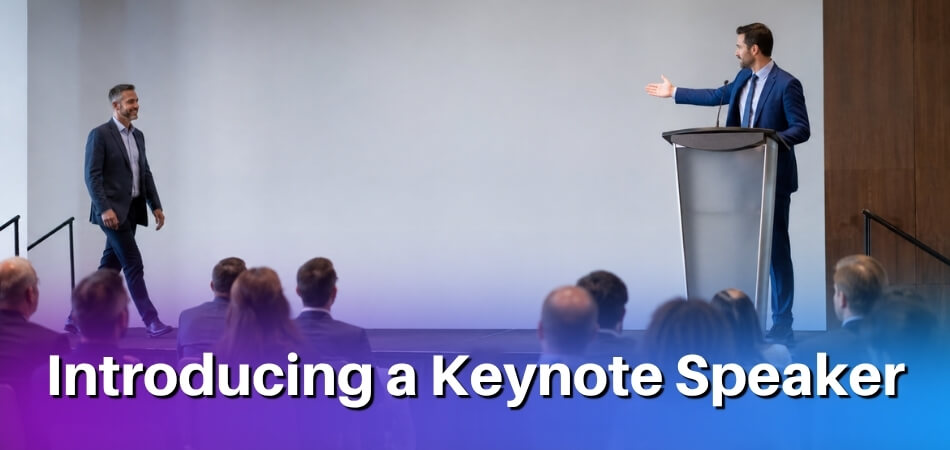
From our experience at MS International: For most applicants, the route to our in-person Greater Toronto Area conferences is the presenting-author track: submit work, receive a decision, and register if accepted. The moderator introduces each speaker, and a certificate is given after presenting. Speakers cover their own travel, accommodation, visa, transportation and personal expenses unless MS International has agreed otherwise in writing, and keynote and invited-speaker roles are arranged separately with the organizing team. A thank you message is a courtesy and does not replace any written arrangement.
FAQ
A brief note to a guest speaker still involves choices: how to write for a whole organization, whether a student or the organizer should send it, whether a gift is needed and what to do after a virtual event with technical issues.
Does the thank you message need to be long?
No. One to five sentences is enough for most formats: a thank you, one specific detail and a warm close; an email can run a few short paragraphs. A few sincere sentences carry more weight than a long paragraph of filler, and for a card or SMS one or two lines is fine.
When should you send the thank you message?
Aim for the same day for a text and within 24 to 48 hours for an email. A late message still means something, but the sooner it arrives, the more it feels tied to the experience.
Is it okay to send a thank you over WhatsApp?
Yes, for informal events, school or college gatherings, and speakers you already know. For a formal event or a speaker you have never met, an email is safer.
What if you are writing on behalf of the whole audience or organization?
Say so directly. “On behalf of everyone at [organization name]” or “Our entire audience appreciated your time” makes the message feel representative without sounding stiff.
Do you need to mention the speaker’s topic specifically?
It helps. A reference to the session title, a point they made, or how students responded makes the message personal. Even one specific detail changes the tone.
Should a keynote speaker get a more formal message than a motivational speaker?
Not necessarily. Formality depends more on the event than on the speaker’s role. A corporate conference calls for a formal tone for either speaker, while a college event can be warmer even with a high-profile name.
Can a student write a thank you message directly, or should it come from the event organizer?
Both work. The organizer covers the official side, and a short note from a student often means more to the speaker personally. If possible, send both.
What is the difference between a thank you message and an appreciation message?
Very little in practice. An appreciation message focuses on the speaker’s qualities or impact, and a thank you focuses on gratitude for their time and effort. Most good messages do both.
Should you still send a thank you if the virtual event had technical issues?
Yes. You can acknowledge the problem briefly: “We apologize for the technical hiccups, but your session was genuinely valuable.” That shows honesty without making the message about the glitches.
Do you need to give a gift with the thank you?
No. A gift is optional, and the message itself matters more. Paid professional speakers do not expect one.
Is a one-liner thank you too casual for a formal event?
It depends on the channel. A one- or two-line note suits a card, a social post or an SMS. After a conference or business event, an email with a few sentences is more fitting.
Final Thoughts
A short thank you to a guest speaker does not need to be elaborate to mean something. A few specific, sincere sentences beat a long generic paragraph every time. Choose the format, match the tone to your relationship with the speaker, and send it promptly.

I have been struggling with this issue for a while and your post has provided me with much-needed guidance and clarity Thank you so much
This blog is not just about the content, but also the community it fosters I’ve connected with so many like-minded individuals here